Love Me Tonight (1932)

lovemeto1This is unequivocally the age of sound! That’s what this film proclaims from the rooftops with its symphony of syncopation as the world of Paris awakens from its slumber. Its opening rhythms are pure ingenuity and the glorious unfoldings never cease for the rest of the cheery production.
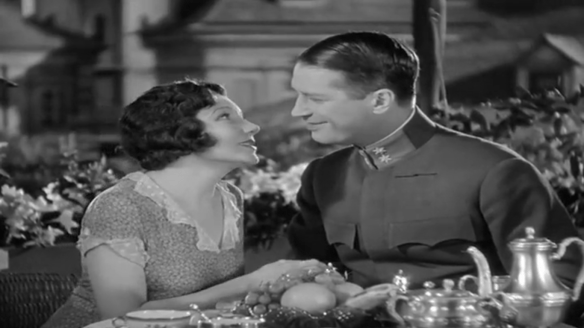
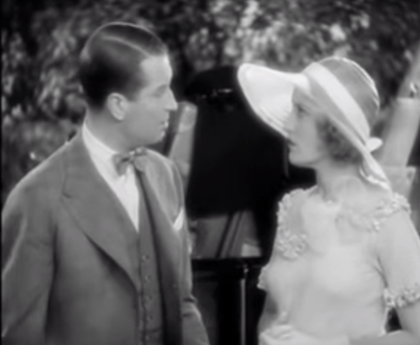
In its efforts to tip a hat to Lubitsch, Rouben Mamoulian’s film manages to eclipse him or rather make a name for itself completely removed from the previous Maurice Chevalier musicals. In fact, Love Me Tonight feels like the obvious precursor to later classics like An American in Paris and the works of Jacques Demy. Whereas Lubitsch’s films almost always function as a comedy and social commentary, Love Me Tonight is first and foremost a musical and it rides on its melodies even while simultaneously driving forward its plot line.

When our humble but nevertheless jovial tailor winds up chasing after one of his notorious spendthrift customers to his relative’s aristocratic residence, things are in motion. Maurice is certainly out of his element, but his charm wins him many an admirer in the household including the Duke (C. Aubrey Smith) and his man-hungry niece (Myrna Loy). In fact, there are only two people who seem wary of this new arrival, the Duke’s skeptical daughter, Princess Jeanette (Jeanette MacDonald) and her feeble suitor.

Everybody else persuades The Baron — as he is called — to stay because his is such a magnetic and disarming personality. Of course, when the real news about him gets out following an incriminating wager for his honor, it dooms his romance. But every story needs a final epiphany of realization and, in this case, Princess Jeanette comes to her senses. She throws the utter absurdity of family rank and status out the window.

True, this is a love story, but while that could be the focal point there are wonderful sequences that fill all the nooks and crannies. Fine gentlemen walking around a tailor’s shop without their pants on or a trio of aunts who come right out of the pages of Hamlet. As a Pre-Code film, it certainly has a few risque moments including a Doctor’s visit and one or two mentions of a nymphomaniac — all played for comedic effect of course.

Meanwhile, tunes like “How are you?” and “Isn’t it Romantic” literally takes the country by storm manifesting themselves in all forms imaginable. “Mimi” is a particularly saucy number that pays homage to our main female heroine and it’s opening refrains boast some wonderful point of view shots of our fated lovers. Love Me Tonight winds up being an operetta of repeatedly and ingeniously inventive rhyme and melody all the way through. It also has brilliant sound design from head to toe.

Maurice Chevalier is as charming as ever, still melding his song with a magnetism that flows right into his role, ironically enough, as a character named Maurice. Although Myrna Loy might have become a bigger name arguably, this is Jeanette MacDonald’s film and she plays her part with the necessary aloofness that nevertheless gives way to amorousness. By the end, we like them both and we can’t help but be won over by their songs. For being lesser known on the generally accepted spectrum of classic musicals, this one is a gem.

4.5/5 Stars

The Smiling Lieutenant (1931)

thesmiling1One would never think that one well-placed wink would change the course of an entire life or be the basis for an entire film, but on both accounts it is true. Ernst Lubitsch’s The Smiling Lieutenant represents all that is good and right about one of his films. It’s light and airy with a dash of charm and a tune in its heart. It’s light on its feet with humor and somehow maintains its self-respect, much like the man at the center of this one (Maurice Chevalier).

In fact, this pre-code musical comedy is a lot more unassuming than it has any right to be. Lieutenant Nikki von Preyn (Chevalier) falls for the talented violinist named Franzi (Claudette Colbert) and cannot contain his excitement whenever he’s around her. Except one ill-timed smile followed by a suggestive wink lands him in some hot water with the recently arrived royalty who are making a sightseeing trip around the country.

Princess Anna (Miriam Hopkins) is appalled by such a public act of indecency, but she also happens to be quite culturally naive. In other words, she hasn’t been outside the palace grounds much. In other words, she’s never known many dashing gentlemen before. Wink. Wink. You get the picture.

Nikki is beside himself but vies to take the most obvious option out. Professing his love for the princess — that’s why he winked. But she outdoes him threatening her father that she would wed an American (GASP!) if she is not engaged to Nikki. So daddy is all but obliged to follow through with the whole thing.

Of course, now we have a love triangle of unrequited love, with the Lieutenant’s smile turned upside down and his beautiful beau grief-stricken. She does the only thing she can, confront her competition and have it out with her. What follows is a slap-filled sob fest and our two heroines become real chummy real quick.

thesmiling2But Lubitsch’s final twist is completely out of left field and a completely comic inversion of what’s supposed to happen — capping off his oeuvre of song, suavity, and sensuality in high fashion.
Chevalier is the quintessential French crooner and his touch of comedy is perfectly measured by both Colbert and Hopkins. Colbert is a typical glamour girl of the 1930s, while Hopkins is also pretty, but with more outlandish tendencies. She also gives a brilliant turn on the piano!

In truth, I have long tried to put a finger on just what the Lubitsch Touch is, but it seems that everyone who has ever said anything about it comes up with a different answer. It began as a PR stunt to sell his brand in Hollywood and from thenceforth it took on a life of its own. As a filmmaker and auteur, there is certainly no one quite like him in substance or style.

If I had to try and draw up my own definition of his Touch it would be something like this: His films convey sensuality in such a way that was palatable to the American audience, while simultaneously making romance something humorous. His sensibilities are such that he can be suggestive and still refined. The true irony here is that he’s in a sense winking at his audience by the end. The joke’s really on us.

4/5 Stars

Shanghai Express (1932)

shanghaiex2The same year as Grand Hotel there came another film, that while still boasting an ensemble cast felt far more intimate. In its day it was christened “Grand Hotel on wheels” and its narrative does unravel aboard a train. However, Josef von Sternberg’s film opens with a faceless atmosphere spilling over with the bustling commotion of a railway station. It takes a few moments to lock onto the characters we will be making the journey with, but we won’t soon forget them.
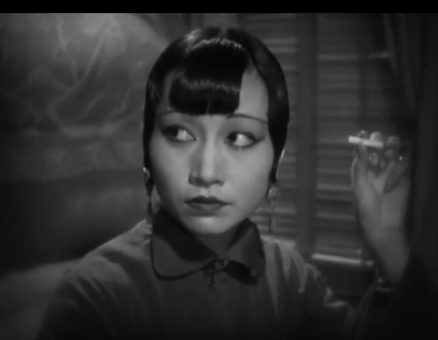
The always reputable Eugene Palette, perpetually gambling his way to Shanghai. The invalid opium dealer is rather an annoying fellow, and the man of faith appears conventionally narrow-minded, although he does make a turn for the better. Warner Oland takes on a more menacing iteration of his Charlie Chan character, while Anna May Wong gets a well-deserved role as a fellow passenger who shares a room with the famed Shanghai Lilly, the fastest lady in the East. Yes, Marlene Dietrich is Lilly, a woman of notorious reputation, but she also carries a distant, wistful love affair in her memories. The train to Shanghai brings all that hurtling back in the form of Captain Donald Harvey (Clive Brooks).

All this is set against the backdrop of a Chinese nation fraught with unrest. When the engine isn’t impeded by a stray cow or chicken, Chinese soldiers board it to apprehend an enemy agent. But that’s just the beginning. The rebels retaliate by holding up the train as well and questioning all the passengers on their financial and political capital. It’s a tense sequence of events that has no simple resolution.

shanghaiex1It is in these moments that are two female heroines must act. Hui Fei (Anna May Wong) so that she might defend the honor of herself and her country. Lilly so that she might express the great, expansive depths of the love she still holds for “Doc.”

Shanghai Express exhibits a simplistic view of religious faith as well love, but perhaps that’s actually one of its strengths. It suggests that faith and love go hand and hand whether it be Christianity or romantic relationships. It’s true that there’s no greater act of love than someone laying down their life or putting their life on the line for friends. There’s nothing overly melodramatic here, but everyone ends up where they are supposed to and justice is dealt. It’s an eventful, passionate, perilous train ride indeed.

Ironically enough, this is a film for the masses that completely disregards their class in favor of the first class club car. Except you could make the argument that they rather preferred the sumptuous extravagance of the upper classes to their own Depression-filled lives. Movies most certainly were the grandest of escapes from reality. Shanghai Express undoubtedly quenched their desire. At the same time, it’s simultaneously a story of exotic intrigue and human drama that blends the prodigal and the personal in high fashion.

To its credit, the film makes comment on Warner Oland’s complete lack of ability to look Asian, although he does fall into some other stereotypical potholes. Also, it acknowledges the preconceived expectations of Asian women that Anna May Wong resoundingly rebuts with her performance. She represents everything pushing back against the Yellow Face of Oland’s numerous portrayals. The effort by Asians to get more complex, multidimensional, and sympathetic. The path is still yet to be fully paved, and representation in media for any class or race is never going to be fully realized. We can never expect it to be perfect or overly politically correct. Because humanity is inherently broken and always and forever incorrect.

You can certainly say that Marlene Dietrich unequivocally overshadowed the career of her longtime lover and collaborator Joseph von Sternberg, but Shanghai Express belongs to both of them. He as her director. She as his muse. Despite, its meager running time, it’s a fine achievement and an enduring Pre-Code classic. 

4/5 Stars

She Done Him Wrong (1933)

shedonehim1“I always did like a man in a uniform. That one fits you grand. Why don’t you come up sometime and see me? I’m home every evening.”  ~ Mae West
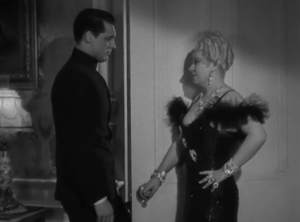
Mae West is a larger-than-life personality if there ever was one. So large in fact that it’s hard to believe she was even a real life person. It’s easy to watch a film like She Done Him Wrong and just see her as almost a mythic figure. Because, honestly this 30s pre-code comedy is only a small trifle at most. Its story is only a partially hewn tale of a gay nineties joint and the nightclub singer that rules its sleazy halls with her diamonds, stoles, and mischievous nature. There are a wide array of men in her life all ages, shapes, and sizes: Noah Beery Sr., Owen Moore, Gilbert Roland, and of course, Cary Grant.

The film gives us this very early appearance from Cary Grant, and he’s the only person close to giving West a run for her money. When they share scenes together they don’t exactly fit together. He’s young, tall, handsome, and playfully refined. She’s full-figured and older, but still glamorous. In many ways, they represent different eras, and this was most certainly hers.

shedonehim2This is her film — her personal vehicle. She rules it that twinkle in her eye and a rapier wit coming from her mouth. Sometimes it’s not even what she says but how she says it (Why don’t you come up sometime and see me?). No one quite has a delivery like her. Whatever she says seems to carry implications and double meanings. In a modern culture that’s overwrought with sexual innuendo and bad taste, West led the trend when it was still in vogue. Back then, it was certainly controversial, but the box office doesn’t usually lie, and West did pretty well for herself, especially during the Depression era. There’s a reason that soldiers named their life vests after her. She was the queen of double entendres in the post-Shakespearian age, and she was ripe in the public consciousness. There was no one quite like her.

3.5/5 Stars

The Blue Angel (1930)

blueangel1The Blue Angel is the name of a nightclub and it turns out to be a very fateful nightclub indeed. It just takes us a while to figure out why. Although Josef Von Sternberg’s film is known, rightly so, for making a star out of Marlene Dietrich — in the first of their 6 collaborations — this early German sound film is nevertheless about the decline and fall of Emil Janning’s character. Immanuel Rath begins as a professor at the local college, and although his pupils are unruly, he commands the utmost respect. He sees it as his prerogative, and he is quick to bring order and discipline to these young lads. But boys will be boys and they become corrupted by the beautiful cabaret singer Lola-Lola (Marlene Dietrich). One evening the professor drops into the seedy joint to look out for some of his troublemakers and talk with the proprietor. Of course, he unwittingly ends up meeting the gorgeous girl backstage and returns the following evening with a seemingly very flimsy excuse.

Ironically, his boys are not the only one who take a liking to her. The once restrained and reserved man of learning begins to change. He becomes a man obsessed and infatuated beyond the point of logic. But what does he care? He enjoys being in Lola’s company and the idea of a marriage proposal makes complete sense in the reverie that he is swimming in. So they do get married. The professor leaves all the common sense behind and goes on the road traveling with his wife and their promoter.

blueangel2But by this point, he is a sorry figure, so pitiful and bedraggled in every way. He reluctantly parades himself in front of audiences as a clown just to make some money for him and his wife. It is, of course, inevitable that he return back to his old stomping ground, and it does eventually happen. He reluctantly goes onstage and it is difficult to watch this final chapter. Lola is no longer his. He’s completely ruined. Completely destroyed. Oh how far the man has fallen, as he winds up keeled over on top of his former desk in the gymnasium.

I think I enjoyed Emil Janning’s in The Last Laugh more and yet to its credit The Blue Angel does not cop out in the end. It has a tragic trajectory that in some ways feels like a precursor to such noir as Scarlet Street and Nightmare Alley. It’s understandable how Dietrich became a star because stars have the capability of drawing your attention. Janning’s gives a wonderful performance certainly, but the allure of Dietrich is too much to discount. She steals the show just like she steals the Professor’s heart. We’re just “Falling in Love Again and we Can’t Help It.”

4/5 Stars

Grand Illusion (1937)

GrandeIllusionI’m not sure if it’s because I’ve been bred on a certain brand of war movie, but I naively went into Grand Illusion expecting a typical P.O.W. drama. In the back of my mind, I was even ready to compare this title to later works like Stalag 17 (1953) or The Great Escape (1963). Honestly, what was I thinking? With a Jean Renoir film no less.

But that’s the marvelous quality of this film. On the surface level, it looks like an archetype that we are used to. War is being waged. Soldiers are captured. Soldiers are trying to escape. In this case, the particulars are a group of French P.O.W.s in a German camp during WWI. You have the basic idea certainly, but you will not understand the power of this film with such a description. With such a set-up you expect Germans to be the craven villains and the French to be the courageous boys making their nation proud. But that’s not quite the case. It’s more complicated than that.

It’s no surprise that this film was banned by Mussolini, confiscated by Goebbels after the invasion of France, and shown in a private screening to FDR. Certainly, WWII had not started yet, but in 1937 Hitler was on the rise and a wave of fascism mixed with patriotism was flooding Europe. In the midst of such a climate, Jean Renoir, a master of so-called poetic realism, lays down a film like this. It has war, it has patriotism, and it even has enemy factions, but the difference is that Renoir gives them humanity. He casts even his “enemy” in a sympathetic light and suggests that there is a humanity that lies inside of human beings of all different classes, creeds, and nationalities (but he also acknowledges racial discrimination still exists).

Early on in the film von Rauffenstein (Erich von Stroheim) shoots down two enemy flyers in Captain de Boeldieu (Pierre Fresnay) and Marechal (Jean Gabin). However, instead of sending them away to the prisoner of war camp, he shows them the ultimate form of hospitality by inviting them to dine at his table. The cynic inside of me thought, “this must be a trap, a gimmick of some kind because he is a German after all, and they’re supposed to be the villains.” Pretty narrow-minded of me, and of course nothing happens. They share a meal and even find some common ground before going off to the camp.

This next part of the film reminds me the most of a film like Stalag 17 because there is the camaraderie, the mixing of all sorts of different people, but they are all fighting against a common enemy so there is a solidarity between them. For instance, Rosenthal (Marcel Dalio) shares his lavish care packages from back home, Cartier keeps things lively as a former vaudeville performer who is constantly cracking jokes, and even Boledieu, who is of an aristocratic background is generally well liked by everyone. Together they undertake the project of escaping the camp.

Of course, there’s still time for musical performances with song and drag and impromptu renditions of “La Marseillaise.” For such a disturbance Marechal (Gabin) gets solitary confinement, but there never seems to be any malice behind it. It feels more like the protocol of war, and he is let out soon enough. The way things work out the gang is transferred all to different camps and their tunnel is utterly wasted.

De Boldieu and Marechal’s final stop is literally a fortress that is run by their old acquaintance, the now badly maimed Von Rauffenstein. He is as civil as he has ever was but still advises them not to try escape. All the same, he regrets his reassignment and seems generally wistful about the whole situation. Meanwhile, the two officers once again come in contact with Rosenthal. The trio puts together a planned diversion led by De Boldieu which will let the other two escape. It puts von Rauffenstein in another regrettable position, but Rosenthal and Marechal do get away.

As fugitives, their dispositions fluctuate from positivity to loathing, and finally a contented state of comfort when they stay at the farmhouse of a young German woman named Elsa (Dita Parlo from L’Atalante). This is another section of the film that highlights human relationships in an extraordinary way. We expect her to be totally poisoned against “the enemy” and yet she is not. Elsa seems to see the human beings behind the French uniforms and comes to trust and almost rely on their companionship. As Rosenthal recovers from a leg injury, Marechal and Elsa get closer and closer. The time comes for the two men to leave and it is an absolutely heart-wrenching goodbye. It’s so different than our initial preconceptions.

And soon after the film ends, not with some dramatic capturing or even really a chase. But the two men get across the border to snowy Switzerland and that’s where we leave them. Except not with the usual jadedness or even the adrenaline rush of a run-of-the-mill war thriller. Grand Illusion is more piercing than that, speaking to the relationships that can cross war zones if we are only willing to see them.

Jean Gabin is a wonderfully honest-faced actor and the closest description I can give is a man with a Spencer Tracy-like visage except more imposing. Marcell Dalio did some wonderful work with Renoir, and it is unfortunate that he was relegated to such small roles in films like Casablanca, but he is nevertheless even memorable in that. Erich von Stroheim was a titan in his own right as a director and actor, but he was somewhat of a fading star by this point. However, he plays his character with a civility and sense of honor which I have never quite seen equaled before. It was a special performance that reflects a dying breed. The aristocratic soldier of the highest order in all circumstances.

Renoir himself summed up the film years later as being about human relationships and fittingly said the following: “I am confident that such a question is so important today that if we don’t solve it, we will just have to say ‘goodbye’ to our beautiful world.” Here is a master recognizing such a vital key to our very humanity — our personal interactions with one another.

5/5 Stars

Review: Top Hat (1935)

tophat1Perhaps Astaire and Rogers most famous film together, Top Hat has them in top form once more, seemingly defying gravity at the full peak of their powers. The beauty of their partnership is that they’re able to tell the progression of a love story through dance, but they do it with such ease and grace it looks like so much fun. For a brief moment, you almost forget what the plot line of the movie is even about. It doesn’t seem to matter. All that matters is these two harmonious beings in perfect unison with each other.

But for those who take some interest in the plot, it is once more a simple screwball story of mistaken identity and romantic entanglements. Jerry Travers is supposed to perform in the show of one Horace Hardwicke, played impeccably by the stuttering Edward Everett Horton. However, Jerry gets smitten with the girl downstairs, but she gets the wrong idea. After all, he is staying in Horace’s suite. They rendezvous in Italy at a lavish gondola getaway where they meet up with Horace’s wife Madge, the always entertaining Helen Broderick. She’s playing matchmaker for Jerry because he has a girl named Dale Tremont (Rogers), who she wants him to meet. Of course, they already know each other, but again she mistakenly believes he’s Horace.

It’s all very awkward, however, all Travers knows is that he’s infatuated with this girl so he goes headlong after her. She’s aloof with him and eventually tries to marry the overly-honorable Alberto Beddini as a defense. Horace over the entire course of the film is bickering with his butler Bates (Eric Blore) and it seems like he’s constantly getting thrown under the bus. But this time Bates does something that makes everyone happy. All that matter is that Astaire and Rogers are back together because in their universe anything else would be unthinkable.

Astaire’s opening number “Fancy Free” is especially lively setting the tone of the story, while “Isn’t a Lovely Day” taking place under the gazebo in the rain is an important starting point for the love story. “Top Hat, White Tie, and Tails” honestly is not one of my favorite numbers, but it is worth it alone to see Astaire twirl around with his stick using it to develop rhythm and act as almost a third leg.

An American classic from Irving Berlin, “Cheek to Cheek” is undoubtedly the apex of this film, because by now our stars are in love and in this dance they have entered almost a suspended state of bliss personified by their floating forms. All the other players fade away and the dynamic dancing duo gracefully glides into heaven together.

The final number “The Piccolino” is rather decadently extravagant to match the flamboyant set, but again when all else fades away and we are left with only Astaire and Rogers, that’s when the scene truly feels magical. It’s as if within all the noise there is once again a moment of beautiful intimacy. But intimate in the sense of two wonderful performers being seemingly so connected in their art form. They hold the sinews of the screwball romance together if only through their exquisite dances.

Most opinion on film is essentially subjective, and in my opinion Swing Time (1936) from the following year is a stronger picture. It has a few more memorable numbers and it is perhaps a little more well balanced all around. Although you do lose Edward Everett Horton for Victor Moore, a lot of the other players remain the same. Also, Top Hat‘s script feels a little weaker, not that it’s of great importance. Because after all, most people don’t go into a film like this ready to analyze the script. We want to be dazzled by two of the great icons of Hollywood, as much now as during the Depression years, and they certainly do that to perfection.

4.5/5 Stars

Review: Swing Time (1936)

swingtime1I wondered to myself, after watching Swing Time once again, if anyone else might have easily taken Fred Astaire and Ginger Rogers’ places as films greatest dancing couple, and then I quickly discarded this heretical idea. They appeared in 10 films together with this film directed by George Stevens being there six pairing. By now they’re a well-oiled, beautifully elegant dancing machine.

As with many of their films the genre is a hybrid of a screwball comedy and a musical which of course most importantly showcases their legendary dancing prowess.

Astaire is the carefree gambler and hoofer “Lucky” Garnett who gets duped out of his marriage by his buddies and must head to New York to prove himself to his fiancees’ father. He goes off with his faithful friend “Pop” (Victor Moore), who also has a penchant for card tricks. They have nary a penny in their pockets and he meets a pretty young dance teacher (Ginger Rogers) over a stolen quarter.

From her point of view, he just won’t stop leaving her alone and he just wants to get the chance to dance with her. Astaire and Rogers’ first number together, “Pick Yourself Up,” is a peppy piece that sets the bar for the rest of the film. They swivel, glide, and sway, perfectly in sync, orbiting one another. And for the rest of the film whenever they dance together they never seem to lose that innate connection.

As far as the screwball aspect goes, Lucky is tight on money resorting to gambling for some new duds, but his chance to dance with Penny is his big break. They just need an orchestra to accompany them. The only problem is someone else owns the orchestra and the orchestra leader Ricardo is also madly in love with Penny. In a shady set-up all across the board they draw cards for the contract and “Lucky” wins. He and Penny have a growing connection, but he still feels guilt based on his attachment to his fiancee Margaret. And of course his life catches up with him and Penny finds out while simultaneously the orchestra is taken away from him.

It must happen this way so they can realize how much they mean to each other and share one final dance together. Out of all the misunderstandings comes a lot of big laughs and in the end, everybody thinks it’s funny. Since Ricardo loses his pants, Penny decides to marry Lucky after all and everything is right in the world of Astaire and Rogers.

You don’t necessarily watch a film like this for the acting, but thanks undoubtedly to the studio system we have a colorful supporting cast including the two-timing but lovable Pop, Mabel is a wisecracking riot in her own right, and although his screen time is short, Eric Blore is enjoyable as the hissy dance studio boss Mr. Gordon.

“The Way You Look Tonight” is an absolute crooner classic and aside from the initial number it can be heard throughout the film in refrains. The same goes for “A Fine Romance” which feels antiquated, but it still manages to be thoroughly enjoyable in all of its reprises. But the main attraction is, of course, the dancing, from the personified joy of “Waltz in Swing Time” to the graceful gliding of “Never Gonna Dance.” If you set aside the unfortunate blackface for a moment the Bojangles shadow dance is a stroke of creative genius that gives off an amazing result while showcasing Astaire’s individual skill.

From someone with two left feet, this film makes me want to at least attempt to dance because Fred Astaire and Ginger Rogers turn dancing into an almost mystical experience. How does he prance and twirl so effortless on the floor? How does she do it equally as beautifully and in heels no less? It looks like they’re having so much fun and yet, in reality, they practiced for hours upon hours to get it right.  Amazing stuff.

4.5/5 Stars

Review: A Night at the Opera (1935)

ANATOcontract“That’s in every contract, that’s what you call a sanity clause.” – Groucho

“You can’t a fool a me there ain’t no sanity clause” – Chico

The Marx Brothers had a set formula, where everyone else played the drama straight and they did whatever they wanted. So essentially there is no formula, lending itself to the anarchic comedy that they will be forever known for. However, if you put A Night at the Opera up against there earlier work at Paramount (this was their first film with MGM), you can see some important changes. Wunderkind Irving Thalberg wanted to give their films a more concrete plot line and in an effort to make them more sympathetic figures, all their antics were aimed at obvious “villains,” while they helped those who needed help. In this case, it was the aspiring opera star Rosa (Kitty Carlisle) and her beau Ricardo (Allan Jones), who get a helping hand from the boys.

This restructuring worked out because although the film plays out dramatically under the direction of Sam Wood, the Marx Brothers are still up to their old tricks, pulling off the same stunts that they used to. In fact, A Night at the Opera would be a very boring operatic drama by itself. Some of the interludes including song and dance are rather dull even in their extravagance. But Chico, Harpo, and Groucho inject the film with their brand of comedy that is difficult to top.

Groucho’s quips are aimed once more at the oft-abused Margaret Dumont. And then Harpo and Chico help befuddle the conceited opera star Lasparri, an Opera Company magnate (Sig Ruman), and the police among others.

ANightattheOperaStateroomThe film borrows the stowaway storyline from Monkey Business (1931) so the brothers and their friend  Ricardo can follow the opera to New York. This lends itself to the now iconic stateroom scene where a total of 15 individuals are crammed together into Groucho’s tiny ocean liner abode.

Earlier on Chico and Groucho have fun drawing up and ripping apart a contract for their new partnership (including the famed Sanity Clause at the end). It ends up that the three fugitives are on the run from the authorities and Groucho is thrown out of his job finally.

But everything culminates at the opening performance at the opera and the Brothers are in high form. Chico and Harpo invade the orchestra pit, insert “Take Me Out the Ballgame” into the arrangement, and join the cast as a pair of gypsies. Meanwhile, Groucho delivers his usual quips from the box above, much to the dismay of all the patrons. To top it off, Harpo goes swinging up above the performance making a shambles of Lasparri’s big night, and Rosa and Ricardo are able to win over the audience. But it goes without saying, it’s the Marx Brother’s who steal the show. Groucho is as rude as ever. Harpo is always ready to knock someone out, and Chico is just waiting to join in on the ruckus. It’s comic mayhem at its apex.

4.5/5 Stars

Review: Bringing up Baby (1938)


bringingup2“Our relationship has been a series of misadventures from beginning to end, so if you don’t mind, I’ll see Mr. Peabody alone and unarmed.” –
David Huxley

Bringing up Baby is really and truly one of a kind, almost headache-inducing with its sure energy and dizzying with its scatterbrained tracks, but nonetheless it is a screwball masterpiece. From Hollywood master Howard Hawks comes arguably one of his greatest films, boasting the rat-ta-tat-tat of some killer dialogue, some fantastic comedic sequences, and a number of memorable performances.  Honestly, if I learned anything from this film, you can’t watch it just once, because you’re bound to get bowled over, and afterward you probably won’t realize half of what you saw. For instance, there’s so much talking you hardly realize that there’s not much of a score.

Young Katharine Hepburn is at her most radiant and almost smothering with her constant barrage of words. You either love her or hate her. There’s no way to ignore her performance here because it’s completely out there. It’s hard to believe she was a novice when she came into comedy. There’s no inhibition whatsoever. Not in the least.

Cary Grant is the bookish paleontologist who is content with constructing the skeleton of his prized Brontosaurus and then marrying his admiring, no-nonsense sweetheart Ms. Swallow. It sounds like a pleasant albeit mundane lot in life. In an effort to gather a $1 million in funding, he goes out to the golf course ready to do a little business on the side with Mr. Peabody. That’s when hell strikes in the form of one scatterbrained lady extraordinaire Susan Vance (Katharine Hepburn). First, she swipes his golf ball (quite certain it is her’s), then she batters up his car (sure it is her’s again), and to top it all off she causes him to sit on his hat when they cross paths again at a club. Poor Dr. Huxley doesn’t know what’s hit him. He just wants to get away from her and all the fury that comes in her wake.

Good luck with that Cary, because she’s a force of nature! She misunderstands everything, and he gets endlessly caught in her web of miscommunication.  Susan initially roped him into coming along with her, thinking he was a zoologist who could help her take care of “Baby.” Of course, it turns out to be a tame leopard that they must get to her aunt’s home out in Connecticut (Only in a screwball comedy). By now he’s bothered. She’s falling in love.

So she does what any resourceful girl would. She keeps him occupied. First, she swipes his clothes. Then the dog George runs off with his prized possession, the intercostal clavicle. Initially, they want to get rid of the leopard. Then they want to keep it. Auntie comes home along with her gentleman friend Major Horace Applegate. A not so friendly leopard escapes from a carnival. The police get involved led by their bumbling leader Constable Slocum.

bringingup1It’s a doozy of a masquerade and most everything and everyone is utterly confused. It’s as if everything that enters the world of Susan Vance is further complicated. To her, it’s simply a day in the life and Huxley begins as an outsider, but despite all the madness, he becomes accustomed to it.  Running after the dog, getting soaking wet, tripping, falling, fending off a leopard, getting thrown into the clink. Dr. Huxley realizes that he’s never been happier and it ends pretty much as it began. Never a dull moment.

This has to be one of Hepburn’s greatest performances earlier in her career because she has everyone in a tizzy. Although he’s literally getting the run around from Hepburn, Grant is her perfect comedic foil. He dons the glasses at first and carries the sensibility that goes with them. However, he is equally equipped to go without them as a scatterbrained gentleman ready for all the pratfalls, quips, and escapades that ensue. And they are surrounded by a solid set of character actors including a drunken Barry Fitzgerald, the easily distracted Walter Catlett, the big game aficionado Charles Ruggles, and the peppy dog Asta (of Thin Man fame) among others.

Howard Hawks once said that “a good movie is three good scenes and no bad scenes.” In Bringing up Baby some of the memorable moments include the fateful meet cute at the golf course, the chuckle-worthy encounter at the club, and of course the sequence leading up to jail. But it’s also the little comedic moments wedged in between. Maybe Hepburn’s parked in front of a fire hydrant and trying to pull the wool over the policeman’s eyes. Or perhaps Grant dons the only piece of clothing, a frilly bathrobe, and is forced to answer the front door. It’s utterly absurd. It’s become classic and it shows the ability of Hawks behind the camera to make the action flow so organically.

It’s amazing that this film was a flop, Hepburn was labeled “Box Office Poison” by this point, and Cary Grant had yet to become an established star. Oh, how things changed. Because this film, in a sense, was the beginning of something truly wonderful. When two of the greatest stars aligned with one of the great directors.

5/5 Stars