Pursued (1947)

pursued 1.png

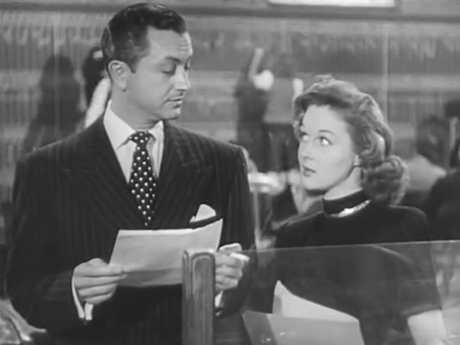
A film like the Searchers (1956) or even The Bravados (1958) frames the western as a tale of vengeance, where a vendetta is carried out from start to finish, only to get twisted up along the way across moral lines. Pursued is a psychological western that takes up the story from the opposite end of the barrel, as its name implies, though the way it goes about it isn’t altogether straightforward. Such stories very rarely are.

Jeb (Robert Mitchum) is hiding out in a cave as his love Thor (played by Teresa Wright) rides to him. We don’t know their history, why he is there, or who is coming after him. All we know through obvious inference is that all these things must be true.

It’s screenwriter Niven Busch’s ploy to draw us into our story and then he fades into a flashback that carries most of the picture’s weight. As many stories channeling Freudian theories must begin, this one is conceived in childhood.

A young boy remembers glimpses of a horrible event. Bullets flying. A body of a woman crawling towards him as he hides under a bed. And this woman (Judith Anderson) would become his adopted mother as her two own kids become rather like his siblings. Thor and Jeb get on well enough but from their boyhood, there has always been an unresolved conflict between Jeb and Adam. The animosity stems from the fact Adam will always see the other as not a true part of his family and Jeb lives with a bit of a chip on his shoulder, understandable or not.

For the sake of their mother and their sister, they begrudgingly tolerate each other and that’s the extent of it. When the Spanish-American War erupts one of them must go and so they decide it in the most arbitrary way possible. With a coin flip. Jeb loses and goes off to be a war hero.

When the family finally reunites and gathers around to sing “Danny Boy” to the tune of Londonderry Aire, there is a sensitivity we feel unaccustomed to, since the rest of the story is brusque and distant nearly scene after scene.

While in its opening moments it began as a story of hospitality and family, Pursued really starts falling apart and allows its core themes to exert their full presence. It’s in these moments where we begin to see hints of a story playing out not unlike a crazed version of the prodigal son.

On another coin flip, Jeb loses out on his piece of the ranch and after having it out with Adam turns to his buddy (Alan Hale Sr.) at a gambling house. He is brought on as part of the operation. Meanwhile, the jealous older brother character begrudges the fact his mother will give Jeb an equal inheritance so he is looking to avenge this personal affront. It doesn’t end peaceably.

At his ensuing trial, Jeb’s life is on the line but even though he gets away scot-free, his relations with his surrogate family will never be the same. And it’s only made worse with every subsequent moment including a town dance where Thor’s latest beau (Harry Carey Jr.) is egged on to confront Jeb.

Dean Jagger makes a nuisance of himself hanging over the entire picture menacingly, but it does feel like his talents are generally wasted. Because when everyone else is gone, the most traumatized parties are Mitchum, Wright, and Anderson.

However, this noir western is a genre-bender blessed by the beautiful black and white imagery of James Wong Howe matched with the direction of that old Warner Bros. vet Raoul Walsh. Whether it’s the distant silhouette of Robert Mitchum illuminated in the doorway at night or the sheer magnitude of the cliffs and crags as they frame insignificant riders galloping by on their horses, the images are undeniably evocative.

There’s nothing all that surprising or thematically interesting about the film’s content initially. Still, this is not a full denunciation of the picture outright. Because the way it plays out does become marginally more intriguing as Mitchum comes under attack and finds himself becoming more abhorred by the minute.

I must admit it’s hard to buy sweet, innocent Teresa Wright could be vindictive at all. However, what the two stars breed is the most detached married life known to man. It’s a tribute to both of them. But they can’t stay that way forever.

What does remain is the fact Mitchum has been hounded his whole life by some unnameable specter hanging over him, and the picture has been hemming and hawing for a final showdown all along. It finally comes, though the ones who take a stand are not who we might expect.

The psychology puzzle of it all is up for debate — how memories come flooding back at just the right moment or how people can love someone and them turn around and hate them and then love them again almost on a dime.

But this does not completely neutralize Pursued which still deserves a reputation as a brooding and atmospheric take on the West. It’s not as mentally stimulating as might have been warranted but with the cast of Robert Mitchum and Teresa Wright, even ill-fit as they may seem, this oater still comes as a fairly easy recommendation.

3.5/5 Stars

Crossfire (1947)

crossfire 1.png

Like any self-respecting film noir, it opens with men whaling on each other amid stylized darkness. Edward Dmytryk’s Crossfire is an issue-driven picture and it’s an important one given the cultural moment in which it came into being. There’s no doubting that.

But though the imagery is spot on and we have numerous noir regulars, it doesn’t feel like a noir film in the semi-conventional sense. Maybe it’s because the issue it was looking to root out takes precedence over any of its more formalistic qualities and that’s perfectly fine.

From a practical standpoint, Dymytrk opted to shoot the film with low key lighting as it’s a cheaper set-up and also a lot quicker which allowed the picture to be churned out in a mere 20 days. However, it’s still quite befuddling how a film this short can still somehow be incomprehensible at times.

Like any good procedural it whips out a long list of characters introduced in every sequence who either have significant amounts of screentime or show up for a few moments and still manage to play a crucial part in this obscured piece of drama.

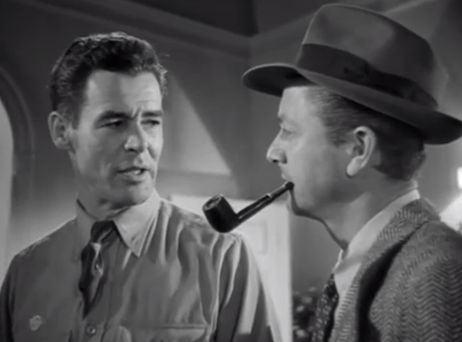
Realistically, Crossfire can be touted as the film of the three Roberts: Young, Ryan, and Mitchum. Robert Young will always be heralded as a television father much like Hugh Beaumont and so while I can never take him quite seriously in such a role as a police investigator, he certainly doesn’t do a poor job as Captain Finlay.

Paradoxically, Robert Ryan is one of those actors who is probably grossly underrated and yet as far as personal taste goes I’ve never liked him much (Though my esteem steadily rises). Maybe that simply pertains to the kind of characters he often played such as the belligerent Montgomery in this film. They are not meant to be affable and he does a wonderful job of eliciting a scornful reaction.

Likewise, Robert Mitchum has arguably the least important role of the three, but he still has that laconic magnetism that wins us over, portraying one of the other soldiers caught up in this whole big mess. Sgt. Peter Keeley is a bit of a tough guy but also ready to watch the back of his brothers in arms. He’s our counterpoint to Robert Ryan.

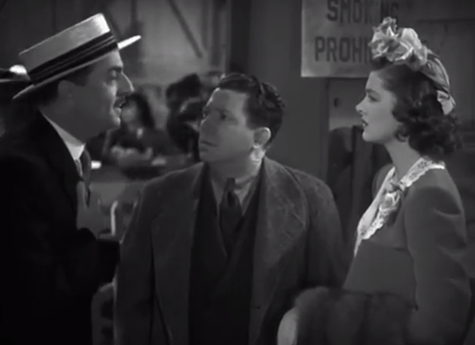
The minor players list out like so. The victim of it all was a man named Samuels (Sam Levene) who crossed paths with the demobilized soldiers in a bar and seemed nice enough. He even struck up a conversation with a homesick G.I. named Mitch (George Cooper) who Keeley guesses might be a prime suspect for murder.

Jacqueline White is the wanted Corporal’s concerned spouse while Gloria Grahame plays a characteristic noir dame who might prove to be an invaluable witness on his behalf, if only she’ll cooperate.

This is yet another link in the chain of post-war crime pictures where soldiers were returning home only to meet a new kind of disillusionment (ie. The Blue Dahlia or Act of Violence). A certain bar scene played over from multiple perspectives proves to be a pivotal moment, but it’s full of fuzzy recollections and screwy bits of information. No one seems quite sure what happened and the film banks on this ambiguity.

However, it’s about time to cease skirting around the obvious and say outright what the film is an indictment of. It’s anti-Semitism. “Jew-boy” is the trigger word. Though the film requires some reading between the lines, thanks to the production codes, there’s no context needed to understand what that means. It’s instantly apparent bigotry is rearing its ugly head.

As such, Crossfire shares a similar conviction with the year’s other famed issue-driven picture The Gentleman’s Agreement (1947) and it brings to mind the wartime short film headlined by Frank Sinatra, The House I Live In (1945).

But, of course, when you begin to analyze one group of people there always seem to be others still being marginalized whether Japanese-American, African-American, Mexican-American. You name it. And that’s part of what makes such a portrait fascinating. To see to what extent the lines of inclusion will be drawn up.

Though it’s evident that he’s preaching, there are still some steadfast truths coming from Robert Young as he tries to convince a soldier (William Phipps), still wet behind the ears, what he must do for the sake of his conscience. There’s a need to stand up to the bigots because hate is always the same. They hated the Irish and the Italians before just like they will continue to hate some other people group in years to come.

Even if the history gets pushed to the fringes and it doesn’t get taught in school, that doesn’t make it any less of the truth or any less of our history. It’s possible to contend that we are made stronger, not weaker when our troubled history and past indiscretions are fully acknowledged. Only then can we learn, heal the wounds, and pursue a better future together.

So Murder, My Sweet (1944) is still a superior film noir from Edward Dmytryk and probably a great deal more fun, but there’s no denying the message that’s at work behind Crossfire.

3.5/5 Stars

Love Crazy (1941)

love crazy 1.png

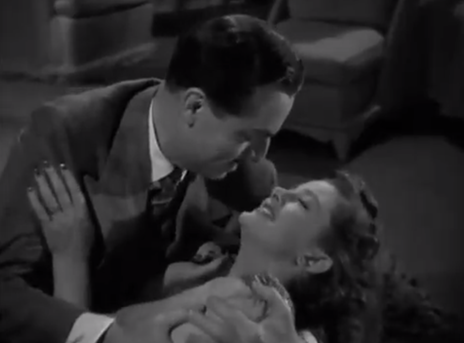
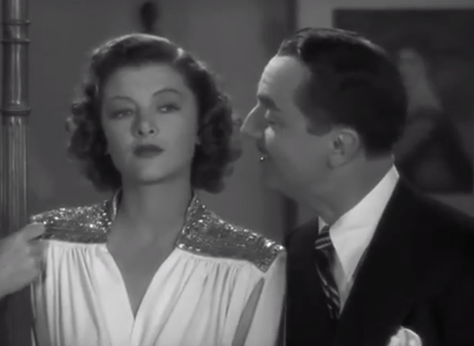
Love Crazy puts William Powell and Myrna Loy in their wheelhouse as the lithe and sprightly romantic partners placed at the center of this screwball comedy.  Steve Ireland (Powell) is in a terribly good mood getting home in his taxi singing ditties as he makes his way up to surprise his wife Susan on their wedding anniversary.

All of which is an encouraging change of pace because Hollywood often made the nagging of marriage look like a real ball and chain. For once that’s not the case. They want a romantic second honeymoon full of dancing, escapades, and a dinner served backward. It’s the fact that he can never get enough time with his wife to suit either of them. Well, there you have the film in a nutshell anyway.

Except storytelling 101 tips us off that the film will have to begin swinging like a pendulum in such a way that both our lovebirds in this connubial comedy will no longer be so inseparable. The main instigators prove to be his overbearing mother-in-law who inserts herself into all their plans. The other is a former flame, Gail Patrick at the most delightful I’ve never known her to be, who playfully cajoles him to have some fun. She’s married but acts as if she’s still single and ready to mingle.

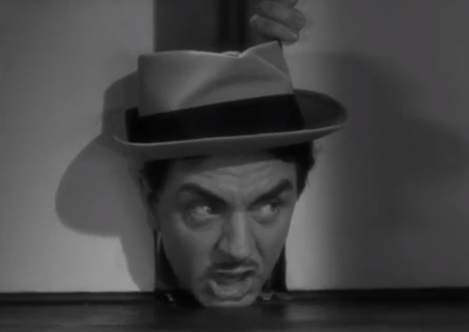
You would think he already had more excitement than he could take getting trapped in the elevator shaft with this frisky female and the elevator boy (Elisha Cook Jr.). Proving I’m no comic snob, I heartily enjoyed watching Powell’s head get clunked around. It’s a resoundingly hilarious image.

love crazy 2

However, he forgot about who was waiting for him back home. It’s the lesser of two evils to sneak out for a drink with Isobel and while his wife has to step out he uses his worst possible lifeline to get away from his aggravating mother-in-law. It doesn’t take too much for the root of doubt to sneak up and it only gets worse when Ward Willoughby (Jack Carson) is introduced as a studly archer in an undershirt. What else? Now both spouses have someone to be jealous of.

It hearkens back to the days where the sitcom hadn’t been invented yet because we didn’t have TV so instead, there were films like this which function around all the most cringe-worthy bits of comedic irony, namely mistaken identity and all sorts of misunderstandings. But like its predecessor from the year prior, I Love You Again, the steam slowly begins to evaporate off about midway through.

Because the main subplot becomes the whole plot in a way that provides some gags but on the whole feels tired and worn out. I want to see Powell and Loy together or at least more of Patrick and Carson who actually bring a lot of comedic chops to the picture. In fact, one of the more hilarious wrinkles involves Powell getting the other man interned at the sanitarium only to have him escape later. But it means very little to the integrity of the story. That’s part of what makes it so enjoyable.

Otherwise, Powell plays up his insanity to string along his wife so she can’t divorce him. His main showcase is at a party where he emancipates a fleet of hats trying to play up his looney side, followed thereafter by a string of other coincidental mishaps. His wife knows it’s a game but the man he’s christened “General Electric Whiskers,” who he met at the party, is actually a doctor who thinks he’s very sick indeed.

This all feels like fairly uninteresting fluff. Meanwhile, the film’s finale relies on another bout of concealed identity but to its credit, it circles back on the things that made it laudable before, entering back into the apartment complex. There the chaos of all those individuals from earlier is heightened in close proximity with a supposed crazy man on the loose and the police after him. They are aided by Willoughby and Steve is helped first by Isobel and then his wife.

But the crowning piece of comedy has to do with Powell’s ultimate masquerade as he even sacrifices his beloved pencil-thin mustache for the sake of it all. While not particularly inspired by today’s standards, Love Crazy boasts Powell and Loy in as fine a form as ever. That is enough to enjoy the picture even in its middling moments.

3.5/5 Stars

I Love You Again (1940)

i love you again 1.png

The film’s plotline can be summed up by amnesia. A no-fun businessman named Larry Wilson who drinks nothing harder than grape juice is conked on the head while saving a drunk who went overboard. Poof! Just like that Larry is no longer and he becomes his presumed former self — the suave alter ego — George Carey. If you’re willing to buy into the premise and not ask too many clarifying questions, it’s quite easy to enjoy the inevitable wacky ride ahead of us.

I even got the inkling that it was going to be a funnier version of Random Harvest (1942). Really it’s part of that esteemed screwball subset — the comedy of remarriage. Carey heads back home with his newfound pal and fellow grifter Doc (Frank McHugh) to scope out his past life and do his best to be the man he is supposed to be with humorous complications. You see they don’t realize he’s a married man until his wife comes to meet them at the gangplank. Well, actually he’s a soon to be a divorced man. Hence the marital conflict perfectly positioned for ensuing comedic fodder.

The main wrinkle and ultimately what makes it so different is that Powell and Loy are at separate poles in this film by necessity. All throughout The Thin Man pictures, they’re in perfect cadence and that’s what makes their chemistry and the onscreen marriage work.

Here Powell is a charming man with a twinkle in his eye like always — but his wife is expecting the same boring schmuck she married all those years before. She’s coming at this man from a different point of view and boy is she surprised with what she gets. In one way, annoyed because he makes it infinitely more difficult for her to let him go but then thankful because he is the precise man she always dreamed was right in front of her.

i love you again 2.png

In this way, I Love You Again is actually a fairly personable romance beyond its simple roots in screwball comedy. There’s almost a bit of depth there if we dare admit it but of course, that doesn’t take away from the underlining laughs most especially offered up by Powell.

He’s not opposed to making a fool of himself by dancing all by his lonesome until his wife saves his self-respect. And he plants a kiss on her that all but broke the world record in the sleepy town of Haversville. But she’s not going to go down without a fight and in one particular squabble he gets scrambled eggs all over his face (and on top of his head). Her current beau is an idiotically annoying bloke in his own right who is made for antagonizing. They always are.

If William Powell fly fishing in Libeled Lady (1936) was one of the defining comic images of his career than perhaps its equal is found in the confines of this film where he dons a boy scout uniform from his past life. Because he’s a woodsman of some repute who has quite the following with newspaper articles being penned about him and little tykes (AKA Alfalfa) being discouraged by how difficult he is to track. I feel that I saw some of these images years later in another intrepid yet bumbling outdoorsman, Barney Fife.

The moments exuding entertainment appeal outpace the rest including Powell’s constant cooing impression of a lovebird but nevertheless, it does drag in segments after a fairly interesting setup. Extended boy scouting sequences and spying out the old stomping grounds aren’t all bad though.

One could say that it’s even necessary as we watch the malleable relationship between Powell and Loy morph into something new. Everything else serves this singular purpose. It’s really what you wait for in a comedy of remarriage as the wistful regrets and longings seep in only to get replaced by happy expectancy of what is yet to come. The future is made sweet and those truths remain in I Love You Again.

3.5/5 Stars

Good News (1947)

good news 1.png

The title Good News means next to nothing to me but it does suggest a certain sunny disposition we tend to equate with MGM musicals of the period. That assumption is fairly well-founded. Furthermore, I am well aware of Adolph Green and Betty Comden, that screenplay dream team, an integral part of Arthur Freed’s unit that had so many quality pictures to their name.

Most obvious inclusions include Singin in the Rain (1952), On the Town (1949), and The Band Wagon (1953). And here they are working in the realm of retro nostalgia pieces, their forte, a light comedy scattered with quips and a substantive lineup of tunes. But the important differentiation here is that this was the first one. This is where it all began, in theory at least, making them into a screenwriting mainstay. While the picture has long since been overshadowed by its successors and was never a huge box office success, there’s no doubting the unassuming charms still present in Good News.

Like Singin in the Rain (1952), the year is 1927 but instead of film sets in a Hollywood back lot, we are met with the world of Flappers and Sheiks — the names for boys and girls on college campuses across Middle America. On this particular campus, good ol’ Tait University, the boys are batty about football and girls and the girls are batty about boys — at least on a very basic level. So nothing is all that different.

And yet for anyone born in the latter half of the 20th-century, you can’t help and look at the depictions and think that everything is different.  Whether its styles of clothing, social rituals, colloquialisms, practically everything. Granted this is a musical.

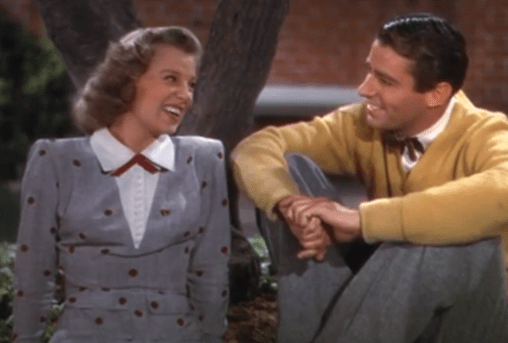
Still, the school’s All-American running back Tommy Marlowe (Peter Lawford) shimmies, shakes, struts, and sings with his buddies about the necessity of being a ladies’ man on campus. Because when they’re not on the field the subject of utmost importance is girls. Obviously. Thus, when a new girl fresh off of finishing school brings her refined manners, stuffy French vocabulary, and flamboyant dress, all the boys heads start turning including Tommy’s.

But as is often the case, not everyone is so infatuated or completely distracted by the opposite sex. For instance, we meet Connie Lane (June Allyson) as she calls for a wrench to remedy a leaky sink and she’s dressed to the nines. She’s a good student and pays her way through school at the local library. Boys are not her main concern though that’s not to say that romance doesn’t tickle her fancy.

So the film is a frolicking and invariably cheesy examination of the mating rituals of college kids. It’s crazy stuff sometimes but be assured we are in for a light and breezy good time — a squeaky-clean version of what college life is if you will.  It’s also short on plot but what is there proves to be a springboard for song and dance. For the most part, that’s promise enough.

A highlight is the familiar velvety fog of crooner Mel Torme as well as the rather dorky but endearing wiles of Joan McCracken who feels much in the same vein to parts Betty Garret would ultimately play. Of course, this is really the Lawford and Allyson show as they must come to know each other, show genuine feelings, get confused about it all, and fall back together again. That’s the way the story has been told since the dawn of time. This one is little different.

A formative number comes off as a musical French lesson as Tommy goes under the tutelage of Ms. Lane to land the new girl in town who is giving him the cold shoulder. Meanwhile, Allyson imparts her knowledge and delivers a warm rendition of the tune, “All The Best Things in Life Are Free.”

“Pass the Peace Pipe” at the local soda fountain — a song that feels doubly archaic coming from the 1920s through the 1940s to the present day — is no less a lively foot-tapping number to be sure. But be relieved that the football scrimmage is not turned into a giant musical number of its own. Football is football and dance is dance. Each gets its own arena and there are plenty of theatrics in both. The cherry on top is a stellar large-scale dance number, “Varsity Drag,” to sum it all up in a rousing fashion much as it began.

3.5/5 Stars

It Happens Every Spring (1949)

It_Happens_Every_Spring_VHSDoes this film glorify those who cheat and deceive taking advantage of others through the advances of modern science? Certainly not! Well, maybe a little but this is one of those ludicrous stories that never makes a pretense of being real life or a moral tale for that matter. It’s just a zany story that’s actually quite rewarding to be a part of.
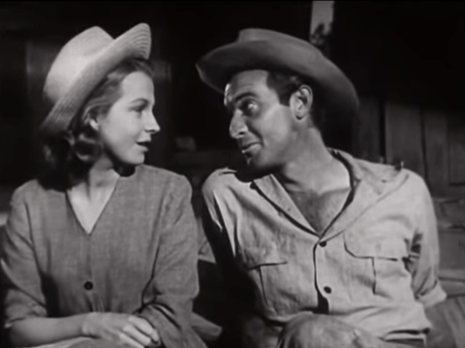
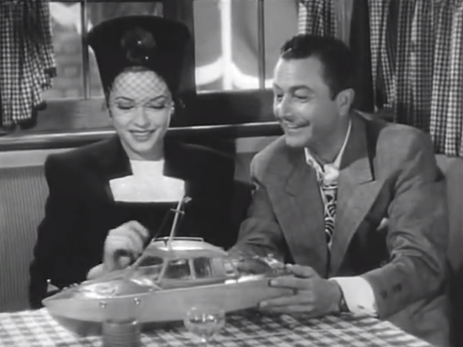
At its core is a middling college researcher. He’s in love with a girl but not rich enough to offer her much of anything. What’s more intimidating is that her father is the dean of the school and Vernon’s tireless amount of research is getting him nowhere fast. Another seemingly trivial detail remains that every spring he gets obsessed with baseball and becomes distracted in his lectures, in his lab, and in life in general.

If you want to think about one of Disneys live-action classics, it’s easy to draw some similarities between this film and The Absent-Minded Professor (1961). In the latter film, flubber is used for an advantage on the basketball court. Here it’s all about baseball.

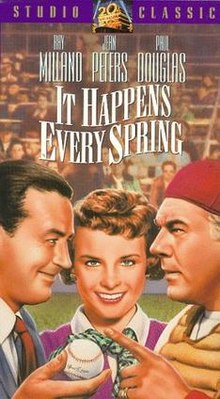
Vernon Simpson (Ray Milland) discovers the extraordinary characteristics of his new substance methylethylpropylbutyl quite by accident when he rolls a dampened baseball by a block of wood only to have the two repel. His eyes almost pop out of their sockets when it works time after time. The implications are simple. He can harness this discovery to make it in the MLB and S.T. Louis has aspirations for a pennant but needs pitching. This is his chance to realize his dreams.

The film admittedly doesn’t explain much about why Vernon is infatuated with baseball. Perhaps it was enough that most Americans still were taken with it since it was “The National Pastime.” Regardless, he hurriedly gets a leave of absence from work and provides a cryptic message to his girl not to worry about him.

His baseball career as chronicled by the film is a meteoric rise that totally revels in its completely ludicrous nature. He walks into the clubhouse talks with the manager (Ted De Corsia) and the teams head executive (Ed Begley) who doubt this adamant thick-headed nobody who brags he can win 30 games. Boy, does he shut them up and they’re glad he did.

Most everything is textbook as far as a film about a science researcher playing major league baseball and using a miracle substance to win ballgames can be. His girlfriend thinks he’s involved with the mob. He tries to keep his true identity a secret under the pseudonym King Kelly, and he begins to form a bond with his veteran bunkmate and backstop Monk Lanigan (Paul Douglas). I’ve always been a fan of Paul Douglas as an actor because he plays his characters straight with a gruff yet palpable sincerity. It’s little different here. Milland though hardly an American bred on stickball nevertheless is a charmingly scatterbrained lead.

I didn’t realize it until now but I’m rather fond of science fiction baseball comedies. It breaks every rule of baseball. It’s absurd. There’s so much to call into question and yet I don’t want to. But just for the fun of it all, let’s look at a few obvious inaccuracies from It Happens Every Spring.

King Kelly would never get a win if he came into a game that his team was already winning and yet he asks for $1,000 in compensation for such an appearance. Furthermore, it looks like he’s committing a balk about everytime he winds up. And if he’s not then baserunners would be stealing on him all day because he never pitches from the stretch. He’d be an easy target.

Believe it or not, Kelly actually doctoring the baseball, secret formula aside, definitely is not all that ludicrous. Pitches such as the spitball and scuffball were famously used in the games early days. Pitchers like Burleigh Grimes, a personal favorite of mine, made a living off the pitch and though the spitball, in particular, was outlawed in 1920, pitchers like Grimes were grandfathered in. He continued throwing it until 1934.

Still, that didn’t completely deter later pitchers from using it like another Dodger great Preacher Roe and then Gaylord Perry in the modern era. As long as you didn’t get caught there was no recompense and the same can be said of Kelly. Again, we’re not glorifying cheating. Don’t get any ideas.

3.5/5 Stars

The Southerner (1945)

the southerner 1.png

It’s easy to infer there is an innate kinship between famed director Jean Renoir and the folks within this picture. Certainly, he was no peasant, by any means related to those found in Millet’s The Gleaners. However, like his painterly father Auguste Renoir (a figure I always find myself reverting back to) he had a penchant for people and nature underlined by a genteel eye for beauty.

That is not to say, Jean was exactly the same. His films can often be socially-minded, capable of both satire and commentary. But underlying such themes is always this same sense of natural and artistic pulchritude.

Though his output in the states is generally forgotten, upon closer analysis, efforts like The Diary of a Chambermaid (1946) and The Woman on The Beach (1947) have glimmers of his brilliance as an auteur. We can even see how the content often fit Renoir, though the system and in some cases, the performers might not have.  However, in its day, most everyone seemed to agree that of all his efforts as an expatriate, The Southerner was his finest achievement stateside. I don’t disagree.

At its core, Zachary Scott gives an understated performance full of grit and common decency as the head of the Tucker clan. Right beside him, his wife, Nona (Betty Field) exhibits a stalwart character exuding both affection and maternal grace, a constant rock to steady her man. In an inciting event that feels strikingly similar to The Grapes of Wrath (1940), Gramps dies and the family sets out on a pilgrimage in search of a new life. This will eventually lead them to a strip of land to call their own.

While Scott’s no Henry Fonda, I’m pretty sure even John Ford would consider Jean Renoir his equal if not a superior director. Regardless, both are visual filmmakers of the most visceral kind. In fact, Poetic Realism was an attempt to put a label on Renoir’s exquisite naturalism, placing the human form in environments like modern day evocations of the Garden of Eden in an otherwise sullied world. A Day in The Country (1936) or even Toni (1938) stand as stunning earlier examples from his native France.

Compared to his other American efforts, The Southerner has the most straightforward and even conventional narrative. Because the story is simplistic and the dialogue unadorned; at it’s worst it’s throwaway. However, it effectively provides a bulwark for Renoir to capture strains of humanity with a truth that gleams with his usual sensibilities. Again, like Ford, such a minimal plot frees him up for digressions that are more lyrical and character based so by the end of the picture as short as it is, we feel like we have witnessed something full-bodied and singular.

The Tuckers have the most darling little kids. Beulah Bondi subverts her angelic image as the cackling, particularly ornery granny. Their new life is hard, their resources scant, and yet the Tuckers are cisterns full to the brim with indefatigable spirit. Sam is driven by the humble desire of Man to cultivate his own land. He never says it implicitly but God was a Creator and so it’s almost innate for him to want to do some of the same.

But Tucker, like Job, is born to trouble with backbreaking labor and constant devastation. His boy is stricken with sickness needing nutrition from vegetables, lemons, and milk that they either don’t have or can’t afford. The Tuckers live by a creed of family and neighborliness but they receive no such charity from those nearest to them. It’s like the gruff farmer next door is seeking to see them fail. Nature too is all but looking to sink them. There’s no amount of clemency

In one pleading moment, Tucker even walks out to his decimated crop he’s toiled over for so long and talks to God in the most candid of ways. It’s like a modern-day psalmist asking the honest questions. His resolution is to keep going and hold his family together thanks to the unremitting determination shared by his wife.

However, overlaid on this is also the struggle between the new urban centers and all the natural wonders of God’s green earth. We saw it in Renoir films such as The Human Beast (1938). In Sam’s case, his friend all but guarantees him a steady factory job and yet he continually balks at the chance. His calling is to be in the fields no matter how inexorable his opposition might prove to be.

The beauty is that we get a bit of a reprieve from the constant barrage of misfortune. It comes in the form of a wedding when two jolly old folks get hitched and it births the most joyous occasion. Partying ensues full of good-old-fashioned gaiety and square dancing brimming over with laughter and hilarious antics made 10 times more humorous in the company of others. Each and every one of them is a part of this grand joke. The Job-like assaults keep on coming and yet in the company of others they hardly seem as catastrophic. There you have a secret to life.

I rather like the conclusion Renoir’s film makes tacitly. It’s quite evident in the following aphorism voiced by one of the characters, “It takes all kinds to make up this world.” So this is not the Romanticist where everything mechanical and technological is inherently bad. Nor is farming or the land being tilled and cultivated any less important. They share equal footing and they need each other.

Again, it’s the humanism of Renoir fully realized. This is an American story, the most American narrative undertaken by the French director. However, in the waning days of WWII, you cannot help but see this as a universal rallying cry. Out of the ashes of destruction and international animosity, ill-will, and hatred, we need each other. Come to think of it, the credo is a timeless one at that. We could use these words now as much as we ever did. There you have a secret to the relevance of Jean Renoir.

4/5 Stars

Diary of a Chambermaid (1946)

diary of a chambermaid 46 1

If Bunuel’s well-remembered adaptation of this material is considerably darker and biting as his pictures always seem to be, then Jean Renoir’s version is fittingly consistent with his own sentiments and oeuvre.

Celestine, as played by the ever precocious Paulette Goddard, looks to be one to tear asunder the stately tranquility of the estate she has been hired to serve at. But in fact what we are met with over time is quite the opposite and that’s one of the great ironies of this film.

Another is the fact that Renoir was called upon to make such a satire under the Hollywood production codes. He is no Bunuel and still, there is a certain anarchy and irreverence that can be taken from many of his native works.

You have only to look at Boudu Saved from Drowning (1932) or is acclaimed masterpiece Rules of the Game (1939) to see the social commentary at work. There is the same upstairs, downstairs dynamic and the pronounced divide between those with means and those who serve those with means.

Paulette Goddard gives a fine showing in the title role that puts her plucky and radiant chambermaid front and center. Whereas she often played opposite a romantic lead like a Chaplin or even Bob Hope, this is her picture and that’s a refreshing change of pace.

What she provides is her usual brand of bodacious energy that carries along her cohort Rose (Irene Ryan) and stands up to the severe and misogynistic valet Joseph (Francis Lederer) who has been in faithful service to the Lanlaire family for 10 years. It sets the tone for the entire picture but it also subsequently reveals that everyone in her vicinity has their own agenda.

There’s Joseph who much like her would love to leave behind his current life for a life of privilege and good fortune. Meanwhile, the controlling Madame Lanlaire (Judith Anderson) wants to use Celestine’s services and certain attributes to help keep her grown son (Hurd Hatfield) at home. She’s suffocated him for an entire lifetime.

The demure, bearded Mr. Lanlaire feels more at ease with Celestine than with his own wife and his feuding next door neighbor the idiosyncratic Captain Mauger (Goddard’s husband and the film’s screenwriter Burgess Meredith) wants to steal Celestine away and hire her on to work at his own estate. He’s even ready to propose marriage and give her nice things if only she’d accept.

So in a sense, if you want to look at the film in very basic terms, Celestine has numerous suitors. One who shares her personal aspirations. One who shares her romantic love. One who makes life a great deal more fun for her and so on. Though only one can end up with her in the end.

It is an admittedly strange circumstance to have a French director of such repute as Renoir directing an English language film from French source material no less. How we ended up with such a project is befuddling. But rather than get caught up in the incongruities it’s suitable to enjoy them for what they are. It could have been a shambles.

I am reminded of Vittorio De Sica’s Terminal Station (1953) that fell under Selznick’s control and was recut and reissued as Indiscretions of An American Wife. The conflicting visions proved to be a disaster.

Here it works to a satisfactory degree. It’s shot and feels like a Renoir film even if the actors themselves or the system they are working in does not. But a Hollywood exterior does not make this film impervious to improprieties. While in some respects it relieves the picture of its claws, there’s nevertheless yet another irony found therein, though the facade must be first pulled away.

It’s so eccentric and giddy with all the flourishes of classical Hollywood and quality supporting actors that it makes us almost forget the strange even indecent behavior that comes to pass. That’s because it’s a Hollywood picture and not a French one.

Furthermore, just because the action is set in France and orchestrated by a French director does not instantly mean that this is a satire of that society alone. Are we so blind as to see the conflicts and relational quibbles that dissect this film as being so far removed from our own?

Surely we don’t have any stratospheres like this or any people with these kinds of behavior in the United States? Charming and unrepressed chambermaids. Brooding men who are bent on vengeance. Mothers willing to use the allure of other women to manipulate their children into still loving them. I can’t speak to any of these things directly but only know we’re often more alike than we would care to admit.

So enjoy Renoir’s Chambermaid on the perfunctory level if you wish. It’s a quirky backroom comedy-drama bolstered by winsome Paulette Goddard. But if you want to see it for something more you may — a satire, a veiled look at risque themes, and anything else you can discern within its frames.

3.5/5 Stars

The Woman on the Beach (1947)

woman on the beach.png

The Woman on the Beach is ripe with subject matter that feels akin to Jean Renoir as much as any Hollywood picture possibly could be. Since the beach, in his specific case, initially evokes not the California coasts but the shores that might have so easily cropped up in the paintings of his renowned father Auguste Renoir. Marrying that preconception with the domain of beguiling femme fatales makes it all the more disconcerting.

But this is also a story of what it is to be an artist and you can see Renoir using the materials at his disposal to grapple with such themes which were no doubt ruminating in his own mind.

Like any director of irrefutable substance, Renoir was probably aspiring to do far more with the medium than his American backers would have preferred and that could explain why his movie was cut down from an unspecified length into the version we now have.

It’s true that the film is yet another collision of worlds with a tortured American tough guy like Robert Ryan paired with a French master of composition and commentary like Renoir. But far from being a mere incomprehensible jumble, the results are still revelatory if not quite flawless.

The opening underwater dreamscape proves to be an entrancing interlude as it plays out in Robert Ryan’s subconscious, brought to us by a self-imposed exile like Renoir no doubt with obstacles of his own to do battle with.

If we want to try and be standard in our appraisal of the picture by providing the cadence of the plot, it’s about a Coast Guard officer (Robert Ryan) stationed on the West Coast who is taken with a woman (Joan Bennett) he comes across when she is picking up firewood on the beach.

There’s an almost uncanny lucidity to how she pinpoints his deepest fears in their initial encounter and they come to the conclusion that they’re pretty much alike. How Peggy Butler can be so sure is slightly beyond the point. Certainly, it doesn’t make sense in rational terms.

Here again, we are met with the bewitching gaze of Joan Bennett that first came to my attention in a portrait found within a dream of a film called Woman in the Window (1944). She’s undoubtedly one of the underrated noir sirens out there because she was one of the preeminent talents in casting a spell of enchantment to entangle her male companions. Ryan falters much like Edward G. Robinson did previously, twice over.

Charles Bickford gives a performance of equal import as the blind artist Tod Butler, a man who is as attached to his work — a passion that he can no longer realize — as much as he is to his wife. They want to get rid of him in one moment and they think he’s faking his frailty in another but all these preoccupations fall by the wayside.

Thus, The Woman on the Beach cannot be branded as a pure film-noir but instead a vein of those crime pictures grafted with Renoir’s own sensibilities. Even if the studio knew in part what they were getting, it still makes sense that they were not completely satisfied.

It looks to be one of those sordid love triangles that were always a mainstay of film noir but, again even in its short running time with footage lopped off, it works beyond that and despite Hollywood’s best efforts (whether intentionally or not), Renoir’s going to have a voice.

To a degree, it’s possible to see some sort of progression from Le Bete Humaine (1938) in its stylized atmospherics highlighted by billowing smoke, psychological duress, and oh yes, an alluring gal playing opposite Jean Gabin in Simone Simon.

Aside from the luminescent Bennett, a few other ideas leave a lasting impression whether it’s the turmoil of an artist caught in the throes of obsession or the dreams that overtake a man plagued by post-traumatic stress. This picture has more to offer than you might expect.

It brings to mind John Huston’s Red Badge of Courage (1951) another cannibalized picture that in its present form is about two-thirds of a minor masterpiece. There’s still an exceptional spirit and resonance to what was leftover. It can only lead us to imagine what might have been on both accounts.

This would prove to be Renoir’s last film in the States before he washed his hands of the whole industry and returned to his native land to continue the creation of high-regarded works like he had never left. True, this is a picture that is often neglected but that’s simply because there are other works of great repute. That does not speak entirely to the detriment of The Woman on the Beach.

3.5/5 Stars

The Clock (1945)

the clock 1

May 25th, 1945. That’s when The Clock was originally released. To save you doing all the mental calculations V-E Day was on Tuesday, May 8th and the folks at home were ready for the war to be over. So in such an environment, this is hardly a war film and it can’t even claim to be a post-war picture like The Best Years of Our Lives (1946). It’s floating in limbo.

This is the story of a fresh-faced soldier boy in the big city (Robert Walker) constantly craning his neck in awe of skyscrapers and cowering a little bit under the weight of them all. As such he’s constantly being bumped into, like a tourist perpetually lost. From such a moment springs an almost unforgivable meet-cute we can spy from a mile away. She trips over him and loses a heel.

But our stars are winsome and their persons genuine in nature in the days when that was unequivocally so. Corporal Joe Allen (Walker) proves to be to New York City what Mr. Smith was to Washington D.C. He even rides the very same sightseeing bus. He’s also a bit of an idealistic builder not unlike George Bailey.

The soldier and the gal he asks to follow a piece, end up taking a Central Park stroll together followed by a tour of the local art museum, taking a load off, butt up against an Egyptian sphinx. There’s something inherently refreshing about its meandering wanderings through New York City. It gives this illusion of circumstance where there is no clear-cut agenda. In a moment of decision, he goes pell-mell chasing after her bus because he knows something special is onboard and he sets up a date just like that.

Vincente Minnelli is looking out for his heroine as Judy Garland was his own new romantic interest but his camera setups also reflect a stewardship over the contents of the film with his usual array of fluid shots. Far from just taking care of Garland you always get a sense Minnelli is watching out for all his actors with his camera often walking alongside them. She proves to be a fine performer sans singing and although long remembered for Strangers on a Train (1951) and his tumultuous personal life, Robert Walker undoubtedly exudes a naive candor of his own.

It’s always striking how Hollywood was able to cast a certain vision of the every day while reality was oftentimes so different. One aspect of that was the wartime shortages which made shooting on location highly impractical so everything from train stations to exteriors were created on the MGM lot to closely mirror their real-life counterparts and it, for the most part, takes very well. We feel like we are traveling through the big city with a soldier and a gal. At any rate, the city crowds feel realistically suffocating.

But beyond the simple (or not so simple) realm of sound stages and set design it also extends to the actors themselves. Robert Walker who played opposite his wife in the epic home front drama Since You Went Away (1944), had a horrid time getting through the picture as their marriage was on the rocks.

By the time he got to The Clock he had been overtaken by alcohol addiction and Jennifer Jones was all but on the way to marrying executive David O. Selznick. Judy Garland on her part, that shining beacon of traditional Americana was struggling with an addiction of her own and after some creative differences with Fred Zinnemann, she had her soon-to-be husband Vincente Minnelli brought on to revitalize the production.

In these ways, it becomes obvious how there’s almost a conflicting double life going on in front of and behind the camera and yet there’s no doubting that this picture is brimming with sincerity whether partially made up or perfectly simulated. It still works.

You can undoubtedly see the same fascination with the very conversations and interactions that make up a relationship in everyday environments. The walking and talking we do when we share time together. The silly things we get caught up on or pop into our heads on a whim. And yes, there is a bit of Before Sunrise (1995) and Before Sunset (2004) in Minnelli’s picture for those who wish to draw the parallels but the beauty of it is The Clock is obviously not trying to be anything else. It takes simple joy in its story and the characters it holds in its stead.

It’s a film that dares have a scene where our two leads sit in a park, silent for a solitary moment as they listen to the street noise emanating from the city center and breaking into their tranquility. Take another extended sequence where the two lovebirds catch a ride on a midnight milk wagon driven by that perennial favorite James Gleason.

He’s the local milkman waiting impatiently for his request on the late night radio station and intent on some company along the route. But a flat tire puts him out of commission only to bring about another inspired piece of casting. Keenan Wynn as a drunk appears for mere minutes and earns high billing in the picture. It’s worth it. When our stars are allowed to sink into the periphery, the accents of the real world come into focus.

It’s equally true that those are the exact moments where you see the extent of another person’s character. Because it’s not simply the two of you but you get the opportunity to see them in a context with other people and that’s often very telling about who they are. Depending on the perceptions it can make you fall even more in love with someone and seeing as these two individuals help their new friend with his milk run, you can just imagine what it does for their relationship.

As for James Gleason and Lucille Gleason, they make the quintessential cute old couple and that’s because they truly are spinning their wisdom and bickering like only the most steadfast wedded folks do. The last leg of the film is when it goes for drama turning into a literal race against the clock bookended by one of the most distinct courthouse weddings ever captured. But even this picture doesn’t end there. Further still, it sinks back into this odd shadowland between the drama and the happy ending.

We could venture a guess it settles in on a realistic denouement where life isn’t always as we would like it but we can still love people deeply and do not regret the decisions we have made. As we walk off into the crowd with Judy Garland there is little to no regret only a faint hope for a future and assurance in the institution of marriage as something worth pursuing.

They are traditional values and yet, in this context, there’s something comforting about them. Minnelli has spun his magic on us even as the cinematic in its so-called reality slowly drifts away from the Hollywood marital standards of its stars. It’s both an idealized vision and a genuine one.

4/5 Stars