Hangmen Also Die! (1943)

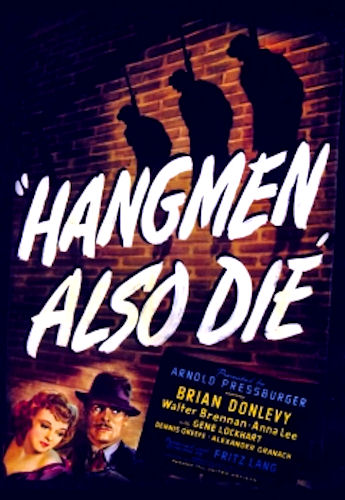
Hangmen_Also_Die_1943There are some fine pieces of intrigue in this modest WWII period film from Fritz Lang. The plot is based off real events in Czechoslovakia surrounding the assassination of Nazi Holocaust proponent Reinhold Heydrich. Mascha (Anna Lee) finds herself admidst a web of trouble when she helps a member of the underground after he commits the killing. But the Nazis are soon hounding her and it brings danger to her father’s household (Walter Brennan) . Ultimately she is forced to choose where her greatest allegiance stands.The film features Gene Lockhart playing the Nazi collaborator Czaka. Perhaps this film is not all that realistic and the casting is not perfect (although I did enjoy seeing Anna Lee in a leading role). At the time it came out this movie functioned as an anti-Nazi film and it still packs a decent punch from that perspective. It deserves some acknowledgement at the very least.

3.5/5 Stars

They Drive By Night (1940)

They_Drive_by_NightThis is a surprisingly nice little film-noir that follows two brothers (George Raft and Humphrey Bogart) who make their meager living transporting loads of produce by night on a big rig. Despite the seemingly mundane topic, They Drive by Night has some juicy bits of drama as the brothers struggle to survive and make their way in life. Along the way there is disaster and treachery. Ida Lupino is absolutely psychotic in her role opposite George Raft and Alan Hale. Then Ann Sheridan plays the nice girl role. I wouldn’t say that this is a great Noir but it certainly is far from boring.

Raoul Walsh proves just how adept he was at making entertaining melodramas and Humphrey Bogart is yet one step closer to his breakthrough with The Maltese Falcon (1941).  The truck drivers can always be found at the local diner getting their burger, talking up the waitress and maybe playing some pinball. When there time is up, it’s a long night ahead hauling fruit crates. The film is a slice of Americana reflecting a bygone era, at least for most of us.

3.5/5 Stars

Moonrise (1948)

MoonriseHere is a low budget yet artistic film from Frank Borzage. I will be honest that I had never heard of Borzage before a year or two ago and he seems to have lost some of the respect he had early on in the 20th century. The same can be said for his stars Dane Clark and Gail Russell who are unknowns to most unless you hailed from those times. I was saddened to find Russell struggled with alcoholism which contrasts with the surprisingly hopeful ending of this melodramatic noir.

Ultimately, Danny Hawkins (Clark) was able to let go of all his hatred and accept justice. Instead of throwing away his life he got the girl and came to terms with reality.

Perhaps the most striking moment of this film was the highly stylized and dark opening showing the hanging of Danny’s father and his early childhood afterwards. In only a few minutes Borzage told us so much about Danny. Thus, during the entire films those images stuck with us and we could still feel a sense of empathy for him.

Despite there small parts, I was excited to see Lloyd Bridges, a young Harry Morgan, and Harry Carey Jr. All in all this was an interesting film and it causes me to want to see more from Borzage.

3.5/5 Stars

A Letter to Three Wives (1949)

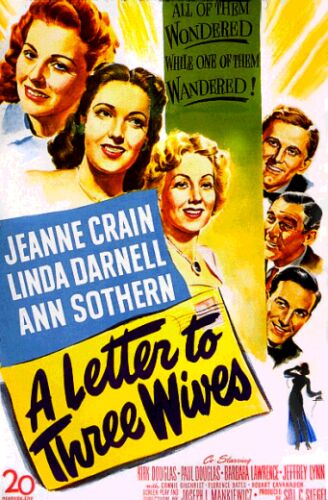
A_letter_to_three_wives_movie_posterHere is a story about three wives, the three husbands that go with them, and the one woman who got in the middle of them all. The main plot device is simply this: This woman named Addie Grace, who we never see but who is always being referred to, has left town and she also left a letter addressed to the three wives. The women get it as they board a boat for an afternoon out at sea with some underprivileged children. When they read what it says their afternoon takes a major turn. The one and only Addie Ross has run off with one of their husbands and yet she does not say who it is.

The rest of their time is spent thinking back on their marriages and each recollection is framed as a long flashback. First, comes Deborah Bishop (Jeanne Crain), a farm girl who met her husband during the war. Now with his friends back home she wishes to make a good impression, but she feels like she can never measure up with such elite society. To make matters worse, she learns that before the war it was thought that Brad would marry Addie Grace because they grew up together.

Next, comes Rita Phipps (Ann Sothern), who puts on an extra special dinner for her bosses from the radio station she writes for. The night includes a forgotten birthday, sappy radio programs, and all the while Rita is constantly trying to please and appease her bosses. They enjoy the evening but her husband George is upset that she constantly caves to them. To make matters worse, as a school teacher, it is difficult for him, as the man of the house, to have her bring in a great deal of their income.

Last but not least is Lora Mae Hollingsway (Linda Darnell) who grew up in a poor household near the train tracks with her mother and younger sister. She focuses her attention on Porter Hollingsway (her future husband), an older divorced man who also happens to own a chain of department stores. After a great deal of back and forth, they get married but underlying their marriage is this assumption that she only went after him for his money. Their relationship hardly seems to involve true love.

All three women return to their lives. Rita is grateful to find George sitting in the living room. Porter, who Lora Mae half expected to be gone, has come into the house exhausted after a long day of work. Deborah is seemingly not so lucky. All of them get ready for the dance that evening with their spirits all at different levels. However, after Porter shares a revelation the evening gets a whole lot better.

This Joseph L. Mankiewicz precursor to All About Eve is a remarkable drama in its own right thanks to its primary narrative device and fine performances from the cast. Thelma Ritter was as entertaining as ever and Celeste Holme was tantalizing as the unseen voice of Addie. It is interesting how all the stories of the film interconnect characters, making us come to understand each and every one of them a little better. The ending was slightly abrupt but still clever. All in all, A Letter to Three Wives was an interesting concept that paid off beautifully.

4.5/5 Stars

Pitfall (1948)

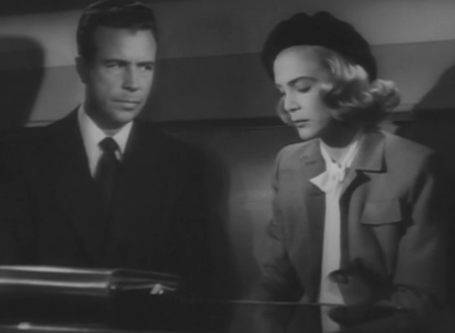
4ac39-pitfall2In Italy Pitfall‘s title was translated to Tragedy in Santa Monica. And that it is, but it plays out as a typical, everyday tragedy. It is far from Shakespearian. John Forbes (Dick Powell) is sorely tired of the monotony of his life: A wheel within a wheel within a wheel so to speak. And he is tired of being the so-called “backbone of the country” employed at Olympic Mutual Insurance Company.

He has a steady job and all, a beautiful, loving wife (Jane Wyatt), and a cute little son Tommy. He’s your prototypical middle-class man from your typical middle-class family. That’s what’s wrong with his life. To put it plainly he’s in a rut and desperately wants to get out.

Pitfall is a  bit of a riff off of Double Indemnity. There is some of the same framework but very different variables and outcomes, so that’s enough comparison.

Things get interesting when Mona Stevens (Lizabeth Scott) comes into the picture. She is a model with a boyfriend who was just recently put into prison for embezzlement. Now Forbes’ company is charged with getting back some valuables from Stevens and she gives them up willingly. Along the way, a hired private investigator named Mac (Raymond Burr) takes a liking for her, but the feelings are not reciprocated. That’s before she meets Forbes.

When they meet, Forbes is immediately struck by her and she takes a liking to his goodwill. Everything would be great in another world. Except in the real world, Forbes is married and Mac is jealous. After he gets accosted by Mac, Mona finds out about her fling’s home life. Surprisingly she lets him off the hook, but Mac won’t let her off.

Forbes’ overall demeanor changes and he feels reinvigorated, even back at home and in the office. But it’s never that simple, and things begin to get messy as Smiley finally gets his ticket out of the clink. Mac has been his constant visitor, filling the paranoid brute with ideas. He thinks Mona has been unfaithful, and he wants to get the guy she was with.

The ending of Pitfall is far more painful than a multitude of meaningless deaths in a monster movie. The reason being, these characters actually have some importance. There is a sense that human life is sacred and if anyone dies it is a big deal, whether they were “good” or “bad.”

Furthermore, there are hardly words enough to describe the look on Jane Wyatt’s face when she finds out the truth. This is one instance when the father did not know best, and their marriage was shaken to the core. It feels all too real. However, this film’s denouement is not quite as fatalistic as Double Indemnity. There still is a tinge of hope that these two individuals can salvage something out of a very difficult situation.

This is yet another feather in the cap of film-noir. So simple and yet so potently effective. I cannot wait for more with Dick Powell.

3.5/5 Stars

Review: Double Indemnity (1944)

Double_indemnity_screenshot_8It was a hot afternoon, and I can still remember the smell of honeysuckle all along that street. How could I have known murder can sometimes smell like honeysuckle?” – Walter Neff

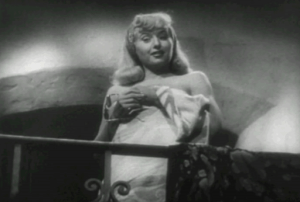
I can’t say this enough. Double Indemnity is so deliciously enticing each and every time I see it. Maybe it’s the A-grade script from Billy Wilder and crime novelist Raymond Chandler with its noir cynicism and memorable phraseology. Maybe it’s the shadowy, low-key interiors or L.A. exteriors. The monotonous beating score of Miklos Rozsa, mourning impending doom. Maybe it’s the plain, laconic way of Walter Neff or his bloodhound buddy Keyes. Is it the innocent Lola who gives the film morality? Or the artificial wig and the silky smooth purring of Phyllis Dietrichson?

In fact, I named many, if not all, of the many facets of this film, because I want to attempt to acknowledge all of them before I forget. But the reality is I love Double Indemnity at its most basic level as a piece of prime American cinema. Yes, it is film-noir and yes, it came from a European director, but it is very much a product of 1940s sentiment as the war years waned.

The story is pulled right from some pulp fiction sleaze by James M. Cain and cemented itself as a noir classic in its own right with all the trappings that are called for.

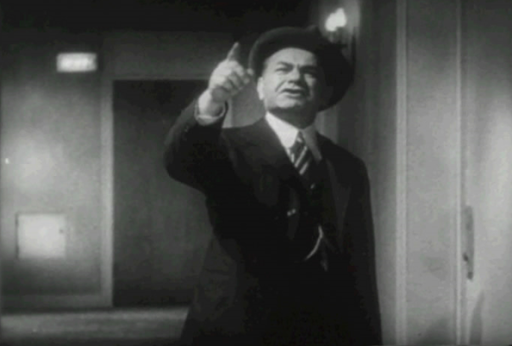
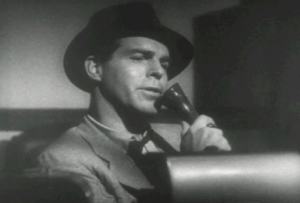
It opens with the beginnings of Rozsa’s score reverberating in our ears and it very rarely lets up. A car blazes wildly down the street and winds up in front of an insurance agency. Out stumbles our protagonist Walter Neff (Fred MacMurray) and for the rest of the film, he relates the recent happenings over the Dictaphone of his colleague Barton Keyes (Edward G. Robinson). It goes something like this:

During his first visit to the home of a Mr. Dietrichson, he instead has his first encounter with the man’s sensual wife, and his heart goes pitter-patter from then on. His motivation is no longer insurance. Now he just wants the chance to see her more. He gets his chance to advise her on a plan, and it all seems playful enough until she insinuates that she wants to knock off her ol’ hubby. At least that’s how Neff reads it. However, he cannot get her out of his head as he has fallen into her web. There’s no turning back.

They think of everything and Neff has everything figured out to a tee. As he suggests, it’s like having the perfect odds on the roulette wheel, you just need an accomplice to spin and Phyllis is just that person. From then it’s just straight down the line. They corroborate on all the details at local Jerry’s Market, Walter sets up his alibi, and he does the devilish deed as Phyllis stares with cool satisfaction at the road ahead.

They set it all up like an accident as the last touch, because as Neff knows all too well if it looks like Mr. Dietrichson was killed from riding a train the Double Indemnity clause of the insurance will mean double the payoff due to how unlikely the occurrence is.

 Double Indemnity (1944) - UpdatedHis only fear is the inquisitive nose of Keyes and the “little man” inside the claims investigator’s stomach, who warns him of the first sign of anything fishy. He gets close to the truth but not quite there. Neff is too close for him to see it. However, as things begin to heat up Phyllis and Neff must separate.

As Neff tries to console Lola Dietrichson over the death of her father, he quickly finds out what the naive girl has to say about her step-mother. It puts a little light on the subject, and Neff realizes what he’s been taken for. He wants to remedy things while he can, patching Lola up with her boyfriend, and going to confront Phyllis one last time.

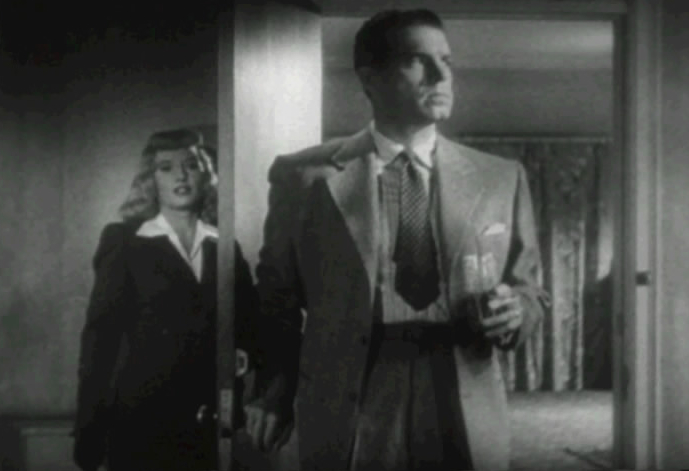
It’s the perfect set-up. Darkened rooms with curtains drawn. Phyllis reclined in an armchair with evil intentions on her mind. In walks Walter and they have it out. Shots are fired, literally. Phyllis will never let up with her ploys until Walter gives her a little help for the final time. I’m sure the Hays Codes loved this one. I certainly did.
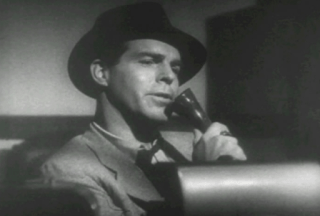
Back in the office Keyes finally overhears the end of Walter’s “confession” as his friend bleeds to death. In one last touching moment, Keyes returns the favor and lights the cigarette like Walter has been obliging to do the entire film.

Walter: “Know why you couldn’t figure this one, Keyes? I’ll tell ya. ‘Cause the guy you were looking for was too close. Right across the desk from ya.”
Keyes: “Closer than that, Walter.”
Walter: “I love you too”

Billy Wilder traded longtime partner Charles Brackett for Raymond Chandler, and despite a rocky partnership, they ended up with one of the greatest scripts, chock full of memorable bits of dialogue. You know you have an impressive cast when Edward G. Robinson is your third lead and each character is playing against type. It’s great casting, in a quintessential American drama solidified by great cinematography and storytelling.

It doesn’t get much better than this and it certainly does not need to. You know Double Indemnity is good when I’ve seen it multiple times and each time the bullets still keep me on the edge of my seat. Thank you, Billy Wilder, for teaching us murder sometimes smells like honeysuckle. That’s absolutely beautiful.

Phyllis: “No, I never loved you, Walter, not you or anybody else. I’m rotten to the heart. I used you just as you said. That’s all you ever meant to me. Until a minute ago, when I couldn’t fire that second shot. I never thought that could happen to me.”
Walter: “Sorry, baby, I’m not buying”
Phyllis: “I’m not asking you to buy. Just hold me close.
Walter: “Good-bye baby.”

5/5 Stars

Cover Girl (1944)

5fff5-covergirlmpRusty Parker (Rita Hayworth) is a chorus girl at Danny McGuire’s place (Gene Kelly), however she has the chance of a lifetime to be the cover girl of a major magazine. She is going places with a rich suitor who wants to hire her and then propose marriage. Rusty neglects her old job and it leaves Danny dejected and angry. He knows that Rusty has a great future in front of her but he cannot stand to break up their team that includes their mutual friend Genius (Phil Silvers). At first Rusty does not understand her true feelings and rashly decides to get married. However, much like her grandmother before her, Rusty realizes in the nick of time how she feels.

This Technicolor film has one or two decent numbers and I was surprised how nimble Phil Silvers is on his toes. He dances well with Kelly and Hayworth. As always Eve Arden is as humorous as ever and Gene Kelly used his artistic control fairly well.

3.5/5 Stars

The Ghost Breakers (1940)

9c09c-the_ghost_breakersYou have two great leads in Bob Hope and Paulette Goddard for this horror comedy film. It is not the best film of either of them by a long shot and it is not much to write home about but if you like the stars you will probably get some laughs out of this one.

It is a dark and stormy night in Manhattan when Mary (Goddard) learns that she is the new owner of a supposedly haunted island. Larry (Hope) on his part is a radio man who is soon on the run from mobsters after a comment he made on air. After a shooting Larry finds himself face to face with Mary and she helps him out of a pickle. Soon she boards her ship heading for her island and he has no choice but to tag along. There everything comes to fruition and the Ghost Breaksers take on the haunts and the dangers of Castillo Maldito. This is a good example of the horror comedies of the 1930s and 40s. Hope was better with Crosby and Goddard was better with Chaplin, but this film certainly has some hilarity.

3.5/5 Stars

Review: It’s a Wonderful Life (1946)

5632c-wonderfullife4Every time I go through the emotional, romantic, heart-warming and at times uncomfortable roller coaster that is It’s a Wonderful Life, something new always seems to stick out to me.

It is always impressive for a film of this length that so much is packed into it. Within minutes we are fully enveloped in this story, and every sequence gives further insight into these characters. There is hardly ever a wasted moment because there is significance in each scene. Pointing us to the nature of George Bailey.

Furthermore, it is easy to forget the darkness that this film submerges itself in because it reaches such a jubilant crescendo. However, this is a story that covers the years including The Great Depression and World War II. Its protagonist sinks into a state of wretchedness complete with angry outbursts, negative feelings, and drunkenness. George Bailey loses all hope and his perspective is so completely distorted. For all intent and purposes, his life looks like it’s over, and it takes a frightening alternate reality to shake him out of his disillusionment. Put in this framework, it makes sense why it was a commercial flop when you juxtapose it with the big winner that year The Best Years of Our Lives. They both deal with post-war reality, but with very different lenses.

That’s the benefit of hindsight and a new context since we do not usually see It’s a Wonderful Life as a gloomy post-war tale, but a more positive parable that is universal in its impact. The first part of this story feels a bit like a Job story of hardship, and the second act is reminiscent to Dickens’ A Christmas Carol, but that’s the simplest of observations. There is a lot more to be parsed through.

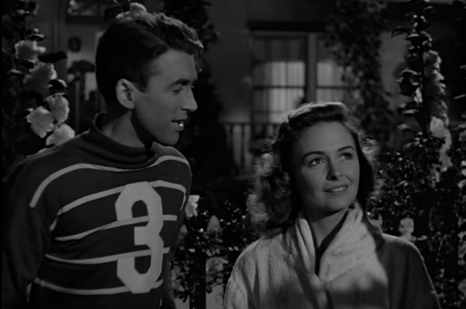
The romance of George and Mary is what many of us aspire to and it causes us to really empathize with their young love that weathers the good and bad breaks they receive. It’s the fairy tale love story we want, with the rock hard reality we are used to in our own lives. Some favorite moments in their life together would be the splash they make during the Charleston dance off, singing Buffalo Gals together, smooching on the telephone together, sharing a makeshift honeymoon together, and embracing after George gets his new perspective on life.

There are a fair number of close-ups utilized in this film, but they are usually used at crucial points in the narrative, and they tell us a great deal about both George and Mary.

The first key moment comes during a freeze frame of grown up George with hands outstretched giving us our first look at the man we will be following from there on out. The next big moment occurs when George learns that Potter will gain control and the Building and Loan will be disbanded if he leaves. He realizes in an instant that he must give up his plans. Then, he waits excitedly for Harry with Uncle Billy and it is a happy moment, but George learns his younger brother might have another job. The camera follows his worried face as he goes to follow his new sister-in-law. Never thinking of himself, he realizes that Harry has a chance for better things and that leaves George still working the Building and Loan.

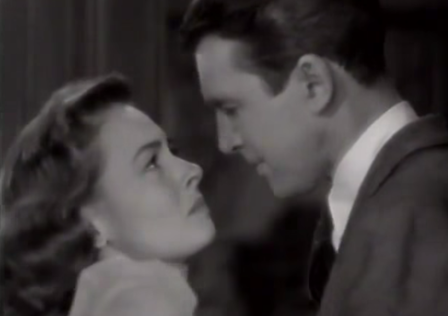
After their tiff, the scene where George and Mary are talking on the phone with Sam Wainwright is a solidifying moment in their relationship. There are so many underlying emotions and unspoken feelings that they are having trouble figuring out and reconciling. And yet there is that violent epiphany when their eyes link. The tears and anger are quickly traded for passionate kisses reflecting the often complicated facts of romance.

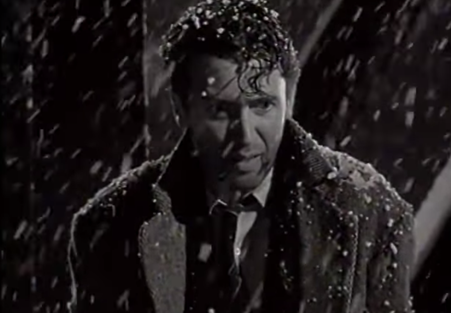
One of the final close-ups that hits home occurs when the now non-existent George stumbles away from the front door of his mother, who now has no concept of him. There is sweat on his brow (maybe from the 90 degree summer heatwave) and desperate bewilderment in his eyes. This is the lowest point he could have imagined. His own mother does not know who he is. His wife has grown old and lonely in an existence of exile. Stewart’s face is so expressive and earnest suggesting that George knows just how important human companionship is. Humanity was made to be in fellowship with each other. Lack of money means very little in comparison to our friendships and family ties. This is essentially what George finally comprehends and what Clarence reminds him. George understandably lost sight of his wife and his children and his friends. They were a gift not to be taken lightly.

Aside from these close-ups, it is also evident that a great deal of  effort was put into creating this world from the characters and their back stories to the town itself which was constructed on the RKO lot. Everything from the building facades, to stray dogs, and snow make the drama more atmospheric. It’s one of those films that reveals the beauty of using real props inhabited by seemingly real people. That’s why I sometimes am disillusioned by CGI. Although it can allow us to create amazing spectacles, oftentimes it creates a world that feels altogether fake and alien. It’s not relatable and it lacks the humanity that makes up our existence each and every day. In other words, it has very little of what makes It’s a Wonderful Life so compelling to me.

Perhaps there are more impressive or greater films, but there are few with greater heart and there is something to be said for that.

5/5 Stars

Review: Miracle of 34th Street (1947)

703c5-miracleon34thChristmas movies do not get much better than this. What a concept! Here’s a film about a man who really is Kris Kringle aka Santa Claus. He gets picked up by Macy’s department store to be their Santa Claus, and he winds up facing a hearing to decide whether he is legitimate or not. His pet project is to make an unsentimental little girl (Natalie Wood), and her practical mother (Maureen O’Hara) believe in him. He finds an ally in a young lawyer (John Payne) who believes in his holiday cheer and is also smitten with the girl’s mother.

Some people would undoubtedly say it’s a bunch a hogwash to make a movie about such a topic. Maybe it is only holiday tripe, but I find it is very hard to refute this “Miracle” of a Christmas classic. The characters portrayed are so spot on and heartfelt it is so easy to get pulled into their story. At the same time, it’s difficult not to like a film where department stores help each other, the hustle and bustle is toned down, and for once mankind has faith in each other for awhile.

As an audience, we gravitate towards Edmund Gwen because he represents the Santa we all wish to know. He is kind, thoughtful, generous, and above all a magical gift giver. Maureen O’Hara goes through a character progression that mirrors that of her daughter, except it is perhaps a little more poignant in her case due to her maturity. It would seemingly be easy to dislike her and yet thanks to O’Hara we cannot help but feel for her. She is also extremely beautiful, even in black and white. Although young, Wood proves to be a memorable little girl in this one, and she was just getting started. Payne is a good addition in his own right — a highly underrated actor.

The film is rounded out by a wonderful array of characters in the Macy’s store like magnate R.H. Macy (Harry Atrim), well-meaning Mr. Shellhammer (Philip Tonge) and friendly young janitor Alfred (Alvin Greeman). Shoppers such as the one and only Thelma Ritter in an early role, and civil servants like Judge Harper  (Gene Lockhart) round out New York’s population with generally decent people who we can relate to. The one exception is Dr. Sawyer (Porter Hall), the company psychologist, and greatest villain of the film, who is the antithesis of Kris and his Christmas spirit.

My hope is that this one never pales, never loses its cheer, and maintains its timelessness for many Christmases to come. Until the next Macy’s Thanksgiving parade comes along have yourself a merry little Christmas and remember all psychologists are not evil jerks looking to ruin the holidays!

5/5 Stars