The Great Dictator (1940)

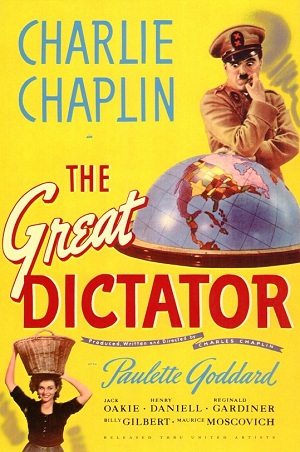
ac211-the_great_dictatorStarring Charlie Chaplin with Paulette Goddard, this satire blatantly critiques Hitler and the Nazis. The film opens during WWI where a little solider (Chaplin) saves an important military man. However, as a result he lands in a hospital with amnesia. All the while the power hungry dictator of Tomania, Adenoid Hynkel (also Chaplin) is on the rise. The man with amnesia returns to his barber shop in the Jewish ghetto and there he catches the eye of a beautiful girl Hannah. However, as Jews they are not safe, and even when things start improving, quickly Hynkel puts down his iron fist. The barber and another dissident are imprisoned, Hannah is in trouble, and Hynkel is ironing out his differences with Benzino Napaloni. However, after a gutsy escape, the barber poses as Hynkel and makes an impassioned plea to the people.

I see this film as a drama full of pathos. It is important to realize that is is not trying to make light of the situation but it is in fact condemning what Hitler was doing at the time. I think that is part of the brilliance and universality of Chaplin’s films. He could balance drama and comedy so aptly, making it possible for him to tackle this controversial topic head on. Furthermore, even though this was his first true talkie he still kept one foot in the silent age in his portrayal of the barber (very similar to the Tramp), and yet he also acknowledged the very present danger of Hitler. This film has some wonderful moments, but I think the two that really stick out are the opening speech by Hynkel which blatantly derides Hitler’s mannerisms and rhetoric. Then, in a complete 360, Chaplin gives his powerful speech aimed to rally mankind. Overall, it is a stellar duel performance from Chaplin and Goddard is as radiant as ever. That mustache certainly did not hurt the film either!

5/5 Stars

Lifeboat (1944) – Alfred Hitchcock

Directed by Alfred Hitchcock and starring Tallulah Bankhead, the film follows the passengers of a liner who escape in a lifeboat after the ship is sunk. Together they try and survive in order to make it back to civilization. Along the way they must make many difficult decisions. This includes saving the life of a German who sank their boat as well as amputating a man’s leg. Through it all there is ongoing conflict among the people who would normally be genial. However, their circumstances are by no means ordinary. By the end they are so desperate and crazed they seemingly turn against some and fall in love with others. This technical challenge of such a small setting did not disable Hitchcock’s storytelling ability. Written by John Steinbeck, the film’s story is an interesting view of humanity during World War II. This movie also includes Hitchcock’s most ingenious cameo of any of his films.

4/5 Stars

Shadow of a Doubt (1943) – Alfred Hitchcock

08054-original_movie_poster_for_the_film_shadow_of_a_doubtIn one of Hitchcock’s earlier American films starring Joseph Cotten and Teresa Wright, Uncle Charlie comes to visit his niece namesake “Charlie” and the rest of the family. Initially the whole family seems to be in a funk until they find Charlie (Cotten) is coming to visit them in Santa Rosa. However, what they do not know is that he is a wanted murderer. Over time “Charlie” (Wright) becomes suspicious of her uncle and finally comes across the truth. Her uncle figures out what she knows and decides he must get rid of her. Living in constant peril, “Charlie” finally is forced to face him. In the ensuing struggle she fights madly for her life. With the constant discomfort and suspense, Hitchcock proves how powerful thrillers can be even in the home. Cotten and Wright both do a very good job in this film. Supposedly this was Hitchcock’s favorite among his own films. I think it certainly one of the best of his lesser known movies.

5/5 Stars

Rebecca (1940) – Alfred Hitchcock

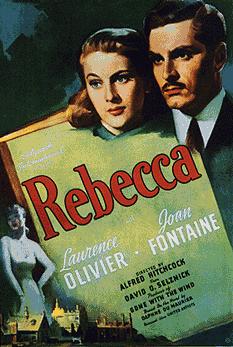
This film directed by Alfred Hitchcock and starring Laurence Olivier with Joan Fontaine, was adapted from the Daphne du Maurier novel of the same name. The story begins in Monte Carlo where Max De Winter (Olivier) and a young woman (Fontaine) have a chance meeting as she is working for an older lady. Soon she learns that his previous wife died the year before. Fairly soon the two of them are attracted to each other and Max has plans of marriage and returning to his Manderley. However, back home the fairy tale is over and the new Mrs. De Winter is constantly tormented by the housekeeper Mrs. Danvers. Pretty soon Max himself seems to have changed. Confused Mrs. De Winter must learn what happened to Rebecca, the lady who was so enchanting. When she actually finds out the truth it is almost too much to bear. Like many Hitchcock films this one is certainly worth watching and it was actually his first American film. Olivier, Fontaine, George Sanders, and Judith Anderson all have very good performances.

4.5/5 Stars

Foreign Correspondent (1940) – Alfred Hitchcock

Directed by Alfred Hitchcock, this film stars a cast including Joel McCrea, Laraine Day, Herbert Marshall, and George Sanders. Wanting a good scoop about events in Europe a newspaper editor sends a reporter off to dig something up. Joel McCrea’s character finds himself entangled in a complicated kidnapping scheme and assassination. On top of that he falls in love while on the job. With no one believing him at first, he must try and gather the facts that ultimately might lead to a war. Dodging two attempts on his own life, he knows he is getting close. However, little does he know how near he actually is. After more twists and turns McCrea finally gets his story and the girl but at a cost. From the scenes in the windmill until the tense moments on the plane, this movie does much to intrigue. It serves a double purpose, a decent piece of propaganda and a good thriller.

4/5 Stars

Kind Hearts and Coronets (1949)

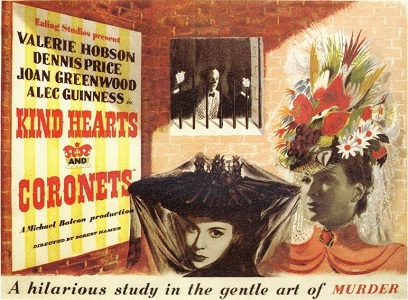
d4c15-kind_hearts_and_coronetsStarring Dennis Price and Alec Guinness (in eight roles), this black comedy follows a commoner who tries to avenge his mother by killing eight relatives. The story begins with a man about to be hung and as he waits, he writes his memoir. Through a flashback, his childhood and adult life is shown. He worked tirelessly to move up in society and he also did away with everyone standing between him and the Dukedom (all played by Guinness). Things get complicated when he is about to marry a deceased victim’s wife and then a childhood beau tries to blackmail him. Ironically, the one murder he did not mean to commit is the one for which he gets caught. Yet there is still hope, or is there? Price plays the young and clever English gentleman very well and needless to say Guinness is extremely funny. Also, the two female characters are different but both good in their own right.

5/5 Stars

Great Expectations (1946)

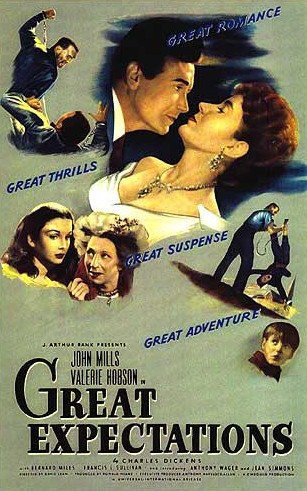
ad366-great_expectationsWith director David Lean, and starring John Mills as Pip, the film begins with Pip as a young boy. Upon meeting a fugitive, Pip show him kindness and the man promises he will return the favor. A year or so later Pip begins to go to the home of an eccentric, rich widow to call on her. There he meets the lady’s adopted daughter Estelle and he falls for her. Now an adult, Pip learns he has a mysterious beneficiary who is paying for him to move to London to be a Gentleman. There he interacts with Mr. Wemmick, the attorney of Mr. Jaggers, and also Herbert Pocket (Alec Guinness). Then, someone shows up on his doorstep and changes his world. Soon he is orchestrating an escape for his friend, saying goodbye to the cold Estelle, and showing his displeasure for the elderly Ms. Havisham. However, in the end he learns a happy truth and reunites with Estelle. This moody, Dickens adaption actually has an optimistic side which is a nice change.

5/5 Stars

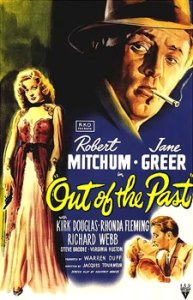
Out of the Past (1947) – Film-Noir

13659-outofthepastStarring Robert Mitchum, Jane Greer, and Kirk Douglas, this classic has every element of a good film noir.   Jeff Bailey (Mitchum) makes his living in a small town working at a gas station. He has an honest living and a girl. However, soon his past catches up with him when a man from his former life comes to see him, and he must explain it all to his innocent girlfriend.

Once he was a private investigator, who got mixed up with a powerful man named Whit (Douglas). He wanted some money found, but most importantly he wanted a deadly girl brought back to him. Pretty soon Jeff’s searching leads him down to Mexico. He has a chance meeting with the beautiful woman (Greer), and he understands why Whit wanted her back.

However, Kathie is not eager to go back, and they are attracted to each other. She and Jeff agree to run off together to San Francisco — away from the searching of Whit. They are nearly found out, but they get away. San Francisco is not a nice place, but they make do, until the day where Jeff is spotted by his old partner. He must split up with Kathie and they set a rendezvous. Only there is a hitch in the plan that Jeff did not foresee. He tries to deal with it in his own way, but Kathie takes more drastic measures. She left him there and went out of his life, or so Jeff thought. He had tried to forget his past dealings, and yet they creep back into his life. With a murder pinned on him, Bailey can do nothing but go along with Whit and Kathie. Soon he becomes embroiled in more treachery and backstabbing, which all has to do with the manipulative femme fatale.

With one last entreaty, she urges him to flee with her since they both have dark pasts. In the end, Kathie’s fanciful plan to escape is foiled by Bailey and it soon turns fatal. One last time she tried to control the situation, but this final time Jeff, or at least fate, got the best of her. After his violent death, Jeff’s girl wishes to know once and for all if he was running off with Kathie. A mute boy (Dickie Moore), who knew Jeff well lies so that the girl can continue her life. Because in Jeff’s case the past came back to haunt him. The kid goes back to the station, but not before looking up at Bailey’s name on the sign, because he did what Jeff would have wanted.

With its dialogue, extended flashback, voice over, and femme fatales played by Jane Greer and Rhonda Fleming, there are not many noir experiences better than this one. Obviously, the chiaroscuro cinematography is a major aspect of this film. Except for the shots in Bridgeport, it seems like every scene is veiled in shadow whether it takes place in Acapulco or San Fran, at day, night, inside, or out. Shadows are perpetual and they seem to reflect not only these characters but also the story. They are not easy to figure and none of them can ever be fully trusted.

Mitchum is perfect in the role of Jeff Bailey, thanks to his demeanor, his fitting voice, and the constant attire of a trench coat and fedora, with a cigarette clenched in his teeth. He is a man who looks like a saint compared to his acquaintances, and yet he is a man who can show a complex set of traits ranging from avarice, cruelty, love, and sometimes heroism. Kirk Douglas is great in his role as the crooked Whit, who acts the nice guy only to be cruel at heart. Every character from the henchman Joe, to the mute boy, the accomplice Meta  Carson, and even the loyal taxi driver are all memorable in the scenes they show up in. Jane Greer stands out, however, because she is one of the most notorious femme fatales in any noir. I think she toys with the audience as much as she does with Jeff. We find ourselves starting to believe her, then we have our doubts, and then we go on believing her again. It is a fine performance.

5/5 Stars

“She can’t be all bad. No one is.”
“She comes the closest.”
~ Ann and Jeff talking about Kathie

The Palm Beach Story (1942)

06b18-the_palm_beach_story_postrStarring Claudette Colbert and Joel McCrea with direction by Preston Sturges, the film opens with the chaotic marriage of a couple. As the story progresses we learn they are essentially broke because the husband is a lowly architect and his wife cannot do much anything. She resolves to divorce him so that he will not have to support her. She makes her way to Palm Beach by train, using her feminine charm on many men. One such millionaire is especially smitten with her. Despite his awkwardness, she continues the relationship as she wants to send money to her husband so his airport can be built. However, things get complicated when her husband comes for her and the millionaire’s chatterbox sister comes to visit as well. In order to save face Colbert’s character introduces him as her brother. Now her husband is being pursued by another woman and she is close to being proposed to. Finally, she explains what is going on leaving the brother and sister disappointed. However, there is still hope thanks to a hilarious coincidence. The film ends with there beautiful simultaneous wedding ceremonies. Preston Sturges definitely has a knack for the quirky dialogue and situations. I have to say I personally enjoyed the Lady Eve and Sullivan’s Travels more but this film was certainly all over the place.
 
4/5 Stars

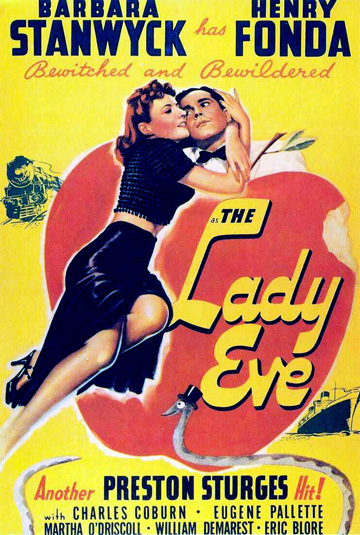
The Lady Eve (1941)

Starring Henry Fonda and Barbara Stanwyck with director Preston Sturges, this screwball comedy is a good one. The supporting cast is rounded out wonderfully by Charles Coburn, Eugene Pallete, and William Demarest. The story begins on a big ocean liner where a beautiful young woman (Stanwyck) tries to pull a con on a naive, rich bachelor (Fonda). Slowly however they begin to fall in love and they plan to get married. He catches wind of her notoriety and becomes cold and that ends their relationship. In an act of revenge she poses as someone’s niece, a Lady Eve, so that she can be close to him. Through a series of events he thinks she is a different person who looks similar and over time they decide to get married. When Eve tells him about all her boyfriends he feels he has made a mistake. Back on the ship he is ecstatic to see the first girl and they embrace. Fonda’s character feels guilty because he is already married but then again she is too…to him. This film has a great combination of wit and slapstick which makes it an enjoyable classic.

4.5/5 Stars