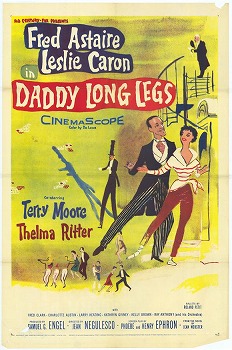
Daddy Long Legs (1955)

The movie opens with a snooty art docent bloviating to a rapt audience about the various paintings within the Pendleton family collection from Renoir to Whistler. The joke is that the latest member of the family, Jervis Pendleton III, has gone a bit off the rails. It’s reflected in his portrait and by the fact he bangs away on his drums in the next room over like the eccentric, happy-go-luck magnate that he is.

The action quickly gets transposed from New York to France. The reason doesn’t matter much. However, the aforementioned Mr. Jervis happens to wander onto the premises of a local orphanage in search of a telephone. Instead, he discovers a young woman named Julie Andre (Leslie Caron) from a respectable distance.

He notices the rapport she has with the kids in her care and learns she, too, is an orphan without family or prospects. Right on the spot, he feels moved to do something. He gets back to his grousing second-in-command, Griggs — the man managing his assets — and vows to sponsor her (since adoption is out of the question).

If it’s not apparent already, it’s a fluffy little fairy tale, a bit too thick in the middle, but soon enough Leslie Caron finds herself off to America! Our French Cinderella travels to New York to begin university thanks to her mysterious benefactor.

Daddy Long Legs becomes a kind of collegiate musical having more in common with the worlds of Good News or Take Care of My Little Girl than it does An American in Paris (or even the cross-cultural Silk Stockings), though she is a Frenchwoman in America if you will. It’s a not-so-subtle twist on the formula as Caron receives her room, two new roommates (including a perky Terry Moore), and some light hazing from the upperclassmen. Two trunks also arrive at her doorstep, laden with the most exquisite of clothes.

Fred Astaire disappears for a while, and it becomes Caron’s movie by design. Her absent sponsor forgets about her, running off to do who knows what, as is his nature. He’s a creature of caprice. She’s left melancholy and teary-eyed as she writes to her pen pal, “Daddy Long Legs,” who never writes her back.

That doesn’t mean no one’s reading her heartfelt messages. Namely, the company secretary played by the pitch-perfect Thelma Ritter (one could watch her all day). She’s a closet romantic who grows misty with each subsequent letter added to the growing dossier. In her eyes, this is cruel and unusual punishment; someone needs to respond to the girl! She has a point.

Fred Clark plays his curmudgeonly corporate sui,t who has no time for sentiments. He has enough grief keeping the boss’s affairs in order while he’s off gallivanting around.

One of the first standout musical numbers has Caron conjuring up her dream benefactor. The movie quite vividly brings her dreams to life about who he might be, from a Stetson-wearing moneybags to a suave playboy in a top hat and tails, and finally a guardian angel. This last incarnation is one of the most enchanting, bringing our two stars together in a bit of a fantasy where Astaire effectively guides her steps like an angelic shadow, though they very rarely touch.

Eventually, Astaire does respawn in the flesh, and being such a good-natured fellow, he decides to pay a visit to his college girl under a pretense. You see, his niece (Terry Moore) conveniently is Julie’s roommate, so he goes down to the school with his sister-in-law while actually wanting to catch a glimpse of his orphan, who has come into her own with campus life.

It’s no small effort to try and disregard the universe where Astaire going to a college dance is not cringey, especially when there’s a comment made about his leering at co-eds and how very young they are. Perhaps Daddy Long Legs is more self-aware of the disparity between its stars than most of its contemporaries.

It gets a bit more tolerable with Astaire hamming it up on the dance floor with a full dance card, all while feigning ignorance (he only knows the box step). And of course, all the students want to be hospitable to Linda’s elderly uncle.

When it’s their turn, Caron and Astaire set up court near the statue of his dear grandfather, and she divulges to him about her relationship with “Daddy Long Legs.” The movie tried to kickstart its own dance craze, the “Slewfoot,” and I gather it didn’t catch on. Although watching Astaire and Caron do anything together feels spectacular in itself. It need not be more.

Astaire is also still a stellar interpreter of song. Here it takes the form of “Something’s Gotta Give,” but it also foregrounds the uncomfortable undercurrents of this relationship inching toward romance. It doesn’t help when Jervis’s indignant friend (Larry Keating), eavesdropping next door, makes an unflattering comparison between him and King David of biblical times, even if it is only a misunderstanding.

Thus, it’s easiest to talk about the film on the plane of performance and the brand of physicality where romance is implied on the dance floor. Though he does sneak a quick kiss, Astaire was always best in this kind of Classical Hollywood’s coded distillation of passion, most memorably achieved with Ginger Rogers. There’s an elegance to the metaphor and two people being connected and knowing one another through dance.

Astaire and Caron match each other step to step and grace for grace. The way they move down to their hands and the tilt of their heads each represent the complete epitome and essence of elegance. It’s like there’s a giant tractor beam drawing us in.

The final opportunity for Caron to do some ballet would feel like a missed opportunity otherwise, but the ensuing Hong Kong Cafe segment feels a bit queasy, like she’s cast as her own diminutive version of a sensual Cyd Charisse, and it doesn’t fit with Caron’s image, especially for such a young woman.

But despite whatever misgivings the plot might engender, Leslie Caron and Fred Astaire are able to transcend these pitfalls with bits of movie magic. What’s more, at such a precocious age, Caron had the distinction of dancing opposite the two greatest movie dancers of all time (There are six women in the coveted club). And she is hardly an ancillary addition. This must be stated outright.

The partnership only works if both parties are up to it. With her rigorous training as a ballerina, she more than holds her own and blesses the audience in the process.

In fact, although Fred would continue to be visible in That’s Entertainment extravaganzas and TV specials with Barrie Chase, he was in the twilight years of his film career. Although she ascended early, Caron still had much further to go; she was just beginning as a star.

3.5/5 Stars

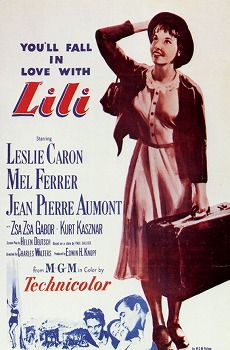
Lili (1953)

“She’s like a little bell who gives off a pure sound.”

Leslie Caron always cast an image of a sweet young gamine presaging Audrey Hepburn, and thus, early in her career, it’s a masterstroke to cast her in the role of a destitute orphan with nowhere to go.

Set in provincial Hollywood — somewhere vague and still distinctly French, Lili (Caron) shows up in a small town with an address and a name. Her father is dead, she has no relatives, and the acquaintance she meant to inquire about has since moved away. She has no leads, no food, no shelter.

A shopkeeper next door hears her sad story and is prepared to take advantage of her. She flees his abode and follows a troupe of performers like a little lost puppy. They feel sorry for her, and so they try and do her a favor.

Their world is a cornucopia of colors. The story itself is a trifle. Magician Marc is such a charismatic fellow. Lili is quickly devoted to him and taken by his lifestyle, mesmerizing people with his illusions. She, too, falls under his spell, smitten with her first crush. She’s so taken in fact she quickly gets fired from a temp job as a waitress. She was too invested in the floor show to keep up with her work.

While Ferrer is the biggest name, he somehow flies under the radar until we become aware he’s in love with this girl. He cuts a gaunt figure, mostly agitated and repressed as he nurses his wounds and bruised ego since he can no longer dance after being maimed in the war. He masks his feelings by treating Lili gruffly and pushing her away.

However, because he and his compatriot are puppeteers, Ferrer uses his alter ego to form a bond with her. There’s a fine line here for them to walk, and somehow it comes off because of Caron’s clear-eyed belief. Each interaction feels real and genuine. I liken it to the authenticity I always felt in the human-to-puppet interactions in childhood episodes of Mr. Rogers’ Neighborhood of Make-Believe. There’s no condescension, and everything seems to be taken with true sincerity.

Lili expands on their performance because she imbues the puppets with meaning and attributes personality to them just with her gaze and a total commitment to their words. She believes they are real, and it becomes one of the enchanted conceits of the movie.

Otherwise, it would fall apart and feel disingenuous. Within the story itself, her interplay draws in an audience and helps their little trio grow a following. She, in turn, is given a stake in their profits and a small place to stay. For the time being, she has a home.

The meta conversations with the puppets become more pointed when they ask her, under the veil of performance, what she wants in life and how she feels about her love potentially leaving her. What’s special about her is that there is no compartmentalizing of fantasy and reality; she keeps them both together so they remain one and the same. The curtain between Lili and Paul makes it all the more intriguing. Because there is some kind of shroud mediating them.

Although Audrey Hepburn has already been mentioned, there is also a shared affinity between Lili’s performance on the green and the Punch and Judy Show in Charade. It might feel like reaching, but because of the connection between Hepburn and Mel Ferrer, it’s difficult not to intertwine them in my mind.

A turning point in Lili’s maturity is not so much one of passion or romance, but recognizing there is cruelty in the world, and it is something to buttress yourself against. We see Marc in a different light. He’s a married man and free spirit who plays up his bachelorhood for the sake of their show and perhaps his own desire to live the life of an uninhibited bon vivant. Fidelity is not one of his highest priorities.

Zsa Zsa Gabor is poised as the blonde “other woman” or rival for Marc’s affections, and yet she is given a more sympathetic position once we realize Marc is actually her husband. She has every right to be protective of him.

It occurs to me, just like how Lili says she was living in a dream like a little girl, this movie is like a fairy tale. As C.S. Lewis pointed out in close conjunction with his friend J.R.R. Tolkien, these tales can be a kind of safe space to explore topics of evil and suffering while eliciting responses like wonder and joy.

When Mel Ferrer pulls back the curtains and makes his pronouncements about his character, a bit of something is lost, but not enough to look down upon the movie. Lili had me charmed, and it doesn’t outstay its welcome. It’s slight and enchanting in a way children can appreciate, and adults so often dismiss. You must come to it with a childlike heart.

It’s possible to be prejudiced against musicals that only have songs. Dance is something that taps into the visual medium in other ways. No pun intended. Caron, of course, made a name for herself as a ballerina, and although her opportunities here are minor, there’s a lithe elegance with which she carries herself that serves her well.

The ending evokes Dorothy on the Yellow Brick Road with all her friends. And yet, for her, as the puppets become living, breathing beings in her dreams, it signals the end of something, not the beginning of the journey.

With each representing some part of Paul, their absence is too much for her to bear. Like all the great musical interludes, it’s almost wordless, but the confluence of movement and melody conjures up all the emotions we require between Caron and Ferrer to make their parting and reunification mean something.

Because of the child-like outlook of the movie, it brings to mind the words written by journalist Francis Church to a young girl named Virginia. He said:

“You may tear apart the baby’s rattle and see what makes the noise inside, but there is a veil covering the unseen world which not the strongest man, nor even the united strength of all the strongest men that ever lived, could tear apart. Only faith, fancy, poetry, love, romance, can push aside that curtain and view and picture the supernal beauty and glory beyond.”

The magic of Lili is how its own veil is torn in two, and still the movie maintains the semblance of a fairy tale. When the divide is breached, it brings more supernal beauty and not less. Again, it’s a lovely paradox wrapped up in an often overshadowed MGM musical. Perhaps this is the eucatastrophe Tolkien talked about.

3.5/5 Stars

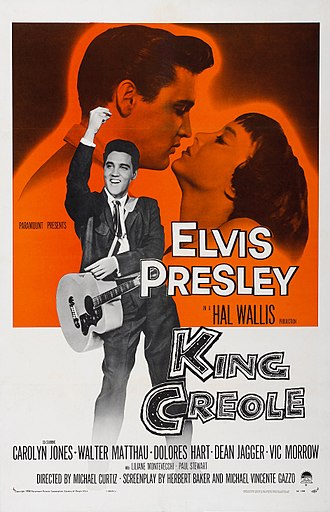
King Creole (1958)

It might be on the nose, but Elvis Presley doing a call and response rendition of “Crawfish” from his balcony with the lady vendor (jazz singer Kitty White) on the street below places us instantly in the movie’s milieu.

We’re in the French Quarter of New Orleans, a place blessed with so much musical culture thanks to the Black community. Like many films of the era, they exist on the periphery underrepresented and unappreciated, but they must be acknowledged.

King Creole came out at an earlier juncture in Elvis’s career. He still has license to be himself, and yet the cult of Elvis doesn’t completely overwhelm director Michael Curtiz’s picture. It’s about “The King” in so many ways, yes, but it still has an identity outside of him as a genuinely absorbing story.

His movie career went down hill when everything was about formula and easy cash grabs relying solely on his personality. King Creole actually has substance and danger because it functions as both a vehicle for him and a genuine showcase for his talents and the talents of the actors around him.

Danny Fisher (Elvis) is a teenager who works bussing tables, morning and night, while he tries to squeeze in high school. It’s a tough schedule to maintain, and he’s already failed one year. But his father (Dean Jagger) is out of work so he feels there’s no recourse but to continue in the dive establishment. Danny’s a good kid dealt a tough hand.

It gets even worse one evening when a couple of drunken thugs induce him to sing for them, and then start pushing around one of their lady friends (Carolyn Jones). He comes to her defense, but he has a target on his back and his new female companion causes a mini scandal (and fistfight) on the last day of school. He flunks out again and that’s the end of his short-lived scholastic career.

I feel compelled to bring up Blackboard Jungle because although they’re set in different places, we’re dealing with the same segment of society: struggling working-class teenagers.

You could easily see Elvis in a version of that film especially because it was one of the instigators of the rock ‘n roll craze in movies. King Creole also depicts  delinquency though not purely in an instructive sense. We feel like we are watching a movie that’s entertainment first without an attached agenda (aside from banking on Elvis’s stardom before he was drafted into the military).

It evokes the aesthetic of gangster movies of old with Bogart and Cagney, which were directed by Curtiz two decades prior. King Creole has a self-contained world. There’s nothing outside these sets and the interiors that make up the movie. And there’s a sweaty claustrophobia to the tenements and cruddy street corners.

The French Quarter positively oozes with atmosphere, but there’s no way to run away because everyone and everything is tied together. It just so happens that Maxie Fields (Walter Matthau) pulls most of the strings.

The money, economy, and the inertia of almost everyone gravitates in and around the big kahuna. It’s just the way he likes it. He calls for Danny since he’s heard about his voice and his tenacity. Also, Ronnie (Jones) is his girl and he’s a jealous, vindictive man. He likes to keep tabs on what’s his.

Danny takes a job singing at the only spot Maxie doesn’t have his hands in — the modest club King Creole — and he becomes a local hit. Meanwhile, he reluctantly falls in with a few ambitious street hoods led by Vic Morrow. They’re vying to join Maxie’s payroll.

It’s the old story of Danny trying to stay out of trouble, and yet he’s constantly drawn in by want of money and further ashamed of his father’s subservient role as a stooge at the local drugstore. He also starts seeing a pretty shop girl (Dolores Hart). Although his intentions seem far from honorable, there’s still something sympathetic and not fully-formed between them.

All the narrative sinews don’t fit together seamlessly, but I appreciate the dynamics with different actors rubbing up against one another like matchsticks. There is a gritty, operatic quality to it. The music elements are a case and point, allowing us to stretch the parameters of reality just a tinge as Elvis entertains his audience both in-camera and beyond the screen.

Carolyn Jones could be a kind of one note Carmen-like Vamp — the other woman pulling Danny into the web, and she does this, but it’s all in spite of her best efforts. She wants him to get away from Maxie and the same hold the gangster has over her own life. Perhaps in the back of her mind is the hope of some freedom and a life beyond for both of them outside of this private hell.

What can I say about Walter Matthau? It amuses me to even make this comparison because I had never thought about it until this film, but Matthau had a trajectory similar to Bogart’s. Based on how I perceive him in hindsight, I always find it funny he started out as a heavy, and over time he became not only a comic hero but a leading man and a love interest. Here he’s everything despicable and abhorrent about local crime.

Dean Jagger could play characters with such bearing and integrity, and yet in a picture like Bad Day at Black Rock or here, he isn’t squeamish about portraying a bona fide weakling. It’s not a showy part, but there is a sense of bravery to it.

Vic Morrow’s still fairly early in his evolution as he moves on from Blackboard Jungle in the next stage of his dashing hoodlum career. It would be easy to typecast him in the role since it fits so seamlessly.

The same might be said of Dolores Hart but for completely different reasons. She embodies the good girl of the movie reminiscent of Eva Marie Saint a few years earlier, representing a reach for something more tender and resolutely decent opposite Brando in On The Waterfront.

Hart’s eyes are always so vibrant even in black & white. I find it fitting when she divulges to Danny about Father Franklin, a man of the cloth she’s known her entire life — someone who’s excited to meet him. And yet Danny’s despondent over his own failings. He cannot bear walking into a church given his current crisis. Nellie represents a level of graciousness to him and of course, Hart famously gave up an ephemeral acting career to become a nun driven by a similar higher calling.

There’s weight to everything Danny does and every mistake comes back to haunt him. His sister (Jan Shepard) strikes up a relationship with the older owner (Paul Stewart) of the King Creole; their relationship also hangs in the balance.

We see Elvis at his most tortured and earnest because he actually gets some material to tear through and try his hand at acting. The part gives him even a small sliver of what Brando had in Waterfront or Dean in Rebel. You can’t put them on the same plane, but then Elvis did what they could never do on the stage with his voice and his pelvis. King Creole is the finest showcase he got to do both in the same film.

The fist fights are pretty epic, and they mean something. Violence is not glorified, but it is an integral and unabashed element of this story. It’s one of the few ways to bring equilibrium to the world.

I’m no pre-germ medical theorist, but a lot of these Classical Hollywood movies seem to function by their own unique humoral theory where you have imbalances of all these different fluid forces at work: the good and the evil, the apathetic and the weak. There’s constant interplay and war between them until finally some kind of stasis is found at the behest of the production code.

The bad is lost and all the abscesses, both corrupt and sullied, are excised until all that’s left in the primordial moral soup is the good. It doesn’t matter how wild the undulations. Finally, our hero is given an existence made up entirely of hope and happiness as everything is brought back into balance.

With the antagonist gone and the promise of a pretty girl’s love, Elvis is able to sing out one final ditty as all the most important people in his life look on with smiles. It’s a classic denouement that doesn’t devalue the seedy sides of humanity. It really is a fine piece of work and it just might be Elvis at his very best. It’s a shame his career took a more insipid trajectory going forward. Because he had so much more to offer beyond a pretty face and peppy music.

3.5/5 Stars

Marty (1955)

To my mind, Marty is the only movie adapted from TV to win an Oscar and certainly to get as much publicity as it did. During the surge of the Golden Age of Television, Paddy Chayefsky was king and Marty became a pinnacle of what could be accomplished by a writer with a singular voice.

It’s a triumph of the small screen brought to the large, breaking down the boundaries and some of the prejudices that come with it thanks to the particular story it chooses to tell.

Marty is easy enough to place. He takes up residence in the territory Chayefsky would canvass in many of his stories including later efforts like The Catered Affair or Middle of The Night. There’s a “write what you know” imperative to his work. If it’s not quite realism — the words are too precise in their cadence and meter — then it certainly makes for unadorned cinema away from the normally watchful eyes of Hollywood.

Marty is a butcher and an unmarried man who lives with his mother. He’s kindly enough cutting up meat as the ladies of the neighborhood chide him that he should be getting married. All his siblings are hitched, and he’s the eldest and still alone.

It’s the earnest simplicity of the story that always appealed to me in the past. But as I grow older Marty speaks to me more and more. Because you begin to see it differently in light of new experiences and the kind of tensions that come with familial relationships and adulthood in general.

As I’ve gotten older and recall periods of singleness in my life and the lives of others, I’m all the more moved by Ernest Borgnine’s performance. He was always relegated to heavies. Like Raymond Burr, the only way to play the hero was on the small screen. Burr got Perry Mason and Borgnine got, well, McHale’s Navy. But before that, there was Marty (1955), and it was an unassuming film that proved to be a stirring success. It’s an underdog story in an industry predicated on prestige, star power, and publicity. Borgnine plays it beautifully.

On a Saturday night, he and his best bud Angie (Joe Mantell) drink beer together perusing the newspaper and quibbling over what they’ll do for the evening like a pair of vultures out of The Jungle Book.

At his mother’s behest, they make their way to the Stardust Ballroom to hopefully meet a couple of “tomatoes.” It feels a bit like a watering hole with dancing and fast music. All the various enclaves stand around looking for mates and finally stirring up the courage to meet someone. It’s a space where everyone gives everyone else the once-over before making a decision.

Social psychologists tell us that certain traits like facial symmetry, height in men, or hip-to-waist ratio in women have been the unconscious cues throughout the history of humankind. We’ve progressed toward swipes and likes and what have you, from the dance hall circuit, but it’s not too dissimilar. Just less personal and more commoditized.

It’s all still founded on the same premise of surface-level attraction. Obviously, there’s something to this. But whatever generation you hail from, it’s still a game of wooing and putting the best version of yourself out there.

Flaws and vulnerability might come but far later down the line when you know someone and can let your guard down. What makes Marty is how this butcher, who feels chewed up and spit out by the world’s mating game, finds someone to connect with on a far less superficial level. It begins with an observation.

He notices someone else’s humiliation and reaches out to her because he knows what it is to be looked down upon and disregarded. And just like that Marty and Clara (Betsy Blair) are brought together into one another’s orbits. They start to share about their livesb and we learn she’s a school teacher who still lives with her parents. Marty gets so comfortable in her presence and starts babbling incessantly — it’s over the top — but it’s also lovable.

Borgnine and Blair are cast so well together, and it’s not because ’50s Hollywood assumed them to be plain. There’s such a sincere candor about them that comes out on the screen, and the movie requires this for their chemistry to work and for the sake of the story. We like them because they feel like us.

Marty admits, “Dogs like us, we’re not really as bad as we think we are.” He’s internalized the language of the culture at-large, but in the presence of a kindred spirit, he feels happy and more like himself, totally at ease in her presence. It makes me think of the advice that you should enjoy talking with your future spouse because contrary to popular belief, that’s probably what you’ll be spending most of your life doing together. Spending mundane moments in one another’s company.

They have a bit of a bubble for themselves of near-delirious happiness; the drama comes from all the outside forces weighing on them. The guys like Angie and that crowd are gruff and crude. They try and set Marty up with other girls and tell him Clara’s not attractive. Meanwhile, their conversations are full of vulgarities involving Mickey Spillane novels and magazine centerfolds.

But this is not the only criticism. Marty also hears from his mother, a deeply devout Catholic and Italian mother who cares about her family and her boys. She does not want to be discarded as an old maid and worries her son’s new, non-Italian girl will cause a rift between them like she’s already seen in their extended family.

It’s almost too much for him. Marty lives under the lie that he must conform and listen to what others speak into his life, and certainly there is some truth in considering the counsel of those around you.

However, sometimes it can also be pernicious and he realizes amid this sea of tedium and insecurity being projected onto him, he has something worth pursuing. Why would he ever consider giving that up? And so he gives up everything miserable, lonely, and stupid in pursuit of a priceless gift. In his relationship with Clara, Marty is a richer man than most.

4/5 Stars

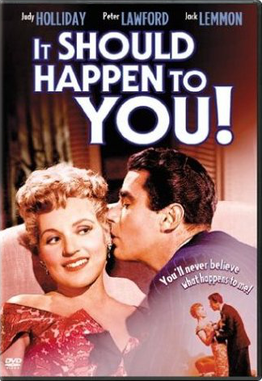
It Should Happen to You (1954)

It Should Happen to You was the brainchild of screenwriter Garson Kanin and director George Cukor with Judy Holliday as their lead. As such it’s easy to cast the movie in the same lineage of Adam’s Rib (1949) and Born Yesterday (1950). Except in this movie, there’s also a featured newcomer, a young man named Jack Lemmon.

The movie opens as any respectable New York movie does in Central Park. In the outdoor reverie of men at their chess boards and kids running around, Gladys Glover causes a hullabaloo for feeding pigeons. One man takes particular umbrage at having her try to pick him up while he was minding his own business, listening to the horse races.

In the aftermath, she meets a documentarian, Pete Sheppard (Lemmon), who has his camera at the ready and an eye for people (Think a precursor to Humans of New York). He’s fascinated by this barefoot woman, and strikes up a conversation before they go their separate ways.

There’s an ethereal, fated tone I can’t quite put my finger on, but we know they will meet again and something is bound to happen. Judy Holliday perfectly exemplifies this airy bubbliness. I would never condescend to exhibit her as a dumb blonde archetype because there is far more going on here.

Gladys Glover sees an open billboard and resolves to buy up the prominent real estate on Columbus Circle. For what purpose we can’t be sure exactly. She says its personal. But she goes through the paces, speaks to the proprietor, and forks out the money that’s normally attributed to marketing corporations, not individual citizens.

Soon the words GLADYS GLOVER appear up on a street corner in lettering that looks like high rises. It’s an extravagant decision and Gladys beams with pride seeing her name like it’s never been before. But that’s not the end of it.

The rest of the movie is about the cascading effects it has since movies are meant to feed off delights of serendipity. It Should Happen to You is that kind of movie.

Peter Lawford plays a disgruntled marketing exec miffed to find out someone else has shouldered in on the billboard that has always been theirs in the past; it was an unspoken agreement between them. When he finds out about Gladys he wants to strike a deal with her. Surely a lady can be bought.

It must be said an angry Jack Lemmon is not always becoming and after moving in down the hall from Gladys, he seems to think more and more that he owns her. A more charitable reading of it is that he’s the only person who actually cares for her well-being beyond her growing reputation as a minor celebrity; he’s also falling in love.

Meanwhile Gladys strikes up an agreement to get her name put up on signage all over the city. When she’s shopping with Pete, a saleswoman helps them only for her demeanor to change instantly when she realizes who she’s helping. It’s like being queen for a day as a crowd forms around Gladys soliciting autographs from the local phenomenon.

She has effectively given them something — a nice souvenir to take with them in their day — and in this way it’s hard not to compare her to Elwood P. Dowd of Harvey. In the movie world they’re able to break into the everyday and give people some common decency and kindness.

However, we also watch from a distance as Gladys gets carried away by the mechanisms and machinery of television. She’s paraded out in front of America without much consideration of who she is as a human being. In one segment she’s even featured on a prim and proper panel show with the likes of Constance Bennett and Wendy Barrie. It feels twee by today’s standards, but the point is made.

Soon she finds herself caught between the indignant protectiveness of Lemmon and the business conferences of Peter Lawford including some extracurricular activities. His company has transformed the typical ethos marketing appeal into the Gladys Glover everywoman appeal for the average American girl. It’s a smashing success.

It Should Happen to You doesn’t feel like a groundbreaking story and part of this might be the fact we’ve seen so many analogous film’s in its wake. There’s this tension between celebrity and success and the kind of down-to-earth humanity that keeps one grounded.

I must say I was taken with the ending where Lemmon says goodbye to his girl using a film, and yet again it presages many of the meta qualities of a film within a film that have enamored writers and directors for decades.

In this particular instance, it’s in service of a romance. The happy ending is that he actually receives a reply. Gladys writes it in the sky for him with letters as big as her billboard. She hasn’t lost her knack for the spectacular, but she simultaneously recognizes someone who has her best interest in mind.

If you said you were going to make a romantic comedy with Judy Holliday and Jack Lemmon, it wouldn’t immediately strike me. Still, if you have two likable performers and put them together, the results speak for themselves, even if the returns are mostly modest.

3.5/5 Stars

Bitter Victory (1957)

“He and you and I will become a part of history — of its futility” – Richard Burton as Jim Leith

Bitter Victory is a curious confluence of talents and material. Nicholas Ray was earmarked to helm this British war movie with French-American backing. Aside from the primary leads, the rest of the cast was purportedly decided by lottery.

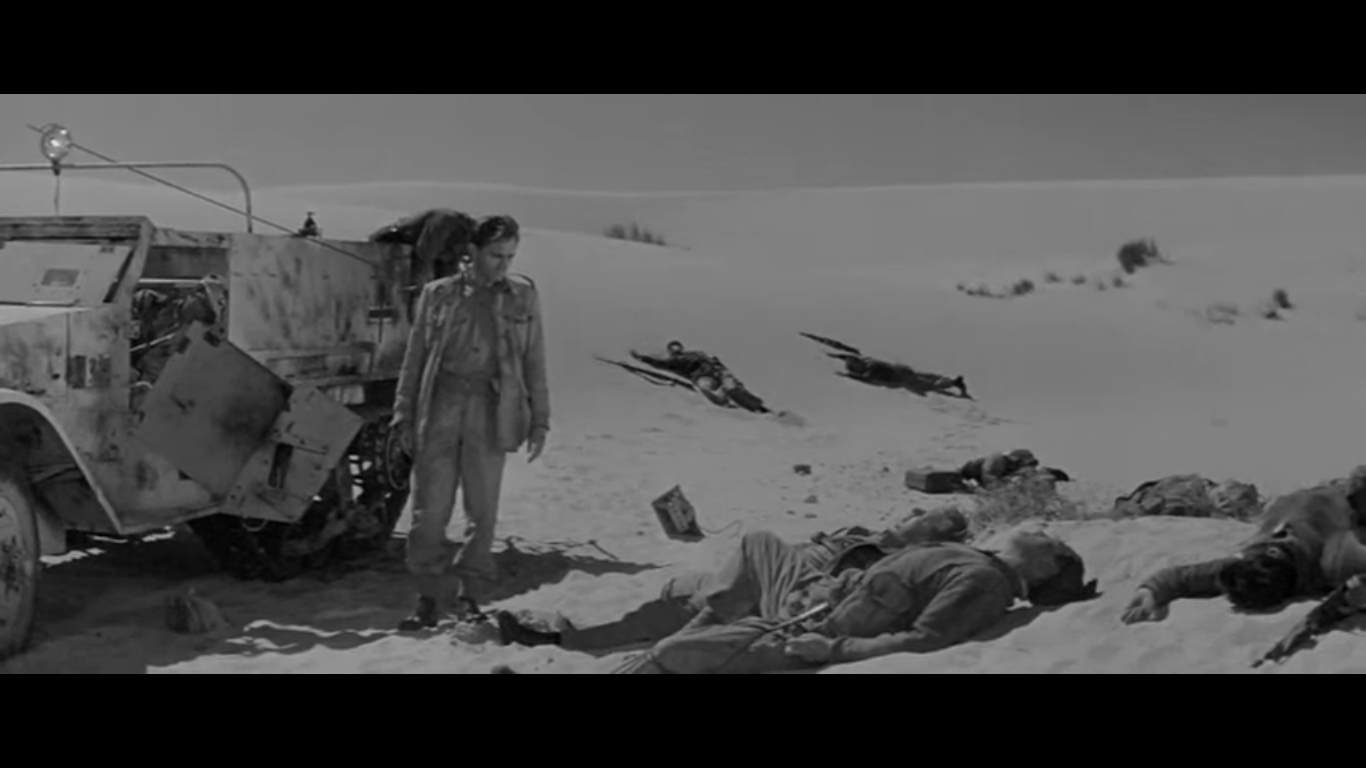
The film’s aesthetic is somehow impeccably represented by the wide array of combat dummies shot in black in white accentuating the muted tones of a rational military drama. It’s instigated by a secret mission behind enemy lines in Benghazi. This is North Africa during WWII.

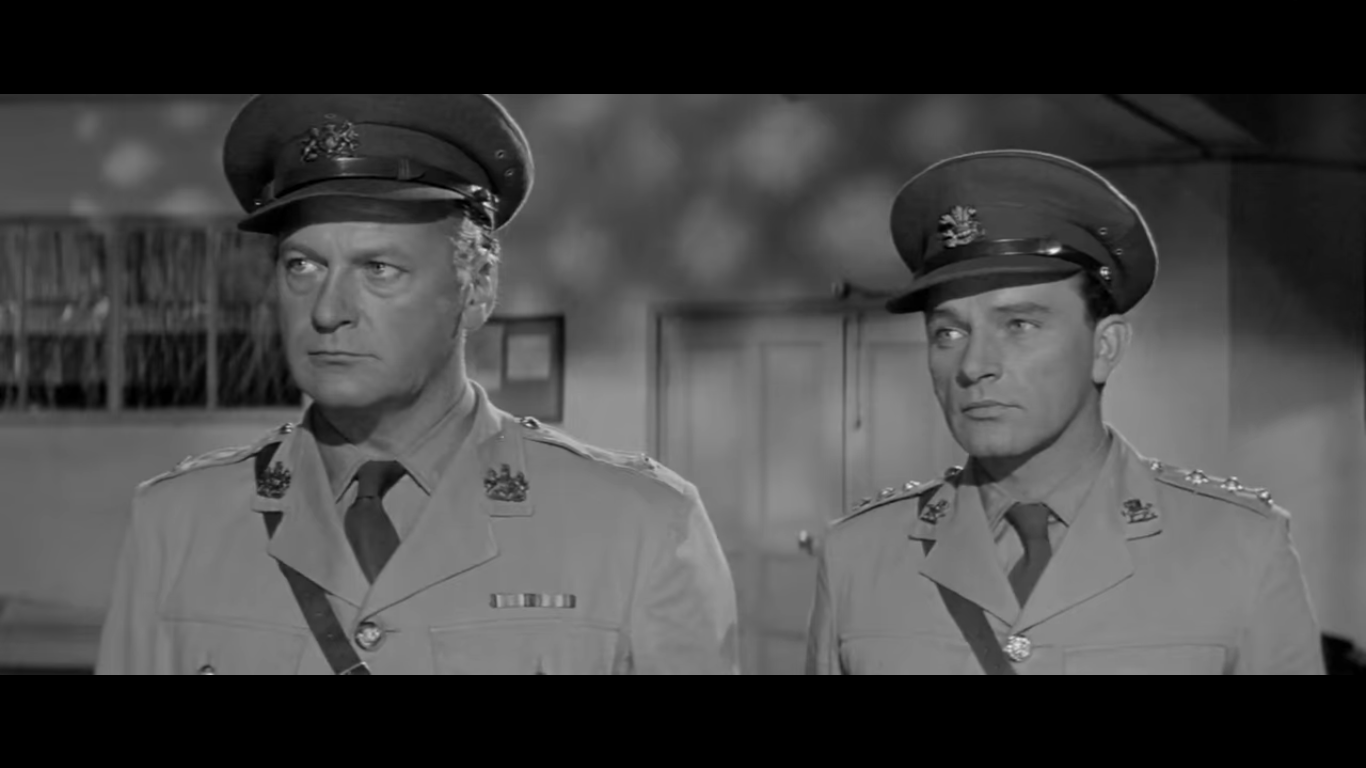
There are two men being considered to lead the excursion: A curt, lifelong soldier Major Brand (Curd Jurgens). He’s by the book and adamant no one see his weakness. Then, a young, handsome fellow named Captain Leigh (Richard Burton) with a certain no-nonsense perspicuity and a background in ancient artifacts, not the mechanisms of war. He’s volunteered to serve his country. Whatever that means.

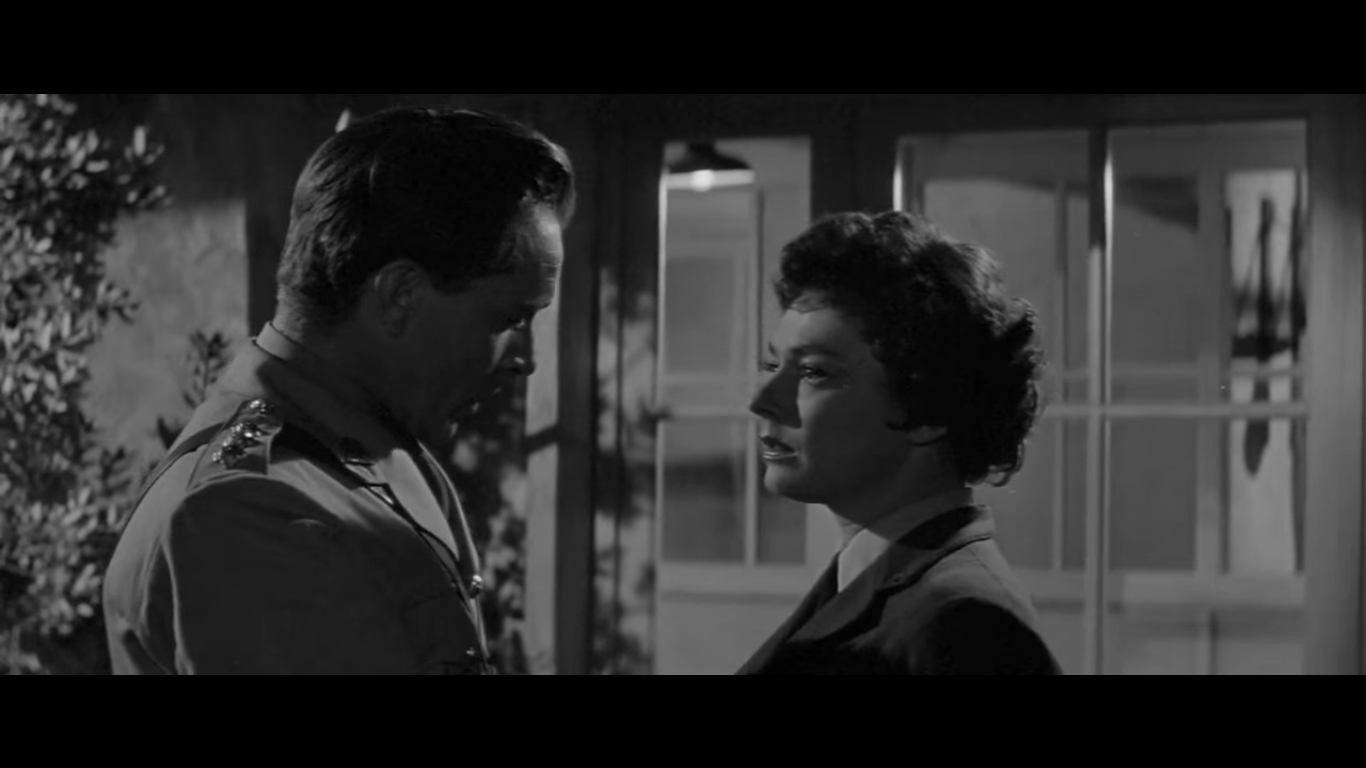
There are some pleasantries, and they take off to the club for the enlisted, a momentary calm before the work at hand. Thrown into the narrative as we are, it becomes apparent these are characters with some kind of overlapping history in a broad sense, and we become aware of their subtext involving a woman (Ruth Roman).

At first, it isn’t so engaging. The soldier with the sound effects and pyrotechnics at the bar seems to do more with his inebriated histrionics than them. Still, Ray ends the mounting sequence with a kiss in a carriage. Except before we see it in full, the carriage whisks away in this brilliant bit of kinetic energy playing out on the screen.

Roman is more mature and less delicate than we’ve ever seen her, partially thanks to the military garb but also due to the men she’s kept in her life. They’ve toughened her even as they grapple with romance.

It’s hardly a movie of jingoism as Burton represents a kind of jaundiced pessimism that would be his closest companion in The Spy Who Came in From The Cold as well. He’s hardly an adherent to wartime hero worship. And if Jurgens is beholden to the strictures of military protocol, he certainly doesn’t allow them to make him a joyful spirit. He’s constantly living life dictated by honor, fear, and his own inadequacies in command.

But we must remember there is a task at hand. They gather their company of recruits. Their plans are relayed through a model in a control room and curiously everyone seems to laugh off what might happen if their transportation a la humpback camel doesn’t make it to their rendezvous.

Soon they’ve become robed infiltrators cloaked by night loitering around the streets under Nazi occupation. Murder in the dark is silent though no less traumatic when it comes, even when it involves taking the life of an enemy in the line of duty.

These mission scenes have a clean and efficient luster, hardly dawdling when it comes to the action and as they disappear into the night and fight a skirmish over the sand dunes, it’s another perfect encapsulation of their clandestine task.

But the futility rushes back to Captain Leigh when it comes to the wounded. An enterprising soldier suggests getting a stretcher for a fallen comrade — but the pragmatist notes they would bleed to death in an hour — so the soldier goes down to offer a cigarette as a final consolation. He has an inherent human kindness and there’s something in Burton’s eyes as he watches. Is it regret or helplessness? Such decent showings of goodwill don’t come easily to him.

For some explicable reason, he stays behind as the others move forward. It might have been an order, but it might as well be to spite his superior. Whatever the reason, it’s hardly as baffling as Jurgens being cast as an Allied soldier. It feels like a gross mischaracterization no fault of his own.

Bitter Victory does continue to tease out a version of the love triangle involving  David and Bathsheba where the man in the position of power is jealous for another man’s wife. Here the tables are turned. At the same time, the movie does feel like the antithesis of many “men on a mission” movies because it rarely feels bloated by pace, set pieces, and bits of narrative exposition and execution.

The character conflict becomes of greater interest than the actual task at hand. This is the movie’s wellspring because Burton and Jergens cultivate a mutual distaste throughout the entire movie. It continuously simmers and reaches the extremes of venomous vitriol. It’s more poisonous than the Germans, or even scorpions up a pant leg.

Burton bemusedly admits, “I kill the living and I save the dead,” and yet he still manages to scoff at his superior. “You have the Christian decency that forbids killing the dying man, but approves the work of a sharpshooter.” War so often seems to operate in baffling hypocrisies. It doesn’t make sense nor are the outcomes of war particularly equitable. They never have been.

When Roman clings to the arm of one of the barracks mannequins for support, her innate tenderness makes it feel like a totem for the man who didn’t come back. Again, it’s this dissonance of conflicting moods and emotions — what the military exonerates and exults in the service of duty and what the present company of soldiers standing by knows to be actually true.

The visual metaphor becomes even more overt when the same dummy is pinned with a medal. It comes to represent the core dilemma of the movie caught between duty, heroism, and the very manner in which we express and memorialize our sense of wartime. There are no easy answers. By the time Burton and Ray are done with us, they’ve blistered us to our core. You know a war picture has probably succeeded when it galls you and leaves you even momentarily disconsolate.

3.5/5 Stars

Run for Cover (1955)

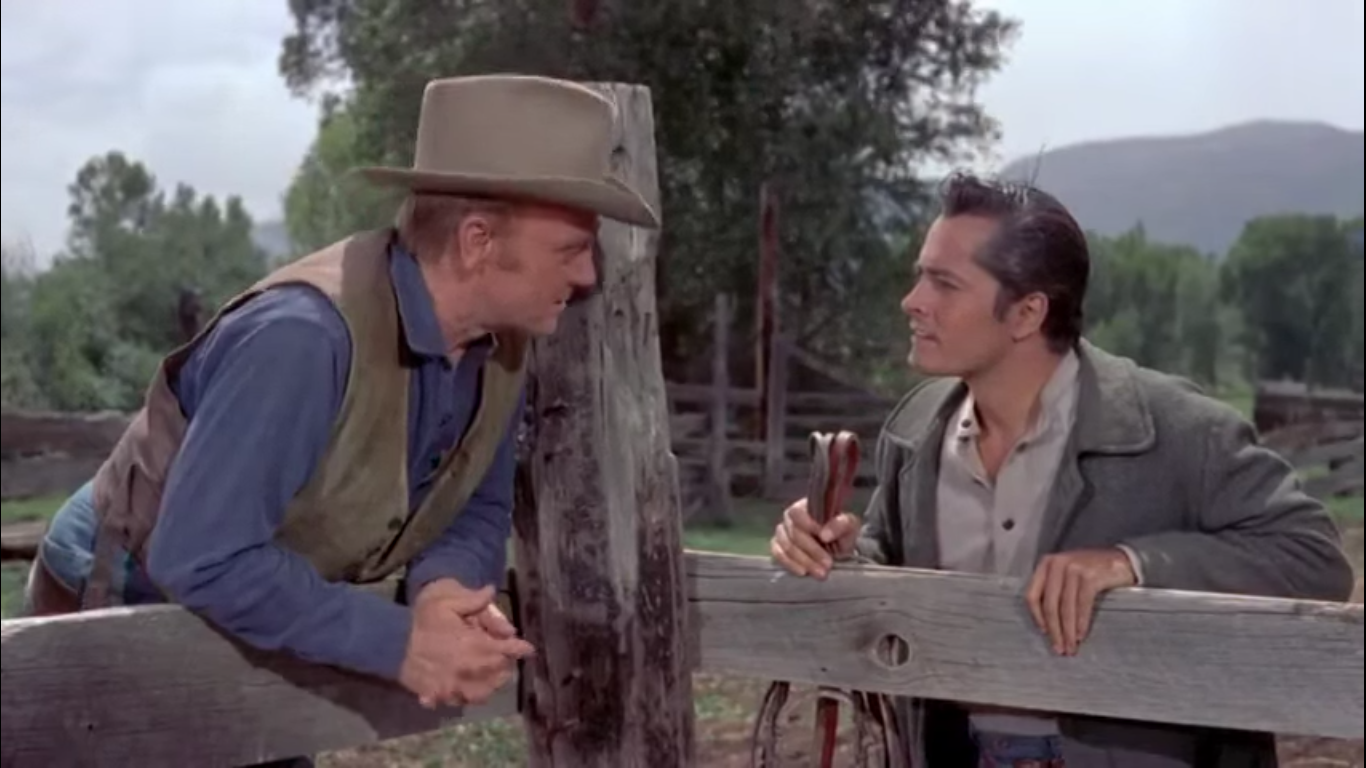
Run for Cover is rarely talked about in conversations of westerns, but there’s something fascinating about getting a James Cagney-led sagebrusher.  Like seeing Edward G. Robinson in The Violent Men, it’s hard not to read his entire history of gangster pictures into his backstory because although it’s a different decade, genre pictures still hold a place in the viewing public’s hearts.

Before they broke out with the likes of Hud, Harriet Frank Jr. and Irving Ravetch penned the story this movie was based on. Although it hardly has the pedigree of Nicholas Ray’s Johnny Guitar, the images of the picture are still stunning in their own right shot on location in Aztec, New Mexico.

The opening premise is frankly pretty corny. Cagney meets John Derek at a watering hole very conveniently. They ride on together with no apparent purpose except to get to the nearby town. Then, in a freak misunderstanding, while they’re shooting some scavengers out of the sky, the two men are mistaken for train robbers, and they have a bag full of cash literally dropped in their laps.

The locomotive heaps on the coal to race back to town to sound the alarm after their close scrape with the “outlaws.” Realizing what has happened, Cagney, always the level-headed one, looks to follow behind and return the money. They have nothing to hide. Still, there’s only one way this might end.

The mountains in the background are towering — truly awesome to look at — but there are more pressing matters at hand. It’s rather foreboding. It’s been some time between viewings, but there definitely are elements of The Ox-Bow Incident and Johnny Guitar here where the lynch-mob mentality takes over the local populations driven mostly by fear and traumatic experience.

However, this is all a false start, a way of developing the scenario ahead of us. It’s about that same man played by Cagney — now the town marshal — and his young companion who’s stricken with a life-altering injury. They must figure out what it means to live their lives.

Cagney rarely got a lot of late-period credit. There’s White Heat and then One, Two, Three comes to mind — these are marvelous showcases for his tenacious talents. Run for Cover is rarely talked about, whether it’s in the context of ’50s westerns, the career of Nicholas Ray, or that of Cagney himself.

But it does feel like another picture to buttress his legacy with. Not because it’s some grand masterpiece; he proves that he can make a slighter, quieter picture like this sing. Because his talents were not always purely bellicose or irascible. He has a more general charisma even later in his career.

He’s summed up so beautifully in a crucial scene. The doctor says Derek will never walk again. Cagney won’t hear of it, and he walks into the adjoining room as the boy lies on the floor crying out that he can’t get up. As their kindly Swedish benefactor (Viveca Lindfors) attends to him, Cagney simply beseeches him to “get up.”

There’s an authority in his words that feels almost Christ-like. It might seem like it comes out of a place of callousness, but really there is so much concern there. He doesn’t want the boy to give in and waste his life. In some manner, he is a miracle maker, a man of faith looking to bring the best out of this boy.

it’s a fairly slow-paced, straightforward western and this means much of the brunt of the movie must be carried by the merit of the performances — the relationships cultivated between them.

John Derek feels like little more than a pretty face, and the young actor might have said as much, but Cagney seems generous to him just as his character is generous to his young companion enlisting him as his deputy. He gives him credence and importance in this movie that he wouldn’t get otherwise without such a consummate professional to partner with.

There is some menace in the picture. Ernest Borgnine represents one — a shifty outlaw — and later some godless out-of-towners come tumbling into church mid “Christ The Lord is Risen Today” prepared to raid the bank.

What Run for Cover has to its advantage is how it turns all manner of dynamics on its head. The sheriff lambasts the townsfolk who are so righteous, so willing to condemn others, even as they are supposed to represent civilized society.

Then his one protégé becomes the film’s final and most crucial point of conflict, and this is not just like the Searchers, the ornery old man budding heads with the impetuous youth.

It’s a different kind of complication as they must face off against one another and come to terms with who they are down to their very core.  There’s a clear-cut emotional intensity that can only be resolved in one telling act. It’s tragedy and redemption all rolled up into one, and here we have something that feels distinctly of Nicholas Ray.

3.5/5 Stars

Born to Be Bad (1950)

“When you came here that first day, I fell flat on my face over your suitcase. I never really got up.” – Joan Leslie as Donna

Born to Be Bad is not high-grade stuff. Its trashy exploitive title says as much, but it’s also worthwhile for exactly these reasons. Nicholas Ray would make a name for himself in Technicolor — not black and white — capturing a bevy of emotive performances from the likes of James Mason and James Dean. But it’s easy to forget some of his earlier films are equally stirring. Bogart in In a Lonely Place or Robert Ryan in On Dangerous Ground.

There’s something lighter, more convivial about the performances in Born to Be Bad, but straight down the line, it offers up a thoroughly intriguing cast. It has to do with how they can play off one another and couple up with various character dynamics forming between them.

We have a disorientating beginning because we don’t see Joan Fontaine, but someone who turns out to be Joan Leslie. She’s older now, mature, assured, and still more ebullient than I ever remembered her before in the early Warner Bros. days.

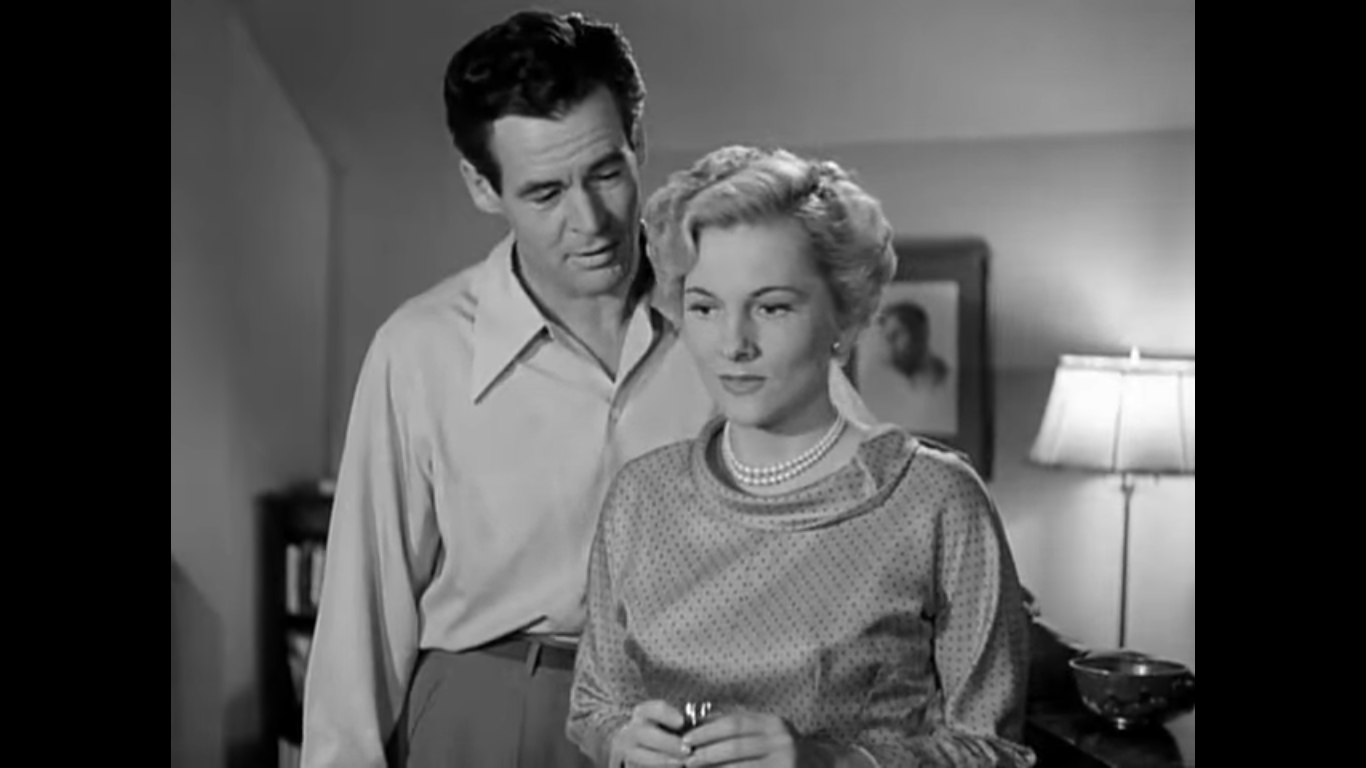
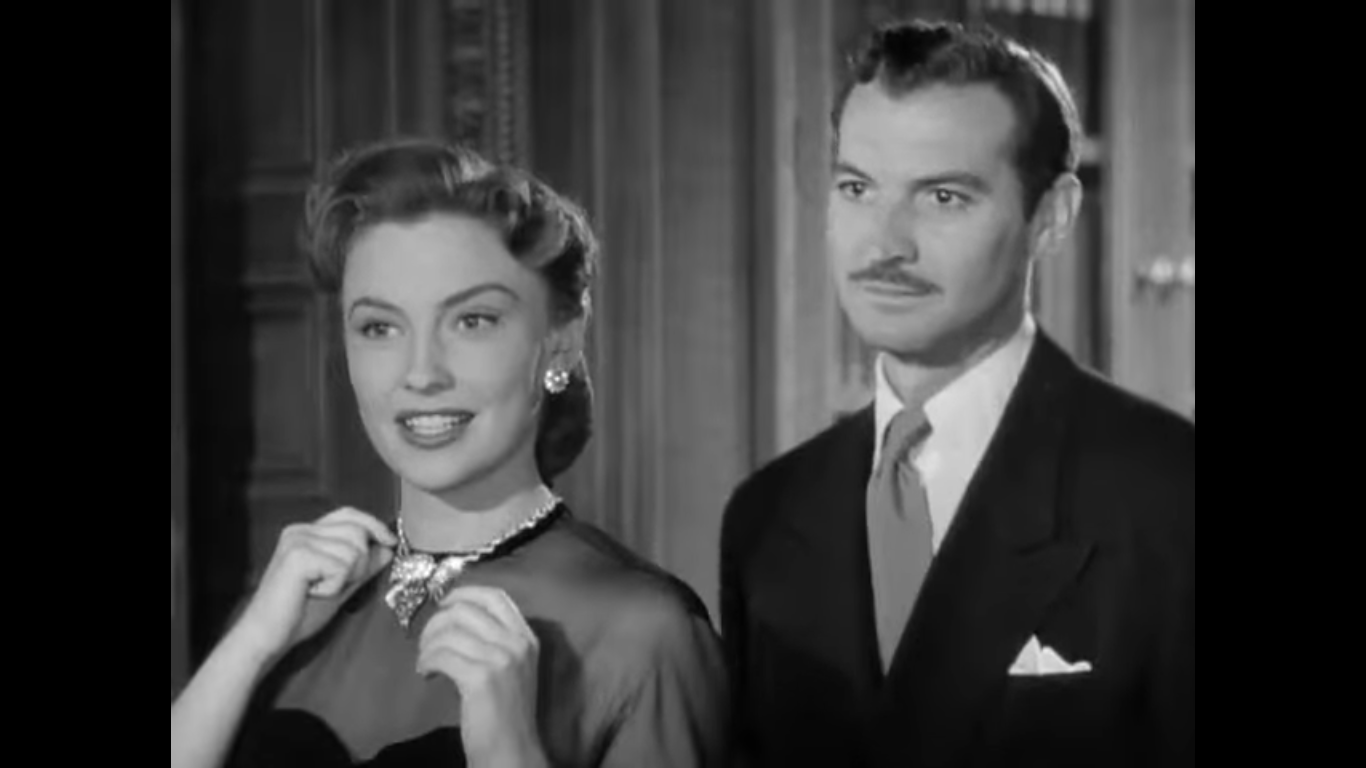
Within the context of the picture, she has reason to be. She’s deliriously happy, about to marry the love of her life, a rich moneybags (Zachary Scott), and yet she still finds time for a job and other wisecracking male companions. One’s a painter (Mel Ferrer), the other a purported novelist (Robert Ryan). There’s a happy-go-lucky familiarity to it all. We almost forget what the movie is meant to be about.

Then, Joan Leslie trips over a suitcase, her hair tossed violently askew, and she looks up to see the soft features of none other than Joan Fontaine perched on a couch. The unassuming beauty is her usual diffident self. However, this iteration of her screen image holds a manipulative underbelly.

As Cristabel ingratiates herself into Donna’s good graces and initiates designs on her man, it’s almost easy enough to dismiss her actions as first. She wheedles her way bit by bit until it’s more and more evident her ingenue from Rebecca or Suspicion has gone sour and self-serving.

Even when he’s partially a victim, Zachary Scott manages to give off a smarmy veneer. Robert Ryan has his own curious introduction, berating Cristabel when she’s on the phone, but it’s not a party line. He’s in the house and she wanders into the kitchen to see the stranger raiding the icebox. At first, she’s indignant. Then she starts to fall for his blunt charms.

Ryan would join forces again with Ray in On Dangerous Ground, and he seems like the kind of actor the director can use well. There’s a raw incisiveness to him that can function durably without sacrificing certain levels of emotional honesty. Because he has an unsparing frankness about him that one can either appreciate or become royally turned off by. Very rarely does Ryan elicit an apathetic response.

Fontaine does her part beautifully — her eyes constantly flittering around. In one particular conversation between Scott and Ferrer, she casually listens as she takes in the scene around her, just happy to be in such a place. She manages to be so helpful and so helpless getting everything she wants as a result.

Donna’s preparing to storm off to London, her relationship with Curtis torn asunder. Her pointed remarks to her rival have a delightful sting: “Somebody should have told the birds and the bees about you.” I don’t know what to make of it, but there’s something in Joan Leslie’s eyes when she’s been slighted that’s reminiscent of Marsha Hunt — a glint that Fontaine never owned. Leslie provides her a fine foil as we continue to explore a variation on the All About Eve dynamic.

Two exemplary shots of juxtaposition happen in adjacent scenes with Fontaine’s sparkling features framed on the chest of her man as she reposes there and, of course, there are two of them. She’s so good at flitting back and forth between two men. They both speak to her in different ways or rather, they both offer something unique that she can benefit from.

The jilted lovers, Leslie and Ryan, fall in together as friends and business associates if not romantic partners because there is something more in the works. Cristabel finally gets caught in her lies, though Born To Be Bad has a fairly lightweight ending. No one gets tragically wounded and everyone seems to laugh it off or get their wrist slapped. It’s not noir, nor is it effectively weighty, but it’s an intermittent pleasure to watch if you’re fond of the players. It more than lives up to its title.

3.5/5 Stars

The Little Fugitive (1953)

The aesthetic of The Little Fugitive is made plain thanks to chalk drawing credits playing over “Home on The Range.” We are about to enter a little boy’s world with all the joys and menial problems an adolescent life engenders. The key is giving these problems credence. Because in a young life, they feel ginormous.

Joey Norton always has his trusty pistol and holster and his big brother Lennie can always be found with his harmonica. They have your typical sibling dynamic. The little brother nagging, the big brother both put-upon and protective.

There’s an initial impression from the clunky dialogue causing the illusion of the film to falter. However, everything else around it feels real and sincere in a way we are unaccustomed to seeing in 1950s American films. Then you realize the whole picture had its dialogues done after the fact and it falls into place.

Coincidentally, it does give it a European sensibility with the dubbed dialogue. I can see how a film like this might have come to Cahiers du Cinema, Francois Truffaut in particular, and lit a fire under them. This is what movies could be, and not only something they could be, but also something attainable to others as long as they had a personal story to tell.

The 400 Blows but also Breathless and Le Beau Serge, developed narratives out of spaces the directors knew intimately. It wasn’t outside the purview of their experience, and it made a stunning entry point into their respective cinematic visions as they continually evolved over time. Still, one cannot discount their origins.

In the era of The Little Fugitive, a boy’s world was occupied by very specific things: baseball, guns, cowboys and Indians, television serials, comic books. The premise itself feels like an episode of Leave It to Beaver albeit outside of the watchful eye of middle-class suburbia.

Mother has to go away to pay a visit to a sick grandparent. Lennie has to watch over his little brother, and it’s going to derail his birthday outing to Coney Island with his friends. We have a simple dramatic situation and although he’s not a bad guy, he needs to use his boyish ingenuity to find a way out of his responsibilities. A dagger made out of ice is too impractical so they get the idea of using ketchup to fake a grisly death like they do in the movies.

The trick works wonders on getting rid of a pesky brother, and the film really comes into its own as they take it to the streets, and he’s out on the lam. It seems prudent to mention Ray Ashley, Morris Engel, and Ruth Orkin, the trifecta behind the film’s conception.

Their greatest asset was a cutting-edge 35 mm camera both portable and unobtrusive making The Little Fugitive landmark for another reason. It really feels like one of the obvious birthplaces of independent cinema because we have this idea of film emerging from the studio lots out onto the streets. And these aren’t just exotic foreign locales but the humble spaces you and I frequent in our daily lives. Even these spaces can have their share of fascination for a willing audience.

It’s a cornucopia of leisure, a boy’s delight having a day on Coney Island. We get a steady stream of vignettes: photo cutouts, batting cages, hot dogs, watermelon, the beach, ball toss, and whirling carousel rides providing full immersion of a different era.

Not since Harold Lloyd can I recall such a great showcase for Coney Island. We’re even reminded recycling was a problem at the beach back in the 1950s too. Joey quickly learns he can make some loose change culling the seashore for glass bottles and simultaneously proving himself to be inquisitive and quite entrepreneurial.

I’m not sure how our little fugitive had so much money to begin with; the film doesn’t find need to explain itself, but then he figures out how he can get more and uses them on a very sound investment: pony rides. He’s positively infatuated with ponies, and it shows him returning time and time again just to get another chance to live out his dreams on the range.

Although the film is mostly kid-centric, it’s a pleasure to observe several of the adults who seem to be genuinely nurturing souls. Whether it’s the photographer (Will Lee) or Jay the ponyman (Jay Williams), they seem to encourage kids in their interests and imagination. It would be so easy for a film like this to feel severe and somehow oppressive, yet what comes off is the lightness and the joy of each of these very specific moments as experienced by a little boy.

If I’m honest, I’ve recognized a growing bias in my own film appreciation. I’m partial to films that use modest means, modest runtimes even, and still manage to transport us with stories and worlds we can relate to. I can think of no finer compliment for The Little Fugitive because it captures a moment plucked out of my parent’s generation, honed in on a very particular Brooklyn milieu, and through its images we are able to imbibe all these tactile sensations pulling us into the moment.

Although the boys at Cahiers can feel a bit arrogant and combative, even in how they dismissed much of the past and canonized the auteur-director as king, I do like the idea that they placed no undue importance on bigger, larger productions tossed out as awards bait. There’s something almost more satisfying happening in a movie like this because not so many folks will be joining the bandwagon — the fad of the cultural moment. That is the road lined with glitz, accolades, and transience.

Only with a bit of diligence and an open mind, do we get the opportunity to unearth it, and what a glorious joy it is. Unassuming gems like this make the moviegoing experience such a spectacular journey of human revelation. Because this little boy’s day speaks to so much and since I was a boy once, it resonates deeply. I won’t forget it until the next time I return to this story caught in time, where it will be waiting for me again even as I continue to change. This is the magic of the movies.

4.5/5 Stars

CMBA Blogathon: The Last Hurrah (1958)

This is my entry in the Spring CMBA Blogathon Debuts and Last Hurrahs.

In the isolated occasions when I had to debate in high school classes those who did this kind of thing for fun and seemed most destined for politics, were all people I would never want to vote for regardless of affiliation.

Because it seemed like there was a self-selecting bias. The people who wanted, nay desired, this kind of world, were not ones I necessarily respected.

How could a decent person of moral fiber get through and win? The cynical answer is they can’t unless they are propped up by a political apparatus of some kind. However, before I sound too jaded, I still am optimistic there are good people working in government.

No one would confuse John Ford’s The Last Hurrah for a tirade against big government and political machines. This is not a Frank Capra picture. Instead, there’s a certain level of give and take, a nuance, celebrating a style of old-fashioned politics while acknowledging the need for political strategy and networks.

No director brought more of the Irish-American experience to film than John Ford and you see it from his Calvary westerns to his West Point hagiographies, and even a portrait of his homeland like The Quiet Man.

Frank Skeffington (Spencer Tracy) is in the midst of his latest and perhaps final foray campaigning for the mayorship in a New England town. His personal entourage of right-hand men in bowler hats (including Pat O’Brien and James Gleason in his final role) have seen him through everything.

My initial observation is that this is a mature man’s game. The young (including myself) seem like idiots. His son (Arthur Walsh) isn’t registered to vote, doesn’t watch the debates, and is always running off after golf or other frivolous entertainments.

Another local magnate (Basil Rathbone) who opposes Skeffington has a son (O.Z. Whitehead) who makes a fool of himself by unwittingly accepting the position of local fire commissioner. Skeffington has instant leverage against his old adversary. Then, there’s an up-and-coming appointment — a young Catholic war hero and lawyer. More on him in a moment.

Skeffington is not naïve. He knows how to play the game. He’s continually pragmatic, pressing his advantages and the alliances at his disposal and knowing what it takes to win. You don’t maintain the office year after year without knowing the rules of the game. Perhaps Ford casts him with a rose-colored, nostalgic tinge, but at least he has some scruples or at least a sense of who his people and electorate are. Because he’s been knee-deep in the community.

His most obvious opponent is an unknown newcomer named McCluskey, and it becomes apparent he feels like a caricature cutout of John F. Kennedy if the man lacked charisma and intelligence.

Of course, JFK was a famously photogenic figurehead who used Frank Sinatra jingles, his public image, along with a platform to beat out Richard Nixon in 1960 (He also hailed from one of the most influential families of its day thanks in part to his father Joe Kennedy).

Nixon himself practically instigated the political television revolution with the pathos appeal of his Checkers speech in 1952, and thenceforward the televised debate presaged a radical new kind of American politics. The rules changed.

Adam Caulfield (Jeffrey Hunter), Skeffington’s nephew, works as a sportswriter at a local paper. His editor (John Carradine) fights tooth and nail against Skeffington with an obsessive grudge, throwing every iota he has behind McCluskey so he might vanquish his mortal enemy. Adam is far more accommodating and has a congenial relationship with his uncle.

When he pays the seasoned politician a visit, Skeffington calls politics the greatest spectator sport! He invites Adam to cover the events and tells him in confidence that he wants to try and win a campaign race one last time the old-fashioned way; he’s astute enough to know his days are numbered thanks to television and other readymade forms of advertising.

Although it’s not mentioned explicitly I can imagine Skeffington admired the political acumen and rhetorical vigor of a great American stalwart like Abraham Lincoln. John Ford of course made a whole film about his early years and rise to prominence before he ever became president.

I mention this only to echo the thoughts of Neil Postman in Amusing Ourselves to Death. Our culture shifted drastically from a literary culture where arguments were well-thought-out and expounded upon in debates hours long. And yet in the 1950s and 60s, we see this concurrent shift to a visual, image-based society.

Suddenly we watch campaigns being won and lost by optics, the most beautiful people, or those with the largest media share. It’s a far cry from the past and this is part that’s being memorialized. It’s a strange thing to be reminiscing about a world cataloged most comically in a movie like The Great McGinty, but there is something rather quaint about it compared to the juggernauts of media and consolidated power at work today on a global scale. It dwarfs anything out of the past by sheer scope and reach.

The whole film might easily be encapsulated by a few adjoining sequences. There’s a quiet scene with Anna Lee. Her husband Knocko has passed and left her little to nothing to subsist on. In an act of sheepish compassion at the kitchen table, Tracy offers her a sum of money on behalf of his dead wife. It feels like a pretense he’s made up, and yet here no one sees his kindness aside from the camera.

However, he sticks around for Knocko’s wake, and it becomes an extension of his political campaign. When word gets out, everyone seems to be coming by to pay their respects too, though it feels more like posturing. These moments can be humorous, darkly cynical, and still somehow have glimpses of communal warmth.

Taken on the whole, The Last Hurrah is a grand picture with a lot of cast, story, and ambition. But all that space gives Ford the opportunity to move around in and go to work with his gaze set on humanity. It’s the communal events or moments of ritual where Ford is at his finest: dances, weddings; here it’s a wake and a funeral.

I mentioned Capra before and his pictures, Mr. Smith Goes to Washington in particular, decry the mechanism of the political machine. However, the adapted novel and surely Ford as well had a prescience about them.

He somehow bridges a gap between Capra’s cinema, Sturges’s McGinty, and the emerging landscape. Because Elia Kazan in some ways would depict our certain future with A Face in the Crowd. It offered up a harsh critique focused on a country bumpkin turned charlatan who uses television to captivate the public and wield his newfound influence for political gain.

In such a climate the old guard like Skeffington can no longer exist. Part of this is the march of time. There are aspects of him that feel archaic and ugly with his back parlor dealings. And yet in the same breath, as we look at the vitriol that is shoveled today and the proliferation of social media, it does feel almost quaint. Again, this might be naivete speaking. We so quickly forget the political muckraking of prior centuries because we were not there.

I had to sit with this film, and the longer I was with it the more it moved me. Ford does what he does best by eulogizing someone he deems to be an everyday American hero. The flaws are laid bare and still, he can be lauded as a great man by all those he groused so bitterly with all through the years. On his deathbed, before he is about to be given the last rites, the local Cardinal (Donald Crisp) comes to ask his forgiveness. They have been at odds, bitter rivals, and yet, in the end, there is grace and mutual respect.

It feels like a beautiful testament, like a bygone sentiment we rarely see in politics today. Because Skeffington does signal the end of something — maybe it’s the classical statesman or something else.

Spencer Tracy lying on his deathbed is a picture of blissful contentment, and he has the feisty spirit of an Irishman to the end. The film has all the hallmarks of a swan song, but thankfully he and Ford still had so much to offer us respectively, and in their final years they continued to deliver some of their most rewarding work.

4/5 Stars