Limelight (1952)

limelight 1The glamour of limelight, from which age must pass as youth centers 

A story of a ballerina and a clown… 

In Limelight it quickly becomes evident that Charles Chaplin was well aware of his own legend and how couldn’t he be? For years he had been held in the highest regards, loved by the masses worldwide as one of Hollywood’s founding royalty. He was at the center of the universe and the limelight was burning brightly around him.

I’ve recently been reacquainting myself with Chaplin’s early works most notably those that paired him with the indelible Edna Purviance as well as the gargantuan behemoth of a bully Eric Campbell. But Limelight is a major flashforward in his career, really at the end of it all. By now Chaplin is in his twilight years.

In fact, Limelight is one of his last prominent roles and the feature where he audaciously placed everything in the public eye–a picture that is unequivocally autobiographical in nature, accented with Chaplin’s own romantic dealings and tumultuous history from his entire career up to that point. And yes, he faced scandal in his later years, not simply for his past indiscretions but also more overtly for his political affiliations which unquestionably must have made him an easy target during the supercharged age of McCarthyism.

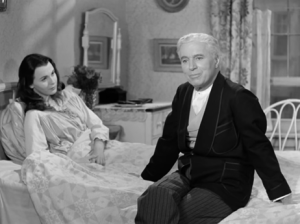
Still, in a simple heartfelt narrative once more, for one last time, Charlie Chaplin captured his audience. The title card reads much like his old silents would have in setting the scene. It’s 1914, back in the days when he was probably just making it big in real life. However, as Calvero, Chaplin is a washed-up comedian prone to alcoholism with a career that has suffered dearly. But in a moment of action, he saves an aspiring dancer (Claire Bloom) from a self-attempted suicide and from then on becomes a sort of guardian angel for the girl.

Calvero heeds the doctor and allows the girl to stay in his flat, away from the trauma and although it receives the ire of their landlady, he calls Thereza his wife in order not to cause a local stir. It’s one half human drama, other half stage production because while he looks to lift her spirits in any manner possible, he daydreams of his past forays in comedy. He was the man who could pull off a whole gag with a pretense of performing fleas and he had wall to wall crowds.
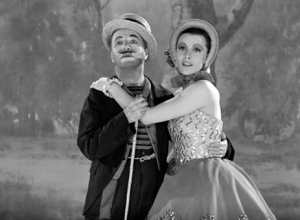
limelight 2But now no one’s there. The seats are empty, the aisles quiet, and he sits with a dazed look in his flat the only recourse but to go back to bed. It’s as if the poster on the wall reading Calvero – Tramp Comedian is paying a bit of homage to his own legend but also the very reality of his waning, or at the very least, scandalized stardom. It adds insult to injury.

Still, in real life and on celluloid he put up the front of respectability for people. Although he went through 5 wives and now has a young woman living in his home less than half his age, he believes that after all his years of experience, “a platonic friendship can be sustained on the highest moral plane” as he puts it.

And it’s true Calvero is perfectly civil. This isn’t some passionate romance though he does try and call Terry to action in other ways. Chaplin composed his scripts of many great lines, monologues and sonnets where he himself gets to deliver beautiful rhetoric and impassioned rallying cries of truth to anyone who is listening. In this case, it’s the girl who sits despairingly in her bed but it’s for everyone else too. It’s like he took the stalwart speech from The Great Dictator and economized it into smaller bite sized pieces (That’s the problem with the world. We all despise ourselves, There’s something just as inevitable as death. Life! Life! Life!).

But there is something rather tragically demoralizing about watching crowds walk out on Chaplin even if it’s his fictional alter ego because you get the sense that his once faithful viewing public undoubtedly did the same thing–driven by the tides of the times and their own fickle ways.

But even as his fictional self fades, he watches Thereza ascend to the top of the dancing world as a prima ballerina and she looks to take her beloved Calvero along with her. There’s a necessity in life to never subsist, never cease fighting that she learns from him and takes to heart. So the second half is the role reversal. He began as her good samaritan and now in her bounty, she looks to take care of him going so far as professing her love for him and her desire to get married.

limelight 3It’s important to know that he writes off such an assertion as nonsense and one can question whether this is Chaplin’s chance at revisionist history or more so an affirmation of his life’s actual trajectory–working through his current reality that the world questions (IE. Marrying a woman much younger than himself in Oona O’Neil who he nevertheless dearly loved).

It’s ingenious really because there’s positively no way not to empathize with him, no matter our position and as he always was a premier master at, Chaplin once more tugs at our heartstrings in a very personal way–pathos overflowing from his performance one last time. He casts himself as the great sacrificial martyr and stepping down from his post as one of the luminaries of the cinema, his legacy burning brightly in his wake.

It’s also easy to suspect the tragedy of the Blue Angel or the madness of The Red Shoes displayed for all to see on the center stage will reveal itself in due time but Chaplin allows himself go out on his own terms since he’s a master of his own fate, in the film at least.

He’s reflected on his life and deemed it as about as good as it can be. That’s enough. Whether it’s his earlier marital troubles, his current marriage, the criticisms of the public, or even a real or fabricated feud between himself and Buster Keaton if there ever was such a thing. It is all laid to rest. It’s like old times even as the new age begins.

4/5 Stars


Review: A Streetcar Named Desire (1951)

Brando_-_Leigh_-_1951Blanche Dubois and Stanley Kowalski. They’re both so iconic not simply in the lore of cinema history but literature and American culture in general. It’s difficult to know exactly what to do with them. Stanley Kowalski the archetypical chauvinistic beast. Driven by anger, prone to abuse, and a mega slob in a bulging t-shirt who also happens to be a hardline adherent to the Napoleonic Codes. But then there’s Blanche, the fragile, flittering, self-conscious southern belle driven to the brink of insanity by her own efforts to maintain her epicurean facade. They’re larger than life figures.
In truth, A Streetcar Named Desire is one of those cases where play and film are so closely intertwined it’s hard to pull them apart. And there’s so many connecting points. Tennessee Williams helped to adapt his initial work and Marlon Brando, Kim Hunter, and Karl Malden all transposed their original stage roles to the screen while Elia Kazan took on direction once more.

As such it became the showcase of The Method, the shining beacon championing that long heralded yet controversial movement born of Stanislav Konstitine and disseminated in the U.S. by such instructors as Lee Strasberg and Stella Adler. It was from this latter teacher from whom Marlon Brando honed his craft and it’s true that he was one for the ages. The Greatest by some people’s account.

But before this film, Vivien Leigh was the biggest name on the marquee and she, of course, had ties to Laurence Olivier, the apex of Shakespearian actors and arguably the most reputed actor of the age until Brando came along. In Streetcar, you can invariably see the thin link connecting such luxuriant Hollywood offerings as Gone with the Wind to the evolution of cinema with later classics like The Godfather because it’s physically there on the screen.

Vivien Leigh, forever synonymous with Scarlet O’Hara and Brando’s own brand of sometimes brutal authenticity. She wavers and sashays through her scenes, clinging to the set and delivering her lines as pure searing drama. Whereas Brando just is. This animalistic force of brawn stuffing his face with chicken and moving through his home like he actually lives there. It’s social realism but it’s also a conflict on multiple levels that goes far beyond the main tension within the film itself.

Within the narrative, it is certainly a clash of culture, dialect, and acting styles and we’re never allowed to forget it anytime Stanley (Brando) or Blanche (Leigh) are in a room together. Still, they are not the only players in this film and Kim Hunter lends an added layer to the conflict as she simultaneously yearns for the romantic passion coursing through Stanely while wanting to protect her sister from harm. It’s a precarious tightrope to walk and Hunter makes it heartwrenching. Beyond her, Karl Malden plays Mitch, one of Stanley’s old war buddies who nevertheless exhibits a softer side that is easily taken with Blanche’s cursory level of class.

So in the end, Blanche’s fall not only harms Stella but Mitch too as he sees his heart get hurt and he feels lied too. But the one who fairs the worst is, of course, Blanche herself as she becomes completely overtaken by her delusions of grandeur. The fact that she goes for magic over reality ultimately becomes her undoing.

Today Streetcar does come off as stagy and yet Kazan is still able to personify the sticky, grungy, sweaty atmosphere of New Orleans — palpable with its billowing cigarette smoke and humidity. It somehow functions as this odd dichotomy between the theatrical and utter realism. In one way at odds and in another married perfectly because the juxtaposition only draws out the drama even further.  And the fact that the film pushed the boundaries as far as content easily heightens the drama. Stanley’s attack on Blanche is not only in a verbal or emotional sense but physical as well and we have little problem believing Brando in his role.

It also struck me that in her final moments Blanche feels hauntingly reminiscent of Norma Desmond in Sunset Blvd only a year prior. But her delusions are far more pitiful because she never was anything and yet she still tries to cling to this sense of pride in her upbringing and the looks that once were. She constantly needs the affirmation and adulation of others to reassure her in her fears and frailties. Always putting on a pretense — a face to get by — but she’s the only one she’s able to deceive in the end. It’s one of the preeminent tragedies of the 20th century and its actors guide it into transcendent territory.

4.5/5 Stars

Park Row (1952)

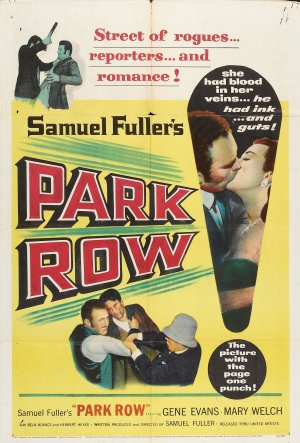
Park_Row_FilmPoster.jpegIt’s no secret that Sam Fuller cut his teeth in the journalism trade at the ripe young age of 18 (give or take a year) and so Park Row is not just another delicious B picture from one of the best, it’s a passion project memorializing the trade that he revered so dearly.
It’s also his typical style of economical filmmaking, shot in only two weeks and clocking in at just over 80 minutes and also funded on his own dime. To show just how much this movie meant to him he wrote, directed, and produced it. It was, of course, a monumental flop at the box office (despite an opening at Grauman’s Chinese). Still, that type of result could never quell a maverick like Fuller always prone to be a bit of a loose cannon who nevertheless perennially released a string of enduringly interesting projects. Consider a lineup of pictures including Steel Helmet, Fixed Bayonets, Park Row, and Pickup on South Street from 1951 to 1953 and you get the idea.

In some ways, Park Row seems like an invariably different film than its compatriots, very unlike Fuller, and yet it still gives off glimpses of Fuller’s style and sentiments.

The year is 1886. An industry has been developed and honed out of the invention and tradition of the likes of Johannes Gutenberg and Ben Franklin. The names of Horace Greeley and Joseph Pulitzer are as good as gold and the hub of that honorable profession, known to the masses as journalism, is based in Park Row.

Phineas Mitchell portrayed by Gene Evans–Fuller’s favorite brawny everyman–is a reporter at The Star, the publication that has a bit of a monopoly run by the icy empress Charity Hackett (Mary Welch). As he badmouths the very same newspaper at the local watering hole, he subsequently finds himself relieved of his position along with a couple of his colleagues.

But together, with the help of an eager benefactor they set out to craft their own newspaper. As envisioned by Mitchell, The Globe will be a paper for the people, devoted to honest to goodness journalism beholden to the facts. And in the subsequent days they take an abandoned office space, build a ragtag team, fix up a printing press, and scrounge around for any type of paper they can get their hands on. What they lack in resources they make up for with grit and determination. Because they have something Charity never had–verve and ingenuity. It sets their little paper apart and the public takes note.

Thus, the film’s entire narrative captures the ensuing journalistic feud between the established paper The Star and their rising rival The Globe. The main conflict coming from the very fact that their business models and mission statements are diametrically opposed.

Led by Mitchell, The Globe finds compelling cover stories to reel in the public. First, it’s a rallying cry for a man sent to prison for illegally jumping 120 stories off the Brooklyn Bridge and living to tell about it. They become his voice, interceding on his behalf and people listen. Next, it’s a public fund to help pay for the base of The Statue of Liberty–that symbol of goodwill, friendship, and ultimately, American liberty and idealism. Every member of the community, no matter the contribution, gets their name printed in the paper out of gratitude.

Still, Ms. Hackett is not about to be outplayed and while she admires her competitor’s tenacity, she is ready to resort to any means necessary to sink them for good. She tries all number of tactics, some more destructive than she ever anticipated. And while she might not be the most virtuous individual she’s hardly a killer. Mitchell hates her guts, rightfully so but that’s not how she wants to be known. There’s some nuance in their relationship, in fact, there’s a great deal of appeal to many of these relationships because they’re brimming with life.

Some noticeable hallmarks of Park Row include Sam Fuller’s typically dynamic camera that moves rapidly into close-ups and tracking shots gliding down the long avenues of Park Row with its horse-drawn carriages, train tracks, and the general hubbub of humanity. There are the accustomary fistfights and explosions, but the film stands out among Fuller’s other narratives for its championing of virtue, honor, and integrity especially in relation to a profession like journalism. It would have been so easy for this to be another expose of lurid sleaze and corruption and yet it’s surprisingly laudatory to the very end.

3.5/5 Stars

The Prowler (1951)

the-prowler-1The whole thing turned on a freak accident. You’ve got to believe that Susan.

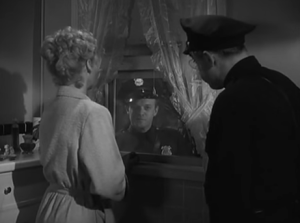
The Prowler doesn’t waste a moment of time with its opening credits as we are privy to a woman shrieking from within her bathroom. Why is fairly obvious. There’s a voyeuristic prowler on the loose and the police must be called on the scene. The men on call are Webb Garwood (Van Heflin) the discontent young gun and Bud Crocker (John Maxwell) the genial veteran. They search the premises, meet the flustered gal (Evelyn Keyes) and leave her be with no signs of a prowler remaining.

In fact, from that moment onward the prowler is only a phantom, a figment of the imagination, a convenient scapegoat. But blacklisted screenwriter Dalton Trumbo also cleverly uses this “person” to move his story forward seamlessly. The stage has been set. Our young cop has his interest piqued. Here is a beautiful, seemingly lonely woman and he can be her knight in shining armor. He’s taken by her and drops in on her with the pretense of monitoring her safety. In such a way, the narrative progresses into a love affair and an adulterous one at that. Because Susan Gilvray is married to the man who is always on the other end of the radio (ironically voiced by Trumbo himself sneaking his way into the film). He talks to her from far off and rather like the eponymous prowler, he too seems an almost otherworldly phantom haunting both Webb and his girl in their deceit.

It becomes obvious soon enough that Webb is the most crooked cop on record as he sets up a scenario that is tragic and he casts himself as a victim of circumstance. But it’s all orchestrated in such a way that Susan is free of her marriage and Webb receives the sympathies of the general public in the ensuing court proceedings. Soon after the drama has subsided, the pair of clandestine lovebirds turn around and get hitched. The next stop on their journey together is out to the desert as the action gets transplanted. Webb is keen on running a hotel and seeing a bit of the desolate country his former partner was always touting.

It’s in this back half where director Joseph Losey is able to develop his second major locale the ghost town of Calico which becomes the stark backdrop for the final act. It’s in such a setting where the couple looks to flee their misdeeds but they’re already so far gone, caught up in a lie that they cannot hope to mitigate. And that’s the tragedy. Webb cannot help to give up the lie even even with the love that he has found. Worst of all, it never was love at all.

Van Heflin was mostly an earthy, rough-hewn sort of actor but in the Prowler he’s surprisingly slimy and it’s a joy to watch him in that kind of role. Meanwhile, Evelyn Keyes is quite pretty and evocative but there’s almost a weary gauntness to her that’s hard to pinpoint. It hints a little bit at the hollowness and fleeting aspect of this romance that initially enraptures her but leaves her disillusioned. Also, the fact that Webb is surrounded by chummy average Joes like Bud and the dead man’s brother (Emerson Treacy), it just becomes more obvious how corrupted he is. Because it’s these real square, true blue individuals who willingly vouch for his character when he has none. They trust him completely when there’s nothing but deceit within him.

Dalton Trumbo is certainly ripping a few pages out of the likes of Double Indemnity and The Postman Always Rings Twice, but he does a master class job to the glory of the B pictures. And he really only seems to falter once. Although it’s a major plot point, a turning point, it somehow hurts the film that we see Susan’s husband in the flesh. It’s only for an instance, but in that instance, he loses that phantom quality. He’s real and far from being haunting, the fact that we know him, makes this story sad really. In the end, we realize The Prowler in the expected sense, never existed. It was all an apparition, a figment of the imagination, simply utility for one man’s avarice.

3.5/5 Stars

D.O.A. (1950)

doa1950As one of the greatest B-films of its day, D.O.A. is framed by a crackerjack gimmick that actually pays heavy dividends. We watch a man making his way down a long corridor as the typically stringent score of Dimitri Tiomkin pounds away behind the credits. In this initial moment, our protagonist Frank Bigelow (Edmond O’Brien) rushes into police headquarters to report a murder: His own.

So begins a film that’s a gripping piece of noir from start to finish.  Through the following flashback encapsulating almost the entire storyline, Bigelow recounts his former life. He was an insurance man working the daily grind in beautiful Banning California. When he’s not working he’s trying to dodge the come-ons of his secretary Paula (Pamela Britton).

In fact, he gets away for a little vacation in San Francisco, away from the girl and from his suffocating job and he’s looking to live a little. A lively sales convention that’s taken over his hotel gets his spirits up as does the large population of charming women. In fact, every time a pretty gal walks by his eyes bulge out of their sockets (denoted by comic sound effects). He even makes a few chums.

But this is just the topsoil, the initial slice of life that Bigelow finds himself partaking of. He doesn’t realize what will soon happen and it happens so haphazardly it’s almost hilarious. It’s ludicrous really. Still going on the town, he hits up a jazz club that’s gone absolutely jive crazy as the beatniks of the day might say. It’s a real swinging place. But there’s also something deadly waiting for our hapless protagonist.

In one fateful moment, everything changes. He begins to feel sick. He’s disoriented as his existence takes a nose dive into a world of paranoia — it’s the true markings of noir. The news from the doctors isn’t good either. He’s been infected with a luminous toxin. How or by whom, he doesn’t quite know. It’s all deliciously cruel suggesting that all that is evil, all that is depraved, all that is poisonous, shines ever so brightly in the dark. In fact, that’s where evil thrives.

Still, Bigelow has no idea what he’s gotten himself into and he’s tasked with something that perhaps no one in the history of cinema has ever had to do. Find and apprehend their own murderer. There’s a trail of sultry girls and distracting exposition that all in all makes for a thoroughly bewildering plot. We should expect nothing less. Still, the end goal is finding one George Reynolds or Raymond Rakubian. Bigelow doesn’t quite know which one yet and neither do we.

Needless to say, watching O’Brien scramble across the streets of SF past onlookers and incoming traffic feels quite real and that’s because it was filmed with a certain amount of authenticity. There are scenes that were filmed on backlots to be sure but this isn’t one of them. In such moments, it’s quite easy to get a sense that in some ways this sequence directed by Rudolph Mare could be real. In fact, his background in cinematography can be seen plainly with what he finds interest in shooting. It all works together rather well. D.O.A. has one foot in reality and the faithfully doting Paula gives a little more weight to Bigelow’s state of being. There’s more at stake now, thanks in part to this girl who really does love him. She’s worried about him for most of the story.

Perhaps most extraordinarily, to the elation of film-noir lovers everywhere, D.O.A. does not cop out and it delivers a satisfying conclusion. Aside from a compelling lead performance by the promoted supporting player O’Brien, the hulking Neville Brand comes onto the scene with a psychotic turn as Chester the nervously taunting heavy (always mumbling ‘soft in the belly’). It’s true that many a good film noir needs a quality thug and Brand fits the bill. He personifies the tone of the film — brooding and deadly.

4/5 Stars

Panic in the Streets (1950)

panic_in_the_streets_1950It disappoints me that I was not more taken with the material than I was but despite not being wholly engaged, there are still some fascinating aspects to Panic in the Streets. Though a somewhat simple picture, it seems possible that I might just need to give it a second viewing soon. Let’s begin with the reality.
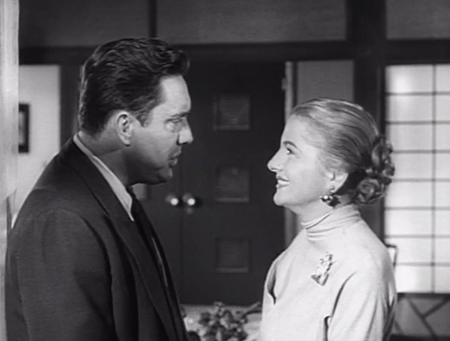
This noir docudrama is somehow not as tense as some of Elia Kazan’s other works. In fact, it’s port locale anticipate the memorable atmosphere of On The Waterfront, although it’s hard to stand up to such a revered classic. Still, the film does have its own appeals.

It begins with a gritty setting full of grungy character and New Orleans charm that continues the trend of post-war films taking the movie cameras to the streets and to the people who actually dwell there. In this way, the film shares some similarities to The Naked City.

The acting talent is also a wonderful strength with Richard Widmark playing our lead, Lt. Commander Clint Reed, this time on the right side of the law as a Naval Doctor trying to contain an outbreak of pneumonic plague before it spreads exponentially. His compatriot is played by the always enjoyable Paul Douglas a world-wearied police captain who must grin and bear joining forces with Reed.

The film is full of seedy undesirables and the most important and memorable one is Jack Palance (in his screen debut) showing off his tough as nails personality that was certainly no fluke. His right hand blubbering crony is the equally conniving Zero Mostel and together they make a slimy pair for the police to close in on. Because it’s one of their associates who ends up murdered but it’s only in the coroner’s office where they find out he was infected with something fierce.

This sets the sirens going off in Reed’s head and while not an alarmist, he wants everyone to consider the gravity of the situation. He has some trouble working with the police but he also seems to understand that this is not an isolated issue but it can affect his family — his wife Nancy (Barbara Bel Geddes) and his precocious boy (Tommy Rettig). But not just his immediate circle, but his entire community. And so he and Captain Warren race against the clock to not only to prevent an epidemic but solve a crime and apprehend the perpetrators. So this is undoubtedly your typical police procedural enlivened by New Orleans but there are also different layers to what is going on that have broader implications.

For instance, what do you tell the press? Do you keep it under wraps or let them shout it from the rooftops so the criminals get away scot-free — like rats fleeing the scene of the crime? Are you just looking for the murderers or are you considering the entire community at large? These questions deserve to be parsed through more thoroughly than I possibly can. So while Panic in the Streets is more methodical than a tense drama there are some very good things to it. Namely its location, its cast, and the universal nature of its central conflict.

3.5/5 Stars

The Bigamist (1953)

the-bigamist-1I despise you and I pity you. ~ Edmund Gwenn as Mr. Jordan

The Bigamist is at first a delightful noir — in one aspect unassuming and yet groundbreaking when put in a broader context. Ida Lupino is not simply a good female director. She is a good director, period.   She left a body of work both behind and in front of the camera that speaks for itself. Even the small ones like The Hitchhiker and The Bigamist have a certain strength about them.

In this case, the film’s title flashes with the superficial tinges of a sordid drama but when you actually get into the thick of it all, there’s a great deal of tenderness and certain heartbreak there.

In some ways, Edmund Gwenn becomes our main character’s father confessor as the protagonist explains how it all began through flashback: The plotting is simple. Harry Graham (Edmond O’Brien) found himself living a double life. But it’s not just that. He loves his wife Eve (Joan Fontaine). They genuinely care for each other deeply and now they share together in business but he spends a great deal of his time on the road. They’re even planning to adopt a child together since Eve cannot have a child of her own. Obviously, during his frequent bouts on the road, Harry gets lonely and we’ve undoubtedly heard that excuse countless times and it’s been the calling card for a great deal of infidelity.

the-bigamist-2Except at first what Harry does, does not seem like infidelity. In one integral scene Harry takes one of those bus tours to see the stars because, after all, Beverly Hills is that land of movie stars and their extravagant lifestyles. Jimmy Stewart, Jack Benny, Oscar Levant, Barbara Stanwyck, and Jane Wyman are all given a nod. There are even a few playful in-jokes to the always genial Edmund Gwenn who turns up as the adoption agent. All of this is essentially fluff but it’s on that same ride where he meets someone — a woman named Phyllis Martin (Ida Lupino).
It’s true that they’re both looking for a friend and they gravitate towards each other. It’s nothing more than that and Phyllis invites her newfound friend to a restaurant made in the popular mode of Early American Chinese. It’s where she works. But he hardly cares. He sees her more and the most astounding thing is that he tells his wife about it almost in jest saying he met a brunette in California. The reason he cites: she wasn’t beautiful but she was nice.

And right in that moment, you can see what’s particularly striking about The Bigamist. It’s a frank, open, and honest film in an often prim and proper era of certain sensibilities. The Bigamist looks to be a film to trod all over those social mores and yet extraordinarily enough it doesn’t. Yes, in certain ways it dissects them but it does it with great care and a tenderness for all parties involved.

It’s not so much a dark brooding noir but a film of interpersonal tragedy rather like earlier such examples as Pitfall or They Live by Night where bits of darkness pervades the home and relationships which are admittedly fragile because of the humans involved. Topics of divorce, infidelity, and pregnancy further complicate matters.  But not in some lurid exploitive way to sell tickets.

It’s oddly ironic on multiple levels. Of course, we know as an audience that he is seeing another woman but that’s only the beginning. In a major fit of situational irony, it works exactly contrary to what we might expect. Edmund O’Brien’s lead is a good and decent man. His wife is not a holy terror but played by one of the sympathetic heroines of the 40s and 50s, Joan Fontaine. Furthermore, Ida Lupino is not some sleazy femme fatale. In fact, she’s the one who initially rejects his advances and shows reluctance to marry him.

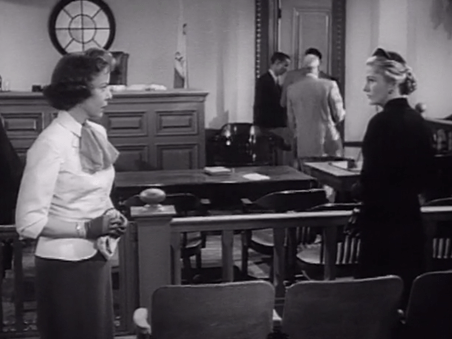
the-bigamist-3It strikes me how it’s often the small, tiny, unassuming pictures that impact me the most and this film did wrench my heart over the course of only a very few minutes. The final court sequence sums up the reasons quite well because it ends the film on a moral note setting up a rather convicting paradigm.
We see both women there. We see the accused sitting in front of the judge and jury willingly admitting his guilt. His is a society that winks an eye at a married fellow with a mistress and yet he, a man who genuinely loved two women, is found at fault under the law. The defense attorney on his behalf calls for punishment tempered by mercy.

When those two women walk out of the courtroom as the proceedings end, it does not mean that any of it can ever go back to normal. Will either of them even take him back? We can make an educated assumption but that’s not really for us to know. However, on a universal level, the words of the attorney reverberate in my ears. Each one of us has aspects of our character that are undoubtedly despicable but also elicit pity. It only makes sense that each of us deserves a certain amount of punishment but also a measure of mercy. It’s up to us to extend that to others. Because the reality is that we might not be that much better than the eponymous bigamist. Judging by his character we might actually be far worse.

3.5/5 Stars

Red Badge of Courage (1951)

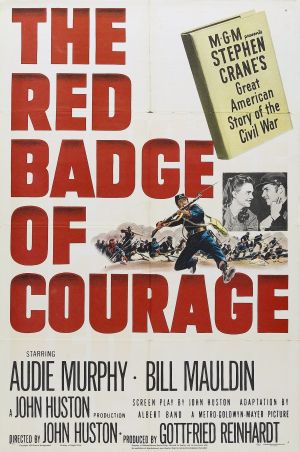
Red_Badge_of_Courage_1951.jpgStephen Crane’s seminal Civil War novel was made to be gripping film material and although my knowledge of the particulars is limited John Huston’s story while streamlined and truncated feels like a fairly faithful adaptation that even takes some effort to pull passages directly from the original text.
Even with the film getting butchered by the producers and chopped down to only 70 minutes from its original 2 hour running time, there’s still a gripping power to this war story. The narration feels a bit forced (despite being delivered by James Whitmore) but beyond that Huston’s film has an undeniable resonance for the atmosphere it develops and the very palpable inner turmoil of its central character as portrayed by famed real-life war hero Audie Murphy.

It suggests the other side of what it is to be a soldier. The fear, the reluctance that wears on the individual, and it begs the question, who are the real heroes if not men who did their duty despite the very fears that shackled them? Portrayed in this film are men and boys who were thrust into conflict and they were forced to respond accordingly. Not necessarily because they wanted to but out of very necessity.

In the end, the realization is that maybe fear is alright and acknowledging it is oftentimes the very sign of a brave individual. Someone who knows their limitations and still manages to push beyond them to do extraordinary things. Because as FDR so famously noted, the only thing we have to fear is fear itself. It can be debilitating, stifling our resolve to take action. Thus, it’s our response that’s paramount.

Barely 20 during the war Murphy isn’t all that much older here and it feels remarkably fitting for him to play the naive Youth getting his first welcoming to war faced with this very conundrum. He wants the glory of war. He wants that red badge of courage. But he’s too afraid to take it. The utter irony is how battle-tested Murphy was by that point in time–but of course, he became a hero at a very young age and that doesn’t necessarily mean it came easily or without a cost.

Huston also examines the disillusionment in the utter absurdity and idiocy of war sometimes. Though it had already been 6 years since the end of WW II with men such as Audie Murphy and Bill Maudlin involved it’s easy to get the sense that this was a rumination on that particular war’s effect. Huston as well had been involved in documenting the life of soldiers and Maudlin made a name for himself as one of the great wartime cartoonists originating the iconic duo of Willie and Joe. Murphy’s accolades spoke for themselves as one of the most highly decorated soldiers of his day but he also undoubtedly suffered from the trauma of PTSD.

The dialogue is ripe with colloquialisms and the images seem generally authentic with photorealistic visuals to match a fairly dismal outlook. It does not shy away from the reality. Figures constantly moving through the frame mechanistically. Claustrophic closeups, tights angels, billows of smoke and relentless gunfire make the battle sequences truly immersive. And the soldiers are played by actors of all shapes and sizes including Murphy, Mauldin, Royal Dano, John Dierkes, Arthur Hunnicut, and even Andy Devine.

If it had not been for the studio’s meddling we might be calling Red Badge of Courage one of the great American war movies. As it stands today, cut down from its original running time and slightly removed from John Huston’s original ambitions, it’s still a highly moving picture. Because moments of greatness shine through no matter the muddling factors. So despite its minor status and a runtime that suggests lesser fare, Red Badge of Courage is really Class A material through and through. Huston did not call it one of his best movies for nothing.

3.5/5 Stars

Have a wonderful Memorial Day and here’s to all the humble heroes in our armed forces.

Review: East of Eden (1955)

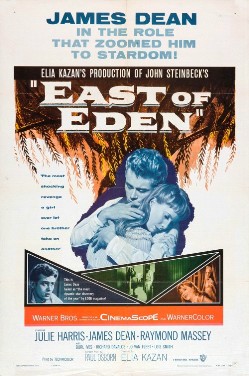
east_of_eden_posterEast of Eden. It was John Steinbeck’s epic work. Showcasing a familial narrative sprawled across his familiar locales of Salinas and Monterey over the turn of the century. But as a film, it rather unwittingly became James Dean’s. He wasn’t even a star yet. He had been on the stage and in a few small roles on television. His performance as Cal Trask was his first film role and the only one that ever got released during his lifetime. As his following two films, both premiered after his untimely death (curiously not all that far away from this film’s setting).

Director Elia Kazan utilized Technicolor and the harrowing perspective of Cinemascope to paint East of Eden with vibrant colors and rather unnerving angles. It’s also true that Kazan, known for evoking intense performances from actors bread on the Method,  was more inspired than perhaps even he realized when he cast Dean. The actor’s body movements. His moody histrionics. His angst emanating from those piercing eyes of his. Even his terminal sadness channeled from his own real-life desire for his father’s love. It’s all within the role of Cal Trask and takes away any doubt about who the focal point of this film is.

And for some, this might be a rather glaring problem with the film. Kazan’s adaptation of the latter half of Steinbeck’s novel focuses on the Cain and Abel dynamic between brothers Cal and Aron as they vie for the affection of their father Adam. For the film to work, each of these characters should be on equal footing. And it’s true that the film is a pendulum of emotional turmoil. It’s positively charged with virulent intensity. First, it’s Cal who is angry and isolated as he tries to discover the whereabouts of the mother he never knew. Meanwhile, his brother Aron (Richard Davalos) is happily in love with his girl and readily defends his brother against any criticism.

But as Cal tries with all his might to win the affection of his father by any means possible, things begin to change. No, his father never exhibits the type of pleasure in him that he so desires, but in his struggles, Cal becomes closer with his brother’s girl — gaining her sympathy.

As time passes, the U.S. is teetering on the brink of the Great War and still, Cal cannot earn his father’s love and his brother becomes more and more jealous. As Cal comes into his own, showing a certain amount of industry and thoughtfulness, it seems Aron becomes more withdrawn and cold. And still, Adam loves his “good son” the best.

James Dean’s performance is spectacularly engaging. I would argue it’s not a morbid sense of curiosity that draws us to him as a tragic hero. But he truly had a special ability to control entire scenes with a glance or some slight movement. Like a Brando or a Clift, he had a certain ability to tap into something that classical actors couldn’t quite touch. Whether it was realism or not is slightly beside the point because they live in characters who are charged with real emotions. It makes Dean’s role as Cal Trask almost palpable. You can feel all that is going on inside of him.

It’s the fact that Dean is so memorable, that brings to light just how much some of the other roles pale in comparison. Davalos does a fine job in his first film, but he cannot balance the scales weighed down by Dean. Raymond Massey on his part is a fairly flat actor not given to anything altogether interesting. It is Dean who elevates Massey’s role in a sense (even though Massey despised the younger actor). Furthermore, Julie Harris is a reputable performer with great heart but she somehow seems miscast (perhaps she’s too old for her role). And Jo Van Fleet gets into the film with a few integral scenes but even she does not have enough time to neutralize Dean.

Perhaps it’s because of the now iconic screen tests of Dean and Paul Newman working off each other, but part of me wonders if Newman in the role of Aron could have done anything to counterbalance Dean. Part of me rejects this hypothesis because Newman never had the same type of melancholy or intensity that Dean was able to muster. He was the likable one. Still, it’s an interesting supposition that in no way takes away from the phenomenal way James Dean burst onto the scene in 1955. He was an explosive supernova of talent — unfortunately for us, he was snuffed out far too quickly.

4/5 Stars

Roman Holiday (1953): Escapism and Why That’s Okay Sometimes

Audrey_Hepburn_and_Gregory_Peck_on_Vespa_in_Roman_Holiday_trailer.jpg

I’ve made a point of suggesting that the reason that I return to movies, again and again, is not because I go to them as an outlet of escapism but for the fact that films give us a little bit more insight into the lives we lead as human beings. In some ways, you could say I’ve even vehemently warned against films functioning in such a way if that’s their sole purpose. In other words, I’m not a proponent of turning on a movie and tuning out all the periphery. It sounds a little too much like Timothy Leary for my tastes.

And yet I return to Roman Holiday time after time.  This story that literally functions as a fairy tale, a vignette-filled journey that perfectly encapsulates a day on the town. And we get the pleasure of returning to it again and again along with Gregory Peck and Audrey Hepburn. I will qualify why this all still makes sense but first, a little background is in order.

From the first time I saw it, on a plane flight to England, I was enamored by the whole adventure and the individuals involved. Hepburn has remained unequivocally my favorite actress of all time period. Gregory Peck’s lasting screen presence keeps him among the greats as far as film stars go.

They make Roman Holiday work so impeccably, but the major key to director William Wyler’s success is the very fact that he took his film on location — something that was still a fairly new phenomenon. So instead of getting some artificial Italian world conjured up on the Paramount backlot, we got a far more realistic experience that is almost palpable with its authentic flourishes.

They’re the kind of iconic panoramas that you cannot try and fake without them turning out ridiculously corny. But Roman Holiday is the real deal and that shines through its crisp black and white imagery and successfully turns Rome into the third major player in this romance.

I think it’s telling that Roman Holiday is a fairy tale in itself. It’s the story of Princess Ann’s little bit of escapism. It’s a bit of bliss that she gets to share with someone very special. But does she wrap herself in it forever and never return to reality and the responsibilities she has? No, she goes back to them. And there’s a reluctance and as an audience, it’s certainly bittersweet.

But look at Ann in the end and we see that she has truly grown up in that short span of time. If she had not, she would have undoubtedly been content with a life living out her little fantasy and forgetting everything else around her of substance. That’s so easy to desire after all. However, in doing what she did, she not only grew immeasurably but, in the end, she has a magical experience to hold onto and remember fondly. The fact that it cannot last forever only makes it that much more special.

There’s nothing wrong with vacation — a day of rest and relaxation is necessary for all of us. It’s no coincidence that we have a weekend built into our daily rhythms. That’s why I enjoy returning to Roman Holiday every few years because it’s alright to have that guilty pleasure every once and a while. In fact, it’s not a guilty pleasure at all. You could make a case that stories like this are even necessary. But the important distinction to make is that escapism is fine — I’m not against it completely — but it needs to be in moderation.

We can return back to earth after the fun of the fairy tale and simultaneously our lives are made better and we have the good times to look back on. I will continue returning to Roman Holiday for years to come and without the least bit of hesitation. A little bit of fantasy can be a very good thing. I’ll try and remember that.

5/5 Stars