Journey to Italy (1954)

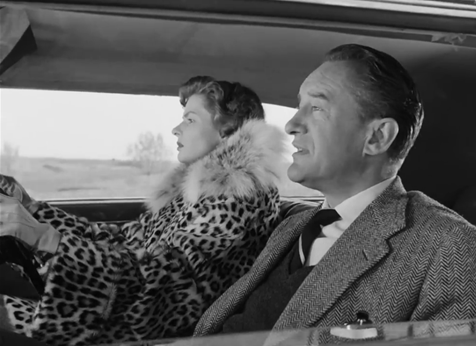
journeytoitaly1Journey to Italy is the splintering of a relationship where the slivers of bitterness begin to wedge themselves under the skin. It’s like slow, painful, nagging torture. Roberto Rossellini’s noted romance film feels like the antithesis of Roman Holiday. It avoids the other film’s bustling streets for more secluded getaways. It leaves behind fairytale romance and fun, for the bitter onset of marriage and middle-age. It seems hardly exciting, mostly driving and sitting, drinking and eating. Rather droll to say the least. And yet this in itself is juxtaposed with lively impassioned tunes and historic pieces of architecture and sculpture snuggled up against the Italian countryside. Because it is a goldmine of culture whether you look at Pompey or the remnants of the Greeks and Romans. There is a glorious history here and yet it makes for a rather meandering backdrop for our two stars Ingrid Bergman and George Sanders. Again, Bergman especially was a big name (and at the time Rosselini’s lover) and though usually a supporting player Sanders was usually held in high regard. They feel like the exact inverses of Gregory Peck and Audrey Hepburn, in a way that’s rather intriguing.

journeytoitaly2Yet again, as an audience, we do feel like tourists taking in the sights, but this time we’re riding along with a couple who don’t know what to do when they’re alone together. They don’t know what one is to say or how one is to act, because, in all honesty, they haven’t tried too hard. We don’t get much of their backstory, but they are certainly well-off because he takes his work seriously and it shows. But he hasn’t taken his marriage all that seriously and that shows too. His wife is more like his partner in this business endeavor they have going. She keeps up appearances, and he can offer her a lot in return, but hardly love.

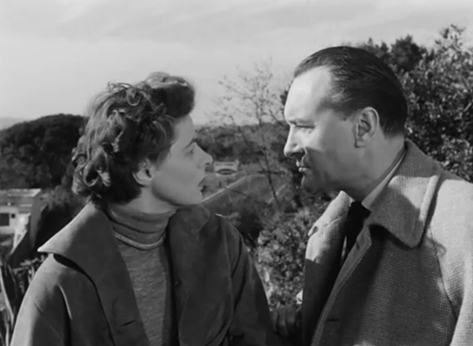
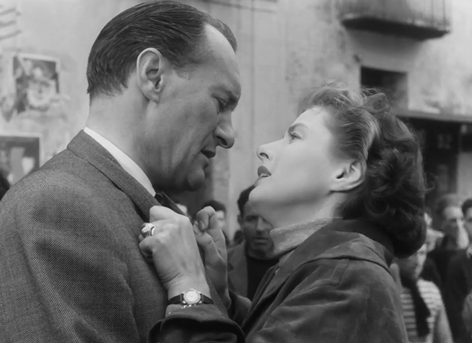
It struck me that is a film about a faltering relationship and here is a couple that seems to be apart as much as they are together.They think that the best thing they can do is stay away from each other because no damage can be done that way. There’s jealousy, pettiness, biting sarcasm, all ready and waiting to be unleashed. Alex fosters a liking for a young Italian girl, and although Katherine doesn’t know all the details, she suspects as much from him. To combat Sander’s snide tone that can cut to the quick, Bergman counters with a thick layer of sulking.

journeytoitaly3Thus, I’m not sure about the denouement of this film. Will they stay together or get the divorce that they both seem to have come to terms with? It seems like they might possibly make things work, or is that just the work of the romantic Italian countryside around them? Because no passionate embrace can alleviate and completely overshadow their myriad of problems. They are unable to communicate on a meaningful level, and they treat each other rather poorly more often than not.

In fact, this film is an interesting study, but there is a lack of investment in these characters. After all, it’s only a quick snapshot that gives us a feel for a relationship. I’m probably partial to the similar feeling Before Midnight (2013) because we are already given two films beforehand to truly grow invested in the characters and their story. But there’s no doubt that Rosselini’s film with Bergman and Sanders is well worth the journey.

4/5 Stars

The Steel Helmet (1951)

steelhelmet1“What a fouled-up outfit I got myself into” – Sgt. Zack

Samuel Fuller always had an eye for the visually dynamic and a nose for controversy. His war picture The Steel Helmet was at the forefront of films about the Korean War, in fact, it was probably the first.

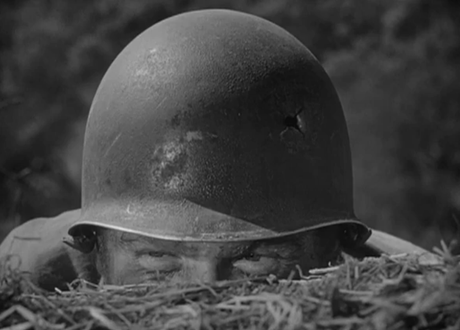
Despite, being shot in a few solitary days in California, he somehow managed to develop a generally atmospheric terrain overflowing with fog of war and overgrown with foliage. It’s an unsentimental, gritty, sweaty storyline. In other words, it’s very Fuller and its cynical lead is Gene Evans as the thick-headed Sergeant Zack weighed down by war-induced pessimism. He’s got a bullet hole in his helmet to prove it. He’s been good enough to last through this game of survival of the fittest thus far, and he hopes to keep it that way.

Zack picks up a peppy young South Korean, the original “Short Round,” and the sergeant reluctantly allows him to tag along as he continues his pilgrimage. Next, comes the African-American medic Corporal Thomson, who like Zack was the sole survivor of his unit. In the forest depths, they run into a band of soldiers led by the experienced Lt. Driscoll. Although Zack wants nothing to do with them, he agrees to stick around after they get pinned down by a couple snipers.

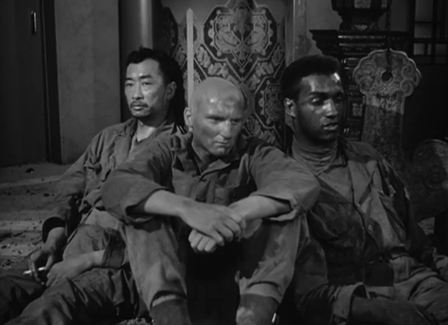
Their mission: to set up an observation post at a nearby Buddhist temple.  However, the road ahead includes booby traps and other menacing perils of war. They have one of their hated “gooks” waiting for them, and he causes some havoc before being captured. However, perhaps more insidiously he tries to undermine the men by going after Thompson and the “Buddha head” Nisei vet named Tanaka (Richard Loo). The wily enemy, in perfect English mind you, notes the hypocrisy of an American society where African-Americans can die on the battlefield, but then only get to sit on the back of a bus. He then suggests how he and Tanaka have a great  more in common, aside from their eyes, especially since the American government put Japanese-Americans in Internment camps

steelhelmet2But the old WWII vet simply acknowledges the facts and retorts with his own piece of trivia. In the all Japanese-American regiment the 442nd 3,000 Nisei “idiots” got the purple heart for bravery. All he knows is that he’s an American no matter how he’s treated. That doesn’t change. Once more Fuller delivers some of the most engaging portrayals of Asian characters ever and the discussions of race relations were way ahead of their time. Both Richard Loo and James Edwards are honorable characters who hardly fall into any common stereotype.

After staving off this psychological warfare, the band calls in an artillery barrage on some nearby snipers. But soon the enemy is swarming them and it’s a wildly thrashing, blasting battle to the death.  The fight scenes are sheer chaotic madness, but then again isn’t that what war often escalates to? It just doesn’t make sense. Billows of smoky haze engulfing the war zone. Whirrs, bangs, explosions, and every other sound imaginable except silence. That comes when the bodies are dead and strewn all over the battlefield. In truth, silver stars mean very little when you’re just trying to survive.

Fuller was prophetic by suggesting that there is no end to this story. He was right. It went on for a couple more years and ended in a cease-fire that still continues between North and South Korea to this day. He’s also one of the great economical filmmakers where less is most certainly more. What a stroke of brilliance that he could use a weeks time, the grounds of The Griffith Observatory, and a few minor actors and extras to create such a fascinating film.

4/5 Stars

Review: Some Like it Hot (1959)

somelikeithot1Only Billy Wilder would dare to make such a film. Somewhere amidst the St. Valentine’s Day Massacre and men dressed in drag, he could find the inspiration for one of the most high-powered, zaniest, even subversive comedies of all times. There’s very little overstatement in that assertion because Some Like it Hot is all that and most importantly it’s just good unadulterated fun.

It finds its genesis in the Jazz Age of Chicago circa 1929 where gangsters like Spats Colombo (George Raft) are running the streets, the crash hasn’t quite hit yet, and the Dodgers are a long way away from leaving Brooklyn. George Raft takes on a parody role hearkening back to the days of Scarface, but this time, there are a lot of laughs in the wake of his destruction.

Small-time musicians, Joe and Jerry, are living paycheck to paycheck and things aren’t going so hot for them when the authorities raid a not so legitimate establishment. Immediately they high tail it, but they’re not safe for long when they unwittingly stumble upon the St. Valentine’s Day Massacre. They frantically flee the scene of the crime knowing the mobsters will soon be after them and to make matters worse they have no money. What to do? What any desperate pair of musicians would do, dress up as women and join an all-girl ensemble for three glorious weeks in sunny Florida. Sounds ludicrous when Jerry (Jack Lemmon) first drops the idea half-serious, but after the hot water they find themselves in, Jerry (Tony Curtis) takes him up on the masquerade.

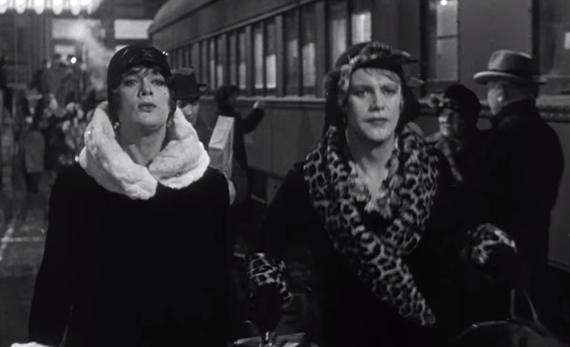
somelikeithot2So they pack their bags, do up their faces, and change their voices an octave or so higher. They wobble to the train station on top of their heels as Josephine and Daphne, just what the band leader Sweet Sue ordered and our two effeminate fugitives get aboard for a wild ride indeed.

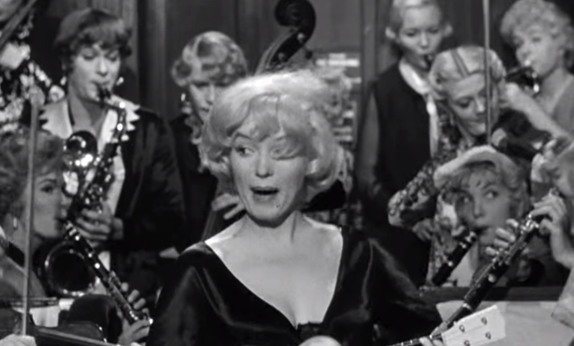
They soon meet the other gals including the vivaciously scatterbrained Sugar Kane (Marilyn Monroe), who already has a strike against her for getting caught drinking. It looks like bad news for her during a bouncy rendition of the 20s tune “Runnin’ Wild.” Amid the toot-tooting of Josephine’s sax and the bass twirling of Daphne, Daphne also finds time to bail Sugar out. She’s quick to make friends too during an after-hours get-together in her compartment. It’s one of the uproarious moments where Jerry/Daphne must go through the battle of the sexes. He’s so giddy to have so much female company and yet he must maintain his facade. What’s brilliant about Lemmon is he actually seem to genuinely relish his part. Whether it’s his character or not I’m not sure, but he buys into his role especially when it comes to his budding romance, but that comes later.

All things are bright and cheery when they arrive in Florida with palm trees and bachelors galore, all ready and waiting for a little tete-a-tete. One such bachelor is Osgood Fielding (Joe E. Brown), who immediately has his eyes on Daphne. And let the comedic irony and romantic entanglements begin. What follows are two absolutely preposterous tales of romance that crank up the absurdity.

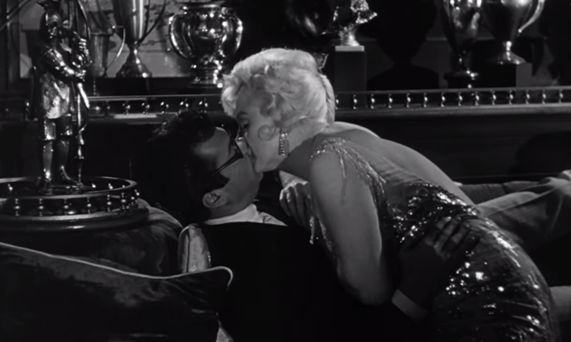
somelikeithot4Joe swipes a sailor’s cap and a pair of glasses while donning his best/worst Cary Grant impression to woo Sugar as an aloof magnate complete with oil fields and a yacht. It’s all part of his plan to win her love, and Daphne views the whole thing disapprovingly, hoping to catch his buddy in the lie. Thus, now Joe has committed himself to two roles and somehow he’s able to keep the plates spinning by borrowing Osgood’s boat for a romantic night with Sugar and using a bicycle to rush back to the hotel and put on the whole Josephine act.

Meanwhile, Jerry gets more and more invested in the whole Daphne performance dodging Osgood’s playful advances, while finally dancing the night away to a killer tango. It’s the diversion Joe needs in his plan to get with Sugar, and he’s succeeding. But Jerry, or should we say Daphne, isn’t doing so bad either. With a flower between her teeth and when she’s not trying to lead, they make quite the couple. Could there be wedding bells?

All that hilarity goes on halt when Spats Colombo and his gang come to town for a conference and the girls avoid suspicion at first, but their nervousness tips the mobsters off. The chase continues and the boys must finally drop the act if they want to get out alive. But Joe delivers one final gesture to Sugar not wanting to ditch her completely. They plan to catch a ride with Osgood who will elope with Daphne. But in a last-ditch effort, Joe finally lets everything drop and breaks all pretenses. It makes for an awkward situation when he gives Sugar a big kiss in front of a full audience, still dressed in drag.

As they get away in the little motorboat, Joe pleads with Sugar not to stick by him, because he really is a bum. But she doesn’t care, does she? He’s Tony Curtis, a Cary Grant type. Now it’s Jerry’s turns as he tries to cook up excuse after excuse why he cannot marry Osgood, and of course every time he’s rebuffed. Finally, in exasperation, he pulls off the wig, loses the voice, and yells, “I’m a man!” Without missing a beat, his beau shoots back, “Well, Nobody’s Perfect.” The look on Lemmon’s face is priceless and this moment is the perfect capstone on one of the wildest films you could ever imagine.

somelikeithot5It’s absolutely astounding that despite all the headaches and troubles Marilyn Monroe brought to the set, including constantly flubbing lines and being generally difficult, her performance bubbles over with a playfully ditsy sensuality that captivates the screen. I for one can hardly ever see the turmoil going on underneath because the role of Sugar is so vibrantly joyful, innocent, and genuinely funny put up next to her great co-stars. Her numbers like “I Wanna Be Loved by You” exude the friskiness that she was known for and there’s no question that Monroe has a magnetism on the screen that was unequivocally her.

Joe E. Brown plays the giddy playboy with devilish hilarity, the perfect comic companion for Lemmon. While Tony Curtis is great, he plays the straight man in the sense, that it feels like he’s just doing this out of necessity. Lemmon is an absolute riot, taking on this role willingly and bubbling over with enthusiasm that is palpable. He has that cackling laugh that adds an exclamation point too many of his conversations and when he starts dancing around with those maracas, shaking his hips, it’s hard not to crack a big goofy smile.

Billy Wilder always had a gift for films with wonderfully entertaining characters and plot lines that poke holes and find humor in modern sensibilities. He gets away with so much by dancing the fine line of what is acceptable for the 1950s and yet he puts it together in such an engaging and uproarious way that it remains a classic. Not just of comedy but of film in general. I’m not ashamed to say that I do like it hot. Although air conditioning is nice every once and awhile.

5/5 Stars

Review: Shane (1953)

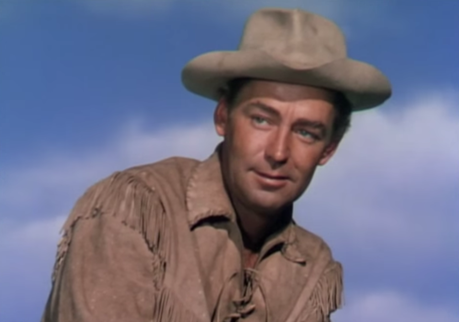
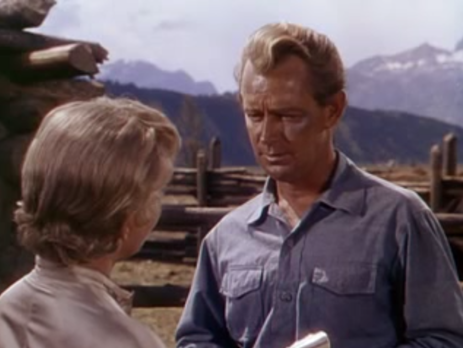
shane1Jackson Hole, Wyoming and the looming Tetons lend the same iconic majesty to this western that Monument Valley does for many of Ford’s best pictures. But then again, George Stevens was another master and he too was changed by the war, coming back with a different tone and an “American Trilogy” that included some of his best work. Shot in Technicolor, this picture boasts more than wide open spaces and raw Midwestern imagery. Stevens has some wonderfully constructed sequences and there are a number of great characters to inhabit them.

Shane is the eponymous gunman who is content to linger in the background while others become the focal point. Namely, Joe Starrett (Van Heflin), a man who came to the untamed land due to the Homestead Act and won’t let the rancher Stryker muscle them off the land that he believes is rightfully theirs. Despite this being her final film — and a favor to her previous collaborator Stevens — Jean Arthur is as wonderful as ever. The character Marian is brimming with goodness and a sensitivity that is hard to discount. It’s a part very different than her earlier work and yet she plays it so wonderfully. As for newcomer Brandon De Wilde, he’s an astute little actor and we really see this world through his eyes, so he does wonders to hold the story together.

Grafton’s general store and saloon become a wonderful arena of conflict within the film because it is rather like Ryker’s stomping ground since he and his men can always be found lounging around there when they aren’t terrorizing some poor sodbuster. After he agrees to work for Starrett, Shane goes into town for new duds, leaving his gun behind, and he quickly learns what he’s in for. It’s in such a scene that we learn who this man really is. He’s not a hot-head and he initially takes the abuse of Stryker’s guns, who call him out for purchasing soda pop. It’s for the boy Joey, but he doesn’t have to say that, because he needs not prove himself, at least not yet. Also, the relationship between Shane and Marian might be troubling to some — will they fall for each other — but when Ryker makes insinuations about Starrett’s wife, Shane is quick to shut him up. He’s not that kind of man. When Shane does return to the store, he’s prepared this time for retaliation and although it might not have been the smartest thing, it sure is gratifying for him and for the audience. He and Starrett make a killer team, after all, beaten and bruised as they end up.

shane2What follows is retribution from Stryker as he tries to buy out, threaten, and continually lean on the sodbusters, but Starrett remains resolute in keeping his friends together. In fact, there’s still time to share a wonderful Fourth of July dance with all the neighbors and it shows signs of a brighter, happier time that could be possible. With neighbors joining together in simple community and sharing life together. Shane feels somewhat out of place in this type of environment, and maybe deep down he knows it too, but he seems oddly content.

This happy time is juxtaposed with the funeral of ornery “Stonewall” (Elisha Cook Jr.), who was gunned down near the saloon by hired gun Jack Wilson (Jack Palance). His death is making some of the others jumpy, but once again Starrett keeps his group together, by first giving their former friend a proper burial and banding together once more. But by this point, they’re barely hanging on. Stryker’s got them on the run and Joe knows he needs to have it out with his arch-nemesis once and for all if things are ever going to return to the status quo. His dreams of ending this whole thing are ludicrous because there is no way he can get out alive. His wife knows it. He knows it, but it doesn’t stop him and his American Dream.

shane3It’s interesting how Shane at first does not try to stop him, but then he gets tipped off to what awaits Joe, and he decides to go in his place. This is his arena after all. The gun we all fawn over is finally getting put to use as Shane rides into town for the final showdown to have it out with the men in the saloon. However, although the shootout is intense it ends very quickly. Thus, what is really interesting are the moments beforehand where friend is literally fighting friend. Both doing what they think is right. However, since Joey only thinks in absolutes, when he sees Shane hit his father over the back of the head, he initially reacts with hatred towards his fallen hero. He doesn’t understand why all this is necessary. But as time goes on and he sees events unfold, he gets it.

As Shane rides off into the night, Joey yells after him to come back, he cannot bear for this idolized man to ride off. It makes me wonder if young Joey grew up with the image of Shane, the hero of his childhood. The doer of good and the ultimate champion of the oppressed.

The cast was rounded out nicely by some solid supporting players like Palance, Ben Johnson, Edgar Buchanan, Elisha Cook Jr., and down to Ellen Corby and even Nancy Kulp. It’s astounding to think that this film could have starred Monty Clift and William Holden potentially with Katharine Hepburn as well. Because, after all, the casting of Shane feels just right. Clift would have brought depth and emotional chops to the role, as a wonderfully impassioned actor. Just look at George Stevens’ A Place in the Sun (1951) for proof of that. However, what Alan Ladd has is a serenity and simple goodness that still somehow suggests something under the surface. It begs the question, how can someone so upright make a living packing a six-shooter? No doubt I like Holden better as an actor, but Heflin has the scruffy outdoors-man look, while still reflecting high ideals. Hepburn just does not seem to fit a western. This is one of the instances when all the pieces seemed to fit into place and we were blessed by a western classic that never seems to lose its luster. In a sense, we become boys again like Joey, completely in awe of Shane. Let us revel in that feeling, that moment of innocence once more.

5/5 Stars

Ordet (1955)

Ordet1955screenshotCarol Theodor Dreyer’s Ordet is a deeply thought-provoking, spiritual foray into the realms of faith and love. However, it is as much about doubt as it is faith, as much about discord as it is about love. It shows a spectrum that, while irrevocably Danish with its actors and setting (a bit reminiscent of Bergman), still has a universality that correlates to the contemporary world we live in. This later work by Dreyer is deliberate in pace, simple in its misce-en-scene, but the life is breathed into it by the characterizations and a beautifully subtle approach to depicting them.

The story is based off a play by Lutheran Pastor Kaj Munk, which was first performed in 1932. The majority of the tale takes place on a rural farm belonging to aged and bearded widower Morten Borgen. Aside from being a farmer, he is a prominent member of his community and a devout Christian. Now he contents himself smoking his pipe as he has three grown sons and a couple grandchildren.

His first son is happily married to a wonderful woman and mother of two, but he himself is struggling with belief in a God, and he acknowledges lacking faith in such things. His wife continues to encourage him, but he knows that such news will deeply trouble his father.

Johannes, the middle son, began believing he himself was the incarnation of Jesus Christ after deluging himself with the works of the famed Christian existentialist Soren Kierkegaard. So now he goes around spouting off scripture and calling out those around him for their lack of faith. What makes it so mesmerizing is the dazed sincerity behind each word. He truly believes what he is saying.

Finally Borgen’s third boy, Anders, is deeply taken with a girl named Anne from the nearby town, but of course her father Peter is from a different sect, and so everyone knows that neither father would willingly agree to a marriage.

These are the problems that plague the Borgen family, so they are undoubtedly commonplace in any spiritual community. Dreyer depicts it all in very mundane terms but not as unimportant, not without a deft hand and sensitive touch.

There is one scene in particular that comes to mind. The young girl Inger, a namesake for her mother, comes up behind her uncle Johannes and with all sincerity, in her eyes and voice, she begins to ask him to raise her mother from the dead. They talk about it for a time and while they talk pensively the camera slowly makes a spiral around them. Now if this was Tarantino (in Django for instance), he would need to bring attention to his camera and the scene loses all of its impact, because he’s a director who is often about as subdued as a toothache. But with Dreyer there is a sensitivity to his movement that’s gracefully smooth, accentuated by his long takes, with a simple backdrop, and pinpoint lighting.

Between the bickering over Ander’s betrothal and the sudden decline in the condition of the pregnant Inger,  there is a lot of soul searching to be done and problems to be parsed through. In a sense, it looks like any life full of conflict, pain, and unforeseeable suffering. It’s all there and it hurts the Borgen family and turns neighbor against neighbor. This film has so many different worldviews and philosophy colliding at once. There are those who are devout in their faith, but their faiths differ. There are those who doubt it all or want cold hard facts. Some have blind faith and others are off-putting with their message. Then there those who seem content in their spiritual lives even though they are not perfect people. So essentially we have almost every iteration or cross-section of society, at least to some degree. It makes for an interesting battleground, but within that, it’s interesting how these characters start to find common ground and build rapport instead of breeding bitterness.

Furthermore, the final moments of the film are so surprising in their sincerity as they are for what actually happens. It’s in a sense wholly unbelievable, but we don’t disbelieve it — in fact, we want it — because we have followed this film thus far. What happened felt so close to home and so the ending, although somewhat unusual, feels right. It’s a strikingly beautiful conclusion to a film that speaks to our doubts, questions about faith, and ultimately our capacity to love and be loved.

This is the sort of film that would probably never see the light of day in Hollywood. It’s either you make God’s Not Dead or something that has no spirituality in it whatsoever. Ordet goes far beyond the depth of such films and it is better for it. I will not say I agree with everything that each character says, but that’s the point, because they all come from different perspectives. The best we can do is come and try to understand what others think so we can move forward from there. But spiritual conversations matter.

4.5/5 Stars

La Strada (1954)

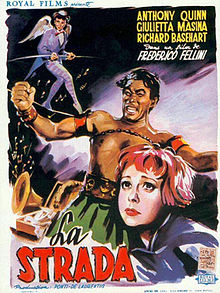
220px-La_Strada_PosterFederico Fellini’s La Strada is in the tradition of other films like Chaplin’s The Circus (1928) and even Nightmare Alley (1947). He even goes so far as to feature two regular Hollywood performers in Anthony Quinn and Richard Basehart. This film is prominent for helping the Italian master achieve mainstream success, and it functions as a sort of crossroads. It still has one foot planted in a neorealist world with the other slowly entering a world of whimsy. It also suffered a production schedule that was as plagued with problems as the characters depicted therein.

The plot itself is relatively straightforward following a volatile strongman (Quinn) who buys a shy young woman off her mother to travel from town to town with him. He’s a real entertainer, and he teaches her most of what he knows so she can assist in the act. However, when they’re not working together, and the show is done, he goes right back to treating her badly and making life quite miserable for her. Zampano’s not the understanding sort.

Giulietta Masina has a starry-eyed quizzical face that elicits not so much a negative response, but one of perplexment. It’s the perfect visage for say a clown (which she masquerades as) since it can be so jovial and in the same instant sad and somehow distant. As her life on the road progresses she finally forgets loyalty and goes on her own to get away from Zampano’s abuse. While being alone she comes across the performance of a skilled acrobat (Richard Basehart) and what follows is a rocky partnership in a rat tag act that once again includes the strongman. But the constant heckling and joking of “The Fool” gets on Zampano’s nerves until things start to get violent. Once he gets out of prison for his behavior, he and Gelsomina get back together, but a run-in once more with his old nemesis turns out badly.

This time all the wind is taken out of her sails after what happens. She is a mime without any emotion, hardly any life left in her. One night Zampano leaves her behind in the night never to see or hear from her again. His existence from then on is as dismal as Gelsomina’s outcome.

Fellini himself suggested that La Strada was a very personal film, and it brings into question if he had a bit of Zampano and Gelsomina inside himself. La Strada also lacks the excess of his later films, instead contenting itself with simple roads and humble people — a stream of beautifully austere images without much extravagance. Also, with the character of Gelsomina comes a wistfulness that drives the tone of the film. As she contemplates with “The Fool,” everything must have a purpose, because if even a pebble has no purpose then everything is pointless. It’s in many ways a dismally bleak film, but still enduringly interesting.

4/5 Stars

Pillow Talk (1959)

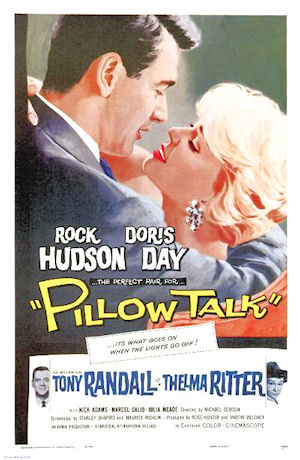
Pillowtalk_posterIt’s the original Rock Hudson Doris Day Rom-Com, with the seemingly perpetual split screen, to match the party line that constantly weaves its way through the story. It’s technicolor, it has an infectious title track, and it’s absurd wackiness somehow adds up to a boy-gets-girl happy ending.

The imposing and dashing Hudson plays songwriter and major playboy Brad Allen, before masquerading as tenderhearted Texan Rex Stetson. But how does he get there? What causes him to play such a ludicrous part? It comes in the form of Jan Morrow, our peppy platinum-haired interior decorator who has had just about enough of her party-line partner, the estimable Mr. Allen.

Her often swanked housekeeper Alma (Thelma Ritter) doesn’t mind eavesdropping and swooning along with all the other impressionable women he romances over the telephone. Jan, on the other, thinks it’s sickening behavior for a man. She would never allow herself to be taken in by such a cad.

Of course, there’s more to the story since one of Jan’s clients, the neurotic millionaire Johnathan Forbes (Tony Randall), is madly in love with her. There’s another wrinkle though, that’s far more important. He knows Allen from his college days. When Brad gets his first view of Jan, she’s an absolute knockout and he wants to win her over, but she hates his guts, at least over the phone. Enter a sweetly sincere Texan and she is swept off her feet surreptitiously.

Brad manages the charade for some time, but for the comedy to work, it must all come crumbling down. In this case, as expected, Ms. Morrow and Mr. Forbes figure things out at almost the same precise moment. It looks like Brad is sunk for good. There’s no hope for such a louse. But then again, if Pillow Talk ended there, it’s audience would be left muttering despairingly and crying inconsolably. The exclamation point comes when Hudson pulls his bride-to-be out of her bed and forcibly carries her through the streets of New York. It sets the stage for some quips perfectly at home in a quaint bedroom comedy plucked out of the 1950s.

Day and Hudson were stupendously popular with the populous and this film would begin their string of pictures together. Although they never reached the excellence, or more aptly, the above-averageness of Pillow Talk, they have remained relatively popular even to this day. Ms. Day was always a fan favorite and rightly so with her impeccably powerful voice, raucous comedic performances, and self-assured charm. And she’s still with us bless her heart! It will undoubtedly be antiquated and overly saccharine to many, but if you have a soft spot for either  Rock or Doris, then enjoy it without reservations. It’s a rather entertaining guilty pleasure.

3.5/5 Stars

Brad: Look, I don’t know what’s bothering you, but don’t take your bedroom problems out on me.

Jan: I have no bedroom problems. There’s nothing in my bedroom that bothers me.

Brad: Oh-h-h-h. That’s too bad.

Royal Wedding (1951)

royalwedding1The Wedding of Queen Elizabeth and Prince Phillip was a once in a lifetime experience. They’re still together to this day and yet when they got married she was not even queen yet. It’s hard to believe. It’s only fitting that a momentous occasion like that would get a film, and Stanley Donen‘s musical is a bouncy little dance fest that uses the wedding as its backdrop, hence the title.

The story follows the brother-sister dance team extraordinaire of Tom (Fred Astaire) and Ellen Bowden (Jane Powell), who after a smashing opening weekend of their show Every Night on Sunday, get a call to perform in London in the wake of the big occasion. So they get aboard the first ocean liner available and head abroad. Tom is more interested in work than love, and Ellen leaves behind a string of beaus behind, but none of them meant much to her. She finds a budding romance with Lord Brindale (Peter Lawford), and it looks like it might actually amount to something. Quite by chance, Tom finds out a woman he meets on the street happens to be part of their production, the dancer Anne Ashmond (none other than Winston Churchill’s daughter Sarah). So of course, we have these two budding romances forming as the show gets into high gear and siblings must balance their obligations with love. It’s not always easy or without heartache, but it ends up just as glorious as the Royal Wedding.

Fred Astaire is an ageless wonder looking as spry as he ever did, and his individual numbers are probably the film’s best. His coat rack dance in the gym seemingly pays homage to his friend Gene Kelly and shows his brilliance at breathing life and vitality into inanimate objects. They become his partners in the dance. His inspiration for expression.

royalwedding2Furthermore, his dance on the ceiling looks as remarkable now and feels just as magical as it probably was back then. It’s a marvel because we look for any sign of a trick, but everything looks so fluid. Thus, it’s so easy to quickly forget the technical aspect and simply be blown away by the inventiveness of Astaire.

Jane Powell is a wonderfully bright young beauty and a lovely co-star for Astaire in both song and dance. It was refreshing not to have them playing romantic leads opposite one another and the brother-sister dynamic fittingly mirrored Astaire’s own longtime real-life partnership with his sister Adele. All in all, it’s a light and elegant bit of fun that’s an exuberant delight. It does what it sets out to do and that’s about all you can ask for.

3.5/5 Stars

Review: North By Northwest (1959)

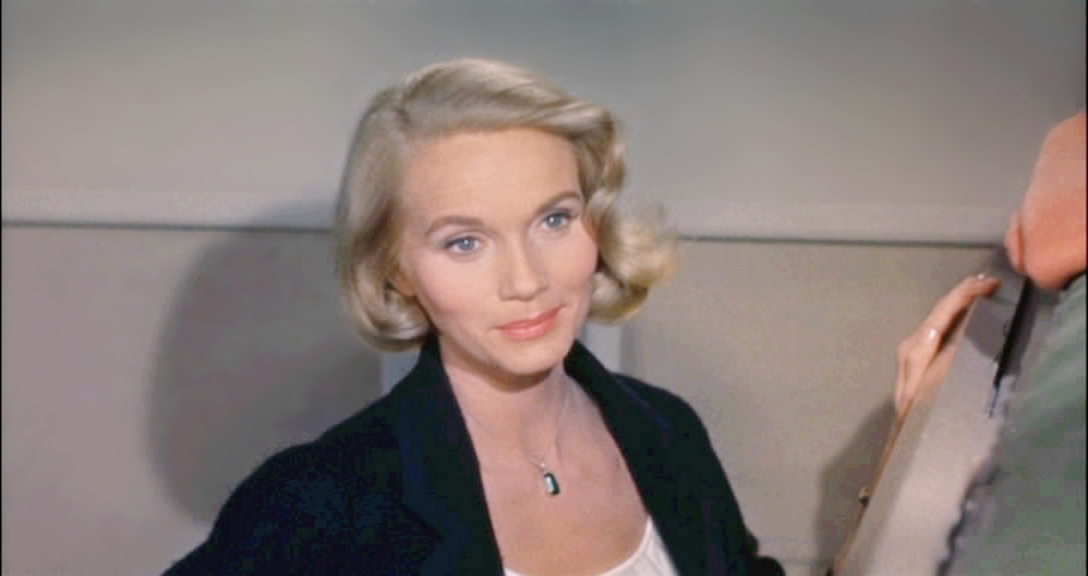
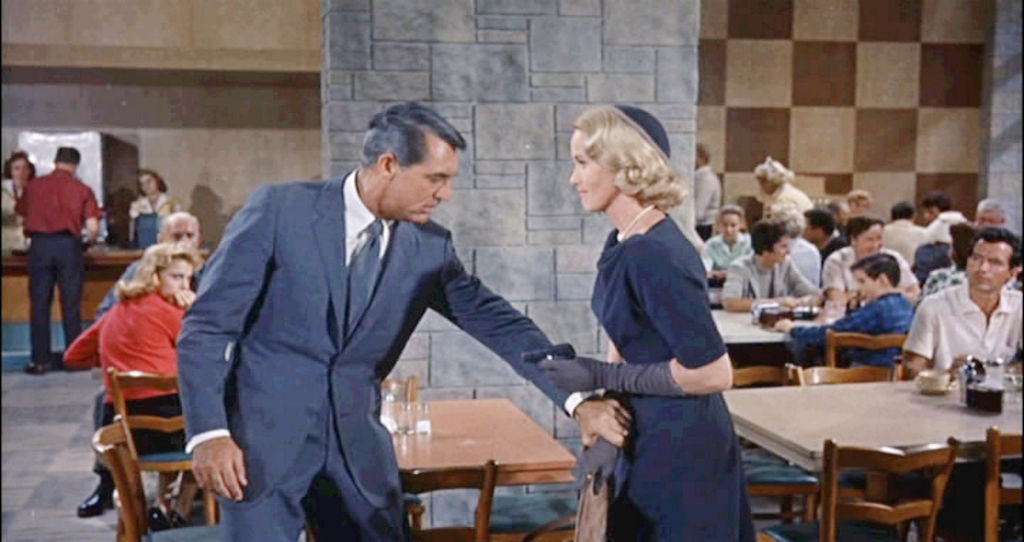
1024px-North_by_Northwest_movie_trailer_screenshot_(6)Wedged between two landmark Hitchcock films in Vertigo (1958) and Psycho (1960), North by Northwest is iconic in its own right, but it boasts sprawling adventure and a bit of a lighter tone. It’s rather like Teddy Roosevelt wedged in between Jefferson and Lincoln on Mt. Rushmore but that comes later.

Supposedly the film was once to be called In Lincoln’s Nose, but when the now famous slanted North by Northwest logo hits the screen you instantly know you’re in for something extraordinary. The title sequence is wonderfully exciting given a boost by yet another impeccable score from Bernard Hermann.

This film is once again beautifully shot in color (VistaVision), but it covers more ground than Vertigo and has far more elaborate set pieces. The action begins ordinarily enough at an office building where advertising man Roger O. Thornhill (Cary Grant) makes his way out of the office. It’s a busy day at the office, but Roger has a dinner engagement and an evening at the theater to look forward to. His plans and his whole life are put on hold after he fatefully flags down a waiter.

His actions don’t go unnoticed and two menacing men lead him off at gunpoint as he tries to head to a phone. He is utterly confused, but we know it has something to do with the name George Caplan. These men think that’s who he is, and not to be persuaded otherwise, they take him to their leader (James Mason), who is very interested to meet him. Over the course of a harrowing evening, Thornhill is left on the edge of the road in a completely drunken state to die. But instead he gets brought in on a drunk driving charge and of course, no one will believe his cockamamie story, even his skeptical mother (Jesse Royce Landis).

North_by_Northwest_movie_trailer_screenshot_(21)Next, it’s onto the U.N. Building to find out who Lester Townsend is, but of course, his captors are on his trail and just like that Thornhill is framed for murder and a fugitive on the run from the thugs and the cops. He tries to get away train ticket out of town, but in order to evade the law he ducks onto a train and meets the pretty blonde Eve Kendall (Eva Marie Sainte), who extends a favor. Little does he know what her angle is. Right now all he cares about is a little tete a tete and perhaps an amorous evening.

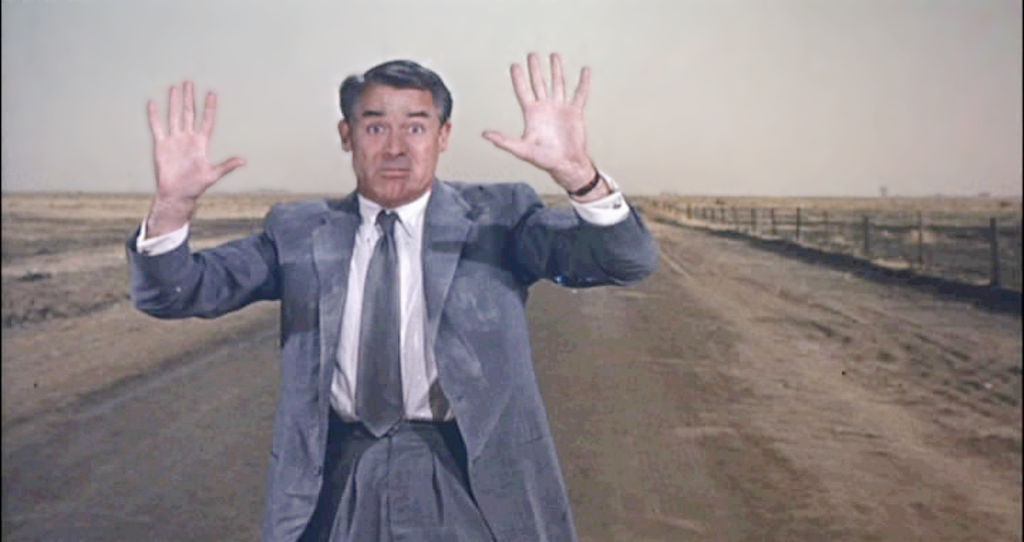
Kendall wistfully sends her new lover off to meet Caplan. Instead, he is met by a bi-plane and once again running for his life. But the build-up of this now iconic scene is wonderful. Hitchcock utilizes his background in silents to allow the scene to progress without hardly any dialogue and it unfolds ominously. However, he proves that even on an isolated roadside stop danger can still be present. Thornhill has new opinions of Kendall now and continues following the trail of Caplan which leads him to his old nemesis (Mason) and wouldn’t you know, Eve is by his side.

North_by_Northwest_movie_trailer_screenshot_(31)Roger feels like he has everything figured out, but he gets a visit from the mysterious Professor (Leo G. Carroll), who helps straighten him out with all the business surrounding the elusive George Caplan. With this new insight, Roger goes to the Professor to Rapid City and the one and only Mount Rushmore. It’s the perfect spot for a Hitchcockian finale to satisfy the director’s flair for the thematic.

North By Northwest is fun because we get to be right alongside Grant when he gets caught up in the whole mess. Although we see the picture a little more clearly than him, all the details are not handed over to us. So in a sense Hitch lets us in on a few secrets without showing us his entire hand. The staging is also wonderful whether it is the U.N. Building (with that marvelous aerial shot), or desolate Bakersfield, and even the soundstage set up to look like the surrounding area of Mt. Rushmore. It’s such a contrast to Rear Window and it uses the scenery very effectively similar to Vertigo.

Ernest Lehman’s script simply put is a lot of fun, because we have our villains, we have our romantic leads having a lot of great scenes together, and the pacing is surprisingly good. I am amazed how spry Cary Grant looks for his age (especially compared to aging Jimmy Stewart). Eva Marie Saint is great and in my estimation, she is the second-best Hitchcock Blonde following Grace Kelly, but you can easily disagree. James Mason plays yet another debonair villain and there are a handful of fun appearances by the likes of Martin Landau and Edward Platt.

One reason I’m constantly drawn to this film is that it feels rather like a road trip as we slowly cross the continental United States with Cary Grant. Furthermore, it’s simply good, unadulterated fun. There’s not a ton of analysis or commentary to mull over or to think deeply about (maybe some implications to the Cold War). But I’m content to sit back and watch with glee as a crop duster nearly clotheslines Cary Grant. Movies don’t get much better than this, seriously.

5/5 Stars

A Christmas Carol (1951)

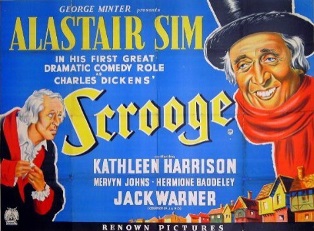
Scrooge_–_1951_UK_film_posterOftentimes during the holidays, we are quick to label someone a “Scrooge,” almost jokingly because it’s a moniker that’s somehow lost a great deal of its magnitude with overuse and the passage of time. However, if we look at this film, so wonderfully anchored by Alastair Sim, and even Charles Dickens original work from which it is derivative, we would adopt a much wider definition of the word “Scrooge.”

Surely it is the archetypal Christmas tale and one of the most widely adapted works. Off the top of my head, I can think of versions from 1938, ’51, ’70, ’84, and 2009, not to mention countless retellings by Disney, Mr. Magoo, the Muppets, and Bill Murray no less.

We all know at least a little of the legend of Ebenezer Scrooge, and we can come up with a rough composite of what he must be like. He’s money-grubbing, has no spirit, and hates Christmas. If you say any of this you would be, in fact, most heartily correct, but there’s so much more to his character and his story. It’s far more universal than perhaps I would even give it credit for.

The narrative is beautifully elongated with the device of the three specters represented by the Ghosts of Christmas Past, Present, and Future respectively. Of course, it takes the apparition of his long-deceased partner Jacob Marley to scare Ebenezer out of the status quo — out of exactly the kind of person we assume him to be. But the key is he wasn’t always about the “humbugs” and lack of charity towards the poor and needy.

We learn about his story more in depth by the illumination of the first ghost. Scrooge began, a relatively humble young man, but his sister Fan had great affection for him, and he found a young woman named Anne, who loved him in spite of his lowly status. Money did not define their happiness — in fact, they were happier without it. But the way of the world back then was, and still is now, the pursuit of happiness by way of money. In a sense, although Scrooge greatly admired his generous employer Fezziwig, he became scared by the ways of the world. Once joining forces with another ambitious gentleman Jacob Marley, the two of them pressed their advantages when necessary and expanded their assets exponentially. The sweet, savory call of money quickly seduced them and as a result hardened their hearts. You see in the moments where Scrooge loses his sister and breaks off his engagement, that they are so emotionally charged even in the present. He hasn’t quite found a way to alleviate the pain because not even money can satiate that hurt.

The ghost of Christmas present shows him the inside of the humble Cratchit home, bringing to mind his previous comments about prisons and workhouses — as one of their foremost supporters. But the Cratchits, and specifically young Tiny Tim give a humanity to the common man like he has never seen before. He realizes that he has failed miserably in doing one of the most basic things — loving his fellow man and taking care of the widows and orphans. Scrooge still clings to the most poisonous belief that he is too far gone and he cannot be redeemed. That’s why what the Ghost of Christmas Yet to Come shows him scares him the most. The pictures he sees ahead of him are haunting and all too real, but it makes his opportunity at a second chance all the sweeter.

In truth, when Scrooge wakes up from his dream-filled slumber he’s giddy almost to the point of insanity, but Alastair Sim is so brilliant to play his part that way. His character change is so radical because his paradigm has been completely overturned. It shows in how he interacts with his world whether it’s his housekeeper, a lad on the street, his nephew, or even the long-suffering Bob Cratchit. Ebenezer Scrooge represents the hope of Christmas when mankind begins living for their fellow man instead of all the fortunes in the world that will only grow old and dusty. Thus, before calling someone “a Scrooge,” it is best to take note of what you’re saying and then get the whole story. People are a lot more complex than we often give them credit for. That becomes obvious even in this streamlined Christmas classic of only 86 minutes.

4/5 Stars