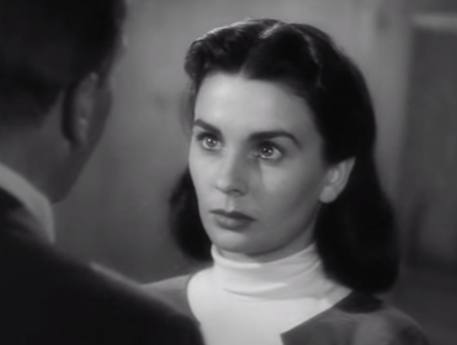
Review: Vertigo (1958)

Vertigo_1958_trailer_embrace“The Greatest Film of All Time.” It certainly seems like an arbitrary title, but if nothing else it gives film aficionados something to discuss. And that’s what Alfred Hitchcock’s Vertigo is now being called for many reasons. Rather than join the debate, I wish to take a few moments to acknowledge what makes the film itself special.

On the surface, shall we say the first viewing, Vertigo is thoroughly enjoyable as a psychological thriller and mystery. The title sequence is haunting with an eye staring back at us from behind the credits and as an audience we are quickly thrown into the action, watching the opening chase scene unfold. In only a few moments one man is dead and the other John “Scottie” Ferguson (James Stewart) now has debilitating vertigo that takes him off the police force. We never learn why they were chasing a man on the rooftops. It doesn’t really matter. It’s a time later with his friend Midge (Barbara Bel Geddes) that we first see Scottie after the harrowing events. She obviously cares deeply for him, and he sees her simply as a good friend so we can undoubtedly expect her to be in the film more.

Then, rather mysteriously, an old school acquaintance named Elster (Tom Helmore) calls up Ferguson, hoping to get him to shadow his wife. It has nothing to do with infidelity, but fear, because the worried husband believes that something is wrong with his wife Madeleine. She disappears for hours at a time and is barely conscious half the time. He would describe her as possessed and Scottie is noticeably skeptical. But he relents and agrees to tail her sending himself spinning headlong into a mystery that will become his obsession.

Vertigo_1958_trailer_NovakHe gets to know Madeleine by following her, all throughout the streets of San Francisco, and much like Rear Window, this part of the film becomes a repetition of scenes followed by the reactions of Stewart. Hitchcock’s background in silents is seemingly at work here as he lets the images and score of Bernard Hermann take center stage along with Stewart’s expressions. We end up all over, from a flower stand to a cemetery, an art museum, and an old hotel. Madeleine goes from place to place like a solemn specter and we watch in expectation. Something must happen.

In an instant, she leaps into the water near the Golden Gate to commit suicide and that’s when Scottie swoops in to rescue her. He can’t lose her now because by this point he’s entranced by the icy blond who he only knows from a distance. And so their relationship progresses if you can call it that. They wander together and Madeleine shares her nightmares with Scottie.

The two of them head to San Juan Bautista and that’s when the nightmares become a reality for both of them. It’s devastating to Scottie, and the second phase of the film begins. He’s inconsolable and madly in love with this girl he cannot have. She’s hardly real. But then wandering the streets listlessly he spies Judy Barton, who coincidentally looks strikingly like Madeleine.

So he does the only thing that he can think of, meet her and try to turn into the girl he so desires. His obsessions are the only things that drive him, that and the haunting memories. Finally, he figures out the mystery, but the swirling cycle continues as he goes back to San Juan Bautista. A cruel twist of deja vu rears it’s ugly head once more.

Vertigo_1958_trailer_Kim_Novak_at_Golden_Gate_Bridge_Fort_PointHitchcock always was one for visual showmanship and it reveals itself whether it’s the parallel symbolism that Scottie notes in the painting of Carlotta Valdes or the out-of-body dream sequence that he suffers through. There’s also the dizzying zoom creating the so-called Vertigo Effect whenever Stewart looks down from a great height. These are obvious visual flourishes, but it’s almost more interesting to watch our main characters walk the streets of San Francisco, especially since there are so many real landmarks to work with (ie. Golden Gate, Mission San Juan Bautista, Muir Woods National Monument, and the Coit Tower among others). There’s something mesmerizing and trance-like about all these scenes that’s difficult to discount. It pulls us in as an audience. We want to see more. Bernard Hermann’s score is, of course, noteworthy and at its core, there is a constant disconcerting quality. It is strangely majestic and beautiful, but it pounds away menacingly. And it spirals in and out with the same sounds, the same crescendos. You think you would get sick of it, but strangely enough, you don’t. It enraptures us.
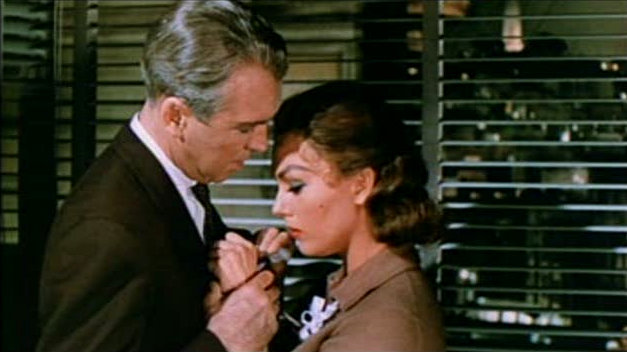
Vertigo_1958_trailer_embrace_2Then there are the players. Kim Novak has the dual role as Madeleine and Judy. She carries out both with the needed precision. Elster’s wife is elegantly beautiful, aloof and ethereal in a way that makes her the obvious fantasy of Stewart’s character. When she casts a sidelong glance or stares up at Stewart there is a faraway quality in her eyes. The clothes. The hair. How she talks. Even how she carries herself. She is spellbinding, otherworldly, and almost unattainable in all ways. Then there’s Judy, the epitome of a Midwestern girl. Pretty but not elegant. Smart but not cultured. But she falls for Ferguson as he falls for an impossible ideal.

Vertigo_1958_trailer_Stewart_on_a_laddderJames Stewart is an important piece in this film because it’s his character’s obsession that drives the plot. His instabilities, his desires, his anguish, his vertigo. It has been said that Stewart himself is a stand-in for Hitchcock and the own inner workings of the director’s being. His obsession and lusts. That may be true but something else that could be inferred is that Stewart is really a stand-in for all of us. After all, there was no greater every man than him, but there also is a universal quality to the baggage weighing on his being. Stewart’s every man is certainly being subverted, or could it be he is becoming a more accurate depiction of everyone? It’s a scary thought but what is buried inside of us? What are our own fantasies, obsessions, and lusts that lurk under the surface? Let me put it a different way.

For Stewart, he has three prominent women in his life. There’s the fantasy in Madeleine, the perfect ideal, who will ultimately ruin his life because intimacy with her is impossible. There’s Judy who has a passionate love for him, but it seems complicated in so many ways. She’s trying to measure up to his standards. The ideals and fantasies he has created poison what they could have. Then, there’s Midge who is practical, funny, and also completely devoted to Scottie. If his head were on straight he would go right to her because he would undoubtedly find the most satisfaction in that relationship, but his obsessions have undermined that.

There was an alternate ending of the film which showed Scottie with Midge once more, listening on the radio about Elster’s capture. The ending that was kept is more powerful, not because Elster got away scotch free, but because we don’t see Midge again. She all but disappears by the end of the film and with her goes all that could have been decent and good about reality for Scottie. He gets so caught up in fantasy and that tears his life apart. He’s literally spiraling in a web of never-ending hellish obsession.  Who knows what becomes of him? We can only guess.

5/5 Stars
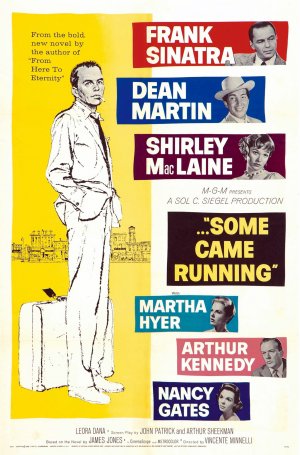
Some Came Running (1958)

Poster_of_the_movie_Some_Came_RunningSome Came Running is a film that can so easily get lost in the shuffle of 1950s Hollywood. It’s hardly the most well-known picture of director Vincente Minnelli, known generally for his musicals and excellent set direction. Furthermore, this is most certainly a melodrama, certainly affecting, but not quite as falsely superficial to the degree of Douglas Sirk’s work. In a way, it feels like a 50s variation on The Best Years of Our Lives.

In the post-war years drifting vet and one-time author Dave Hirsh (Frank Sinatra) comes back to the town he skipped out on as a young kid. He’s a bit hung over getting off the Greyhound and realizes he has another traveler in his wake. The fellow passenger is the potentially disreputable and slightly dumb Ginny Moorehead (Shirley MacLaine), who came along for the ride from Chicago on his invitation.

Now that he’s back home, he just wants Ginny to head back the way she came, while he gets over with the obligatory meeting with his older brother. After handing his brother over to a boarding school, Frank Hirsh (Arthur Kennedy) did pretty well for himself. He married a wife (Leora Dana) from a good family and inherited a profitable jewelry business. By now he’s living the American Dream and his daughter Dawn (Betty Lou Keim) is growing up to be a beautiful young woman. In fact, you might call Frank a pillar of society, because everything’s working for him and people look up to him for what he has made for himself.

Thus, the arrival of Dave is not without its problems. The brothers have not talked for well nigh 16 years now. Frank looks to play things up like nothing’s changed and they’re both pals. He sets his brother up to an evening with a Professor French and his beautiful and highly intelligent daughter Gwen (Martha Hyer), who happens to be a literature teacher at the local high school. This is his way of trying to get his brother into good company. After all, he can’t bear that people should talk. He’s got a reputation to uphold.

But Dave’s not much for that type of company, although he takes a liking to Gwen, who avoids his advances while still taking a great interest in his work as an author. Furthermore, the cynical drifter begins to keep company with jovial gambler Bama Dillert, played by none other than a boozing, poker playing Dean Martin. Thus, there are some genuinely entertaining moments that feel like nothing more than a Rat Pack hangout.

But Some Came Running is quick to plunge back into dramatic turmoil. There are affairs, hypocrisy, unbridled passion, bar fights, parades, and carnivals all highlighted by the eye-catching staging of Minnelli. In fact, Minnelli always has an eye for his scenes, and there’s nothing different about this film. We are watching the players of course, but the space they fill, the clothes they wear, and so on are almost just as interesting. Colors pop making for vibrant viewing to match the spectacle. The climactic moments feel rather Hitchcockian with the pulse-pounding intensity set to the backdrop of a bustling carnival and the Elmer Bernstein score reverberates with his usual fervor.

Dean Martin is the comedy. Arthur Kennedy is necessary. Shirley MacLaine is the tragedy. Martha Hyer is rationality. But Frank Sinatra is the core of this film because he balances a surface level cynicism with genuine affection. He shows his interior on multiple occasions. His eyes watch over his niece with great care. His heart yearns for Gwen ardently, and he holds a deep sympathy for Ginny. Sinatra was in many quality films, but this is perhaps his greatest performance.

Is it blasphemy that in many ways I appreciate this James Jones adaptation just as much, if not more than, the long-heralded From Here to Eternity?  I suppose I am entitled to my opinion.

4/5 Stars

Ugetsu (1953)

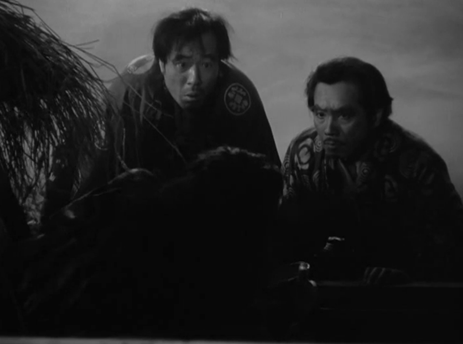
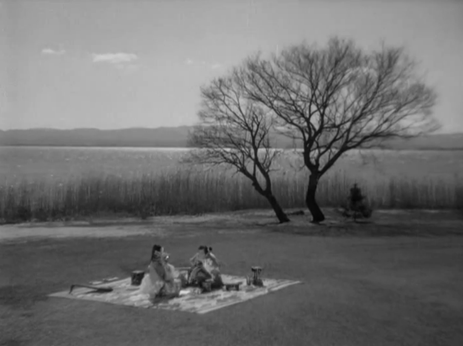
ugetsu1During my film odyssey, I first met Kurosawa, then Ozu, and finally Mizoguchi. Each with similarities and most importantly their own personal touches when it comes to the language of cinema. Kenji Mizoguchi seems especially at home with Japanese folk tales in the jidaigeki mode of Japanese period-dramas. Ugetsu finds its inspiration in such a fable from 18th-century author Ueda Akinari, and it also gathers some inspiration from scroll painting. As the narrative arc begins, it’s as if the story is slowly getting rolled out bit by bit with the camera slowly tracking with the action.

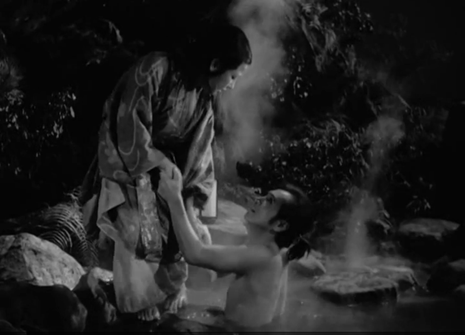
In this case, our subject is a group peasant villagers who live with their wives. Genjuro is a farmer with a penchant for pottery, who has a little boy together with his wife Miyagi. Then, there is the often buffoonish Tobei, who has fantasies of one day becoming a samurai. His wife Ohama often becomes annoyed with his obsession. When marauders come and uproot them from their homes and yet they remain together. However, with the progression of time, Genjuro has become more obsessive over his pottery as avarice overtakes him, and Tobei can no longer quell his desire for military honor. Miyagi particularly notices a change in her husband, because money has become his everything and he has put his heart and soul into that kiln of his. True, it seems to pay heavy dividends when he takes his wares to the marketplace and gets a pretty penny, while also meeting the ravishingly beautiful Lady Wakasa.

ugetsu3For our male protagonists, their wildest dreams begin to play out. Genjuro has begun a euphoric fling with his new mistress with little concern for his wife and child he left behind. Simultaneously Tobei in a stroke of good-fortune captures the severed head of a high ranking general. Although he’s a nobody, he gets in with the right crowd and his greatest wish is granted. He becomes a big shot samurai complete with weapons, armor, tassels, and an imposing entourage.

Meanwhile, unspeakable things are happening to the women in their lives, but the men seem to be lost in their dreams. When they finally are given a heavy dose of reality, it can be painful, even violently chaotic at times. And yet the reality check proves necessary because in a way it allows these men to shake off the ethereal and live in the present — allowing them to be more fully realized versions of themselves.

ugetsu2Mizoguchi rather like Fellini has a great interest in the supernatural or at least dream worlds. It’s far from nightmarish horror at least in the modern sense, but it is an everyday type of horror, where husbands act out on their darkest desires, family members die, and so on. Some would say this is far worst because it hits closer to home. The world of dreamscapes and ghosts overlap with reality.

The director is also constantly utilizing long takes, but they’re far from stagnant, very often panning to the left to accentuate the feel of a scroll being unfurled. Especially in the marketplace you get the sense that you could easily be lost in a sea of people, but Mizoguchi only goes to close-ups at the most opportune moments. Otherwise, he is best suited in pseudo outdoors settings — integrating architecture and nature in perfect cohesion. These facades are put up for people to interact with whether it’s a hut or an outdoor pool, but it never loses its naturalistic beauty.

It feels quintessentially different than his contemporaries, allowing for a thoroughly unique view of the human condition. Certain types of ghosts haunt all of us whether they are choices that we wish we could take back or the hand we are dealt when our lives began. Thus, Ugetsu is remarkably poignant even in its antiquity.

5/5 Stars

5 Fingers (1952)

5fingersHonestly, this doesn’t feel like a typical Joseph L. Mankiewicz film. It was written by someone else and because he was nearing the end of his contract with 20th Century, he didn’t end up editing the project. Supposedly the overseeing of Daryl Zanuck led to several scenes being scrapped which Mankiewicz thought were good. Also, as a director, his name does not usually scream spy thriller like an Alfred Hitchcock. He’s more in his element with cultured dramas about relationships. However, 5 Fingers is still an engaging tale based on the historical wartime events surrounding the informant code-named Cicero.

In real life, Elyesa Bazna was an Albanian born valet who worked under the British ambassador to Turkey. He played both sides, first ingratiating himself as a gentleman among the Brits and then taking pictures of top secret information and passing it off to the Germans in the period between 1943-44. Cicero, as he was called, could easily come off as an abhorrent traitor and yet James Mason plays his character Diello with an adeptness that is underlined with an air of civility. We don’t particularly care for the man, but he’s not a monster, just a bit crooked and concerned with personal gain. Mason certainly did have a knack for playing the criminal type and I must admit I’m curious to watch more films with him because his performances have not quite won me over yet. There’s still time for that.

The film altogether is not that tense, but it does set the groundwork for some interesting interactions which all seem to stem from Cicero. He is subservient and aloof when it comes to serving the ambassador. He’s quite open with the Countess Anna Staviska (Danielle Darreux), who turns into a confident, romantic partner, and in some ways an accomplice — just wait. Meanwhile, he deals with the Germans self-assuredly knowing what he wants and how he’s going to get it. He’s no slouch and he seems devilishly good at the spy game.

Throw in some double-crossing from the countess and a dynamite word like “Overlord” (aka D-Day) and Dellio finds himself on the run with the Brit’s counterintelligence operative (Michael Rennie) hot on his tail. Thanks to his assistance, the Germans are trying to protect him as he gets ready to hightail it to South America. There’s one small thing he didn’t account for. He’s been duped. He and the countess both. All he can do is break out in a fit of laughter. I’m not sure if that’s how the real story ended — probably not, but it makes for a fitting conclusion of this tale as his money slowly drifts away in the wind.

3.5/5 Stars

No Way Out (1950)

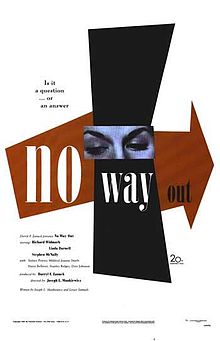
220px-No_Way_Out_(1950_film)_posterI had a preconceived notion that No Way Out might be the kind of social drama that was groundbreaking for its day and by today’s standards looks mundane and quaint. 65 years have passed and this film from Joseph L. Mankiewicz still packs a wallop, believe it or not. We are blessed with the first major role for screen icon Sidney Poitier as young doctor Luther Brooks. His main antagonist is Richard Widmark playing a racist scumbag like he does best, and Linda Darnell also gives a key performance, although her career would soon be on the decline.

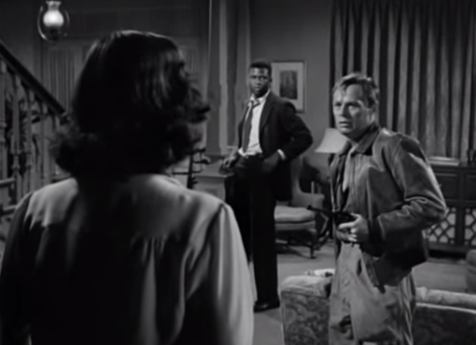
The film opens with the young interning doctor — Poitier was only 22 at the time –getting ready for a night shift. His first customers just happen to be Johnny and Ray Biddle, who both got it in the leg after a botched robbery attempt. At first glance, their wounds look superficial, but Luther notices Johnny is disoriented. His diagnosis is a brain tumor so he tries to administer a spinal tap which ends up unsuccessful, partially due to Ray’s constant berating. But Ray has no sympathy; all he knows is that this black doctor has killed his brother. A white doctor could have saved him and all his prejudiced beliefs of blacks are confirmed. At least that’s what he tells himself in his narrow little mind.  Luther even goes to his superior Dr. Wharton (Stephen McNally), and although he cannot be absolutely certain, he maintains confidence in Luther’s competence.

nowayout1Again that bears little importance to Ray and he will not grant them the opportunity to do an autopsy. After all, his mind is already made up. So the next best thing is to track down Johnny’s former wife Edie (Darnell), who has pulled herself out of the gutter which is Beaver Canal and made a modest living for herself. They want her help, and unbeknownst to them, she does go see Ray. You can see it in how they interact with each other. She was Johnny’s wife once, but there was something between them and Ray won’t let her forget it. That’s undoubtedly why she wanted to get away, but Ray brings out the worst in her. Even as they speak, her racist sentiments come bubbling to the surface. It’s in her veins after all. It doesn’t help that unrest is building in the city. A riot is at hand and the slow build-up leading to the imminent rumble is boiling with tension. Mankiewicz does something important here. He shows both perspectives. I cannot help but think some things have not changed a whole lot over the years. Black vs. white. The same racism. The same belligerence. The same lack of understanding.

nowayout2Of course, after that is all done, that still does not wrap things up with Ray. He still has to settle a score with Luther and he uses Edie against her will. They set a trap at the home of Dr. Wharton for the unsuspecting Luther, and this scene has vital importance to the film, not simply because Biddle and Brooks come face to face once more. This is the scene where Edie must make a choice. Really it’s the universal choice. Stand passively by as injustice is being done or take a stand against it.

So you can make your own diagnosis, but this was not a superficial message movie. It hits fairly hard. I was even surprised by how often Ray Biddle lets the N-word fly. It completely fit Widmark’s characterization, but the production codes allowed it. Supposedly the actor apologized profusely after many of his scenes with Poitier, but his performance is nevertheless potent. It’s certainly convicting and we cannot be too quick to find fault with any of these characters because, truth be told, we all have some apathy and narrow-mindedness stuck inside our skulls. No Way Out is a striking reminder of that.

4/5 Stars

Review: High Noon (1952)

highnoon1Drums softly beating. A voice mournfully bellowing,”Do not forsake me, oh, my darlin‘.” It can only mean one thing, the beginning of High Noon, a western that has grown near and dear to my heart in the recent years. And yet how can a western of under 90 minutes mesmerize and cause goose bumps to form time after time? That opening ballad sung so wonderfully and folksy by Tex Ritter is one great reason. It’s a mournful dirge of a song which nevertheless draws us into this film, and personally, I cannot help but belt out a few lines now and then (I’m unashamed to say I know the whole song). After all, it’s this song that reflects the story of our main character Marshall Will Kane (Gary Cooper) and reiterations of the tune can be heard throughout for the following hour as we all wait for the noon train.

The song makes it clear that Ben Miller is coming after Kane for sending him to prison. He’s got revenge on the mind and three of his buddies, including his brother, are waiting for his arrival, along with everybody else in town. Meanwhile, the Marshall is about to hang up his badge as it were, because he’s gotten hitched to a pretty young quaker (the estimable Grace Kelly), and they look to settle down with a store in some sleepy town. He’s well-deserving of it after all he’s done and the town stands behind him.

But the news of Miller’s return is no way to start the honeymoon. Still, the couple sets off, but Kane turns around realizing he cannot run (I do not know what fate awaits me. I only know I must be brave. For I must face a man who hates me, Or lie a coward, a craven coward; Or lie a coward in my grave).

highnoon4

This is the backdrop that he’s trying to scrounge up a posse with. Others getting out of town, some telling him he should get out of town too, and a general commotion about what they should do about the whole mess. There are numerous cross-sections and enclaves all with different motives and most importantly excuses. They all turn down a chance to help Kane for one reason or another (even his closest friends). It seems so easy to pass judgment, but then again what would we do in such a situation? In fact, it brings to mind the Hollywood Blacklist which this story was supposed to be an allegory for. This is not just some fictionalized parable, it was mirroring real life to some extent.

What really resonates about this film is the resolve of one man, because when it comes down to it, Kane did not need to stay, he did not need to do what he did, but he stood by his guns, literally, when no one else would stand with him. It’s easy to conform, easy to go with the crowd. It takes real courage to walk out on your own — although the Marshall did have a little help. So whether or not John Wayne thought this film was wholly “Un-American” or not, I think I would have to disagree with him on this one. Maybe what Kane has is reluctant courage, and I could see how the Duke would be disgusted by such a “spineless” individual. But for me, he’s all the more relatable played so aptly by Gary Cooper.

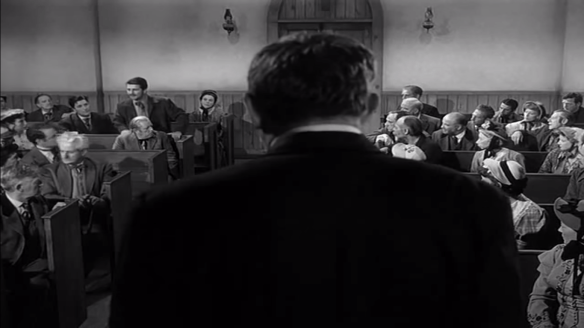
highnoon7It continues to amaze me that a film of this length can have so many wonderful characters who leave an indelible mark on the story. Certainly, you have the hero and the villains, but then we have character actors such as Thomas Mitchell, Harry Morgan, and Lon Chaney Jr. playing some of Kane’s buddies. There’s the gang at the bar and the hotel clerk, who are no friends of the Marshall. There’s his former flame Helen Ramirez (Katy Jurado) and his hot-headed deputy (Beau Bridges). The rest are filled out by men, woman, children, town drunks, and churchgoers. Zinnemann does a wonderful thing aside from just using the clock as a plot device and tension builder. He also calls back all these many characters as the noon train comes in with smoke billowing black. The audience and all these people know what that shrill whistle means. Things are going down, and Kane is going to face it all alone.highnoon2The isolation is so wonderfully conveyed by an aerial shot where the camera moves up to show the stoic Marshall standing in the middle of a ghost town. No people around and no one showing their faces. Then of course, when it’s all over, the floodgates open and all the folks rush into the center of town. Fittingly,  Kane drops his tin star in the dirt in disgust as the refrains of Tex Ritter’s ballad continue.

Put High Noon up against other films and it could be criticized as nothing more than a western, but perhaps that’s why I like it. I cannot help but gravitate towards it. In some ways, it reminds me of growing up and it allows me to forget about any sort of deeper meaning for an instant so I can be fully enraptured with this story, this song, and these characters. It’s a worthy incarnation of the mythic west, that also leaves a little space for some humanity.

People gotta talk themselves into law and order before they do anything about it. Maybe because down deep they don’t care. They just don’t care.” – Martin Howe (Lon Chaney Jr.)

5/5 Stars

Fourteen Hours (1951)

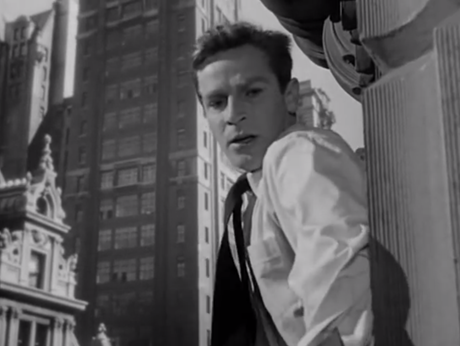
fourteenhours1Fourteen Hours is a taut little thriller, based on real circumstances that occurred in New York in 1938. The film opens with a young man standing on the ledge of a tall hotel in New York City. An unsuspecting waiter happens upon him and a traffic cop (Paul Douglas) spies him from the street below. All of a sudden, a mundane day gets a little more exciting for all the wrong reasons.

Henry Hathaway’s film has the kind of self-contained drama of a modern film like Phone Booth (2002) and a media frenzy that is in some ways similar to Billy Wilder’s Ace in the Hole (1951). Really when you break it down it’s essentially about two men. Robert Cosick (Richard Baseheart) is the despondent and disturbed man tottering on the edge of destruction. He needs a friend. He needs guidance. The rapport built between him and Charlie Dunnigan (Douglas) is what keeps him where he is.

Outside of this main dynamic, we have a lot of smaller events all happening at once. The gruff deputy chief Moskar (Howard Da Silva) tries to work on the inside of the hotel to get the man indoors. A psychiatrist with a hypnotic stair (Martin Gabel) tries to divvy out advice to Dunnigan and others. Meanwhile, Robert’s histrionic mother (Agnes Moorehead) and his plain-speaking father both make appearances, but to no avail. They even finally track down his girl Virginia (Barbara Bel Geddes) in the hopes that she can get him down. All the while the journalists scrounge around for a good story that they can feed to their papers because this is news!

fourteenhours3Down in the streets below young people (Debra Paget and Jefferey Hunter) look up wishing they could do something. The cynical cabbies decide to make a wager on when the man will jump since they aren’t getting any more business for the time being. Even Grace Kelly makes an appearance (her debut), as a young wife who is about to go through with her divorce. But the man on the ledge flusters her and she and her husband have a happy ending.

Hour after hour drags on as Dunnigan continues to work on Robert to get him to come in. He loses his temper once, converses about fishing for floppers, and talks fondly about his wife. By far Paul Douglas is the standout because he has such a genial quality that makes his newfound friend, and the audience, trust him. He’s a good egg as they say, and at the end of the day, he gets to walk off with his wife and son after a good day’s work.

I think it’s true that the film was remade as Man on the Ledge, but I doubt that I would ever want to see it after this film. Don’t get me wrong, it crawls a little bit in the middle, but the combination of this human drama and the plethora of characters lent itself to a generally interesting tale. Also, it’s never static visually. Hathaway gives us a lot to look at. I will admit that several of the storylines were flimsy and unnecessary, but it was still fun to see Grace Kelly for at least a few moments.

3.5/5 Stars

Review: All About Eve (1950)

EveEveMargotCasswellWitt“Fasten your seatbelts. It’s going to be a bumpy night” ~ Margo Channing

It’s cliche, I do admit, but they simply do not make films like this anymore. Stories about people talking where the actors take center stage. In this case, the story from Joseph L. Mankiewicz is about the Broadway stage and all that happens behind the curtains, in the dressing rooms, and behind the closed doors of the royalty of that profession.There is so much that could be dissected, antagonized over, or acknowledged so I will move through it the best way I know how.

A moment must be spent acknowledging that this is the film that revitalized the career of Bette Davis. She was the tops during the 30s and early 40s, but the role of the histrionic stage icon Margo Channing was her comeback and it thoroughly suited Davis. I have actually never been a fan of hers because I always found her rather arrogant and she scares me visually. However, All About Eve plays on my personal sentiments wonderfully. When we’re first introduced to Margo, she’s everything we expect in a Bette Davis character, and truth be told I don’t really like her. But interestingly enough that changes. That’s where Eve and the rest of the cast come in.

The film is book-ended by the wonderfully wry and snooty commentary of theater critic Addison DeWitt (George Sanders). He makes it his mission to rake every new play over the coals, and he can be merciless. But he also is a great ally and he proves so for young Eve Harrington (Anne Baxter). Because, after all, this film is her story, we just don’t quite understand why at the beginning.

Eve came from humble roots and was the most devoted young fan of Margo Channing. She would attend every one of her performances and wait outside her dressing room timidly, just to get a glimpse of the star. One of Margo’s best friends Karen Richards (Celeste Holm) was accustomed to seeing the girl and in a kindly gesture she invited Eve up to the dressing room. And just like that Eve had her backstage pass into this world rounded out by Margo Channing, Karen, her husband the playwright Lloyd Richards (Hugh Marlowe), and the young director Bill Simpson (Gary Merrill) who also happens to be Margo’s suitor.

She begins unassuming enough on the outskirts of their little group. Always seen, not heard. Always thoughtful and ready to be of service. Eve takes on the role of Margo’s personal assistant just like that and an ego like Channing doesn’t mind. In fact, everyone seems to like having her around except the skeptical Birdie (embodied by the always spunky Thelma Ritter).

As time marches on, Eve loses her charm. More and more it feels as if she’s analyzing Margo. Watching her every move. Monitoring her success and slowly moving in. She plants the idea that she can be the next understudy and so it is. One fateful night Karen agrees to stall Margo and Eve gets her big chance as an understudy. She of course politely invites all the major critics to see the performance. It was the conscientious thing to do after all. Ironically, it’s at this point where things turn. Margo becomes the victim and in her great vulnerability, while sharing with Karen, we begin to sympathize with this woman hiding behind the facade of Margo Channing. Meanwhile, Eve continues her ascent using whatever means possible. She alienates Margo and begins driving a wedge between the always amiable working relationship of Lloyd and Bill. Eve even resorts to blackmail and home wrecking sharing her master plot with Addison.

She’s used everybody else and so he seems like the next logical target. However, he’s too much like her. He’s too cynical to fall for her act, and he points out a few chinks in her armor. So like that we end up back at the award ceremony where Eve is about to win her big award. Now we know all the clawing and backstabbing it took for her to get there. Now all that is veiled under her perfectly demure features and charming voice. But we see it on the faces of all the ones who sit there knowingly. Each one knows all too well the damage that this girl has done. She came out of the woodwork, used and abused them because everything was about Eve. Nothing else mattered to her.

But the beauty of the film’s ending is that the cycle continues. Margo is fading away yes, and Eve is taking her place, but that means that there are more Eves where she came from. Young girls obsessed with stardom, fame, and success. It’s a frightening evolution and it proves to be a sharp indictment of the industry as a whole.

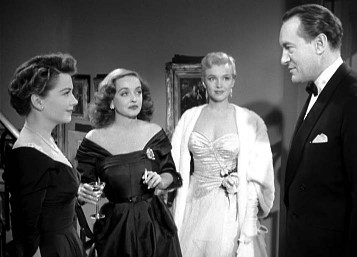
The five leads are solid and their performances shift as the Margo-Eve dynamic fluctuates. However, George Sanders is possibly the most enjoyable character, because, despite his cruel wit, he’s the one who is outside of Eve’s influence, or at least he catches her in her charade. There’s something utterly satisfying in that. Also, he has some memorable moments alongside the aspiring Ms. Casswell (none other than the show-stopping Marilyn Monroe in an early role). So really this is a film about the performances and they are well worth it because they suggest that in such a cultured world, so many things lurk under the surface. It might be insecurity, fear, suppressed desire, or savagery. Humanity is most definitely messy, you just have to look behind the curtain sometimes.

5/5 Stars

People Will Talk (1951)

peoplewill1People Will Talk is in this weird gray area between genres. It has humor but it’s not screwy enough to be a screwball. It has drama, but it’s not intense enough to be a full-fledged melodrama. And underlining all this are issues that reflect such areas as the medical industry, the Korean War, and most definitely the witch hunts that were going on in the nation — bleeding into the Hollywood industry.

Written and directed by Joseph L. Mankiewicz, this is a minor classic about a doctor named Noah Praetorius (Cary Grant), who is under investigation from one of his by-the-book colleagues Dr. Elwell (Hume Cronyn), who dislikes the good doctor’s unorthodox and thoroughly effective approach to his trade. Praetorius by now is a preeminent physician who started his own clinic and also teaches classes at a local med school.

One of these individuals happens to be Mrs. Deborah Higgins (Jeanne Crain). She is not a student but sits in the lecture because her former partner was a medic. A date with a cadaver proves to be too much for her and she faints. Seems normal enough right? Wrong. After examining her, the Dr. tells her she’s pregnant. The truth comes out that she’s not really married and the father is dead. Her own father would be greatly distressed to learn about her condition, since he cannot provide for her.

That’s where Dr. Praetorious comes into the picture, and he takes great concern in Ms. Higgins condition. He attempts to allay her anxiety by saying she’s not really pregnant, and she runs away from his clinic out of embarrassment, since she is falling in love with him. He goes with his stoic friend Mr. Shunderson to the farm owned by Deborah’s uncle.

Deborah turns out to have a strange mix of aloofness and lovesickness, but when she realizes the Doctor’s true motive for being there (before he even does) she is wholly relieved. They share a passionate kiss and leave the farm behind to get married. Of course, the Doctor still hasn’t told her about the pregnancy.

Meanwhile, the whole storyline culminates with a concert conducted by Praetorious himself, but it just so happens that the hearing to analyze his conduct is happening simultaneously. Some mysterious truths about Mr. Shunderson are given in his own words, and stale Mr. Elwell’s case is dumped. Everything wraps up nicely as you expect with a happy marriage and Grant free to direct the symphony in one last glorious crescendo.

So you see if you really look at this film, there are these two main story arcs. One is a response to McCarthy’s witch hunts, the other an equally subversive love story about a doctor marrying a woman who had a pregnancy out of wedlock. When you put it that way this film seems chock full of controversy, and yet it is all veiled in a palatable comedy-romance. Walter Slezak is a welcomed addition to the cast as the nutty colleague and Hume Cronyn has taken on better roles, but nonetheless, he is always an enjoyable character actor. Obviously, this is a lesser Grant performance, but his pairing with Jeanne Crain is still a fun one.

4/5 Stars

Angel Face (1953)

angelface1Rumor has it that Howard Hughes was angry at Jean Simmons who had cut her hair short prior to filming, as her contract was due to expire soon. But not to be outdone he told Otto Preminger that the director would get a bonus if he could shoot the picture before Simmons was released. That he did, and in the 20-day interim he gave us yet another stylish film-noir classic to follow in the footsteps of Laura and Where the Sidewalk Ends.

Robert Mitchum plays ambulance driver Frank Jessup who falls victim to the webs of young beauty Diane Treymayne who adores her superficial father, but nurses a lifelong grudge against her step-mother. She has it in for her arch nemesis and meanwhile strings Frank along, coaxing him to become her family’s chauffeur. He loses sight of her other side, and their budding romance means trouble for Frank’s longtime relationship with the sensible Mary. She sees a better fit in one of Frank’s ambulance coworkers, but he still wants her back.

Instead, Diane and Frank get caught up in a trial for their lives, after they are accused of a murder that Diane did indeed commit. But due to some wheeling and dealing, their shrewd attorney gets them off. It’s at this point that Angel Face takes an unsuspecting twist that ends up being intriguing. Could it be that the seductive Tremayne girl is actually remorseful for her actions? Is she a more nuanced femme fatale then would first be assumed? Frank was an unsuspecting lout, but then again maybe Diane is a sort of victim too.

angelface2

Her tryst with Frank is doomed and he is stuck because Mary no longer wants him, so of course, he can only end up going one place. The slow buildup to the finale makes these last moments all the more shocking. Angel Face seems to be less of a deadly poisoning than a slowly ticking time bomb just waiting to blow.

Jean Simmons is most often associated with civilized and demure beauties. A couple counterpoints or variations would be The Grass is Greener and this film. Playing against type proves to be as fruitful for her as it did for the likes of Barbara Stanwyck, Gene Tierney, Cary Grant, and Henry Fonda, just to name a few. However, in a way, Angel Face had a far more complex femme fatale than I was expecting and that’s to its credit. Still, I would never want to be trapped in her nightmarish world like Frank.

4/5 Stars