
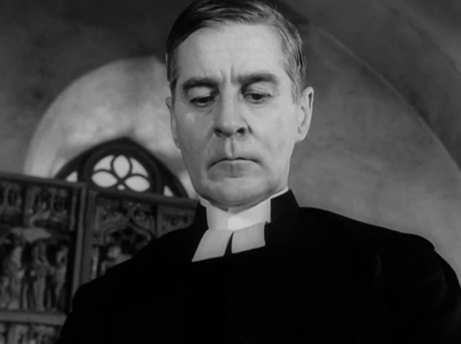
 In the second leg of Ingmar Bergman’s Faith Trilogy, he gets right to the core of all matters of faith. He takes an up close and personal look at a man of the cloth named Tomas (Gunnar Bjorstrand), who shepherds a small congregation in a rural Swedish town. Such is the life of a clergyman, as with any life, where there are rough patches and emotional highs that rejuvenate you, but mostly rough patches. In fact, he is going through such a spell when the film begins. We survey his humble little chapel, and there are only a few scattered members of the community present. Half seem disinterested and Tomas himself speaks words of spiritual truth and yet it seems like he is only going through the motions. Does he actually believe these benedictions and words that he is proclaiming? I’m not sure he even knows for sure.
He’s been withstanding a winter period of his life personified by the icy weather engulfing his humble city on a hill. It reflects his own heart and mind which are going through a season of extraordinary indifference. On top of that, he’s fighting a bad case of the flu, and he is discontent in God’s silence. Where is God? Why is He not more present in his life? Why does he not more clearly reveal himself? Is there any power left in prayer? They are honest questions from a man struggling with faith, and it’s the epitome of an existential crisis. Bergman seems to be churning up all the thoughts creeping up in his own mind, and it’s very human — extremely honest.
Tomas has little in the realm of advice or comfort to offer his parishioners. For instance, when the depressed fishermen Jonas (Max Von Sydow) comes to the pastor after contemplating suicide, given the state of the world in the nuclear age, Tomas has little to say, because in order to encourage others you have to be encouraged. There’s nothing that can be done if the well you’re running on goes dry. You cannot sustain yourself that way. About all he is able to offer are a few downward glances because there’s no conviction left in him.
 On a personal note, Tomas lost his beloved wife and now he deflects the affections of local teacher Marta, who herself does not believe in God, but still, she loves Tomas dearly. In a deeply heartfelt letter, she confesses her true feelings for him, and he responds with very little acknowledgment. He cannot bear the townsfolk talking about them, and he still misses his wife dearly. It doesn’t help when he gets tragic news about Jonas.
Winter Light never reaches a clear conclusion, because life is hardly ever like that. In fact, there is an underlying irony that becomes apparent in this story. After Tomas lashes out against Marta and tells her to let him be, it becomes all too clear that Marta, though she does not believe in God, is in a sense, living a better life. They are both lost in the throes of winter still, but she at least has the capacity for love and vulnerability. Tomas’s apathy seems to be a far greater plight since he feels trapped in a labyrinth of idiotic trivialities, as he puts it.
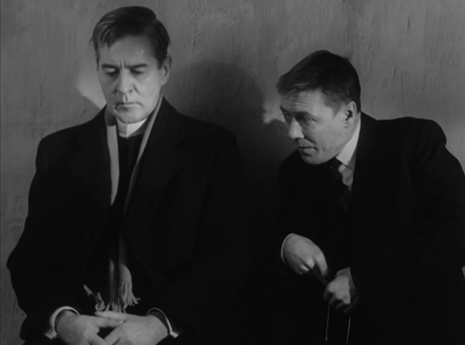 The sexton Algot brings up an interesting point about the suffering of Christ. His physical suffering must have been immense, but how much greater must he have suffered when everyone deserted him. The disciples didn’t understand a thing he said, Peter denied him, everyone else deserted him, and he was even forsaken by God. It suggests the importance of our interactions with one another. In the days of our lives, it becomes so easy to continue constantly in the endless cycle of life. Never getting outside of it and relating to our fellow man. Falling into apathy and indifference, which is especially easy when tough times hit.
Bergman does it again, delivering a film full of philosophical depth and questions that force the viewer to ruminate over their own condition, whatever their background or beliefs might be. Sven Nykvist’s photography is beautifully austere once more, and it adds a certain visual depth to the director’s trilogy. It’s stark, pure, and piercing with gorgeous shades of black and white.
4.5/5 Stars
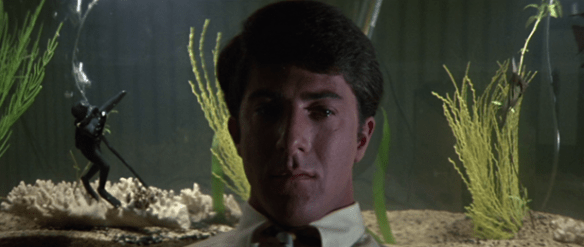 “You’re living at home. Is that right?
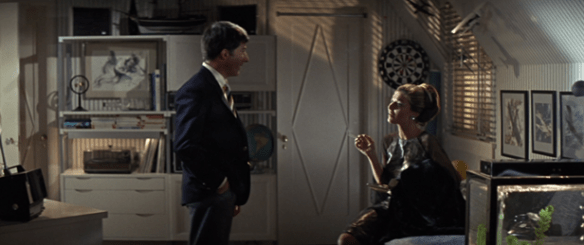 Then Mrs. Robinson coolly enters his life. It’s perhaps best signified when she tosses him the keys. They end up in the fish tank almost as if on purpose and after that she has him reeling for good. Soon he’s walking into the lion’s den (or lioness’s) as she expertly manipulates and elicits the precise response from him. In these moments the film is elevated by the awkward, huffing and puffing, and nervous chattering of Hoffman. We often forget the second part of his famed line, “Mrs. Robinson you’re trying to seduce me. Aren’t you?” His general naivete and hesitancy say it all.
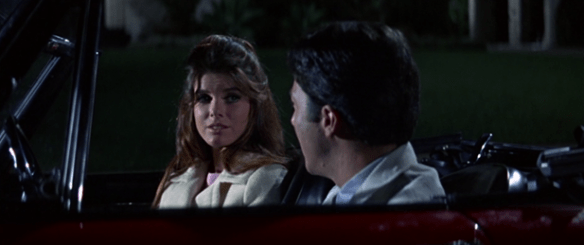 But when he meets Elaine Robinson and finally begins to connect with her on a peer-to-peer level, it’s something so profound to him. Having someone his own age that he can relate to, who feels the same unnamed apprehension and angst that strains on him. It’s what makes Ben become so mixed up. He has true feelings for her, while his affair with Mrs. Robinson only serves to poison all that could be good. And his illogical, unhealthy pursuit of Elaine continues to Berkeley where she is attending school. Still, Mrs. Robinson and her now estranged husband look to send their precious daughter far away from Benjamin Braddock.
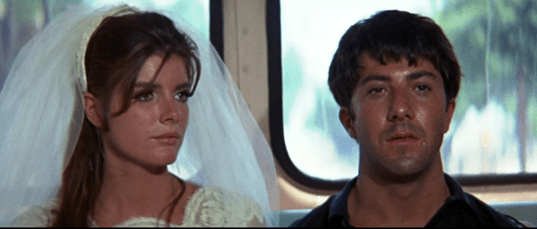 That’s what makes his final Herculean effort all the more climactic. He bursts in on her marriage to another man and whisks her off to another life altogether. A life that seems exciting at first, because, oh how great it is to be young and in love. But once they climb aboard that bus in their tattered garments, have a chance to sit down and really think about what they are embarking on, you see something else in their eyes. The laughter slowly dissipates and as they look around nervously, they begin to somber up. True, Ben is no longer alone in an airport terminal, he has a fellow traveler, but that does not make the future any less unpredictable or scary for that matter.
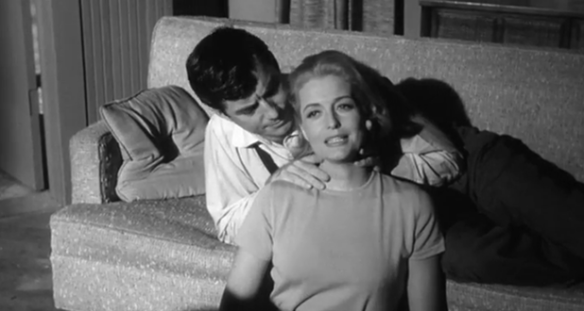 Of course, her first customer happens to be a police chief named Griff (Anthony Eisley), who advises her to skedaddle out of town as quick as possible. He gives her the details on a cozy joint across the border known for their Bonbon girls. He thinks he’s got her pegged, but Kelly goes and does something even he wouldn’t expect.
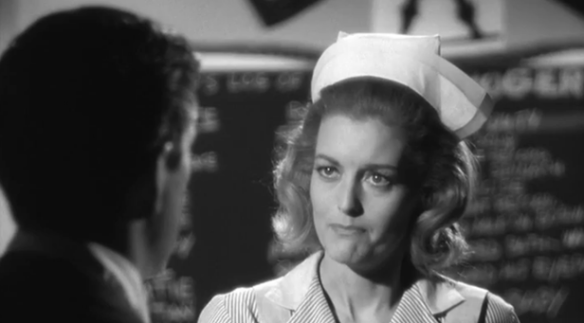 The social commentary is there. The characters are interesting. Meanwhile, Fuller slices and dices through taboo subjects that would have horrified censors and yet he brings them to the forefront in such a way that hardly glorifies them, but actually gets them out in the open. Every detail isn’t written out, but Fuller throws us into the narrative and allows us to track with him. He puts a little faith in his audience.
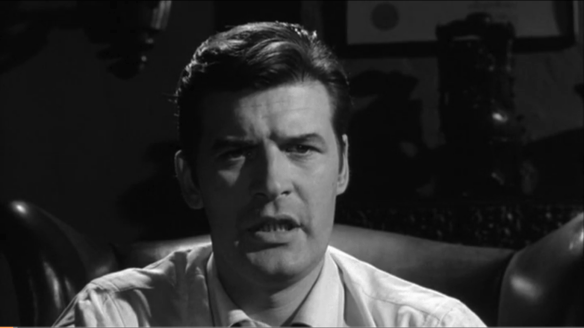 “This long corridor is the magic highway to the Pulitzer Prize” – Johnny Barrett
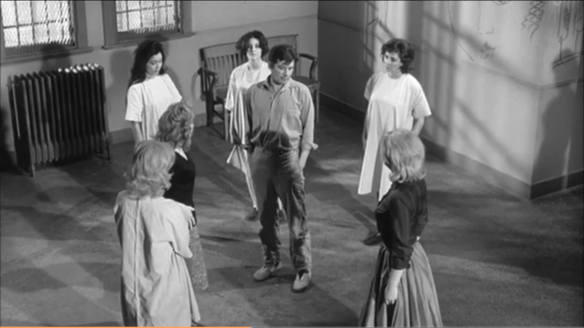 Behind the pearly gates, there are brawls galore and noisy neighbors riddled with all sorts of neurosis, quirks, and ticks. There are the good cop and bad cop who help care for the patients and keep them at bay. Johnny even begins to have hallucinations of his girlfriend drifting through his dreams. He gets introduced to hydrotherapy, dance therapy, and even faces a traumatizing experience at the hands of women in the female ward.
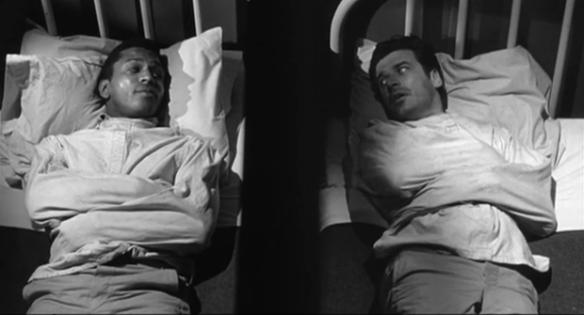 The boisterous, tumultuous chaos of the ward does almost become maddening, even to the viewer. Johnny has a few angry outbursts of his own as the strain of the facility gets to him more and more every day. Electric shock therapy among the other treatments leaves him mixed-up, confused, and overtly paranoid. He’s hardly the man we met in that office so many days ago and even if he got the scoop he was looking for, at what cost? Shock Corridor has a thunderously disconcerting ending worthy of a Fuller production.
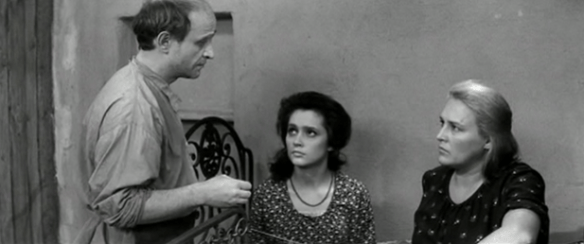



 Bridge to the Sun is one of those films that was ahead of its time. Its main actors are hardly remembered by modern audiences. The top-billed leading lady, Carroll Baker, was probably more notorious for her controversial persona in films like Tennessee’s Williams’ Baby Doll than she was famous. James Shigeta was a pioneering Japanese-American actor, who was once told, “If you were white, you’d be a hell of a big star” (The Slanted Screen). He aged gracefully but was slowly relegated from leading roles to bit parts. Belgium director Etienne Perier was only a slight blip on the Hollywood radar. When it came out in 1961, its narrative based on the memoir of Gwen Terasaki ended up being an abysmal flop. Honestly, it’s not all that surprising, because the public was not ready for such a film, and its candid depiction of interracial marriage. Now, with a fresh pair of eyes in the 21st century, Bridge to the Sun looks quite extraordinary. Certainly, this is a love story, but under very different circumstances, in a very different world. Although it was made in the classical Hollywood mode, it still manages to groundbreaking, not necessarily due to its form, but thanks to its content. Because Bridge to the Sun places an Asian man and a Caucasian woman together, as they navigate two starkly different cultures both tottering on the brink of war.
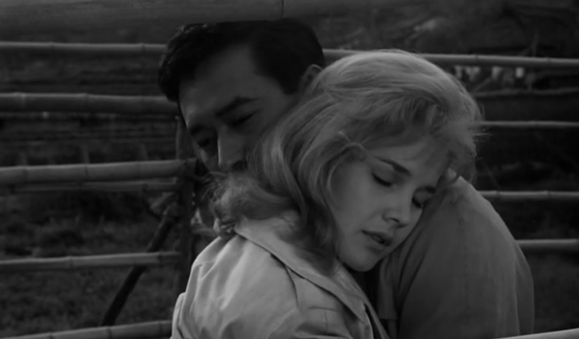
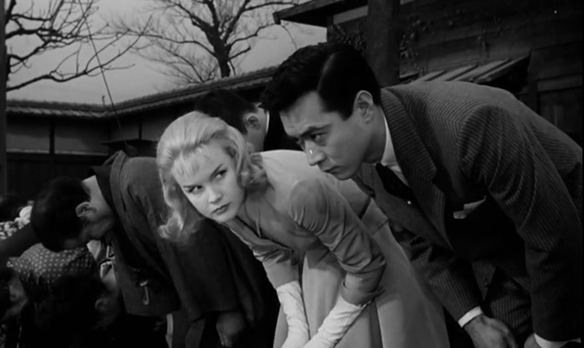
 In truth, this film does not shy away from showing their affection, even though it undoubtedly made some viewers squeamish at the time. More than once Gwen and Terry embrace in intimate moments that signify the deep-rooted love that holds them together. Sometimes it’s far from easy. For instance, when they first travel to Japan, Gwen finds it difficult living in a culture where women are meant to be wholly subservient to their husbands. She’s fine with the bowing and the taking off of shoes even, but not being allowed to speak her mind is about the limit.
 Gwen and Terry cannot stay mad forever, especially with the birth of their little girl Mako. In fact, it is actually in a moment when their family is in danger of being pulled apart that Gwen shows her true resilience and loyalty as a wife. Pearl Harbor has just blown up and that means there is a freeze on all Japanese aliens. Terry is stuck at the embassy about to be deported, and an FBI agent advises Gwen that she would be much better off staying in the states. But as she converses with him you can see the determination in her eyes. She knows what it means to go to Japan. Her daughter as a child of mix race will be scorned, and Gwen herself will be looked down upon if not endangered by her status as an American citizen.
 lously these individuals salvaged their marriage and preserved their family. Meanwhile, the world around them would not make the necessary concessions. It allowed cultural differences to define relationships, and ultimately increase the void between nations. The rubble of WWII was eventually cleared and new hope was built upon that foundation. In reality, the chronicles of the Terasakis was an emblem of that hope. Inherent in their story is the possibility that two people and two nations really, can be reconciled and even thrive together. Perhaps the United States was not ready for such a message to come out of Hollywood, even as late as the 1960s, but nevertheless, it seems like a message we can certainly take to heart today.
 Bridge to the Sun is one of those films that was ahead of its time. Its main players are hardly remembered by modern audiences. Belgium director Etienne Perier was only a little blip on the Hollywood radar. The leading lady Carroll Baker was probably more notorious for her controversial role in Tennessee’s William’s Baby Doll than she was famous. James Shigeta was a pioneering actor, who was famously told, “If you were white, you’d be a hell of a big star.” He aged gracefully, but was slowly relegated from leading roles to bit parts in Hawaii Five-O and Die Hard. In truth, the film, based on the memoirs of one Gwen Terasaki, does suffer from a clunky script at times, and the box office returns were not too favorable. In fact, it was an outrageous flop back in 1961.
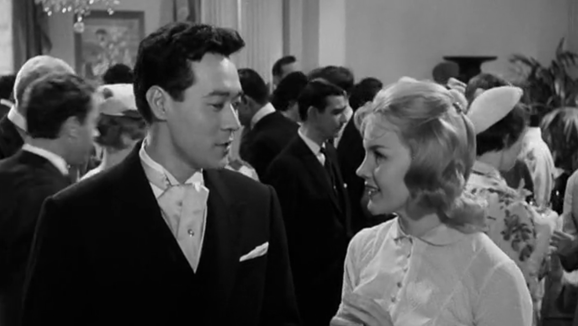
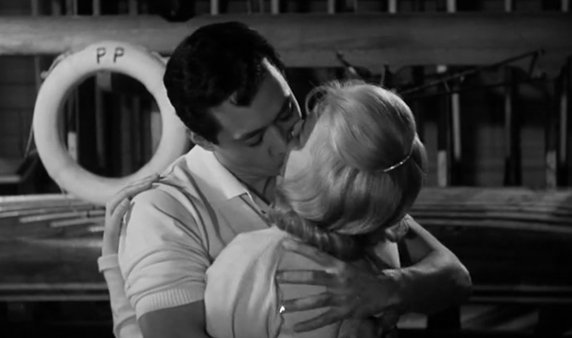 In fact, this film does not shy away from showing that affection, even though it undoubtedly made some viewers squeamish at the time. More than once Gwen and Terry embrace in intimate moments that signify the deep-seated love that holds them together. Because it’s far from easy. Gwen finds it difficult living in a Japanese culture where the woman is meant to be wholly subservient to her husband. She’s fine with the bowing and the taking off of shoes even, but not being allowed to talk is about the limit. With his family, her strong, lovable husband now seems cold and distant. However, they cannot stay mad forever and soon enough their little girl Mako is born, making them a happy little family. But of course, imperial Japan and isolationist America are on the brink of conflict and Terry and his family are tottering on the brink of calamity. He’s seemingly one man trying to hold together the relations of two nations that he has such close ties to. One because of his wife, the other due to his birth. Then, on a fateful day in December 1941 Japan struck the first blow and life would never be the same. Terry is now being detained and Gwen is fearful she might be forever separated from her husband. Disregarding what everyone else says, she takes her young daughter and follows her husband once again to his homeland – knowing full well what might be in store for her and her daughter.
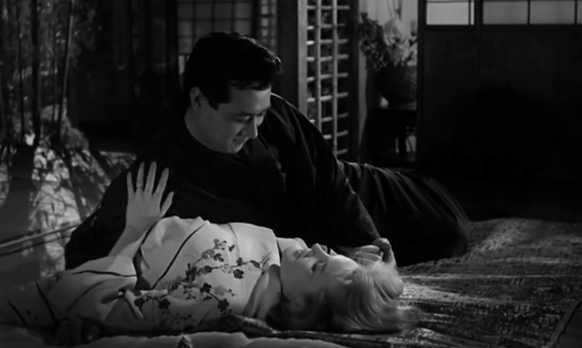 And when they arrive abroad there is the discrimination and the myriad of strange looks. Even as she makes the long journey across the sea all the white folk scoff at her, but Gwen takes it calmly and fearlessly. Once overseas the climate has changed greatly and now Terry is being questioned for his loyalty. The ethnicity of his wife doesn’t help and the firebombs raining down from above don’t exactly calm their nerves. But again and again, Terry and Gwen prove to be a resilient couple. The anomaly that should never have happened—seemingly could never have happened, and yet they did and they remained unequivocally together.
 4 Star Films