Veronika Voss (1982)

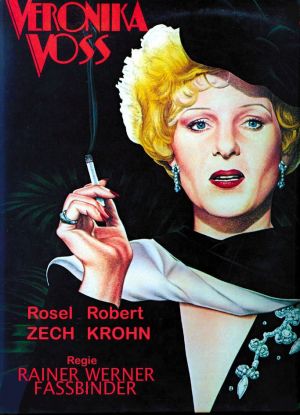
veronikavossYou get a sense that if they had ever met, Norma Desmond and Veronika Voss might have been good friends. Either that or they would have hated each other’s guts. And the reason for that is quite clear. They share so many similarities. Both are fading stars, prima donnas, who used to be big shots and now not so much and that seems to scare them so much so that they try and cover their insecurities with delusions of grandeur. Having to look at your near reflection would be utterly unnerving.
In the case of Rainer Werner Fassbinder’s penultimate film, the tale of Veronika Voss actually finds inspiration in a real-life figure. It’s often true that you cannot make something like this up. You can play with the truth and stretch it a bit but still, there’s at least a kernel of reality here. The source of the story is the UFA actress Sybille Schmitz a star who came under fire for her continued work in the German film industry during the Nazi regime along with a disclosed love affair with Joseph Goebbels. That in itself made her a somewhat controversial legend. That and her tragic demise…

But rather like his forefather Billy Wilder, it seems like Fassbinder too was interested in teasing out a bit of the comedy and bitter tragedy of such a bygone star. Someone who used to be big and must begin to acknowledge the fact that they are no longer what they once were. Except very rarely are they willing to acknowledge their shortcomings. There lies the tension in Sunset Boulevard and Veronika Voss.

Voss, as played by Rosel Zech, is perpetually out of breath, preoccupied with lighting and shadow, the perfect environments to showcase her looks. Nervously trying to hold onto the last shreds of her waning fame. Now she’s scrimping to get just one role a far cry from her commanding star power when she worked with her one-time husband and screenwriter.

She’s rather incredulous when she meets Robert Krohn (Hilmar Thate) a bland sports journalist who doesn’t have the slightest idea who the great Veronika Voss is. Imagine that. It’s hard to know if that’s actually something to be surprised about or if it simply dictates the sign of the times. In 1955 Voss is an apparent nobody, a has-been. She simply has not accepted the reality.

Robert has a girlfriend and they seem generally happy but still, he begins a bit of an amorous romance with Voss. However, he also gazes into the deep recesses of her personal life which are currently dictated by the controlling and manipulative Dr. Katz. The lady doctor constantly keeps the dwindling star medicated and helpless, sucking dry all her assets in the process.

The film ends calamitously but its pale tones almost make us forget the drama. Instead, all conflict gives way to a distinct wistfulness. Popping pills and alcohol are a lethal combination (Fassbinder’s own death is a testament to that), but there’s something so debilitating about human greed and treachery. It’s positively lecherous, sucking the lifeblood out of all adjoining entities.

Going back to the Norma Desmond and Veronika Voss parallels, there’s no doubt that both are thoroughly tragic figures. It shows how fickle humanity can be. We’re so quick to love someone when they provide some sort of agency or pleasure but lose that allure and you’re kicked to the curb. That’s the way things often work — the sad inner workings of the world.

Fassbinder always has a knack for framing his sequences given his background in the theater and numerous scenes are shot through windows, windshields, and the like. Also noticeable are the quick transitions and wipes cutting from scene to scene like films of old. Voss also utilizes a fascinating layered sound developing an auditory collage of dialogue, score, and diegetic music. Featured tunes like Johnny Horton’s Battle of New Orleans and Tennessee Ernie’s Ford’s brooding Sixteen Tons serve a double purpose. They lend a specific time stamp to the alert viewer, while the country sounds simultaneously feel strikingly at odds with this world that we are introduced to.

But one last time the parallels become obvious, this time between the director and his subject. There’s a sense that he knew all too well what it was like to be someone like Veronika Voss. Famous beyond your years and in the same breath so utterly tragic. And both their lives, the adapted truth and the reality, arrived at much the same devastating ending. As surely as sparks fly, Man seems born to trouble.

4/5 Stars

Terms of Endearment (1983)

terms_of_endearment_1983_film

I owe a comedic debt to James L. Brooks and that’s for the basic fact that he’s made me laugh countless times, namely because of his work with sitcoms. The Mary Tyler Moore Show and Taxi are two prime examples. The casts he brought together and the writing, the writing is just absolutely superb, orchestrating that tricky balancing act between humor and heart.

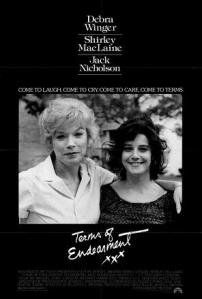
When I look at Terms of Endearment from a purely objective perspective it looks like a wonderful picture. James L. Brooks, the mastermind of so many great projects is writer, director, and producer. It’s his first time behind the camera for a film and his cast is what most others would only dream about. Looking down the cast list is like a hit parade.

Shirley MacLaine as the widowed Aurora, the quirky mother who is strangely difficult, looking for love and still somehow detached — with both her daughter and a plethora of male companions. The always spirited Debra Winger as her daughter Emma. Her husband, the fresh-faced lawyer, Flap is played by Jeff Daniels. The always devilishly grinning Jack Nicholson plays the washed-up astronaut next door who makes the strangest and somehow most viable of suitors for Aurora. And the other nooks and crannies are filled in by the likes of Danny DeVito and John Lithgow. So with such a rank and file, there’s no question that this film should be remarkable.

But for some reason, it just doesn’t come off. It’s not that it doesn’t have its moments or that it’s not intermittently funny, romantic, and moving. There are tinges of those qualities that this film is undoubtedly looking to elicit. But for some reason, one that is somehow difficult to articulate, Terms of Endearment never brought me in like the truly great films have a habit of doing.

Was the plotting too slow? Were there too many characters? Was it due to the fact that I have never been a huge admirer of Shirley MacLaine’s work? To each of these, I would have to give a fairly decisive “No.” In fact, for me, this is one of MacLaine’s finest roles (along with The Apartment) to date. She’s somewhat perturbing, inscrutable you might say, but that also makes her the most interesting character. Watching her cold maternal figure evolve is one of the interesting aspects of this story.

Because she is trying to learn what it is to love and in a sense what it is to show that affection which comes second nature to most. Over time I’ve become increasingly impressed with Debra Winger because there’s always something so dynamic about her — a certain vitality that allows her to do comedy and tragedy equally well.  Both are on display here but for that same unknowable reason, Terms of Endearment did not move me as much as I expected. That’s no criticism just the simple, honest truth as clearly as I can lay it down.

But I respect this film because any film about people, their relationships, and how they navigate the tragedies of life is worth at least a little bit of trouble. Parsing through those very relationships is what this story cares about like Brooks’ earlier works. Maybe it did not affect me as much as I might have expected but that does not take away from the fact that mother-daughter bonds are worth exploring as are marital turbulence and personal tragedy. Because each of these is a very real circumstance and there’s something incredibly honest in trying to examine such things. For that, I commend Brooks as well as his film.  I will not be singing its praises necessarily but we all can respect Terms of Endearment for the very fact that it’s sincerely trying to dissect our world with wit and grace. Whether it succeeds is very subjective indeed. But then again, that’s part of the magic of the movies. At their very core, they are subjective.

3.5/5 Stars

Platoon (1986)

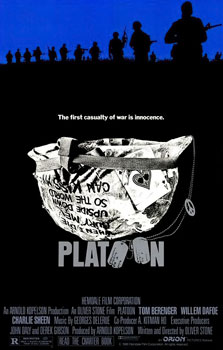
platoon_posters_86It’s a rather interesting parallel that Charlie Sheen is playing much the same role his father did in Apocalypse Now. At least in the sense that they become our entry point into the mire of war, specifically in Vietnam. But where Apocalypse seemed to belong more so to Brando or even Duvall, Platoon is really Willem Dafoe’s film. At least he’s the one who makes it what it is. His final moment is emblematic of the entire narrative.

But it is also striking that the film opens with an excerpt from Ecclesiastes as follows, “Rejoice young man in your youth…” But the latter half of that same verse has major implications that will come into play later.

For now, these soldiers muddle their way through their tours of duty the best they can. Smoke, beer, and Smokey Robinson is the perfect way to combat the insanity and humidity right outside your tent.

Oliver Stone conjures up themes of politics and government conspiracies. The first word is uttered several times throughout Platoon but in the general sense. When you get a group of people together vying for positions and attention there’s bound to be politics. As for government conspiracy, Stone doesn’t quite scrape that barrel, although to be sure as a Vietnam veteran himself perhaps he has a lot to be disgruntled about.

Instead, he has a cast of characters who get to reflect all the angst and disillusionment for him and it’s a fairly impressive bunch. Aside from Sheen and Dafoe, John Bergener, Keith David, John McGinley, Forrest Whitaker, and even Johnny Depp make appearance wading their way through Vietnam.

It’s been far too long since I’ve seen Apocalypse Now to draw too many comparisons. However, although Platoon is a perturbing film it’s not the same type of expansive labyrinth that I recall from Coppola’s epic.  Charlie Sheen’s voiceovers attempt to add an introspective tinge to the entire narrative, but that is not where the strength of the film lies.

Platoon also has its share of pyrotechnics, in fact, it succumbs to them too often but that’s not the reason the film is affecting either. It’s the aftermath of those explosions. The carnage that is left in the wake of the barrages of RPGs. The bodies maimed and the images that haunt these young men.

And as audience members, it’s hard not to feel something. Repulsed. Angry. Frustrated. Confused. Perhaps that is the film working — giving even a zenith of the taste of what it was to be in the jungles of Vietnam back in 1967. This is one of those experiences I cannot take too often because it’s almost too much.

My initial hope was that Stone would not inject this film with his own brand or message and I will say that when I watch Platoon I am not left with the feeling that I am listening to Oliver Stone but instead I am watching something terribly volatile unfold. That’s certainly a testament to this film. In the end, Platoon is bolstered by its sheer intensity.

But back to Ecclesiastes, the earlier verse ends “and let your heart be pleasant during the days of young manhood. And follow the impulses of your heart and the desires of your eyes. Yet know that God will bring you to judgment for all these things.” And it’s this final bit that is important in suggesting that young men are laid low due to their joy. But it’s hard to make that type of assertion. If anything, a film such as Platoon is perplexing because the answers are unclear and the reasons the world works the ways it does are not known to us.

Young men will continue to walk through life naively and he will struggle through life questioning the presence of God as much as this seemingly apathetic indifference towards the suffering in the world. Whether Stone was grappling with those same questions is up for contention but the beauty of film is that it very rarely works on a singular level. It can mean many things to many people. So it is with Platoon.

4/5 Stars

Purple Rose of Cairo (1985)

purple rose of cairo 1.png

“How many times is a man so taken with a woman that he walks off the screen just to get her?”

This line spoken by one of Jeff Daniels’ characters is really the key to opening up the fantasy that is Purple Rose of Cairo. Here is a film where Woody Allen most blatantly gets to parade his love for the movies and it revolves around the Depression, a love story, and a movie theater. Cecilia (Mia Farrow) is a woman who gets by working in a diner with a bum of a husband (Danny Aiello) who beats her more than he loves her. Her one getaway is the escapist thrills derived from the weekly romances and melodramas found at the local theater. She’s one of the most faithful attendees making it out to the movies religiously and she goes back out into the world reciting all that she has seen to anyone who is willing to listen.

And there is a bit of Buster Keaton’s Sherlock Jr. here as well. It’s not as inventive visually but several scenes that include the firing off of dialogue between the screen and reality work to great effect.  That’s something Keaton could not do in a silent picture, have his movie characters and audience members interact so directly.

It’s striking that the scenes that have been constructed as “film” really do look like films of old. There’s an attention to the craft rather than the shoddy caricature of grainy black and white that we’re often accustomed to. Even the striking resemblance of Edward Hermann to Edward Everett Horton as well as the makeup work complete with black eyeshadow lends itself to the whole charade.

And Purple Rose of Cairo is literally about a man coming off the silver screen to interact with one of his viewers — one of the people who is devoted to him — and he loves her. The woman is, of course, Cecilia, and the man off the celluloid is Tom Baxter (Jeff Daniels the first time around) a man who was written as a supporting character, an archaeologist.

That in itself might be enough to play with but Allen takes his story a step further so it’s not simply about this unlikely romance of worlds colliding. But it gets even more intriguing when the famed actor who plays Tom in “real life,” the man Gil Sheppard (Jeff Daniels again) crosses paths with Cecilia. At first, he’s interested in her because she has a way to assist him in his predicament since she knows his unruly alter ego. However, over time it turns into a certain amount of awe because she is devoted to his characters and by a certain amount of transference, him as well. The question that is then raised rather obviously is, do you take the perfectly constructed fantasy man or do you go with reality? That which is right in front of you, both living and breathing and fully human.

It’s also a commentary on the rigid conventions that storytellers are often forced to adhere to. Aside from “art-house,” there can be little to no films with people talking or dealing with philosophical issues. That’s too mundane. Of course, Allen is notably one who matches his comedic delivery with his own philosophical quibblings. And this film is light but it still raises some of the questions he is often preoccupied with. Whether or not he comes to a satisfying conclusion is for only the viewer to decide, and if the film itself is any indication they are the ones who must decide. The viewer, in this case, has great agency. They are the focal point of this film, again, in the literal sense.

As is Woody Allen’s penchant, the film opens with an old standard, in this case, the crooning voice of Fred Astaire knocking off a few bars of “Cheek to Cheek.” And the story ends with Astaire & Rogers dancing the night away. While Purple Rose of Cairo cannot quite top Top Hat, it’s a bittersweet dose of 30s nostalgia all the same. It shows once more that Woody Allen truly does love movies with a passion. That’s one thing that’s difficult to take away from him, but it does beg the question, can movies really be your be all, end all?

Some of the implications are rather troubling as we leave Cecilia completely immersed in a film, her real life completely ripped to shreds without a marriage or a job or really anything else. But she has a movie. Except movies can only go so far in how they emulate reality. They cannot replace it or perfectly replicate what is real. They can only help us understand it better. That is why, while movies can and should be entertainment at times, they should not only be pure escapism. Because the reality is that life is still right outside our door. We cannot get rid of it or lose sight of our role in it — both in good times and bad.

We are probably all just as messed up as the next person and perhaps little better than Woody Allen in some ways, still, if we don’t simply love movies but hope to glean a little from them about life then we are better off. They cannot be the ultimate thing in life but they can direct us towards the important things.

3.5/5 Stars

E.T. The Extra-Terrestrial (1982)

e-t-the-extra-terrestrial

I remember the first time seeing  E.T. and enjoying it immensely, though it never floored me. I felt the same thing this time around for no particularly justifiable reason. Good but, in my estimation, not great, whatever that means because those terms are equally murky. Still, the fact that there had been little change in some ways made me feel uneasy. What was I not seeing?

But then thinking about it more I latched on to this idea that made me appreciate E.T. far more than I had before. Like an epiphany, it came to me what this film really is. It’s a childlike fantasy full of personal notes from a director who just happens to be Steven Spielberg. That’s not much of a discovery, but the implications are great.

The story of young Elliott (Henry Thomas) and his chance encounter and befriending of E.T. is rather like a boy and his dog story. Except both characters are going through almost parallel situations and Spielberg takes it to the literal extreme. They actually feel each other in a sense. They are perfectly empathetic towards one another.  With E.T. the motives are most obvious. His ultimate goal is to “phone home” so that he might be reunited with those that he calls family. For Elliott, it’s also about home. His home life is a bit fragmented with a father who is vaguely mentioned to be in Mexico (although that’s probably not the case) and siblings who quarrel like siblings usually do.

However, it also struck me how this family really does care about each other. Little Gerty –a beyond memorable Drew Barrymore–is the quintessential 5-year-old sister. First frightened of, then intrigued by and finally faithfully devoted to E.T. And the older brother Michael teases his siblings as has always been the case since the beginning of time but he too invests himself in this adventure. Certainly, it’s out of charity towards this visitor from outer space but it’s undoubtedly also an extension of the affection he has for his little brother.

It’s also peculiar that almost all the secondary characters are very ill-defined and the antagonistic forces attempting to impede E.T. and Elliott are even vaguer. At first, this felt wrong in some regards– a potential sign of poor storytelling. But once more I was brought back to the unmistakable idea that this film really is a boyhood dreamscape. This is Elliott’s story and if it’s Elliott’s story, it’s even more so Spielberg’s own meditation on adolescence and his own childhood. The narrative is even said to have been inspired by his own imaginary friend as a child and his own dealings with a split household. And there’s also a hint of the Wizard of Oz here. There’s no place like home.

Thus, what becomes undeniably important is this dynamic relationship between this boy and his newfound friend who just happens to be from outer space. It’s quite simple. It’s childlike really. And that is and forever will be the beauty and allure that comes from this film. Families can watch it. Kids can marvel at it. Parents can soak it up. Because just as it is about a family–dysfunctional as they may be in their suburban life–it is also for families.

There’s the sheer mayhem of the shrimpy kid grabbing a kiss from the pretty girl in class as hordes of frogs hop by. The iconic magic of Elliott and his friends soaring through the sky on their bicycles, John Williams’ score dancing majestically in the background again and again. Even the fact that this extra-terrestrial goes from death to life is strikingly analogous to the archetypal biblical narrative that permeates our culture. It’s all spectacularly remarkable but rather than be skeptical we acknowledge it with almost wide-eyed wonderment, accepting it, accepting these people that we meet. And watching E.T. ascend back into the atmosphere with true awe.

I find it fascinating that only a few years earlier Spielberg was inspired to put Francois Truffaut in Close Encounters. In E.T. I see his closest approximation of the French director’s own thematic elements. To put it in terms of homage. E.T. is Spielberg’s version of 400 Blows, granted featuring space aliens, Star Wars, cultural references and so on, but they’re not all that different. They really are about the same core issues. It takes until after 400 Blows for Antoine Doinel to find love and intimate relationship with his wife. For Elliot, it comes with family, his brother and sister, and mother, and of course, with E.T. This is what has a lasting impact on Elliott and I could guess, with Steven Spielberg as well. But the audience gets to be a part of it too, an equally important  piece in this trinity.

4.5/5 Stars

A Short Film About Love (1988)

a short film about love 1Why do you watch me? -Magda

Because I love you – Tomek

Early on it becomes evident that Tomek is a very lonely young man. He lives in Warsaw in a room belonging to the elderly mother of his best friend, who is off deployed by the U.N. There is also some brief suggestion that Tomek’s parents left him when he was very young. Look at him now and this taciturn lad of 19 is all alone. He has no true friends.

Every evening his routine involves waiting for his alarm clock to go off at precisely 8:30. He pulls out his telescope from under its covering and readies himself for another evening of people watching.  Except he is interested in one person, in particular, his strikingly beautiful neighbor across the way. So, yes, he’s a peeping tom and his voyeurism is a bit reminiscent of Rear Window without the pretenses of a murder mystery.

a short film about love 2And despite the clandestine nature of his activities he still somehow remains innocent in the eyes of the beholder. Daily he works at the post office behind the glass and in the evening he studies languages. But he’s continually drawn to this lady across the way. He feels like he knows her. He wants any pretense to meet her and so he creates a bit of fate anytime he can.
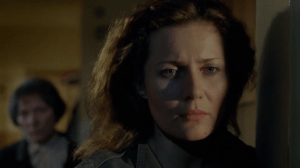
It means sending her fake money orders just so she enters the post office and he can interact with her. It means calling her home at night and hearing her voice over the telephone or taking on a job as an early morning milkman just so he can get another chance encounter with her. It even strays into the territory of purloining her mail and calling the gas company just to disrupt her life a little bit.

All these facets easily push Tomek over the line and his bit of obsession could easily be seen as creepy, in fact, it is creepy. However, when he runs after a distraught Magdelena leaving the post office and discloses his activities, everything changes.

He is ashamed. She is repulsed by his admissions. And that looks to be the end of it. But she ultimately realizes the innocence in his eyes, the sincerity in his voice. He says in the most genuine way possible that he loves her.

Intrigued she pries more. What is it he wants? To kiss her, to make love, to run away together? His answer? Tomek wants nothing, nothing. This surprisingly tender conversation leads to several more encounters. First, she willingly masquerades in front of his telescope and then they meet for ice cream in a cafe.

a short film about love 3However, often times sex and love become synonymous terms and that is the underlying tension between Tomek and Maria Magdelena’s relationship. Though innocent, he wants true love, a love that transcends a simple physical act and is summed up with affection, intimacy, and an inherent closeness. He is taken with her beauty certainly but even more so he is invariably alone. Meanwhile, she is so enraptured with sex and denigrating such a grand (and admittedly messy) thing as love, to a simple physical act. She can’t understand this wide-eyed boy and his delusions. She’s ready to open him up to the way the world actually turns. And her callousness ultimately crushes Tomek’s tender heart. She broke it not by simply rejecting him, because this is a ludicrous love story, but truly obliterating any of the naive aspirations he had for love.

The final act is executed with pristine restraint because Kieslowski does not sink into melodrama but the twinges of emotion begin to overcome Magda as she comes to realize how much she devastated her young admirer. Now she looks out her window every night for any sign of his return. She tries calling him up to acknowledge her mistakes and even goes to see his Godmother.

In the final contemplative moments, Magda is finally given a view into Tomek’s perspective — seeing exactly as he had seen — envisioning the scene from across the way.  As is his nature, Kieslowski’s film is insightful and thought-provoking, a fuller examination of his work in the Decalogue. It’s a rather perturbing parable in some respects, but that is only due to the perversity and desires that dwell within the human heart. It’s a telling Biblical allusion that the main female heroine is named after Mary Magdelena, a woman who was historically known for her dubious reputation and promiscuous ways. But it was the exact same woman who went to a redemptive transformation in the Biblical narrative.

Kieslowski leaves his film essentially open-ended but the character’s name is a powerful one because it somehow suggests even to the tiniest degree that these characters too can be redeemed. There is still hope. It’s certainly a tall order to make a short film about love that still manages to leave its mark and yet Kieslowski does it with immense grace. He employs brevity while still succeeding in delivering a thoughtful study on one of the world’s most perplexing mysteries: Love.

4/5 Stars

An Officer and a Gentleman (1982)

an officer and a gentleman 1Lou Gossett Jr. What a performance. He imprints himself on our brains just like the new recruits he berates, pushes, and toughens on a daily basis. He’s inscrutable. We want to hate him. We want him to get his comeuppance.  Yet in the end, we cannot help but appreciate him. We are just like one of his recruits and that’s, in part, why this story works at all.

We’re there in the mud and the mire. We hold our breath in preparation for the latest inspection. Every drill has some consequence. Each failure and each conquest is like one of our own. And the desire for intimacy and love is in us too. This film takes many of its characters through the hell that is Aviation Officer Candidate School. But isn’t it the most trying times that remain the most memorable and truly mold us as human beings? It seems so.

It’s easy not to like the coolly defiant Richard Gere as Zach, even when we know a bit of his past because he can be distant at times. But we learn more about who he really is and as with most people, he grows on us. The same goes with his best buddy  Sid (Keith David) who is well-liked by everyone but realizes he’s been living his life all wrong. Likewise, Paula (Debra Winger) and Lynette (Lisa Blount) the two bodacious gals who have dreamed of dancing the night away with a pair of up and coming cadets, have their own set of problems.

an officer and a gentleman 2Watching An Officer and a Gentleman, it is rather amazing that it succeeds as part romance, part war drama since all its action takes place at an air force cadet school. They haven’t even reached the front yet. There are no explosions or bombs bursting in air. It even shares similarities with Fred Zinneman’s star-studded From Here to Eternity (1953) years before. But that story had far more star power and a climatic event like Pearl Harbor to build the story around. Here there’s nothing quite like that. But it’s not really needed. We are reminded that mankind is inherently interesting and when you throw a bunch of them together under duress it’s a formula for heightened emotions.
an officer and a gentleman 3Certainly, the film functions because it has all the necessary components, a rebellious hero played by Gere, troubled pasts, innumerable odds and the like. However, breaking the film down to its simple plot points hardly gives the film the credit it is due. There are so many intangibles when you watch something on the screen that really gets to your gut. It’s not necessarily manipulation on the part of any one person, director, screenwriter or otherwise. It’s simply the emotional clout that the medium of film is capable of.
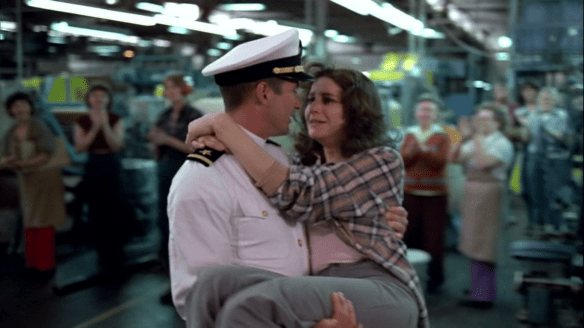
As I watch Richard Gere carry his love (Debra Winger) out of her dead-end factory job, rather like a groom taking his bride over the threshold of their new lives, I too cannot help but smile ruefully. This is the schmaltzy ending of passionate love. But that is only one scene bookending so many others. Some that take us in a stranglehold. Others that fill us with contempt or pity. And as with any film, some that feel superfluous. What stays with you though when the screen goes black are the highs and the lows. An Officer and a Gentleman hits them both with ample fortitude.

4/5 Stars

Lethal Weapon (1987)

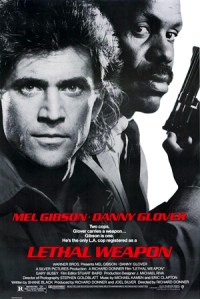
Lethal_weapon1Richard Donner (Superman) has an understanding of the balance of grand spectacle and more subtle moments. The opening aerial shot and the tenuous desert rendezvous with a helicopter churning up sand capture our attention. But it’s the little bits of humor and vulnerability that make the showmanship of Lethal Weapon ultimately worth it. There’s a vibrancy that runs through Shane Black’s script in both the action sequences and character-driven moments.

It’s the quintessential buddy cop action film that in many ways defines the ’80s and that’s because it has a different slant. That’s part of the secret to its success. The main man (Danny Glover) is different and it’s not simply because he’s African-American. His family holds an important place in his life and he’s a genuine person — not an action hero. His partner in crime (Mel Gibson) also has his own deal. We meet Riggs in an abandoned trailer with bedhead, smoking and drinking a beer before he’s even awake. The loss of his wife causes him to contemplate suicide and everyone on the force questions his sanity. But when duty calls these two men are thrown together and out of their initial incompatibility comes mutual respect and genuine fun. As an audience, we enjoy watching them together.

What sets Lethal Weapon apart is how the violence is almost a side thought because what really matters are the characters and their relationships. Friends and family are important. Certainly, there are profane moments but they come in moments of extreme provocation. There’s even gratuitous violence at times but there’s consequence to it, more often than not.

Those in trouble are not simply damsels in distress because most everyone is in the same boat. Martin and Roger both are put in danger, captured and tortured. They don’t just dispense retribution. Their lives and families are put on the line too. However, it’s easy to point out the fact that some characters are killed, most notably in the opening moments, and they feel like mere plot points. For such reasons, the film’s certainly not perfect.

Also, its final moments are admittedly out there. It could be a scene out of Mad Max as Mel Gibson battles in the deluge of a spewing fire hydrant nearly to the death. The question is why, can’t they just arrest the culprit? It’s this scene that allows the character of Riggs to get his desired resolution. In fact, both he and Roger Murtaugh earn a bit of satisfaction as they rise up above the tumult. They are a pair of lethal weapons. But what matters most is that after a hard days work they can get together for a mediocre Christmas dinner. That’s true friendship.

3.5/5 Stars

My Left Foot (1989)

My_Left_FootAs the film opens we watch a foot slowly wiggling its toes. It’s nothing extraordinary because we’ve undoubtedly seen this millions of times. If not on film then at least in our own lives. But it’s what the foot does that piques our interest. Quite dexterously but still straining, it manages to pull a record out of its sheath, set it down on the player, and lay down the needle before music finally emanates out. This simple act gives us some profound insight into the story that we are about to invest ourselves in.

My Left Foot, directed by Jim Sheridan and carried with an early tour de force performance by Daniel Day-Lewis, is an excruciatingly tortuous movie to watch at times. It follows the real-life narrative of Christy Brown, the future painter, poet, and writer who grew up in Ireland only capable of moving his left foot.

Neighbors in the community look at Christy as the bane of his family. He is his kindly mother’s unfortunate cross to bear. And true, his childhood existence is a humble one and his parents don’t quite understand how to empower him, but they still are devoted to him. His mother is the nurturing one and his father sees him as a cripple, but he loves him in spite of it.

As Christy is growing up there’s time for playing football, spin the bottle, and trying his hand (or rather foot) at watercolor. Because the truth is, Christy is a highly intelligent, creative mind only looking to express himself. And his mother continues to build him up with encouragement. In fact, Brenda Fricker’s performance brings to mind all the strong, grounded mothers in the vein of Jane Darwell’s Ma Joad. You can even find a little How Green Was My Valley or The Quiet Man in the family life.

However, it is speech therapy which becomes the next step in Christy’s development and his therapist does so much to open up his world. It’s hard for him not to feel attached and feelings of affection towards her. But as we find out over time, he’s as much a volatile creative force as he was an emblem of perseverance. Because he did not simply sit back, and when he learned to verbalize his thoughts there was a torrent of passion and perhaps even harbored anger that was finally released.

In no scene is this more evident than the one in the restaurant where his longtime therapist Eileen says she is going to marry another man, and aside from his pernicious words and his not ceasing to drink, Christy brings the conversation in the entire establishment to a standstill. In his defiance and anger, he breaks glasses, pulls off the tablecloth, and even threatens bodily harm.

But even when his pride is injured, Christy still remains faithful to his mother and father. His family life prospers even after the untimely death of his and pretty soon his career as an author flourishes after the publishing of his autobiography.

It’s up in question whether or not Christy Brownreal-lifeife received such a happy ending as this cinematic adaptation, but there is no doubt that the film gives the audience a jolt namely thanks to Day-Lewis’ complete dedication to his part. This film much like the likes of The Diving Bell and the Butterfly or even the Theory of Everything allows for great performances, but it also relies on these same actors to use constraints to their advantage. Watching Lewis is a masterclass education in what it means to truly don a role. In this case, My Left Foot truly benefits from it.

4/5 Stars

The Return of the Jedi (1983)

ReturnOfTheJediPoster1983If you’ve read any of my reviews on the original trilogy, you undoubtedly know that Star Wars had a tremendous impact on my childhood. That’s true for many young boys. It was the film franchise of choice, and it wasn’t just a series of movies. The beauty of Star Wars is that it encompasses an entire galaxy of dreams beyond our own. It’s a world that reflects ours in many ways — the difference is that they have lightsabers. But not just lightsabers. Aliens. Spaceships. Planets. The Force. Characters who for all intent and purposes live like us. Good, that is in constant conflict with the evil in the world. It’s a struggle that is constantly evolving.

As a boy, Return of the Jedi always appealed to me the most, and I can still understand that even to this day. This film is the conclusion to the story. It enacts the happy ending that all of us desire as human beings who have an inherent love for storytelling. This film continues the saga of these characters that most everyone has grown to love.

The set pieces are a great deal of fun from Jabba’s Palace to the sail barge where Luke shows off his newfound skills and Boba Fett earns a trip to the Sarlacc Pitt. Then the forest moon of Endor where the cute little Ewoks dwell in full force ready to combat the Empire. In fact, there are numerous heart-wrenching cinematic experiences, but few things are worse than the moment when that Ewok shakes his friend only to find him dead — never to move again. Is there no justice in the galaxy?

There’s the assault of the ragtag rebel fleet against the overwhelming firepower of the Imperials and their newly constructed Death Star where Lando Calrissian, Wedge Antilles, and Admiral Ackbar become standouts in their own right.  Finally, there’s the showdown between Luke and Vader, father and son, as the Emperor looks on in wrathful glee. On multiple fronts the action takes place and each one is a thoroughly engaging piece of this fuller, grander narrative.

There’s something so satisfying about seeing all the many planets in the galaxy celebrating simultaneously when evil has been quelled and peace is fully restored. Because, again, there is something inside of each of us that seems to desire that type of fellowship and joy. You might say that this is only a Star Wars movie, but then again the reason so many people followed this story was not so much for the action, but for the characters because we cannot help but love them.

The dynamic between Han, Luke, and Leia is wrought with conflict but also great love and affection. C3P0 and R2 beep and bicker like an old married couple, and yet there’s so much concern there. Even as Han is freed from his carbonite prison, a helpless corpse, Chewie is always by his side to watch out for his buddy. Ultimately, most importantly of all is the central narrative of Luke and his father. Return of the Jedi is coming full circle as Luke returns to face his father. But he finally understands that this is not about vanquishing this villain or even confronting his fear. It’s more than that. It’s about teasing out the good that still dwells inside of this shell of a man formerly known as Anakin Skywalker. And when that relationship is renewed all the other relationships are made better.

Thus, Return of the Jedi will forever be spellbinding, because I feel like a young boy once more watching this sci-fi mythology unfolding in front of me in glorious majesty. There is a suspension of disbelief that envelops this story for all the aforementioned reasons. There is no question in my mind about the logic or the way things tick or so on. I accept them for what they are and truly and fully allow myself to be immersed in a world, “A Long Time Ago in a Galaxy Far Far Away.” There certainly are better films, but few films have gripped me time and time again like Return of the Jedi. I will hold onto it proudly for as long as I watch movies.

4.5/5 Stars