We meet a college-aged Korean guy (Cha Tae-hyun) as he relates his first encounter with the girl (Jun ji-hyun) who would ultimately become his girlfriend. In the throes of a drunken stupor, she flails perilously near the railway as an incoming train comes on so he steps in to pull her back to safety. They board minutes later — he’s still watching her warily — only for her to puke all over a commuter.
Assuming he is the boyfriend, Gyeon-woo is chastized to do something about his girlfriend and so reluctantly he takes her still intoxicated by piggyback to the nearest hotel. This whole complicated scenario happens to him twice and it lands him in jail. It doesn’t sound like the pitch-perfect moment to start off a romance but then again My Sassy Girl never has perfect pitch and that’s where it succeeds.
The film opens with these exaggerated comically cringe-worthy interactions and yet it settles into something far more fulfilling than its attention-grabbing gross-out antics. While Gyeon-woo gets all but pulled into the scenario you realize that there was a single decision. He cared enough to intervene on this girl’s behalf. Maybe he regretted it but it’s doubtful.
What was his life beforehand? Fairly inane and nondescript. He hangs out with his buddies as they grunt about inconsequential things. His face is prone to glazed over expressions. He’s constantly whining to his mother over the phone after forgetting to visit his Aunt — the Aunt who always pinches his cheeks and tries to set him up with an eligible girl. When he’s not getting swatted at by his mother at home, his father gives him a going over for not getting better grades. He’s a rudderless young man with no true conviction or sense of purpose. He’s in need of some kind of shakeup.

The Girl (who is never given a name) is actually the one who dictates the sheer unpredictability and consequently, the hilarity of the picture. Jun Ji-hyun pulls off a remarkable part that brims with a feistiness, playful whimsy, and utter solemnity as it cycles between scenes. She smacks him around and bosses him to do this and that based on a momentary fancy. Also, her facial expressions are on point.There’s so much sassafras as we used to say in high school. She willingly calls out people for their behavior in public places as well as their wardrobe choices. The filter is all but lacking. She’s a creature of caprice.
Anything that Geon-woo does to her disapproval prompts her threatening catchphrase, “Wanna Die?” Partially as a veiled threat and partially as a rhetorical assertion. It works in many circumstances. Most importantly she has fun because that is her antidote to try and forget something — to get past some prior hurt — and to reclaim her life as her own.
Like the Japanese film Shall We Dance (1996), My Sassy Girl also garnered an American remake due to its popularity. But the remakes in both accounts cannot measure up to the originals for a very simple reason. These stories are meant for the cultures they came out of or at least they are given greater import in their respective countries of origin. The first film was about freedom of expression in a society that values a certain amount of conformity. My Sassy Girl highlights a character who all but goes against the norms of how people are supposed to act as she carries herself with a certain amount of unpredictable vigor.
There are some clunky seemingly superfluous scenes but our leads have a disarming even unorthodox chemistry about them that weathers it all. One scene, in particular, stops up the film’s middle where they sneak into the theme park on The Girl’s birthday only to be held hostage by an AWOL soldier. It’s ultimately another expression of romantic sentiment but it disrupts the hilarity for an extended period of time. Because those are the moments when the story is at its best.
The direction can also be a bit distracting as the camera swirls around and does this and that with POV shots inserted and lines of voiceover narration but we can attribute that merely to the film’s jarring intentions. They help personify this volatile, idiosyncratic character at its core.
The original slap bet is born on the Subway. Squash games inevitably wind up with the ball nailing Geon-woo in the face. He’s also inept at swordplay and he can’t swim. Meanwhile, she holds aspirations for writing screenplays and forces him to read her work. He notes there’s always a hero coming from the future infused with action-packed terminator or samurai vibes.
All of this movie’s finest moments of romantic hilarity can be summed up in the list of 10 points Gyeon-woo recites by heart relaying how to treat his girl:
- First, don’t ask her to be feminine.
- Second, don’t let her drink over three glasses, she’ll beat someone.
- At a cafe, drink coffee instead of coke or juice.
- If she hits you, act like it hurts. If it hurts, act like it doesn’t.
- On your 100th day together, give her a rose during her class. She’ll like it a lot.
- Make sure you learn fencing and squash.
- Also, be prepared to go to prison sometimes.
- If she says she’ll kill you, don’t take it lightly. You’ll feel better.
- If her feet hurt, exchange shoes with her.
- Finally, she likes to write. Encourage her.
The latter half dips more deeply into the well of sincerity and though it might seem difficult to buy this sentimental side of the characters, we’ll gladly make allowances because we’ve been through so much with them. It turns out The Sassy Girl has more to her as we always suspected.
In an excursion to one of her favorite spots that is shaded by a solitary tree, they bury a time capsule with letters written to each other. On her behest, they will come back in two years to read them but for now, she must go away and figure things out. It seems a dismal and confusing point of departure for Geon-woo and the audience. But he resigns himself to it and moves forward.
However, the film very much wants to drill into our heads that fate means building a bridge of chance for your love. It gives romance this edge of grand design where all things fall into place for those who are truly meant to be together. Fittingly, circumstance brings them back full circle. Surely, some will need to take this with a grain of salt but no matter, when it’s all said and done, there’s no question that My Sassy Girl is a satisfying rom-com moment after moment. The leads are just too memorable to pass up.
3.5/5 Stars
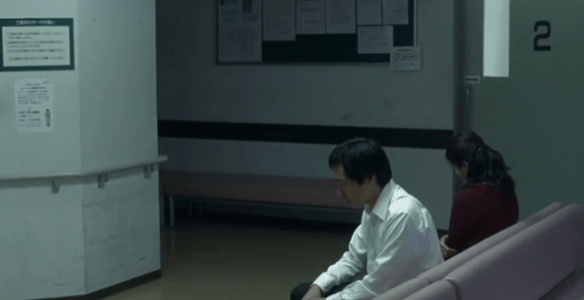
 The initial inclination for seeing Arnaud Desplechin’s sprawling family drama was the presence of the estimable Catherine Deneuve. And she’s truly wonderful giving a shining, nuanced performance that makes the audience respect her, sympathize with her, and even dislike her a little bit. But the same goes for her entire family. The best word to describe them is messy. Dysfunctional is too sterile. Messy fits what they are. If you think your family is bad around the holidays, the Vuillards have a lot of their own issues to cull through.
 Almost Famous is almost so many things. There are truly wonderful moments that channel certain aspects of our culture’s infatuation with rock n roll.
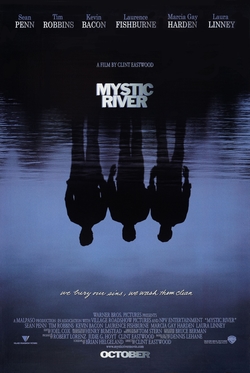 When you enter into the world of a film you often expect it to be perfect in your own minds-eye, following your own rationale to a logical conclusion. In that sense, Mystic River is invariably imperfect in how it ties up all its loose ends, but then again, what film really can bear that weight — and it’s all subjective anyhow. Instead, Clint Eastwood’s Boston-set drama builds off a story about three young boys and evolves into an engaging police procedural intertwining the lives and events of these three individuals. But it all starts with a game of street hockey.
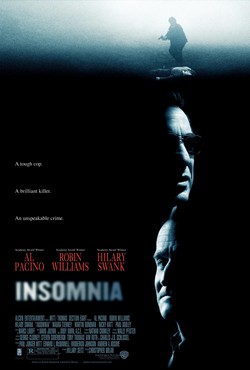 “You and I share a secret. We know how easy it is to kill somebody.” – Robin Williams as Walter Finch
 Peter Pan was immortalized by Disney in 1953, but as with many of the great fairy tales that they have adapted, it’s easy to forget that there was an earlier spark. These stories do not begin and end with Disney. They have a far more complex origin story and ensuing history. So it goes with J.M. Barrie’s Peter Pan.
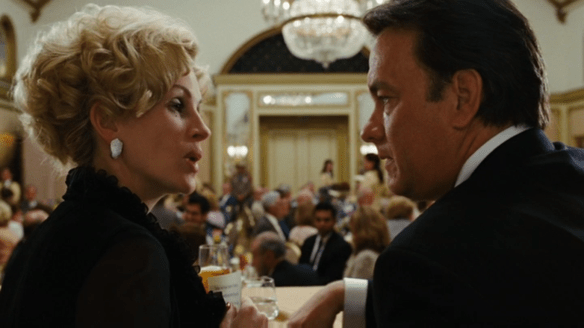 With Aaron Sorkin’s script as a road map, Charlie Wilson is a character that Mike Nichols can truly have fun with. You can easily see him getting an undue amount of delight in this man who was able to do such a momentous thing while simultaneously walking on the wild side. It had to be a good story to warrant the director’s cinematic swan song.
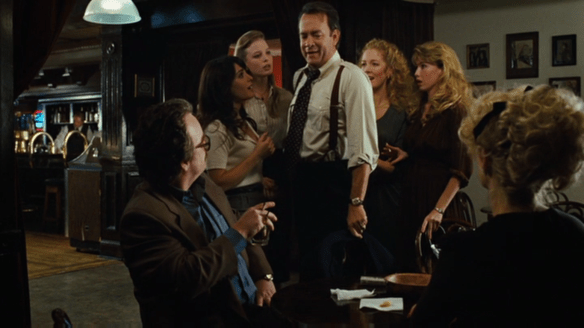 In the opening moments, it becomes obvious that Charlie Wilson is not so much an easily corruptible representative as he is a sexed-up man who enjoys charming female company. He’s “Good Time Charlie” for good reason. He surrounds himself with pretty young things, doesn’t mind playing around a bit, and even has a cocaine charge hanging over him after a potentially objectionable night in Vegas. In fact, the attorney looking into his case is, interestingly enough, one Rudy Giuliani.