Get Out (2017)

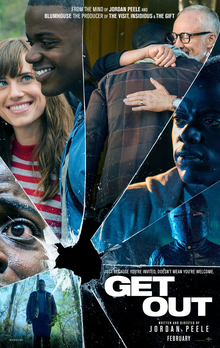
Teaser_poster_for_2017_film_Get_Out.pngGet Out seems like a simple enough premise. Ridiculously simple even. We’ve seen it millions of times in rom-coms or other fare. It’s the fateful day when the significant other is being taken to meet the parents. Whether they pass this test will have irreversible repercussions on the entire probability of the relationship’s success. Maybe that’s a tad over the top but anyways you get the idea as Rose (Allison Williams) drives her boyfriend Chris (Daniel Kaluuya) to meet her parents.

But if anything Get Out is the Anti-Guess Whose’s Coming to Dinner and I say that for a number of reasons. That picture was groundbreaking in its day because Stanley Kramer made an issue-driven film about an interracial couple coming to meet the parents in the age of Loving v. Virginia  (1967) still being on the recent record books. Miscegenation was still outlawed in numerous states across the country. Granted, it was set in California, that open-minded oasis in the West, but that doesn’t mean parents weren’t still skeptical about the union. It’s easy to be a champion of racial equality and quite another to have your daughter marry a man of a different race. At least in 1967. Now it shouldn’t be an issue at all. We are an enlightened people, after all, informed by a 21st-century worldview…

Yet Get Out works because it shows the flip side of the coin. You have that same forward thinking, liberal idealism that’s reflected on the surface for all to see. It’s a bit of the Hepburn and Tracy characters from the earlier picture that we see in these parents (Bradley Whitford and Catherine Keener).

Except here they’re not who they seem to be and their enlightened qualities only mask the ugliness that is hiding inside of them. Perhaps they are more nefarious and wily than the outright bigots because they hide their prejudice proclivities so well. Their racism is systematic and acceptable in the framework of modern society.

It’s nodded at and laughed off at cocktail parties because they are the folks who would have voted for Obama for a third term and their favorite golfer, of course, is Tiger Woods. He plays their civilized game and before his downfall, he played it well. As such, they can accept them without much hesitation because it’s these men who have seemingly conformed to their way of life.

A few other obvious cinematic touchstones to appreciate Get Out are The Shining (1980) because there’s an inscrutable nature to the horror that’s  underlined by dread more than fear in the accepted sense. It makes for an unsettling final act that lingers for a long time. Meanwhile, the entire conspiracy that’s going on under the surface brings to mind Rosemary’s Baby (1968), simultaneously unnerving and darkly comic to its final moments much like Get Out.

This is by no means a pop out at you horror movie which I admittedly don’t hold much taste for. Jordan Peele’s effort is far more than that. Slowly crawling under your skin insidiously looking at some unnamed problems of our society in the domain of race and it does it in such a way that’s perturbing and ultimately brings up some powerful questions on the front of a social commentary.

This is a movie that upends expectations starting out as one thing which we assume will be offered in the package of a horror picture and it morphs into something far more interesting that has the compelling power to stay with audiences long after the momentary shock value might dissipate in a typical film with few lofty aspirations.

If nothing else, it confirms that there is still so much progress that needs to be made in our nation and Peele positions himself as far more than a comedian but a fascinating creative mind behind the camera. Get Out is a shining reaffirmation that creatively potent and timely films are still being made today. It is not meant for everyone but there’s no question it has something new to offer.

4/5 Stars

Columbus (2017)

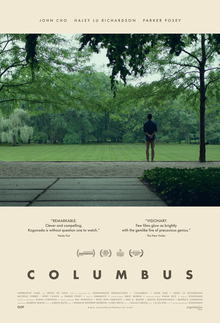
ColumbusPosterI wrote an article quite a few years back where I considered what it would be like if and when an Asian made the leap toward a true leading role in Hollywood. The performers I put up for consideration were John Cho and Ken Jeong. Back then I thought they deserved a platform to go beyond the Star Trek and The Hangover franchises.

While Columbus was not exactly the picture I was considering at the time, it’s more than I could have hoped for. I finally got my wish in this moving character study looking for pulchritude in the midst of life’s incessant turbulence. It’s an unassuming even meandering story. A version of it could exist in real life and that’s a glimmer of the allure.

The narrative plants us in Columbus, Indiana (not Ohio), a Mecca of modernist architecture, and not much else. A Korean-American translator named Jin (Cho) comes back home from Korea to call on his estranged father who is currently bedridden in a coma. It’s difficult to discern what is more tragic: That he is dying or that his son could care less.

Then there’s Casey (Haley Lu Richardson) a young college-aged woman who has foregone the typical trajectory of a person her age with her intelligence to stay behind with her mom, a recovering addict with a serial poor choice in men. While her mother tries to keep a menial job, Casey all but cares for her, spending her days working at the local library and the nights preparing their meals.

The proposed dynamic is obvious but nevertheless satiating when it comes to fruition. Where two people who seem so diametrically opposed in their life stage and social circles somehow form an immense bond in a world so often hampered by superficial, surface-level interaction.

In this facet alone, John Cho, a man waiting so long for such a time as this, has confirmed what many of us have long known. He deserves to anchor a film and Columbus proves he is more than up to the task. While relative newcomer Richardson (Edge of Seventeen) provides him a fascinating talking partner and friend who deals in terms that are simultaneously candid and profound.

Especially in the film’s opening moments, there is a brazenness to Kogonada’s staging and often stationary camera, because it creates this so perfectly symmetrical, oftentimes cavernous space. It’s the height of art and overtly so. In such moments where a color pops in a composition so obviously or he dares to linger on an immaculately staged frame, I see the touches of Ozu. Whether this was done consciously or not is hardly up for contention. It’s too close to be mere coincidence.

The framing of shots. How doorways are used as an entry point for seeing an entire sequence. The fearlessness in using what other people would deem establishing shots to tell a story through the building of an environment in front of us.

It strikes me that often shot length corresponds with the confidence a filmmaker seems to put in their work. Because if you constantly splice and dice every second or two there’s no precision necessary. It will go all but unnoticed on the cutting room floor but to be brave enough to put a sequence up to scrutiny for seconds on end — sometimes even achingly so — it’s something that has become a forgotten practice.

Where it’s alright to linger and watch faces and to catch the nuances of reactions rather than a constant barrage of over-articulated actions and histrionics. Sure, we have a few of those moments here that feel like they are the rhythms of a film drama trying too hard to be a version of reality. The character Jin even remarking in one needlessly self-reflexive moment, “This isn’t a movie.”

Whereas Lost in Translation was built around a city full of energy and cultural clout in Tokyo, with its bright lights and cutting-edge society, where there’s so much to do and a lot of stimuli, Columbus is the antithesis of this.

In fact, an issue might be that it tries to derive so many of its conclusions not through actions but the mining of personal struggles and familial strife. Those are vital areas and yet in the same sense, it’s when the film tries to unwind this exposition we feel like we are, indeed, watching a movie. Still, when it intentionally digs into conversation and moments and feelings, it’s done with tact and an undisputed transparency that’s refreshing even in its heightened realism.

Each character has their alternative foils casting a light into their lives. Certainly, they have each other and they have their parents, who have no doubt made them who they are, while also influencing the direction of their lives. But when we look at Jin there’s Eleanor (Parker Posey), his father’s assistant, and though she’s married now, Jin’s long harbored feelings for her since they first met.

Meanwhile, Casey’s coworker (Rory Culkin) is her continuous companion in the vast hall of the library they work at. He is a doctoral student serving as both a friend and someone to assist her in considering her future endeavors. But there’s no doubting he likes her even as she casually dodges his well-meaning advances.

But Columbus is also bathed in a Midwest malaise. Those terms I put together rather tentatively. In fact maybe like Lost in Translation before it, this is less about the location and more about the people who find their paths crossing. I think this might be it.

Richardson appeals to us because there’s something so chill about her. She ambles through life like one of those people who doesn’t take things too seriously, at least on the surface, because you can easily imagine if she didn’t manage to go with the flow her hardships might tear her apart limb by limb. In fact, they almost do.

But I think I only recall one character who ever had the same sense of wonderment and affection for something like the architecture in Columbus. It came in another artistically-minded and entrancing movie, Museum Hours, where the bright-eyed security guard watches over the art in his stead with the same degree of relish. He loves being surrounded by such sights.

Yes, she says most people could care less about these relics, and yet that’s not everyone. She rattles off facts like a seasoned tour guide but that’s not what does it for her. It’s the memories elicited from certain places. It’s the feelings. The undeniable monuments of magnificence found in her humble corner of the world.

There’s a mood wafting over the film’s canvas that can either be interpreted as melancholy or serenity. Because beautiful things often manage to raise our spirits while also burrowing into our distinct places of hurt. That’s how we manage to cope and ultimately come to terms with them.

So Columbus is a picture coming like a whisper, looking austere and aloof, but rip away the walls, the exteriors of some phenomenal architectural marvels, and you will come to find a beating heart that is well worth its weight. No doubt this picture will be glossed over by many. But that makes its discovery all the sweeter.

4/5 Stars

Clouds of Sils Maria (2014)

Clouds_of_Sils_Maria_film_posterIt’s my prerogative to respect films that dare to leave me questioning their ambitions and their outcomes. Clouds of Sils Maria is such a film. At times it gets so caught up in its own meta-narrative perhaps too much so.

Still, this is a story about a middle-aged actress (Juliette Binoche) called upon to return to the script that made her famous but this time in the much more unglamorous role. Her stardom is such that she can pick and choose her work still but that doesn’t make growing older and life in general any easier. She must navigate press junkets, paparazzi, divorce proceedings, and on top of it all the death of a good friend — the man who helped make her famous.

The person keeping Maria sane through every bit of drama and every tiresome ordeal is her personal assistant Valentine (Kristen Stewart). She is also the one who cajoles her client to take the role. My gut further suggests that there are the inklings of All About Eve echoed in Olivier Assayas story between a mature actress and a rising star who is a prima donna scandal maker of the social media age (played by Chloe Grace Moretz).

But still that dynamic proves to be less fruitul and ultimately less interesting than the relationship that is examined between Maria and Valentine. It is their scenes together that are tirelessly engaging because their interactions run the gamut of emotions. How do you begin to define them?

The dividing line between this play that they are bouncing off each other and their actual lives at times feel perilously close as they jump in and out. Somehow in some unknowable way, it seems to reflect real truths about their relationship.

The meta moments are innumerable including those that suggest Binoche’s earlier film Rendez-vous, Chloe Grace Moretz forays into superhero blockbusters, even a passing coincidental remark Stewart makes about a film featuring werewolves. There’s a Harrison Ford film directed by Sydney Pollack (a lah Sabrina) maybe lightly poking fun at how Juliette Binoche and Julia Ormond could easily be confused.

But if nothing else these feel like only slight nods if not pastiche that do not necessarily aid the aspirations of the film. They mean very little. The far more fascinating suggestion is just how closely the characters of Maria and Valentine read to the figures in the script while they practice the lines in the mountains. But it’s not just that. It’s how their conversation organically reveals bits and pieces of their personal philosophies.

So to clarify it’s not reality intersecting with fiction but the fiction within the fiction that creates a greater depth that complicates matters. That’s what makes the film at times beautiful and perplexing. The fact that Valentine evaporates is tantamount to Michelangelo Antioni losing his main character in L’Avventura. Likewise, Valentine disappears into the clouds never to be seen again and that’s far more interesting than any amount of commentary that could have been crammed into the storyline about Stewart’s actual career.

And in truth, this has to be without question the greatest performance of Stewart’s career thus far because there’s something streetwise, nuanced, and clever about her. There’s a strange sense through her wardrobe and demeanor that this is part of Stewart that we are actually seeing, although I’m not sure how true that is. It feels the very essence of “un-acting” if we can coin that phrase.

Binoche, of course, has a lauded spot as one of the eminent stars of European cinema for very good reason with a career that has been held in regard for well nigh 30 years. Somehow she feels like oil and water mixed with the likes of Stewart and Moretz, products of Hollywood blockbusters, but that’s what makes this film an interesting marriage of backgrounds.

Far from being conflicting, the pairing of Binoche and Stewart is ripe with interesting qualities because their differences make the interactions pop. They can be so diametrically opposed. Their age, backgrounds, and at the very core how they view these central characters of Sigrid and Helena in the film within the film. Yet at the same time, they’re so closely tied together and interconnected — their relationship of a star with her personal assistant that proves to be even closer still to that between friends and confidantes.

When Stewart disappears from the story much of what was interesting vanished from the picture but then again because she vanished it made the picture’s denouement more interesting.

By the end, as an audience, it feels as if we have little stake in the trajectory of Maria’s career. It’s hard to care too much about her at this point because she’s been a star, she is a star and she probably still will be one unless her own temperamental nature gets in the way. It doesn’t leave us with the same empathy that comes with All About Eve because our heroine still has a career fully intact.

Clouds of Sils Maria’s immaculate classical music played over elegant tracking shots, matched by soft fade outs between sequences is pleasant if not a tad pretentious. But its ambitions thematically, by the time the curtain falls, feel noticeably more nuanced than its predecessor. It leaves us with something mystifying to ruminate over and that is nearly enough if not wholly satisfying.

4/5 Stars

Star Wars: The Last Jedi (2017)

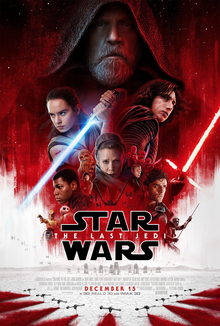
Star_Wars_The_Last_Jedi.jpg“Let the past die.”  – Adam Driver as Kylo Ren

I left the theater feeling completely taciturn. It’s an onerous task to begin articulating all the jumbled fragments circulating through my mind but I will try my very best.  Certainly, there is a great deal to be enjoyed and to be relished about Episode VIII and you would be served well to go into The Last Jedi not searching out its faults but reveling in the successes that are there. Let it be known that there are many and Rian Johnson is a fine maker of movies as he guides us through the Resistance’s latest evasion of The First Order still up to their old business of quashing anyone who dares defy them.

True, I did not necessarily find it a narrative of revelatory reveals or epic showdowns in the vein of what I initially envisioned. However, I can see the picture separating itself from all of its predecessors — subverting the norm and drawing away from all that we knew before. That gels with much of what was said in the wake of The Force Awakens. It could not simply be another Empire Strikes Back if the new franchise was to flourish. In that regard, there’s no doubt Johnson’s film is an undisputed success building on the character arcs instigated in J.J. Abrams’ effort.

Yet my feelings are somehow conflicted.  Kylo Ren’s (Adam Driver) call to action to Rey (Daisy Ridley) midway through was never more pointed. “Let the past die. Kill it if you have to.” And that’s much of what has been done here. Not simply in a single film or to the Jedi order or the legacy of a character but in some respects to an entire franchise.

I am realizing that though I cherish Star Wars as my own, the many aspirations and fantasies of my childhood, it is a communal narrative. It might seem odd to get so thoroughly introspective but I can’t help it. Star Wars is almost inbred into my DNA.

Watching this film might topple the white knights. For one, the Jedi order as we know it. They lose much of their mythical stature that they always evoked. We already lost Han Solo and it’s little surprise that Luke and Leia (with Carrie Fisher’s passing) will most likely not be returning either. The old guard has been all but removed from their posts (with the exception of R2, C3PO, and Chewbacca though Anthony Daniels is the only other returning core cast member).

But it’s no surprise that I often savor the past — the way things used to be. That’s part of what made The Force Awakens such an enjoyable ride. There was an innate sense that this was something new, yes, but it was also squarely centered on the glories of the original trilogy. If I said it once I said it a thousand times, it was like returning to the company of old friends.

Now the old is gone and don’t get me wrong the new additions were greatly appreciated. Once more Rey (Ridley), Fin (John Boyega), and Poe (Oscar Issac) are indubitably winning personalities and fine action heroes. It’s easy to become immersed in their individual journeys along with the newcomers such as Rose (Kelly Marie Tran). However, that doesn’t take away my wistfulness at the conclusion of The Last Jedi.

It wasn’t even the kind of bittersweet conclusion we saw in earlier installments either but a plaintive ending without a giant climax. Harrison Ford received a venerable though tragic send off. His contemporaries not so much. There is still hope and events have been prolonged for Episode IX but not in some monumental cliffhanger fashion.

Whenever I take in a new film I am also constantly filtering it through the reference points that I already know. Obviously, Star Wars has such a vast lineage that must be sorted through but this latest film also can be read through various other archetypes. It strikes me that Luke Skywalker, the Star Wars hero I always aspired to emulate, was like Welles’ Harry Lime in The Third Man — waiting in the wings until he finally stepped out of the shadows.

Though I enjoyed that moment and the pure rush of adrenaline when he came back to the fore, expectations do not always correlate with reality.  Although we get to see Luke Skywalker and there are some enjoyable moments, the best of them come as all too brief reunions with his faithful astromech pal and his sister followed by a showdown with his main adversary — The nephew who turned to the Dark Side — again it was this wistful sense of an anticlimax.

We see in Luke what Obi-Wan (Alec Guinness) once was at least in a visual sense. A hermit who has removed himself from society. Cloaked, bearded, and detached. But whereas Old Ben was a wise, eccentric, and even a fatherly wizard, Luke has become a world-wearied, surly misanthrope. A far cry from the man we dreamed about.

The reverberations of the past echo down in other ways too from the inciting distress signal from his sister that started him off on this cinematic adventure all those many years before and then a visitation from a furry friend.

Likewise, the final showdown is somehow more reminiscent to the archetypal lightsaber battle of A New Hope than all the fanciful epic showdowns we imagined of Jedi Master Luke Skywalker tackling every conceivable villain with his green lightsaber. The old man’s words even mirror the final lines of his late mentor (Strike me down in anger and I’ll always be with you. Just like your father).

Even briefly with lightsaber in hand facing down the greatest forces in the universe as we always thought possible in our mind’s eye, there’s a momentary catharsis. Though the full satisfaction of the moment is stripped from us. Luke is not quite how we remembered him, nay, maybe not even the same man Mark Hamill embodied all those years ago.

It does bring to mind the mythological line out of John Ford’s The Man Who Shot Liberty Valance. “When the legend becomes fact, print the legend.” And it’s still true of Luke Skywalker for those in the galaxy far, far away and right there he can remain a hero.

The film’s most intriguing dynamic reveals itself in the perceived connection between arguably our two most crucial characters in Rey and Kylo Ren also known as Ben Solo. But that core struggle between the two of them — literally the dissonance between the Light and Dark sides of the Force — is rudely disrupted. It’s such an ambiguous dividing line between good and evil and though it still remains, the character of Supreme Leader Snoke, equally implicated in this web comes off as little more than a ploy. All the potential grand conspiracies around it are gone in a puff of improbable smoke.

Intertwined with this is Rey’s familial identity which has been of paramount importance to everyone ever since these new pictures were conceived. It’s not so much that I minded what the revelation was (minor as it was) but it was more the fact that this bit of seemingly crucial exposition was so quickly cast aside as well. It felt once more a bit like a bait and switch — as if the Star Wars saga was somehow rewriting its own mythos in counterintuitive ways.

Maybe for once, Star Wars has become a bit more pragmatic; it has sought out realism and the things of this world more than a galaxy far, far away. Here I will admittedly contradict myself but I am not sure how to deal with this development because Star Wars was always a fantasy, always a science fiction fairy tale built out of imagination and dreams. Now it seems to be inching more and more toward the real world. Not because there are any fewer lightsaber battles or blaster fights or fewer alien species and star systems to explore, but the makeup of the new generation of characters is somehow different.

It is a pipe dream to believe that Star Wars could always be the same because it was not created in a vacuum, it is no longer George Lucas’s, and it has so many other parties invested in it. I for one must come to accept that. The film ends on a rather odd beat with young children getting rapt up in tales of the Last Jedi and looking off into space empowered by the hope brought by the Resistance before the credits roll. Though it felt very un-Star Wars it’s somewhat fitting given this new direction.

Hopefully, younger fans eat up this latest installment and conceive adventures and worlds of their own like I once did, feeding on the visions of the screen as fuel for countless Lego lightsaber battles and made up assaults on the enemy forces with their ragtag band of Rebel Scum. These new films don’t mean so much to me but maybe they can mean something to the current generation. Maybe that’s what they’re meant to do.

Will I see The Last Jedi again? I wouldn’t be at all surprised but unlike The Force Awakens, this isn’t so much an extension of the original trilogy. This is a breaking of the chain. This is something starkly different and it’s taken the galaxy into uncharacteristic territory.

I resolutely admire Rian Johnson for his choices because it seems like he’s made a Star Wars film that is hardly cookie cutter in nature and the fact that it will not please everyone is a marvel (no pun intended) given the usual reality that blockbusters are supposed to be easy on the eyes while hardly divisive. Though flawed, it’s a relatively bold movie in running time, in how it utilizes its characters, and ultimately how it chooses to depart from its longheld traditions. But the boy inside of me still yearns for the Luke Skywalker of my youth as naive as that might sound. I suppose I’ve never been much of a realist.

4/5 Stars

Manchester by the Sea (2016)

Manchester_by_the_SeaIn Manchester by the Sea, you can distinctly see Kenneth Lonergan once more translating some of his skills as a playwright and stage director into his film. There’s a very inherent understanding of two-dimensional space and how images can be framed in a very linear way as they would be seen by an audience taking in a stage production. But even more noteworthy than that is his dialogue which functions in remarkably realistic ways. Some will easily write this film off as the sheer doldrums because it’s fairly fearless in its pacing.

But that very structure and the things it spends time on slowly reveal more and more about the characters as if the curtain is slowly being torn away and their guts are being spilled out in front of us, in the most labored way possible.

It’s true that a great deal of the acting is an exhibition in non-emotive near anti-acting. It goes against the normal penchant for histrionics and gut-busting displays of emotion. Those crop up here and there understandably for a story that deals with such heart-wrenching topics. However, this particular study finds the majority of its most illuminating revelations in the minor moments, quiet asides, and soft tears rather than more overt outbreaks.

Sometimes it’s those very dramatic moments that catch our attention but most of the film — most of the instances that we actually come to learn a great deal about these seemingly unextraordinary individuals happens in the moments that initially appear far more mundane.

Crucial to this whole narrative is Casey Affleck as Lee Chandler. His performance is painful to watch because he himself looks so uncomfortable, despondent, and forlorn in every frame. There’s no relief for him. He never gives it to himself and he never accepts it from others. The fact that his elder brother has passed away suddenly is the inciting action that only aggravates his status quo but it’s not the main cause for his current state of being.

Because, of course, the question becomes what happened to him to make him such a misanthrope? That’s one issue because the past informs his present and stoke the flames of his continual discontentment.

The latest revelation is that he is made the legal guardian of his teenage nephew and this among all his other personal demons is the situation he must grapple with. Their dynamic stays front and center.

Together they must navigate all the responsibilities that come after Joe’s death whether it’s signing off on his belongings or setting up his burial with this insurmountable amount of grief still hanging over them. Lee willfully takes his nephew to school and band practice at one of his girlfriends.

But he’s not good at showing affection. He’s difficult and in such a contentious moment of pain they both lash out at each other more than once. But there’s still an underlying sense that they care for each other. Lee wants to protect his nephew but he doesn’t quite know how–he does not know if he will be able to bear the responsibility.

Still, others of note also crop up and play a part in the story including Lee’s ex-wife Randi (Michelle Williams) who has moved forward with her life but still feels tortured for the very way that she treated Lee when they were married. There’s so much hurt there and Lee buries that too.

His now deceased brother (Kyle Chandler) who we begin to meet through flashback is not developed quite as much but he does stand as a symbol of family and how deeply the loss of loved ones is earth-shattering. Because often these are the people who are a perpetual part of your life. You come to love them and accept that they will always but there. Even when your own life is going down the drain at least they remain. Except in an instant, their flames can be cruelly snuffed out.

The story’s visuals not surprisingly cast a vision of a tranquil seaside locale that nevertheless can be a place of bitter cold and blue-collar mediocrity. Lee would be the poster boy of this lifestyle as he spends his days as an isolated handyman janitor grinding away at life. But as with any life, we can never make preconceptions. We need to get to know someone before we judge their character. That’s what a film such as Manchester by the Sea makes us realize as human beings.

Everybody has a story. We all make mistakes. Our flaws are many. No one knows how to cope with guilt and it hurts like a slug in the face sometimes. Even if it is a taxing film and a difficult film to traverse with its share of profanity, Lonergan’s piece is still a nuanced look at what that process is like. Perhaps you haven’t experienced the death of a loved one yet but most definitely you have and you know the pain and the helplessness and the messiness therein.

If any of that resonates with places you’ve been before then Manchester by the Sea might easily speak to you because it understands some of the unassuming power in the human experience and its innumerable complexities. Unsatisfying in the end, yes, but alas that is life so often. People constantly struggling with trials, tribulations, and dissatisfaction til the end of days.

It’s after one particular scene where a very special guest star makes an appearance a man that Patrick notes is “Pretty Christian” while Lee responds that “we’re Christian too. Catholics are Christian.” And he’s perfectly correct. It’s in this passing moment that the film teases on something interesting that it, unfortunately, doesn’t wrestle with more. Spirituality and faith in a God in the midst of suffering. Maybe the characters still need time to get there and that’s okay. But Manchester by the Sea does make us empathize with other people and come to understand their stories. That is crucial if we’re ever going to live together in this world of ours. For that reason alone this story has something to offer us.

4/5 Stars


Blade Runner: 2049 (2017)

Blade_Runner_2049_poster.pngThe finest compliment that can be paid to Blade Runner 2049 is that it is indubitably the most enigmatic film I have seen in ages. Typically, that’s newspeak for a film that probably deserves multiple viewings, because its intentions, much like Ridley Scott’s Blade Runner (1982) are not always clearly laid out. Especially in this day and age when we often expect things to be given to us and our hands to be held as an audience.
For that very reason, those who admired the original will potentially find a worthy successor in Denis Villeneuve’s rendition but this cult franchise might be hard-pressed to convert a new fanbase. Because while the greatest cinematic achievements are often equally artistic endeavors and continually entertaining, Blade Runner is worthy of the former while still lacking the kind of visceral fun that will grab hold of a new generation.

Still, there’s a necessity to draw up a distinction between faulty pacing and a film that is completely comfortable moving at the pace it deems important. The film paints in panoramas and epic strokes that the Ridley Scott’s original simply could not manage. Though perhaps more importantly, it did develop a cyberpunk, tech-noir aesthetic that created a new template for so many future projects.

The veteran cinematographer and Villeneuve favorite, Roger Deakins, produces visual splendors of the first degree with his own brand of photography. They are the kind of immaculate frames where shot after shot can be admired each one on its individual merit as if perusing a vast gallery of paintings. One important key is that oftentimes we are given enough time to take them in without frenetic editing completely cannibalizing the pure joy of a single image.

It can similarly be lauded as not merely a piece of entertainment for thinking people but a piece of visual art and a philosophical exploration. That last point will come up again later.

But it’s also quite easy to liken this installment to George Miller’s Mad Max Fury Road (2015) which was able to provide a facelift to its material by successfully expanding the world that had been built in the original Mad Max trilogy. Likewise, this movie maintains much of the integrity of its predecessor by seeing the return of several cast members, screenwriter Hampton Fancher, and even Ridley Scott to a degree as executive producer.

Our story in this addition begins with a new model of replicants, Nexus-9, who are used as the current force of blade runners as well as other more menial duties. Among their ranks is K (Ryan Gosling) an officer assigned by his boss at the LAPD (Robin Wright) to track down the last remaining rogue models of “skin jobs” still surviving.

Simultaneously the Tyrell Corporation has been replaced by a new organization led by a visionary named Wallace (Jared Leto) who has aspirations to create an even more magnificent android in search of true perfection of the human form. He’s also very much interested in a mysterious discovery that K makes while performing his duties.

Wallace sends out his henchwoman (Sylvia Hoeks) to do his recon for him. Meanwhile, K travels far beyond the metropolis of Los Angeles with its unmistakable imagery full of Coca-Cola ads, Atari game parlors, and countless women walking the streets looking to pick someone up.

It’s comforting to know that my home away from home, San Diego, has been turned into a giant rubbish heap while Las Vegas looks more like the Red Planet than any earthly locale though still strewn with the remnants of the strip’s sleaze. If we ever took for granted that this is an apocalyptic world then we don’t anymore.

In keeping with the integrity of the picture and the curiosity of the viewers, it’s safe to say that Edward James Olmos makes his return as Gaff still partaking in his origami-making ways though his subject matter has changed slightly. And of course, the man everyone has been waiting for, Rick Deckard (Harrison Ford) is of crucial importance that becomes at least a little bit more clear as K progresses in his search for concrete answers. The cornerstone of the story is, of course, Deckard’s beloved Rachael and the life of anonymity he has taken up since his retirement as a blade runner.

But until its very last frame Blade Runner 2049 feels cryptic and mesmerizing in a powerful way. The narrative is so expansive and grandiose making it questionable whether or not the film is able to maintain a cohesive core with a singular purpose but some potentially profound ideas are undeniable.

Plenty of spiritual imagery courses through it and hardly by accident. An almost Christ-like birth of a supernatural nature remains at its center and what we can presume to be several very conscious references to the book of Galatians —  a letter that not only tackled the so-called “fruits of the spirit” but Gnosticism or the idea that the Creator was a lesser divinity (not unlike Wallace).

Upon reflection, I’m still partial to the original because while both films grapple with the dividing line between the human and the non-human, the first Blade Runner came from a human perspective and that’s even in how it was shot and the technology of the time. It looks like our world, dark, dank, and gritty as it may be.

But in this narrative, while a further extension of that same world much of what we know is in question and it hardly feels like we are taking on a human point of view anymore but we are put in the place of a replicant — an android — even if he has a desire to be human. And again, that lack of humanity reveals itself in the very frames of the film full of unfathomable sights acting at times like a tomb-like mausoleum– so bleak and austere and cavernous.

That is to say that the original even in its darkness still managed to have a soul in the incarnation of Deckard. This picture though trying so desperately to do likewise feels even more detached. It, in some ways, brings to mind Gosling’s Drive character who was very much the same. And yet the other side still deserves some acknowledgment because there is an underlying sense that K does evolve into a more sympathetic individual as time passes. The case can be made that he is the most human.

Going beyond that, it’s also an exploration of how the world is saturated with sex and probably even more so than its predecessor. There’s a particularly unnerving scene where a man tries to combine fantasy with physical intimacy in a way that feels all too prevalent to our future society and consequently it brings up similar themes to Her (2013).

Even in such a future, it’s comforting to know that Presley and Sinatra live on in the hearts and the minds of the populous though that reassuring truth cannot completely overshadow the myriad of issues still to be resolved.

The final irony remains, the problems do not begin with the replicants themselves but in the hearts and souls of mankind. I see that central complexity of the film very clearly reflected in the two iconic objects. One an origami unicorn, the other a wooden horse.

Because we can read into the first if we want to as an indication that Deckard is a replicant and we can see the latter as confirmation that K is, in fact, human and yet on both those accounts we might be gravely mistaken. It comes downs to our own personal perceptions. Whether these beings were “born not made” or vice versa.

It gives more credence to the assertion that the eyes remain the window to the soul. That is never truer than in Blade Runner a film that fittingly opens with a closeup of an eye — the ambiguity established in the first shot. As K notes later, he’s never retired something that was born. Because “to be born means you have a soul.”

Of course, that razor-thin dividing line can be very difficult to dissect completely and that’s Blade Runner 2049 stripped down to arguably its most perplexing issue. Could it be true that an android could act with far more humanity than any human? The verdict might well be out far longer than 2049.

4/5 Stars

Dunkirk (2017)

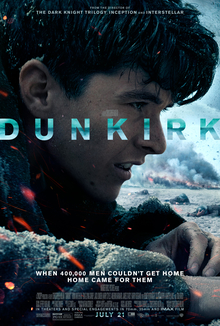
Dunkirk_Film_poster.jpgUpon being thrown headlong into Christopher Nolan’s immersive wartime drama Dunkirk, it becomes obvious that it is hardly a narrative film like any of the director’s previous efforts because it has a singular objective set out.

It’s economical (shorter than many of most recent efforts) and the dialogue is sparse, sprinkled sparingly throughout his picture. After all, the main goal of this film is not so much to tell us a story — drawing up the lines as they might have been — but actually immersing us in that moment that was so crucial to British morale and ultimately the outcome of WWII.

As such, this is visual storytelling to the utmost degree and it comes off splendidly for the precise reason that film has always been a visual medium as much as we try and make it about dialogue. Because invariably dialogue is often used as a crutch while Nolan’s film relies almost solely on its images to tell its story and that’s a quality of filmmaking that is often lacking in the contemporary industry.

Backstories are all but left to the imagination and there’s immense power in that. Too often storytellers feel a need to spell everything out, providing all the perfect cookie cutter moments in order to hold the audience member’s hand so they comprehend it all. But has something as volatile as war ever been like that? I’m sure we can all answer with an emphatic “NO,” so why would a film be any different? Make people use their brains. Make them feel something viscerally. Leave them in the dark. Keep the outcomes ambiguous.

Likewise, there are no imagined interactions between the major figures at play whether Winston Churchill or Adolf Hitler. In fact, we never see a German’s face. We only see the results of their efforts to deter the British and cut off their escape route. As for Churchill, we never see the great English bulldog but his spirit wafts over the picture — certainly his words too — but it’s that spirit of resilience, that never say die attitude that speaks to his own character. That is enough.

Normally these type of decisions would signal a death wish but Nolan has been rewarded for his brazenness offering up a summer blockbuster that’s all but necessary. Because it tramples over much of the conventional wisdom that the industry has tried to impose on itself to reel in success. If there was any man to do it, Christopher Nolan certainly fits the bill.

There’s still very purposeful action playing out on three fronts. You have the soldiers actually stuck on the beach and in this case, we end up following a group of soldiers. Boys really. First, one who flees back to the beach after his compatriots are gunned down then joins with another boy to try and get aboard a battleship with a man on a stretcher. Finally, they get their chance only to get torpedoed out of the water. Treading in the oil-soaked ocean until someone can save them.

Then, there’s a trifecta of British Spitfires (led by Tom Hardy) traveling across the English Channel to provide coverage to their boys down below. Their exploits are documented with engrossing aerial shots that bring us right into their cockpits as they sit behind the controls looking to evade and vanquish their enemy.

Finally, we have the men of the home guard namely a father (Mark Rylance) and his two sons who answer the call to come to the aid of their young men stranded across the channel. You get the sense that they are riding into the valley of the shadow of death except that the valley of death is the sea and German U-Boats are waiting for them. Still, they push onward to rescue men coming by sea and by air. It too requires costly sacrifice.

Dunkirk’s soundtrack is magnified by ticking clocks and Hans Zimmer’s selection of screeching strings but it’s not necessarily developing the drama for drama’s sake. Again, there’s this underlying striving for authenticity.

One scene stands out in particular when the shell-shocked soldier (Cillian Murphy) asks if the boy he accidentally harmed is okay. He’s sorry now but doesn’t know the irreparable damage he has done. Still, the young man’s brother could lash out in anger. Instead, he takes the high road and tells him the boy is fine. His father grimly gives him a nod. He has made the most merciful decision for all parties involved.

It’s so easy to get caught up in the moment and you begin to understand to what extent these British soldiers were sitting ducks on the beaches of Dunkirk.  Because you are right beside them in every waking moment. And if we understand the horrors and the selfishness that begins to breed as survival instincts set in then just as easily we comprehend the pure euphoria that comes over the men when the flotilla from home comes to their rescue.

Even in these moments what is striking is not so much that Dunkirk is a grand epic but it feels surprisingly intimate. Despite the anonymity that runs through a great deal of this film Nolan still gives us characters that we can attach ourselves to and they begin to resonate not because we know their person inside and out necessarily but we start to empathize with their positions first hand.  When you begin to see the world as someone else sees it, it’s difficult not to connect. And that goes for everyone.

Because this was not just a war of soldiers from the army, navy, and air force. This was a war that involved nurses and the home guard and every other man, woman, and child who rationed their supplies and blacked out their windows all because of the collective war effort.

It’s often the most trying circumstances that bring us together so that we are no longer individuals but we become one. Dunkirk seems like precisely one of those galvanizing events that can forever be looked back on with pride. It personifies bravery, resilience, a stiff upper lip if you want to put it that way. And the significance in survival is that they lived to fight another day and ultimately with the other Allied powers they were able to quell the Nazis.

Some might come out of Dunkirk hailing it as one of the great war pictures of our generation, but truthfully it’s more so a survival story and a tribute to the fighting spirit that often dwells in the souls of men. In an age so often lacking in courage, fortitude, and honor those are the very attributes that rise to the surface and become most evident. Dunkirk is a striking reminder, not simply for the British people, but for us all.

4.5/5 Stars

The Edge of Seventeen (2016)

The_Edge_of_Seventeen_2016_film_poster.jpgThere’s a moment in Kelly Fremon Craig’s The Edge of Seventeen where Nadine (Hailee Steinfeld) suffers the ultimate humiliation third wheeling with her older brother Darian (Blake Jenner) and her (former) best friend Krista (Haley Lu Richardson). Needless to say, the evening is less than stellar but it gets worse after Nadine feels like she’s been totally betrayed. She’s been hating her brother recently and her best friend is dead to her now. The fact that she sets up an ultimatum doesn’t make things any better.

It only gets worse when a fellow partygoer notes Nadine’s sibling relationship reminds her a little bit of the movie Twins — if Nadine was Danny Devito and Darian was Arnold Schwarzenegger. It’s a perfect illustration of how she feels.

Growing up is never easy for anyone and it’s little different for Nadine. Mean girls at school. No friends. Until the fateful day when she got one but by the time high school hits everyone’s doomed. Hailee Steinfeld manages the tall order of portraying this maladjusted, histrionic, neurotic teen with a pitch-perfect pout.

She’s simultaneously our Lloyd Dobler and our Molly Ringwald in any of the John Hughes vehicles and yet none of those things because she’s come out of a different millennium. She must put voice to every thought and emotion that comes ricocheting through her head as much as she constantly yearns for the not so pretty boy on campus to notice her existence.

Her family life is little better. The death of her father still lingers with hurt. Her brother is the devil’s incarnate (at least to her) and her mom (Kyra Sedgwick) is a little ridiculous–not to be taken seriously in the least. Did we mention that her best friend is hooking up with her brother?

What the film grasps so impeccably is that the teenage years are often defined by one word: Awkwardness. This film is the creme de la creme of awkward and for a coming-of-age film that’s very much a compliment.

There so many awkward conversations to be had. Steinfeld and Woody Harrelson share some of the best because she comes like a hurricane of emotion and he gives her nothing — only the driest retorts as her smart-aleck history teacher. Equally enjoyable is the budding friendship between Nadine and fellow classmate Erwin Kim (Hayden Szeto) who makes no attempt to hide his crush on her.

It’s easy to quickly assume Erwin is in the tradition of Long Duk Dong from Sixteen Candles but a particular Ferris Wheel conversation throws all those conventions out the window for good with a few self-aware lines of dialogue. It’s a pleasant surprise that this relationship is rife with laughs but not at the expense of the characters. Only in the sense that we have the age-old conundrum of the friend zone, still fretted about by teens to this day.

She thinks he’s nice but isn’t attracted. He thinks she’s the greatest girl in the world and dreams of making it into something. He takes all her signals to heart. She doesn’t. The Edge of Seventeen feels very genuine in these respects and the beauty of these themes are their universal quality. This isn’t just about a girl and a guy–one Caucasian the other Asian–they are two people just like us. It’s the universal unifier. We’re all human.

That’s one of the relationships modeled by Nadine in the film. But there’s another one that is far more unpleasant. The one involving her own crush on Nick a seemingly unextraordinary teen male that Nadine for some inexplicable reasons seems batty over. So much so she wants to get with him and sends him the longest, most explicit, and regrettable text message of her life. Still, it gets her some results–a ride in his car with some extra-curricular activities. Whether it’s exactly what she wanted is another thing entirely.

It’s sad really. Our culture is so saturated by sexual images teenagers think there is a need to play into those expectations, to use those same methods to get others to like them and be with them. When, in reality, that’s not right at all and the funny thing is that isn’t even what we want. It’s fairly clear Nadine finds this out firsthand. She doesn’t want just the sex in the first five minutes. She wants more. Conversation. Relationship. Intimacy. To be known. Anything would be nice. And that’s what we all want to some degree but we have an inherent ability to chase after the imposters and the imitations. They seem so nice and yet leave us with nothing.

We’ve been taught we need to lead with what’s on the outside — it’s our body that matters — as our hearts slowly die on the insides because we feel like no one understands us. Our family is made up of psychos and we have no friends. That’s part of what makes this film so revealing. But also the very fact Nadine, despite all her teenage drama, certainly has her moments.

Speaking into her mom’s life with certain candor at least on one occasion and actually opening up to Darian in a way she’s never been willing to do before. It’s the fact that she and Mr. Bruner can joust and yet by the film’s end you know full well they genuinely enjoy each other. It’s true that the acrimonious relationships with teachers somehow are the ones we remember and ultimately invest in most deeply. It’s those interactions that redeem Nadine and help her figure her life out, even if it’s only a little bit.

My only reservation is that although we greatly enjoy their characters, because of their economical amounts of screen time, it feels a little bit like Nadine’s dad and her best friend were used solely for the sake of the plot.

Still, the film’s ending makes no attempt to suddenly discover the meaning of life in some lightning rod of an epiphany. Instead, it contents itself in concluding its story not so much with endings but with the hint of new beginnings and that is oftentimes so much more rewarding. Can I simply end by saying Erwin’s quite the filmmaker?

4/5 Stars

The Big Sick (2017)

The_Big_Sick.jpgIn his opening introduction, Kumail (comedian Kumail Nanjiani playing a cinematic version of himself) explains what it was like to grow up in Pakistan with cricket and praying and arranged marriages. All those fun Pakistani traditions. There’s a bit of a matter-of-fact flippancy to how he recounts it all. Truthfully, it’s in stark contrast to much of what we’re used to. As he so rightfully points out, it also meant they got episodes of Knight Rider a lot later than everyone else. That’s before his parents made the decision to move to the States with their two sons.

America has always been a melting pot since the day of Alexis De Tocqueville and that’s part of what this film celebrates while never completely denigrating Kumail’s Pakistani roots. It so refreshingly provides a story told from a different point of view — one that we have not seen all that often — which is all illustrated so exquisitely in the opening moments.

But The Big Sick is also resonant in part because of the conflict of cultures that dwells at its core. A differing perspective usually causes chafing and it’s no different in this case. Still, at first, it must start out as a love story and it is or at least it evolves into one. This particular romance feels invariably relevant to the current world we find ourselves in. It’s a picture informed by a 21st-century worldview.

Kumail is making a go of it as a stand-up comedian in the Windy City and he makes ends meet with a bit of Uber driving. He meets a girl named Emily (Zoey Kazan) at his comedy club, a local grad student with aspirations to be a therapist. They go on a date and wouldn’t you know it, they sleep together. That is the culture after all as much as Uber, ethnic diversity, profanity, and irreligiousness.

Perhaps it’s more precisely put by Kumail who so candidly admits he hasn’t prayed for years because he does not know what he believes. That is the world that this movie occurs in, our world right here and now. They have their rounds of playful patter and time spent together watching Kumail’s favorite horror movies (he proudly has a poster of Shaun of the Dead up on his wall like any unabashed nerd). Still, they are equally noncommittal in how they never want to get too serious about relationships.

It makes sense that romances are about relationship but often those very things are also so closely tied to family. Both sets of parents play a significant role in the picture and certainly, none of them are perfect — exhibiting a wide range of idiosyncrasies — and yet the key seems to be that they are more than a pair of punch lines. It’s those very relationships too that seem to add even a greater depth and heighten the stakes. Because parental commitment more often than not is for the long haul even when their kids’ relationships don’t seem to be.

In case the title didn’t tip you off already, I’ll save you the trouble and let you know that Emily winds up sick in the hospitable. The people by her side are her mom (Holly Hunter), her dad (Ray Romano), and Kumail who feels bad even as their relationship was all but finished.

As we get to know them as people though, it really feels as if we are getting a better understanding of Emily and the same goes for Kumail. In the same way that Kumail feared telling his family that he was dating a white girl, we see another culture clash in her parent’s who fell in love years ago despite coming from two very different backgrounds, one a stiff New Yorker the other a southern belle in a football-loving family.

Kumail begins to gain a certain modicum of courage to stand up to his own parents, in particular, a mother who is always trying to set him up with a nice Pakistani girl like she did with his older brother. He’s weathered a long list of resumes and “drop-bys” by the most eligible Pakistani ladies. We sense the need for personal integrity. He needs to learn how to exercise it not only in dealing with Emily but his parents as well.

You can still be an American and embrace other cultures and that’s one of the keys to this story because navigating that can be utterly trying. Our differences far from encumbering us should bless us with life more abundant and humanity still proves that love can be a universal language that crosses many divides, cultural or otherwise.

Furthermore, could it be that this film too succumbs to that character trope formerly in vogue as the manic pixie dream girl? It’s a stretch since this is based on real events but it falls apart further still as we watch the film progress to its full conclusion. Because if you remember this fantasy character is meant to bring something out of the male character and cause a change in them. That does happen to Kumail to an extent.

The crucial development for the sake of Zoe Kazan’s character is the fact that she is allowed more growth than simply being the cause of Kumail’s growth. Thankfully she is more than a mere plot device. She is given the dignity of an actual human being meaning that she’s able to acknowledge that maybe she hasn’t changed as much as him — she’s not ready to just go back to the way things were before — and that’s okay because that feels authentic.

That’s not to say there can’t be a happy ending but as many of the greatest modern romantic comedies have managed this one leans into ambiguity and makes that a strength far more than a weakness. Kumail has gone onto to pursue his stand-up career. Emily no doubt continues her aspirations to become a therapist. Still, there’s such a thing as a fairy tale and this might be a good time to point out again that this is semi-autobiographical. Real life fairytale romances are possible. They just usually happen to be a lot messier than we’ve read about in books. A lot like this story.

3.5/5 Stars

Update: On September 16th, 2017 a man named Nabeel Qureshi passed away. And I bring up his extraordinary life because it was difficult for me not to see the parallels to this film.

Like Kumail, Nabeel was Pakistani-American. Like Kumail, Nabeel also faced the challenges of going against the wishes of his parents when it came to core aspects of his life. Like Kumail, Nabeel and his wife faced the malevolent onslaught of sickness. But in Nabeel’s case, the sickness struck him and he did not recover.

It sounds like a very sad tragedy and it is bittersweet but I reference it because Nabeel was a man who had tremendous joy and hope and he left such a lasting impact on his fellow man. It is a life worth sharing about. I enjoyed the Big Sick but even in the last few months and weeks, I have been inspired by Nabeel Qureshi’s life even more.

Creed (2015)

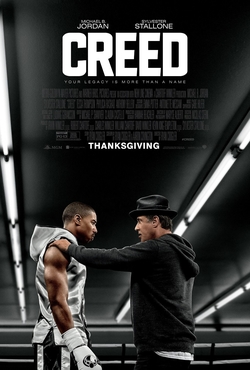
creed_posterThere’s a very special place in my heart for Rocky (1976) and I choose those words very carefully. The reason being, subsequent films lost the appeal of the original and I simultaneously lost interest in the franchise. Perhaps it’s because, after Sylvester Stallone’s breakthrough film, the series lost much of its unassuming charm. It was no longer an underdog story. It no longer felt as personal and intimate.

It’s true that I cannot pass any kind of judgment on Rocky II, III, IV, V, and Rocky Balboa. But it’s so easy to lose your guiding light, for a franchise to drift away from what made it good by simply relying on blockbuster status, star power, and a  robust fanbase. These very things kept me away and yet Creed made me extremely happy that I came back into the fold.

This is by no means a rehash of the original Rocky, that beloved classic in the pantheon of sports movies, but it knows its lineage and maintains the same spirit of that narrative. But when you have such a strong sense of your roots, that makes it all the easier to head out into new terrain.

Creed is, of course, about Apollo Creed’s son. Because whether you know it or not (I didn’t) Apollo Creed has passed away. He was (SPOILER) killed by Ivan Drago. All he left behind was his wife, an illustrious boxing career, and crucial to this story, an illegitimate son who has grown up much of his life in juvie. But his widow tracks down the boy and looks to rehabilitate him, like a prodigal son gone astray.

Over time, Adonis “Donnie” Creed (Michael B. Johnson) grows in knowledge and stature, landing a job in a company where he is rising up the ranks, but he’s discontent. He does some boxing on the side behind closed doors, in places that no one of any repute has heard of but he strives to be like his deceased father. He wants to be a boxer, ditching his job, leaving his step-mother’s lavish home behind to start on his own hero’s journey.

And  unsurprisingly his dreams take him to that gem of a city — the City of Brotherly Love — Philadelphia, to seek out a man who now runs a humble Italian restaurant christened “Adrian’s.” Donnie walks into this establishment with a mission, to get to know the former rival of his father, to get this aging man to train him in his own boxing career.

Rocky Balboa (Stallone reprising his role) is not about that life anymore. Content with simplicity and the memories that are left from his many years in the ring. If his restaurant is any indication, it stands as a testament of the love he still holds for his wife, who passed away. He visits her every week at the local cemetery still sharing his life with her like his closest confidante.

It’s moments like these that suggest that director Ryan Coogler’s film is a cut above some of the previous offerings. It’s this fascinating idea of a transgenerational film — it’s Rocky for the millennial generation but it shows a certain deference and even wistful reverence for its past — even the music constantly hinting at Bill Conti’s iconic score. But that should not be mistaken for being stuck in the past because with Michael B. Jordan in the lead, he motors the story forward with his own Rocky-like resolve.

Yes, his daddy is Apollo Creed, but he’s looking to make a name for himself apart from that. He starts calling on the girl downstairs — the local singer-songwriter Bianca and his relationship with “Uncle” Rocky quickly grows. They’re family now. And for boxing fans, Creed has its fair share of training sequences, buildup, and such, as Creed himself becomes an underdog facing off against world champion Jack Conlon. But if that’s all that Creed was, I would have been content going back to the original Rocky.

However, Creed suggests something very powerful as noted by Rocky early on. Time takes everyone out, time’s undefeated. There are affectionate callbacks to Adrian (the restaurant) and Paulie (Adonis stays in his old bedroom), even Apollo. But all of them are gone now. All of them lost against time. And Rocky nearly does as well. It’s inevitable. However, with the story of young Adonis we are reminded that there’s still room for hope and dreams and love and caring about other people. Those are things to be treasured.

Here Ryan Coogler has proven once more that he is a rising director crafting compelling films. Teaming up again with Michael B. Jordan after the searing Fruitvale Station, he fills the blockbuster with the same ambiance of an independent film with hot dog vendors and little bits of everyday authenticity. There’s a certain amount of documentary realism that still manages to be cinematic and at the same time surprisingly personal. So if you love Rocky go see Creed. If you love boxing go see Creed. But beyond that, it’s a film with a great deal to offer and I was heartily impressed in how it balances the past and the present with so much poise.

4/5 Stars