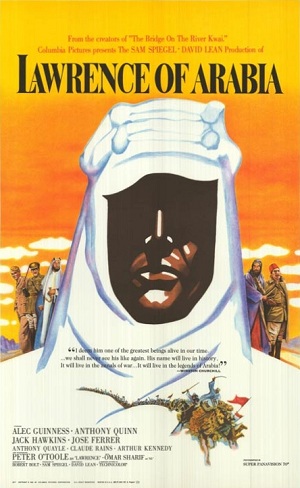
Lawrence of Arabia (1962)


A film of truly epic proportions, in length, scenery, and brilliance, Lawrence of Arabia is essential cinema. Peter O’Toole delivers a stellar performance as T.E. Lawrence, a British soldier during World War I. The movie begins with his death from a motorcycle crash, which gives an early glimpse of the character.

Then, a flashback goes to his time in Arabia where his task was to unite the Arab tribes, and lead them in rebellion against the enemy so the British might win. Against the better judgment of his commanding officer, a Mr. Dryden of the Arab Bureau suggests Lawrence be sent to assess the possibility of an Arab revolt against the Turks. Lawrence heads with his guide to pay a visit to Prince Faisal. However, his guide is shot by another man and Lawrence resolves to make the journey alone. Their paths cross again in the camp of Faisal. There Lawrence interests the Prince because his ideas are far different from his commanding officer.

Showcasing his audaciousness Lawrence suggests a bold attack on Acaba which would allow the British to bring in supplies. He leads a group of men across the brutal desert knowing that this will be less expected. Sheriff Ali (Omar Sharif) doubts it will work and disapproves that Lawrence takes two young outcasts as his servants. It is later during the journey that Lawrence truly wins over the other men, including Ali, because he is relentless, even going back for a lost straggler. With some luck, Lawrence is able to gain the help of Auda Abu Tayi, but it is not without tension. Ultimately, his forces are able to take out the Turks, and Lawrence heads back to Cairo to relay his progress. However, on the way back he must struggle with the loss of a servant and the guilt of executing a man.

Lawrence is sent back to Arabia and there he leads his forces in guerrilla operations against the Turkish railroads. His exploits are documented by an American newsman, and by this point, he has become a mythical hero among his followers. However, after going to scout a town the seemingly invincible Lawrence is ultimately flogged and tortured, leaving him a broken shell of a man. He insists on leaving Arabia but his new commander, General Allenby orders him back for one final push towards Damascus.

This final mission sees a change in Lawrence, who has hired killers and missionaries to help him in his siege. Against the better judgment of Sherif Ali, Lawrence leads a massacre of Turks as they move onward. He takes Damascus, but his fragmented counsel of Arabs are unable to unite, and the city is given back to the English. Major Lawrence is promoted once more to Colonel, and then gets shipped home because his services are no longer necessary.

This is one of those films you want to see on the big screen because the scenery and cinematography is just that impressive by itself. David Lean had a skill at making epics, and this is perhaps his masterpiece. The desert is often stark and desolate, and yet striking in the same instance. The expanse of space that is viewed in a single shot is often mind-blowing. A human being on the horizon is hardly a speck, and the ever-present camels are hardly any more substantial. To complement these grand images is an equally magnificent score by Maurice Jarre, complete with overture and all. The cast must be mentioned too with such supporting stars as Omar Sharif, Anthony Quinn, Alec Guinness, Claude Rains, Jack Hawkins, and Anthony Quayle.

Then, of course, there is the man who played Lawrence. As portrayed so wonderfully by Peter O’Toole, Lawrence is an intelligent and, at times, arrogant man, who can be odd, distant, audacious, and also unscrupulous. That being said, he was an extraordinary man who was a mover and a leader of men. A very unique, at times controversial, and long unheralded man, who contributed to the war effort in a far different way.  In many ways, he was an adopted brother to the Arabs, and their country was also his. He was “Lawrence of Arabia.”

5/5 Stars
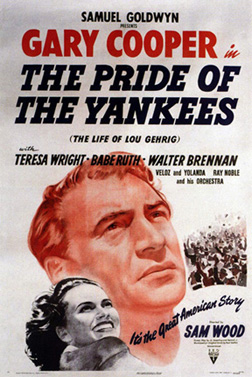
The Pride of the Yankees (1942)


Starring Gary Cooper as Lou Gehrig and Teresa Wright as his wife, this movie honors Gehrig’s life after a tragic death from ALS. From the time he was a boy, Lou could play ball but his immigrant mother wants him to become an engineer. The quiet, young man goes to Columbia and plays some ball. There he is seen by the Yankees who agree to sign him. Despite her disapproval at first his mom becomes his biggest fan. With the Yankees Lou seems slightly out of place being an introvert. Pretty soon he meets Eleanor Twitchell (Wright) however and then gains a spot as the starting first baseman. The two of them fall in love and get married as Gehrig flourishes in the shadow of Babe Ruth. With his career still going strong, Gehrig becomes captain and plays 2,000 straight games. It cruelly comes to an end when he begins feeling weak and is diagnosed with ALS. His career is over and yet in his farewell speech Gehrig gratefully considers himself the luckiest man on the face of the earth. He walked out of the limelight and died soon after, dearly missed. This is one of those truly moving films.

“I consider myself the luckiest man on the face of the earth.” You just cannot make up stuff like that. Here’s to you Lou!

4.5/5 Stars

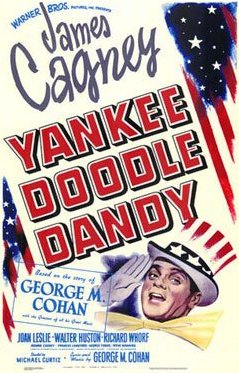
Yankee Doodle Dandy (1942)

Starring James Cagney and an array of others, the film tells the real life story of writer, singer, and dancer George M. Cohan. The story begins with an older Cohan recounting his life story. He began his career with his family in Vaudeville. Slowly he made a name for himself in Broadway and married his love. He and his partner kept making musicals and then the Cohans reunited for one last show. Eventually everyone in the family settled down before they died. The only one left was George who was living with his wife. In his final performance, Cohan gets the country to rally around the flag again as he has done his whole life. This movie has many commendable moments but there is an apparent conflict between biography and musical. Cagney for his part gives a stellar performance as the energetic and ambitious Cohan. The film also doubled as a nice piece of propaganda during World War II.

4.5/5 Stars

The Social Network (2010)

Starring Jesse Eisenberg, Andrew Garfield, and Justin Timberlake, this film follows the rise of Facebook as well as its creator Mark Zuckerberg.

The film opens with the nerdy Harvard man getting dumped by his girlfriend and it sets the tone for the rest of the movie. The story flashes forward to two lawsuits where Zuckerberg is being simultaneously sued by two twins from Harvard and his former partner Eduardo. The plot shifts back and forth showcasing Zuckerberg’s programming skills as well as his difficult personality.

He then takes the initial idea of the facebook and launches it at Harvard, helping it to quickly become a trend. However, with the help of his acquaintances, he works to expand his idea to other campuses all the way to Stanford. After a falling out with Eduardo, Mark takes his team and heads out to Cali on the urging of an entrepreneur named Sean Parker. Facebook has begun to take off across the globe but not without a cost.

After coming to California, Eduardo learns his share of the company has been diluted while Sean is busted for having cocaine in his possession. We leave Zuckerberg in the present as he sits in front of his lap top, the world’s youngest billionaire, but utterly alone. I cannot attest to how much truth there is in this depiction but I do think it is highly pertinent to this generation. It is impressive that a subject that could potentially be dry, is quite engaging thanks to a great script and solid acting. More than anything I felt sorry for Zuckerberg because he wasn’t really a jerk, he just tried too hard to be one.

4.5/5 Stars

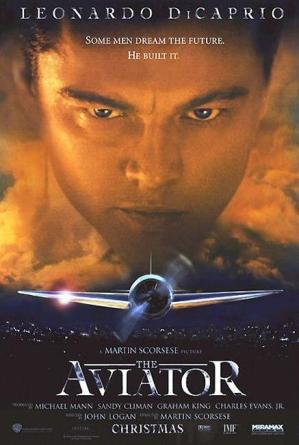
The Aviator (2004)

ccda6-the_aviator_posterDirected by Martin Scorsese and starring Leonardo DiCaprio with a good ensemble cast, this biopic chronicle the life of Howard Hughes. The story begins when the ambitious young man begins to direct an epic movie that is nearly a disaster. After his success, we witness the life of this director, playboy, and above all aviator. He makes Scarface and then later The Outlaw. He has relationships with Katharine Hepburn (Cate Blanchet), a young teenage girl, and Ava Garner (Kate Beckinsdale). Then during the war he designs new planes and afterwards Hughes faces his greatest challenge. He is on the brink of disaster in his competition with Pan-Am and he is the subject of a near-damaging senate hearing. All the while his obsessive compulsive disorder gets worse. I found this film fascinating because I knew very little about Hughes. As a director himself, Scorsese also seemed to have sympathy for the man and also admiration for the olden days.

4.5/5 Stars

Lincoln (2012)

a8b03-lincoln_2012_teaser_posterDirected by Steven Speilberg and starring Daniel Day-Lewis with Sally Fields, and Tommy Lee Jones, the film focuses on Lincoln’s 2nd term as the Civil War comes to a close and he fights to pass the 13th amendment.

At home Lincoln deals with his temperamental wife, argues with his older son about joining the war, and plays with his younger boy Tad. At the same time he must work behind the scenes to get enough representatives while also facing the prospect of a Confederate surrender. His life is beyond stressful, with cabinet meetings, speeches, inspections, and tough decisions to make day in and day out. However, despite the toll, he copes and in the process does great things. Within the film we also become familiar with William Seward, Thaddeus Stevens, and other leaders who must make their own difficult decisions on the issue of slavery.

Ultimately, the landmark amendment is passed but it is short lived with the assassination of Lincoln. He truly was “a man for the ages” and Lewis does a wonderful job of portraying his every aspect. His voice, his features, his parables, his political savvy, and even his frailty give us a crystal clear picture of the man. The supporting cast and the cinematography were both very good. It proves that a film full of drama and some humor does not need action to make it excellent. It is all about the characters and more importantly our very history.

4.5/5 Stars

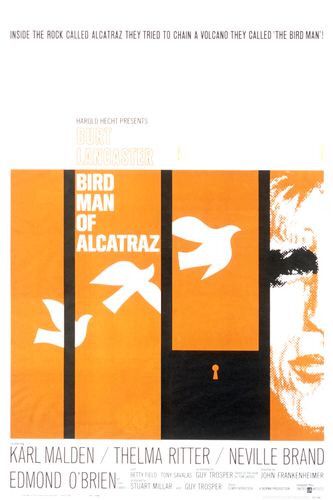
The Birdman of Alcatraz (1962)

Telling the semi-biographical story of Robert Stroud, Birdman relates his life from violent beginnings until his later years. Burt Lancaster superbly characterizes Stroud as a tragic hero. Despite a relatively simple plot following the progression in a man’s life, Birdman is worth seeing. Ultimately, it is the charcters played by Lancaster, Karl Malden, and Thelma Ritter respectively, that make this movie. Ironically, by the end of the film after all he has accomplished the Birdman is still not a free man. Even if it is not completely historically accurate, this movie tells a great story. Having actually toured Alcatraz after viewing this film, I have to say it resonated with me even more.

3.5/5 Stars

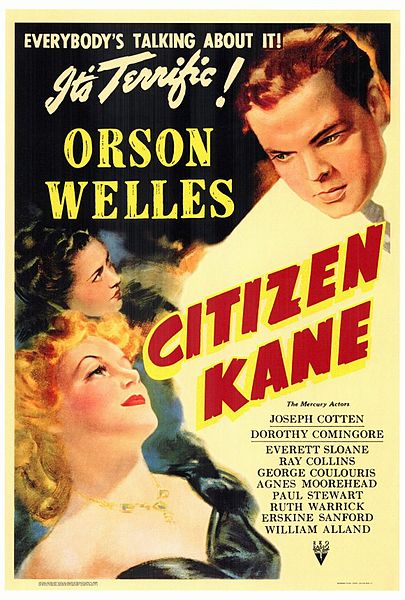
Citizen Kane (1941)

The first time I ever saw the film, I actually wrote Citizen Kane off because my hopes were so high thanks to its major critical acclaim. Those hopes were soon dashed after viewing it once, but over time I realized I needed a second viewing. This second chance allowed me to see the minute details, which can be easily overlooked or forgotten. Now I can truthfully say I have a new found respect for this film.

The brainchild of Orson Welles, Citizen Kane opens somewhat unimpressively, however it is certainly very moody and atmospheric. As the camera closes in on a great mansion, we are given a first-hand view of a dying man followed by his mysterious final word “Rosebud.” In the following newsreel, we learn the man was Charles Foster Kane (Welles), a millionaire tycoon and newspaperman. A journalist (William Alland) is enlisted to find out anything he can about Kane. First, he scours the memoirs of Kane’s deceased childhood guardian (George Coulouris). Then, he talks with Mr. Bernstein (Everett Sloane), who worked with Kane’s paper the Inquirer. He gets around to talking to Kane’s unstable former friend Jedediah Leland (Joseph Cotten), as well as Kane’s second wife (Dorothy Comingore). We learn from these accounts about Kane’s early years, his success with yellow journalism, the evolution of his first marriage, and the rise and fall of his political career. Furthermore, we find out about Kane’s unhappy second marriage that ultimately left him loveless after looking for affection his whole life. Fittingly, we are again left with the bleak view of his fortress Xanadu, and we now have the knowledge that “Rosebud” was in fact utterly trivial.

Obviously, Greg Toland’s black and white cinematography using deep focus and low camera angles is noteworthy. The framing of the narrative with different points of view and flashbacks was unique at the time. The actors age in front of us showing the progression of time and montage is used to effectively condense time. There are the overlapping and fragmentation of dialogue to create a realistic feel throughout the film. Bernard Hermann puts together a score that slowly changes along with Kane. And of course, you have the supposed basis of Kane on William Randolph Hearst. Historically, Citizen Kane may, in fact, be the most important film of all time, and artistically it is certainly up there with the best of them. I will let others decide if that makes it the very best film, period.

4.5/5 Stars

Schindler’s List (1993)

This film is one of the best biographical films and it highlights one of the monstrosities of humanity in the form of the Holocaust. It may be hard to watch and it is overpowering but the fact is the types of events depicted actually happened and must be recognized. The characters of Oskar Schindler and Ammon Goth further make the story come alive serving as a sharp contrast to each other.

From the beginning this film opens in black and white making you realize there is something special here. With Speilberg behind the camera, Liam Neeson takes on the role of Oskar Schindler. Historically, this German industrialist aided over a thousand Jews from the Holocaust. Neeson skillful portrays his character revealing the turmoil and peril Schindler faced. The cast is rounded out nicely by Ben Kingsley and Ralph Fiennes. The film effectively moves the viewer to ponder humanity and also causes us to praise Schindler. Fittingly the movie closes with many surviving Jews laying flowers on the grave of their savior.  

                                                         5/5 Stars