The Lion in Winter (1968)

ae367-lion_in_winter1The year is 1183 and the castle of King Henry II is a dark and dank place during the winter months. You would not think so by the opening moments where an energetic King (Peter O’Toole) duels his young boy John (Nigel Terry). His mistress takes in the scene from afar. On first glance, this whole scenario seems pleasant enough, but that would be far from the truth.

Young John is the King’s favorite, but his aged yet cunning wife Eleanor (Katharine Hepburn) has a special affection for the eldest brother Richard (Anthony Hopkins), who she desires to take the throne. Stuck between the two favorites is middle child Geoffrey (John Castle), who has plans of his own. Bring the French King Phillip II (Timothy Dalton) into the equation and the situation becomes even messier than before. What follows is an elaborate web of lies, deceptions, side deals, false motives, eavesdropping, and of course backstabbing. Henry and Eleanor constantly battle back and forth as their sons bicker among themselves. One big unhappy family to be sure.
Henry tries to marry off his mistress (Jane Merrow) to Richard to satisfy King Phillip, but his son will not have it. Next, Henry tries to compromise with Phillip only to learn that his sons were planning to gang up against him. Now he cannot trust any of them, and they find themselves in the dungeon. He makes a new plan to get remarried to his mistress so that he might have another son to be king, but his other sons will be a threat so long as they live. His dilemma is evident, but he cannot bear to kill them. Things seem to go back to the way they always were with Eleanor going back behind bars and Henry playfully barking at her. All’s well that ends well perhaps.

Peter O’Toole and Katharine Hepburn were certainly two titans in this film. O’Toole, whether he is roaring or confiding in his former love, does everything with purpose and bravado. He does show his soft, vulnerable underbelly at times, though, as a man advanced in years. Hepburn on her part is absolutely acerbic, oftentimes governing the tone of the film with her barbs and snide comments. And yet with her, there is also at least a few instances of true humanity. She and Henry seem to be made for each other and their boys are seemingly just as loathsome and underhanded.

4/5 Stars


Review: The Third Man (1949)

5873f-thirdmanusposterI am continually drawn to The Third Man for a number of reasons, which I would love to highlight right now. To begin with, the opening credits come up and yet behind them is the rather odd image of a row of strings. As an audience, this is our first introduction to the zither, the twangy instrument that will create the strangely haunting score over the course of the film.

Then, we are fed a casual bit of narration that quickly throws us into the story of western writer Holly Martins (Joseph Cotten), as he heads to Vienna to meet his old school chum Harry Lime (to be revealed later!). It seems safe to say that World War II was not good to the city, which is a mixture of ruins, cobblestone streets and ornate architecture that lend itself to an uneasy feeling. In other words, what happens in Vienna, stays in Vienna. Everything is zoned off nicely, and the authorities try and stay out of each other’s way.

Martins learns soon enough that Lime is dead and yet it doesn’t add up. His best friend was hit by a car driven by a colleague, carried off the road by two friends, and diagnosed by his personal doctor who all happened to be present. Martins is urged by a Major Calloway to not get involved. Heading home would be a much better solution.

But of course, Martins does not heed this advice. He meets Harry Lime’s girl, the beautiful but somber Anna (Valli), who has her own troubles with the authorities. Further investigation points to a mysterious third man who a local porter saw from his window. The old man winds up dead and soon Martins himself is threatened. Calloway encourages him to leave again before reluctantly disclosing that Lime was dealing diluted penicillin on the black market. That batch ultimately killed and harmed many a patient.

It’s a whole different ballgame now. But wait, after dropping in on Anna, Martins sees a shadowy figure out her window and in a dramatic entrance Lime shows his face. A magnificent magic trick and fully alive. The next day on a Ferris wheel Lime’s true character comes out. All I will say is that he would have been at home in the Borgia family.

Now Holly is conflicted about helping the police snag his old friend or heading home, wiping his hands of the whole ordeal. He finally reluctantly swings a deal because of his love for Anna. Plans are set and soon a trap is sprung for Lime. He is tipped off by a still faithful Anna, but the police force him to make his getaway into the sewers. That is where it all goes down for good. The next day Holly Martins waits at the side of the road for Anna. She slowly makes her way in his direction and without any acknowledgment, she keeps on walking on. She is now out of the picture and all he can do is light yet another cigarette. That is the cold and painful ending to The Third Man, a perfectly suited story for Post-War Vienna and a great Film-Noir.

We become constantly aware of this film’s almost painful camera angles, at times, which slightly distort scenes and close in on faces. It is an unnerving feeling for the viewer which is only compounded by the bleak and shadowy cinematography, along with the haunting music. It all adds up to a perfectly chilling composition. The story feels starkly real too thanks to the on-location shooting and the mixing in of the German with the English. As a non-German speaker, this extra language only furthered my confusion and, at times, my paranoia. Along with Martins, I often could not understand what was going on, causing me to be more and more befuddled.

All in all, although Orson Welles stole the show, both Joseph Cotten and Valli were superb. The two of them had the most screen time and it certainly was not wasted. Whether they were walking or talking they always made for an interesting contrast. Their accents, their demeanor, even their opinions of Lime were often in juxtaposition. I was not a fan of Trevor Howard, but he was not meant to be a likable character. Bernard Lee, on the other hand, had to be my favorite supporting role.

The Third Man is already on my watch list again and for good reason! Well done Carol Reed, Grahame Green, and Anton Karas!

5/5 Stars
The Lavender Hill Mob (1951)

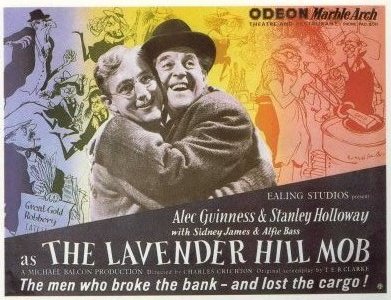
1dadb-the_lavender_hill_mobStarring Alec Guinness and David Holloway this Ealing Studios comedy-heist film begins with an older man recounting how he got away with a large amount of gold bullion. His job had been to ride with gold shipments while they were transported. However, soon he met a quirky fellow partial to art and together they devised a plan to get the gold. They enlisted the help of two small-time criminals. The day of the caper was far from smooth and they must improvise. With luck they get away and the two instigators take their prize to Paris. There they have disastrous results and arrive back in England eventually to even more craziness. This film had endearing characters and its share of comical moments. If you pay attention you can see a young Audrey Hepburn for a blink of an eye near the beginning too!

4.5/5 Stars

The Lady Vanishes (1938) – Alfred Hitchcock

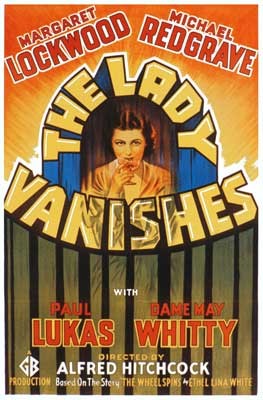
Margaret Lockwood plays an American socialite in Europe in this Hitchcock mystery-thriller. The night before she is to leave, Lockwood meets a kindly middle-aged lady who is fascinated with European music. The next day the two ladies sit together on the train to talk. Being a bit disoriented, Lockwood takes a short nap however when she wakes up Ms. Froy is mysteriously gone. Seemingly no one remembers seeing the woman and no one will believe Lockwood. Finally, she teams up with a man who she had a run in with the night before (Michael Redgrave). Together they try to figure out what has happened to the lady. Finally discovering the truth, they come under great danger and must fight for their lives and those of the other passengers. Hitchcock does it again, bewildering the mind and making us intrigued at the same time.

4.5/5 Stars

39 Steps (1935) – Alfred Hitchcock

In one of Hitchcock’s great English films, he plays with the idea of a man on the run. Robert Donat is just an ordinary Englishman until a strangle woman tells him a deadly secret. Upon finding her murdered by a dangerous foe he flees. However, that puts him under suspicion and the hunt is on. He makes his way up to Scotland and gets some assistance however soon trouble brews. Somehow he finds himself cuffed to a woman he detests and he drags her away with him in order to escape. Due to their predicament, the unlikely pair soften to each other and try to discover the truth. After running for so long the answer finally comes to Donat  in the theater. He finally discovers what the 39 Steps are.

4.5/5 Stars

The Lady Killers (1955)

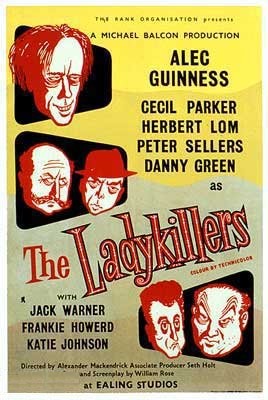
c0838-the_ladykillers_posterStarring Alec Guinness, this is a unique and often hilarious black comedy caper film by the Ealing Studios. The adventure begins with the quirky criminal mastermind, Guinness, renting a room from an old woman. Soon his masquerading accomplices arrive. The five of them plan to commit a robbery and when the day comes things start off smoothly. However, they have the unknowing old woman pick up their prize and chaos follows her. The men get the money but before they can escape the lady accidentally finds out. The latter half of the film follows the double crossing antics of the criminals as they try to run off with the money while trying to figure out who will do the unpleasant job of knocking off the lady. Needless to say they don’t succeed. I was wary of this movie at first but it was actually very enjoyable because of the comedic and odd scenario. Keep your eyes on a young Peter Sellers as well as Herbert Lom.

4.5/5 Stars

Kind Hearts and Coronets (1949)

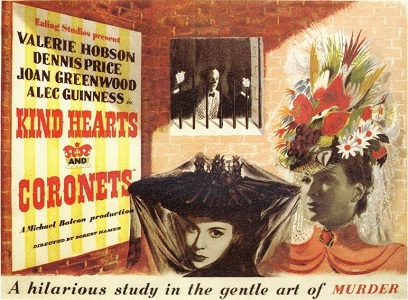
d4c15-kind_hearts_and_coronetsStarring Dennis Price and Alec Guinness (in eight roles), this black comedy follows a commoner who tries to avenge his mother by killing eight relatives. The story begins with a man about to be hung and as he waits, he writes his memoir. Through a flashback, his childhood and adult life is shown. He worked tirelessly to move up in society and he also did away with everyone standing between him and the Dukedom (all played by Guinness). Things get complicated when he is about to marry a deceased victim’s wife and then a childhood beau tries to blackmail him. Ironically, the one murder he did not mean to commit is the one for which he gets caught. Yet there is still hope, or is there? Price plays the young and clever English gentleman very well and needless to say Guinness is extremely funny. Also, the two female characters are different but both good in their own right.

5/5 Stars

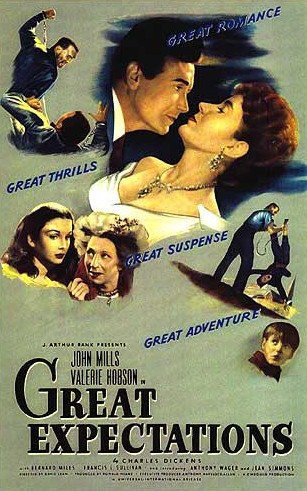
Great Expectations (1946)

ad366-great_expectationsWith director David Lean, and starring John Mills as Pip, the film begins with Pip as a young boy. Upon meeting a fugitive, Pip show him kindness and the man promises he will return the favor. A year or so later Pip begins to go to the home of an eccentric, rich widow to call on her. There he meets the lady’s adopted daughter Estelle and he falls for her. Now an adult, Pip learns he has a mysterious beneficiary who is paying for him to move to London to be a Gentleman. There he interacts with Mr. Wemmick, the attorney of Mr. Jaggers, and also Herbert Pocket (Alec Guinness). Then, someone shows up on his doorstep and changes his world. Soon he is orchestrating an escape for his friend, saying goodbye to the cold Estelle, and showing his displeasure for the elderly Ms. Havisham. However, in the end he learns a happy truth and reunites with Estelle. This moody, Dickens adaption actually has an optimistic side which is a nice change.

5/5 Stars

The Third Man (1949) – Film-Noir

In this film starring Joseph Cotten, Valli, and Orson Welles, an American western writer (Cotten) travels to post-war Vienna to meet a friend. Upon arriving he learns that his buddy has been killed in an accident. Not quite satisfied, he does some of his own investigating and along the way meets his friend’s beautiful lover (Valli). Together they try to cope and make sense of the loose ends. However, neither of them expected the shocking evidence which was to come. Who is the Third Man and where is he? Made in the film-noir fashion, The Third Man utilizes lighting and contrasting black and white cinematography effectively. The actual on location shooting in post-war Vienna helps add to the gritty realism. Although simple, the score comprised solely of zither music is no less powerful.

This movie will have you engrossed in the mysterious occurrences since The Third Man simply has some good twists. Whether Holly Martins is whisked away in a car, Harry Lime makes a dramatic entrance or Lime runs away into the sewer system, many of the moments are full of intrigue. I also think this is one of Orson Welles finest performances, because although his screen time is minimal, he has such a tremendous impact on the film. He portrays a very mysterious character in Harry Lime who certainly has his complexities. The ironic and abrupt ending seems to close the film just as it began. However, so much happens in the course of events. The film is even realistic in the language and dialogue, showing the differences between people. Because when it all comes down to it this film may revolve around one man, but it is really about the varying relationships between people.

5/5 Stars

Skyfall (2012)

Starring Daniel Craig as James Bond and Judi Dench as M, this was the 50 anniversary installment of the franchise. The film opens as Bond is on assignment to track down a mercenary who stole a vital computer hard drive. However, before he can complete his assignment Bond is wounded and seemingly falls to his death. Meanwhile M is under political pressure and she also receives a threatening message that culminates in a giant explosion. Bond comes back from the dead and must struggle to pass his examinations to be cleared for duty. Finally, he goes out again to track down the mercenary and his investigation leads him to a shady casino. He helps out a women in trouble and accompanies her to a remote island. However,, they are captured and Bond comes face to face with the mastermind behind all the chaos. Bond is able to save himself while capturing Silva to take back to England. But Silva has one last trick up his sleeve allowing himself to escape. Realizing M is in danger, Bond rescues her and heads for his childhood home. There he prepares for the final showdown with Silva and his henchmen. Although he prevails it was not without sacrifice. This film was intriguing because both Bond and M had to set out and prove they were not washed up. Also, Adele’s title song is probably the most memorable Bond theme in quite sometime.

4/5 Stars