Here Comes Mr. Jordan (1941)

here comes mr. jordan 1.png

I’ll lay my cards right on the table. I’ve never been a huge fan of Robert Montgomery. He just doesn’t have a charisma or a delivery that I much care for so as far as carrying a whole picture I’m not quite sold.

Still, with Here Comes Mr. Jordan, it all seems to work and it’s funny and clever in ways that would cause Hollywood to strive for storytelling that looked to think outside the box. Of course, the irony is, a new box gets created for people to work inside — a new style or sub-genre — but there’s little question that Here Comes Mr. Jordan feels very much the first of its kind. If not, I stand corrected.

It’s a story effortlessly built around quirky inventiveness. There are fantasy elements here that feel very much akin to the likes of Stairway to Heaven (1946), Random Harvest (1942), and Heaven Can Wait (both films from 1943 and 78).

Heaven is depicted as a kind of celestial processing center where human beings are plucked away from their life on earth to begin a new afterlife. Through intervention, by angelic beings, lovers can all but forget one another only to have some deja vu feeling that they’ve been together before.

And further still, the ideas of the heavenly and angels entering into everyday life soon became a staple of 40s and 50s Hollywood much in part to this picture. Without it, there’s a possibility that classics such as It’s a Wonderful Life (1946) and the Bishop’s Wife (1947) would not have been conceived in their most remembered forms. After all, what would those films be without Clarence or Dudley? Or what would this one be without Mr. Jordan for that matter?

Elaine May must have thought the story was ripe for more exploration too when she penned Heaven Can Wait which expanded a great many of these ideas only in a different context.

Unequivocably this rendition proves to be far from a one trick pony, taking a main conceit that admittedly seems absurd at first — even gimmicky — and turning it into a fantastical comedy with continual possibilities.

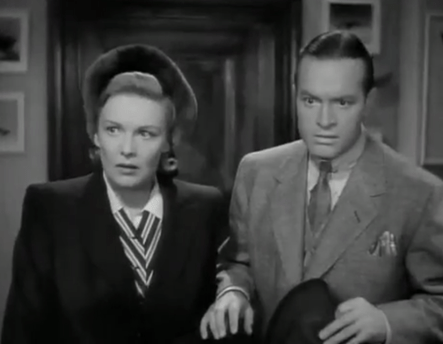
Imagine just for one moment that a feisty boxer, Joe Pendelton (Montgomery), preparing for his next big bout flies to the site of the fight only to have his plane malfunction en route. He looks like a goner but he’s pulled from the aircraft too soon by 7013 (Edward Everett Horton). In fact, it’s 50 years too early, his date with the afterlife is not until 1991 (In case you were wondering, Montgomery actually passed away in 1981). Being the bullish personality that he is, Joe’s not going to sit by when he had such a good thing going on earth.

The genial Mr. Jordan (Claude Rains) grants his wish and inserts Joe back into life but they must find him a new body — you see his previous one has already been cremated which makes for added complications.

We plot his journey between two distinct individuals and their bodies and aside from the opening plane crash, a few puffs of smoke, and a few parlor tricks, the film doesn’t rely too heavily on any amount of special effects. For all intent and purposes, things are normal as they’ve always been. It’s just the parameters that have changed. Namely the fact that Joe can see Mr. Jordan and no one else can. First, he’s Bruce Farnsworth formerly a crooked magnate who was murdered in his bathtub by his wife and her lover.

Boy, are they surprised when he turns up again. Mr. Jordan and the audience see Montgomery but the others see and hear the man that they think they’ve done away with. Still, coaxed by Mr. Jordan, Joe or Farnsworth, turns this man’s life around, taking ownership of his past indiscretions and helping the father of a young woman (Evelyn Keyes) who was accused of fraud.

here comes mr. jordan 3.png

Meanwhile, Joe, err, Farnsworth still has his sights on his previous shot at the boxing ring. It all comes off rather odd to those who used to know his alter ego but he calls up his old coach Max Corkle (James Gleason) and he’s finally able to convince him of his true identity due to his beloved saxophone always in tow.

Finally, it looks like he’s on the road that he wants but alas complications ensue. He finds himself falling for Ms. Logan and circumstances are such that he must find another body. He settles on a straight-arrow named Murdoch and subsequently gives the fighter a second chance in the ring while hiring on Max to be his coach so he can still actualize his dreams.

Mr. Jordan leaves Joe in this moment, seeing he has a version of the life he always wanted and the celestial being conveniently removes all of Joe’s memories of a previous life. Of being a man named Joe Pendleton. It makes for some goofy comedy with Corkle and supplies one budding meet-cute with Ms. Logan.

While the theology is probably sketchy at best, it’s a good-natured, comic interpretation of the afterlife that serves the world of the film well. The only thing in question is the ethical nature of angels removing human memories but surely Claude Rains knows what he is doing.

James Gleason is an absolute riot as the one human privy to the whole gag only to look like a complete nutcase when questioned by anyone else who is “normal.” He easily puts you in stitches and Edward Everett Horton has his flustered indignance down pat. He made a career out of it after all.

4/5 Stars

Mr. Blandings Builds His Dream House (1948)

mr. blandings 1.png

Here is a Cary Grant and Myrna Loy vehicle that makes a comedy out of the morning drudgery and cramped quarters of domesticated life in that pearl of a city, New York. It’s a satire of the All-American Dream with the wry commentary of Melvyn Douglas guiding us through the raucous adventure.

He positions the story as such, the main confidante and best friend of advertising executive James Blandings (Grant) and his wife Muriel (Loy). Any given morning in their apartment involves early morning duels over shutting off the alarm clock for a few last seconds of slumber. Then, there’s the fighting over mirror space and closet space and drawer space.

But they’re true Americans singing “Home on the Range” in the shower. Singing in the shower seems to generally be a hobby of Cary Grant as he would do it again in at least one other picture. Meanwhile, their prim daughters are attending a progressive school and filling Mr. Blandings breakfast conversation with unwanted social significance.

All he wants is to drink his coffee and read his paper in peace and intact. He’s granted neither luxury. But these are only symptoms of the problem. They have a lovely home in a lovely city with two lovely daughters and a terribly lovely marriage. They’re just hemmed in on every side. And at work, he’s been slammed with the advertising campaign for “Wham Ham” which seems a living nightmare.

It’s Mrs. Blandings’ idea to consider a renovation while Mr. Blandings isn’t too keen on bankrolling interior designing and home redecorating courtesy of one Bunny Funkhouser. Instead, they mutually agree to purchase a quaint Connecticut home with real “character” that coincidentally no one has had the courage (or the naivety) to even try and buy.

But attracted by the “convenient” commute of 50 minutes, a little Revolutionary War History about General Gates’ horse, and their own dissatisfaction with the current state of affairs, they commence the biggest undertaking of their lives.

The Hackett Place could very easily be the prototype of the Haney Place years later in Green Acres. In fact, this film made me yearn for the rustic folks from Hootersville and the construction craziness of Extreme Home Makeover from year’s past because it evokes both.

Rather than deal with it as is, the Blandings knock it to the ground and sink their first wad of cash in the mammoth project. The first of many. But they are hardly attuned with what remodeling entails and the complications never seem to end nor do the bills which come one after another.

While I was secretly hoping that Dreamhouse would be an update on Buster Keaton’s One Week (1920) with Grant showcasing his usually brilliant physical antics, what we got instead is a household comedy full of incessant complications.

While I probably would have enjoyed the former even more, there’s no doubt that this film is worth it for the Cary Grant and Myrna Loy dynamic. It’s that ability to bicker and joust and fight and still have the innate capability to make up and have the audience enjoy every minute. If the film had been made years later it would have been called Mr. and Mrs. Blandings Build Their Dream House. This is without question a joint effort of marital madness and reconstruction.

For those who cherish glimpses of the past available in the present, the Blandings home can still be seen on the property of Malibu Creek State Park in California. Unfortunately, I don’t think the Blandings still live there. Sadly, they vacated the premises some time ago. The commute from Malibu to New York City was probably too much for them.

3.5/5 Stars


100 Men and a Girl (1937)

one girl and 100 men.png

It’s fascinating how history works. Deanna Durbin and Judy Garland came up at the same time. In their day, stars were groomed from an early age and MGM had both the starlets under contract. But instead of holding onto both talents it turned out that Garland remained and Durbin signed a new agreement with Universal.

The conventional wisdom was that you only needed one young singing girl at a studio. That niche was filled. Of course, that proved to be far from the truth as Durbin became a smash hit in her own right rivaling Garland.

100 Men and a Girl is only one film in a long list of successful outings she had in the 1930s starting with Three Smart Girls (1936). Most of these pictures were directed by Henry Koster and proved very popular with audiences.

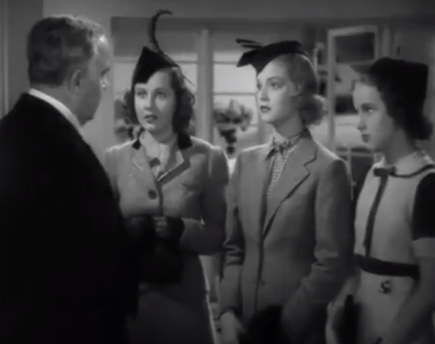
This particular one surrounds Durbin with players including Adolph Menjou and has some My Man Godfrey (1936) castmates carried over from the previous year. There’s the inclusion of flabbergasted Billy Gilbert as the easily duped funnyman and other crucial character actors like Mischa Auer and Frank Jenks taking up posts as a flutist and a stymied cabbie respectively.

But front and center and most agreeable of everyone is this pleasant girl who unwittingly finds herself in high society and taken under the wing of a bubbly socialite (Alice Brady), who finds this girl’s demeanor charming perhaps for the very fact that she’s so sweet and well, a frantic force of nature. It’s delightfully refreshing and different from the snooty company the lady is used to having in her presence.

But Patsy Cardell can also sing quite stupendously and that’s to her credit. I’m hardly musically inclined but Durbin even at this age hardly seems a show tunes singer, sweetly navigating the utmost of classical compositions with a voice that feels beyond her years. My personal tastes are simpler but there’s no discounting her vocal abilities.

Still, the film is born out of an admittedly absurd idea and the light bulb flashes in a rapid burst of inspiration. Patsy’s father (Menjou) is out of work and so are 100 of his fellow musicians. What should she do? Starting a symphony orchestra is what she should do! It’s as clear as day and she motors forward determined to make her idea turn into something tangible with the promise of backing from Mrs. Frost (Brady).

The wind is in her sails and she’s not about to allow logistics or the scorn of others uproot her vision. Her goal is to get her daddy on Mr. John R. Frost’s radio show. It’s just what her father needs to get back to work. Presto! This is a film plot that might as well have gotten resolved with a puff of smoke. Just like that. Instead, she is crushed by the curmudgeon husband (Eugene Pallette), his wife now off in Europe out of sight. So Patsy has no recourse to go to the top and famed conductor Leopold Stokowski (playing himself).

The rest of the story relies on a number of convenient happenstances. False hopes and crushed dreams become real hopes and true dreams. Although it’s a pure pipe dream of a film, sometimes that’s just what we need whether we’re still wrangling with the Great Depression or in the here and now 80 years onward. Because films like this that are ethereal, fluffy, and light still give us something.

Durbin holds her own with cheerfulness and a certain amount of sass that doesn’t compromise her basic principles. She was instantly likable in her day and still much the same today.

Henry Koster will never get any respect for the kind of pictures that he made but that’s okay because he made films that were crafted with a genuine heart. That speaks to people in ways that other types of films can’t seem to manage. True, this picture can hardly claim the title of an artistic masterpiece for critics to fawn over and dissect to death with their immaculate vocabulary and academic analyses. That too is okay. Here is a film that’s wacky, fun, and it’s okay with being just that.

Deanna Durbin was credited with saving her studio from the pits of bankruptcy during the depression years with her voice and her spirit and a certain candor that made her a beloved girl-next-door icon for a generation. She was crystallized in that image and never quite broke out like she probably would have liked.

She also never saw the same acclaim from modern generations like a Judy Garland since she didn’t have a film like The Wizard of Oz (1939) for folks to rally around but in her time she was quite the attraction. All told, finding her again today is still a lovely revelation. She remains enjoyable to watch even for nostalgia’s sake. Sometimes that’s enough.

3.5/5 Stars

Take Me out to The Ball Game (1949)

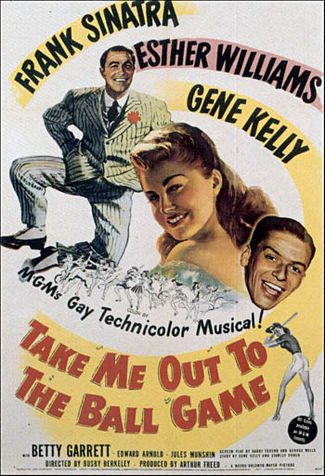
Take_Me_Out_To_The_Ballgame_(MGM_film).jpgThere’s something perfectly in sync between Gene Kelly and Donald O’Connor so I could never choose another duo over them but Kelly and Frank Sinatra are such wonderful entertainers that they help make this period baseball number a real musical classic even if it has to fall in line behind a row of other quality contenders.

It’s easy to half expect to see Stanley Donen’s name on the marquee as director in part because of his prestigious partnership with Kelly but instead, we get an equally renowned name in Busby Berkeley. In fact, at this time Berkeley was a veteran of musicals. However, it’s true that Donen did help with crafting the narrative on this one with Kelly and would pick up directing duties with On the Town (1949).

America’s original Pasttime (before being challenged by Basketball and Football) is ripe for a musical homage as MGM seemed to take aim at all the popular arenas of entertainment. Set during the golden years of baseball, this story, in particular, takes interest in the fictional Wolves who share some resemblance to the famed Cubs of the early 1900s with the double-play combination of Joe Tinker, Johnny Evers, and Frank Chance. In this film, the archetypal slogan, “Tinkers to Evers to Chance” is adapted into a giddy tune “O’Brien to Ryan to Goldberg” with the trio of Kelly, Sinatra, and Jules Munshin taking the leads.

Esther Williams even gets her obligatory dip in the pool while still showing her prowess as a baseball player, a desirable heartthrob, and a club owner with a certain amount of business acumen. Because she really is at the core of the story’s plot.

You see the boys, O’Brien and Ryan, are having a grand old time coming off a stint in vaudeville during the offseason and now spring training is upon them and they are reunited with their clubmates along with the scintillating prospect of another league pennant. That is until they find out that they’re under new ownership, and they suspect it’s a stuffy nobody named K.C. Higgins.

Are they surprised with what meets their eyes? K.C. Higgins turns out to be a “she” instead of a “he” and a very attractive one at that. But that doesn’t detract from the bottom line. She’s a woman who expects that she knows the game better than they do. Thus, it’s a slight musical riff on the old battle of the sexes dilemma.

Their plan of action entails setting up their buddy Denny (Sinatra) with Ms. Catherine so they can keep her occupied and off their backs. Kelly is the fast-moving playboy ballplayer who also has a complicated relationship with Katherine Catherine (that’s what K.C. stands for). While the forward Shirley Delwyn (Betty Garret) is out to snag herself a man and sets her sights on poor helpless Dennis.

There’s a bit of a black sox scandal type thread that’s grafted in at the end with Edward Arnold playing his usual corrupt businessman who is looking to ruin O’Brien’s reputation and make a killing off betting against the Wolves. Thank goodness in this case Kenesaw Mountain Landis does not come in and expulse Gene Kelly who instead is allowed to dance another day this time with all his costars.

Aside from singing the game’s most revered song on screen, (which is a relief given its name), the film also has adequate room for some of the other important aspects of baseball namely antagonizing umpires, trash talk, clowning, and brawls. After all, what would America’s game be without those finer points?

Gene Kelly even gets around to putting another feather in his dancing cap with an Irish jig proving him to be yet again a master showman and virtuoso performer on taps. He’s also probably the first baseball player in history who carried two careers as a ballplayer by day and a hoofer by night. All in all, this was the kind of Technicolor spectacle that MGM was accustomed to offering up in the 40s and 50s and it’s satisfying stuff, if not quite their best.

3.5/5 Stars

Review: The Way Way Back (2013)

way way back 1.PNG

Kyrie Eleison along the road that I must travel…” ~ Mr. Mister

Liam James is undoubtedly a kindred spirit to many young men because he’s the epitome of awkward. His posture is terminally awful. He has no confidence, no presence, his hair could use a trim, and he’s pale and unassertive. He doesn’t even have a go-to dance move, heaven forbid. He’s the kind of kid who wears jeans to the beach in the throes of summer.

But that’s what we have at face value. The problem is he plays into the narrative that others have written for him and it’s a self-fulfilling prophecy. Take Trent (Steve Carell), the man Duncan’s mother (Toni Colette) is seeing. He calls the boy out on his apparent lack of social skills and criticizes him for being a 3 on a scale from 1 to 10.

That’s what Ducan has to go up against as his makeshift family travels to the beachfront for summer vacation. It looks like a dead end, several months that Duncan will simply have to survive tagging along awkwardly with Trent’s self-absorbed teenage daughter or getting systematically belittled by Trent in small ways.

And yet this same summer that looks like a veritable disaster ends up becoming the most formative time in Duncan’s life because in the thick of all the bad stacked up against him he is introduced to a world of so much good. It’s one of those moments of sheer happenstance. He begins riding a pink bicycle around town to get away from the suffocation at home and finds himself crossing paths with everyone’s new favorite friend Owen (Sam Rockwell).

They meet over a Pac-Man game and it’s awkward. Because every conversation Duncan has is awkward (ie. He talks to his pretty next-door neighbor Susannah about the weather). But not about to give up on a kid in need of some camaraderie, Owen lets the lad into his life and offers him something remarkable: A job helping him at the water park Wizz World.

In itself cleaning up vomit and stacking chairs isn’t the image of a perfect summer. But by reaching out and giving Duncan something, Owen impacts someone else more than he will ever know. Because that park represents so much for Duncan. It’s the family he’s struggling to find. It’s his fountain of confidence. It provides him a much-needed platform where even he can be cool and be known by others. That’s what we all want, to be known and appreciated.

That’s why he returns again and again. In fact, it’s so apparent how often he rides off that Susannah (AnnaSophia Robb) follows him one day and the rest is history. This girl who is different than her peers begins to take an interest in his paradise because she sees a confidence and enthusiasm in him that never existed before and she too seeks an escape.

Meanwhile, Duncan’s home life is still a shambles. Things are shot to hell as Trent is cheating on his mother and their vacation gets quickly terminated. He’s unhappy with it all and there’s very little his mother can do about the situation. Forced to say goodbye to the best family he ever had, there’s still some satisfaction in one last trip to the water park.

He emblazons his name forever in the lore of Wizz World and he gets the joy of Owen facing down Trent. Perhaps most importantly, the ride in the way-back of the station wagon is a little less lonely on the return trip. His mother has made the concerted effort to be by his side which is a statement of her new resolve to hold their family unit together.

This film is a dream. No one would go so far as to say that this is the dream summer or the dream job but it is a bit of a fantasy and we wish it could be true. Because Wizz World much like Adventureland (2009) before it is an oasis from the worries and distractions of the world at large. It’s one of those places frozen in time year in and year out, in this case, stuck permanently in the 1980s. But this Neverland, far from stunting your growth, helps one teenager discover more of his confidence than he ever thought possible.

Likewise, Sam Rockwell is a cinematic creation, the voice we always wish we had, the cool guy we wish we had in our corner, the jokester who helps us become a better version of ourselves by bringing us out of our shells. In some ways, he’s Peter Pan. Because if he existed in reality, it would only be depressing, but here there’s a special aura about him that instantly makes him our favorite character.

Meanwhile, Steve Carell much to his credit shows another side of himself and even greater range as an actor as Trent, a man who can best be described as a Grade-A jerk. Still, there’s something tragic in the characterization. Everyone else from Maya Rudolph a fellow Wizz World manager, Allison Janney the uninhibited mom-next-door living life buzzed, or even writer/director partners Nat Faxon and Jim Rash, all utilize their various quirks and qualities to stand out. Even Rob Corddry and Amanda Peet while playing a pair of obnoxious friends manage to leave their marks on those roles that feel surprisingly believable.

Faxon and Rash’s previous effort The Descendants (2011) is the kind of film that got award buzz and it’s a searing drama that’s almost brutal in impact. Whereas The Way Way Back is made for summer. It’s light, funny, full of life while still managing to be poignant. Coming-of-age nostalgia pieces are a personal weakness — a guilty pleasure even — and this film hits that sweet spot. Are there flaws? Yes, but why focus on those when there’s so much that’s refreshing like a summer vacation of old that you took with your family or ventures to the water park with your best friends? Sometimes we need films like this.

4/5 Stars

Sunday in New York (1963)

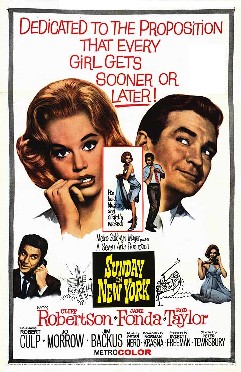
Sunday_ny_moviep.jpgIt would appear that a film like Sunday in New York would never exist today. First, it’s obviously rooted in a stage play and it functions with the kind of moments you might expect out of some of Neil Simon’s works around New York though this particular story was crafted from a play by longtime screenwriter Norman Krasna who wrote many a screwball comedy back in the day.

But this is a film of the 1960s and it looks as such by today’s standards because it’s a chaste sex comedy that is charmingly madcap in its romance and numerous mishaps all while dodging around the social mores of the day. It’s never biting, always palatable, and fairly tame fun given its central themes.

New York becomes a lovely place for a pit stop over the weekend. Numerous people are headed there. First on the list is an airline pilot (Cliff Robertson) who is titillated by the prospect of a whole day alone with his best girl. Of course, being on active call near a busy terminal can be very aggravating for your love life and he and Mona constantly find themselves spending more time on the opposite ends of a telephone than actually together eating bagels and doing whatever else they normally do.

Then there’s Eileen (Jane Fonda), Adam’s little sister who is trying to get over a breakup with her beau. As a young, naive 22-year-old, she’s still trying to figure out the conventions of society and she goes to her big brother for advice on life’s most important questions. He’s someone she can trust about this particular issue.

The fact is she’s still a virgin (Gasp!). He does the brotherly thing and commends her as a respectable man will come along sometime for her. Meanwhile, he conveniently equivocates about what his romantic life looks like.

She does meet a man (Rod Taylor) and there is something between them rather odd at first and then strained by sexual tension and finally complicated by the fact that first her beau (Robert Culp) and then her brother Adam both come back and she must explain the presence of her guest. The film has plenty of comings and goings and while the plot is nothing new and noteworthy the cast makes it work rather well.

Jane Fonda gives a delightfully radiant performance opposite the always personable Rod Taylor with a meet-cute that’s so obviously absurd that it’s easy to laugh it off and simply enjoy it. They get thrown together on public transportation, aboard a bus, but the lady’s jacket gets caught on his coat and they must proceed to exit together. One of those awkward rom-com trifles. The film is full of these cute moments. Little do they know they will be spending a great deal more time with one another on a Sunday in New York.

3.5/5 Stars

Tampopo (1985)

220px-Tampopo_cover.jpgJuzo Itami’s so-called ramen western Tampopo is unequivocably original in its hilarity, opening with what could best be called a public service announcement. A suave gangster is getting ready for the movie screening only to be disrupted by a noisy bag of curry potato chips. He threatens the foodie and sits back down to enjoy the entertainment, concluding the film within a film.

What follows in the actual movie is an unabashed love letter to food with some oddly sensual elements. It has off-beat scatterbrained touches of humor that send it in all sorts of odd directions, picking up momentary storylines and varying vignettes focused on different people all over Japan with the one unifying element being the food that they eat and enjoy.

There are the businessmen going out for a meal together who all order the same thing in deference to their leader only to be put off by their youngest associate who turns out to be well-versed in French cuisine and champagne. Then a society of women gets a lesson in how to eat Spaghetti like a true westerner which apparently means shoveling noodles into your face and making as much noise as you possibly can. They`re not wrong per se. Even the aforementioned debonair gangster and his lover turn up several more times romancing each other over their favorite dishes.

But the main attraction and the one that takes up most of the runtime has to do with the art of the perfect ramen shop with touches of what can best be termed a ramen western (an oriental rendition of Italy’s own affectionate spinoff, Spaghetti Westerns).

Goro (Tsutomu Yamazaki) and his sidekick Gun (Ken Watanabe) ride into town in their big rig and happen on a ramen shop that’s not doing so well. Its proprietor is a single mother who lives with her young son and looks to maintain the establishment after the death of her husband.

Unfortunately, she’s not much of a chief or a businesswoman and the shop has been suffering as a result. Thus, the newcomers main objective becomes turning the humble Lai Lai into a 3 star ramen operation. They are the hired hands who swoop in to save the helpless villagers, metaphorically speaking.

Recall Seven Samurai, The Magnificent Seven, or Shane and you`ll probably be on the right track. In this particular rendition, the first order of business is a name change to Tampopo Ramen. A regiment of further fortifications follows thereafter.

Goro takes his new benefactor to scout out the major competition in the area, gleaning from their success and also their failures. A good ramen shop has no wasted movement and provides a quiet atmosphere for the customers to savor.

Next, Tampopo trains with the foremost masters who know how to make a truly delectable bowl of ramen in every dimension. Finally, Goro and his compatriots help build a team to ensure her little shop will have the best of everything from food, to decor, and, of course, noodles. They are ready to face the inevitable onslaught headed their way: The lunch rush.

In her final test, Tampopo succeeds with flying colors. Goro`s work here is done so he can drift on further down the road a spell until another ramen shop catches his interest.

To its very core, Tampopo is a meandering film that ambles along forcing no clear agenda nor does it seem intent on getting to a certain destination. Instead, as it roams it slowly causes us to become attuned to the simple pleasures of food while wrapping us further still in the idiosyncrasies of humanity. This is the holy grail for ramen-lovers everywhere. It will make their mouth’s water in frame after frame and leave them raising an eyebrow on more than one occasion.

It’s possible to guarantee that you’ve probably never seen a film quite like Tampopo. While it revels in Japan’s rich culture of food it may not be for everyone. The same might be said of Japanese cuisine. I for one am more partial to the noodles but the film no doubt has a few savory moments.

4/5 Stars

Kiss Me, Stupid (1964)

KissMeStupidPosterWhile a less heralded picture, this Billy Wilder film is a minor classic built around a contrived comedic situation. Dean Martin opens playing a parodied version of himself as Dino the boozing, womanizing, but altogether good-natured playboy who makes a short pit stop in the gas station of the small town of Climax, Nevada following his latest Las Vegas circuit.

The beauty of his performance, though it may be exaggerated, there is no sense that this is a thinly veiled caricature. It’s blatantly obvious that “Dino” as he is called in the film is really only playing his “Rat Pack” persona that was known the world over.

That sets the groundwork for the film’s self-reflexive nature that is keenly aware of its cultural moment and the preoccupations of the general public as with many of Wilder and I.A.L. Diamond’s best scripts.

Truthfully I’ve always been fond of Ray Walston ever since my first viewing of My Favorite Martian and before this picture, he cropped up in Billy Wilder’s The Apartment (1960). Although I do adore Peter Sellers (who had to bow out due to a heart attack) and he’s often an ad-libbing genius, somehow Walston seems to more aptly fit the bill here.

That doesn’t mean I don’t regret that Jack Lemmon couldn’t take the role because he really was Billy Wilder’s greatest comedic counterpart, portraying every bit of neuroses that manifests itself in the middle-class everyman. He just gets it and putting him opposite his real-life wife in Felicia Farr would have been another delightful ironic layer to this comedy with its roots in infidelity.

No matter. It was not to be and what we are left with is still some fairly hefty star power. Walston audaciously takes center stage as Orville Spooner, a small town piano teacher with a paranoid fit of jealousy in relation to his gorgeous wife (Felicia Farr). He believes everyone from his teenage pupil to the local milkman is out to pluck his bright-eyed, loving bride away from him.

That’s of the utmost importance when his buddy (Cliff Osmond) dreams up a plan to get themselves a contract deal with Dino. It involves hosting the conveniently laid up pop singer, getting rid of Orville’s wife, and employing the services of one of the main attractions at the local watering hole The Belly Button — the one and only Polly the Pistol (Kim Novak). It seems simple enough to get her to masquerade as Orville’s wife just for the evening so she can make Dino feel at home.

You can see already that the narrative is entangled with bits and pieces of The Apartment (1960) and The Seven Year Itch (1957). Miscommunication and four parties involved means all sorts of foreseeable consequences. Kiss Me, Stupid is also fully aware of the contemporary Hollywood framework much in the same way of Sunset Blvd. Thus, it’s not above satirizing the ways of the entertainment industry — especially the movie stars — with the Rat Pack placed front and center thanks to Martin.

The small-time piano man and gas station attendant also have dreams of being the next Henry Mancini & Johnny Mercer dynamic duo with aspirations for The Ed Sullivan Show no doubt.

Even in its throwaway lines about churchgoers, there’s something starkly sobering being acknowledged as there are in many of the things that Wilder finds time to take a jab at. The owner of the Belly Button, Big Bertha, has all her girls attend the local church because she thinks it’s good for public relations.

It passes like a blip but the suggestion seems to be that these lines of dialogue and what we see on screen might point out some kind of hypocrisy and although it’s played for comedy, instead what I see is the inherent brokenness.

The film spins in such a way that the infidelity somehow ends in a kind of loving understanding that feels like utter absurdity but maybe Wilder has done that on purpose. Still, in spite of myself, I found some humor in this film in ways that I never could in The Seven Year Itch or The Apartment.

The first was too empty with little to offer of substance and the second is often too stark and morose to be funny. This film is raucous and utterly insane in a sense but that’s the way Wilder likes it from Some Like it Hot (1959) to One, Two, Three (1961). Kiss Me Stupid isn’t such a spectacular comedy with some misfires but there’s no doubt that Wilder still has his stuff.

He always seemed to take a very basic concept that was wacky and far from allowing it to fizzle out, he sees it to completion, finding an ending that derives laughs while simultaneously providing wry commentary.

In another screenwriter’s hands or another director for that matter, the romantic comedy aspects would be endangered of becoming trite and uninspired but no such issue here. Wilder would never allow it.

The punchline of Kiss Me, Stupid is that both spouses were deceptive and unfaithful but they do it out of love — that final touch of trenchant Wilder wit. Ultimately, the film’s title is reminiscent of the famed quip in The Apartment (1960), “Shut up and deal.” You get the same sense of the relationship.

The men are essentially cads — spineless at times — and lacking much of a moral makeup (even if Orville plays the organ at church) but their women seem to give them some substance whether they be barmaids or plucky housewives. It’s still slightly mindboggling that Wilder pulled this movie off and got away with it no less.

3.5/5 Stars

Logan Lucky (2017)

Logan_Lucky.png

On a surface level, Logan Lucky is diverting for the basic fact that it proves to be the utter antithesis of Steven Soderbergh’s Ocean films as far as heist pictures go. As one savvy newscaster notes within the film, it’s Oceans Seven-Eleven, if you will.

Sure, the novelty of a red-neck heist is probably enough to get us started but the execution and the characters of interest make it far more than a run-of-the-mill endeavor.

What’s evident is that there’s a quirky down-home absurdity to seeing these country bumpkin types filled by actors like Channing Tatum, Adam Driver, and especially Daniel Craig. Adam Driver’s not necessarily a classically handsome performer but he’s even more unique armed with a fake appendage and a fairly free and easy personality.

Tatum likewise is a miner saddled with a hard hat and a limp of his own. He’s a fairly sorry individual who gets laid off from work and has been estranged from his former wife for some time. The glory days as a high school quarterback with NFL aspirations didn’t really pan out. Still, he loves his daughter, loves himself some John Denver, and cares about his family. We can buy into liking such a figure.

Because even in their less than perfect life, an everyday dignity is attributed to both Logan brothers that feels relatable in human terms.  Even with these characterizations and as breezy as the scenario might seem at times, there’s still a kernel of truth buried under it all.

After being equated with Bond for so many years, there’s also this underlying sense that Craig relishes this opportunity to play such a weirdo as Joe Bang, a prison inmate with a penchant for salted eggs. His southern twang and bleached hair mask Craig’s usual British sentiments while his rap sheet leaves little doubt that he’s the man to help pull off the job, supremely capable of concocting homemade bombs out of gummy bears, salt substitutes, and bleach wrapped in a plastic bag.

Of course, the only problem is that he’s still in prison. Nothing for it but to break him out. Clyde gets himself sent to prison and starts their plan in motion. He and Joe orchestrate the perfect escape while the inmates cover for them by instigating a riot.

Meanwhile, on the outside, Jimmy gathers the talents of his sister Mellie behind the wheel (Riley Keough) and Bang’s two cockeyed yet surprisingly competent brothers (Brian Gleeson and Jack Quaid) to bring all the pieces together in a remarkably efficient operation organized on meager means.

However, somehow, through it all, there manages to be that continued dose of humanity on display and an uncertain amount of depth to our everyday antiheroes. Look no further than the former flame and physician assistant that Jimmy sends a donation to or his joy in seeing his little girl go off script and sing his favorite song at her beauty pageant. You aren’t going to find those scenes in Oceans Eleven (2001) or Baby Driver (2017) for that matter.

But the payoff is the kind of double-take ending that makes us rethink the events we have witnessed, suggesting that things are not always as they appear. Still more satisfying than any of that is that Jimmy still has his family and there’s this sense of closure to it all. We can sit back with a smile on our face and really take a moment to appreciate all that has transpired. No better place to end up than the old watering hole Duck Tape. Classic.

One of the film’s major pluses is the number of characters who just randomly seem to pop up within its frames. Foremost among them is Hilary Swank as a government investigator, an almost unrecognizable Seth Macfarlane as a batty racing promoter, and Sebastian Stan as his health-conscious driver. Fans of The Office and Parks and Recreation will also see a couple strangely familiar faces.

By my own admission, I have never considered Steven Soderbergh in the upper echelon of filmmakers but there’s no disputing his station as a skilled craftsman and Logan Lucky proves once more that he knows how to assemble efficient entertainment of quality and levity. Expect both in this much-appreciated riff off your typical sleek heist confections.

It’s perfectly fit for laid-back blue-collar, NASCAR-cheering, John Denver-loving Americans.  The kind of people who know full well that some days are diamonds and some days are stone. Logan Lucky is a crime film carrying that kind of sentiment.

3.5/5 Star


Review: Back to the Future (1985)

back to the future 1.png

Back to the Future zooms at us as a lovely mishmash of sci-fi thrills and 50s nostalgia that feels like pure happenstance. The one purported flaw, the fact that Marty McFly has no right to be in his family, is partially understandable. As Michael J. Fox wasn’t even slated to appear in the film. He was a last-minute replacement that just happened to pan out. But what a bit of serendipity it was all the same.

Without question Back to the Future clocks in as one of the most enjoyable adventures of the 1980s for delivering unadulterated audience satisfaction. It has all the great hallmarks we yearn for starting with rewarding characters, inventiveness that makes up for any corny interludes, and a pulse on what’s fundamentally entertaining.

Our introduction to the story tells us as much about Doc Brown as it does the teen rolling in on his skateboard, if not more so. Marty, the plucky kid with a penchant for rock n roll, finds Doc’s workspace in complete disarray thanks to an extended period of neglect. More on that later.

For now, the iconically cool vibe of “The Power of Love” underscores Alan Silvestri’s own cinematic orchestration on the project providing a fitting anthem for everything that is Back to the Future. McFly coasts around town on his skateboard using each passing car as his own personal lift. Rock is his main passion while his girlfriend Jennifer remains his main distraction. Meanwhile, Mayor Goldie Wilson looks to get reelected a la Nashville (1975) and Marty is accosted by locals championing the “Save the Clock Tower” campaign.

In fact, Hill Valley is a bit of a mythical city. It’s part Middle America, part fantasy, where the local principal is out to get our hero, his closest friend is a mad scientist, and he must battle against the ultimate affront of all time that he might not amount to anything just like his old man. Those are the stakes and this is the world. The perfect place for time travel. Doc in all his scatterbrained kookiness makes an appearance to introduce a DeLorean time machine into the storyline as well as the main conflict. The rest is in Marty’s hands as he whizzes away into the past.

The fact that it paints this world as a caricature as well instead of reality, far from being a weakness, becomes one of its bolstering charms. Refrains of “Mister Sandman” play throughout town. The local marques boast the star power of Barbara Stanwyck and Ronald Reagan (wink wink) in Cattle Queen of Montana (1954). Further still, the local five and dime features the tunes of Nat King Cole, Pattie Page, and of course, Tennessee Ernie Ford. Everyone gets a plug to set the scene.

A few good-natured jabs at incumbent President Reagan are also in order. After all, who could ever believe that an actor could become a president? Of course, nothing is all too surprising in this day and age. Still, the 50s via the 1980s were in many ways both simpler times. Star Wars and Van Halen. Chuck Berry and Jackie Gleason. That was the life.

It devolves into a glorious unfolding of circumstances as worlds collide and Marty’s cause begins to unravel at two ends. First, he needs to get back to the future, hence the all-encompassing title but in his haste, he accidentally tampered with the natural order of things – namely the initial meet-cute of his mother and father. It subsequently instigates one of the most awkward cinematic mother-son relationships known to mankind.

Having done irreconcilable damage to their relationship, Marty must do all he can to get his parents back on track. The problems are innumerable. Namely his mother’s infatuation with him, the dreamy out-of-towner Calvin Klein, his father’s undeniable dorkiness, and of course the bullies to end all bullies Biff. In fact, he’s been a thorn in George’s side for 30 years.

Still, with Doc’s aid (the quintessential secondary helper), Marty looks to right all that is wrong. It proves difficult as he attempts to set his parents up to attend the Enchanted Under the Sea Dance together – the fateful dance where young love kindled. Yet Marty watches his life slowly disappearing moment by moment as his parent’s union seems a slight chance at best.

With a few riffs of “Johnny B. Goode” and an imminent date with Doc at the old clock tower in town, a happy conclusion seems possible if not for the Libyan Terrorists still waiting for Doc in the future. After all, Plutonium doesn’t grow on trees and there are consequences for swiping it. Thankfully he doesn’t necessarily listen to his own advice about altering the future and Marty returns to a world that is strikingly different to the one he used to know. It’s strangely rewarding even if it does feel all too perfect in this third world.

While it becomes one of the most obvious films to shamelessly set up and plug its sequels (ultimately two other offerings), there’s no doubt that Back to the Future makes each a rewarding prospect. Not only is it boosted by a winsome performance by Family Ties favorite Michael J. Fox in a now defining role but Christopher Lloyd’s turn is equally laudable even if it easily typecast him in future tech nerd projects. There are certainly worst places to be.

Furthermore, under the tutelage of executive producer Steven Spielberg, director Robert Zemeckis became one of the great successes of the 80s and 90s with Back to the Future being yet another reason why Spielberg remained at the forefront of popular entertainment throughout the decade.

For their part, whether they like it or not Michael J. Fox and Christopher Lloyd will remain pop culture gods in the hearts of nearly everyone. Bless them for that. Doc and Marty are as memorable now as they were back then and no doubt even years into the future. That’s right, a movie about a time-traveling DeLorean has staying power. There’s a bit of the magic of the movies for you.

4.5/5 Stars