Mr. Deeds Goes to Town (1936)

Starring Gary Cooper and Jean Arthur with director Frank Capra, this film follows a man from a small town who is left $2 million by a dead relative. Longfellow Deeds is thrust into a life in New York where everyone wants his attention in order to get money and support. However, this man they took for a stooge has common sense and grows fed up with them all. The only person he talks to is Arthur’s character who is actually a reporter. While she writes damaging articles, they slowly begin to fall for each other. He finds out what she did and eventually decides to give his money away. Fortune hunters try to claim he is crazy and they bring their case to court. Initially Deeds does not defend himself, but when his love speaks on his behalf he changes his mind and fights for his cause. Capra was wonderful at making the feel good films about the common man. Here he does it once again in a precursor to Mr. Smith Goes to Washington and Meet John Doe.

4.5/5 Stars

My Man Godfrey (1936)

24635-my_man_godfreyStarring William Powell and Carole Lombard with a zany cast of others, the film follows a funny socialite daughter who takes a “Forgotten Man” as her family’s butler. Godfrey takes the job and soon learns how to cope with the scatterbrained girl, her stuck up sister, their ditsy mother, their long suffering father, and Carlo who is the man patronized by Mrs. Bullock. On accident Godfrey comes in contact with an old friend and his secret almost comes out. In the cover up Lombard’s character believes him to be married with children. Because she loves him, she goes away to Europe to try and forget him. However, upon hearing the truth, she is ecstatic and Godfrey finds himself being married all of the sudden. This is a good example of the screwball comedies of the 1930s and I will admit, it is a pretty good film.

4/5 Stars

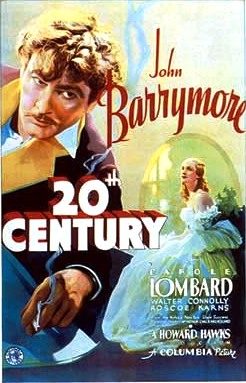
Twentieth Century (1934)

63742-twentieth-century-post1Starring John Barrymore and Carol Lombard with direction by Howard Hawks, this archetypal screwball comedy revolves around a frenetic impresario and the emotional girl he made into a household name on Broadway. 

Oscar Jaffe is the undisputed king of Broadway and after he christens the inexperienced Mildred Plotka, Lily Garland, she becomes his box office Queen. He makes her into a great actress and their numerous collaborations turn out success after success. However, as several years pass Lily is fed up and she ends her connection with Jaffe in a volatile falling out after she finds that he has hired a private investigator to keep tabs on her. Without his starlet Jaffe produces flop after flop and he is endangered of being jailed by his backers. He escapes in disguise and boards the Twentieth Century Limited train. He is accompanied by his two quirky assistants and it just so happens that Lily has boarded that same train. Jaffe sees it as a chance to make amends, but Lily will have nothing of it. They have some more frenzied confrontations on the train as Jaffe tries to convince her to star in his next project. In a last ditch effort he pretends to be deathly ill after a scuffle so that she will sign a contract in her distress. In the end she proves to truly care for him and once again they are back on Broadway, Lily Garland star extraordinaire, and Oscar Jaffe the domineering visionary. 

Along with It Happened One Night, this is one of the early examples of the screwball comedies. This was a perfect practice run at it for Howard Hawks who would direct the more well-known Bringing Up Baby in 1938. The leading performers are absolutely chaotic and over the top in their performances, but it’s the way it should be. Furthermore, like most screwball comedies the odd supporting characters are often a great source of laughs. The extended train sequence here reminded me somewhat of The Palm Beach Story another raucous film.
 
4/5 Stars

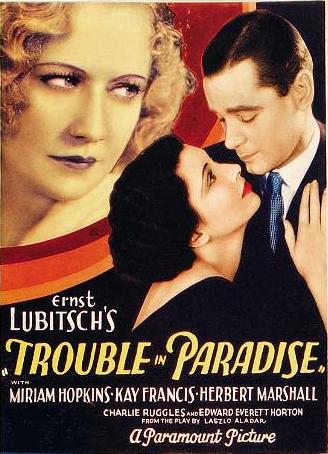
Trouble in Paradise (1932)

73432-troubleinparadise1932Starring Kay Francis, Herbert Marshall, and Miriam Hopkins with director Ernst Lubitsch, this film is a funny pre-code era romantic comedy. A man and a woman crook meet each other in Venice and after wreaking some havoc they fall in love and get married. The two of them move to Paris in order to pull a big heist on the elegant Collete perfume tycoon. Things get complicated when the male crook begins to fall in love with her. Furthermore, her two other suitors get jealous and eventually realize where they have seen him before! Then his wife learns what is going on and she is jealous. He sadly breaks off his relationship with the lady he meant to rob. But once a pick pocket always a pick pocket and he and his wife make up. For being an early 1930s film, I particularly enjoyed this one. Lubitsch did a fine job directing and there is a lot of wit.

4.5/5 Stars

A Day at the Races (1937)

Starring The Marx Brothers, the film begins with a pretty young lady who owns a sanitarium near a racetrack. In danger of closing, she brings in a new doctor named Hackenbush (who specializes in horses) and at the same time her love buys a race horse. A powerful man wants the place closed down so he can build a casino and he is in cahoots with the financial adviser  a wily woman, and the police. However, wanting to help the two lovebirds out, Groucho, Chico, and Harpo lend a wild helping hand. It all culminates with an uproarious Day at the Races. This film is full of funny moments such as the code book sequence, the dinner and wall papering scene, the medical exam, and of course the final race. I felt that a lot of the music was an unnecessary added feature.

4/5 Stars

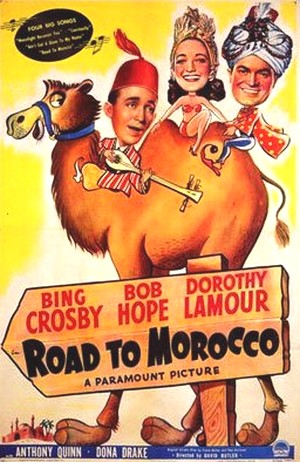
Road to Morocco (1942)

58f0c-roadtomorocco_1942Starring Bing Crosby, Bob Hope, and Dorothy Lamour in this third installment in the Road Series, this film has the boys floating towards Morocco as castaways. They finally reach land, hitch a ride on a camel, and just like that they are off on the Road to Morocco. They wander the streets looking for food at first then Jeff (Crosby) sells Orville (Hope) for money. Little does he know that Hope has been taken to the castle of a beautiful princess (Lamour) to be married in order to fulfill a prophesy. Jeff finds out soon enough and he tries to win the affections of the princess as well, but trouble arrives in the form of the jealous suitor of the princess. He takes the girl and the two lovebirds are left to chase after mirages in the desert. They are imprisoned, but after a daring escape they come up with a comedic solution to turn a visiting sheik against Kasim (Anthony Quinn). In the chaos both Jeff and Orville get away with a girl of their own. This has to be my favorite road picture. The title song is great, Hope has some great one liners, Crosby croons nicely, Aunt Lucy makes an appearance, there are talking camels, Hope tries to win an Oscar, and I love it when the three stars sing together in the desert.  Unfortunately the film is stereotypical, but as far as the Road pictures go it is a good one.
 
4/5 Stars

Road to Utopia (1946)

Starringc0cc6-roadtoutopia_1946 Bing Crosby, Bob Hope, and Dorothy Lamour in this fourth Road picture, this film begins in the present with an old marry couple who gets a surprise visitor. Then the story flashes back to the turn of the century where two lowlifes commit murder in order to steal the map to a gold mine. However, the police are on their tails so they duck into a vaudeville show where Duke (Crosby) and Chester (Hope) are performing. Eventually the two con men decide to part ways, but they double cross each other only to end up heading for Alaska on the same ship as the two killers. Through a bit of luck they get the map and take the place of the two killers, but trouble follows close behind them. The daughter of the man who was killed (Lamour) is intent to get the map back and she is unknowingly working with some undesirables. As always happen both hapless adventurers fall head over heels for Sal, who wants to get close to them for the map. However, the map is in two parts and then Sperry and McGurk are on the loose again. Duke and Chester’s real identities are revealed to Sal and now the trio must hightail it, with two killers and a multitude of others looking for them. Miraculously they escape by sled, but only two can get away so Duke heroically holds off the pursuers. This Road film is probably one of the best and all the stars are in fine form in Utopia.

4/5 Stars


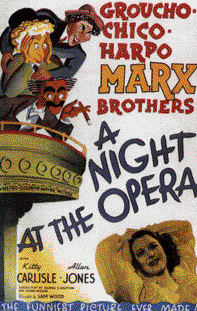
A Night at the Opera (1935)

Starring The Marx Brothers, this vehicle for their comedy has Groucho, Harpo, and Chico trying to help two lovers earn  positions at the opera. Along the way Groucho tries to marry a rich patron and Chico and Harpo run from the law as stowaways. This film which could be seen as having a dramatic story, is constantly interrupted by Marxian gags. Some memorable moments include the insanity clause, two hard-boiled eggs, Groucho’s crowded stateroom, and the final scenes in the opera house. Only with the Marx Brothers would you hear Take Me Out to the Ball Game at the opera. Although Duck Soup has critical acclaim, I find this one more entertaining as comedy with a real story line. The MGM years were ushered in by this film and solidified the Marx Brother’s legacy.

4.5/5 Stars

Road to Zanzibar (1941)

3bcc4-roadtozanzibar_1941This is the second installment in the Road Series and it follows two con men who must go on the run which leads them to Africa. Crosby is pulled into saving Dorothy Lamour from a life of slaver. Little do the hapless con men know what her true motives are. They travel on a safari together and a midst the song and comedy love creeps up. Both believe Lamour has her eyes on them but then they figure out what is really going on and they head off on their own. However, all too soon they are captured by cannibals and it looks like they will become shish kabobs. That’s when a little game of “Patty Cake” comes in handy and in the end everyone is reunited. There are some choice moments in this Road Film but I think it was one of the weaker ones.

3.5/5 Stars

Road to Singapore (1940)

2e545-roadtosingapore_1940This is the Road film that started all with the brilliant comic pairing of Bing Crosby and Bob Hope. The two bozos both skip out on obligations and relationships back home and together they hightail it to Singapore. There they both fall head over heels for the same girl despite having vowed to give up women.  Together the trio hide from their respective pasts. However, with barely any money  they must muddle through with cons. Everything comes to fruition at a native marriage ceremony where Mallon’s father and fiancee catch up with him. In the end everything works out as it always does and Singapore was only the tip of the iceberg. The film works based on the chemistry of the leading trio and the ad-libbing and various gags such as “Patty-Cake.”

3.5/5 Stars