Review: Chinatown (1974)

chinatown1Forget it, Jake, it’s Chinatown

The more you watch movies like Chinatown, the more you realize how much you’re still learning. I saw it the first time and I naively thought I knew everything about it. After all, it seemed fairly cut and dry. But the beauty of this film is a labyrinth-like story that can still keep me engaged after multiple viewings. There are things that I missed, things that I have to piece together once more, and more often than not details I simply forgot.

Robert Towne’s script has an intricacy to its constantly spiraling mystery plot that remains powerful and Roman Polanski — with cameo included — directs the film with a sure hand as well as a cynically bitter ending worthy of his work. At that point, he was returning to the same city where a few years prior his wife Sharon Tate had been brutally murdered and that certainly had to still be heavy on his mind.

Throughout, Chinatown has elegant visuals of a desert-dry Los Angeles circa 1930s, and it is aided by a smooth Jerry Goldsmith score made for such a period crime film as this. Jake Gittes (Jack Nicholson), is the smooth-talking, smart-aleck P.I. with a penchant for trouble, but that goes with the business. In the tradition of all his heirs like Spade and Marlowe, the whole story is told from his point of view and we get the details at the same pace as him. That means a lot of the time we are just as confused as him, trying to pick up all the pieces.

Aside from Nicholson, Faye Dunaway’s performance is an interesting reworking of the archetypal femme fatale, because she has a different side to her. Also, John Huston’s performance is wonderfully nefarious, because he plays Noah Cross with a top layer of geniality that is ultimately undermined by his base nature. It’s wonderfully wicked.

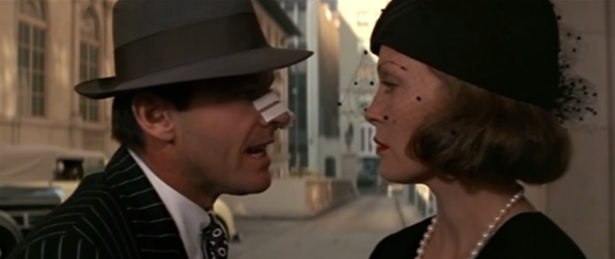
In the story’s first few moments of being in his office, we begin to learn a little about the means Gittes uses to appease his clients. Then, his newest client walks through the door, a Mrs. Mulwray, who wishes for him to tail her husband. And so he does, just like that, and he’s pretty good at it too. Hollis Mulwray (an anagram for Mullholland) happens to be an integral part of the L.A. Department of Water and Power as the chief engineer. From what Gittes sees, the bespectacled Mulwray seems to have his scruples, but he also has a secret girl, who the P.I. is able to snap some incriminating photos of.chinatown2 Back at the office, another woman shows up, a Mrs. Mulwray, but this time the real one. She wants to slam J.J. with a lawsuit, but he realizes he got framed, and in the end, she quickly drops her case. Pretty soon Gittes former colleague Lt. Escobar digs up Mulwray’s body and the cause of death is the height of irony. He drowned during a drought, a cruel demise, and his body is joined by that of a drunk, who also was wandering around the local reservoir. It’s time for our nosy P.I. to do a little more snooping, but he is scared off by two security guards from Water and Power who give him a deadly nose job.

None worse for wear aside from a small cast, J.J. knows the department is diverting water. It’s more than a little runoff like they contend. He gets lunch with Noah Cross (The great John Huston), who is the father of Mrs. Mulwray and the former business partner of the deceased. Like J.J., he’s curious about finding the mysterious girl, and he sweetens the pot for the P.I.

A bit of detective work takes Gittes to the hall of records and then a vast acreage of orange groves where he is mistaken for a member of the Department of Water and Power. They aren’t too happy to see him, but Mrs. Mulwray is able to bail him out. They check up on an assisted living home and tie it into the whole conspiracy. Someone is buying up land under the names of the unknowing residents.
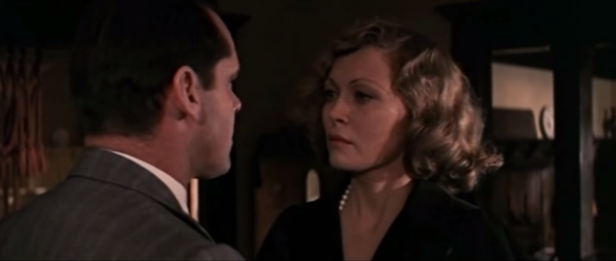
chinatown3But as it turns out, Mrs. Mulwray is hiding a major secret of her own that she’s been keeping. Another girl is murdered and since he’s found at the crime scene, Gittes is in a tight spot with the police and so he wants to get things straightened out. But he doesn’t quite understand what he’s gotten himself caught up in. At the last minute, he decides to take the hero’s path, but it’s to no avail. The good is snuffed out, the bad walk away free, and corruption still runs the streets of L.A. There’s not much the cops can do about it either.

chinatown4So many people remember the film’s final words, which epitomize this place of confusion, corruption, and helplessness. The final words of Jake are just as illuminating, however, because he repeats the words he spoke to Mrs. Mulwray earlier when she asked what he did when he worked a beat in Chinatown, “As little as possible.” It’s so pessimistic and yet it’s the truth that everybody knows. He must resign himself to doing nothing because there is no way he can win, no way to overcome the forces that be. It’s a haunting conclusion, but ultimately the most powerful one we could hope for.

Earlier I alluded to the fact that every time I watch this film I pick on things that I missed before. For instance, within Robert Towne’s script are some interesting instances of foreshadowing. The first comes in the form of a pun uttered by the Chinese gardener who is constantly muttering, “It’s bad for the glass/grass.”

Then, while they are in the car Mrs. Mulwray dejectedly drops her head on the steering wheel and it lets out a short honk. This acts as an important portent to the end of the film along with the blemish in her left eye. If you have not seen the film yet, this might sound very cryptic, but if you keep your eyes open these little details are rewarding. Chinatown is a fascinating place to return to again and again after all.

5/5 Stars
Review: The French Connection (1971)

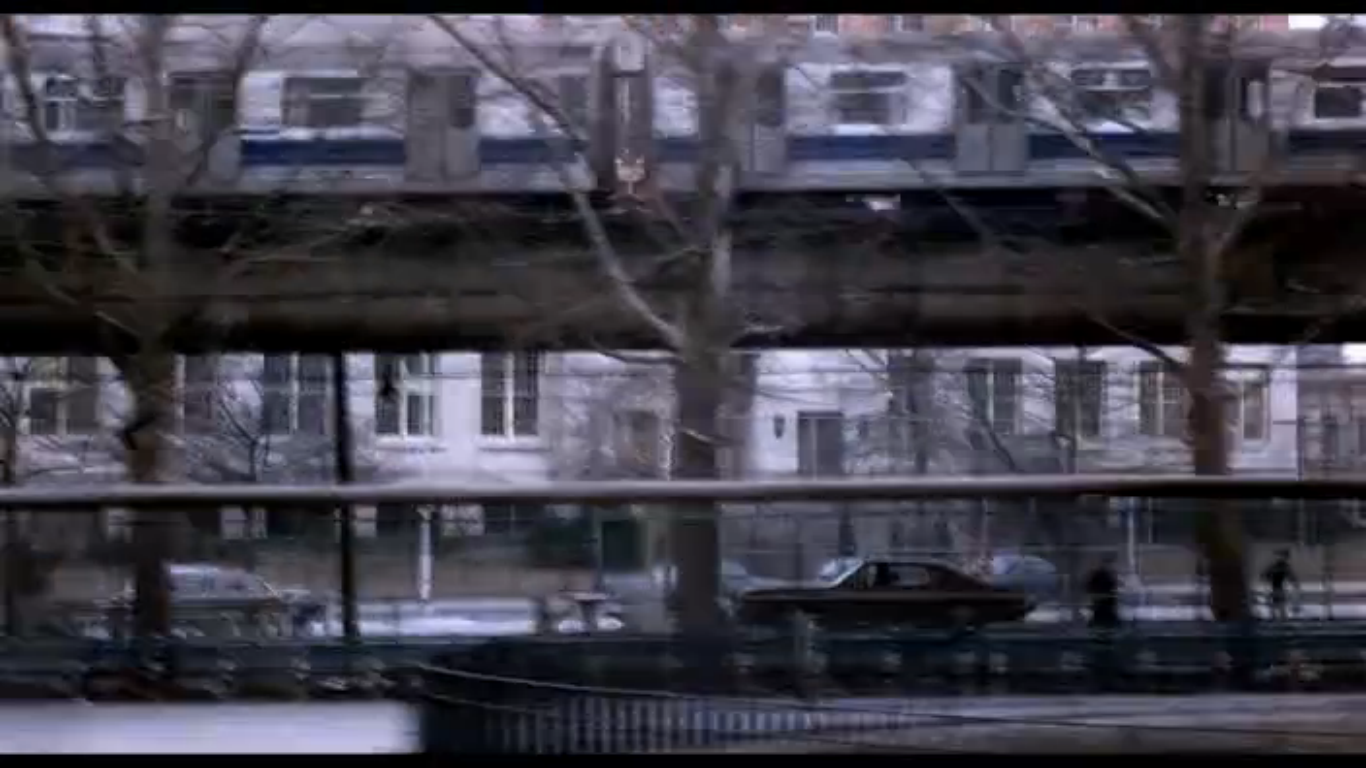
frenchcon5There is a pervading gritty realism to William Friedkin’s French Connection that undoubtedly took some cues from the French New Wave and the Neorealist movements. Hand-held cameras are taken to the streets of New York and to the train terminals. There is literally trash piling up in the gutters, old dilapidated bathroom stalls, and worn out facades all over the city. It’s urban, depressed, and a place of crime. In many ways this film is like Bullitt for New York, in fact, Steve McQueen was even offered the lead.

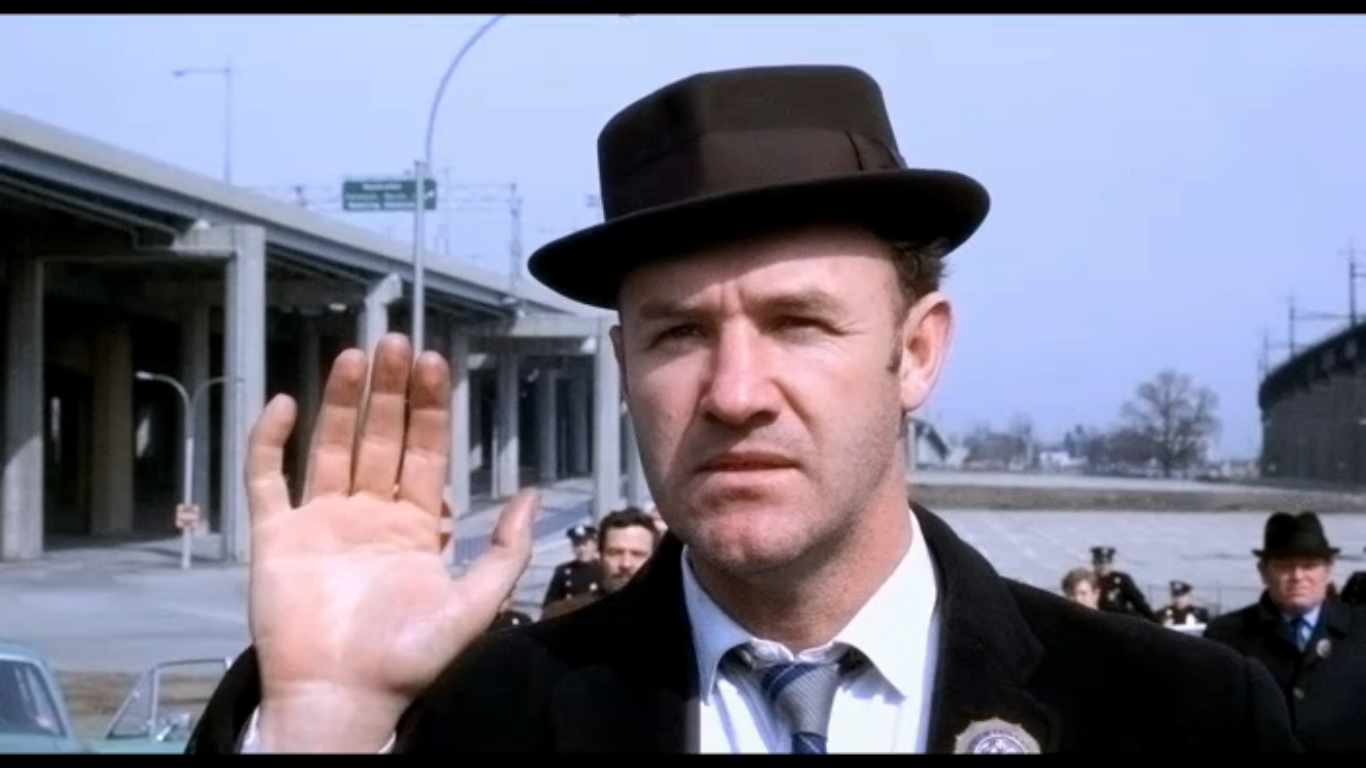
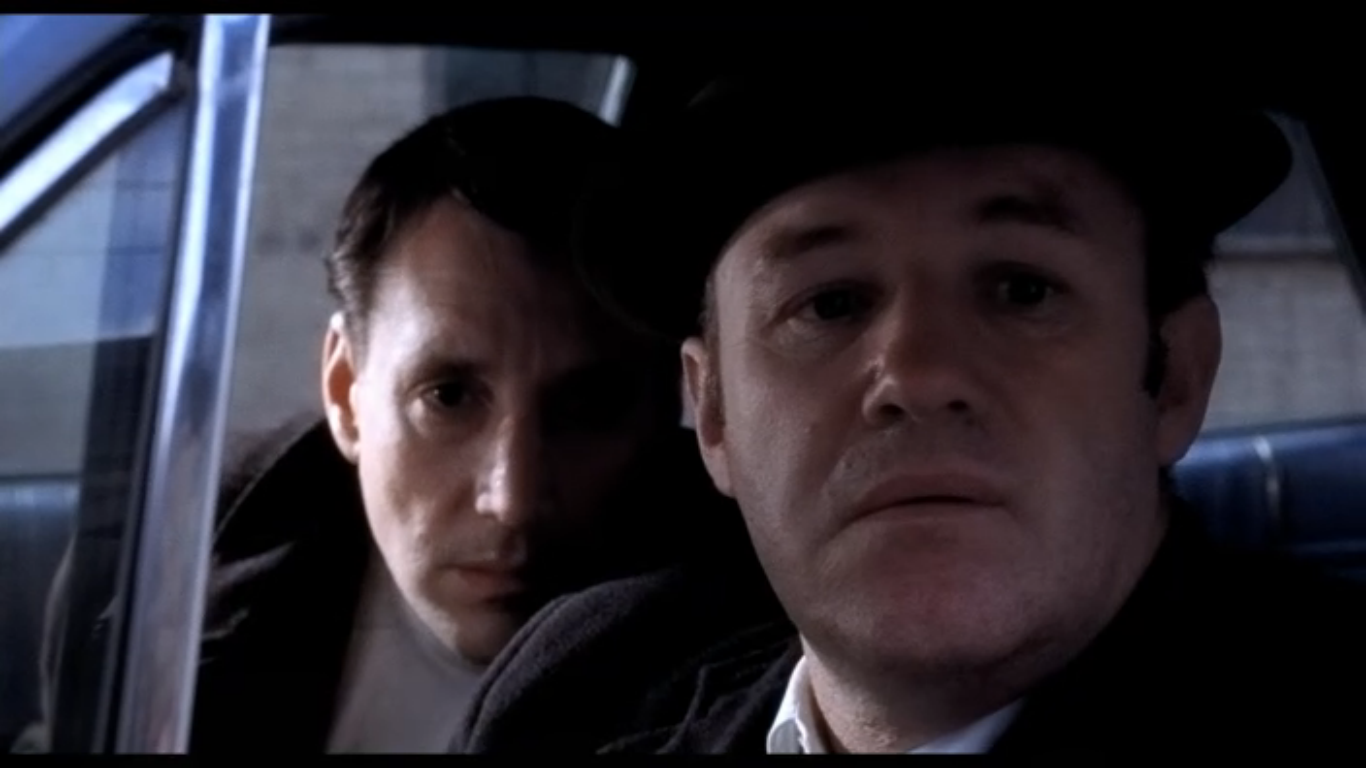
However, this time around our main cop is Popeye Doyle (played by Gene Hackman) and his partner Cloudy Russo (Roy Scheider). Both play a key role, but Popeye (the man with the hat) is of the greater interest. He’s a wise guy, belligerent, barking, loud-mouthed hot head, often driven by obsession in his job. He also happens to be an undercover cop in the narcotics division. He’s used to getting dirty and using the rough stuff when necessary. After all, it’s a jungle out there and there’s no room for pushovers.

From the get-go, we come to understand that this story has a French Connection, in Marseilles to be exact, and we know who is involved (Fernando Rey). We just cannot quite pick out all the details. Simultaneously, on a hunch, Doyle and Russo start running surveillance on a guy they happen upon in a club. Things don’t quite add up since he runs a deli called Sal and Angie’s by day and lives it up at night. An undercover informant also tips Popeye off to a big shipment of heroin that’s coming in.

frenchcon9Sal Boca has to be into something and so a game of tailing begins on the streets after he and his French contacts are spotted together. Frog 1 named Charnier (Rey) has Popeye on his tail only to shake him adeptly. That’s only the beginning, however, after a sniper comes after Popeye and yet another chase ensues. The fugitive boards a train and Doyle commandeers a car to follow close behind. Thus, was born one of the greatest car chases of all time and it doesn’t even involve two cars. After the adrenaline of that moment has worn off Doyle and Russo are on another stakeout and this time impound a car belonging to frog # 2 Henri Devereaux. Popeye has a gut feeling that the vehicle’s dirty and they literally tear it apart end to end, with little luck. But he’s a force of nature and very little will get in the way of his obstinate drive.

frenchcon11When the drop finally takes place everything goes off smoothly enough, but there’s a roadblock, and Popeye is waiting for them with a playful wave. He’s got them now. The final roundup leads him into an old warehouse as the hunt continues, but The French Connection finishes open-ended. Sal was gunned down, the meeting was busted, but not everyone was caught, and Charnier seems to have vanished into thin air. To top it off, Doyle shoots the wrong man and without flinching continues his obsessive hunt.

Friedkin’s film was partially based on true events from the 1960s and the two men the story was patterned after actually are featured as the boys’ superior Walt Simonson (Eddie Egan) and federal agent Bill Mulderig (Bill Hickman), who has a longstanding dislike for Doyle. Their presence in the production of this film helps to lend to the realism and nuances that the film is able to take on. The score isn’t all that noticeable, but it’s a tense arrangement that adds some underlining anxiety to some scenes. Stakeouts get more interesting than you would ever give them credit for. Really on the simplest level, this film is about one man’s hunt, his obsessive chase, which at times no longer seems about justice at all, but personal vindication.

4.5/5 Stars

Fargo (1996)

fargo1The Coen Brothers have always been an interesting case for me. I admit that there are still a lot of their films that I wish and need to see. Films like True Grit and Fargo I find thoroughly enjoyable or at least passable, but they do not completely resonate with me. However, I certainly respect them as writers, directors, and auteurs, because they know the lineage of film as a medium and they have their own unique way of approaching movies. It’s often clever, unique, and carries a wickedly funny tone no matter their subject matter.

Fargo is arguably their greatest work, following a kidnapping and murder investigation that involves Fargo, North Dakota and Minneapolis. William H. Macy is your standard Midwestern dupe Jerry Lundegaard, who makes an honest living selling cars. However, there’s another area of his life that’s not so honest. He’s in desperate need of money; we don’t know the reason, but he has resolved to hire two men to kidnap his wife. It doesn’t make much sense to the audience or the easily agitated crony Carl (Steve Buscemi). However, Jerry has a rich father in law with the necessary funds to bail out his daughter. And so it goes.

Except after the deed is done Carl and his taciturn accomplice Gaear get stopped by a highway patrolman and things are downhill from there. Murder, and blood, and more murder, all on a snowy Minneapolis evening.

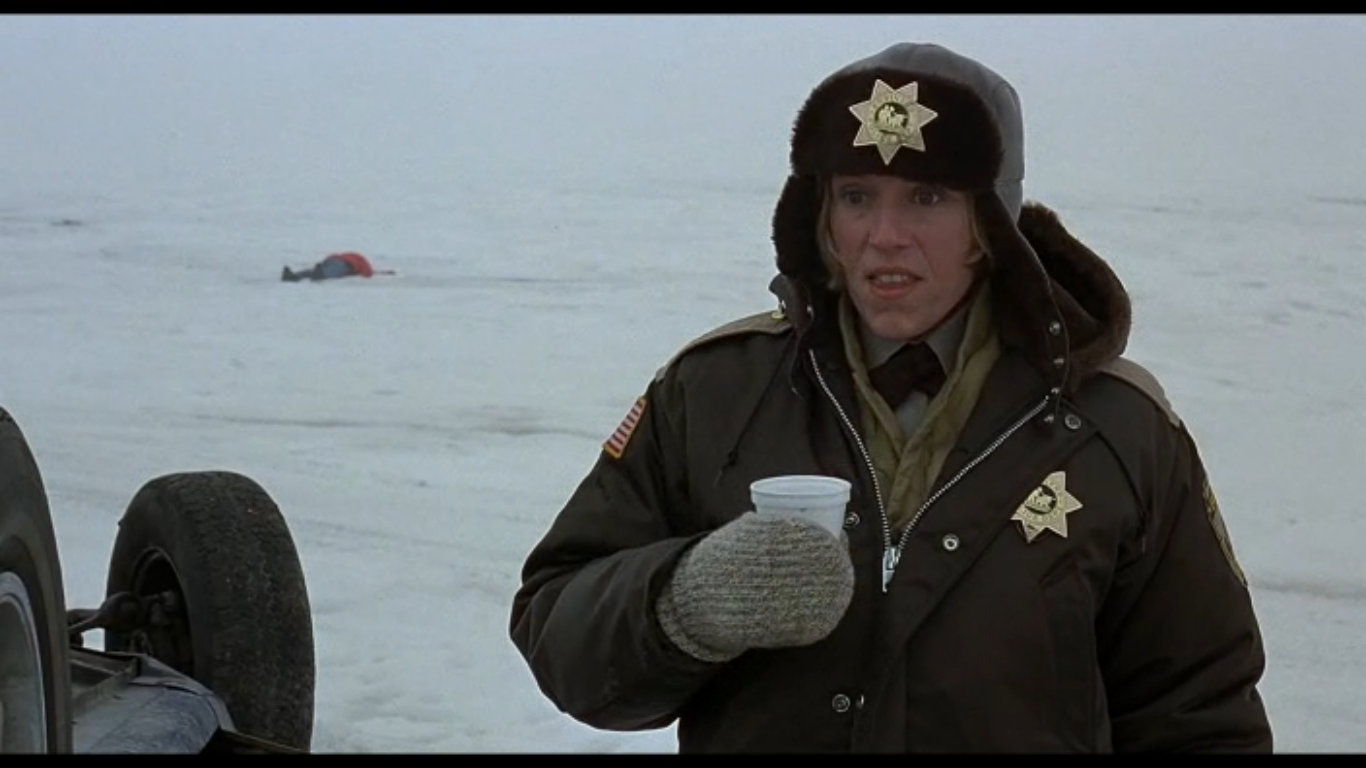
The next morning pregnant cop Marge Gunderson (Frances McDormand) leaves her hubby and heads to the scene of the crime where she quickly pieces together the turn of the events. The search is on for the vehicle, and she questions a couple of prostitutes who aren’t much help except pointing out one of the men was “funny looking.”

Meanwhile, everything is falling apart on Jerry’s end with his father in law and he even gets paid a visit by Gunderson. When the drop finally does take place, Carl is livid when he is met by Wade instead of Jerry. He’s not messing around and neither is Jerry. Crime scene number 2 is set up. Carl finds a snowy locale to bury the payoff and heads back to the cabin, but he’s about had it with Gaear and the feelings are mutual.

Meanwhile, after a disturbing meeting with an old high school classmate Mike Yanagita (a rather troubling performance by Steve Park), Marge decides to question Jerry once again, and this time she gets somewhere. The reunion with Mike sets something off in her head.  Another tip eventually leads her to Gaear and his friendly neighborhood wood chipper. Being the pro-cop that she is, Marge subdues the culprit and gets an ABP out on Jerry which leads to his arrest. After a successful day at the office, it’s back to fast food and tv in bed with her loving husband Norm.

Fargo, to its credit, exudes a Midwestern charm thanks to all its colloquial “You betchas, darn tootin’s, heyas”, and so on. Perhaps most effectively it mixes the mundane and the violently shockingly in one pot of inspiration. The two-pronged story following two very different worlds somehow meets in the middle amidst all the improbability. The Coens start the film off labeling it as “based on a true story” and that opening statement had many people tricked. I myself was taken in the first time I saw it because however outrageous the following events are we trust the words of the filmmakers guiding us. And in the characters of Marge, Jerry, and most everyone else there is a charm or normalcy that feels so familiar. Thus, the Coens could get away with such outrageous plotting, because it so often felt grounded in truth.

4/5 Stars

I Wake up Screaming (1941)

iwakeup1So the title doesn’t have a bearing on much of anything, but who cares? It sets the tone brilliantly for this wickedly twisted noir. The film opens like other films, after the death of a beautiful young woman. Two people are getting grilled in adjoining rooms. Frankie Christopher (Victor Mature) is a promoter and the former love interest of the girl, so he also happens to be high on the suspect list. He lays out how he first met the pretty young waitress Vicky Lynn (Carole Landis). With the help of two conniving friends, he made her into the next big thing. The has-been actor Robin Ray (Alan Mowbray) helps her reach the higher echelon of society. Mustachioed gossip columnist Larry Evans (Allyn Joslyn) plasters her name and picture all over his paper until the world is bound to notice. They make quite the trifecta, all too happy to give this unassuming girl a break.

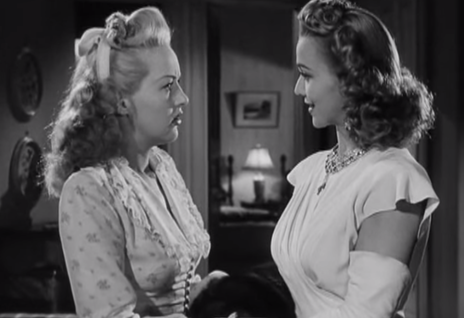
In the next room, Vicky’s sister Jill (Betty Grable) tells her side of the story: She saw how Vicky was beginning to change. She stopped working as a waitress, became entitled, and began to look down at all those around her. Now a real prima donna, she ditches her benefactors ready to head off to Hollywood for a screen test, and Christophers is understandably ticked. It doesn’t help that both Ray and Evans fell in love with Vicky. There’s also something going on between Jill and Frankie, because in the wake of the murder they turn to each other.

iwakeup2For a time the murder gets pinned on the switchboard operator — the always wide-eyed and nervous Elisha Cook Jr. But the menacing police officer Cornell (Laird Cregar), has an almost obsessive drive to find Frankie guilty of the murder. There’s something else going on here. Like so many films of this period, this story is full of men desiring women. Some of it is understandable, some of it is casual, and some of it is downright twisted.

Although she is out of the film early on, Carole Landis has the key role as the rising starlet and she is the closest thing to a femme fatale in this film. But there are a lot of characters of interest aside from our main couple of Betty Grable and Victor Mature. His two opportunistic friends are no-goods but thoroughly entertaining, and Laird Cregar is downright spooky. The film takes on another level of significance due to the tragic suicide of Carole Landis which occurred in 1948. There is most definitely an allure to her just like the women in prominent film-noir like The Woman in the Window or Laura (1944). Throughout some haunting refrains of “Somewhere Over the Rainbow” can be heard, helping to make I Wake up Screaming disconcerting from beginning to end.

3.5/5 Stars

No Way Out (1950)

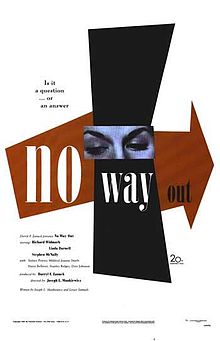
220px-No_Way_Out_(1950_film)_posterI had a preconceived notion that No Way Out might be the kind of social drama that was groundbreaking for its day and by today’s standards looks mundane and quaint. 65 years have passed and this film from Joseph L. Mankiewicz still packs a wallop, believe it or not. We are blessed with the first major role for screen icon Sidney Poitier as young doctor Luther Brooks. His main antagonist is Richard Widmark playing a racist scumbag like he does best, and Linda Darnell also gives a key performance, although her career would soon be on the decline.

The film opens with the young interning doctor — Poitier was only 22 at the time –getting ready for a night shift. His first customers just happen to be Johnny and Ray Biddle, who both got it in the leg after a botched robbery attempt. At first glance, their wounds look superficial, but Luther notices Johnny is disoriented. His diagnosis is a brain tumor so he tries to administer a spinal tap which ends up unsuccessful, partially due to Ray’s constant berating. But Ray has no sympathy; all he knows is that this black doctor has killed his brother. A white doctor could have saved him and all his prejudiced beliefs of blacks are confirmed. At least that’s what he tells himself in his narrow little mind.  Luther even goes to his superior Dr. Wharton (Stephen McNally), and although he cannot be absolutely certain, he maintains confidence in Luther’s competence.

nowayout1Again that bears little importance to Ray and he will not grant them the opportunity to do an autopsy. After all, his mind is already made up. So the next best thing is to track down Johnny’s former wife Edie (Darnell), who has pulled herself out of the gutter which is Beaver Canal and made a modest living for herself. They want her help, and unbeknownst to them, she does go see Ray. You can see it in how they interact with each other. She was Johnny’s wife once, but there was something between them and Ray won’t let her forget it. That’s undoubtedly why she wanted to get away, but Ray brings out the worst in her. Even as they speak, her racist sentiments come bubbling to the surface. It’s in her veins after all. It doesn’t help that unrest is building in the city. A riot is at hand and the slow build-up leading to the imminent rumble is boiling with tension. Mankiewicz does something important here. He shows both perspectives. I cannot help but think some things have not changed a whole lot over the years. Black vs. white. The same racism. The same belligerence. The same lack of understanding.

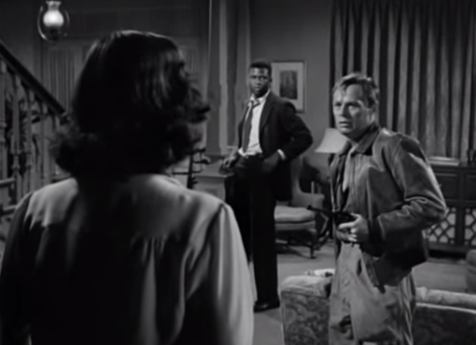
nowayout2Of course, after that is all done, that still does not wrap things up with Ray. He still has to settle a score with Luther and he uses Edie against her will. They set a trap at the home of Dr. Wharton for the unsuspecting Luther, and this scene has vital importance to the film, not simply because Biddle and Brooks come face to face once more. This is the scene where Edie must make a choice. Really it’s the universal choice. Stand passively by as injustice is being done or take a stand against it.

So you can make your own diagnosis, but this was not a superficial message movie. It hits fairly hard. I was even surprised by how often Ray Biddle lets the N-word fly. It completely fit Widmark’s characterization, but the production codes allowed it. Supposedly the actor apologized profusely after many of his scenes with Poitier, but his performance is nevertheless potent. It’s certainly convicting and we cannot be too quick to find fault with any of these characters because, truth be told, we all have some apathy and narrow-mindedness stuck inside our skulls. No Way Out is a striking reminder of that.

4/5 Stars

The Dark Corner (1946)

Dark_Corner_1946“I’m backed up into a dark corner and I don’t know who’s hitting me.”

It’s always satisfying to find another little gem of a film-noir, and I think this thriller from Henry Hathaway fits that bill. Our stars include a serious and quite beautiful Lucille Ball along with Mark Stevens as gumshoe Bradford Galt. He’s more of a Cornel Wilde type. A rather nondescript lead compared to Bogey or even Dick Powell, but he works well enough as the focal point of this story.

He served a stretch in prison after he was framed for a murder wrap and now he’s a P.I. trying to keep himself on the right side of the law. But nevertheless, it’s a dirty business that’s bound to catch up with him. He’s being shadowed by a man in a white suit and almost gets mowed down by a car that had his name on it. His secretary Ms. Kathleen Stewart genuinely worries for his safety and tries to help him, so he reluctantly lets her into his life.

Everything seems to point back to one man. Anthony Jardine was the attorney who set Galt up and sent him off to the clink. It only makes sense that he would want to silence the P.I. for good. After all, if not him who else could it be? Except things get especially dicey when Galt gets framed once more and this time he knows for sure his old nemesis cannot be involved.darkcorner1The race is on for the real murderer because Galt must also attempt to clear his name before he gets charged with another killing leading to a date with the electric chair. This is when a juicy piece of dramatic irony comes in since as the audience we know who has it out for the P.I. We just don’t know why… Some sleuthing leads Galt to another crime scene and finally to an art gallery where he follows a hunch. His suspicions were on point, and he finally fights his way out of the corner.

It should go without saying that The Dark Corner is beautifully shot with a lot of wonderful low lit sequences that are deliciously moody. Interestingly enough, the storyline is infused with a lot of Culture whether it is jazz music or pieces of fine art. It’s a weird juxtaposition of this noir world bleeding into these higher echelons of society. The people and places criss-cross and intertwine in a web of the urban and the urbane. It proves that treachery can rise up from any level of society.

3.5/5 Stars

Scarface: The Shame of a Nation (1932)

Ga220px-Scar2ngsters, prohibition, Al Capone, the St. Valentine Day’s Massacre. It all sounds like some distant piece of folklore that by now is far removed from our modern day sensibilities. But when films like The Public Enemy, Little Caesar, and of course Scarface came out, these things were at the forefront of the national conscience. In fact, it seems like these films have seeped into our culture, making it hard to pull the legends and cinematic stereotypes away from the cold hard facts that have now dissipated with time.
Like the other gangster dramas, Howard Hawks‘ effort makes it blatantly obvious with its introductory title card that it is a story condemning the rise and fall of the gangsters. Much like many modern films, there is a great deal of screen time given to corrupt characters, but in this case, there is meant to be less ambiguity. The audience is directed to the fact that this is not a glorification, but an indictment. That didn’t mean controversy was not stirred up since Scarface’s immense amount of violence got it held up by the censors. But it did finally make it past in 1932.

What follows is what we would expect: The rise and fall of one ambitious mobster Tony “Scarface” Carmona. He starts out as an enforcer and tough guy who is ready to make his way up the ranks and he’s not going to allow any Tom, Dick, or Giuseppe get in his way. He often incurs the displeasure of his worried mother, and he is often distraught with his baby sister (Ann Dvorak) since she will not keep away from the boys.

Pretty soon Tony is made second in command, and his boss is looking into taking over the South Side after the previous big shot was knocked off. The little men cannot do much about Johnny and his crew moving in on the territory, but of course Tony’s not satisfied. Along with making a pass at the bosses girl, he starts taking it to rival mobsters on the North Side even when Johnny told him to lay off.

Retaliation follows with a vengeance and the cops are also taking an increasing interest in nailing Tony since he’s such a smug hotshot. But Scarface’s new best friend is the Tommy Gun. Tony only increases his ambitions by countering the rival mobsters, ambushing and gunning them down all across town. There’s no mercy and he even annihilates the rival boss Gaffney (Boris Karloff) at a bowling alley. Tony even manages to escape a hit put on him by Johnny and pretty soon old Scarface is running the show like he always wanted.

Every rise is always followed by a crushing fall, and Tony is no different. He is enraged to find his buddy and perpetual coin flipper Little Boy (George Raft) calling on his sister. Tony literally loses his mind gunning his friend down in cold blood and thus unwittingly setting himself up for an undisputed murder wrap. He deliriously holds himself up in his barricaded flat, but the hourglass is slowly running out. The game is up as quickly as it began.

Paul Muni is a fairly captivating lead who pulls off the gruff Italian tough guy pretty well. His supporting cast including the glowering George Raft and his hapless “secretary” (Vince Barnett). Although Ann Dvorak felt like a girl miscast. Otherwise, this pre-code film has its fair share of bullets flying and sirens blaring. It’s a film full of grit and shadowy avenues that are sometimes swimming with beer and sometimes blood. It is extraordinary to think of where Hawks went from this film, one of his earlier works because he really was one of the most adaptable and successful directors I can think of. His films do not always reflect his own personal style per se, but they are more often than not engaging, self-assured, and dynamic. Scarface is little different. An early classic from one of the great American visionaries of film.

4.5/5 Stars

Donnie Brasco (1997)

220px-Donnie_brasco_ver2In the tradition of such films as Serpico, Goodfellas, and even The Departed, Donnie Brasco is another worthy addition to the gangster canon. You have a necessary mainstay in Al Pacino, playing the veteran and streetwise hit man Lefty. He’s been around and is claimed to have 26 “whacks” to his name. One fateful day he took Donnie under his wing and the two became real pals. Better than that they were family and Lefty vouched for Donnie, bringing him into his life and his business. It’s just that his business revolves being a member of one of the mob families.

The story is twofold, however, because Donnie Brasco’s real name is Joe Pisone, and he is an undercover agent for the FBI. However, in order to do his job he has to be gone for months on end. He checks in and has a tape recorder on his person, but for all intent and purposes, he is a member of the mob. They think he’s one of them which Pistone’s superiors are delighted about, but he also begins to relate to them and see himself pulled into their reality.

Long months away from his wife and kids do not help their marriage or his family life. Whenever he drops in their life, he’s cold and detached. His wife expects something more. She wants her husband back, but all he has for her is a fiery temper courtesy of the crowd he hangs out with now.

He follows their crowd from New York, down to Florida trying to get a cut of the land there, but after getting ousted by the cops, they must head dejectedly back to New York. Several times Joe almost gets his cover blown, but even more perturbing he stops checking in with his superiors. His wife is bearing the toll of his absence and tries to content herself with thoughts of him being dead. It’s easier to take.

Meanwhile, young hopeful Sonny (Michael Madsen), with the help of his cronies, knocks off his rival and things are looking up for the whole lot of them. Donnie knows however that there will come a point where he will be pulled out and that will be the end of it. He tries to give his new found friend and confidante Lefty a way out. He offers money to his pal, in a last-ditch effort to get the vet to leave this life behind. Instead, they follow through with the hit that they’re supposed to.

The irony of this story is that Joe Pisone gets a medal and a $500 check for his services to his country. He spent however many months and years in this high tension, high-stress environment and that’s what he gets. You can see him scoffing at it. His marriage is essentially shot to hell. He lost one of the best friends he had and that’s the end of it.

It’s great having Al Pacino in this film because he along with Robert De Niro will always embody the gangster to me. Except instead of playing the steely Michael Corleone, he’s the more world wearied type. Bruno Kirby sounded so much like Joe Pesci that it was almost uncanny to me. And it was a pleasure to see Johnny Depp in such a role since he is so often remembered for his quirkier roles. Here he truly seems to show his dramatic acting chops, and the camaraderie between him and Pacino is palpable in their scenes.

4/5 Stars

99 River Street (1953)

99river4This is a Sam Fuller type crime film that’s not pretty, it’s full of gritty realism, and it ends up being an unassuming little gem that is a great joy. However, instead, this film comes from director Phil Karlson pairing him with John Payne. In film-noir, boxers always seem to take a center stage and it is never (or hardly ever) the champs. It’s the near misses or the bums. Ernie Driscoll (Payne) falls into this category as well.

After his big fight and an unfortunate conclusion to the bout, Driscoll is all washed up and he and his wife know it. He relives the moment in agony and dejectedly takes a job as a taxi driver, while he tries to figure out a future without boxing. You can tell his wife is fed up with this way of life, and she’s getting awfully snappy. Driscoll is unhappy, with his marriage going down the tubes, so his only encouragement comes down at the coffee counter with his buddy Stan and the bubbly actress Linda.

Things get worse when Ernie sees his wife with another man who also happens to be a real thug. Ernie is humiliated and looking for revenge, but on Linda’s bidding, he follows her to the theater because she is in desperate trouble. He obliges and yet again he feels like he’s been made a fool of. He cannot even seem to trust her.

Ernie wants desperately to get back into the ring, against the better judgment of his former manager. But he still is caught up in the whole mess with the cunning tough guy Victor Rawlins who stole Driscoll’s wife. The man shows how little the girl meant to him in comparison to the money and after getting a payoff for a fat load of diamonds, he waits for a freighter to take him away.

Linda wants to help Ernie after what happened on the stage, but she cannot stop Rawlins. It’s up to Ernie to duke it out on the docks, and it turns into a real brawl where he struggles not to get his bell completely rung after a gunshot to the chest. It’s the biggest fight of his career and somehow he wins. Really 99 River Street sounds like a run-of-the-mill noir, but Payne’s performance is rather good. It feels rather like Edward G. Robinson in Scarlet Street where no one seems to be on his side. However, he does ultimately have two solid allies in the faithful dispatcher Stan and the always vibrant Linda. Ernie finally follows Stan’s earlier advice and whispers sweet nothings into the ear of his love. It’s a happy ending for a noir.

The cast is rounded out nicely by a wonderful group of character actors including Brad Dexter, Jack Lambert, and Jay Adler who all work as the scum of the earth-dwelling in New York. The contrast of the bubbly Evelyn Keyes with the more aloof Peggie Castle was also very effective in the film. Now I need to see Kansas City Confidential as well.

4/5 Stars

Kiss of Death (1947)

kissof1Film-Noir gets interesting when the stylized, more formalistic world of this dark genre begins to seep into the familiar human drama that we as an audience are more used to. Many of us have families. We have jobs so we can provide for our families.  Or maybe some of us don’t and that makes for some tough decisions.

In Henry Hathaway’s Kiss of Death, Nick Bianco (Victor Mature) has been out of work for a long time now, so on Christmas Eve, in order to get presents for his two little girls, he robs a jewelry store with a few other accomplices. What sets him apart is he’s not your stereotypical ruthless criminal. He’s a family man, but he’s also bought into the idea that you don’t squeal. So inevitably after he gets caught and booked, Nick will not talk and he gets sent to the clink. The assistant D.A. (Brian Dunleavy) tried to help him, but Bianco took the three years in Sing Sing instead.  After all, his wife is doing fine and so are his daughters.

While he’s in the clink, however, he gets tragic news that his wife committed suicide and his two girls were sent to an orphanage and that changes his entire outlook. He needs to get out of there, and he’s ready to sing if that means getting to see his girls. He begins communication with D.A. Louis D’Angelo again, and he also begins to receive visits from a pretty young woman named Nettie (Colleen Gray), who used to babysit his girls back when his wife was still alive. As his relationship and gratefulness in Nettie grow, Nick also comes in contact with Tommy Udo who is also serving time. He’s a thug with a maniacal laugh and psychopathic personality if there ever was one. He’s not a good guy to cross.

The dkissof2ay finally comes when Nick gets out and he has Nettie waiting for him with his two girls. They are a beautiful happy family and Bianco has remade his life possibly better than it ever was before. However, he’s still beholden to the D.A. and they want him to get dirt on Tommy Udo. They don’t know what they’re asking, but still, Nick goes through it reassured that depending on what he can get, Udo will be put away for good. But of course, the slimeball beats the rap and Nick’s now a sitting duck. He sends his family away and waits for a confrontation with Udo.

His home life has all of a sudden been shattered, and he’s a wreck. Udo’s sadistic laugh undoubtedly ringing in his ears. In a different era, this film could have spiraled deeper and deeper into the darkness after the final confrontation. Supposedly there was one cut of the film where Widmark’s character actually got away and Mature was left for dead. The ending that was decided upon is still harrowing but holds a Hollywood silver lining as Coleen Gray’s narration ties up the story in a nice bow.

There potentially was also a scene in Kiss of Death with Mrs. Bianco where Udo took advantage of her and drove her to commit suicide, but it was deemed too graphic at the time. Although I would admit that such a scene would have made Udo even more despicable, he really did not need much help. Widmark plays him to a tee with a chilling laugh that would make the Joker proud. Mature is certainly not the standout, but he’s a necessary every man who we can empathize with. The demure Colleen Gray (who unfortunately just left us) is also fun to watch as the girl who stands by him. She also serves to narrate our story informally. Maybe it’s just me, but I really do not grasp the importance of this title. It gave me major misconceptions going in, but that’s not necessarily a bad thing.

4/5 Stars