Desperate (1947): Anthony Mann Noir

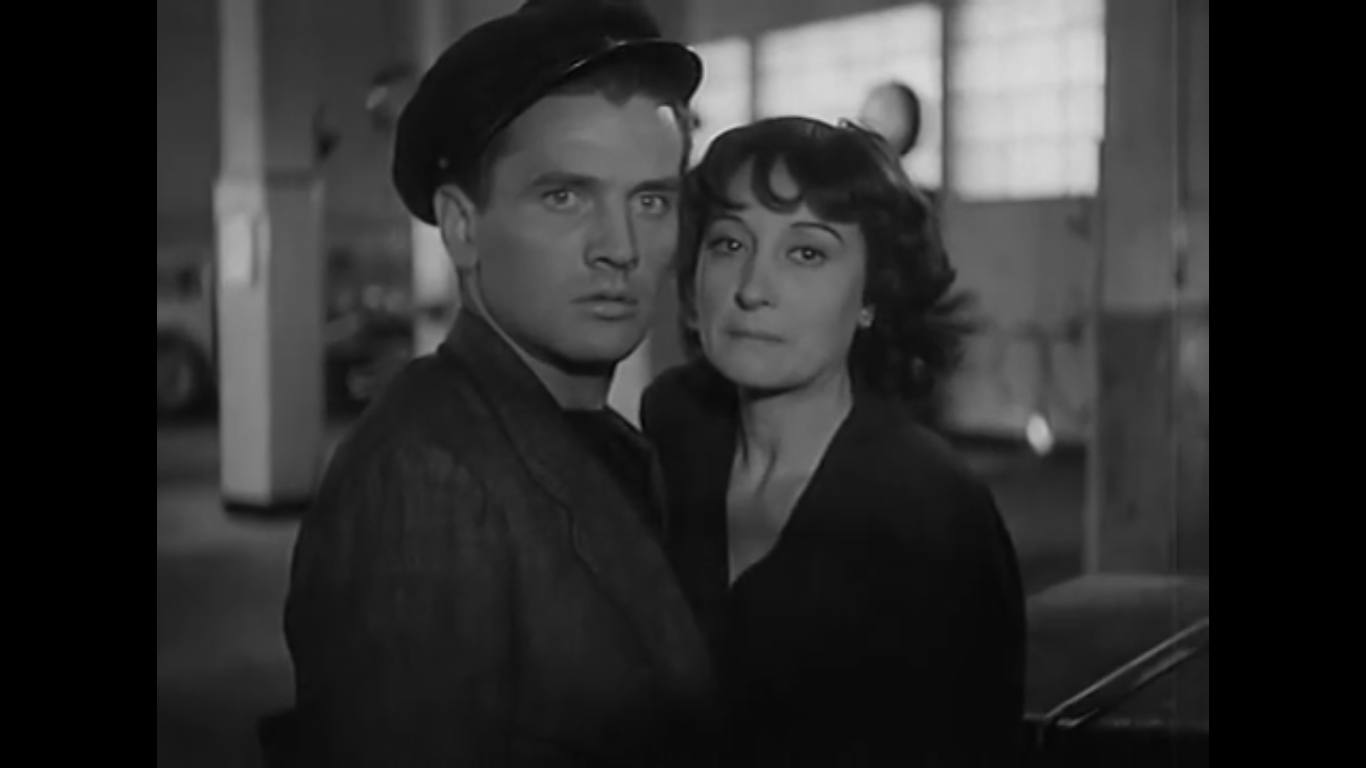
It’s easy to imagine Steve Randall (Steve Brodie) has the life of many men circa 1947. He’s a war vet, and he makes an honest wage as a truck driver. Brodie and the effervescent Audrey Long are stars befitting the budget of the film, but I rather like them for it. There’s nothing prepossessing about them, and we appreciate them for their sheer likability; they’re humble, honest folks.

From the first instance they’re in a room together, they also prove themselves to be an adorably in-love couple, between flowers, anniversary cakes, and news of a baby on the way. It certainly is an auspicious beginning, and yet it’s all so wholesome; it feels like an instant tip-off that this picture is going to hell very fast. It proves to be the case.

Because Steve gets a call to carry a special load of goods. He doesn’t think anything of it, and he could use the extra dough on his salary. Only too late does he realize his old friend is asking him to haul stolen merchandise. This wasn’t what he signed up for, but they don’t care.

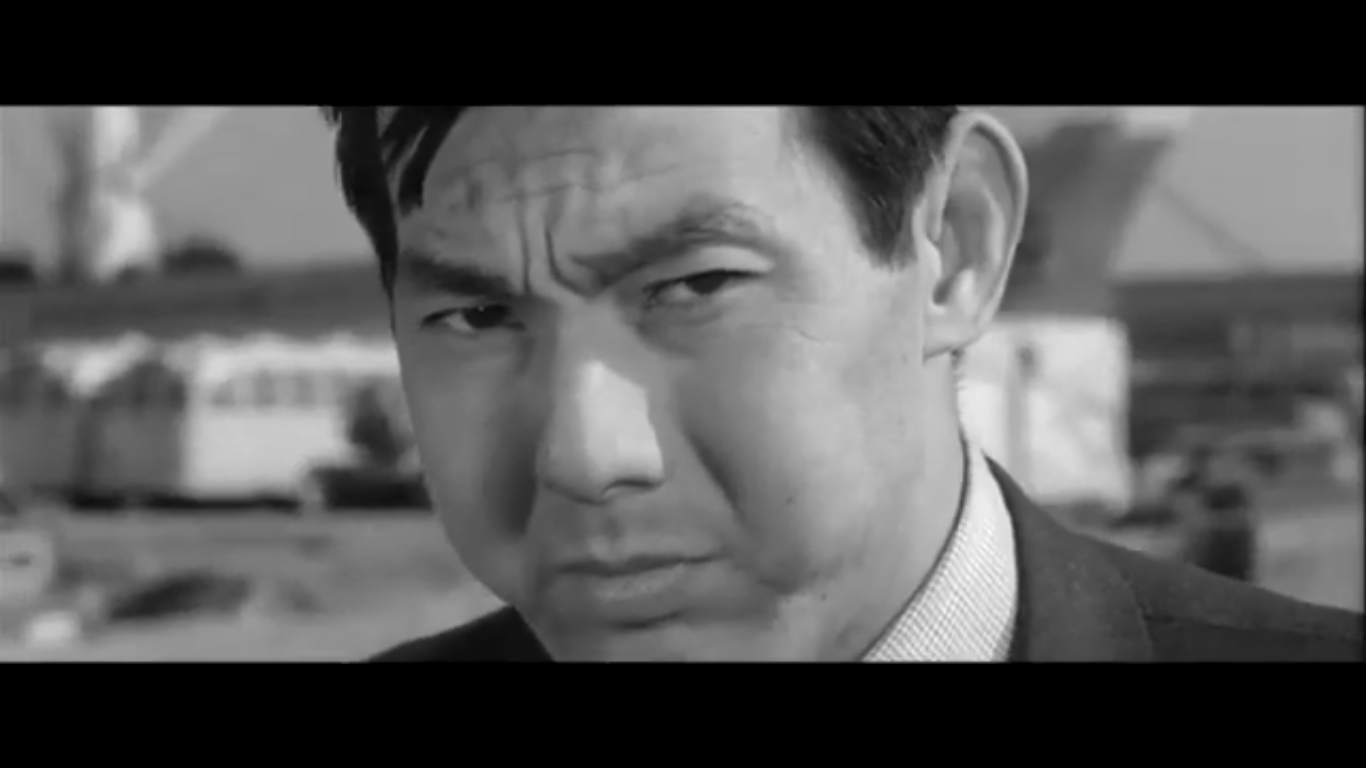
Raymond Burr fortuitously has a reputation for playing the pertinacious district attorney Perry Mason because without that there’s little doubt he would be forever immortalized as one of the most vicious baddies ever conceived in the age of noir. There’s something between his piercing eyes, the command of his voice, and his formidable frame that just leave an instant impression. He knows how to use them to his full advantage in the role of Walt Radak, a merciless criminal who also has a protective streak when it comes to his kid brother.

This is crucial because, in the botched burglary, it’s his brother who is taken by the authorities; the other thugs are frazzled but get away, and all of a sudden Steve is in a load of quicksand sinking fast.

Arguably, the creative apex of the film — or at least its fundamental allure — is suggested in a low-lit sequence in the gangster lair. Steve is cornered and Walt is ready to rough him up, literally knuckling the camera. Moments later, the man’s face is disfigured by a jagged bottle, and he’s pounded to a pulp under a swinging light fixture. We don’t see it explicitly, but the scene is so violently expressive; it’s all the more evocative thanks to this very specific stylization. It’s noir at its finest courtesy of Anthony Mann.

Although maimed, Steve does get away, and he whisks Anne out of town, disregarding her pleas for him to go to the police. He’s scared, worried for his wife’s safety, and he wants to vindicate himself before going to the authorities. What it means is that both Walt and a wry police detective named Ferrari (Jason Robards Sr.) are looking for him, and only time will tell what happens when one of them finds him.

They trade out the urban apartments, trains, and trucks for rural farm life, which becomes a kind of escape valve accentuated even visually. It’s the film’s moment of reprieve as they are immersed in Anne’s doting family who agree to throw her a true Czechoslovakian country wedding — what they never had time for before — and they dance the day away.

The ending is already inevitable. Walt’s slimy private dick (Douglas Fawley) is able to locate Steve, and the vindictive mobster comes ready to pay the fugitive a call. With his baby brother’s impending appointment with the electrical chair, he’s bent on having Steve knocked off at the exact same hour. He might not be able to save his brother, but he can get some semblance of revenge. It’s an eye for an eye mentality with noirish stakes.

When they’re finally thrown together in Steve’s apartment, Mann’s not messing around, and the film’s climax delivers both in its theatrics and as an extraordinary exercise in substantive style. Between the music, the smoke, and the nervous rat-tat-tatting creating the cadence of scenes, he goes into those fabulous claustrophobic close-ups of all his main players and the ticking clock smashed together as one. They create an excruciating effect because we know when the time runs out so does Steve’s life.

Mann milks the moment for everything it’s worth and his handling of time is so very effective. There’s not an ounce of realism in the scene. Maybe we have a dining room table, a kitchen, a fridge, but everything else is fabricated and manipulated to ratchet up the tension of the moment. The results speak for themselves.

The final shootout on the stairwell of the apartment building is yet another feat of ingenuity using everything at his disposal from the visual motif to the shadows, even frightened neighbors opening their doors momentarily only to slam them again.  It all culminates in the final crescendo and the ultimate release of anxiety.

It’s easy to see Anthony Mann coming into his own and what a stunning creative force he was. Desperate doesn’t garner too many laurels today, but it capably highlights what makes Mann such a popular journeyman filmmaker. There’s so much grit and tenacity stamped into the very fabric of his genre pieces, whether film noir or his later westerns with Jimmy Stewart. There’s nothing lifelike about them, and yet he magnifies the tension so much so that they function as such a blistering exploration of crime and vindictive human psychology.

3.5/5 Stars
Ossessione (1943): Luchino Visconti Does James M. Cain

You half expect cinema to have remained dormant in wartorn Europe during the 1940s. That’s part of what makes Ossessione such a fascinating curio within this context. In fact, the film almost never made it out of the decade alive. One can only imagine how unpopular the picture might have been with the reigning government.

It doesn’t exactly preach good old-fashioned fascist values and Mussolini looked to exterminate the picture completely. Legend has it that Visconti, who had also joined the communist party, managed to salvage a copy so that his film debut could live on and he got out of the war as well with a sprawling career still to be determined ahead of him.

I learned only very recently that Visconti started out as an assistant on the films of Jean Renoir of all people. Not only does that seem like the most propitious of apprenticeships, but it’s also easy to trace the lineage of the Italian from the Poetic Realism of the French Master that would eventually coalesce into Italian Neorealism.

The films of Renoir and Michel Carne are fully present in this early work with the opening images of a train evoking something like Le Bete Humaine or Toni. Gino Costa (Massimo Girotti ) is the kind of working-class hero you’d expect in one of those earlier pictures or even some of John Ford’s work.

He’s an itinerant bum who used to be a soldier and then a mechanic in a former life. Now he’s hitched a ride on a truck bed only to be dumped outside a roadside tavern. And Visconti proceeds to introduce his primary couple through the visual synecdoche of two pairs of legs.

Finally, we see their faces together. They’re in a kitchen. Although Anna Magnani was originally meant to have the role, Clara Calamai channels the sultry come-hither coquettishness quite well even when it’s impossible to unsee the platinum blonde of Lana Turner in the part. But they have their own instant spark, like flint — burning with a consuming passion tantamount to spontaneous combustion.

If you’re well aware of the story already, she is a young woman married to a chubby misogynist named Bragana (Juan da Landa), who thinks he’s more than deserving of the marital comforts afforded by such a wife. He calls on her to rub him down after a long day, and she can’t bear to touch him. She has designs for someone else.

While her husband goes off with the local priest to do some duck hunting, in an early example of a bike-and-talk, Giovanna is quick to stoke the flames of romance with her much more desirable confidante. Visconti’s unauthorized rendition is purportedly more faithful to its source material although it’s hardly as streamlined as MGM’s later adaptation, essentially leaving more space for narrative asides.

When Giovanna clings to the security of her current life, Gino sets off on his own alone soon falling in with a hospitable street salesman, “The Spaniard,” who entertains the crowds. In what can only be expressed as noir sentiment, the tides of the narrative bring the couple together quite by chance.

Bragana is pleased to see their old friend and Gino gets pulled back into the whirlpool taking in some opera at a local tavern. This more than anything betrays Visconti’s affections for the stage.

Consequently, it’s also a film where arguably the biggest moments play out off-screen. I’m thinking of the illicit couples’ first rendezvous and then the fatal accident altering the course of the entire picture. Not all of this is due to content concerns either, but it does highlight how Visconti and his scripting compatriots, Mario Alicata, Giuseppe De Santis, and Gianni Puccini, conceived the story.

It offers another kind of dissonance because we don’t get to see what actually happened even if we’re well aware of their mutual intentions. We must wait for events to play out to see how the canker and unrest reveal themselves in due time. The most explicit response comes when Gino peels off  some bandages and then a violent struggle over a trinket ends in a passionate kiss. This might be the movie summed up in visual terms.

They must reckon with an unsettling state of limbo: freedom that feels more like purgatory as they stew in their infidelities. A man of the cloth suggests that they part ways because people do talk about their situation, real or imagined, and of course, it is very real.

Instead of detonating the story to be a full-blown melodrama like The Postman Always Rings Twice, Ossessione maintains these high levels of human intimacies. Gino reunites with his old pal again beyond delighted to see a familiar face, and yet it ends in fisticuffs because his fellow traveler is able to put words to everything he’s currently tormented by.

Then there’s a demure “ballerina.” Gino meets her knitting on a park bench, and they share an ice cream. I had to acclimate myself, thinking only momentarily that she was Giovana, but the emotions in the scene are enough to give this away. Because being around her Gino feels different; it’s as if, ironically, her purity is able to cover all his sins or at the very least help him forget them.

But the digressions only aid in leading him back to Giovana. If they aren’t totally a destructive pair, frolicking on the beach together, having rekindled their chemistry, then there’s some kind of fatalism that needs to be satiated.

In passing, Ossessione might earn the labels of Italian neorealism for its striking, ever austere imagery emblematic of the post-war working class. But it’s also often designated as film-noir for its sordid details and futile finale. However, I can’t stop but marvel at how Visconti was able to make the picture to begin with. Even after its initial release, it was hit with so many roadblocks of censorship and copyright problems only to gain a second life.

What an auspicious way to start a career, especially under such tumultuous circumstances. Much of the finest pieces of art are born out of the burnishing fires of the furnace and, for that matter, a certain level of creative obsession.

4/5 Stars

A Colt is My Passport (1967)

Nikkatsu studio’s reputation for these kinds of down and dirty pieces of noir pulp employed action and gangster plots to entice the youth market. Obviously, the influence of the American canon cannot be disregarded, and yet the films came into their own given Japan’s own turbulent history with syndicated crime.

However, A Colt is My Passport does something more with the genre archetypes. It starts with this mythical weapon, not traditionally of mobsters and hitmen, but western heroes and villains dueling out on the range. Wherever the firearm might have progressed, it always carries this mythos about it.

As such, the movie is introduced with a whistling, stringed, and partially staccato score that might as well be plucked out of a  spaghetti western. Further strengthening the ties is Quick Draw Joe, a movie Joe Shishido starred in that was also directed by Takashi Nomura. Now half a dozen years they meet again to build on their collaboration.

The initial beats are familiar if you’ve seen any of these types of pictures. There’s a target to knock off. His name’s Shimazu, and when he’s not constantly being shadowed by a bodyguard, he’s stashed away behind bulletproof glass. It’s a tough job with only one day to see it out.

In this world of guns and souped-up automobiles, Shishido, the chipmunked-cheeked cult hero of cool, somehow feels right at home. It’s all part of his work as he studies his target, sets himself up with a hotel room, and then prepares to get in and get out with surgical precision behind his sniper rifle.

If there’s a methodology here it suggests how Colt is a film built out of a regimen and the setting of its protagonist in an architectural world. He is always completely cognizant of his location and how he functions in relation to the spaces around him. Thus, it becomes as much about mood and milieu as it is focused on action and violence.

Take for instance, how the story is constantly switching contexts. It’s in a car, about getting to a plane at the airport, holding up in a hotel, then fetching a barge out of the country, and when that fails, commandeering a big rig to retaliate against the enemy.

Of course, there must be a love interest. In the subplot, Mina, a young woman who works at the Nagisakan hotel, offers them asylum from their pursuers. What draws her to them? She says the god of death follows in her wake. Her former beau must have been like them, and as she spends her days serving the riffraff and sewer rats always loitering around, she looks to take back her life in some way. This is her form of rebellion in a world generally dominated by men.

However, even with the proliferation of gangster imagery and this kind of masculine bravado, the contours are the film consistently emulate the West with its own recurring motifs. There’s a musical aside of guitar not unlike Ricky Nelson or Dean Martin might knockback in Rio Bravo (Your star is a lonely little star…but now your face is a ghost town in the mist”).

It’s a way to bide the time before inevitable showdowns while also distilling this sense of male camaraderie in such a way as to make it palpable. It evokes the loyalty forged between two men, one mentor and his pupil, who have been through so much together. He shields his partner by giving himself up.

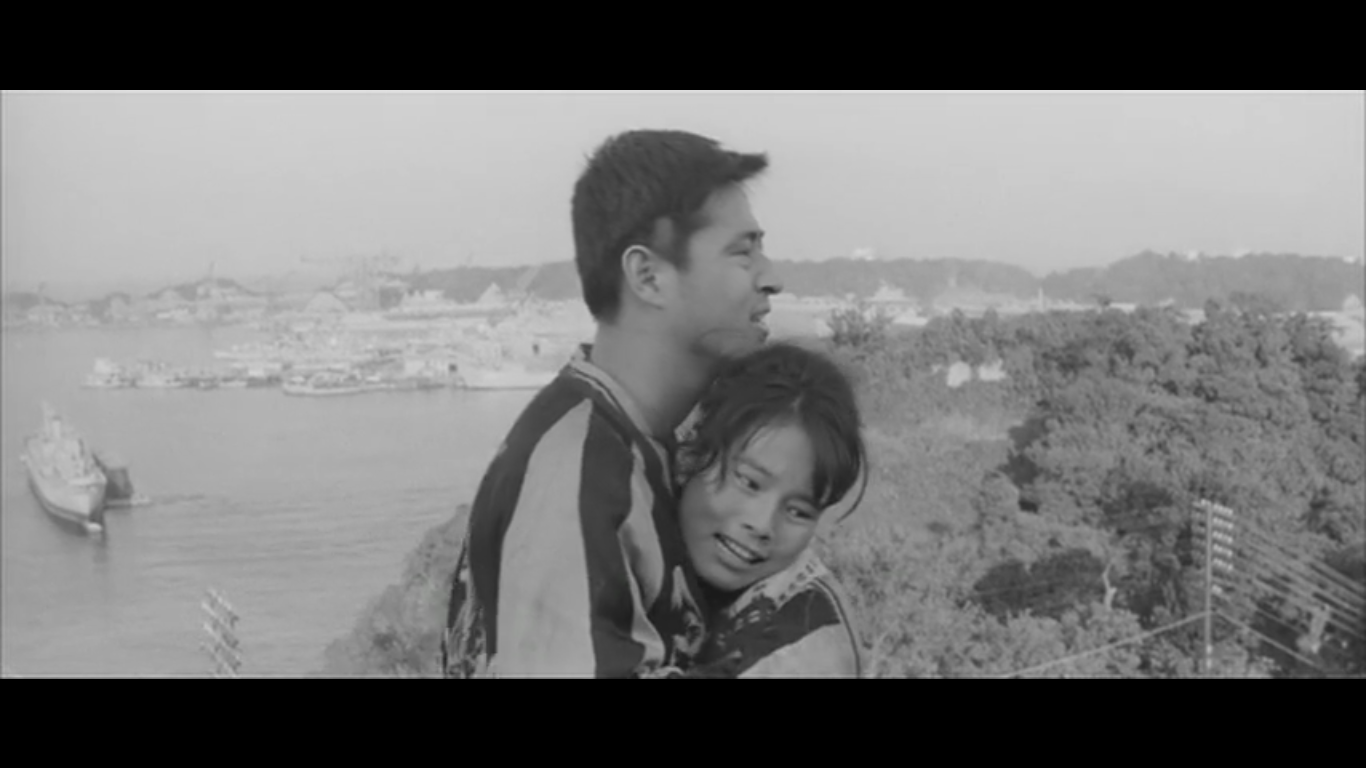
He knows where he must go. Where else would we end up but a deserted, windswept landfill where we half expect to see a tumbleweed roll by? Instantly the urban world and streets, even the maritime port of Yokohama, all but evaporate and fade into the periphery. The entire film culminates in one definitive moment where the sides are drawn up all but prepared to have it out in an instant. While the final showdown is fairly spare, it still manages to blow the lid off the picture with its gritty cross-pollination of the noir, western, and yakuza inspirations.

It’s hardly drawn out — finished in what feels like a few suspended moments of chaos — and yet it might be one of the most monumental standoffs you’ve ever seen. As Shishido digs a hole (what might as well be his grave), then sets a charge of dynamite, which might as well be a self-destruct mechanization, and then finally fights for his life, we are inundated by the full brunt of the impact.

There’s hardly any mistaking who came out victorious, but then again it might be just as difficult to claim a hero as a man totters away from the wreckage.  I’m not altogether familiar with the etymology of “borderless action” cinema as marketed by Nikkatsu, but here it feels like one meaning is about this unabashed melding of genre and inspirations.

Shishido channels hitman, gunslinger, and jaded antihero all rolled into one. He’s got a dash of Eastwood, maybe a bit of a Melville assassin, but also a distinctly Japanese sensibility. It creates this pleasing amalgamation that finds something rather gripping in its myriad of influences. There’s an indiscriminate and still somehow an artful freedom to it drawing me in all the more. 

4/5 Stars

Pigs and Battleships (1961)

If you want to make some sense of the rise of Shohei Imamura, it’s convenient enough to fit him into the context of two of Japan’s foremost filmmakers. During his time as a university student at the prestigious Waseda University, he saw a screening of Akira Kurosawa’s Rashomon, which not only became a catalyst for Japanese film worldwide but also for young men like Imamura.

However, upon arriving in the film industry he found himself working with another acclaimed master, Yasujiro Ozu. The only problem is that Imamura’s own sentiments played in stark contrast to his elder’s fairly sedate albeit meticulous style. Imamura wanted to get into the issues and the conflicts of the times. He feels like both a  nonconformist with a bit of a rebellion in his blood and someone with an acute appreciation for humanity.

Here he positions himself as a Japanese New Wave iconoclast having some fun at the expense of his countrymen and their most prominent post-war ally: the United States. In his own words, he was an anthropologist using his films to analyze humanity in all its foibles and messier predilections.

This might be as good a place as any to provide a jumping-off point for Pigs and Battleships. It plays as the antithesis of his elder Ozu by readily showing Japan at its most pathetic with a host of men who might well be a circus of dim-witted ignoramuses in a comedy of errors.

In the opening frames, you get an instant impression of the backstreets and alleyways frequented by American sailors, bums, and pretty girls with their come-hither looks. Vagrants of all sizes can be found scampering around town messing with sailors — swiping their hats — and generally causing mischief. Some of this is organized.

This is the unruly underbelly of Japan as represented by the seaport of Yokosuka and those with a certain perception of civilized Japanese society, would do well to avert their eyes. Imamura has no intent to present some idealized or cloying sense of his homeland

Kinta is one of the ilk of street trash gaining our attention for whatever reason. He’s a lowly gangster yet to earn his stripes.  Hiroyuki Nagato plays him in such a way that his movements come off as those of a callow, entirely overgrown child. While he tries to make a name for himself among the local gangsters, he has an on-and-off fling with a local girl named Haruko.

She’s not a glamour queen, but there’s something good and decent about the naivete found in her eyes. However innocent she might be, she still chides Kinta to get out of the racket and take up a steady factory job out of town.

Whether he meant to or not, you begin to see how the Japanese New Wave was carried on the shoulders of filmmakers such as Imamura. He accentuates a certain world through a particular methodology.

Where hoodlums feel more like snickering hyenas in baggy clothing ready to pound the populous for a good laugh. These aren’t criminals given any amount of deference or import. It feels like we should scorn them even in their hijinks trying to make some money off a drove of pigs.

However, the movie is not without a shock factor. You know when a man’s head is dunked in a tank of gasoline and a thug waves a lighter in front of him ominously, he’s making the threat count. It’s easy to see the director pushing back against any post-war American tokenism. Because Kinta is found right in the crosshairs.

Where being American is king and if you can’t be white Anglo-Saxon — victors of WWII and wooer of Japanese women — at least with the gangs you get to do something cool with your life. You belong to something bigger than yourself. Anything honest and menial is frowned upon. There’s a self-contained scene when a little boy reads out loud how refined and highly cultivated Japan has been able to fluidly integrate aspects of other nations, the irony is not lost.

You only must watch what happens before and after to have a good laugh. The hiccups keep on coming. The mobsters have their hands full disposing of a body, and it feels like a bout derivative from The Trouble With Harry than any hardened crime drama. Try not to giggle with morbid glee when they find a false tooth inside the pig they’re chowing down on!

Even, the yakuza boss, that symbol of towering and lethal villainy is a sorry figure. He’s dying of cancer — looking pitiful when his little brother comes to visit him — the gang gathered around his bedside. He thinks he only has days to live and there are so many affairs to get in order. Namely, all the debts he still needs to collect!

We also meet the man known only as Sakiyama at a bar talking with a Chinese fellow. They’re involved in this pork deal between the Americans and the locals. Although the “Japanese-American” man speaks English, it’s easy enough to tell in a moment it’s not his native tongue. This actor is Japanese and so the illusion is broken, but given the carnivalesque bits of business we’ve already been privy to, it’s not completely out of place.

Because things just keep on falling apart in this ever-changing state of fateful narrative entropy. For most of the film, Imamura remains an observer, but in one specifically pointed setup, he inserts himself into the action. It happens in the aftermath of a row between Kinta and Haruko. They’re probably not getting back together, and she vows to get drunk and party with American seamen as an act of spite.

Instead, she ends up in an empty hotel room with three brawny men prepared to overpower her in their stupor. The overhead shot of Haruka and the three boisterous sailors might be the pinnacle of the film’s hysteria in this intersection of worlds and toxic schemes of life. It breaks the moment down to its most pointed elements as we spin toward oblivion and a horrible outcome that cannot be undone.

Going with its prevailing tone, Pigs and Battleships owns a final act built on total futility. However, there’s something about seeing pigs roaming in the streets that made this feel like Pamplona for porkers. It’s a hilarious image even as the film comes to terms with its own human tragedies. Ozu would never make this movie; not even Kurosawa with his more dynamic proclivities. No, this is something new.

Most important is the implicit message found in the title and much of the comedy. In the post-war landscape, Japan was very much subjugated to America, and they too became conduits of Capitalism.  However, in case it’s not already apparent, our way of life and systems come with their share of flaws. Pigs and Battleships begins to suss out the complexities of this relationship. We’d do well to consider it.

3.5/5 Stars

Tiger Bay (1959)

Horst Bucholtz has always held a soft spot in my heart. There are several very simple reasons. My father’s favorite movie might be The Magnificent Seven, and I grew up watching this young raffish upstart join forces with Yul Brynner and Steve McQueen against the forces that be. Then, years later, there he was again as an old man in La Vita è Bella. Somehow it served the movie and my own history with him well, to see him this way. A mere 5 years later he would be gone.

Of course, Tiger Bay, if you’ve never been acquainted with it before, is the picture that really put him on the map, at least for English-speaking audiences. And it’s easy to see why. He was advertised once upon a time as Germany’s James Dean, and if the comparison makes a modicum of sense at all it has to do with how masculinity can be at one time violent and then sensitive. There would be no other way for him to hold the movie together with Hayley Mills so well. More on that in a moment.

I must take a moment to acknowledge my growing esteem for J. Lee Thompson in recent days because although I am a fan of Cape Fear and not so big an admirer of The Guns of Navarone, it was earlier in his career where he showed his capability with material like Yield to the Night and here in Tiger Bay. The world is easy to place, especially in England with a working-class port town acting as a window to the world. One of the men fresh off one of these ships is the youthful sailor Bronislav Korchinsky, who looks to be reunited with his lover.

Hayley Mills makes her screen debut moments later as a feisty tomboyish pipsqueak ready to roughhouse with all the other street rats. She gleams with a delightful impudence, those large searching eyes of her projecting curiosity and at times rebellion. Her aunt is always scolding her and she always scampers around bumping into neighbors on the stairs or eavesdropping on conversations she has no business in.

One of them is between Korchinsky and his girlfriend Anya. But the scene before us is hardly bliss. It comes seething with angst and vindictive daggers you feel like would hardly have been in vogue across the pond at the same time — at least in mainstream Hollywood. As the woman scoffs at the money he sent home and lets him have it in their native tongue, it becomes apparent this kind of gritty vitriol might only seep into an American noir picture.

In fact, if there is any immediate reference point, it’s possible to find Tiger Bay reminiscent of The Window. However, in this case, Gillie Evans (Mills) is not so much a “kid who’s cried wolf” as a serial annoyance no rational-minded adult looks to take seriously. Still, she’s an eyewitness to what looks to be a shooting. A woman’s dead and the man is on the lam. What’s more, in the moment of initial tumult they crossed paths as he streaked away, and she nicked the evidence to bring back to her aunt’s apartment. For her, this entire scene feels like a novel curiosity, but she thinks little of the consequences in the moment.

Instead, she dodges the inspector’s gentle interrogations (John Mills) before rushing off to drop into church service late, taking up her spot in the choir while still packing the purloined pistol.

It’s fitting that in one moment they seem to be singing a hymn out of Psalm 23 and suddenly the spiritual journey through the valley of the shadow of death becomes all too real. There stands a familiar face in the crowded pews and suddenly her self-assured nonchalance drops off in the middle of her solo. There’s the man!

It feels like a showdown set up for Hitchcockian dread as the church clears out and she’s left to fend for her own against the crazed young man. This can only end poorly. And yet Tiger Bay works because the villain in this equation is not a horrible human being. There are moments he could press his advantage, whether it’s pushing her to her death or doing away with her with the gun, but this is not his character.

In fact, in its best and brightest moments, Buckholtz and young Mills become the welcomed nucleus of the movie, at first as wary adversaries and then companions and finally friends capable of playacting in the morning light. For a few moments, they are able to shed all the worries of the world and enjoy being in one another’s company.

In the latter half, it takes on a different tilt altogether as a little girl, now beholden to her new friend, looks to buy him time as he looks to sneak off on a ship out to sea. We have ticking clocks and stakes, all those storytelling tricks of the trade, but the core of the entire story is the relational capital that we build. It becomes a new, far more compelling kind of movie. Because now a child must live in the ambiguity of the moment and how are they to decipher the difference between right and wrong and what those terms even mean?

The ending feels a bit prolonged and drawn out for its own good though it’s kept afloat by this underlying relational tension. A man’s life hangs in the balance as Mills drags his real-life daughter out to sea to identify the purported killer before he can get away for good.

John Mills feels generally flat and uninteresting if a mostly benevolent authority representing a prevailing moralism. Otherwise, this picture has much to offer and a colorful perspective on the world circa 1959.

Suddenly, British society, cinematography notwithstanding, doesn’t look quite so monochrome. Because of course, it wasn’t. It’s a world of Polish immigrants, vibrant Calypso music on the street corners, and foreign sailors who are not totally subservient to the British powers. It’s a reminder that ports really can be windows to the world even as they can also bring disparate people together.

3.5/5 Stars

The Bowery (1933) and Jumping Off Brooklyn Bridge

There is an immediate sense The Bowery was meant to capitalize on Wallace Beery and Jackie Cooper’s success in The Champ from the year prior, as well as the rising stock of George Raft after Scarface. In short, the creative paring works quite well because although Beery was the highest-paid talent at MGM, Raft proves himself to be a chipper and able sparring partner for his formidable colleague. 

The world being projected and explored is the relatively distant past of the Gay Nineties, and yet still recent enough to remain as a living memory for some contemporary audiences. The movie is capped off by a prologue touting the Bowery as “The Livest mile of the face of the globe,” and here we have our entry point into the turn-of-the-century milieu. 

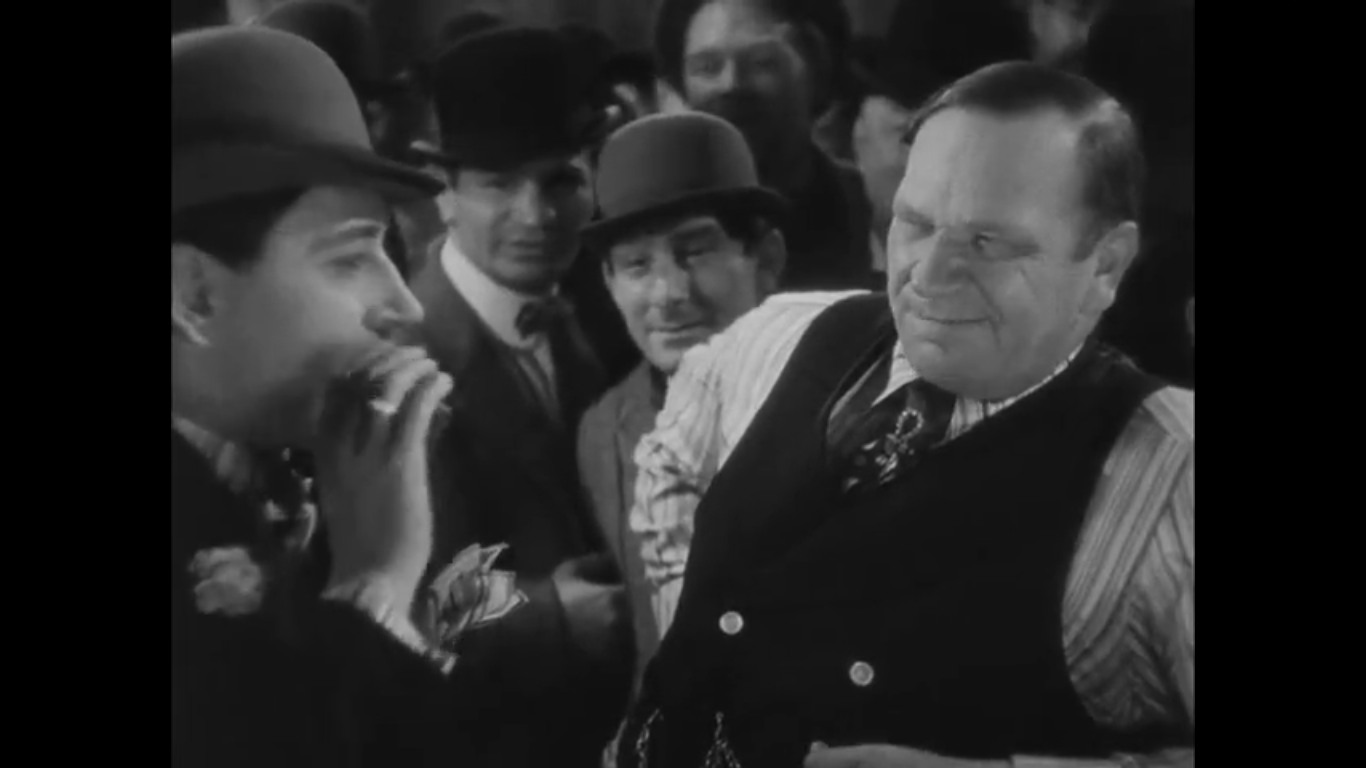
Before The Rifleman, there was another Chuck Connors (Beery), who is a larger-than-life figure on the bowery with his bowler hat and brawny shoulders. He runs the local saloon, an expectantly raucous and bawdy place, it also carries with it a rather off-putting name. Strike one.

Of course, none of these folks care and why should they? They’re too busy knocking back a pint and ogling the floor show. And Connors is right in the middle of the daily bedlam. One of Beery’s favorite drinks is “boy-bin” in the local parlance. He’s also not above clubbing a woman who gets too touchy-feely with him. 

However, for all his boisterous show of bravado, he does have a soft spot. One of the most important people in his life is Swipes (Cooper) a young vagabond he adopted off the streets whose hobbies include throwing rocks at the Chinks. Strike two. Does it need to be said that, although these elements are period, they definitely don’t play now? Well, there you are. 

Despite, these immediate if realistic racial insensitivities, there is some instantly immersive world-building director Raoul Walsh synthesizes through a host of vignettes on the streets. It might only be a figment of my own mind, but there’s a reason Bowery sounds like Bowels because we’ve found ourselves in one of the lowliest, basest melting pots of the world.  

But there would be no movie without our two stars. If Beery opens the film and establishes himself, then George Raft comes right on his heels making an entrance of his own as Steve Brodie (Don’t ever say I don’t give you nothin’!). What they provide the movie is the simultaneous presence of two colossal movers and shakers in the local community. 

Beyond being snappy dressers, they are men of many hobbies and even bigger boasts. They’re both pugilistic promoters in the ring, and they run rival fire brigades on the side, which consequently are more like street gangs than civil servant assemblies. It’s all the better to whip up some brassy entertainment. 

The street brawl in the wake of a conflagration is extraordinarily choreographed as pure fist and brick-throwing chaos. While I’m not altogether enamored with the world, the ongoing sense of atmosphere is impressive in such moments of machismo.

What’s more, they become tempered and subsequently more complicated by the introduction of another character. Because the mantle of the movie is built off the trifecta of males, and they remain the focal point. However, then one Lucy Calhoun (Fay Wray) arrives on the scene. She’s a woman from Albany — a virtuous schoolteacher — who Chuck rescues from the depths of destitution. She’s eternally grateful and offers to clean house for him. The most telling outcome is the big man’s chivalry. 

It is a bit of a clash of cultures — she is not of this world — and it’s in part because of her vulnerability; he protects her from the wolves on the prowl. But if Lucy brings out another side of Chuck, the same might be said of Steve Brodie. He comes off as a brute in their opening encounter, everything we expect him to be, but then he warms and softens. And she does too.

She’s still devoted to Chuck (though Swipes can’t stand her much), but her romance with Steve starts to bloom. They have excursions out to the beach at Coney Island — romantic moments like that. The only question remaining is where will the movie go? 

For those familiar with the real-life Steve Brodie, it must escalate into a bet and a dare to jump off the Brooklyn Bridge, which he looks to weasel his way out of. Although, in the end, he’s forced to prove his mettle with the whole town gaping and the authorities on high alert. 

Walsh expertly understands the cadence of the scene with Brodie flying across the bridge in his carriage — the policeman sprinting after him in pursuit. Meanwhile, the director cuts across the panoply of humanity — the faces we know like Wray and Cooper — and the host of onlookers who fill out the world. It’s the strangest kind of social event, and yet how it’s delivered to us builds up the mounting tension of the moment.

Ultimately, Chuck loses at the hands of Brodie (and Carrie Nation!). His bar is flipped in the process. With his pride and joy taken away from him, and his gambling debts weighing him down, he winds up living a life of poverty as Brodie ascends and becomes the new grand man about town. The balance of power — their aggressive stalemate — has finally shifted, and there is a forlornness about it. What made them such formidable rivals before had to do with them both being on equal footing. It looks like one has finally won out. 

Being a proud man, Chuck isn’t quite over his vendetta, and knowing Brodie’s own wellspring of pride, they agree to a river barge face-off, man to man, just like the old days. But the most curious development is this. It’s summed up with only a few words: “Remember the Maine.” Suddenly patriotic fervor is afoot. There is a new enemy. Suddenly, the two sworn enemies make their amends.

Fay Wray is a mediator, and they agree to have themselves a lark in Cuba because with two palookas like them, the war’s bound to be over in a fortnight. So the Bowery’s greatest source of conflict simultaneously becomes its new hub of comedy and comradery as the rivalry evolves, and we get to see it turn. It’s yet another entry in the Walsh canon fully in tune with its own idea of fun. There’s never a sense this picture takes itself too seriously. 

I am not sure if the director had a certain preoccupation with the Gay Nineties from his youth or what have you — his filmography is very robust and equally diverse — but the Bowery certainly would pair nicely with the likes of Strawberry Blonde and Gentleman Jim in how they so readily evoke the era. Nothing speaks to that more than John L. Sullivan and a bit of temperance imposed by Carrie Nation.

4/5 Stars

Blonde Crazy (1931) with Joan Blondell and James Cagney

blonde crazy

From the outset, Blonde Crazy promises to be a midwestern hotel chamber piece. It’s a story of the help: including opportunistic bellboys (James Cagney) and plucky chambermaids (Joan Blondell). He does her a service by nabbing her a job, and in such a world, he probably expects some recompense.

James Cagney is still kicking around and feeling out his persona; Joan Blondell’s on the way up with him. It’s mind-boggling that in the year 1931 alone both of them put in time in over half a dozen pictures each for Warner Bros. They were both building up a body of work quite quickly.

In a movie like this, the people I’m often preoccupied with are the Charles Lanes and Guy Kibbees — the host of able character actors who always show up in a movie like this. Blonde Crazy has quite the assortment. It’s stuffed with the kind of familiar faces, making a small trifle like this worthwhile, playing desk clerks and delinquent jewels salesmen, among other things. You know the types.

If the story remained in the hotel, it would be severely handcuffed because its stars are meant to be out in the world! Thankfully, the movie breaks out of the constraining formula and finds itself allowing Cagney to shine because there was no one who could do charisma like him. However, Blondell’s never one to be discounted, keeping with him tit for tat.

She exhibits plucky defiance ranking up there with any of the top female performers of the 1930s, coping with the social systems while still holding her own in a man’s world teeming with come-ons and everyday misogyny.

Does it matter what it has in the way of plot? Hardly. Instead, Bert (Cagney) and Anne (Blondell) leave the hotel, becoming business associates or better yet, accomplices drumming up clever (and slightly dubious ways) to make a quick buck.

Blondell is never taken in. She sees right through Burt and still stays with him. He has flashes of decency but driven as he is by money and other superficial qualities, he’s a tough guy to try and wrangle in. Still, their prevailing attribute is their loyalty to one another. Cagney likens himself to a modern Robin Hood. He does have that kind of rapacious charm (and this is before the world knew Errol Flynn).

In time, they’ve had an upgrade frequenting the lavish hotel circuit as partners, though their romantic status remains a bit hazy. Bert inserts himself into a fistfight on the dance floor. It seems like the perfect point of intersection for Cagney. He comes to the aid of Louis Calhern a man he’s been eyeing for some time namely, because of his scintillating female company (Noel Francis). She’s been giving him the look. Anne knows it too. She wasn’t born yesterday.

Unfortunately, Bert gets punked. He’s been made a sucker. In the movie world, you don’t make a sucker of Jimmy Cagney and get away with it. With his pride hurt by the big boys, he looks to regain his stripes by pulling a double-sided con of his own, just to break even. He doesn’t bother to tell Anne. It’s preliminary work for greater coming attractions. If you want to try and get a line on Cagney’s character, he’s not quite his usual gangster type; he’s a smaller operator, but still stretching the boundaries of the law. In his own words, he’s “not tough just mercenary.”

For all the names crammed in the picture, I almost forgot to mention Ray Milland. I hardly knew he was in pictures this early in time, and he looks like a babyface, albeit a handsome one. He’s relegated to the secondary role. He’s Anne’s dreamboat. The complete antithesis of Cagney. He has class. So they get married. But he’s fallen into a bit of misfortune. The only man who can probably pull him out is good ol’ Bert.

All these bits and pieces feel conventional. There’s the immediate romantic tension and the story zips along. Milland is nothing aside from the other man. But if you miss out on Cagney and Blondell’s rapport, then you’ve failed to appreciate the merit of the picture. They make it shine.

While it’s not cutting-edge entertainment, Blonde Crazy does simultaneously straddle the lines of genre. It’s not totally gangster — there’s romance and melodramatic flourishes — and there’s a lightness of comedy. This is what lingers.

Because, in the end, Bert’s sent up for a prison sentence and Anne dutifully shows up professing her undying love. They were meant to be together. What I will remember is how Cagney says “Hone-eee,” and how Cagney, donning his most elocutionary voice, spouts off a bit of Elizabeth Barrett Browning. And it’s a violent picture: full of socks, slaps, and spanks, all in a comical vein and totally indiscriminate. Everyone gets in on it. It helps in illustrating the underlying fact that this is not just Cagney’s movie. Blondell more than holds her own, and they make it better together. What’s more, this was just the beginning.

3.5/5 Stars

The Wrong Man (1956): Henry Fonda The Most Sympathetic of Victims

Screenshot 2020-08-03 at 7.40.08 PM

I never grew up watching reruns of Alfred Hitchcock Presents, but there’s kind of a ubiquitous aura about them. The man himself — the entirety of his portly physique — comes out of the shadows into a family’s living room to narrate some ghastly or unseemly crime with a droll sense of humor. The show ran from 1955 to 1965 becoming a wildly popular cultural touchstone, and it’s easy to see how The Wrong Man (1956) might have fit into this lineage.

Hitchcock was normally a walking cameo, providing a wink-wink to the audience as he pulled the strings from behind the camera. Here he is also a spokesperson assuring his audience every word of the following story is true though it plays stranger than fiction.

What becomes immediately apparent is the New York milieu. It’s unadorned and if it’s themes and star bring to mind Sidney Lumet’s 12 Angry Men with Henry Fonda, then the world itself has the kind of simple humanity of Paddy Chayefsky. And this is a Hitchcock movie, mind you, but the cinematography by Robert Burks is gorgeous in its stark black & white tones. It helps to maintain this suggested sense of concrete realism.

We open on the bustling Stork Club — it’s a real place — and there “Manny” Balestero (Fonda) plays bass as part of the house band. He’s not rich by any means, but he makes an honest wage going home to his wife (Vera Miles) after the dancing is done. Their life together is humble but full of love and decency. They raise two rambunctious boys, and he promises to give them music lessons.

His life is preoccupied with the kind of familial responsibilities we all understand. His wife has some dental work that needs to be done — it’s expensive so he needs to check on their insurance policy — and he plans to check in on his mother. It’s rather unextraordinary. But this is what makes it unusual.

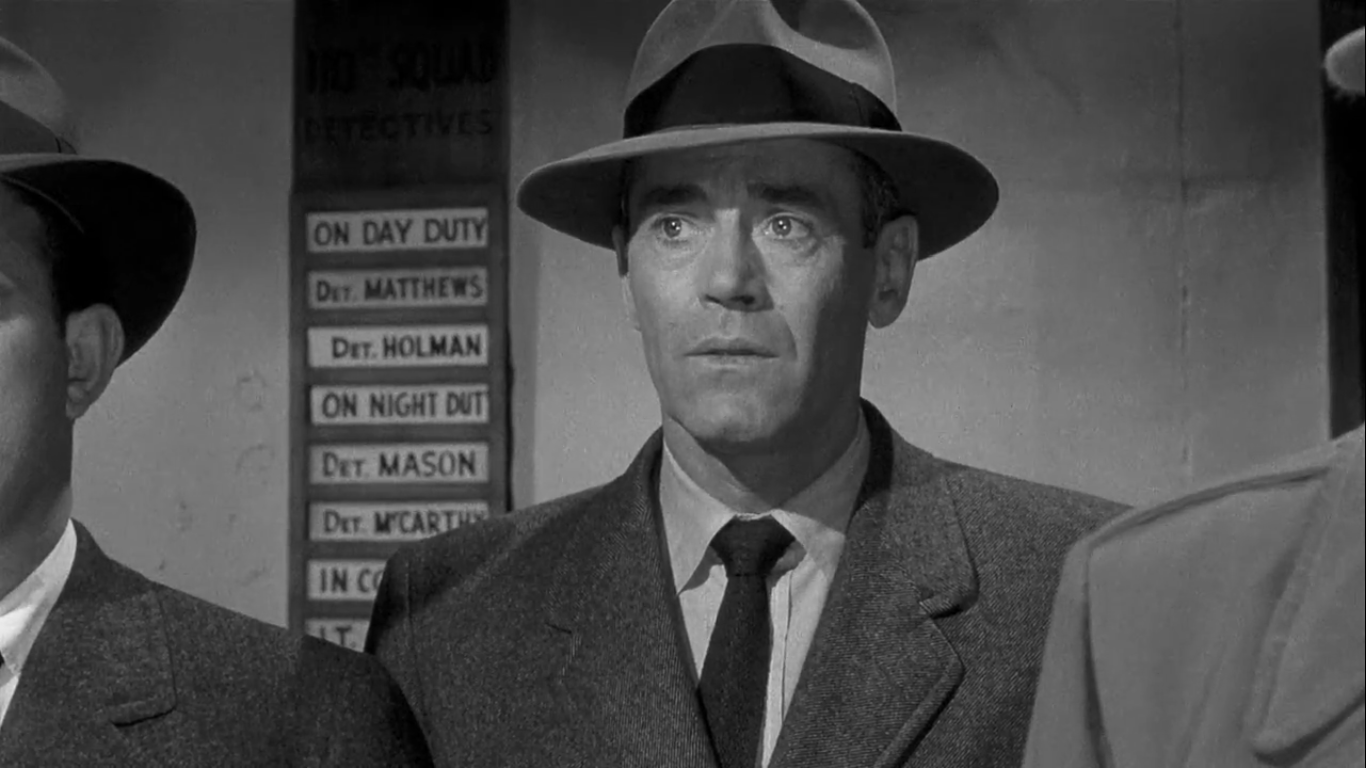
While Manny only looks to check on his wife’s insurance policy, Hitchcock frames it like a bank robbery. Except the gun coming out of his pocket is the paper policy. The teller walks away, her face racked with concern as she consorts with her superior. A holdup hasn’t been committed, and yet it sure feels like it. In a stunning shot, the superior peers past her shoulder and catches sight of Manny perfectly oblivious. It’s the beginning of trouble.

Soon Manny is I.D.’d. He’s not trying to hide anything. Some policemen (including Harold J. Stone) show up on his doorstep to take him in for questioning. They assuage any concerns he might have: “It’s nothing for an innocent man to worry about. It’s the fella who’s done something wrong who has something to worry about.” And so he goes along with their line of interrogation because he naively believes in the veracity of justice.

What becomes more apparent is the fallibility of eyewitness testimony and the coincidence found in circumstantial evidence. I am reminded of the work done by the likes of Elizabeth Loftus and of confirmation bias. Of how misleading information often molds responses. Two ladies pick Manny out of a lineup which doesn’t bode well. Then, whether or not it’s uncanny, his handwriting also looks close enough to an incriminating stick-up note.

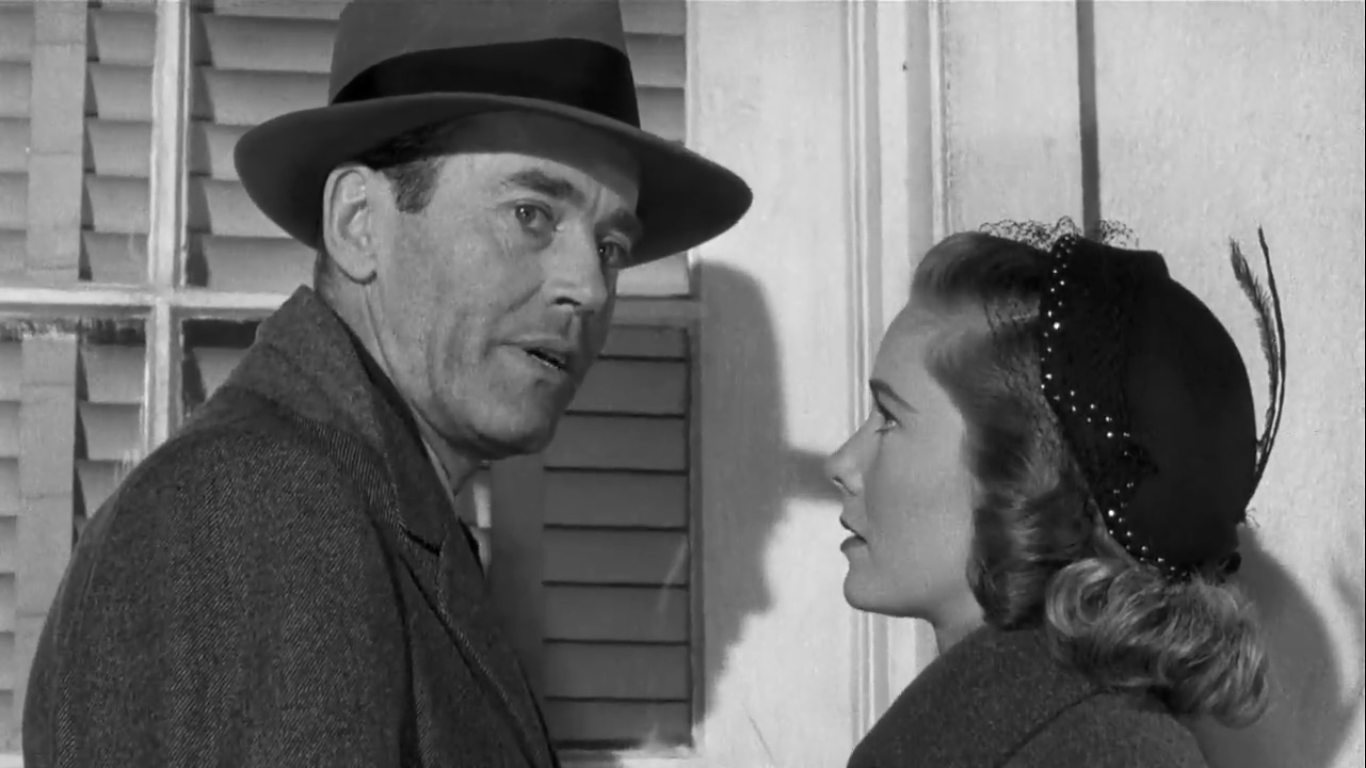
However, more so than any of the implications on law and the criminal justice system, The Wrong Man is such a powerful exemplification of Hitchcock’s directorial talents. It’s devilishly simple on the exterior, and yet he does so much to make us totally cognizant of Fonda’s condition. It goes beyond mere osmosis. Thanks to Hitchcock, we live Fonda’s point of view.

When he’s first approached, then, again, when he finds himself actually booked and imprisoned, Hitchcock does something deceptively simple — taking on Fonda’s eyes. He looks around the confines of the space — to the sink in the corner, up at the ceiling, and we are there with him. We forget about a camera — that there is visual trickery going on — and we fall into Manny’s predicament sitting right there by his side.

We recognize the shame of being imprisoned — to be robbed of your dignity even if you manage to be exonerated. He’s taken through all the paces of justice in all its drab mundanity. It takes all the sheen out of law and order; this isn’t Elliot Ness or Perry Mason. This is common, everyday people grinding through their daily lives.

Manny watches as they do their jobs around him with a kind of detached efficiency. He has no idea what he’s caught up in nor does he think about trying to speak up on his behalf. The machine is moving too fast, and he’s already reticent. Could it be it’s hopeless? Instead, as he’s handcuffed, he watches the footfalls of his fellow prisoners being led to the van. What’s he supposed to do? Worst of all, he isn’t able to notify his wife, and he always calls her if he’s out late. He’s that kind of man.

the wrong man

The resulting storyline involves a valiant lawyer (Anthony Quayle), who agrees to take his case. However, every possible alibi proves a dead-end. Manny’s wife, once the image of so much jovial warmth, has become delusional in the lead up to his trial. She can’t take the strain.

Finally, we are in the throes of the court proceedings. Manny holds his rosary under his desk and later the cross hangs suspended up above him. It’s hard to take it any other way but that of a symbol: here is a man being falsely accused crucified for something he did not do. Like I Confess, this is not only a tale of a man put on trial unjustly, it’s the tribulations of a devout man of faith.

True to form, The Wrong Man also reflects the most perceptive and honest of courtrooms. As Manny sits there, his fate in the balance, he glances around to see all the various side conversations going on — for other people the proceedings only hold mild curiosity — but again, Hitchcock has made us totally empathize with Manny.

After his mother implores him to pray to God, he prepares for work as per usual, but then takes a moment to heed her advice. Looking at the picture of Jesus on the wall, he begins to whisper his prayers under his breath. The visuals start to superimpose. There is Manny — that is Henry Fonda’s face — and the mug of the wanted man comes into view and meets him in the middle of the screen. All of sudden, he’s got a bit of luck. It’s the fortuitous key to the whole horrid mess. Christians would believe this is Providence.

The ending hardly matters nor does the fact that it is a “true story.” It’s the impression the movie leaves on us casting the greatest shadow. Hank Fonda is the most sympathetic of victims. However, it’s Alfred Hitchcock who intuitively understands how to augment his plight by making it viscerally resonate frame after frame. Without the bells and whistles he grew accustomed to, he shows he’s still capable of making a superior film.

4/5 Stars

I Confess (1953): What Would Hitch Do?

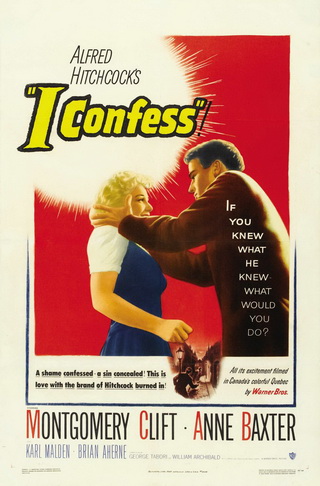
I_confess_poster

Religion doesn’t always play a prominent role in the films of Alfred Hitchock — he could possibly be considered a lapsed Catholic — but I Confess is his most overt exploration of moral and religious convictions. Although one could make the argument that he’s most interested in the mechanisms created by the moral conundrum since his priest becomes another innocent man accused. Nonetheless, the story speaks for itself.

It opens in quintessential Hitchock fashion as signage seems to indicate a route and then moments later a murder is announced with a body sprawled out on the floor. A man walks down the street briskly in the cosset of a priest. If nothing else, it suggests a man of the cloth might soon be implicated.

Father Michael Logan (Montgomery Clift), who will soon become of primary importance, is in the church when he is met by Otto Keller (O.E. Hasse), who works in the local parish with his wife. The Father has always been good to him, his friend even, and now he has a confession.

The confessional becomes such a powerful dramatic element: It’s been used to stirring effect in everything from Leon Morin, Priest to the more recent Calvary. In I Confess it conveniently sets up Hitchcock’s core dilemma. The flustered European immigrant confesses to the murder of a man named Vilette. Priests, of course, take a vow of confidentiality. Thus, the picture is not entirely a mystery. This is laid in the audience’s lap before we know what exactly to do with it.

Everything must become far more complicated. It involves the Father’s past relationship with the now married Ruth Grandfort (Anne Baxter). That was many years ago, although Logan remains above reproach.

Still, the police inspector (Karl Malden) needles him and cannot understand why he will not be more compliant. After all, he was supposed to meet Vilette the morning after his death, and he was seen with the young woman on the street corner, the day after. It’s true enough, but he will not divulge more regardless of how it looks.

Flashbacks clog up the story’s midriff even as it becomes imperative to inform the narrative. Because before he ever took his vows, they were in love. He went off to war and she was left despondent, receiving small comfort from her employer and future husband: Pierre.

Not all the performances feel altogether pristine or polished but as with the environment, this is a bit of added authentic charm. The more readily-remembered Hollywood actors feel mostly like dressing compared to Father Logan — Malden’s obdurateness might be the exception. Still, this is not altogether problematic and while the picture’s not exactly taut, it does feel psychologically distressing. Clift is made to suffer in silence.

We often forget, with the lustrous Technicolor glories of the Paramount years and pictures from Rear Window to Marnie, that Hitchcock was comfortable with smaller scale and black & white. Quebec is a very unique locale, but it effectively serves his plot and the evocation of provincial character quite well.

Although Hitchcock was never one to see eye to eye with so-called “Method actors,” I think of Clift and Paul Newman in particular, there’s no argument that he allows Monty to shine even sets him up for a nuanced but ultimately towering performance. There’s a quiet magnitude imbued by his stoicism in front of the camera.

He literally becomes a Christ figure and it’s no mere coincidence that Hitchcock shoots looking down past a sculpture of a man carrying the cross as Logan himself walks below on the street. Or for that matter, how often do you see a crucifix so prominently featured in a courtroom? It’s because this courtroom drama has a priest on the stand. The whole movie is playing out through what he will and will not do. His convictions dictate what will happen.

It’s the district attorney (Brian Aherne) who has the undesirable job of getting a conviction by doing his job to the best of his abilities. This means cross-examining a mutual friend (Baxter) as well as the man of the cloth. Is he in a sense, Pontius Pilate? Because even if Father Logan comes out of the trial alive, the media attention and the aspersions on his character can never be undone. He will be faced with public ignominy.

He’s also made to walk the gauntlet so many times; Hitchcock blesses Clift with some phenomenal close-ups and allows the camera to take on his protagonist’s point of view multiple times. He’s not the only one, but one can hardly forget the very final scene in the Chateau Frontenac Hotel: The Father goes in to confront the man who was going to let him take the rap for a murder he did not commit.

The man has a gun. He’s holding himself up and by now he’s desperate already, having killed at least one other person. The room couldn’t seem larger and still, with a kind of peerless conviction, Clift’s hero makes the long walk prepared to sacrifice himself yet again.

Ultimately, he is vindicated; there is a sense of justice, but what a terrifying portrait it is. For those without major religious convictions, it might feel absurd. I must admit it seems almost inconceivable a priest cannot alert the police about a murderer. Surely, even the Bible talks about there being a season for everything, and a time for every purpose under Heaven. Still, Hitchcock even made a point in an interview:

“We Catholics know that a priest cannot disclose the secret of the confessional, but the Protestants, the atheists, and the agnostics all say, ‘Ridiculous! No man would remain silent and sacrifice his life for such a thing.”

It should be noted, in a Hitchcock film, it usually seems like a time to kill and a time for hate because what better way to explore our moral makeup and the forums of human justice? In the end, Father Logan holds fast and is exculpated. If not only by earthly powers, then higher powers too. I’m still left to wonder what Hitchcock would have said in the confessional if he was faced with it.

You can tell a lot about a man from his fears as well as his vices. What stands out about the picture is how it never feels undermined by jokes. It feels as sincere as the man at its core. For some, it might be a turnoff. For others, it will make you appreciate the director even more. He willingly enters into the realm of the pious, albeit through the lens of murder.

3.5/5 Stars

Family Plot (1976): Hitch’s Swan Song

Screenshot 2020-07-26 at 3.48.36 PM

You rarely hear mention of Alfred Hitchcock’s last cinematic foray, Family Plot, and you would assume that means a throwaway title — a fall from his illustrious heights. Not so! In fact, it’s rather a shame more folks haven’t turned the movie on because it proves the Master still has it. There’s still a twinkle in his directorial eye as he leads us on one final merry jaunt of murder, crime, and passion.

I was always under the illusion family plot was about some kind of conspiracy. The first inkling is from a cemetery plot even as it evolves into a broader conspiracy unraveling in front of us. It never registered as a pun until the story began to run its course. Allow me to explain.

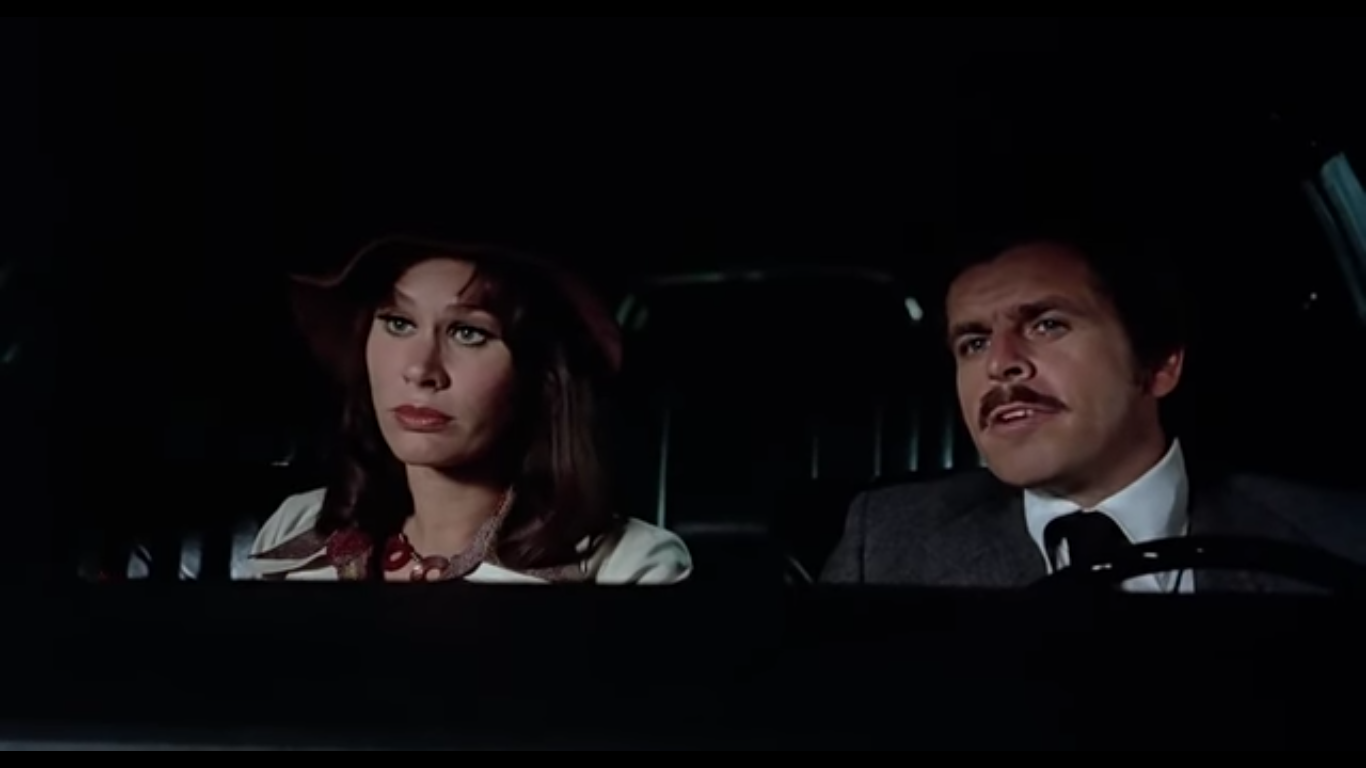
Our story opens with a quack psychic (Barabara Harris) drumming up business with rich old spinsters ready to fork out money to get their fortunes told. She’s running the ongoing con with her boyfriend George Lumley (Bruce Dern). They’re purely small-time operators.

Soon he is on the beat poking around about a man named Shoebridge. What he’s doing at first isn’t exactly clear — he’s a taxi cabbie by day — however, soon we realize he’s digging up tidbits for future seance fodder.

Their latest coup involves a wealthy widow, if only they can locate her long-lost nephew who was given up for adoption years before. She looks to bequeath him some of her vast fortunes on behalf of her guilt-ridden dear departed sister. They too have a stake in finding him: $10,000 to be exact, which is a fortune to them.

Meanwhile, the headlines are taken with a crime of a different sort: The Constantine Ransom for a priceless gem. It really is the perfect crime. The police are befuddled and there hasn’t been a single false step. Their hands are tied as a mysterious lady in black — a twist on the Hitchcock blonde — shows up to make the trade. She leaves with her gem and orders a helicopter to aid in her getaway, all planned so she can drift back into anonymity.

It turns out she also has an accomplice: her lover, who works as a local jeweler (William Devane). By sheer coincidence, he is the very same man Dern is hunting for. Instantly we have the glorious joke at the center of the drama.

Because these circumstances have nothing to do with his dubious extracurricular activities and still, this uncanny connection becomes a lovely fulcrum for the movie to balance on with comic underpinnings. In one defining moment, the stolen diamond is kept in a very visible hiding spot established by a telling Hitchcock closeup. He looks to be having a gleeful good time of it.

Ernest Lehman’s script (remember he collaborated with Hitch on North by Northwest) is more liberal with the profanities, but it readily amuses itself with the quandary at its core exploring the relationships of these two couples and how these separate scenarios are tied together. In some strange way, it’s all things police procedural, murder mystery, and a bit like a vintage drawing-room comedy. They’re both after two very different pots!

The ransomers’ latest plans involve the brazen kidnapping of a local bishop taking full advantage of the congregation’s shock. Diagnosing the situation later, as they tear off their disguises and zoom away he notes smugly, “they’re all too religiously polite.”

Lumley’s travails take him to a religious setting of his own, in his case, the funeral of a balding gas station attendant named Maloney (Ed Lautner). There’s no need to get into his death although it involved some winding roads and a car chase of sorts…

In the most captivating shot, Hitchcock captures the overgrown cemetery from a birdseye perspective. Maloney’s reticent wife (Katherine Helmond) scurries away and Dern scampers along until he corners her. It’s the same old story. She wants to be left alone, and he just wants information.

The search for A.A. Adamson leads to all sorts of people and visual gags placed in front of us with a wry wink. But this is hardly the grandest joke as Hitchcock allows us to watch the stories converge as we are caught right in the middle. Again, it’s wonderful bits of coincidence getting in the way or more precisely bringing the story to an impeccable climax.

I’ve been mulling over the assertion that the great directors have a distinct point of view. With Hitch, he used the shot-reverse-shot paradigm certainly, but there was always a cadence to it. If he needed to break out of the rhythm he would.

My mind flashes to a scene with Dern as he’s hiding on the stairwell. The couple has returned from their latest crime totally unaware of their guest. Their feet wander around the kitchen as they talk. We’re paying partial attention to that but like Dern, Hitch makes us crane our necks and feel uncomfortable as the audience. In that individual moment, we don’t have the whole picture, and we are forced to be in his shoes for even an instant. There’s definitely a profound level of audience identification and inherent tension. This is all Hitchcock’s doing.

The ending is more than satisfactory, but Barbara Harris’s wink to the camera is like a final curtain call for Hitch. This last gesture sums up his career for me. It was built on suspense and an intuitive understanding of visual cinema and audience manipulation. However, his very own persona and the connection he created with the masses wouldn’t be anything without his sense of humor.

Due to his deteriorating health, he would never complete another film, dying 4 years later in 1980. He was planning on a film called The Short Night, a project that obviously was never realized. With his death, the film world lost one of its most consummate craftsmen and storytellers.

In a Hitchcock movie, you feel well taken care of because the director knows what he’s doing, oftentimes even when we don’t. He scares us when we want to be scared. Thrills us. Gives us romance. And even deigns to allow us to be in on the joke.

Under the circumstances, I can’t think of a more appreciative place to leave the Master. His powers haven’t atrophied. On the contrary, he still knows how to play the game and how to have fun doing it. This might be the most pleasant surprise of Family Plot. Alfred Hitchcock never lost his wonderfully grim sense of humor.

3.5/5 Stars