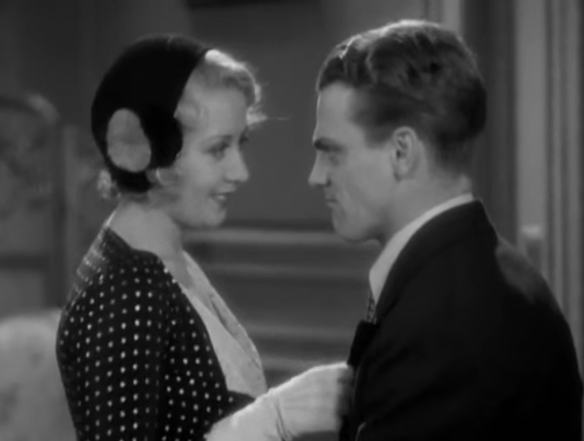
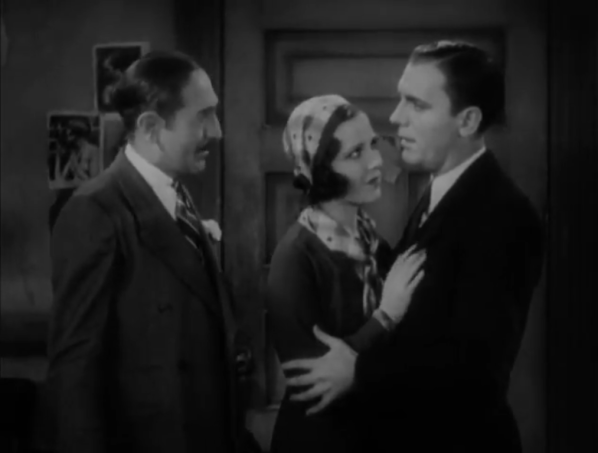
Blonde Crazy (1931) with Joan Blondell and James Cagney

blonde crazy

From the outset, Blonde Crazy promises to be a midwestern hotel chamber piece. It’s a story of the help: including opportunistic bellboys (James Cagney) and plucky chambermaids (Joan Blondell). He does her a service by nabbing her a job, and in such a world, he probably expects some recompense.

James Cagney is still kicking around and feeling out his persona; Joan Blondell’s on the way up with him. It’s mind-boggling that in the year 1931 alone both of them put in time in over half a dozen pictures each for Warner Bros. They were both building up a body of work quite quickly.

In a movie like this, the people I’m often preoccupied with are the Charles Lanes and Guy Kibbees — the host of able character actors who always show up in a movie like this. Blonde Crazy has quite the assortment. It’s stuffed with the kind of familiar faces, making a small trifle like this worthwhile, playing desk clerks and delinquent jewels salesmen, among other things. You know the types.

If the story remained in the hotel, it would be severely handcuffed because its stars are meant to be out in the world! Thankfully, the movie breaks out of the constraining formula and finds itself allowing Cagney to shine because there was no one who could do charisma like him. However, Blondell’s never one to be discounted, keeping with him tit for tat.

She exhibits plucky defiance ranking up there with any of the top female performers of the 1930s, coping with the social systems while still holding her own in a man’s world teeming with come-ons and everyday misogyny.

Does it matter what it has in the way of plot? Hardly. Instead, Bert (Cagney) and Anne (Blondell) leave the hotel, becoming business associates or better yet, accomplices drumming up clever (and slightly dubious ways) to make a quick buck.

Blondell is never taken in. She sees right through Burt and still stays with him. He has flashes of decency but driven as he is by money and other superficial qualities, he’s a tough guy to try and wrangle in. Still, their prevailing attribute is their loyalty to one another. Cagney likens himself to a modern Robin Hood. He does have that kind of rapacious charm (and this is before the world knew Errol Flynn).

In time, they’ve had an upgrade frequenting the lavish hotel circuit as partners, though their romantic status remains a bit hazy. Bert inserts himself into a fistfight on the dance floor. It seems like the perfect point of intersection for Cagney. He comes to the aid of Louis Calhern a man he’s been eyeing for some time namely, because of his scintillating female company (Noel Francis). She’s been giving him the look. Anne knows it too. She wasn’t born yesterday.

Unfortunately, Bert gets punked. He’s been made a sucker. In the movie world, you don’t make a sucker of Jimmy Cagney and get away with it. With his pride hurt by the big boys, he looks to regain his stripes by pulling a double-sided con of his own, just to break even. He doesn’t bother to tell Anne. It’s preliminary work for greater coming attractions. If you want to try and get a line on Cagney’s character, he’s not quite his usual gangster type; he’s a smaller operator, but still stretching the boundaries of the law. In his own words, he’s “not tough just mercenary.”

For all the names crammed in the picture, I almost forgot to mention Ray Milland. I hardly knew he was in pictures this early in time, and he looks like a babyface, albeit a handsome one. He’s relegated to the secondary role. He’s Anne’s dreamboat. The complete antithesis of Cagney. He has class. So they get married. But he’s fallen into a bit of misfortune. The only man who can probably pull him out is good ol’ Bert.

All these bits and pieces feel conventional. There’s the immediate romantic tension and the story zips along. Milland is nothing aside from the other man. But if you miss out on Cagney and Blondell’s rapport, then you’ve failed to appreciate the merit of the picture. They make it shine.

While it’s not cutting-edge entertainment, Blonde Crazy does simultaneously straddle the lines of genre. It’s not totally gangster — there’s romance and melodramatic flourishes — and there’s a lightness of comedy. This is what lingers.

Because, in the end, Bert’s sent up for a prison sentence and Anne dutifully shows up professing her undying love. They were meant to be together. What I will remember is how Cagney says “Hone-eee,” and how Cagney, donning his most elocutionary voice, spouts off a bit of Elizabeth Barrett Browning. And it’s a violent picture: full of socks, slaps, and spanks, all in a comical vein and totally indiscriminate. Everyone gets in on it. It helps in illustrating the underlying fact that this is not just Cagney’s movie. Blondell more than holds her own, and they make it better together. What’s more, this was just the beginning.

3.5/5 Stars

The Wrong Man (1956): Henry Fonda The Most Sympathetic of Victims

Screenshot 2020-08-03 at 7.40.08 PM

I never grew up watching reruns of Alfred Hitchcock Presents, but there’s kind of a ubiquitous aura about them. The man himself — the entirety of his portly physique — comes out of the shadows into a family’s living room to narrate some ghastly or unseemly crime with a droll sense of humor. The show ran from 1955 to 1965 becoming a wildly popular cultural touchstone, and it’s easy to see how The Wrong Man (1956) might have fit into this lineage.

Hitchcock was normally a walking cameo, providing a wink-wink to the audience as he pulled the strings from behind the camera. Here he is also a spokesperson assuring his audience every word of the following story is true though it plays stranger than fiction.

What becomes immediately apparent is the New York milieu. It’s unadorned and if it’s themes and star bring to mind Sidney Lumet’s 12 Angry Men with Henry Fonda, then the world itself has the kind of simple humanity of Paddy Chayefsky. And this is a Hitchcock movie, mind you, but the cinematography by Robert Burks is gorgeous in its stark black & white tones. It helps to maintain this suggested sense of concrete realism.

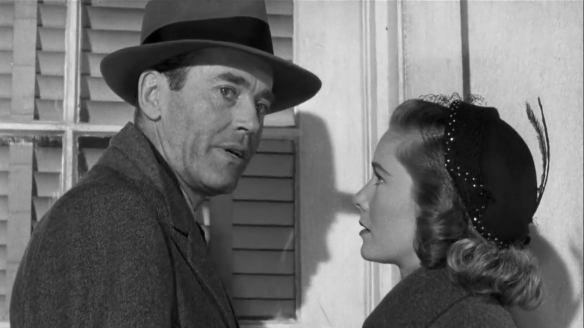
We open on the bustling Stork Club — it’s a real place — and there “Manny” Balestero (Fonda) plays bass as part of the house band. He’s not rich by any means, but he makes an honest wage going home to his wife (Vera Miles) after the dancing is done. Their life together is humble but full of love and decency. They raise two rambunctious boys, and he promises to give them music lessons.

His life is preoccupied with the kind of familial responsibilities we all understand. His wife has some dental work that needs to be done — it’s expensive so he needs to check on their insurance policy — and he plans to check in on his mother. It’s rather unextraordinary. But this is what makes it unusual.

While Manny only looks to check on his wife’s insurance policy, Hitchcock frames it like a bank robbery. Except the gun coming out of his pocket is the paper policy. The teller walks away, her face racked with concern as she consorts with her superior. A holdup hasn’t been committed, and yet it sure feels like it. In a stunning shot, the superior peers past her shoulder and catches sight of Manny perfectly oblivious. It’s the beginning of trouble.

Soon Manny is I.D.’d. He’s not trying to hide anything. Some policemen (including Harold J. Stone) show up on his doorstep to take him in for questioning. They assuage any concerns he might have: “It’s nothing for an innocent man to worry about. It’s the fella who’s done something wrong who has something to worry about.” And so he goes along with their line of interrogation because he naively believes in the veracity of justice.

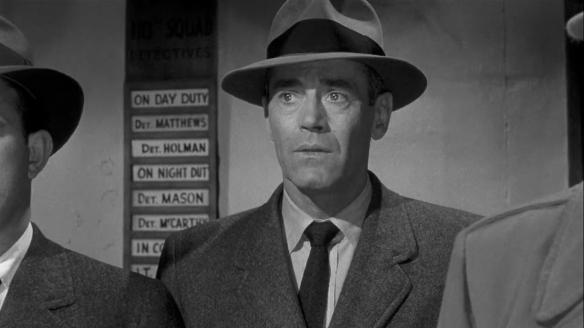
What becomes more apparent is the fallibility of eyewitness testimony and the coincidence found in circumstantial evidence. I am reminded of the work done by the likes of Elizabeth Loftus and of confirmation bias. Of how misleading information often molds responses. Two ladies pick Manny out of a lineup which doesn’t bode well. Then, whether or not it’s uncanny, his handwriting also looks close enough to an incriminating stick-up note.

However, more so than any of the implications on law and the criminal justice system, The Wrong Man is such a powerful exemplification of Hitchcock’s directorial talents. It’s devilishly simple on the exterior, and yet he does so much to make us totally cognizant of Fonda’s condition. It goes beyond mere osmosis. Thanks to Hitchcock, we live Fonda’s point of view.

When he’s first approached, then, again, when he finds himself actually booked and imprisoned, Hitchcock does something deceptively simple — taking on Fonda’s eyes. He looks around the confines of the space — to the sink in the corner, up at the ceiling, and we are there with him. We forget about a camera — that there is visual trickery going on — and we fall into Manny’s predicament sitting right there by his side.

We recognize the shame of being imprisoned — to be robbed of your dignity even if you manage to be exonerated. He’s taken through all the paces of justice in all its drab mundanity. It takes all the sheen out of law and order; this isn’t Elliot Ness or Perry Mason. This is common, everyday people grinding through their daily lives.

Manny watches as they do their jobs around him with a kind of detached efficiency. He has no idea what he’s caught up in nor does he think about trying to speak up on his behalf. The machine is moving too fast, and he’s already reticent. Could it be it’s hopeless? Instead, as he’s handcuffed, he watches the footfalls of his fellow prisoners being led to the van. What’s he supposed to do? Worst of all, he isn’t able to notify his wife, and he always calls her if he’s out late. He’s that kind of man.

the wrong man

The resulting storyline involves a valiant lawyer (Anthony Quayle), who agrees to take his case. However, every possible alibi proves a dead-end. Manny’s wife, once the image of so much jovial warmth, has become delusional in the lead up to his trial. She can’t take the strain.

Finally, we are in the throes of the court proceedings. Manny holds his rosary under his desk and later the cross hangs suspended up above him. It’s hard to take it any other way but that of a symbol: here is a man being falsely accused crucified for something he did not do. Like I Confess, this is not only a tale of a man put on trial unjustly, it’s the tribulations of a devout man of faith.

True to form, The Wrong Man also reflects the most perceptive and honest of courtrooms. As Manny sits there, his fate in the balance, he glances around to see all the various side conversations going on — for other people the proceedings only hold mild curiosity — but again, Hitchcock has made us totally empathize with Manny.

After his mother implores him to pray to God, he prepares for work as per usual, but then takes a moment to heed her advice. Looking at the picture of Jesus on the wall, he begins to whisper his prayers under his breath. The visuals start to superimpose. There is Manny — that is Henry Fonda’s face — and the mug of the wanted man comes into view and meets him in the middle of the screen. All of sudden, he’s got a bit of luck. It’s the fortuitous key to the whole horrid mess. Christians would believe this is Providence.

The ending hardly matters nor does the fact that it is a “true story.” It’s the impression the movie leaves on us casting the greatest shadow. Hank Fonda is the most sympathetic of victims. However, it’s Alfred Hitchcock who intuitively understands how to augment his plight by making it viscerally resonate frame after frame. Without the bells and whistles he grew accustomed to, he shows he’s still capable of making a superior film.

4/5 Stars

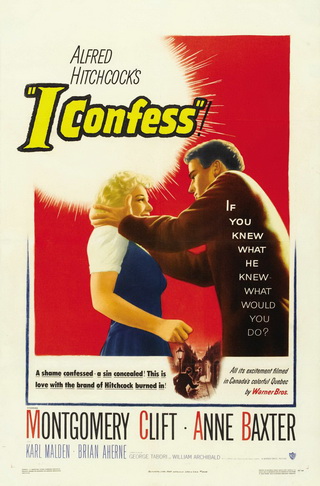
I Confess (1953): What Would Hitch Do?

I_confess_poster

Religion doesn’t always play a prominent role in the films of Alfred Hitchock — he could possibly be considered a lapsed Catholic — but I Confess is his most overt exploration of moral and religious convictions. Although one could make the argument that he’s most interested in the mechanisms created by the moral conundrum since his priest becomes another innocent man accused. Nonetheless, the story speaks for itself.

It opens in quintessential Hitchock fashion as signage seems to indicate a route and then moments later a murder is announced with a body sprawled out on the floor. A man walks down the street briskly in the cosset of a priest. If nothing else, it suggests a man of the cloth might soon be implicated.

Father Michael Logan (Montgomery Clift), who will soon become of primary importance, is in the church when he is met by Otto Keller (O.E. Hasse), who works in the local parish with his wife. The Father has always been good to him, his friend even, and now he has a confession.

The confessional becomes such a powerful dramatic element: It’s been used to stirring effect in everything from Leon Morin, Priest to the more recent Calvary. In I Confess it conveniently sets up Hitchcock’s core dilemma. The flustered European immigrant confesses to the murder of a man named Vilette. Priests, of course, take a vow of confidentiality. Thus, the picture is not entirely a mystery. This is laid in the audience’s lap before we know what exactly to do with it.

Everything must become far more complicated. It involves the Father’s past relationship with the now married Ruth Grandfort (Anne Baxter). That was many years ago, although Logan remains above reproach.

Still, the police inspector (Karl Malden) needles him and cannot understand why he will not be more compliant. After all, he was supposed to meet Vilette the morning after his death, and he was seen with the young woman on the street corner, the day after. It’s true enough, but he will not divulge more regardless of how it looks.

Flashbacks clog up the story’s midriff even as it becomes imperative to inform the narrative. Because before he ever took his vows, they were in love. He went off to war and she was left despondent, receiving small comfort from her employer and future husband: Pierre.

Not all the performances feel altogether pristine or polished but as with the environment, this is a bit of added authentic charm. The more readily-remembered Hollywood actors feel mostly like dressing compared to Father Logan — Malden’s obdurateness might be the exception. Still, this is not altogether problematic and while the picture’s not exactly taut, it does feel psychologically distressing. Clift is made to suffer in silence.

We often forget, with the lustrous Technicolor glories of the Paramount years and pictures from Rear Window to Marnie, that Hitchcock was comfortable with smaller scale and black & white. Quebec is a very unique locale, but it effectively serves his plot and the evocation of provincial character quite well.

Although Hitchcock was never one to see eye to eye with so-called “Method actors,” I think of Clift and Paul Newman in particular, there’s no argument that he allows Monty to shine even sets him up for a nuanced but ultimately towering performance. There’s a quiet magnitude imbued by his stoicism in front of the camera.

He literally becomes a Christ figure and it’s no mere coincidence that Hitchcock shoots looking down past a sculpture of a man carrying the cross as Logan himself walks below on the street. Or for that matter, how often do you see a crucifix so prominently featured in a courtroom? It’s because this courtroom drama has a priest on the stand. The whole movie is playing out through what he will and will not do. His convictions dictate what will happen.

It’s the district attorney (Brian Aherne) who has the undesirable job of getting a conviction by doing his job to the best of his abilities. This means cross-examining a mutual friend (Baxter) as well as the man of the cloth. Is he in a sense, Pontius Pilate? Because even if Father Logan comes out of the trial alive, the media attention and the aspersions on his character can never be undone. He will be faced with public ignominy.

He’s also made to walk the gauntlet so many times; Hitchcock blesses Clift with some phenomenal close-ups and allows the camera to take on his protagonist’s point of view multiple times. He’s not the only one, but one can hardly forget the very final scene in the Chateau Frontenac Hotel: The Father goes in to confront the man who was going to let him take the rap for a murder he did not commit.

The man has a gun. He’s holding himself up and by now he’s desperate already, having killed at least one other person. The room couldn’t seem larger and still, with a kind of peerless conviction, Clift’s hero makes the long walk prepared to sacrifice himself yet again.

Ultimately, he is vindicated; there is a sense of justice, but what a terrifying portrait it is. For those without major religious convictions, it might feel absurd. I must admit it seems almost inconceivable a priest cannot alert the police about a murderer. Surely, even the Bible talks about there being a season for everything, and a time for every purpose under Heaven. Still, Hitchcock even made a point in an interview:

“We Catholics know that a priest cannot disclose the secret of the confessional, but the Protestants, the atheists, and the agnostics all say, ‘Ridiculous! No man would remain silent and sacrifice his life for such a thing.”

It should be noted, in a Hitchcock film, it usually seems like a time to kill and a time for hate because what better way to explore our moral makeup and the forums of human justice? In the end, Father Logan holds fast and is exculpated. If not only by earthly powers, then higher powers too. I’m still left to wonder what Hitchcock would have said in the confessional if he was faced with it.

You can tell a lot about a man from his fears as well as his vices. What stands out about the picture is how it never feels undermined by jokes. It feels as sincere as the man at its core. For some, it might be a turnoff. For others, it will make you appreciate the director even more. He willingly enters into the realm of the pious, albeit through the lens of murder.

3.5/5 Stars

Frenzy (1972): Cleaning Up The Streets

Screenshot 2020-07-28 at 5.28.11 PM

There we are gliding across the River Thames making our way toward the regal facade of Tower Bridge. Where’s one apt to find a more picturesque view of London? It’s definitely an auspicious return to his native land for the Master of Suspense.

Frenzy is without question a singular Hitchcock movie taking him back to his roots in the ’20s and ’30s — not just the days of Stage Fright (1950) or The Man Who Knew Too Much (1956) — something like The Lodger (1927) or Sabotage (1936) springs to mind.

Of course, it’s a different England. It’s gotten bitten by the bug. Certainly one of them was Swinging London and The Beatles, but even as the old world, the small-town world continues to pass away, there’s a sense this same progression is being documented in Frenzy.

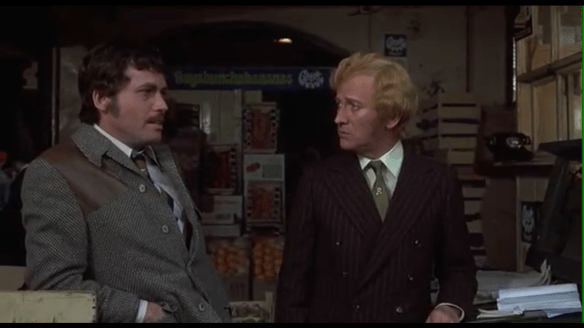
The characters knock around town at all the pubs, street corner grocers, and everywhere else in Convent Gardens — what’s left is a remnant of Hitchcock’s boyhood world. The director’s father was a grocer, and thus, it’s a return to his roots in the most Hitchcockian way possible: replete with murder.

A charismatic civil servant stands atop his soapbox with a rapt audience rallying the people they’ll soon clear the rivers and canals of society’s refuse — pollution will be banished — and right on cue, there’s an interruption from the masses. He gets preempted when an onlooker realizes something bobbing in the river: A woman’s body with a tie twisted around her neck.

Irony notwithstanding, it causes a surge through the crowds as gossip about the rash of necktie murders throughout town. In this way, the traditions of Jack the Ripper have been modernized and remain alive and well in contemporary London.

It’s not only these onlookers but acquaintances in pubs and any other random passerby who all have a callous, morbid curiosity about them — their conversations are overwhelmingly about the killer — and they come off darkly cynical.

The men from New Scotland Yard for their part are on the lookout for a sexual psychopath and a social misfit who might be easily categorized. Because what better way than to put criminals in a box to understand them?

Right about now we must introduce our protagonist, who also becomes the obvious target of all this foreshadowing. We are led to believe Richard Blaney (Jon Finch) an acerbic ex-RAF man who is the obvious culprit, although, for the time being, he’s unsuspected.

Still, after his ex-wife, who runs a new-fangled matrimonial agency is brutally murdered, unbeknownst to him, the forces of the plot are already out of his control. It’s as if the film is cruelly conspiring to ensnare him like all the most crippling of Hitchcock’s man-on-the-run thrillers.

The police are looking for a fugitive with a tweed jacket with patches on the shoulders and elbows. It’s true all pieces of circumstantial evidence, motive, and eyewitness accounts point to Blaney. At every turn, he looks to be guilty and he does very little to help his case. A hotel bellman tips off the law, and then the testy bar owner (Bernard Cribbins) he used to work under accuses him further.

He does have several allies in the generally morose landscape. One is the local barmaid Babs (Barbara Massey), who stands by him in his innocence. Another is Johnny Porter, a buddy who gives Richard asylum, despite the chastisement of his suspicious wife.

Although Johnny feels like a far too convenient character — he implicates himself in a potential crime quite readily — but let’s not allow this to detract from the story. Dick does have one other friend: a local grocery worker named Bob Rusk (Barry Foster), who gives him free handouts and tips at the races, among other things.

Frenzy is the most visually grisly and unnerving Hitchcock picture with a kind of in-your-face depiction of the murders. In this regard, it seems uncharacteristic of the man who often seemed the king of simulated gore and suggested horror.

The Shower Scene in Psycho is the unadulterated pinnacle of this. Where the intensity comes in the layering and total manipulation of all the formalistic elements. Frenzy is on the complete opposite end of the spectrum showing everything far more explicitly. It almost seems to lack the elegance of a Hitchcock picture — Blaney and Bob are earthier types than we’re used to.

Still, in one of Frenzy’s most telling shots, Hitch literally pulls the camera down the stairs out into the street just as we recognize that the dastardly deed is being done. It’s a second murder, and he makes us painfully aware of it without ever putting us inside the room. The same cannot be said in the other instances.

However, what truly sets the picture apart is how Hitchcock scrapes the dividing line between psychotic killer and despicable human being so close that nobody wins. Because Dick’s yet another man on the run framed by fate. The only difference is he’s a wholesale cad. Whether he’s innocent or not is immaterial here. He might be The Wrong Man, but he’s no Henry Fonda and he’s certainly not Cary Grant.

The movie wraps up briskly and abruptly. There’s hardly time to catch our breath though Hitch does put us out of our misery. Our “hero” is exonerated, and the police apprehend the criminal, all in a matter of seconds. All this might be true, but it doesn’t make the world any more livable. There’s still refuse in the waterways and rubbish in the streets. Not only is the nostalgic world Hitchcock knew disappearing — this is sad in itself — it does feel like the world itself is a tawdry, cynical place.

To be fair, this might not be the director’s perspective — he holds a far more perverse sense of humor than mine — but when I look at this world it’s far from comforting. I’m a bit of an anglophile so there’s an appreciation in seeing familiar faces like Clive Swift (Keeping up Appearances) or Bernard Cribbins (Doctor Who), but maybe I’ve been watching the wrong things.

Then again, Hitchcock always did suggest the dark desires and inclinations of society conveyed through this lens of macabre amusement. Now his depictions are simply sharper and more direct.

In other words, the legacies of Jack the Ripper or Jekyll & Hyde aren’t dead. Over time, we just got better at trying to dissect them, and we’ve become increasingly more numb to their depravity. Could it be presumed innocence no longer matters? We’re all on the run. We all go a little mad sometimes. We’re all guilty of something.

3.5/5 Stars

The Passenger (1975): From Dust to Dust

Screenshot 2020-07-24 at 10.07.49 PM

Jack Nicholson was awarded the distribution rights of The Passenger soon after the movie came out, and he purportedly kept it out of circulation until the 2000s. From my understanding, it wasn’t for the typical reasons. He wasn’t trying to kill it so no one would catch wind of what a debacle it was. On the contrary, in some way, he was looking to preserve its artistic integrity and keep it pristine. What better way to do this by only allowing it to exist in your memories.

These circumstances allow for an intriguing dialogue on art vs. commerce and what this means in the Hollywood landscape. Take, for instance, One Flew Over the Cuckoo’s Nest, released in the same year — wildly popular, an Oscar cash cow, and still well-regarded to this day.

I don’t want to make any unfair insinuations about Milos Forman’s film — it can still be art — but by sheer box office appeal, it readily fits the category of commerce. It was a highly successful film in many regards and no doubt a lot of people have seen it and enjoyed it immensely.

Whereas The Passenger is a film, also released in 1975, that probably only cinephiles have a passing interest in because it hardly has any visibility. Even as I dipped my toes into the filmography of Michelangelo Antonioni, I was made aware of all his other works from L’Avventura to Blow-up before I ever had an inkling of this movie.

But it does exist and it’s such a fascinating, understated counterpoint to the rest of Jack Nicholson’s career. You get a sense of why it would remain so near and dear to his heart even as it becomes difficult to categorize. For one thing, he plays journalist David Locke at his most sincere — normally he feels a bit disingenuous, here every action rings with a core resonance.

This in itself might be a strange remark. We meet Locke in Africa. He is following a fast-evolving story about the local liberation front. He’s conducted many interviews and promoted the revolutionaries, but there is this sense he still doesn’t know what he’s in the middle of. In earlier decades he would have been the imperialist trying to make sense of the natives. A generation after that he would have been Jake in Chinatown.

But the most curious development is this: Locke finds another foreigner dead in the adjoining hotel room. They shared a conversation earlier. Now, he looks to take on the man’s identity. It remains to be seen why he does it. Locke’s not a criminal or a spy; he’s a journalist, and yet there’s a premonition that seeing this other fellow’s life — a globetrotter, as it were — proves highly attractive. He’s not weighed down by the same regimen and responsibilities.

If you’re unfamiliar with Antonioni, the premise might sound like a precursor to Bourne or maybe an Alan Pakula paranoia thriller. However, it has none of those hallmarks. It’s never preoccupied with the narrative beats. They only seem to be there — to exist as a conduit with which to explore something else.

The movie shifts to Germany but location is far too convenient a reference point. The movie freely shifts wherever it pleases, within time frames, as a kind of exercise in fluid, stream-of-consciousness storytelling. Where the present and the past can literally crossover and play out into one another within a single scene. Prior conversations echo in Locke’s ears even as he begins globetrotting around the world.

Over time they play more like moments and memories than traditional scenes adding up to what we would consider a conventional plot. He meets with some revolutionaries and realizes he’s a gunrunner. His wife and her lover learn of his death, go digging through his interviews, and go looking for this missing person. However, it all spins together another totally elusive tale as envisioned by Antonioni. This is his whole modus operandi as a filmmaker.

Locke (or Robertson) thinks he’s being followed and he is, but there’s never a true sense of fear or dread. In fact, we don’t quite know what to feel. It could be called a mood piece or a tone poem although I’m not sure those are quite right.

These moments are plucked out of time. There’s a chance encounter in Barcelona. He casually explains to a young French student (Maria Schneider) he’s running away. She wishes him well — hopes he makes it — noting people disappear every day. Sometimes it’s just around the corner, sometimes it’s with the cut of a film, and sometimes it’s for good. In perfect cadence with Nicholson’s amiability, Maria Schneider has a pleasant forthrightness about her; she’s another creature drifting on by, made solely to exist in this world.

Screenshot 2020-07-24 at 9.35.54 PM

It’s very rare to pull Antonioni away from the architectural landscapes he finds at his disposal because this is where he derives geometry, shapes, and with it an overarching composition for his works. Barcelona is a perfect marriage because one of its supreme talents was the incomparable Antoni Gaudi. Even a couple years of remedial art history tell us his buildings were of an unmistakable, singular design. The most startling progression is from dour Gothic interiors to these near-fantastical exteriors. Like Picasso and others like him, somehow in these shapes, or lack thereof, they derive meaning. Because how else are we going to ascribe it to our world?

It’s fitting that a movie that’s plot was incited in a hotel room should end in one as well. There’s a near-imperceptible zoom during the film’s famed denouement — peering out into the world. Up until this point, the story seldom feels chaotic as if our hero is resigned to his fate, and he has a kind of solace in it.

Luciano Tovoli’s camera magically pushes through the bars of the window to view the sandy plaza outside. It’s these tracking shots across the horizontal plane of existence I won’t soon forget opening up the world to be fuller and more immersive. In one full cycle of the camera, it’s like we see the plot and a life’s journey come to its conclusion all in one fell swoop.

Like others, I spent time deliberating over the meaning of the title. In Italy, it was known as Professione: Reporter. In English, it was changed to The Passenger. There might be numerous logical readings for both, but for me, I couldn’t get the picture of those two dead bodies lying on beds. You have to see them to know what I mean. They feel empty when they are found. Only a shell of a human being because it’s true the spirit or the life force of the person or whatever you to call it, is gone.

We are a culture rich in euphemism or closer yet metaphors. In the biblical text, Jesus gave up his spirit. Others have fallen asleep. Hamlet talks about shuffling off this mortal coil. And others have passed on. For me, this is what the title resonates with. This idea of how we are only on this earth a finite time. We are not solely defined by our body and our vocation and all these other intangibles.

It’s the spirit inside — the beating heart, the breath in our lungs, our souls — these are what make us alive as human beings. So quickly do we arrive and in another moment we are gone. In The Passenger, death is not violent. It’s only a voyage finally coming to an end.

What makes it disconcerting is the lingering alienation and dissatisfaction propagated by the world. It feels like a sullen place to be. Death as such seems like a tranquil respite. Each must decide for themselves if this holds true for them. Because surely we are not meant to live life without hope, existing in a constant state of listlessness. There has to be more.

4/5 Stars

Five Easy Pieces (1970): Ours Hearts Are Restless

Screenshot 2020-07-22 at 5.27.29 PM

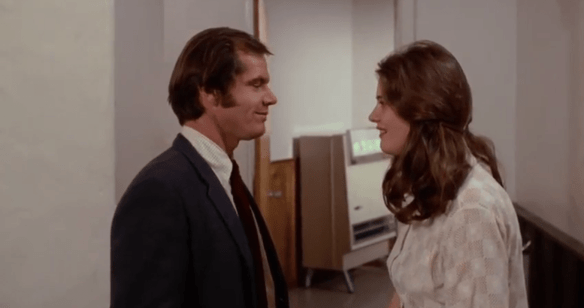
The world of blue-collar workers is immediately spelled out through a visual shorthand of hard hats, bulldozers, and oil rigs. At the center of Carole Eastman’s story is Bobby (Jack Nicholson) a young man who works alongside his buddy Elton and lives with his sometime girlfriend Rayette (Karen Black).

She’s pretty and nice enough, but there’s a sense Bobby feels like she’s somehow beneath him. Sure, she’s not the smartest girl — working as a local waitress — but she means well and seeks love like any normal human being. Still, it’s the kind of lifestyle perfectly summarized by the sounds of Tammy Wynette singing about heartbreak, songs like D-I-V-O-R-C-E, and the like.

Upon closer observation, it would appear Jack Nicholson is entering his prime — his snide, derisive years — as a seminal antihero of New Hollywood. The only difference, here he’s found in the bowling alley playing a round with his friends. He comes off as a jerk berating his girlfriend for being such a crummy player. So she can’t bowl, but Bobby makes it personal, bringing her to tears. It’s indicative of the toxic cycles that they go through together. He belittles her, pushes her away, and then asks her to come back. He’s never willing to commit. Never able to say I love you. And yet he can’t be without her.

The first third of the movie is mostly about slotting his character. Soon we learn a little more about him. His sister (Lois Smith) is a classically trained pianist. In fact, it runs in their family. Bobby was a bit of a prodigy himself, though he turned his back on the family obsession. Now he learns his father is dying. He doesn’t want to see him — it’s easy enough to tell — because they weren’t exactly on pleasant terms, but the supplications of his sister have an effect and he acquiesces.

The arc of the story is simple and Bob Rafelson’s picture is built out of the framework of the performances more than anything else. I think this is what I missed the first time I watched Five Easy Pieces. I was waiting for something to happen when all the time it was happening right in front of me.

Bobby’s prepared to go it alone and at the very last minute reconciles with Rayette yet again so they head up together. They also pick up a pair of lady hitchhikers making their way up to Alaska because it’s a destination not full of crap like everywhere else. They bemoan a pessimistic world full of maggots and riots; Bobby doesn’t want to hear it because he’s a bit of a misanthrope himself. He takes no pleasure in the trip he is making and they’re not helping.

Again, the prevailing mood of the picture is this kind of rustic, blue-collar atmosphere exemplified by that Tammy Wynette soundtrack and the bowling alley milieu. It plays as the complete antithesis of classical music on the piano and the family’s cozy residence tucked away in idyllic Washington state. It’s the music and change in scenery acting as the main signifier of Bobby’s quaintly middle-class upbringing. Tammy might be great in her own right, but she’s not exactly Mozart or Beethoven.

When Bobby makes his fateful return, he finds his father now is catatonic and looked after by a burly caregiver. His brother Carl (Ralph Waite) is a loquacious eccentric who walks like a duck and wears a neck brace after a recent injury. Parita (Smith) is the most likable but still a creature of this insular and totally pretentious ecosystem. She doesn’t know any better.

It might say more about my own affinities rather than any fault of this film, but I never feel any amount of investment or emotional exchange going on. However, this is exactly the point. We understand the drudgery Bobby associates with his familial life and everything it entails. It’s better to be poor and free than to be trapped by expectations and crowded by pompous self-entitled armchair analysts trying to outdo one another.

Screenshot 2020-07-22 at 5.45.15 PM

Bobby at the same time is self-conscious of Rayette and protective of her because, in her own unadorned, simple manner, she’s a whole lot more real than any of these other imposters. At first, he puts her up in a hotel, and then she shows up unannounced willfully chafing against the propriety around her simply by being herself.

There is one person who does captivate Bobby. It’s his brother’s wife-to-be, another pianist named Catherine (Susan Anspach). The attraction between them is evident though he cannot figure out how she is so contented with the life he has run away from. In observing his condition, she notes he’s a person with no love for himself, no respect for himself, no love of friends, family, work. It strikes a little too close as he strives listlessly after some semblance of happiness.

I will say that Jack’s scene with his father, now crippled and silenced by a stroke, makes me appreciate his individual talents as a performer on their own merit. It’s not about any amount of trickery or charisma as much as we are privy to his acting process. We see him at work evoking a brokenness and a transparency of character I don’t often attribute to him.

Here he is before us laying it bear and crying out. It’s a release if not a total resolution. The film’s ending is another telling evolution in his ongoing saga of discontentment. We watch him as he ditches his car, his girl, his coat, and grabs a ride on a big rig up north. The destination is uncertain. Could it be Canada maybe Alaska? It doesn’t really matter.

What we do know is that he’s incorrigible, and yet it’s only a symptom of a broader problem. I’m can’t personally speak to whether this is true, but there is a sense Bobby is indicative of a broader social enigma. An entire generation of people lost and searching for something in the landscape of the 1970s — the dawn of a new decade — and still weighed down by the baggage of the past. This isn’t a new phenomenon and it’s universal. Because we realize over 50 years later there’s still something relatable by this unabating restlessness.

4/5 Stars

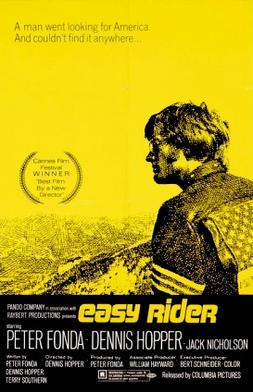
Easy Rider (1969): An Emblem of The ’60s

EasyRider

“If God did not exist, it would be necessary to invent him.”

There’s no beating around the bush when it comes to Easy Rider. It remains a cultural landmark not only of the counterculture of the ’60s, but it also stands tall as one of the Great American Road movies, albeit from a very specific perspective.

It opens with a dope deal. First, picking up the product below the border. Then, with planes taking off overheard — they make their connection with their contact (Phil Spector) — jamming away to the conspicuous “Pusher” by Steppenwolf. In a matter of minutes, our two cult heroes have got it made. They have a pile of cash for their troubles, and they’re ready to take on America.

Fonda’s Captain America is the epitome of disaffected cool — a triumphant symbol of a restless generation sticking it to the man — living on their own time and by their own standards as they see fit. It’s a new paradigm of manhood. But in his own way, he does have a certain idealism. He wouldn’t be taking to the road or living in this manner if he wasn’t driven by something: his own version of the American Dream.

Dennis Hopper’s performance is pervaded by a paranoid chatter, laughing in fits and starts when he’s not taking a drag. For now, they’re as light as a feather cruising down the highways and byways lazily with a steady array of classic tunes availing them with an anthemic backdrop. Take “Born to Be Wild,” “I Wasn’t Born to Follow,” and my personal favorite, “The Weight,” and there’s no looking back as we get to breathe in the fresh air and appreciate this land that was made for you and me. It’s during this invigorating outset one is made to appreciate America’s diverse geography.

Out of these open-air beginnings, Easy Rider becomes tantamount to a cinematic drug trip through flickering images, lens flairs, psychedelic rock, and certainly a copious amount of drugs. It’s composed of vignettes of many shapes and sizes coloring the journey of Captain American and Billy.

They’re thrust up against all sorts of lifestyles. In one moment they stopover in a man’s barn to remedy a busted tire, and the backcountry farmer shares his table with them. He’s contented in life with a Catholic wife and tons of children.

Another moment they pick up a hitchhiker who leads them to a rural commune bustling with kiddos and bleating livestock. The folks there are looking to subsist off the land, even as they share and share alike — holding carnivalesque stage performances for evening entertainment. It’s yet another form of the good life — living in solidarity and unity with one another.

However, the boys also butt up against the complete opposite subset of society. By this, I mean yokums suspicious of long-haired dudes they don’t understand in the slightest. They might as well be from the planet Uranus. Cutting a path to the Mardi Gras festivities, the boys wind up imprisoned for parading without a permit thanks to “weirdo hicks.”

Their jail bunkmate, George (Jack Nicholson in one of his early triumphs) is a rich-kid southern boy who nevertheless extends the olive branch. They come to appreciate one another. He’s as fed up with the scissor-happy locals beautifying America and subsequently making everyone look like Yul Brynner, a bald-pated Russian, I might add.

Furthermore, they partake in campfire chit-chat babbling about satellites and UFOs while getting totally stoned out of their brains. It feels like the beginner’s guide to writing such dialogue — mostly informed by ad-libs and circuitous digressions.

A roadside cafe becomes another microcosm of small-town America, and they stir up quite the maelstrom of gossip. If there’s anything close to empathy for the two bikers, it’s garnered in scenes like these because we understand what it is to be considered a social pariah on what feels like little fault of their own.

George is perceptive when he wants to be and also an affable companion on the road with his dorky football helmet. I’ve rarely appreciated Nicholson more. But he also has no illusions about how guys like Captain America and Bobby fit into the social order.

He sees that people are scared of what they represent: freedom. Because talking about freedom and being free are two different things. As an esoteric concept, individual freedom is nice to talk about even comfortable, but what about seeing an individual free — totally uninhibited and living by their own cadence. It’s true even the soothsayers are eventually silenced.

They make it out to a choice brothel with “prime rib” in memoriam to a dear departed friend, though it quickly turns into a night on the town for Mardi Gras. If we can say it, these are the most spontaneous sequences of the movie. Everything else feels sincere in its attempts at truth and authenticity, but it’s in this footage during the real Mardi Gras where everything starts to meld together. They wander around goofing off and making out with their new companions (Karen Black & Toni Basil).

Of course, this “reality” culminates in the infamous acid trip sprawled out in a cemetery. A solemn girl recites The Apostle’s Creed and Lord’s Prayer as they lose themselves totally to the psychedelics. It feels like an act of desecration but also an unveiling of all their fears and anxieties. Fonda clutches a statue and goes to pieces dialoguing with his long-deceased mother.

The soundtrack may only sound like audio atmosphere in the beginning but more and more it overtly informs the beats of the story. As they rebound and make their way forward, Bob Dylan’s “Alright Ma I’m Only Bleeding” becomes another uncanny expression of both their private and public angst. They all feel in a state of unceasing paranoid helplessness.

At its most compelling, the picture is like this perplexing tableau of performance art, indie slap-dash filmmaking, and docudrama. The production was notorious — Fonda and Hopper as director and producer respectively were at each other’s throats even as they remained the driving forces behind the film from its conception. And far from just portraying Hippies being brutalized by podunk America, it has the ring of truth.

Formalistically it’s informed by jump-cut-infused, schizophrenic pacing. One can only imagine what it might have felt like in the 3-hour monolith Hopper originally had cut. In its theatrical form, it feels more impressionistic and light leaving us stunned more than we are stultified because it never totally loses its resonance.

It runs parallel to Bonnie and Clyde — the sense of these outlaw heroes being decimated by the establishment — although in Easy Rider the retribution seems even more needlessly violent and unelicited. George’s caution never seemed more prescient. People are scared of seeing other people acting free.

But also thematically, Easy Rider fits with The Graduate and any other movies capturing the generational shift with youth breaking out of the shackles of the past, looking to exert and define their own road ahead. It just so happens the road ahead can be daunting even unnerving when the American Dream seems to have gone totally awry.

Easy Rider is another lodestone in the cultural conversation. You can hardly begin to grapple with the moment without bumping up against it, and the movie suggests so much in its many facets, through its decisions — its sense of truth and freedom — but also by what it doesn’t say. It makes the world out to be galvanizing and terrifying all at the same time. Far from just being about the corrosive nature of mind-altering drugs, sometimes humanity can be equally merciless. Take your pick. These dudes couldn’t win.

4/5 Stars

The Last Hunt (1956) and The Killing Fields

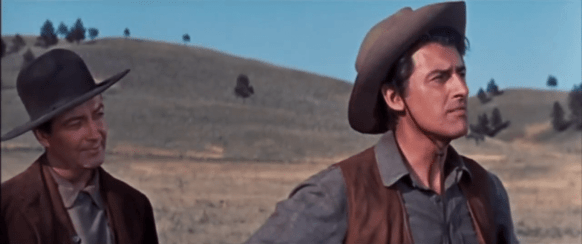
The Last Hunt considers an era that is no more. Once America’s Great Plains ran rampant with herds of bison numbering up to 60,000,000 based on the estimation of this movie. The initial premise of Richard Brooks’ western intrigues for the sole fact that this is a slice of history that doesn’t get much screen time in the cinematic west and, thus, it offers a framework for some potentially pointed commentary.

The onus for the circumstances is placed on both hunters and American Indians for recklessly slaughtering the population down to a mere 3,000. With the benefit of hindsight, it seems much of the blame must be cast on the white men. But this is something to get into later. 

For now, it should be briefly mentioned the movie has a great deal of footage shot in the famed Custer State Park spread out across the Badlands, and if you’ve never had the opportunity to go there, I would certainly recommend it, if only for the chance to see some bison. 

I’ve gotten the exhilarating opportunity to see bison several times in my life and let us just say, there’s nothing quite like it as far as putting you in touch with the sheer majesty of nature. To look at one of those creatures in close proximity, even from the relative safety of an automobile, is breathtaking. It gives one an even deeper appreciation for both the magnitude and the inner turmoil The Last Hunt attempts to grapple with. 

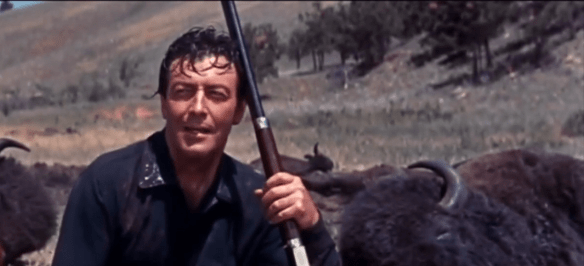
Sandy McKenzie (Stewart Granger) for one, is a big-time hunter who wants to wash his hands clean of the profession. He’s intent on taking one last job and moving on. However,  it’s one of his colleagues, the bloody-thirsty Charlie Gilson (Robert Taylor), who derives an unseemly amount of pleasure out of his vocation. He stays matter-of-factly, “Killing, fighting, war, that’s the natural state of things” and he wholeheartedly believes it. This mentality bleeds into all facets of his life. 

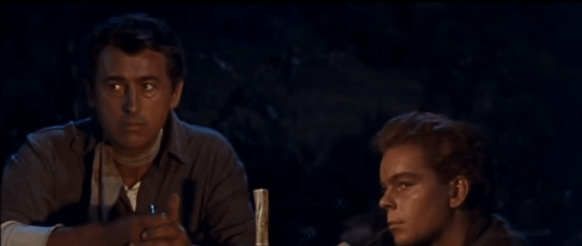
For one thing, he despises Indians. They’re hardly better than the big-time game he bags, and he’s quick to deride the genial half-breed who joins their company (Russ Tamblyn). Sandy is just as quick to welcome the boy on, and it’s yet another uneasy wedge between the two hunters. 

Screenshot 2020-07-19 at 5.36.42 PM
Watching the bison drop instantly to the ground as dead weight is in itself a bit perturbing and feels unnatural. Be forewarned, The Last Hunt is not for the squeamish because there is nothing simulated about the hunting throughout the film, actually performed by government sharpshooters who thinned out the bison population. Why it is done this way I’m not quite sure.

Likewise, watching Taylor blast away at the giant beasts until he’s decimated a whole pack for their skins, and then a moment layer cutting away to what feels like a bison killing field leaves a startling impression. The baby bison are left parent-less and a majestic white buffalo — believed to be medicine for the natives — is unceremoniously struck down. 

But this is only a backdrop or even a representation of what is going in the hearts & minds of the two characters as they chafe against one another. The movie would not work without both of their points of view. Charlie continues to exercise his almighty power of life and death over the beasts, relishing every minute, because killing is the only real proof you’re alive. His words, not mine.  Sandy could care less — having his own personal crisis of conscience — even as he extends a courteousness to his fellow man, no matter their creed. 

 Lloyd Nolan, who might best be remembered for character parts in the 30s and 40s, to my recollection puts together one of the most colorful portrayals of his career. His cackling “Woodfoot” holds a foolhardy appreciation for life and the rush of the hunt. It’s a lark to him, but he’s also good at what he does. The resplendent green plains laden with sheets of pine trees capture the sense of rip-roaring adventure out on the trail as the raucous pegleg tears across the territory with a giddy sense of abandon. 

Over time he settles into a good-natured sagacity even as he provides nighttime accordion playing to lighten the mood. He’s a bit of insulation between the men around him while offering the young boy neighborly advice. He softens and becomes more decent as Charlie becomes more and more stricken with his crazed obsession. 

the last hunt

Because there are only a handful of primary characters, each one has a very specific personality put on display and each earns their keep in the movie. The one exception seems to be Debra Padget, no fault of her own. She is an extremely alluring albeit absent beauty. Charlie desires her lustily, despite his bigotry, while Sandy becomes her de facto protectorate. I feel sorry for her because with the part she has to play — as the captured Indian maiden with child — she can’t win. Obviously, there’s a vague sense of her being a love interest, but in a male-dominated arena, she doesn’t have much import, unfortunately.

 Though the picture doesn’t have the best track record with American Indians — this is often the case with westerns circa 1956 — The Last Hunt does make a valiant attempt at some kinds of off-handed commentary. When talking about their customs, Charlie says, “Indians they don’t have religion.” Woodfoot replies with a cynical response of his own, “Indian religion is just the same as ours, except they don’t pass the hat after they pray.”

There’s another moment worth mentioning as a kind of mutual appreciation builds between Sandy and Padget’s nameless Indian girl. He acknowledges that he learned how to ride and learned about life from natives, so he holds them in the highest esteem. Proximity breeds this kind of empathy. 

She comes back around with her own version (by taking care of a toddling infant who is not her own child). She learned babies belong to all people, a sympathetic pearl of wisdom gained from Christian missionaries. It’s in this space where they form a kind of shared understanding built on mutual respect. 

But there comes a point of no return. For Sandy, he goes into town to sell their skins for a hefty sum, but he’s also resolved to get some of the buffalo stench off of him. He’s ashamed and the whole outpost points to his ignominy. Soon he’s brawling over the beasts to the chorus of rowdy honky-tonk and bodies flying over and under the bar.

 Charlie fairs little better as he goes into a continued fit of paranoid delusion leading him toward a chasm of madness. He believes his partner is looking to double-cross him, and he’s prepared to track him down and kill him if he has to (or anyone else who might get in his way). For all his disreputable malevolence, Robert Taylor is undoubtedly the film’s standout totally committing to his demented role. Granger is a necessary foil, but he and most everyone else must play cool and understated only smoldering under Nilson’s provocations. 

Truthfully, the ending feels woefully anticlimactic, or at least ill-gotten, failing to follow the trajectory that the story looked to be paying off. Still, up until this point The Last Hunt has a nervy tenacity in its best moments that might well leave a lasting impression on a willing audience. It remains a contentious indictment of America’s dubious indiscretions even as it also helps to unwittingly propagate a few more. Sometimes the good comes with the bad. 

3/5 Stars

Westward The Women (1951): A Fuller, Richer Kind of Western

westward the women

My only qualm with Westward The Women might be the title itself because otherwise, it’s a striking movie that should rightfully be heralded as a supremely significant western for the story it chooses to tell. At the very least, the title does make it evident that this is a story with women at the forefront — after all, the journey west was just as much theirs as anyone else’s. They just needed someone in a position of influence to enable them.

John McIntire is the visionary who can see what his land would become if subdued by men who could settle down with wives and make it into a suitable country. He’s already got the land. He’s already got the hands to work it. He just needs the women.

But he needs a man with the grit and horse sense to make it a reality because the closest females are thousands of miles away from his pristine California valley. Buck Wyatt (Robert Taylor) is the man for the job with a plethora of experience when it comes to being a wagon master. This task seems nearly unthinkable, and he takes it mainly for the money. He doesn’t necessarily believe they can make it. He hasn’t met the women yet.

As if to confirm his expectations, most of them are city folk and have neither fired guns nor ridden horses. They already have a few strikes against them. He’s hardly impressed, propped up in the corner with his hat tipped back contemptuously. During the vetting process, Mr. Whitman takes on the recruits with a far more benevolent eye.

They run the gamut from the imposing Hope Emerson to ladies with sullied reputations (among them Denise Darcel). The fact that an Italian widow and her young son sign aboard must also make us pause for a moment.

Because Westward the Women isn’t merely a story about heroic women — it is certainly this. However, since it was originally conceived by Frank Capra (who wrote the story and planned to direct), it’s an immigrant tale, albeit between Chicago and California.

Screenshot 2020-07-18 at 7.29.12 AM

While Robert Taylor is rightfully acerbic and disaffected for the part, he also has a strict sense of equity extending to both genders. Although he has a crew of veteran men working with him, he’s not going to take any of their guff or fooling around, and he’s prepared to kill to maintain order. It’s supremely harsh but then again, he seems to understand something few others do: This is a life or death scenario.

There are the torrential downpours that nearly wash them away, the treacherous terrain crushes a couple of their wagons to pieces, and, of course, there’s the threat of Indian raids. Worst of all is the internal division inside the company. Buck knows they will never survive if they can’t stick together.

The trail requires the supreme sacrifice of many who give their lives in service to the journey. It’s never easy but more than anyone else, the women’s resolve is firm. They will make it to their destination even if it kills them. Moment by moment, we learn more about the depth of their character.

The movie is a western that cuts against the grain — of both the 1850s and the 1950s —  engaged in telling a story predominantly about women featuring a Japanese character who feels at least a little bit more substantial than a sideshow attraction. His existence at all feels unheard of for depictions of either era.

I wish more directors and westerns had seen fit to have characters like Henry Nakamura (also featured prominently in Go For Broke!). While he might not be a totally integral piece, he adds yet another perspective to the movie and provides a kind of empathetic echo chamber for Robert Taylor (ie. When you’re wrong big boss, I’ll tell you).

There’s also the long-running gag with Ito’s Japanese creating an unspoken irony between what he says in his native tongue and what he expresses to Wyatt. When they finally happen upon the grave of Wyatt’s dead buddy (and with it a cache of rum), Ito voices his surprise, then says “Good ol’ Quackenbush.” His translation is liberal, to say the least!

Still, one of the most unforgettable interludes comes with reading off the roll call of those who were lost in the latest raid. It moved me immensely. Most of these women we don’t know by name, but they leave an insurmountable impact on the story representing so much of the human spirit and the dignity held aloft by the film. They feel, rightfully so, like a hallowed list of heroes.

And again, over any prevailing plot points, it’s the specific touches that will be remembered going forward. With the trail getting unstable ahead, the women are beseeched to lighten their loads and begrudgingly ditch all their worldly possessions at the roadside. It becomes a graveyard of discarded belongings as they roll ever onward.

westward the women

Then, there’s a little dog being carried along in a bucket under the birth of the wagon or the impression of a wayward wagon wheel left behind in the middle of the desert in their wake. They stop for nothing.

Finally, they get to The Promised Land, with fresh springs of running water, but before they go over the hill, Buck vows to gather together garments so they can look their best for their future husbands. There’s a kind of mounting expectation on all sides. It’s something supremely special they all get to take part in and we are privy to it as well.

When Taylor speaks to the men, he entreats them, “These are good women, great women, make sure you treat them right because God help you if you don’t.” He’s grown to esteem them just as his audience has. Thankfully, these men will too.

When the sexes finally get together, it feels a bit like a western cotillion and the ending is fittingly idyllic as they create a kind of rural utopia built on the bedrock of matrimony, decency, and hard work.

John Ford was always the purveyor of civilization making its way across the West, but we must remember Capra also had a stake in representing the American Dream. As the actual director of this film, William Wellman does a fine job capturing the adventure with the trials and tribulations of a wagon train, highlighted by numerous standout performances garnering an abiding admiration for all these folks.

Westward The Women is sadly the exception to the rules governing the western genre, but what a treasure it is to have as a kind of hagiography to the pioneering ladies who weathered immense hardship to pursue their dreams. Whether fact or fiction, the portrayals feel revolutionary, and what a joy it is to find such bountiful parts for people as diverse as Hope Emerson and Henry Nakamura. They suggest a fuller, richer western landscape than we’re in a habit of seeing.

4/5 Stars

Warlock (1959): Fonda, Quinn, and Widmark

warlock

There are three names emblazoned over the title credits engulfing the screen: Richard Widmark, Henry Fonda, and Anthony Quinn. Somehow they all figure into this story — into the war that we are about to be privy to. The question remains, how so and on what sides? It turns out, it’s far from a clearcut answer.

As Warlock progresses, I couldn’t help but think of that quote: “Suppose they gave a war and nobody came?” Its variations have been attributed to individuals as diverse as Bertolt Brecht, Carl Sandburg, and the Vietnam-era Hippie movement. Regardless, the most overt sentiment remains the same. War is perpetuated by people who willingly show up to fight, whether it’s out of a sense of duty, an assertion of masculinity, personal advancement, or a desire to watch the world burn. 

The San Pablo gang frequents Warlock quite often, prepared to terrorize a town and demoralize all those who stand for law & order, even to the point of death. The incumbent deputy sheriff is sent out of town on an honor guard of emasculation. He’s the most recent casualty, yet another man who will have his name crossed out on the brick wall of the jail. Because everyone is keeping tally. The whole town observes the public humiliation with distaste and private shame behind curtains and tucked away on second-story balconies. 

Richard Widmark’s Gannon consorts with the rebels, but he doesn’t like it. He looks decidedly conflicted in their company. It’s his baby brother (a scrawny Frank Gorshin), who keeps him connected to the gang by association. We must come to decipher where his allegiances lie just as he does. 

 What a majestic pair Henry Fonda and Anthony Quinn make together as they trot toward Warlock. They give off a sense of having traversed much of the world. Hank’s been installed as the new Marshall famed for his golden-handled colt revolvers.

From years of experience, he predicts the local community will be pleased with him until it grows into a general resentment as he maintains such a high degree of autonomy. But as their town has already given itself over to anarchy and murder, this is a form of salvation at a very high wage. It remains to be seen if it’s worth the price. 

warlock fonda and quinn

In this way, Warlock courts themes not unfamiliar to Wichita or Man with a Gun. Director Jacques Tourneur’s sense of the town somehow felt more atmospheric and real, and then Robert Mitchum in the latter film was a singular hero without peer, ready to go to war alone. In Warlock, the talent is more substantial and as such, we get something slightly more complex, if not always more compelling or artful than Wichita, in particular. 

One might be reminded that this is a Moab-shot western, and yet while there are some stunning exterior shots, what’s just as telling is how much of the movie takes place either in interiors or at the very least in the confines of the town. Director Edward Dmytryk finally ensconced again after the Hollywood Blacklist, looks far more engaged in the psychological underpinnings of his characters than he does in making the picture look pretty with sweeping grandstanding. The color schemes are bright if a bit gaudy, and the same might be said of the costuming. 

But what does it matter in comparison to his characters? Even someone like Deforest Kelley has a say as a delightfully thuggish heavy with a wicked sense of humor. Then, the stage brings Dorothy Malone. She’s not exactly an antagonist, but she owns a vindictive streak having it out with Quinn in back parlor rooms over past grievances.

In another scene, she lays flowers at the perfectly constructed Hollywood grave of the murdered Bob Nicholson. What’s curious is the scriptural epitaph: How long, oh Lord?” It’s the implicit question at the heart of the story.

If she is one surprise inserted into the storyline, another is Gannon volunteering to become Deputy Sheriff. It’s not out of any amount of duplicity or self-lobbying. There’s a sense he legitimately wants to pursue law and order — standing tall, knowing he’s committed to veracity for once in his life. It should be noted Fonda is a Marshall, and the film makes a distinction. He is not bound by the same strictures.  

Thus, Widmark becomes the fulcrum in the film’s dialogue covering all realms from law & order to the tenets of western masculinity. Where does Widmark get his teeth? Where does he get his sense of conscience? These questions might be up for debate, but to his credit, despite being the top-billed actor among a group of heavyweights, he’s brave enough in the role to come off as pitiful at times. It’s a deceptive performance, and I mean this as a compliment. 

Since this is a western, albeit set mostly in a specific locality, there are very few female characters — only two of note — and the leading ladies are both blondes, conveniently mirroring one another as they pair off with the leading men.  Jessie Marlow (Dolores Michael) is a creature of civility, who is surprised to find their hired gunman has a courteous manner. In his view, he practices with his pistols the way she practices the church organ. Their vocations are different, but as people, they have a surprising amount of common ground. 

Likewise, it is Lily (Malone) who rebuffs Morgan (Quinn) due to his undying allegiance to Blaisedel (Fonda) only to turn her affections to Gannon. Again, it feels like a curious pairing, but if the other couple functions, then so can they. 

If we are to analyze Warlock on a perfunctory level of criticism, the problem is that it has three climaxes, which means it possibly has none. However, there’s a nugget in here somewhere, and it’s couched in the ending. The whole movie is transmuted in the final visual summation. It’s announced by Henry Fonda with nary a word. If you want to call it a deconstruction of the West you can, a subversion of convention, that too, but what is it, if not a definitive statement?

Warlock is a talky western and perilously long, but in those final moments, it spits out our American genre back into the dust and leaves us to meditate on our corporate understanding of so many things. In Anthony Quinn, I see a character who is not willing to break with tradition. He is trapped in the habitual cycle of his ways, in a life that can never last, and out of preservation, he buries himself. It’s a tragedy, and not because he’s a cripple. Fonda has the whole town sing “Rock of Ages” out of deference to his lifelong companion.

Richard Widmark, time and time again, finds it within himself — this unexplainable compulsion to uphold the law — it’s as if once he pins on that badge, he’s devoted to his post. Whether it’s totally blind or not, he comes out of the picture with this peculiar kind of integrity we never would have expected. It’s not a flashy part, but it’s vital.

Finally, Hank Fonda. Good ol’ Hank. He feels like such an enigma for the entirety of the picture. He has that casual soft-spoken charm of his and yet he really is a vigilante; ironically, a symbol of chaos. It makes it all the more imperative to dwell on his final actions. I’m not sure if they’re warranted and from what we know of his character, I’m not sure they made sense. Maybe they do. But the image speaks volumes. It’s an ending to a western you won’t soon forget.

3.5/5 Stars