
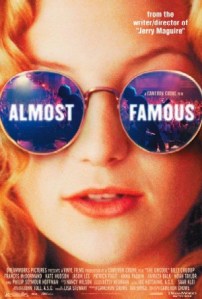
 Almost Famous is almost so many things. There are truly wonderful moments that channel certain aspects of our culture’s infatuation with rock n roll.
It’s easy to become entranced with the opening moments, not necessarily because we are introduced to William, his protective mother (Frances McDormand), or even his older sister (Zooey Deschanel) who looks to leave the nest behind to go off and find herself. To steal a line from Simon & Garfunkel, she goes off, “To look for America” and we can ride the wistful waves of Paul Simon’s lyrics to understand exactly what she means. But she also leaves behind a gift for her little brother under his bed. It’s easy to surmise that it’s drugs, something to “expand his horizons” but instead it’s so much more. It’s what this entire film hinges on: Music.
And when he opens the treasure trove of records his sister bequeathed him this is an initial kairos moment that also manages to be one of the most magical in the film–one that leaves goosebumps from sheer recognition. He flips through the albums. The Beatles, The Stones, Dylan, The Who, Led Zeppelin, Hendrix and on and on. Enough said. Each of these bands means so much to so many people as do some of these albums.
Almost Famous is at its best when it’s channeling those very things. Its soundtrack has the propitious fortune to include some authorized tracks from Led Zeppelin as well as Neil Young, David Bowie, and of course Elton John, his “Tiny Dancer” filling up the band’s bus with a chorus of voices in one of the most remembered sequences.
The film’s story is intriguing for the very fact that it has the potential to feel so personal in nature. It functions as a fictionalized autobiography of Cameron Crowe’s foray into rock journalism as a bit of a teenage prodigy from sunny San Diego who first wrote for Creem and then in the big leagues for Rolling Stone Magazine circa 1973.
That’s a narrative ripe with possibilities and anecdotes sure to pique the interest of anyone who loves music and there are certainly some of those moments. People jumping off rooftops into swimming pools their heads spinning on acid, tour buses crashing through gates to make a quick getaway from a horrible gig, and plane flights on the edge of death that elicit a long line of last-minute confessions.
But we are also reminded that life on the road is a grind, it can be dangerous too but more often than not it’s surprisingly dull. What happens to William (Patrick Fugit) is that he gets subjected to this life and far from changing, it simply changes how he sees these people. Ultimately, there’s a bit of disillusionment and alienation with getting that close to people you idolize. In many respects, he looks ridiculously out of place in this lifestyle of groupies, tour buses, backstage antics, sleazy hotel rooms, and sex, drugs, and rock n roll. He’s too clean cut. Too much of a straight arrow. And that’s part of what’s interesting.
But while it’s easy to latch onto the trajectory of our character and care about his growth and maturity, the themes of Almost Famous feel muddled and not in a way that’s enigmatic and mysterious. It just drops off at a certain point.
It’s almost transcendent, almost a masterstroke, almost captures our heart but it’s not quite there. Despite its best efforts it somehow still feels slightly removed from the moment it comes out of–a moment that now is easy to eulogize about as both electric and exciting in a way that the band Stillwater never is. Maybe that’s the point.
We can reiterate again and again that the music is phenomenal and while the situations had potential to be gripping they never quite reached that apex. Everything is quite satisfactory, it’s enjoyable watching this wide-eyed lad follow around this rock band, but there are moments when the film drags. Take the rock and roll out of these people and they aren’t altogether compelling. That might be an unfortunately cruel thing to say too.
But Lester Bangs (Phillip Seymour Hoffman) the famed rock critic repeatedly notes that rock is on the way out and this film seems to surmise as much. At times it doesn’t feel completely caught up in the throes of its time, it’s not caught up in the moment as if there’s this subconscious feeling that it will all come to an end.
On the reverse side, William lives life alongside some of these figures who are never truly all that magnetic or memorable whether Russell (Billy Crudup) or even the iconically named Penny Lane (Kate Hudson). The name dropping and connections to others make them the most intriguing. Dinner with Dylan here, something from David Crosby there. Led Zeppelin fanboys, David Bowie’s manager, and so on and so forth. Those connections have cultural clout still but once again the fictional Stillwater were only almost famous. Their name whether in fiction or reality has been lost to time and there’s no aura to them. Because we have nothing to sink our teeth into.
Maybe it’s the very fact that the film does this so well that it feels unremarkable. It takes time on those who really didn’t matter in the grand scheme of rock ‘n roll when the critics and pundits got together to write the narrative that would be accepted for a historical fact from that point forward.
However, Almost Famous also takes a particular care to show what it was and still is to be a rock star in this kind of volatile lifestyle always on the road. The fame and applause are amplified but so in many ways are the heartbreaks and ultimately the scrutiny that can either make or break you. There’s no privacy in the general sense. But that’s the point, as a rock star you give much of that up. The question is, what happens when you’re in the middle ground? You’re not quite there but the journalists are still looking for their story, digging through your music, life, and affairs. No one has ever desired to be Almost Famous because, in some cases, you get the worst of both worlds.
4/5 Stars
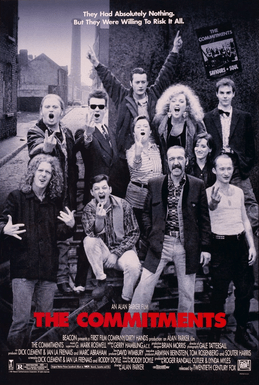 The Commitments is a very coarse film, extremely rough around the edges, and yet to its credit, the real appeal of this crowd-pleaser from Alan Curtis is the way that music is able to bring so much good into a dire situation. Because in some ways The Commitments are not just the christened “Saviors of Soul” but for one brief shining moment, they’re the “Saviors of Dublin” too.
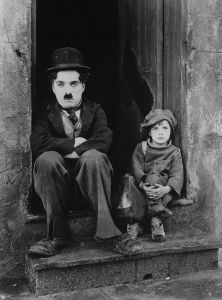 “A picture with a smile — and perhaps, a tear…”
 In Manchester by the Sea, you can distinctly see Kenneth Lonergan once more translating some of his skills as a playwright and stage director into his film. There’s a very inherent understanding of two-dimensional space and how images can be framed in a very linear way as they would be seen by an audience taking in a stage production. But even more noteworthy than that is his dialogue which functions in remarkably realistic ways. Some will easily write this film off as the sheer doldrums because it’s fairly fearless in its pacing.
 Upon watching A Few Good Men for the first time, it was hard not to draw parallels with An Officer and a Gentlemen for some reason and it went beyond some cursory elements such as both films involving branches of the military. Perhaps more so than that is the intensity that manages to surge through the plot despite the potentially stagnant battleground like Cadet Schools, Courtrooms, and the like. And that can in both cases is a testament to the stellar performances in front of the camera.
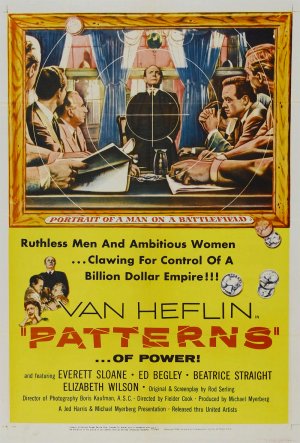 Patterns has little right to be any good. It takes place almost exclusively in interiors. Boardrooms, offices, hallways, at desks, and in elevators. But thanks to a fantastic teleplay from Twilight Zone mastermind Rod Serling, this little picture exceeds the meager expectations placed on it. In fact, it was a major hit when it came out as a live television drama, so successful that it was performed a second time and subsequently developed into this film version.
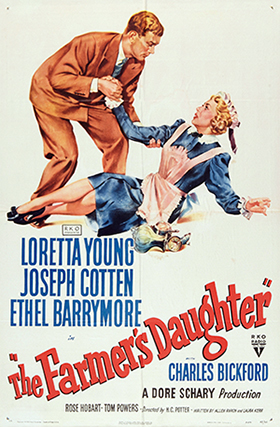 Whatever our criticisms of the previous generations, there’s still something within me that sees something uniquely compelling about films of old. Hollywood in the 30s and 40s could sugar coat, they could oversell the drama, but there was also a general decency that pervaded many of those films.
 Like the fella says, in Italy for 30 years under the Borgias they had warfare, terror, murder, and bloodshed, but they produced Michelangelo, Leonardo da Vinci, and the Renaissance. In Switzerland they had brotherly love – they had 500 years of democracy and peace, and what did that produce? The cuckoo clock.
 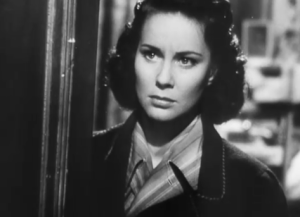 Joseph Cotten is surprisingly compelling as the poor, unfortunate stiff and it’s hard not to feel sorry for him in his ignorance because we can relate with him. Alida Valli is striking as the aloof beauty who nevertheless has an unswerving affection for her former love that remains the only joyous thing in her current existence. Then, of course, there’s Orson Welles as the charismatic myth of a man–arguably the most intriguing supporting character there ever was even if it’s mostly thanks to the legend created by those who knew him.
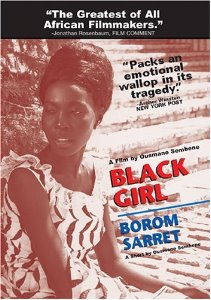 What’s fascinating about this film is how it manages to give voice to those who are normally silenced and even in her subservience this narrative powerfully lends agency to a young Senegalese woman’s perspective. Because even when she is silent and words are not coming out of her mouth and her status ultimately makes her powerless, the very fact that her mind is constantly thinking, her eyes observing and so on mean something. Inherently there’s a great empowerment found there even if it’s only known by her and seen by the outside observer peering into her life. That’s part of her. We are given a view into what she sees. We can begin to understand her helplessness and isolation. Where she came from and the life she left behind. Giving up the master narrative of the entitled and shown the flip side of the world for once.
 4 Star Films