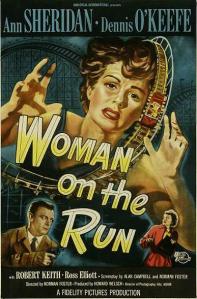
Woman on the Run (1950)

Woman_on_the_RunB-films have little time to waste and this one jumps right into the action. In a matter of moments, a man is shot, another man has killed him and a third witness gets away into the night. Although Frank Johnson (Ross Elliot) is rounded up by the police to be a witness he gives them the slip for an undisclosed reason and they must spend every waking hour trying to track him down.

What’s important to this particular story is that he left behind his wife Eleanor (Ann Sheridan) to be questioned by the police and they are hurting for a break. They need answers so they slam her with all sorts of inquiries.

She’s not all that cooperative though and the reasons are rather hard to discern. Is it belligerence, fear, or sheer apathy to the entire ordeal? Because you see, Ms. Johnson for some time had been drifting apart from her husband an accomplished painter who nevertheless put little stock in his own skill.

And that’s where the film’s two themes begin to intertwine.  The police surmise that the runaway man is fleeing a killer, but for his wife the implications are twofold. In her eyes, he’s just as likely running away from a marriage he couldn’t cope with. That is her dilemma which she masks both pointedly and inadvertently with various diversions to keep the police reeling.  After all, she’s not particularly keen on helping them or sticking around for that matter.

Whereas in earlier roles Ann Sheridan was always slightly overshadowed by other performers, most notable of those being the always electrifying James Cagney, here she gives perhaps her finest performance and she’s at the center of it all. That’s not to say she isn’t surrounded by a stellar supporting gallery.

Dennis O’Keefe, remembered as a gritty leading man in pictures such as T-Men and Raw Deal, showcases a new playful side as a journalist trying to nab a scoop on the runaway witness and at the same time making eyes at the man’s bride. But he manages to give the part some life that goes far beyond a one-dimensional characterization. There’s more to him as we soon find out.

The other important player turns out to be Inspector Ferris (Robert Keith) who as the long arm of the law is looking to find his man before his adversary does. But he’s not about to take flack from anyone and if ever there was a cop who was no-nonsense he fits the bill. His croaking voice always interrogating his subjects in a continuous effort to get his job done. Too bad he wasn’t quite counting on Ann Sheridan.

A relentless climax aboard a roller coaster at a local amusement park precedes Hitchcock’s Strangers on the Train when it comes to making carnival games such a deadly ordeal. And there are hints along the way ratcheting up the tension whether it’s a familiar cigarette lighter, a striking coincidence, or a passing remark that initially goes unnoticed.

The script strikes a strange path at times given to clunky expositional dialogue that feels as trite as can be and then in the very next sequence there’s a bit of patter or a dry quip that makes things all the more interesting. Also, a pair of small supporting roles for Victor Sen Yung and Reiko Sato add another layer of authenticity to the characterization only surpassed by the on location shooting that catches the essence of mid-century San Francisco.

In the end, Woman on the Run turns out to be one of those wonderful treasures that has rather unfairly gotten buried in the dusty attic of film noir. But far from being an antique, it plays fairly well today with an underlying tension running through Sheridan’s performance as she not only reflects on her own dwindling marriage but stresses to discover her husband’s whereabouts in fear of his very well-being.

It’s surprisingly entertaining and you get the sense that if Norman Forster (a fairly prolific actor, director, and screenwriter) were someone other than Norman Forster, this picture might have been scrutinized more closely. As it is, it’s just waiting for more people to dredge it up. How did I get here? If you’re a sucker for film noir and Ann Sheridan there’s no better place to go than Woman on the Run.

3.5/5 Stars

Review: Mr. Smith Goes to Washington (1939)

James_Stewart_in_Mr._Smith_Goes_to_Washington_trailer_cropThe opening credits roll and recognition comes with each name that pops on the screen. Jean Arthur, James Stewart, Claude Rains, Edward Arnold, Guy Kibbee, Thomas Mitchell, Eugene Palette, Beulah Bondi, H.B. Warner, Harry Carey, Porter Hall, Charles Lane, William Demarest, Jack Carson, and of course, Frank Capra himself.

We are met with the ubiquitous visage of Charles Lane calling in a big scoop on the telephone. A senator has died suddenly. The likes of Porter Hall and H.B. Warner fill the Senate Chamber presided over by a wryly comic VP, Harry Carey. Corruption is personified by the flabby pair of Edward Arnold and Eugene Palette while Claude Rains embodies the tortured political journeyman. The eminent members of the press include not only Lane but the often swacked Thomas Mitchell and a particularly cheeky Jack Carson.

To some people, these are just names much like any other but to others of us, linked together and placed in one film, these figures elicit immense significance and simultaneously help to make Mr. Smith Goes to Washington one of the most satisfying creations of Hollywood’s Golden Age from arguably “The Greatest Year in Cinematic History.”  The acting from the biggest to the smallest role is a sheer joy to observe as is Capra’s candid approach to the material.

As someone with a deep affection for film’s continued impact, it gives me great pleasure that stories such as Mr. Smith exist on the silver screen if only for the simple fact that they continually renew my belief in humanity, whatever that means. Because it’s an admittedly broad, sweeping statement to make but then again that’s what Frank Capra was always phenomenally skilled at doing. He could take feelings, emotions, beliefs, and ideals synthesizing them into the perfect cultural concoctions commonly known as moving pictures.

But his pictures always maintained an unfaltering optimism notably in the face of all sorts of trials and tribulations. He never disregarded the corruption dwelling in his stories–it was always there–in this case personified by the stifling political machine of Jim Taylor gorging itself off the lives of the weak and stupid.

The key is that his narratives always rise above the graft and corruption. They latch onto the common everyday decency, looking out for the other guy, and in some small way uphold the great commandment to love thy neighbor.

Politics have never been my forte. Like many others, I’m easily disillusioned by “politics” as this becomes a dirty word full of arrogance, partisanship, and scandal among other issues. It seems like the founding principles that laid the groundwork for this entire democracy often get buried under pomp & circumstance or even worse personal ambitions.

Although this film was shot over 75 years ago everyone who’s been around the block lives as if that’s the case then too and so they’re not all that different from today at least where it matters. Cynicism is a hard thing to crack when it runs through the fabric of society from the politicians, to the newspapers, all the way down to the general public. It’s not hard to understand why. Still, the genuine qualities of a man like Jefferson Smith can act as a bit of an antidote. He as a character himself might be a bit of an ideal, yes, but I’d like to have enough faith to believe that people with a little bit of Jefferson Smith might still live today.

Common, everyday people who nevertheless are capable of extraordinary things like standing up for what’s right when they know that no one else will or when they know all that waits for them at the end of the tunnel is disgrace. But the promise of what is beyond the tunnel is enough. That is true integrity to be able to do that and those are the causes worth cheering for when David must fight Goliath and still he somehow manages to overcome. That’s the chord Mr. Smith strikes with me. thanks in part to Capra’s vision but also Stewart’s impassioned embodiment of those same ideals.  He has a knack for compelling performances to be sure.

Time and time again James Stewart pulls me in. His career is one of the most iconic in any decade, any era no questions asked. There are so many extraordinary films within that context perhaps many that are technically or artistically superior to Mr. Smith by some  estimations, but he was never more candid or disarming than those final moments in the senate chambers as he fights for his life — clinging to the ideals that he’s been such a stalwart proponent for even as his naivete has been mercilessly stripped away from him.

In the opening moments, his eyes carried that glow of honest to goodness optimism, his posture gangly and unsure represented all that is genuine in man. Now watching those same ideals and heroes come back to perniciously attack him, he presides with almost reckless abandon. Is he out of his mind? At times, it seems so, but as he wearies, his hair becomes more disheveled, and his vocal chords have only a few rasps left he still fights the good fight. There’s an earnest zeal to him that’s positively palpable.

As our stand-in, Saunders (Jean Arthur) first writes him off as a first class phony or at the very least a political stooge ready to do another man’s bidding but she does not know Jefferson Smith though she does grow to love him. And Arthur’s performance truly is a masterful one because without her Smith would hardly be the same figure. She brings out his naivete by sheer juxtaposition but she also puts the fight back into him because he brought a change over her that in turn rallies him to keep on pushing. They’ve got a bit of a mutually symbiotic relationship going on in the best way possible. You might call it love.

Capra repeatedly underlines Smith’s honesty and genuine nature not only through numerous rather simplistic montages of Capitol Hill and the surrounding national monuments but in the very way his character carries himself around others. He never assumes a position of superiority. He’s always humble. He sees the inherent need to raise up young people well so that they might progress to become the leaders of tomorrow with a great deal to offer our world. He fumbles with his hat in the presence of pretty girls and holds his idols in the highest esteem. It’s all there on Stewart’s face and in his actions. We too comprehend the solemnity and the gravity that he senses in the office of the Senate.

While this was not Jimmy Stewart’s debut and it was only at the beginning of a shining career as has already been noted, it was in these moments that the cinematic world fell in love with him. He can’t be licked and for good reason. He was never one to give up on lost causes just like his father before him.

I guess this is just another lost cause, Mr. Paine. All you people don’t know about lost causes. Mr. Paine does. He said once they were the only causes worth fighting for, and he fought for them once, for the only reason any man ever fights for them: Because of one plain simple rule: Love thy neighbor. ~ James Stewart as Jefferson Smith

5/5 Stars

Review: Mr. Deeds Goes to Town (1936)

Gary_Cooper_in_Mr._Deeds_Goes_to_Town_trailer“He could never fit in with our distorted viewpoint, because he’s honest, and sincere, and good. If that man’s crazy, Your Honor, the rest of us belong in straitjackets!” ~ Jean Arthur as Babe Bennett

Mr. Deeds Goes to Town is a true treasure of idealism and Americana. People, especially now, may have many quibbles with the films of Frank Capra because he was the undisputed champion of feel good cinema that revelled in happy endings, stalwart honesty, and the little guy being permitted a fighting chance.

It’s no wonder that he made such good use of the likes of Gary Cooper and James Stewart because they embodied common, everyday American decency like few other actors could ever claim. Admittedly it’s easy to belittle his pictures as saccharine and sentimental to the nth degree but beyond that Capra always seemed to have an inherent sense of what America stood for or at least what he believed it could and still can stand for.

Every man deserves a certain amount of respect. You might call them inalienable rights like life, liberty, and the pursuit of happiness. And any force that tries to impede that is in simple terms an affront to all humanity. Because though we might all think we’re different, we share a lot more similarities than we often want to concede. It’s easy for us to forget that and that’s what happens here.

Longfellow Deeds (Cooper) becomes the overnight talk of the town because his rich uncle dies in a horrible car crash and bequeaths his wealth to his unsuspecting nephew. It’s the kind of good fortune that others drool over but in Deeds’ hands, he takes it in stride. He comes off as a real Yokum from the one horse town of Mandrake Falls but if anything Deeds is incredibly smart. He realizes he can have contentment out of the limelight and with very little. He enjoys quiet days oftentimes filling idle hours with his prized tuba and poetry that he writes for postcards.

But his new status as a millionaire forces him into the life that he doesn’t much want. Mansions and butlers, folks looking for handouts, ravenous newspapermen (and women) and conniving lawyers. Front and center is Mr. Cedar (Douglass Dumbrille). It’s these very individuals who see Deeds as a ridiculous outsider to be belittled and taken advantage of.

The brilliance of Capra’s movie is that he makes his hero, while simple and practical, still very astute. He may have his many quirks but there’s a surprising amount of business acumen and common sense flowing through his veins that consequently sends everyone else for a loop. He spies phonies from a mile of away and he looks to reform the local opera while finding ways to spend his newfound fortune sagaciously.

The only thing he’s not watching out for is a pretty girl, journalist Louise “Babe” Bennett (Jean Arthur) is ready to nab him, capturing his heart and simultaneously giving the whole city a front row seat to his exploits about town from quarrels with a snooty circle of poets to an evening jaunt ending on a fire engine. She’s a pro at spinning the tale into one of a first class boob, christening him the “Cinderella Man” that the whole world laughs at. They eat it up and they want to see him fall–this idiotic nobody suddenly being scrutinized by society for his good fortune. It’s all rather unfair but oftentimes that’s the way the world turns. It’s a cruel and sometimes curious place.

Because while Deeds grows fed up with this whole lifestyle, ready to leave it all behind him, Babe finds herself truly falling for her project since he models something she rarely sees in a man — real honest to goodness integrity that guides his every action. There’s never a false pretense or a veiled intention. What you see is what you get. Ironically enough, in this land of fakes, she’s the only “real” person he thinks he’s met. And she knows what’s been going on, going so far as to tell her editor that she’s quitting. There’s no way she can keep up the charade only injuring the character of the one she loves more and more.

But of course, everything dives into the depths of despair when Deeds is sent to trial calling into question his sanity after he resolves to use $18,000,000 to portion off acres of land to destitute farmers to work for him. It’s utter lunacy, isn’t it? The workers line up around the block leading into his home as he offers them a chance at a real life without starving children and food lines every day. This is what Cedar, Cedar, Cedar, and Blumenfeld are bringing him to court for or is it the fact that they want a portion of his fortune? Yes, that just might be it.

Anyways, far worse than that fate is the fact that he thinks his girl has betrayed him and she has in a sense, but she’s also devoted to him by now. She watches helplessly as her man gets railroaded. She began as the one to crucify him in the tabloids and now she prepares to watch him get crucified in the courtroom. In these moments, he does take on a Christ-like post watching all the proceedings without a word. He never makes any effort to defend himself after accusation after accusation is thrown his direction.

But the bottom line is that he does not have to let himself be destroyed. Being the martyr, in this case, is not his job and Capra lifts him out of the pit and resurrects him. The fact that Louise fights for him and numerous others including his cynical right-hand man Cornelius Cobb (Lionel Stander) and the local newspaper editor (George Bancroft), not to mention a legion of grateful farmers. So Mr. Deeds ends with a tumultuous courtroom finale befitting one of Capra’s finest pictures. It brims with goodness and bubbles over with humor that constantly underlines this feel good classic.

Though Gary Cooper represents Capra’s love of the every man with common decency and common sense, Jean Arthur remains equally crucial to the worlds that he creates. It has to do with her quality as an actor that allows her to play the snappy, witty, world-wearied types. Because she represents all the many people with that very same cynical streak and yet the very fact that her heart can be melted and her whole mindset can be changed suggests that there might be hope for all of us. That hope burgeons up from Mr. Deeds and leaves us with a warm feeling indeed.

4.5/5 Stars

A Christmas Tale (2008)

achristmastaleposterThe initial inclination for seeing Arnaud Desplechin’s sprawling family drama was the presence of the estimable Catherine Deneuve. And she’s truly wonderful giving a shining, nuanced performance that makes the audience respect her, sympathize with her, and even dislike her a little bit. But the same goes for her entire family. The best word to describe them is messy. Dysfunctional is too sterile. Messy fits what they are. If you think your family is bad around the holidays, the Vuillards have a lot of their own issues to cull through.

The inciting incident sends a shock wave through their already crumbling family unit. Their matriarch has been diagnosed with bone marrow cancer and must make the difficult decision of whether or not to risk treatment or go without. But Deneuve carries herself with that same quietly assured beauty that she’s had even since the days of Umbrellas of Cherbourg. In this capacity, she makes A Christmas Tale, far from a tearful, sobfest. She’s strong, distant, and you might even venture to say fearless.

And because of her strength, this story is not only about her own plight – it’s easy to downplay it because she is so resilient – but it frames the rest of the interconnecting relationships. It began when her first son passed away. The children who followed included Elizabeth (Anne Cosigny) who became the oldest and grew up to be a successful playwright. Junon’s middle child Henri (Mathieu Amalric) can best be described as the black sheep while the youngest, Ivan, was caught in the midst of the familial turmoil.

Because the issues go back at least five years before Junon gets her life-altering news. It was five years ago that Elizabeth paid Henri’s way out of an extended prison sentence (for a reason that is never explained) with the stipulation that she never has to see her brother again. Not at family gatherings, not for anything. And she gets her way for a time.

But with Junon’s news she and her husband Abel (Jean-Paul Roussillon) realize this is a crucial time to get their family back together because, above all, their matriarch needs a donor and due to her unique genetic makeup, a family member is her best bet.

Underlying these overt issues are numerous tensions that go beyond sibling grudges and sickness. Elizabeth’s own relationships have been fraught with unhappiness and her son Paul has been struggling through a bout of depression. Ivan and his wife (Chiarra Mastroianni) are seemingly happy with two young boys of her own. But old secrets about unrequited love get dredged up and Sylvia is looking for answers of her own. Although it’s a side note, it’s striking that Chiarra Mastroianni is Deneuve’s real-life daughter and in her eyes, I see the spitting image of her father, the icon, Marcello Mastroianni.

There’s also a lot of truth and honesty buried within A Christma Tale and in most competitions, it would win for the most melancholy of yuletide offerings. However, it’s important to note that its darkness is balanced out with romance, comedy, and a decent dose of apathy as well.

Still, the most troubling thing about A Christmas Tale is not the fact that it is extremely transparent, but the reality that the themes of Christmas have no bearing on its plot. We leave these characters different than they were before but whether they are better for it is up for debate.

The sentimentality of a It’s Wonderful Life crescendo would be overdone and fake in this context but some sort of reevaluation still seems necessary. Because without faith in anything — faith in their family is ludicrous — their world looks utterly hopeless. The two little grandsons wait in front of the nativity staying up to get a glimpse at Jesus (perhaps mistaken for Santa Claus) and their father calmly states they should go to bed because he’s never existed anyways. And there’s nothing inherently wrong with holding such beliefs.

Even the fact that Junon and her grown son Henri attend midnight mass is an interesting development. But during this season emblematic of hope and joy, it seems like the Vuillard’s can have very little of either one. Henri can be his mother’s savior for a time by extending her life for 1.7 years or whatever the probabilities suggest. But then what?

It’s this reason and not the family drama that ultimately makes A Christmas Tale a downer holiday story. Its denouement feels rather like a dead end more than fresh beginnings. Because Nietzche and coin flips are not the most satisfying ways to decipher the incomprehensibility of life – especially with death looming large during the holidays.

But that’s only one man’s opinion. That’s not to downplay all that is candid about this film in any way. If you are intrigued by the interpersonal relationships and entanglements of a family  — may be a lot like yours and mine — this film is an elightening exposé.

3.5/5 Stars

A Tale of Two Cities (1935)

a tale of two cities 1.png

It’s no surprise that this adaptation begins with that oft-repeated bit of poetic parallelism. “It was the best of times it was the worst of times” etc. Of course, in its abridged format the opening suggests the universal quality of those iconic words. It was a period very much like the present.

The scene is set. What follows are images that prove to be deliciously atmospheric with a loving mixture of British colloquialism and Hollywood storytelling all stirred together in an agreeable period drama.

Perhaps the highest compliment I can pay this film, directed by Jack Conway, is that it manages to capture some of the essence of Dickens’ novel even if it does not wholly enrapture me as the source material did those many years ago in my freshman honors English class.

The beauty of literature is that it allows you to create pictures in your head — to let your imagination run rampant — the magic of film is how it allows for such spectacles to be brought to us visually though they might come out imperfectly. Owing to length and practicality, it cannot completely transcribe every last detail onto the screen resorting to jumps in time and abridging of the text.

In fact, a slight criticism is that the film resorts to title cards too much. Still, there are some inspiring moments including the climactic storming of the Bastille sequences courtesy of that inspired combination of Val Lewton and Jacques Tourneur. It’s simultaneously harrowing and marvelously condenses the sweeping forces of the mob rule’s swift rise during the French Revolution into a matter of brief images that overwhelm with their sheer scope and ferocity.

Also, whether this film succumbs to pure histrionics or is instead an impassioned interpretation of Charles Dickens’ material is up for debate but there is no denying that there is a pleasing texturing to many of the most prominent characterizations.

Though a minor part, Basil Rathbone that legendary villain turns in one of his myriad performances as a heartless French nobleman. Whereas Miss Pross is played with endearing yet resolute defiance by Edna May Oliver. Both Lucie Manette and Charles Darnay exude a certain geniality that we’ve come to attribute to the roles. They are less interesting but necessary for the story to have any magnitude.

The most telling difference in depictions for me was in the character of Mr. Lorry (Charles Gillingwater) likened to a crotchety old coot though Dickens paints a picture of him that feels much more reserved and similarly steadfast. I would know because out of all the many figures, I always resonated with him a man who remained a supporting player but nevertheless reflected fine qualities of loyalty and quiet integrity.

But of course, we must inevitably come to Sydney Carton. In the book, he transforms into our hero coming to the fore among a wide array of other characters but with Ronald Colman undoubtedly the biggest star in our film we are conveniently tipped off to his crucial importance and he is vital to the story.

It could have been all too probable that like The Prisoner of Zenda, Ronald Colman could have taken a double role because (SPOILER ALERT) Dickens’ original novel hinges on the likeness of Charles Darnay and Sydney Carton. But in this case, it’s almost a stroke of good fortune that Colman was only given one part.

In it, Ronald Colman plays the brilliant young solicitor who nevertheless spends most of his evenings with his snout in a bottle wasting so much of his talent toward purposeless diversions. He’s a charming fellow but he seems hardly a person of note. But that’s not the final word.

Colman is aptly able to focus all his energies on the man and he’s further allowed to embody one of the great redemption tales in all of English literature. It seems he knew it too, willingly relinquishing his iconic and beloved mustache in deference to the role which no doubt was one of the defining moments of his career.

There’s also no denying the transcendent themes that course through this narrative and reveal themselves much as we would expect. Because this is a story of ultimate sacrifice and a very overt evocation of the Christ story.

Thus, it seems no small coincidence that as Carton takes part in a selfless act that will define his life the trills of “Come All Ye Faithful” quietly play in the background. The inference is plain. Though, it’s a political fable as well a spiritual one, Carton’s words are what entrench themselves into the viewer’s consciousness, “It is a far, far better thing that I do, than I have ever done; it is a far, far better rest that I go to than I have ever known.” Some might vehemently disagree but this is a Christmas film if ever there was one. Because it points to hope even in the darkest times. That’s how those paradoxical lines can stand true. It was the worst of times but also the very best.

4/5 Stars

Almost Famous (2000)

Almost_famous_poster1Almost Famous is almost so many things. There are truly wonderful moments that channel certain aspects of our culture’s infatuation with rock n roll.

It’s easy to become entranced with the opening moments, not necessarily because we are introduced to William, his protective mother (Frances McDormand), or even his older sister (Zooey Deschanel) who looks to leave the nest behind to go off and find herself. To steal a line from Simon & Garfunkel, she goes off, “To look for America” and we can ride the wistful waves of Paul Simon’s lyrics to understand exactly what she means.  But she also leaves behind a gift for her little brother under his bed. It’s easy to surmise that it’s drugs, something to “expand his horizons” but instead it’s so much more. It’s what this entire film hinges on: Music.

And when he opens the treasure trove of records his sister bequeathed him this is an initial kairos moment that also manages to be one of the most magical in the film–one that leaves goosebumps from sheer recognition. He flips through the albums. The Beatles, The Stones, Dylan, The Who, Led Zeppelin, Hendrix and on and on. Enough said. Each of these bands means so much to so many people as do some of these albums.

Almost Famous is at its best when it’s channeling those very things. Its soundtrack has the propitious fortune to include some authorized tracks from Led Zeppelin as well as Neil Young, David Bowie, and of course Elton John, his “Tiny Dancer” filling up the band’s bus with a chorus of voices in one of the most remembered sequences.

The film’s story is intriguing for the very fact that it has the potential to feel so personal in nature. It functions as a fictionalized autobiography of Cameron Crowe’s foray into rock journalism as a bit of a teenage prodigy from sunny San Diego who first wrote for Creem and then in the big leagues for Rolling Stone Magazine circa 1973.

That’s a narrative ripe with possibilities and anecdotes sure to pique the interest of anyone who loves music and there are certainly some of those moments. People jumping off rooftops into swimming pools their heads spinning on acid, tour buses crashing through gates to make a quick getaway from a horrible gig, and plane flights on the edge of death that elicit a long line of last-minute confessions.

But we are also reminded that life on the road is a grind, it can be dangerous too but more often than not it’s surprisingly dull. What happens to William (Patrick Fugit) is that he gets subjected to this life and far from changing, it simply changes how he sees these people. Ultimately, there’s a bit of disillusionment and alienation with getting that close to people you idolize. In many respects, he looks ridiculously out of place in this lifestyle of groupies, tour buses, backstage antics, sleazy hotel rooms, and sex, drugs, and rock n roll.  He’s too clean cut. Too much of a straight arrow. And that’s part of what’s interesting.

But while it’s easy to latch onto the trajectory of our character and care about his growth and maturity, the themes of Almost Famous feel muddled and not in a way that’s  enigmatic and mysterious. It just drops off at a certain point.

It’s almost transcendent, almost a masterstroke, almost captures our heart but it’s not quite there. Despite its best efforts it somehow still feels slightly removed from the moment it comes out of–a moment that now is easy to eulogize about as both electric and exciting in a way that the band Stillwater never is. Maybe that’s the point.

We can reiterate again and again that the music is phenomenal and while the situations had potential to be gripping they never quite reached that apex. Everything is quite satisfactory, it’s enjoyable watching this wide-eyed lad follow around this rock band, but there are moments when the film drags. Take the rock and roll out of these people and they aren’t altogether compelling. That might be an unfortunately cruel thing to say too.

But Lester Bangs (Phillip Seymour Hoffman) the famed rock critic repeatedly notes that rock is on the way out and this film seems to surmise as much. At times it doesn’t feel completely caught up in the throes of its time, it’s not caught up in the moment as if there’s this subconscious feeling that it will all come to an end.

On the reverse side, William lives life alongside some of these figures who are never truly all that magnetic or memorable whether Russell (Billy Crudup) or even the iconically named Penny Lane (Kate Hudson). The name dropping and connections to others make them the most intriguing. Dinner with Dylan here, something from David Crosby there. Led Zeppelin fanboys, David Bowie’s manager, and so on and so forth. Those connections have cultural clout still but once again the fictional Stillwater were only almost famous. Their name whether in fiction or reality has been lost to time and there’s no aura to them. Because we have nothing to sink our teeth into.

Maybe it’s the very fact that the film does this so well that it feels unremarkable. It takes time on those who really didn’t matter in the grand scheme of rock ‘n roll when the critics and pundits got together to write the narrative that would be accepted for a historical fact from that point forward.

However, Almost Famous also takes a particular care to show what it was and still is to be a rock star in this kind of volatile lifestyle always on the road. The fame and applause are amplified but so in many ways are the heartbreaks and ultimately the scrutiny that can either make or break you.  There’s no privacy in the general sense. But that’s the point, as a rock star you give much of that up. The question is, what happens when you’re in the middle ground? You’re not quite there but the journalists are still looking for their story, digging through your music, life, and affairs. No one has ever desired to be Almost Famous because, in some cases, you get the worst of both worlds.

4/5 Stars


The Commitments (1991)

The_Commitments_posterThe Commitments is a very coarse film, extremely rough around the edges, and yet to its credit, the real appeal of this crowd-pleaser from Alan Curtis is the way that music is able to bring so much good into a dire situation. Because in some ways The Commitments are not just the christened “Saviors of Soul” but for one brief shining moment, they’re the “Saviors of Dublin” too.

It feels almost unfair to call The Commitments a cover band because although their debt is to soul and they cover soul tunes from the likes of the late great Wilson Pickett, from those tunes we begin to see the individuals coming into their own as together they create a sound that has the local crowds cheering in the bars and pool halls.

Their visionary leader is Jimmy Rabbitte a young man with ambitions to create a successful band that will play real music and in his humble opinion soul is where it’s at. Not the Beatles. Not the Stones. Not even U2. But the likes of “The Godfather of Soul” himself James Brown.

Far from being mere cultural appropriation, taking a very much African-American inspired music and imitating it, with The Commitments, their allegiance to soul seems to suggest mimicry is the highest form of flattery. And it seems like Jimmy as manager and the main ringleader sees this clearer than anyone else.

Soul represents something so simple and powerful and moving. A sound that speaks to the working class Dubliners in a way other strains of music simply cannot muster. So yes, Irish Soul sounds like an oxymoron but The Commitments prove that far from being incongruous, Irish Soul is capable of quite the following.

Part of the enjoyment is getting to know all the figures who play a part in the band’s journey and there are quite a few. Deco is the lead singer, a slobbish jerk who also has an impressive pair of pipes. Lead guitarist Outspan (Glen Hansard of Once fame) with other local lads filling in on saxophone, bass, and drums. The backing vocals are provided by a trio of gals including the fawned over beauty Imelda.

But the oldest member of the band Joey “The Lips” Fagan is a rather mythical figure with a laid back almost spiritual streak. It’s also no joke that he’s played trumpet with some of the biggest soul brothers out there. He too provides guidance to the band’s vision but sometimes he’s not as zen as he lets on. Getting so many different people together is bound to cause friction — namely shouting matches, fistfights, and more than a few hurt feelings. Strangely enough, these are some of the very places the story finds its comic inspirations. People constantly bickering and getting on each other’s nerves in this way or that.

Equally enjoyable are the actual rehearsals and jam sessions which in truth are the heart and soul of this film. No pun intended. The music is what matters in the community from street corner performances of Cathy’s Clown, a father belting out his best rendition of Elvis, and the most wholesome member of the Commitments, Steven, playing a rather soothing version of Whiter Side of Pale on a grand church organ. That’s the stuff that makes the movie buzz.

We see the energy that gets people to notice. Sure, it’s not the type of coverage that will make them into international sensations but with this film much like its progeny like Sing Street, you see the pure ability of music and song to enrich the world. They not only give the musicians a powerful avenue of expression and joy but those performances can evoke an equally gripping reaction from their audiences.

In the end, The Commitments as a group begin to split at the seams after a number of promising gigs, even a bit of cash for their efforts and a spot in the local paper. But in the end they implode and it’s probably for the best as everyone goes their separate ways. Maybe they never quite got around to jamming with Wilson Pickett, but they did play with him in spirit every time they put all their passion into one of his songs. It didn’t turn into some profound watershed moment in musical history, but like this film, it was a recurrently lively ride.

3.5/5 Stars

The Kid (1921)

The Kid 1“A picture with a smile — and perhaps, a tear…”

In his earliest works The Tramp made a name mostly for his antics but here Chaplin shows an innate understanding of pathos which would become his main calling card throughout his illustrious career because it was never just about the jokes. Surely, the Tramp is a gloriously funny character time and time again but that would mean nothing without his tender heart and soul. The qualities that in one sense make him “a tramp” but also allow him to win over the masses because there are very few figures who have ever been so endearing. If anything The Kid shows that The Tramp could also make a sympathetic father.

Edna Purviance is cast as a Hester Prynne type heroine except she gives up her child, an ignominious reminder of her transgressions, only to regret the decision later on. Because she has fortune smile upon her and with her destitution gone all she can think of is the child who she left behind — the child she lost. It leads her to spend many of her waking hours in charity paying visits to the poorest of the town, unwittingly bringing her in contact with the very son she is looking for.

Except he has grown up in the stead of the lowly Tramp who found him discarded by a rubbish pile. Though he’s at a bit of a loss of what to do with a small infant initially, he uses his general ingenuity and natural affections to take on the paternal role. Jackie Coogan is the boy, and the cutest, pluckiest kid you’ve ever seen with a floppy mop of hair often kept in check by an equally floppy cap. And it’s fitting that he would be the most prominent child stars before Shirley Temple or Jackie Cooper and all the rest because his adopted father was the patriarch of Hollywood.

There’s an inherent chemistry that just simply works between Chaplin and Coogan as they sit around their humble flat together eating pancakes or traipsing around town shattering/repairing window panes. Some of the street scenes especially share striking similarities to Chaplin’s Easy Street as he must face off against the town thug and authoritarian policemen while his son battles it out with a pint-sized bully. Both throw wickedly hilarious haymakers.

Strikingly, in this narrative, Chaplin leaves behind the more simplistic themes of his earlier shorts to go for more lofty territory and it pays heavy dividends. There’s also an indisputable spiritual undertone to the film that becomes evident through numerous allusions. First, with the women and making her into a sort of scandalized martyr. Going so far as to intercut her tragedy with an image of Christ carrying his cross up to Golgotha to give his life for all humanity. It’s certainly hyperbole but also an astute piece of storytelling. Because no matter your religious belief, there’s no doubt this parallel casts our heroine in a sympathetic light as well as Chaplin’s rather overt choice of placing her in front of a stain glass window giving her a makeshift halo.

In the film’s waning moments, the heavenly dreamscape of harps, angels, and yes even a few demons fill up the Tramp’s head and give Chaplin yet another creative avenue as his visions take him into a world rife with whimsical antics that signal a change. Whether or not the new heaven and earth are realistic is nominally beside the point because they suggest the joys that are ahead for the Tramp and his adopted child.

Fittingly he’s reunited with his son in the residence of the woman who welcomes them both in.The lost get found, the downtrodden get lifted up, and all can be redeemed. A fluffy conclusion, perhaps, but an enjoyable one nonetheless from one of the seminal masters of storytelling. You can make the argument that there were greater directors than Chaplin but he truly was second to none not only as an actor but in building a universal connection with his audience. A connection that still manages to reach out to us earnestly nearly a century later.

4.5/5 Stars

Casablanca (1942): 75th Anniversary Review

Casablanca,_Trailer_Screenshot.JPG

When someone inquires if I consider Casablanca one of my favorite movies, I don’t quite know how to respond. Yes, I do love this film passionately but I feel as if Casablanca is more deeply America’s favorite classic movie. It is not for me to call my own and I will gladly share a joint appreciation for it. Because it’s a film for all of us. As it should be. It’s the perfect articulation and expression of that former Hollywood that existed during the studio age as brought to us by Michael Curtiz.

When we are finally allowed to enter into Rick’s Cafe Americain, it almost feels like hallowed ground. It’s a mythical place that never existed in reality and yet feels so immersive to us as an audience. Curtiz moves through the space with such intent that it makes us completely involved with every person his camera settles on. This is a picture for romantics and sentimentalists to be sure but it caters to those with a cynical edge too. It suggests a deceitful world of pickpockets, unscrupulous officials, and of course, Nazis.

The political tides of the times are reflected in that cinematic bastion of a man Rick Blaine (Bogart). His foreign policy is that he sticks his neck out for no one. But that’s only on the surface. That’s the beauty of the character. There’s a sensitivity and a sacrificial nature that wells up deep inside him, hidden from view. Tortured and embittered as he is, that is not the last word.

There’s also an undeniable undercurrent to the film. Yes, this is not reality. As enveloping as it is, this is wholly a Warner Bros. aesthetic but moreover there’s a sense that the emotions that deluge over Casablanca are very real.

Aside from Bogart and the lovely, incomparable Ingrid Bergman, our cast is made up of a plethora of emigres, men and women, who fled the Nazis for this reason or that. Whether they were Jewish or had different political affiliations or just couldn’t bear to live under such an oppressive regime.

Director Michael Curtiz was originally from Hungary and in him, we find someone who totally understood the plight of those fleeing and the context of the moment where Casablanca was only a pitstop for America. Because take the picture out of its context and something would be lost. Firmly plant it in the era and you have blessed the production with something enduringly special.

Furthermore, in the scene where Lazlo (Paul Henreid) calls on the band to play “La Marseillaise” to drown out the German’s proud merrimaking it ceases to be a mere scene in a film but becomes an event that swells with real emotions. You can see it in the very body language, the tears in the eyes, and the fervor that comes over everyone. Madeleine Lebeau (the film’s last surviving cast member who passed away last year) singing defiantly, with the tears freely flowing. No longer acting but pure feelings incarnate.

When so many other minority characters make me cringe in pictures of the 30s and 40s, Sam, the piano man (Dooley Wilson), remarkably rarely does. That’s because he’s endowed with a certain autonomy attributed to him in part by Blaine. They are partners, friends, and they watch out for each other.

His singing holds the love story together. Like many of the film’s greatest faces, he’s not a mere sideshow attraction. There’s a necessity to his characterization that adds another dimension to the world that has been conjured up on the Warner Bros. lot. What would Casablanca be without Dooley Wilson, Peter Lorre, Sydney Greenstreet, S. Z. Sazall, Curt Bois, Leonid Kinskey, Marcel Dalio, John Qualen, etc.? It would lose so much color — so much definition.

Another joy of the picture after you see it too many times to count is the continued relish of the script, waiting for your favorite lines only to be taken with new quips that you never picked up on before. For me, most lines of this nature come from the wonderfully amoral and yet completely personable Captain Renault (Claude Rains). But there’s also so much going on around the edges of the frame. One of my favorites involves the young woman who fled from Bulgaria with her husband. The young lady is played by Jack Warner’s step-daughter Joy Page.

Here we see a relationship that mirrors that of Rick and Elsa in a way that only becomes apparent later on. Because she is a woman desperate to get to America with her impoverished husband. He is trying to win money gambling but it’s a desperate even futile situation.

She loves him so much, she is willing to try and use her own beauty and the influence of another man, Inspector Renault to help the man she truly loves. There’s so much subtext to the scene written with the production codes in mind and the sincerity is immediately evident even if some of the import can be lost on us. The same can be said for the foreshadowing.

Part of what makes the picture’s final act work is the fact that Lazlo is such a decent human being. He loves his wife so much, he’s willing to have Blaine take her to safety by using the Letters of Transit if need be. Thus, this dichotomy is set up and Rick must make a decision. He must do the thinking for both of them but that request from Lazlo saves Rick’s reputation no matter the decision that he makes. We know that either might be right. Even though deep in our hearts, there’s only one denouement we want.

Did I even need to write this review? Certainly not but it’s more for my sake than anyone else’s. Casablanca is a dear friend of mine and after 75 years it still comes up smelling like roses. Its themes are timeless in the sense that it allows romance to be its guiding light while still tempering it with the disillusionment and licentiousness that often is so prevalent in this world of ours. That makes its bittersweet interludes ring with a certain deep-seated truth that never comes off as fake. It’s as evocative and witty now as it was in 1942. Perhaps even more so.

5/5 Stars

Manchester by the Sea (2016)

Manchester_by_the_SeaIn Manchester by the Sea, you can distinctly see Kenneth Lonergan once more translating some of his skills as a playwright and stage director into his film. There’s a very inherent understanding of two-dimensional space and how images can be framed in a very linear way as they would be seen by an audience taking in a stage production. But even more noteworthy than that is his dialogue which functions in remarkably realistic ways. Some will easily write this film off as the sheer doldrums because it’s fairly fearless in its pacing.

But that very structure and the things it spends time on slowly reveal more and more about the characters as if the curtain is slowly being torn away and their guts are being spilled out in front of us, in the most labored way possible.

It’s true that a great deal of the acting is an exhibition in non-emotive near anti-acting. It goes against the normal penchant for histrionics and gut-busting displays of emotion. Those crop up here and there understandably for a story that deals with such heart-wrenching topics. However, this particular study finds the majority of its most illuminating revelations in the minor moments, quiet asides, and soft tears rather than more overt outbreaks.

Sometimes it’s those very dramatic moments that catch our attention but most of the film — most of the instances that we actually come to learn a great deal about these seemingly unextraordinary individuals happens in the moments that initially appear far more mundane.

Crucial to this whole narrative is Casey Affleck as Lee Chandler. His performance is painful to watch because he himself looks so uncomfortable, despondent, and forlorn in every frame. There’s no relief for him. He never gives it to himself and he never accepts it from others. The fact that his elder brother has passed away suddenly is the inciting action that only aggravates his status quo but it’s not the main cause for his current state of being.

Because, of course, the question becomes what happened to him to make him such a misanthrope? That’s one issue because the past informs his present and stoke the flames of his continual discontentment.

The latest revelation is that he is made the legal guardian of his teenage nephew and this among all his other personal demons is the situation he must grapple with. Their dynamic stays front and center.

Together they must navigate all the responsibilities that come after Joe’s death whether it’s signing off on his belongings or setting up his burial with this insurmountable amount of grief still hanging over them. Lee willfully takes his nephew to school and band practice at one of his girlfriends.

But he’s not good at showing affection. He’s difficult and in such a contentious moment of pain they both lash out at each other more than once. But there’s still an underlying sense that they care for each other. Lee wants to protect his nephew but he doesn’t quite know how–he does not know if he will be able to bear the responsibility.

Still, others of note also crop up and play a part in the story including Lee’s ex-wife Randi (Michelle Williams) who has moved forward with her life but still feels tortured for the very way that she treated Lee when they were married. There’s so much hurt there and Lee buries that too.

His now deceased brother (Kyle Chandler) who we begin to meet through flashback is not developed quite as much but he does stand as a symbol of family and how deeply the loss of loved ones is earth-shattering. Because often these are the people who are a perpetual part of your life. You come to love them and accept that they will always but there. Even when your own life is going down the drain at least they remain. Except in an instant, their flames can be cruelly snuffed out.

The story’s visuals not surprisingly cast a vision of a tranquil seaside locale that nevertheless can be a place of bitter cold and blue-collar mediocrity. Lee would be the poster boy of this lifestyle as he spends his days as an isolated handyman janitor grinding away at life. But as with any life, we can never make preconceptions. We need to get to know someone before we judge their character. That’s what a film such as Manchester by the Sea makes us realize as human beings.

Everybody has a story. We all make mistakes. Our flaws are many. No one knows how to cope with guilt and it hurts like a slug in the face sometimes. Even if it is a taxing film and a difficult film to traverse with its share of profanity, Lonergan’s piece is still a nuanced look at what that process is like. Perhaps you haven’t experienced the death of a loved one yet but most definitely you have and you know the pain and the helplessness and the messiness therein.

If any of that resonates with places you’ve been before then Manchester by the Sea might easily speak to you because it understands some of the unassuming power in the human experience and its innumerable complexities. Unsatisfying in the end, yes, but alas that is life so often. People constantly struggling with trials, tribulations, and dissatisfaction til the end of days.

It’s after one particular scene where a very special guest star makes an appearance a man that Patrick notes is “Pretty Christian” while Lee responds that “we’re Christian too. Catholics are Christian.” And he’s perfectly correct. It’s in this passing moment that the film teases on something interesting that it, unfortunately, doesn’t wrestle with more. Spirituality and faith in a God in the midst of suffering. Maybe the characters still need time to get there and that’s okay. But Manchester by the Sea does make us empathize with other people and come to understand their stories. That is crucial if we’re ever going to live together in this world of ours. For that reason alone this story has something to offer us.

4/5 Stars