Japanese War Bride (1952)

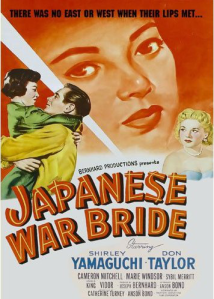
Japanese_War_Bride_VideoCoverMuch like Sam Fuller’s Crimson Kimono (1959), Japanese War Bride’s title carries certain negative stereotypes, however, its central romance similarly feels groundbreaking, allowing it to exceed expectations.
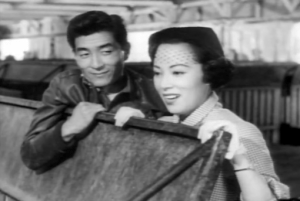
The film opens during the waning days of the Korean War. A man lies incapacitated in a hospital bed, but he couldn’t be happier because he’s met the love of his life. Maybe it’s war fatigue or something else, but he simply cannot take his eyes off the pretty young nurse Ms. Shimuzu (Shirley Yamaguchi).

And although prospects don’t necessarily look that promising, since duty calls, Jim leaves that hospital bent on getting that girl for his wife. He’s serious. So serious in fact that he goes straight away to convene with Tae’s grandfather (Philip Ahn) that he might persuade him for Tae’s hand in marriage. Although warning that the road ahead will be a difficult one, the sagacious man, relents, reluctant to stand in the way of this blossoming love.

It’s after the happy couple is picked up at the train station by family and settle into the old family home, that it becomes obvious that things aren’t quite the same. They’ll be more difficult than they first appeared.

Jim’s parents and brother are welcoming enough, but there is still a necessary period of gelling as they get used to their new family member. Even Jim encourages his petite young wife to be more assertive and embrace American culture fully. She does her best.

japanesewarbride2Jim looks to build up a happy life with her as he looks to take some of his father’s land to keep a home of his own and raise crops. Tae begins to acclimate to her new life and gains the respect of the Taylor family while making a few friends including the kindly Hasagawa siblings (Lane Nakano and May Takasugi) who work at a factory nearby. The icing on the cake is when Tae announces she’s pregnant and Jim could not be more ecstatic.
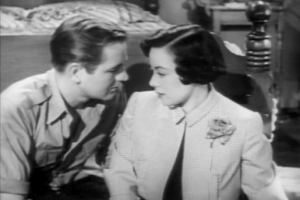
Still, what crops up are the subtleties of racism through slight snubs and bits of insensitivity. First, the skeptical sister-in-law (Marie Windsor) drops pointed remarks towards Tae. At first, they are so veiled, they seem only a passing wisp of a word, hardly worth acknowledging. But following one of the neighbors confessing how much she hates all the Japanese, it becomes evident that all is not right in Monterrey.

One moment Tae is getting accosted by a drunken merrymaker at a party who jokingly calls her a geisha girl. Then the family is scared, rightfully so, when Mr. Taylor receives a threatening letter. It voices the opinion of an unnamed “friend” about the fact that there are rumors floating around that Tae’s baby looks fully Japanese and she has been spending time with Shiro Hasagawa. A scandal of this kind will ruin Mr. Taylor’s reputation among his fellow growers. It will ruin him period.

But most important to this story, it infuriates Jim with a fiery rage. He’s angry at all the narrow-minded folks he used to call friends. He’s mad at his family and most of all Fran for her part in Tae’s distress. It’s in these most tenuous moments that  Tae decides to take her baby and seek asylum somewhere else to get away from the cultural chasm that has formed. Of course, they are reunited and there is a version of a happy ending, but it does not take away from the bottom line. They’ll still have to struggle against societal pressures and flat-out bigotry. However, if you’re in love, there are many rivers you are willing to ford and the same goes for Jim and Tae.

japanesewarbride1Japanese War Bride is continuously fascinating for the presence of Japanese within its frames. First, we have a rather groundbreaking and relatively unheard of interracial romance between the always personable average everyman Don Taylor and stunning newcomer Shirley Yamaguchi. Their scenes are tender and hold a great deal of emotional impact. It’s the kind of drama that has the power to make us mentally distraught but also imbue us with joy.
The film carries even more sobering underlying tension given the relative freshness of World War II. Mothers are still bitter about the deaths of their sons and that righteous anger is not discriminating between people. It only sees race. Meanwhile, Shiro and his sister reflect the times as Nisei, who were affected by internment and increased amounts of prejudice. While Shiro was imprisoned in Japan during the war, his family was interned at Tulare near Sacramento and his resentful father nearly had all of his land taken. Many other Japanese farmers were not so lucky.

For her part Marie Windsor plays her prime role as the antagonistic woman to the tee, effectively embodying all the small-minded, underhanded folks out there that live life without a genuine kindness for their fellow man. Poisoning other people’s mind just as they are poisoned, and it’s this type of rancor that leads to fear and bigotry. A breeding ground for hatred. In some shape and form, it still rears its ugly head to this day. What makes this film special is how it reflects the realities as it pertains to Japanese and Japanese-Americans. Veteran director King Vidor’s effort is a generally authentic and nuanced tale that pays his subjects the ultimate respect even in its more melodramatic moments.

3.5/5 Stars

Mystic River (2003)

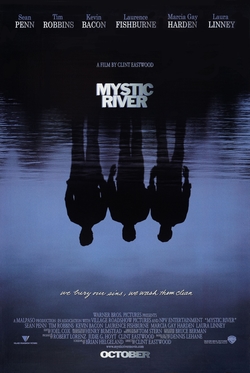
Mystic_River_posterWhen you enter into the world of a film you often expect it to be perfect in your own minds-eye, following your own rationale to a logical conclusion. In that sense, Mystic River is invariably imperfect in how it ties up all its loose ends, but then again, what film really can bear that weight — and it’s all subjective anyhow. Instead, Clint Eastwood’s Boston-set drama builds off a story about three young boys and evolves into an engaging police procedural intertwining the lives and events of these three individuals. But it all starts with a game of street hockey.

After losing their ball down a gutter drain, the three lads sign their names in a slab of wet cement, only to be accosted by a formidable man who won’t take their small act of defiance. He yells at the most unnerved of the three to pile into the backstreet of his tinted car. The boy thinks he’s off to the police station, but these men have far more traumatic intentions for him. It’s three days before young David flees into the woods like a spooked animal disappearing into the fog.

It’s a harrowing entry point of reference, that only makes sense after flashing forward to the present. The three boys are grown up. Dave, still hounded by his past, is married and raising his young son. Although work is hard to come by, they’re eking by.After a stint in prison and the death of his first wife, Jimmy is remarried, running a local convenience store. Sean is the straight-arrow of the bunch and became a cop.

As is the case with youth and childhood friendships, the ties that bind us together are often severed with the passing of time as people grow up and drift apart. But those formative years never leave us and when these three men are subsequently thrown back together, their past resurfaces.

One evening when Jimmy is in the backroom of his shop his daughter from his first marriage, the vivacious Katie gives him a goodnight kiss, as she is about to go out with friends. That same night Dave spies her partying at the local watering hole, but before he goes home he gets into an altercation with a mugger — at least that’s what he tells his wife. Except the next morning, Sean is assigned to a local crime scene along with his colleague (Laurence Fishburne), and it looks to be a grisly ordeal.

From thence forward, the seeds of doubt begin to spring up in our minds. What did Dave really do? Who killed this girl full of life and exuberance? Jimmy wants to know those exact same answers, and he’s welling up with bitterness and discontent. Sean walks this fine line of doing his duty and treading lightly on this man he used to know well and now is practically a stranger. Meanwhile, Dave lives his apathetic little life, looking to obfuscate what happened that night with the help of his fearful wife.

But of course, when Jimmy catches wind of what Dave did, he puts two and two together and comes to his own convenient conclusions. He wants justice after all. Even when Sean and Whitey make crucial discoveries of their own, it’s too late to stop the wheels from turning. Jimmy’s mind is already made up.

To his credit, Brian Helgeland’s script adeptly keeps all its arcs afloat, crisscrossing in such a way that leads to more and more questions, because there’s ever a hint of ambiguity. Nothing is quite spelled out and that’s paying respect to the viewer. However, there are moments where Mystic River enters unbelievable or even illogical territory, near its conclusion. Still, that does not take away from its overall strengths as a magnetic character study and gripping procedural. Tim Robbins and Sean Penn especially give stellar turns, the first as a frightened and mentally distressed man, the other as a hardened ex-con with vigilante tendencies. The fact that each character is grounded by their families is a crucial piece of the storyline, tying them all together.

4/5 Stars

The Trial (1962)

thetrial1Citizen Kane is so often lauded for the simple fact that never before had a director had so much creative control on a project and exercised it in such an unprecedented fashion, especially given the state of affairs in the Hollywood studio system. It’s an enigma, a stunning debut and really an astounding miracle where all things aligned for an instant of so-called perfection.

But some people might assume Welles dropped off the face of the map, only to resurface as a rotund larger than life personality, hardly a cinematic auteur. And it is true, after that initial opportunity, he chased after freedom of artistic expression rather unsuccessfully. That does mean he never found it. Not by a long shot.

The Trial is indisputable evidence of that. It’s greatly under-viewed and that really is a shame, because within its frame you see the glimpses of that same master,  perhaps even more mature than he ever was in Kane.

The story grounds itself in the absurdist prose of Franz Kafka with Orson Welles delivering the opening narration in the form of Kafka’s parable “Before the Law,” setting the groundwork for the rest of the narrative. Anthony Perkins works seamlessly as Josef K. a tentative man set adrift in a world where he has been arrested and put on trial for a crime that is never revealed to him. He fluctuates easily between indignation and resigned timidity.

thetrial3At first glance The Trial is a bare-boned parable, feeling gaunt and cavernous with empty sets and even emptier words. Everyone Josef meets talks him in circles, tirelessly — never leading to any significant conclusion, only the next diversion in his journey.

There are some interludes in the film that could be characterized as dull, especially as we are getting acclimated to this storyline, or more precisely coming to grips with the fact that The Trial is not so much about Story. Kafka revels in the absurd rather than convention and Welles uses that surrealist absurdity as a vehicle for his own endeavors as a director.

Welles had his hands tied with lack of financial capital leading to only an abandoned railway station to work with, and he in turns transforms the space into a gloriously visual labyrinth. In his case limitations only meant further inspiration. In fact, his camera feels ever more inventive and engaging wherever it takes us within this surrealistic space. Large landscapes of dizzying scope mixed with confined, claustrophobic crevices. Further blanketed in light, utilizing a much simpler (as well as cheaper) black and white to develop an ever intricate gradation of field mingled with fascinating angles. These alone take a relatively bare scene and dress them up into something that is entrancing.

More than once, including the film’s final moments as  Josef looks to be headed towards death, it’s easy to be mesmerized because there are no clear narrative distinctions. Characters function as Kafka characters should, and Welles does the rest if you only give him your attention.

thetrial4If The Trial is a hodgepodge of talent,  with the presence of Americans Orson Welles and Anthony Perkins, international sirens Jeanne Moreau, Elsa Martinelli and Romy Schneider, with European backing and source material from Kafka,  then it is a thoroughly intriguing marriage all the same. This film is perhaps the greatest adaptation of the work of Kafka and not due necessarily to its faithfulness to its source material, but because it displays an unmistakably Wellesian vision.  The cyclical nature of the legal system pales in comparison with the fascination that comes with watching the continual creativity that is projected up on the screen — this is a hollow dream of a film.
So Orson Welles did get his artistic freedom, complete with a few surprising moments of cursing, international talent and meager funding that nevertheless gave him what he so desired. Welles ends the film with more narration and instead of running end credits he opts to list off all the names of his players. While the final intonations of his voice leave little doubt that this is his creation first and last, it also suggests that this is a personal film. Something outside of the realm of conventional Hollywood, but still very much worthwhile, even if it’s due mostly to form over content.

4/5 Stars

Insomnia (2002)

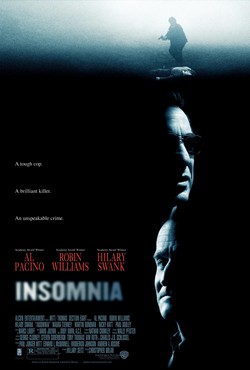
Insomnia2002Poster“You and I share a secret. We know how easy it is to kill somebody.” – Robin Williams as Walter Finch

As I come to understand it, calling Christopher Nolan’s film a remake of the Norwegian thriller of the same name starring Stellan Skarsgaard is not exactly fair. As a director with a singular artistic vision of his own, it’s only fair to say his thriller set in the icy outskirts of an Alaskan fishing village is a re-imagining of the material.

His tale follows a jaded sage of an L.A. cop who comes with his partner on a reassignment, but Dormer (Al Pacino) is also running away from something — something that undoubtedly has major repercussions on not only his life but the case he is about to be met with.

Getting acclimated to Nightmute is no easy task. The town is quiet and the local police are nice enough, including Bill’s old buddy and the overly zealous but industrious rookie Ellie Burr (Hilary Swank). To her, the estimable Will Dormer is a legend, the man you only read about in case files, not actually witness in person. She holds that kind of awe for him, but he just takes it in stride as he and his partner Hap (Martin Donovan) go about their business

Worst of all is the perpetual daylight. It’s something we take for granted, but in this story, the sun never truly sets. It’s always there. There’s no relief and, in a sense, it haunts Dormer. He struggles to sleep, he struggles when he is awake, because he hasn’t been able to sleep, and then the title Insomnia begins to make so much sense. It’s perpetuated to the extent that we begin to feel its effects on us as an audience. The story wears us down, making us into jaded individuals like Dormer (strikingly close to Dormir) and the fact that Al Pacino half-whispers his dialogue with his methodical delivery only aggravates the situation. Our vision is clouded just as much as his.

Set pieces are relatively few, but they are used to great effect. The ones that come to mind are a chase that ensues in the thick Alaskan fog, where the pursuer all too quickly becomes the helpless victim, the paranoia leading to a lapse of judgment. Another equally gripping chase sequence takes place over floating logs and that’s the first time we actually catch a glimpse of  Walter Finch (Robin Williams).

Otherwise, Insomnia is all about the mind games, as fatigue sets in and Dormer must reconcile all he knows and does. Maybe his lapse of judgment was really his innate desire, but the dividing lines are blurring.

Moral ambiguity becomes of great interest because in some ways our main players really are not all that different. Dormer has sidestepped protocol in order for his brand of justice can be enacted — the justice he thinks the people want. And he may be right, but there are consequences for any act and he quickly learns what that means for him.

By the end, we hardly know who is in the right and I think Dormer is as confused as us — or otherwise, he’s just too exhausted by this point to care either way. Robin Williams gives a surprisingly chilling and generally subdued performance. He is our villain in the general sense, but his villain looks suspiciously like a twisted, sick little man. Perhaps a far scarier reality.

Insomnia is the story of Will Dormer and Walter Finch getting twisted up in knots, and in both cases, each man loses a little more of their sanity. It’s in the film’s climactic moments that Ellie must make a choice, and Will implores her to make the right one. She’s the purest, most innocent character in this narrative, and if she falters then there is little hope. But Will succeeds in protecting the last shred of decency that still exists. A small victory, given his circumstances, but a victory nonetheless.

4/5 Stars

Weekend (1967)

weekend1One of Jean-Luc Godard’s strengths is his capability of feigning pretentiousness, while still simultaneously articulating humor. His film opens with its first of many inter-titles, “A film adrift in the cosmos,” followed by the equally poignant “A film found in a dump.”

Our protagonists Roland (Jean Yanne) and Corrinne (Mireille Darc) are hardly protagonists at all, but curmudgeon bourgeoisie couple both caught up in affairs and preparing to out into the country in order to acquire Corinne’s rightful inheritance from her dying father. But this is never a character study and the actual arrival at the home of her parents is of little consequence. It’s another occurrence in a long string of events that Godard plays at with acerbic wit.

We are constantly reminded that this is an age of sexual revolution and political unrest–the class struggle against the tyranny of the powers that. In foreshadowing the events of the 68ers or even putting a finger to the social unrest, Godard is not alone. It’s how he does it that should be of note.

Weekend quickly becomes a discordant cacophony of sound and image that immaculately illustrates the dissonance of the decade.  Rather like a Tati film, Godard uses color prolifically, but it’s hardly as innocent as the former. The colors show the pools of blood and piles of wreckage scattered across the land–In one instance inane and another horrifying.

It’s the emblematic film of the modern age of noise pollution where Godard practically tortures us with the sound of car horns. Constantly adding to the general din. Not to mention the universal, ubiquitous road rage that overtakes everyone and leads to heavy carnage. Some seen, some unseen. Meanwhile, actors or real-life historical figures–the distinction is difficult–including St. Just (Jean-Pierre Leaud) wander the wasteland spouting off inconsequential rubbish in anachronistic garb.

weekend2Conflagrations engulf cars and human bodies while above the din comes the piercing screams of a woman bemoaning the loss of her Hermes handbag. We cannot take this anyway but humorous because it once again is yet another moment of utter insanity.
The French countryside becomes the perfect locale for an apocalypse mixed with a modern coup de’tait. There’s a call to arms for guerrilla tactics–a new French Revolution. Still, Roland and Corinne frantically hurtle towards their destination of Oinville. Their actions there are far from unexpected highlighting the baseness running through the entire film.

Once again it feels of little consequence that the pair is captured by a band of cannibalistic, free-loving revolutionaries. Cracking eggs on lifeless bodies and painting on naked ones. It’s pretty strange. Godard slips in a bit of love of the cinema as their call names include Battleship Potemkin, The Searchers, and Johnny Guitar. But there’s little point to it, only another pointless attribute in this narrative of volatile absurdity. But in that respect, Godard has hit his point home, by spurning convention as always and supercharging his film with political chops. It drags a bit in the second half, but he salvages it with the utter insanity of it all.

Furthermore, Godard and cinematographer Raoul Coutard are absolutely fabulous at utilization tracking shots to the nth degree in several instances, namely with the initial traffic jam extending for what feels like eons and then camera cycling through the town as the music plays in the background and our two travelers wait for their next ride. Let’s not forget the final moments of Weekend either, where Corinne has been transformed into a fellow commune member feasting on a scrumptious piece of meat with a fellow hippie. Her husband was not so lucky. There’s little to no need to say what happened to him.

4/5 Stars

Shadows (1959)

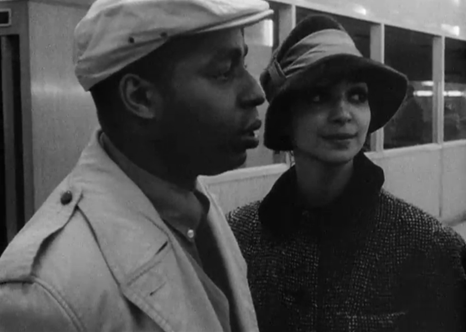
shadows1By today’s standards, it might not look like much, but all conversations of independent filmmaking cannot go anywhere without John Cassavetes and specifically his debut Shadows. It’s hard to get out of our modern perspective with so many different outlets to get films made, but back in the 1950s your only road was Hollywood and that was only a select few. Then Cassavetes got the idea to make a film with a group of his acting school students, who were trying to carve a niche for themselves amidst the method acting revolution overtaking New York.

In its initial cut, Shadows was far from popular, and after it was overhauled and re-edited it did a bit better. But now it is the emblem of indie movies — it’s a different type of film-making altogether. It’s the Beat Generation. It’s New York City. It’s handheld camera work. It’s thumping jazz. It’s improv. It’s spontaneous.  All of this loosely ties together the narrative of three siblings dealing with universal issues like family and highly volatile ones like interracial relationships.

shadows2The first is younger brother Ben Carruthers, a light-skinned black who has a struggling career as a jazz musician which he balances with a nightlife of escapades with his buddies. More often than not he’s getting in trouble, in a pinch for cash, and his violent temper gets the best of him more than once.

Then there’s his older brother Hugh who is trying to sing a new gig with the help of his agent, but he must settle for a stint at a sleazy nightclub. It feels below his talent and completely wastes his ability, but he just goes with it. On the side, he tries to keep an eye on his younger brother and sister who he feels responsible for.

shadows3The youngest, Leila, is still an innocent and naive girl who thinks she knows how to take care of herself. Over the course of the film, she winds up with a few very different men. The first is a stuffy author with an authoritative streak. The second is a soft-spoken bright-eyed man, who gets her to sleep with him. Finally, the last one is a young African-American man who is gentlemanly, but not about to be made fun of. In fact, over the course of these relationships, we see the evolution of Leila as she starts out as a demure girl with the big doleful doe eyes. Slowly she becomes more controlling and self-absorbed, but still, she has a lot to learn about actual romantic love.

She’s not the only one either. We leave Ben as he lays battered with his buddies after they got in a brawl with some tough guys over some broads in a diner. There’s no big epiphany at the end of this or some riveting conclusion. We leave them in a moment of their existences just like any other. It’s nothing altogether novel or interesting, and ironically that’s what makes Cassavetes’ film so fascinating. It broke the mold — perfect in all of its imperfections or more aptly because of them. Not to mention the fact that it flipped conversations on race and gender upside down.

4/5 Stars

Lars and the Real Girl (2007)

larsandtherealgirl1

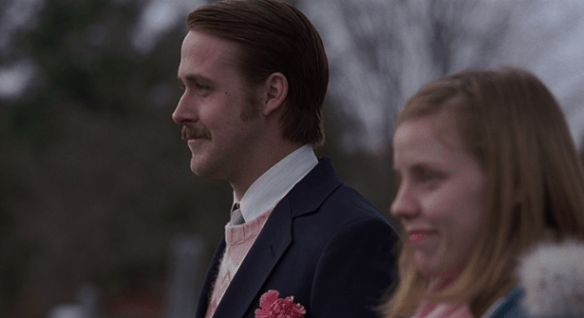
This Canadian-American production, written by Nancy Oliver, undoubtedly frightens the more suppressed of us in the audience (mainly me) with its main hook, a man who begins a relationship with a female sex doll, but just like his entire town, most of us leave this film with a very different perspective. There’s an innate somberness to this film that hearkens to the palette and tone of Alexander Payne, and yet Lars and the Real Girl feels surprisingly innocent. The beauty of the film is how an entire community gets behind this one man and truly accepts him for who he is.

Lars Lindstrom as played so impeccably by Ryan Gosling is an isolated, lonely young man who goes to church on Sundays, lives across from his brother and sister-in-law, and avoids the cute girl at work with averted eyes. He’s an Elwood P. Dowd for the modern age. He trades in a disarming personality for an aloofness that conceals a deep well of loneliness and nevertheless shies away from normal everyday human interaction.

His views of sexuality and intimacy have been in many ways twisted up inside of him due to the specters in his past and a modern culture that does not know how to deal with sex by normal means. For Lars, it manifests itself in the form of a doll he buys off the internet. But far from using it to gratify his utmost desires sexually as we would expect, what he really does is project what he truly cares about onto this figure, christened Bianca.

She wears clothes like you and me, holds a nursing degree, lived the life of a missionary, and is constrained to a wheelchair, relaying all her thoughts to Lars and Lars alone. Harvey was an imaginary being whereas Bianca is tangible–in the flesh–sort of.

At first, this situation feels slightly uncomfortable and increasingly strange and in the moments of discovery Lars’s brother (Paul Schneider) and sister-in-law (Emily Mortimer) are beside themselves. What will the town think? He’s crazy. What are they to do?

But the beautiful thing is that they seek counsel from older, wiser people in the community including the local minister and they preach a message of love, accepting Lars for who he is, and helping him through his healing process, whatever that means.

Everyone else only sees the freak, the dysfunction, but they fail to see the dysfunction in their own lives. It’s the ones who realize that–realize that they too have their own problems. They shed their hypocritical point of view and take Lars for who he is, quirks and all. By this point, the film has subverted expectations and the joke’s on us because although some people stop and gawk, the majority of the locals begin to rally around Lars.

He still maintains his delusions as his own insecurities, fears, and the dark recesses of his childhood become more evident. He’s fearful of contact, scared of being close, and it’s these moments that dredge up all the FOO, and he’s forced to deal with it.  But that makes way for some intricate conversations, brother to brother and between Lars and the kindly psychologist Dagmar.

It’s when he finally realizes just how much people care, that he’s able to let go. Give up Bianca and engross himself in the real world with a real girl. He doesn’t have to live life scared anymore. The film wins because of its sincerity. It never belittles. Never plays its story like a joke. For that, it deserves our respect as an audience. Even in the moments that it feels utterly absurd, pay it the respect it is due — just like what all these characters give to Bianca and in turn Lars.

What struck me in particular, was the nuance of all the main female characters. When we first meet Karin (Emily Mortimer) she is a generally caring sister-in-law who has such a great capacity to extend grace towards Lars. Dagmar (Patricia Clarkson), although she is a doctor, never becomes didactic–trying to change Lars or alter him– instead allowing him to heal of his own accord. Meanwhile, Mrs. Gruner (Nancy Beatty) is spot on as the Christian lady we all wish we knew. She cuts the holier than thou attitude, covering it with a heavy dose of genuine neighborly love. That speaks more than any amount of sermons or platitudes that can be spouted off as actions invariably speak louder than words.

Finally, Margo (Kelli Garner) is the epitome of the girl who Lars deserves. Sweet, authentic and a faithful friend. When Lars let’s go and concludes the grieving process, she is right by his side ready to live life next to him. She’s a real girl, through and through.

3.5/5 Stars

Liberal Arts (2012)

liberalarts1Where to start with Liberal Arts? It’s one of those deep blue funk movies. Zach Braff tackled this issue in Garden State, and Josh Radnor does a similar thing here. Because the reality is that we live in a generation of early onset midlife crises. In the opening moments, 35-year-old Jesse Fisher (Radnor) has nearly every article of clothing he has aside from the shirt off his back stolen from a local laundromat when his back is turned. We can easily surmise that this single event epitomizes his life right now, and this is hammered home rather obviously when his unnamed girlfriend clears her belongings out of his flat. There’s no better symbol of isolation and alienation than a break-up.

That’s when Jesse’s former professor the personable and witty Professor Peter Hoberg (Richard Jenkins) pays him a call that doesn’t so much change his life as it alters his course. The professor is preparing for his retirement and as is usually customary a dinner is being held in his honor. Jesse is one of the people he looks to invite and the former liberal arts major takes him up on it gladly as the nostalgia begins to waft over him. It’s excruciatingly corny at times even painfully awkward.

However, it’s no small coincidence that it was filmed at Radnor’s real-life alma mater Kenyon College in Ohio–a beautifully tranquil campus that reflects an idolized Middle America–a perfect place to rediscover youth and ruminate pensively on past endeavors. Jesse does all of the above, but while staying with the professor he also meets Libby (Elizabeth Olsen), a current college sophomore whose father and mother had ties with Peter as well.

Zibby has a self-assurance–the way she carries herself is completely disarming but in a good way. In fact, it intrigues Jesse (Radnor) sweeping him off his feet before he even knows it. But that’s not the only thing that affects him. Nostalgia is a powerful thing. I can feel it now as I close the books on my own college career, and I can only imagine this character who is looking back at those idyllic glory days when he was an optimistic, naive young man.This peaceful campus is completely different feel than the bustling public institution I became accustomed to, but the important things are not all that dissimilar.

liberalarts2It’s crucial to note that at this juncture nothing substantive builds between these two acquaintances romantically, but they do foster an immense connection. While Jesse is taken by Zibby’s personality, she, in turn, is discontent with a contemporary culture where no one dates–everybody’s casual about relationships. She feels unequivocally millennial and yet she readily admits these areas of old-fashionedness.

As she and Jesse part ways, Zibby burns a CD of classical music for her new confidante and entreats him to write her correspondence with pen and paper–like gentlemen and ladies in days of old. It feels very much like a Jane Austen novel, perhaps a little pretentious, but it’s hardly a criticism of these characters. What it creates within the both of them is not only a deeper connection going beyond sexual attraction but an awareness or realization of being — what people these days often call mindfulness.

As they traverse this road together there are some obvious digressions that we could easily foresee, and yet the film takes a mature and altogether realistic path. It considers the relationship between various points in time, passing of the years,  looking backward and forwards. In one direction with nostalgia and the other with anxiety and maybe even expectancy. All these are the backdrop for this complicated friendship between a 35-year-old and a college student.

The conclusions of Liberal Arts perhaps feels a bit muddled, but that’s only indicative of life. We’re all set adrift in a world that we don’t know all the answers to. As Zibby so rightfully ascertains life is basically improvised. We’ve just got to step out and live it to the best of our capabilities. Pick ourselves up when we fall and do our best to make the most of what we have. A lot of that comes when we learn how to connect with the people around us in such a way that leaves us content with who we are. I think it can be said that we leave both Jesse and Zibby better off than they began.

3.5/5 Stars

This is the only time you get to do this. Read books all day. Have really great conversations about ideas. – Jesse Fisher

Boudu Saved From Drowning (1932)

boudu1“He spat on Balzac!”

Jean Renoir always had a preoccupation with class divides and Boudu showcases that same blatant juxtaposition of class, or more precisely, the lifestyles of the middle class versus a lowly tramp. Except in this specific instance, the tramp (the indelible Michel Simon) could care less about the gap. He thumbs his nose at any charity and makes no effort to conform to the reins put on him by the reputable of middle-class society.

The man who steps to the fore is a middle-aged married bookkeeper who has the hots for his housekeeper. With his wandering spyglass, he spots the hapless Boudu jump into the Seine. From that point, he leaps into action toddling out to the street followed by the crowds of onlookers. He’s the first to plunge himself into the depths to bring the unfortunate soul to safety, and his middle-class brethren laud him for his supreme act of charity. But Monsieur Lestingois does not stop there, insisting that the wretched man be brought to his nearby flat.

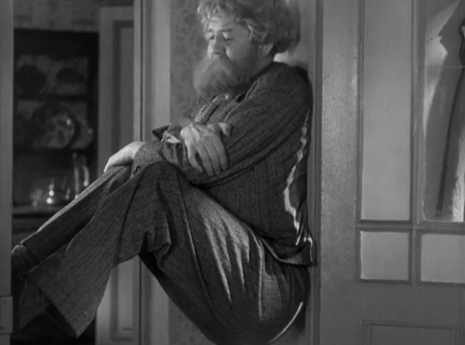
boudu4Soon Boudu is wrapped up in middle-class luxury that he didn’t ask for, at the behest of Edouard who takes an initial liking to this bushy-haired man he happened upon. After all, he is intent on playing savior and Boudu obliges. It’s in these forthcoming scenes that Renoir examines class in a satirical way, feeling rather like a precursor to some of Bunuel’s later work, without the religious undertones. And yet for some reason, we cannot help but like Boudu a lot more. True, he is loud, messy, rude and unruly, but there’s something undeniably charming about his life philosophy. There are no pretenses or false fronts. He lets it all hang out there. In this regard, Michel Simon is the most extraordinary of actors, existing as a caricature with seemingly so little effort at all. He steals every scene whether he’s propped up between two door frames or cutting out a big swath of his beard for little reason.

In the meantime, he wears their clothes and eats their food, but he doesn’t have to concede to their rules. Boudu ends up winning the lottery of 100,000 francs, while unwittingly stealing away his esteemed benefactor’s unhappy wife. Whereas Boudu has the audacity to do the unthinkable out in plain view, he’s perhaps the most brutally honest character in the film. Everyone else veils their vices and hides their true intentions behind good manners and closed doors. But there has to be a point where all parties involved are outed and the moment comes when husband and wife simultaneously catch each other.

boudu3Charity in a sense is met with scorn, but it feels more nuanced than, say, Bunuel’s Viridianna (1961). In many ways, Boudu seems like a proud individual or at least an independent one. He hardly asks for the charity of the wealthy, and he’s content with his lot in life, even to the extent of death. It’s also not simply chaos for the sake of it, and he hardly lowers himself to the debauchery of Bunuel’s unruly bunch. Still, he obviously rubs the more civilized classes the wrong way, by scandalizing their way of life and trampling on their social mores without much thought. It’s perfectly summed up by the last straw when  a fuming Edouard incredulously exclaims, “He spat on Balzac.” The nerve!

The ultimate irony is that Boudu ends up in the water once again, and he’s not the only one this time. This also serves to take Renoir back into his element, because he’s always at his best in the great outdoors where the natural beauty of parks and rivers become his greatest ally in his misc en scene. Still, his framing of shots always gives way to a beautiful overall composition inside and out. Boudu is no different. You simply have to sit back and enjoy it like a pleasant outing on the Seine.

4/5 Stars

The Candidate (1972)

CandidateposterTwo hallmarks of the political film genre are Mr. Smith Goes to Washington and All the President’s Men. The latter starred The Candidate’s lead, Robert Redford. However, in this case, the candidate, Billy McKay, is perhaps a more tempered version of Jefferson Smith. He’s a young lawyer, good looking and passionate about justice and doing right by the people.

But this is not a film about a monumental struggle between good versus evil. There are no blatant moments of scandal or obvious skeletons lurking in the closets (although there’s the suggestion that McKay has a slight fling). Still, both men, both the Democrat and the Republican seem like generally amiable individuals — not venomous monsters. If you were with them around a dinner table, no matter your political bent, it would probably be easy to strike up a conversation. But both men, the incumbent, Crocker Jarmon, and the young challenger are playing this game called politics to win the state of California. There’s no doubt about it.

It’s fascinating that the film was actually penned by the real-life speechwriter of Senator Eugene J McCarthy, Jeremy Larner, so you get a sense that there is inherently some truth to the backroom conversations going on between campaign managers, newscasters, and the Senate hopeful. There’s an ethos being elicited and it helps that The Candidate gives off the aura of documentary more often than film.

But what we do see, is the progression of a man. McKay begins resolutely in his ambitions. He’s not at all a politician and he was not planning to become one until he is called upon by a veteran campaign manager. Marvin Lucas (Peter Boyle) thinks the lawyer has the pedigree (his father was a governor) and the genuine charm to win over votes. And finally, Bill agrees to it all as long as he gets to say what he wants. But as things continue to evolve, this beast that is the political machine begins to churn rather insidiously.

There’s not some dramatic moment of epiphany but there is a sense that McKay has started to allow himself to be sucked into this political popularity contest. His advisors are constantly setting up their next moves, putting together press junkets and public appearances to bring their candidate before the people. Meanwhile, his wife (Karen Carlson) is trying to support his cause and his famous father (Melvyn Douglas) eventually looks to get in on the publicity as well. And McKay is certainly candid and likable but he also soon learns what is expected of him. His answers become vague, he toes the line closer and ladles out the type of rhetoric the masses want to hear. The sad thing is that it’s this strategy which begins helping in the polls. Not astronomically but it’s a systematic shift giving him a good chance to win the contest.

But by election night, the votes are being cast, both sides are frantically preparing and Bill realizes he might be on the edge of a precipice he never foresaw. He’s being hoisted up as a champion of the people and yet he realizes he doesn’t want to be there but by this point, it’s too late. He can’t turn back. He can’t reimagine himself because he played the game already.

It’s hard to decipher where the film goes from here — what truly is next? His staff is happy. His wife is happy. His father is happy. Everyone else seems happy too. But the candidate is left to get whisked away by a mob — still wearing a glum face of bewilderment. In some ways, he’s a Jefferson Smith for the modern era. Duped by a system that he thought he could reform, only to find out he sold out. It’s somehow both comic and cynical — in a rather unnerving way — striking a tender nerve. Imagine if you have an election as volatile as the latest one. This film is no less true even over 40 years later. In some ways, everything still functions like a nefarious game. The question is, who is the joke really on?

3.5/5 Stars