Edge of Tomorrow (2014)

24f4a-edgeoftomorrow1

Time loops are fun. Scratch that. They’re fun to think about and to watch as an audience in the comfort of an armchair, but they get old real fast for movie characters. Just ask public affairs officer-turned-time looper William Cage (Tom Cruise).

He’s an indolent former advertising agent who wants no part of the actual fighting that is taking place in Europe with a mysterious alien army of so-called Mimics. In his attempts to avoid combat, he ends up handcuffed, stripped of his rank of Major, and shipped off to a base at Heathrow. His worst nightmare is becoming reality as he is quickly thrown into the front lines where he is headed to face the enemy without any training. He is an absolute pitiful mess and his platoon mates spare him no mercy. After all, he’s a sniveling complainer.

He’s just as incompetent on the battlefield, and it becomes obvious he’s not going to last long (There’s potential for a very short movie). But before he gets killed by one of the aliens, its blood covers him. Did you get that? Although seemingly insignificant the whole film soon hinges on this fact.

Where does he wake up? No not hell or heaven, but back at Heathrow airport, handcuffs and all, with a superior yelling at him yet again. He’s back in this nightmare once more and it continues for the rest of the film.

Honestly, Edge of Tomorrow is an awful name for this film. The tagline Live. Die. Repeat. is a little closer. At least it gets at the heart of what this sci-fi tale is about. In a similar vein as Phil Connors in Groundhog Day, Cage first gets acclimated to his new ability to experience a moment in time. He learns how to manipulate and navigate it to help himself, but as would be expected it gets tiresome and monotonous. With great power comes great responsibility, difficulty, and fatigue.

Live. Die. Repeat. Live. Die. Repeat. Slowly but surely Cage makes it farther and father against the mimics joining forces with famed soldier Rita Vrataski who is the poster girl for this noble war (Emily Blunt). Her early advice, “Come find me when you wake up,” is the strangest of greetings, but it starts the ball rolling. In a world where humanity is continually walking into an ambush, they are the only two who comprehend what is happening. Vrataski knows because she used to have Cage’s ability but lost it, so he is the new hope. Live. Die. Repeat. Live. Die. Repeat. She shapes him into a more efficient fighter over numerous time loops and gives him more insight into their enemy. He’s getting sick and tired of getting killed too. Live. Die. Repeat. etc.

He starts seeing visions of the Omega (the nucleus of the mimic), but they soon realize that the mimic is leading them on. Live. Die. Repeat. By this point, Cage has gone through so much with Vrataski and he cannot bear to see her continually dying. They finally locate the whereabouts of the Omega but after numerous failures, they finally run out of second chances. Cage loses his ability to loop, like Vrataski before him, needing a blood transfusion to pull through. Live or Die. No repeat this time.

Thus, begins their descent into the throes of their foe towards the Louvre where the Omega is. However, this time Cage convinces his squad to help and they prove their worth. An alpha comes after Cage and Vrataski as he blows up the Omega with a pack of grenades. There’s an instant of doubt, an uneasy feeling. Live. Die. Repeat…

Except now Major William Cage is back on the helicopter. No stripping of rank, no orders to the front lines, and with a newly weakened enemy. The nightmare is over so it seems and Cage is twice the man he was before. Only one thing matters. You guessed it. He goes looking for Sergeant Vrataski and sure enough there she is where he always found her before. She greets him with the same curtness as he smiles knowingly and most definitely with relief. For the last time or the first, depending on how you see it.

Quick cut to credits and “Love Me Again” by John Newman and it’s all over. It’s an ending that we hate as an audience, but it is the right one. As far as modern sci-fi films go, this one reminded me a bit of Source Code and Looper. Similarly, once you bought into the premise and invested in the setup, it proved to be a smart and entertaining ride.

Tom Cruise proved he can still do action movies and Emily Blunt carried the film with a toughness that would have made Ellen Ripley proud. This may be summer blockbuster material, but it’s also a worthwhile trip that takes us for a loop. Awful pun intended.

4/5 Stars

The Grand Budapest Hotel (2014)

35f8c-grandbudapest3

The farthest Eastern boundary of the European continent makes the perfect landscape for a new addition to the quirky Wes Anderson canon. But more on that later. First our story.

It gains inspiration from the writings of forgotten Viennese author of the 30s and 40s Stefan Zweig. In fact, the author’s own plot device is used in this story of friendship, love, and murder. An inquisitive writer (Jude Law) from the 1960s becomes intrigued by the aging proprietor of the Grand Budapest Hotel Zero Moustaffa (F. Murray Abraham).

The rather mysterious figure is glad to tell his story and how he came to acquire the iconic hotel. And that’s where our real story begins, back in 1932, with concierge and small time celebrity M. Gustave (Ralph Fiennes). He is a dying breed of a man, full of culture, a bit effeminate, and known to wine and dine older patrons. He also has an immense affinity for poetry.

It was under his leadership that the young, stoic bellboy Zero got his start. What an exciting beginning it was.  One of Gustave’s most faithful patrons, Madame D (Tilda Swinton), dies suddenly and he is bequeathed the priceless painting Boy with Apple.

The family of the deceased is in an uproar led by belligerent son Dmitri (Adrien Brody). Soon Gustave has become the strangest of fugitives as he is wanted for the murder of the old lady.

During that time, young love springs up and Zero meets the love of his life Agatha (Saoirse Roman), a spunky baker who returns his affection.

Now the imprisoned Gustave takes part in an escape attempt a la Le Trou except this rendition is successful to a degree. Faithful Zero meets up with his mentor, and Gustave turns to the only ones he can. The concierges from all the surrounding area. They oblige, getting the two fugitives away, but soon Dmitri’s cold-blooded assassin Jopling (Willem Dafoe) is on their tails at a local monastery.

War is imminent and back at the Grand Budapest things do not look promising.  The ever fearless Agatha agrees to go fetch Boy with Apple, but she is soon spotted and pursued by the ever brutish Dmitri who tries to use his gun. That’s not a smart thing when all the rooms are full of quartered soldiers and a chaotic gunfight ensues.

In the aftermath, a second will is uncovered that makes M. Gustave the sole owner of the Grand Budapest and many other possessions that Madame D owned. In a Deja Vu moment, Gustave and Zero ride the train once again before getting boarded and questioned. Always the gentlemen, Gustave defends Zero who is targeted for his immigration status. It was in that way the story ends and returns to the young author and elderly Zero Moustaffa.

He never could bear to give up the Grand Budapest despite the toll of Communism. It’s not because of Gustave, but his dear Agatha who died only two years after. It’s his only link to the happiest times of his life.

What The Grand Budapest Hotel ends up being is an odd mix of black comedy and romantic sentiment all wrapped up in an Anderson world.

His shots are often framed symmetrically and muted pastels abound as well as scaled miniatures, creating his always distinctive mise-en-scene. He is also a fan of a smooth moving camera often involving zooms.

Anderson is obviously a student of cinema and his film at times are reminiscent to 30s fair such as Grand Hotel and The Rules of the Game. He also channels another famed Viennese Ernst Lubitsch who was a master of highbrow romantic comedies.

Hotel also boast a superb cast comprising most of Anderson’s stock company. If there’s anyone who has been in more than one of his movies, they are probably in this one, even for just an instant.

So given the normal Wes Anderson flair or eccentricities, this film is visually pleasing and quite entertaining. It is a worthy follow up to Moonrise Kingdom, darling.

4/5 stars

The Breakfast Club (1985)

54f1c-the_breakfast_clubHere is a seminal high school coming of age film that has its moments although it is not altogether brilliant. The story takes place on a Saturday when the local school is empty and five very different characters are all thrown together. For an entire afternoon, apart from your typical adventures through the halls of the high school campus, they sit in a room.

The players are as follows: A brain, an athlete, a social queen, a basket case, and a criminal. Initially they all are annoyed that they have Saturday school and there is tension between them. Over the course of the afternoon they soon open up and realize they all have similarities and despite their differences they can be friends.

There are other coming of age films that are probably better but it is certainly an interesting social commentary and a cult classic thanks in part to the song “Don’t You (Forget About Me).” Lets just face it, the 1980s just would not be the same without John Hughes (Ferris Bueller, 16 Candles, Trains, Plains & Automobiles). He certainly is not the foremost of directors, but he will not be forgotten any time soon.

3.5/5 Stars

T-Men (1947)

fb214-tmen3T-Men looks like it could be a dated 1940s procedural right out of a stuffy newsreel. It’s complete with an omniscient narrator overlaying everything. He gives us all the juicy bits without relaying all the superfluous details because, after all, this is a composite case. Also, a lot of effort is made to bring up similarities with the Al Capone case.  So, in other words, it does feel like a heavy-handed newsreel at times.

However, thanks to director Anthony Mann and the pure cinematography of John Alton, T-Men sheds its shallow top layer and gets interesting.

We are given a bit of dry exposition to kick things off. We are following a couple T-Men named Dennis O’Brien (Dennis O’Keefe) and Tony Genaro (Alfred Ryder), complete with full personal bios, who are called on to infiltrate a counterfeiting ring. They get in with the Vantucci mob and make their way from Detroit to L.A. O’Brien aka Vannie Harrigan goes to all the steam baths across town and finally comes across a man named the Schemer. After putting his phony dough in circulation the plan is set in motion as he gets in with the thugs of L.A. too.

And that’s what the rest of the film entails, with O’Brien keeping his cover, while also staying in contact with his superiors and being joined by Tony, aka Tony Galvani from Detroit. It would be run-of-the-mill if not for a few scenes and Alton’s images as previously mentioned.

One day Toni runs into his wife in the most awkward and potentially deadly of circumstances. A well-meaning friend nearly blows his cover in front of a thug and Mary Genaro (June Lockhart) bravely protects her husband. It’s a painful moment.

All too soon Toni’s in trouble and O’Brien soon after, but he’s almost gotten to the top. The digging and prodding have nearly reached their apex. A bit of luck and some timely police support get to O’Brien soon enough so he survives. It’s a show of heroics and gutsy police work like we have undoubtedly seen many times before.

T-Men is kind of like The Departed without all the thrills and plot twists, and cursing if you want to see it that way. But the images are so moody and beautiful that it’s hard not to at least tip your hat if you had one. Do yourself a favor and see Raw Deal, a film with many of the same components and probably a slightly better payoff.

3.5/5 Stars

The Women (1939)

 6d603-womenHere is a film full of personalities. In fact there is so much personality that it nearly bowls you over with its impact and frenetic force.

In the center of it all is Norma Shearer who is the respectable socialite who is losing her husband to another woman. Joan Crawford is the gold digging woman who is as detestable as ever. Rounding it out is the equally repulsive gossip played to a tee by Rosalind Russell. There is the ever innocent Joan Fontaine and a spunky divorcee played by Paulette Goddard. Throw in numerous other memorable women and you have a cast that completely overwhelms, but in a good way.

Husbands and lovers seem to being switching hands so easily and the whole film is focused on the women who are swapping them. It begins with Mary Haines’ husband only to continually get more complicated as more gossip is divulged and mud is thrown. Not to mention a few angry fists and slaps to go with the caustic words.

There is a lot to admire about this film, because it does what it set out to do very well. It creates some empathy, some laughs, and yes, a whole lot of loathing.

However, as I contemplated the film I realized although the Women is from 1939 and the clothes often seem laughable, the people and issues in the film often seem all too real. Divorce hits close to many homes literally and gossip certainly has not gone instinct. Thus, despite the passage of time, in many ways this film still feels fresh and relevant today.

4/5 Stars

The Passion of Joan of Arc (1928)

6d281-passionarcAs cliche as it will sound, this is one of those films that transcends the years for me. It is still that powerful after so many decades.

Using low angles and numerous close ups Carl Theodor Dreyer pulled me into this story early on. It was tense and claustrophobic causing the viewer to become emotionally involved in the trial and the plight that surrounded Joan.

The actors that he chose have wonderfully expressive visages that are so distinct even with out makeup of any kind. Then there is Falconetti who undoubtedly has a pair of the most expressive eyes ever shown on the silver screen.

I watched the film without any score so the complete silence was a new experience for me, but it forced me to pay particular attention to the images. Those were enough to keep my attention by  making me squirm and empathize the entire time.

By the end of the film there is an immense connection for Joan built because she seems an innocent victim. A martyr to be sure who reflects the sufferings of Christ. That is the story of The Passion of Joan of Arc. Certainly a simple tale but a master work of silent cinema nonetheless.

I am intrigued to see more from Carol Theodor Dreyer especially because his filmography is so sparse.

4.5/5 Stars

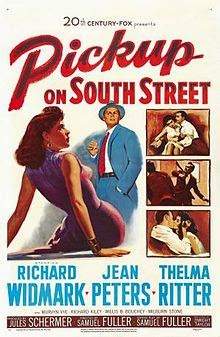
Pickup on South Street (1953)

bf34b-pickuponsouthstreetFrom American cult film director Samuel Fuller comes a brief, yet potent film-noir laced with communism, pickpocketing, and a lot of shady business on the streets of New York.
Grifter Skip McCoy (Richard Widmark) is just recently out of the can, and he is back on the streets up to his old tricks again swiping wallets. His victim this time around is a pretty young dame named Candy (Jean Peters) who has a mission of her own to drop off a package. Neither of them knows quite what they have gotten into and to start off with, nothing happens. What exactly has Skip stumbled upon? The answer includes microfilm, spies, and the Commies. All of a sudden things are hot, as McCoy tries to cut a deal with the Reds, and Candy tries to recover the film she unknowingly lost. Candy gets caught in the middle of her boyfriend who is sided with Communists and Skip who wants to cash in on his good fortune. Between Skip and Candy begins a wild and passionate love affair that seems destined for disaster. Both have their own agendas, but it is ultimately Candy who drops hers because of her new found affection. McCoy is callous at first but he comes around, in the end, leaving this noir on a surprisingly positive note.
Thelma Ritter was usually colorful in her many screen appearances and she has another memorable turn as the wheeler-dealer Moe Williams in this film. However, Moe does not just deal ties and secrets; she is a woman with a conscience and a touch of good old-fashioned patriotism. In her own simple way, she is a hero whether people know it or not.
Widmark played a similar conman in Night and the City (1950), but this time around things worked out a little differently for his character. The pickpocket sequences were perhaps less elaborate but still similarly intricate to Robert Bresson’s Pickpocket (1959). It is possible that he got some of his inspiration from Fuller’s work here.
This is a real communist era thriller that Fuller injects with passion, grit, and some unadulterated violence. It is not a pretty film necessarily, but that is not what Fuller is going for, and he never does. Instead, as a former journalist, he reveals to his audience the nitty-gritty of South Street up close and personal. He succeeds with flying colors in delivering a first rate scoop of uncompromising pulp.
4/5 Stars

Ida (2013)

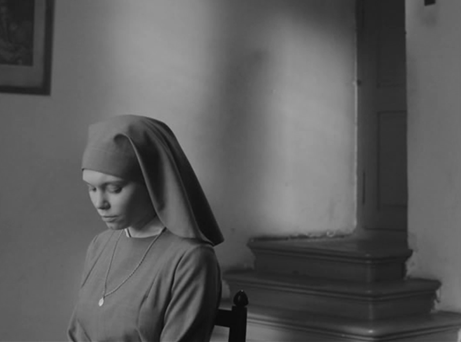
28ceb-ida1At hardly an hour and 20 minutes, you would think Ida has very little to offer, but that just is not the truth whatsoever. Polish director Pawel Pawlikowski blessed us with a nuanced film full of power and strangely pleasing visuals. It’s stark, yet crisp, black and white cinematography did not have to be that way, but it looks absolutely beautiful.

In the opening sequence, we see a young nun carving a statue and then carrying it to the grounds outside. We realize it depicts Christ and it feels rather reminiscent of La Dolce Vita and yet this film has a note of reverence.

We have been transposed to Poland during the 1960s where novice nun Ida lives a simple and disciplined lifestyle within a convent. The meager plot follows her pilgrimage to meet her only relative before taking her vows. It’s the aunt who refused to take her in after Ida’s parents passed. They have never met before now.

There doesn’t seem to be much to say. In fact, what can you say? Ida has taken up a religious calling and her aunt, a former judge named Wanda Gruz, lives life the way she pleases. Men, alcohol, and smoking are all a part of that lifestyle.

Thus, they have little in common until the moment when Gruz discloses the truth to Ida. Her real name is Ida Lebenstein. She is Jewish. Her parents were killed during the War, but the details are not too clear. They can probably guess how it happened.

Ida’s whole identity is rocked because she is now a Jew within a convent which seems like a gross incongruity. Ida’s resolve is to find her parents’ resting place and so the unlikely pair set off looking for answers.

That’s about all the film’s plot right there, and though it does not sound like much, it is far more engrossing than a lot of the other fair we come across. There are moments when it feels like we are watching something from Robert Bresson. It’s simple. There are not frills but it is chock full of humanity and seemingly real characters with real emotions.

Ida is very rarely in the center of the frame, more often than not her eyes are averted, looking away from the camera. Pawlikowski also has a curious habit of focusing on one character during a scene of dialogue. It seems to denote how isolated and confused many of these characters are. It’s one of those films that leaves us with more questions than answers and that lends itself to a truly insightful viewing experience.

4.5/5 Stars

This Jesus of yours adored people like me” ~ Wanda Gruz

Review: Murder, My Sweet (1944)

e30de-murdermysweet1Ann Grayle: You know, I think you’re nuts. You go barging around without a very clear idea of what you’re doing. Everybody bats you down, smacks you over the head, fills you full of stuff…and you keep right on hitting between tackle and end. I don’t think you even know which side you’re on.

Phillip Marlowe: I don’t know which side anybody’s on. I don’t even know who’s playing today.

Now after seeing the original Dick Powell as a crooner in light song and dance flicks, his re-imagined image as Chandler’s Phillip Marlowe is that much more surprising. This film quickly dropped being the potential musical Farewell my Lovely and ultimately became a hard-boiled Noir called Murder, My Sweet. To Powell’s credit, his new alter ego works and he brings his own spin to the role. Perhaps he has a little more humor than Bogart but there is still enough of the tough guy in his role to make it work. He’s also deliciously cheeky which is perfectly illustrated by a scene where he lights his match on the butt of a statue. It’s great.

Edward Dmytryk gave us a film that has often been credited with helping to define the film-noir style of the 1940s. It makes perfect sense since his film brims with many of the major hallmarks of the genre. The powder-burned Marlowe’s initial narration carried through a flashback lends a wry and cynical commentary to the entire story. The screen itself is cloaked in shadows, filled with billows of cigarette smoke, and is often superimposed with disorienting images.

Early on one man named Marriot is dead, Marlowe gets clocked over the head, roughed up several times, not to mention drugged up. He gets hired, used, thrown off, and seduced more than once. All because of an expensive jade necklace. As Anne (Anne Shirley) notes, Marlowe goes charging into his case not quite knowing what is going on or who he is dealing with. That ambiguity is one of the strengths of this film because we are never allowed the comfort of knowing who to side with.

By default, we begin the film from the point of view of Marlowe, and so he is our anti-hero who we track with the entire film. He gets the giant thug Moose (Mike Mazurki) tossed his way first. Marlowe meets the pretty Anne who hides her true intentions, introducing him to her wealthy father (Miles Mander) and seductive stepmother (Claire Trevor). Next up is quack doctor Jules Amthor (Otto Kruger) who appears to be our most clear cut villain and yet nothing is for sure.

It takes a late night confrontation at a beach house for things to straighten themselves out. Yet even up until that point, we do not know Marlowe’s true intentions, and he does not find out the resolution of the case until well after, thanks to the powder burns to the face.

Aside from Dick Powell’s anchoring performance, Claire Trevor is a tantalizing femme fatale, while Anne Shirley plays the guardian angel rather well. The juxtaposition of a morally questionable woman and an innocent girl develops the tension, not to mention that they are step-daughter and step-mother. When it’s all said and done, Marlowe got a sweet deal. He didn’t even need the jade necklace.

4/5 Stars

8 1/2 (1963)

4b2c1-8mezzoDirected by Federico Fellinni and starring Marcello Mastroianni, the film follows the famous director Guido. After an opening sequence that reveals how he feels, we see Guido as he spends time at a spa trying to get healthy. However, he also must prepare for his next epic film production and he is constantly being bombarded by his writer, producer, actors, and all others involved. First his mistress arrives which he is unhappy about and then his wife comes and he is glad to see her. All these various things leave Guido confused since he does not have any answers. He wanted to make a genuine film full of truth and yet he cannot even be truthful in his own life. Even the ideal woman, the actress Claudia, has no real answers for him. Despite this, the film ends on a positive note with everyone holding hands in dance. What makes this film so fascinating is the interlocking dreams, reality, fantasy, and Guido’s childhood memories. Sometimes the viewer may get confused and yet often it is possible to decipher what is going on still. This is  a very personal film about film making itself and for Fellini it is also considered by many to be his greatest achievement.

5/5 Stars