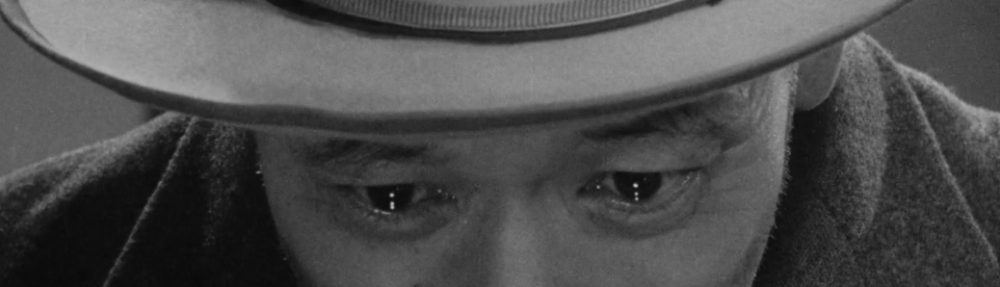
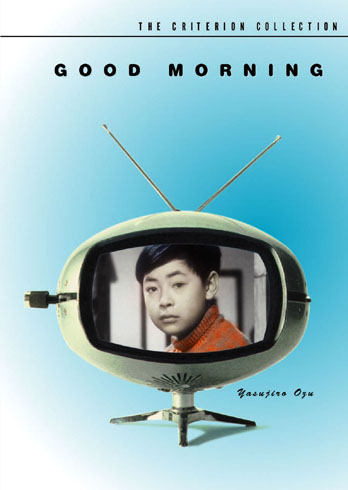
Ohayo (1959)

Good_morning_dvdIf Yasujiro Ozu can be considered foremost among Japan’s preeminent directors then there’s no doubt that Ohayo (Good Morning in English) is one of his most delightfully silly films. But that’s only on the surface level.

Young boys are unified in their affection for watching sumo on television and passing gas as a great gag to pull on their friends. Nosy housewives gossip incessantly whether it be the next door neighbor’s new washing machine or the mysterious disappearance of dues for the local women’s association. Meanwhile, most of the men go to work and spend their evenings knocking a few back at the bar noting how much the world is changing around them. Then they go home oftentimes a little drunk.

Ohayo is actually a reimagining of one of Ozu’s most remembered early pictures during his silent days I Was Born But… (1932) and yet he skillfully reworks the storyline into an everyday comedy of family and neighborhood drama that’s full of humor and his brand of quietly observant social commentary.

Ozu always took great care in analyzing family units and matrimonial bonds that affected relationships. Although we have a bit of a fleeting young romance in the works, this film’s greatest concern are two young boys from the Hayashi family who are giving their parents the silent treatment until they are allowed to have a television. Their parents are holding out and it begins a rather humorous ordeal as the brothers Minoru and the ridiculously comical Isamu (constantly exclaiming “I Love You”) try to make it through dinner, school, and so many other daily activities without a word.

As he would dissect many times over, Ozu focuses on the generational divide that was emerging and becoming increasingly prevalent in the post-war years as reflected by technological advancements like television and other such devices slowly turning present Japan into a land of a million idiots. At least that’s what the older generations feel.

Still, it’s just as equally occupied with the moral customs that have long ruled the nation where wives can speak so kindly to their neighbors up front only to slander them behind their backs a moment later. Saving face and personal honor is often cared about far more deeply than anything else — even in some circumstances when it happens to be at the expense of another family member.

Perhaps the most troubling thing is the very Japanese predilection to talk about nothing in particular, filling conversations with salutations, pleasantries, and comments on the current weather patterns. It hardly ever gets to anything of substance and that comes in numerous forms. Sometimes it means a young man never gets around to sharing his feelings with a girl or adults never being particularly candid with neighbors or spouses. There’s very little of that kind of transparency to be had. Few of the words passed along between people in conversation mean all that much.

The irony of the whole situation is that, in one such instance, it’s a young son who calls them out on it and he proceeds to get a heavy scolding from his father (Chishu Ryu) who bluntly tells him that he talks too much. Meanwhile, although Izamu can be constantly chiming “I Love You” in English, there’s an uneasy sense that his parents and most certainly his father, might have never said the words to him.

In these very simple ways Ozu rather delicately and still humorously tackles many of the issues that have long plagued an honor-based culture such as Japan’s but he does it with an adroitness that uses touches of humor and his own understanding of human nature to craft yet another universal tale that’s ultimately sympathetic in its portrayals.

It unsurprisingly feels like it could be a Japanese episode of Leave it to Beaver except for the father never has much of a talking to with his sons and the mother may be as put together as June Cleaver but hardly feels ever as affectionately maternal.

Equally spectacular is Ozu’s mise-en-scene which as per usual is meticulously staged and gorgeous in scene after scene. He offers up each individual image in a flat two-dimensional way that can best be described as taking cues from not only the theater but Japanese woodblock paintings with wonderful symmetry and compositions boosted by color.

He uses the clique of adjoining homes as the perfect set to send his characters in and out of with the hint of comedic forethought. While watching characters walking by on the hillside up above the homes — their figures slowly moving in and out of the frame past the houses — this provides some of Ohayo’s most visually stimulating images pleasing the eye incessantly.

There’s always a visual fearlessness that you see in very few others because he not only has color at his disposal but the staging is on point as is his disregard of the 180-degree rule of perspective. It just works. What is more, he also continues to use what could best be called establishing shots by western audiences. Except they hardly ever need to establish anything. It’s as if he simply put them there because they are vivid depictions of the reality he is painting — adding yet another distinct contour to the world he is working with — going beyond the figures that he places within the frame.

There’s no doubt that this is Ozu but not all that surprisingly this might be my personal favorite in his oeuvre for the aforementioned reasons. It feels like Ozu operating at his most playful while nevertheless maintaining his peak form as a filmmaker.

4.5/5 Stars


Coco (2017)

Coco_(2017_film)_poster.jpgIt only serves to show where my mind goes when I watch a movie. I couldn’t help but think of Harry Chapin’s elegiac and stirringly heart-wrenching tune “Mr. Tanner” as I was ambushed with some of the most revelatory notes of Coco. The most meaningful line out of that song relates how music made our eponymous hero “whole.” I feel the same guttural satisfaction blooming out of this picture.

Coco proves to be a film about many things. This is a film about music melded with family. The wholeness that comes out of music when you do it for sheer love and passion. Because you couldn’t live without picking up a guitar or throwing back your head to sing. Serenading family or penning a love song is just an extension of who you are. If you know anyone like that you can thoroughly appreciate what we have here.

In the best ways, it’s also about when families and our passions and the traditions that we’re taught to live by and that are passed down to us seem to collide — wholly impervious to any type of reconciliation on first glance — yet still somehow capable of fitting together.

Our hero Miguel (voiced by Anthony Gonzalez) is a precocious boy who lives with his family in Mexico as part of a shoe-making matriarchy where they have long been taught to despise music because their no-good great-great-grandfather left his family behind to pursue his dreams as a musician. The conflict is created right there.

Visually it’s another inventive landscape for Pixar to play with under the helmsmanship of Lee Unkrich because though the setting and storyline are planted in the present world of Miguel’s family, it’s infused with rich undertones of Mexican tradition. Not least among those is “Dia De Los Muertos” or “The Day of The Dead.”

Except instead of taking that as a mere tradition or a cultural practice the film translates that into a fully animated reality as Miguel experiences the “afterlife.” There the spirits of his ancestors exist in skeletal form making a yearly pilgrimage to commune with their still-living relatives. Family is still of the utmost importance to their lives and the most tragic reality is to have no one left to champion your legacy.

The hero’s journey laid out before Miguel is direct and compelling so we know what he is up against. He must receive the blessing of one of his blood ancestors before sunrise or else spend his days forever in the land of the dead. Even now he’s slowly losing more of his definition a la Back to the Future (1985). The stakes are obvious and his inner conflict stressed by the very fact that his relatives will only provide their blessing if he gives up his true love: music.

There’s so much else that could be lauded in the film for how it dares to explore its setting much in the way Inside Out (2015) did. It boasts some clever reversals akin to those found in something like Toy Story 3 (2010) and plays on the themes of hero worship in a similar fashion to UP (2009) with Miguel being charmed by mythical singer Ernesto de la Cruz (Benjamin Bratt). It’s also a bit of a Ratatouille (2007) tale of someone pressing against the currents around them to realize their individual gifts. But far from being to the detriment of the film, every one of these similarities is a genuine compliment. Could there be too many themes even? I’m not sure.

However, the idea I was most taken with deserves a bit more explanation. I’ve purposefully refrained from talking about Coco until now. If you were like me you probably assumed that our hero was named Coco or something like that, without giving it much forethought. However, we soon find out that she’s the fairly senile great-grandmother of our main character.

Because a major aspect of this film has to do with this idea that can best be described as transgenerational memory — where we pass down our recollections of the people that came before us to the younger generations. It’s no small coincidence that the lynchpin track is called “Remember Me.” Because in digging into his family’s personal narrative Miguel develops a deeper bond with his great-grandmother. It’s striking how even as we grow forgetful our long-term memory, the entrenched recollections of childhood or even muscle memory, often stay with us. That’s precisely how it is with Coco and Miguel aids in keeping her memories alive.

In these moments I could not help but reminisce about one of my favorite musicians Glen Campbell who passed away just this past year. He was a high profile casualty of Alzheimer’s and yet during his last tour though he could hardly remember the words anymore to his most famous songs, his fingers were just as nimble on the guitar frets as they were as a young man. Amazing. One of his final tunes was the brutally honest admission “I’m Not Gonna Miss You.”

And I mention it in passing only to suggest that if the idea is that you will only be remembered if other human beings remember you then that’s a terrifying world to be subjected to. As a writer that means that I will fade away unless someone actually unearths some of the mindless drivel I penned and shares it. If I’m single it means I better find someone quick and start a family so my children can not only pass on my gene pool but keep my name.

Even the pervasive theme that two people’s love for each other will live on forever, though a nice sentiment, still rings slightly hollow. Not to be a nitpicker but eternity is a long time. Even a blazing meteor burns out at some point. So if you’re like me maybe Coco will get you to think long and hard about your mortality. I’m not sure the answers are that easy to come by but they’re necessary to consider nonetheless.

In the context of this life at present, Coco fittingly rewrites the negative admonition to never play music with a more positive call to never forget family. Taking the restrictive and making it ripe with promise. That’s something most of us can probably get behind and share with our kids and grandkids as the years go by because we won’t be on this earth forever. The question remains, what do we do if we aren’t so lucky?

4/5 Stars


Song of the Sea (2014)

Song_of_the_Sea_(2014_film)_posterIn an animation market saturated by the likes of Disney, Pixar, and Dreamworks, those that have become some of the foremost names of the latest wave of animation, we sometimes forget that there are other voices as well. Song of the Sea is one of those alternative stories that is ripe for discovery.

Tomm Moore’s creation is so rich and vibrant, steeped in mythology and Irish folk tales. In some strange way, there’s a very cursory resemblance to some of Hayao Miyazaki’s worlds — the way that this story is similarly immersed in the culture in wonderful ways as well as fantasy elements entrenched in the culture (ie. Selkies), yet it still manages to remain universal, grounded in the everyday relationships of a family that pertain to all of us.

It becomes this grandiose mixture of the depressed and even decrepit streets of Ireland, wind-tossed waves, and hardened rocks. But against that very austere environment is something so luminous, magical, and life-giving. It gives the story an immense character both pictorially and thematically that runs through its entire narrative with every frame reflecting a certain essence of Irish culture, history, and even topography.

We watch with a degree of awe as young Ben is brought up to look at the world with the same wonderment in his Irish heritage. His father (voiced by Brendan Gleeson) is the local lighthouse keeper and his mother raises him up in a loving spirit. But with the birth of his younger sister and the loss of his mother, Ben’s life is different. He’s faced with loss just as his father is but he’s also faced with a promise he must keep. To love and protect his little sister Saoirse — to be her guardian — as his mother entreated him to.

Of course, the story devolves into a tale of annoyance and jealousy as Ben grows a little bit older and slowly becomes peeved with his sister’s ways. She still doesn’t talk and seemingly beats by a slightly different drum. He quickly loses sight of the value in her — only seeing the nuisance that dwells there.

But if anything, Song of the Sea is a story of discovery or even rediscovery if you will. Like Narnia or any such fantasy tale, it asks its main protagonist and the audience as well to grab hold of their child-like sensibilities and lose everything that causes them to grumble on a daily basis. That is the road that Ben is taken on. First, his goals are simple. He’s sent away from the family home he’s lived at forever and so his main objective is to escape grandma’s house in the city and get back to his dad and his dog, the massive, huggable, lovable sheepdog Cu.

However, Song of the Sea’s stakes heighten so much more because he comes to realize, begrudgingly at first, how special his little sister is and as his mother entrusted him so long ago, he must protect her. It’s a struggle but to the end, he honors that promise and it reflects the maturity that comes over him. It makes the film’s conclusion especially meaningful because we have seen the full progression and know truly what is at stake. That’s the sign of quality storytelling that will meet both kids and adults and leave them changed for the better.

In truth, my own name is Irish Gaelic and though I don’t speak a lick and the closest I’ve ever gotten geographically is Scotland (not quite close enough), there’s still a fascination I have with the very spirit of the place embodied so perfectly by this film.

The folk songs are elegantly mellifluous and even in all the chaos, all the darkness, great light can still be revealed. That is the hope of this film and even as families are fragmented and split apart. They can be mended and healed. Even if all the pain and hurt does not evaporate, the fact that we can hold family close, share the laughter as well as the tears together, that is often enough. Because it teaches us to care about others — to leave our petty, selfish endeavors behind to love others well.

4/5 Stars

I Remember Mama (1948)

I-remember-mama-1948_poster.jpgInitially, I Remember Mama comes off underwhelmingly. It’s overlong, there’s little conflict, and some of the things the story spends time teasing out seem odd and inconsequential at best. Still, within that framework is a narrative that manages to be rewarding for its utter sincerity in depicting the life of one family–a family that feels foreign in some ways and oh so relatable in many others.

In this case, the Hanson’s are a family of Norwegian immigrants circa 1910 and the story gleaning inspiration from two earlier works features a post-war George Stevens at the helm with Irene Dunne anchoring the cast as the titular character.

And it’s true that the film is rather like a eulogy, memorializing this woman who was such a strong, stalwart example despite her unassuming ways. It is her daughter Katrin (Barbara Bel Geddes) who looks back fondly at her mother, as she, now being an author sees her mama as a worthy protagonist for a story. Because, after all, this is their story, personal, individual, and unique.

The film feels anecdotal as much as it is serial, taking galvanizing moments, little snippets of that time and place and crafting a very distinct picture of what life was like back then. And that’s part of the simplistic beauty of I Remember Mama just like Marta Hanson herself.

In the opening moments, the adult Katrin recounts vividly the evenings at the dining room table where the whole family would gather around to count out the weekly expenses. They scrimp and squeak by with the meager funds at hand so mama never has to go to the bank. Meanwhile, the timid Aunt Trina (Ellen Corby) looks to marry the local undertaker and she calls on her sister to rein in their two other sisters Sigrid and Jenny who are both rather unfeeling.

Other happenings include the entrance of the boisterously quirky Uncle Chris who blusters his way into their lives initially frightening the children with his antics which secretly mask a generous spirit. Young Dagmar subsequently goes in for an operation and Mama goes to visit her breaking hospital protocol to keep a promise to her little girl. This instance reflects exactly the character that Marta imbues.

She also appreciates the influence of the families’ elderly lodger Mr. Hyde who reads each evening from his many editions of classic literature from Dickens and “Fenimore Kipling” as mama recounts erroneously. She sees this as a gift not only to herself but also her children, opening them up to thoughts, ideas, and even a little bit of culture that she can never give them. The fact that he leaves behind his books in lieu of rent receives only her gratitude while her sisters become puffed up with contempt.

Again and again, she exemplifies that almost all-knowing love of a parent. While never perfect, there’s an innate understanding of what is best for each one of her kids and she is continually willing to work and sacrifice for the sake of her family. To say what those things are would be precisely against the ethics of such a person as Mrs. Hanson and so I will refrain. See them for yourself and you too will understand as Katrin does what makes this woman great.

This is yet another feather in the cap of Irene Dunne, confirming my belief that she is one of the most underrated actresses of the 20th century. At times she’s almost unrecognizable hidden behind that accent and a certain amount of stern, straightforward, and still motherly charm. Look at her character and you see a woman of such a phenomenal stock and integrity.

Nicolas Musuracas’ crisp black & white photography lends an authenticity to the San Francisco street corners as well as the interiors helping to develop a healthy aura of nostalgia. And you get the sense, that perhaps George Stevens was intent on tapping into a bit of that old-fashioned goodness because the post-war world was a far different, far darker place. I Remember Mama is a film of tremendous virtue and inextinguishable light.

There’s also a bit of a personal connection to this film as well because half of my ancestors were, themselves, Norwegian immigrants. Although I doubt they came through San Francisco there are some familiar touchstones and it’s easy to imagine that these people pictured up on the screen could share the contours and backgrounds of my own kin from bygone generations. Wishful thinking perhaps but it’s also incredibly exciting and that’s part of the reason that I left this story feeling as if I gained something from it.

So Stevens and Dunne succeed excellently with what they set out to achieve providing a character study that is nuanced and still evocative in its pure depiction of the sacrificial love of a parent. Some would say that there’s no greater love than that.

4/5 Stars


E.T. The Extra-Terrestrial (1982)

e-t-the-extra-terrestrial

I remember the first time seeing  E.T. and enjoying it immensely, though it never floored me. I felt the same thing this time around for no particularly justifiable reason. Good but, in my estimation, not great, whatever that means because those terms are equally murky. Still, the fact that there had been little change in some ways made me feel uneasy. What was I not seeing?

But then thinking about it more I latched on to this idea that made me appreciate E.T. far more than I had before. Like an epiphany, it came to me what this film really is. It’s a childlike fantasy full of personal notes from a director who just happens to be Steven Spielberg. That’s not much of a discovery, but the implications are great.

The story of young Elliott (Henry Thomas) and his chance encounter and befriending of E.T. is rather like a boy and his dog story. Except both characters are going through almost parallel situations and Spielberg takes it to the literal extreme. They actually feel each other in a sense. They are perfectly empathetic towards one another.  With E.T. the motives are most obvious. His ultimate goal is to “phone home” so that he might be reunited with those that he calls family. For Elliott, it’s also about home. His home life is a bit fragmented with a father who is vaguely mentioned to be in Mexico (although that’s probably not the case) and siblings who quarrel like siblings usually do.

However, it also struck me how this family really does care about each other. Little Gerty –a beyond memorable Drew Barrymore–is the quintessential 5-year-old sister. First frightened of, then intrigued by and finally faithfully devoted to E.T. And the older brother Michael teases his siblings as has always been the case since the beginning of time but he too invests himself in this adventure. Certainly, it’s out of charity towards this visitor from outer space but it’s undoubtedly also an extension of the affection he has for his little brother.

It’s also peculiar that almost all the secondary characters are very ill-defined and the antagonistic forces attempting to impede E.T. and Elliott are even vaguer. At first, this felt wrong in some regards– a potential sign of poor storytelling. But once more I was brought back to the unmistakable idea that this film really is a boyhood dreamscape. This is Elliott’s story and if it’s Elliott’s story, it’s even more so Spielberg’s own meditation on adolescence and his own childhood. The narrative is even said to have been inspired by his own imaginary friend as a child and his own dealings with a split household. And there’s also a hint of the Wizard of Oz here. There’s no place like home.

Thus, what becomes undeniably important is this dynamic relationship between this boy and his newfound friend who just happens to be from outer space. It’s quite simple. It’s childlike really. And that is and forever will be the beauty and allure that comes from this film. Families can watch it. Kids can marvel at it. Parents can soak it up. Because just as it is about a family–dysfunctional as they may be in their suburban life–it is also for families.

There’s the sheer mayhem of the shrimpy kid grabbing a kiss from the pretty girl in class as hordes of frogs hop by. The iconic magic of Elliott and his friends soaring through the sky on their bicycles, John Williams’ score dancing majestically in the background again and again. Even the fact that this extra-terrestrial goes from death to life is strikingly analogous to the archetypal biblical narrative that permeates our culture. It’s all spectacularly remarkable but rather than be skeptical we acknowledge it with almost wide-eyed wonderment, accepting it, accepting these people that we meet. And watching E.T. ascend back into the atmosphere with true awe.

I find it fascinating that only a few years earlier Spielberg was inspired to put Francois Truffaut in Close Encounters. In E.T. I see his closest approximation of the French director’s own thematic elements. To put it in terms of homage. E.T. is Spielberg’s version of 400 Blows, granted featuring space aliens, Star Wars, cultural references and so on, but they’re not all that different. They really are about the same core issues. It takes until after 400 Blows for Antoine Doinel to find love and intimate relationship with his wife. For Elliot, it comes with family, his brother and sister, and mother, and of course, with E.T. This is what has a lasting impact on Elliott and I could guess, with Steven Spielberg as well. But the audience gets to be a part of it too, an equally important  piece in this trinity.

4.5/5 Stars

The Father of the Bride (1950)

FatheroftheBride1950I’ve seen both versions of Father of the Bride and Steve Martin is fine and dandy but there is no better lovable curmudgeon than Spencer Tracy and he dons the role of the protective and skeptical father so effortlessly.
Furthermore, all down the line this production is an impressive gathering of talent with a radiantly young Elizabeth Taylor embodying the role of Kay, Joan Bennett leaving behind femme fatale roles for that of the level-headed mother and, of course, Vincente Minnelli positioned behind the camera. All in all, it’s a delightful light comedy that also finds time to say something heartfelt about the relationships of parents and their children, especially between fathers and daughters.

It’s rather like sitting back for story time as Tracy struggles with his shoes and begins to regale us with the recent happenings — the events that left his stately home looking like a hurricane disaster zone. It was all as a result of his daughter’s wedding. The event that is bound to challenge his sanity and bankrupt him in the process. But it’s for his “Kitten” so he’s willing to go through it out of his unwavering love for her.

First, he’s dubious of his future son-in-law, cringing at the thought as he shuffles through his memories of Kay’s many beaus. In his estimation, none of them was a winner, but then again, no one is good enough for his daughter. He’s not too excited about giving his daughter away nor by the prospect of supporting her good for nothing husband either. I’m sure most every father has the same conundrum to wrestle with. And it’s important to note that it’s played for comedic effect but never in a way that belittles these characters.

Minnelli was always a master of the color medium but here he still takes on the important role guiding us through the comedic moments with a deft touch and allowing us to track with the mayhem at large when necessary.

There are also some wonderful spots for veteran supporting players like the overly stuffy wedding coordinator Leo G. Carroll and the charmingly enthusiastic Melville Cooper as he guides the wedding rehearsal with a chaotic vigor.  Then, of course, there’s the prospective groom Buckley, played by the always affable everyman Don Taylor.

But everything must return to Tracy and Taylor because they are the nucleus of the storyline and as such, they work well together. Admittedly, Taylor might feel slightly out of place in such a family, but she is Elizabeth Taylor and she’s captivating all the same. Putting her together with Tracy means a lot of poignant sequences. Those moments where he comforts her, encourages her over a midnight snack at the dining room table, and finally, willingly gives her up to the man she has chosen to have and to hold for the rest of her life. To its credit, the film strikes a fine balance between comedy and heart always returning to this father-daughter relationship.

3.5/5 Stars

Hugo (2011)

hugo1“If you’ve ever wondered where your dreams come from, look around, this is where they’re made.” – Ben Kingsley as George Melies

Hugo is the most curious of Martin Scorsese movies in recent memory. Nowhere within its frames do we see Robert De Niro or Leonardo DiCaprio. There is a complete lack of profanity or violence, and yet it proves wholeheartedly that he is a masterclass filmmaker -– one of the best that we still have the pleasure of observing.

In this case, he took the story The Inventions of Hugo Cabret by Brian Selznick and transformed it into a visual feast of turn-of-the-century Paris, while also crafting a love letter to the very roots of cinema.

Hugo (Asa Butterfield) is now an orphan and spends his days scrounging for food and trying to befuddle the stickler of a station inspector (Sasha Baron Cohen), who is intent on sending all stray children to the orphanage. This is Hugo’s life as he fixes clocks living inside the labyrinth above the train station, and trying to rehabilitate a mechanical automaton that his dad was determined to salvage before he died suddenly.

hugo2Aside from the inspector, the station is full of a wide array of charming individuals who generally exhibit temperaments far more personable. However, the local toy shop owner (Ben Kingsley) is rather an odd fellow, who keeps to himself, but Hugo is wrong to cross him. He’s not a bad man, but he makes the boy work for all the things he has purloined.

Hugo also gains a friend in Isabelle (Chloe Grace Moretz), an inquisitive girl who also happens to be Papa George’s goddaughter. The intrepid pair is intent on having an adventure and so they do. The automaton opens them up to the world of Lloyd, Keaton, Chaplin, Fairbanks, and the like. Hugo used to go to the cinema with his father, but he’s incredulous that Isabelle has never seen a movie picture. Her godfather would never allow it, and that’s where the mystery of this film lies.

hugo3Hugo is a beautifully magical melding of the old with the new –- the mechanical and the visceral. Extravagant colors make Scorsese’s canvas pop. It works together like clockwork.
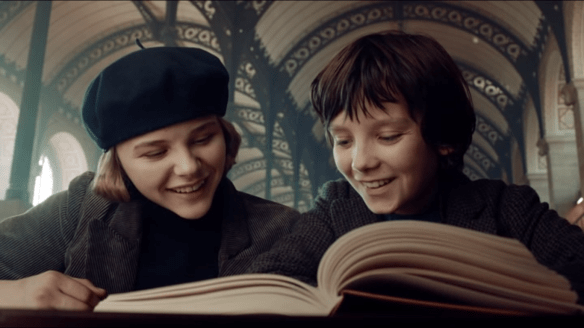
Asa Butterfield’s charm lies greatly in his piercing blue eyes that have a certain innocence as well as a degree of sadness. Chloe Grace Moretz has a twinkle in her eye and her lips are ripe with elaborate language. Literature and poetry rain from her mouth as someone who finds enlightenment in books just as Hugo finds a special place in movies.

These are children who seek adventure in the everyday, find purpose in the tides of life, and discover magic in the world that surrounds them. That’s what gives life color and vibrancy. It could be Paris circa 1931 or right in your own backyard right now. All that matters is your perspective and donning a pair of new eyes – leading to awe in all things whether big or small, extraordinary or mundane. Looking at the world with the wonderment of a child.

In the redemption of George Melies, we truly do see that out of the ashes and fading strips of celluloid beauty still manage to rise again. This is a beautiful, intimate, and innocent film. In an age when a lot of these things are lacking, it’s a breath of fresh air.

4/5 Stars

101 Dalmatians (1961)

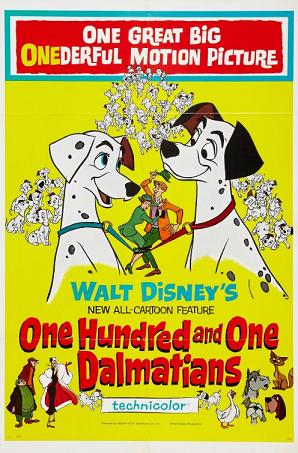
One_Hundred_and_One_Dalmatians_movie_poster.jpgDisney is, by now, a gargantuan media empire of parks, merchandise, and movie magic. It’s easy to forget that there were days when the studio was in desperate need of a hit. 101 Dalmatians proved to be just what the vet ordered.

The film enters the story originated from the Dodie Smith novel, by utilizing the point of view of our protagonist, the Dalmatian  Pongo (Voiced by Rod Taylor). He’s intent to get his faithful “pet” Roger the songwriter hitched, in order to liven up his life a bit. His escapades eventually end in success with Roger landing Anita and Pongo winding up with Perdita. They live in a humble little home perfectly happy with the kindly maid Nanny and a litter of puppies on the way.

In walks one of Disney’s most glorious creations in Cruella De Vil, the witchiest, cruelest, villain you could ever happen to encounter. With billowing furs and long cigarette holder, her presence is hard to avoid and she’s very eager to get some puppies for her nefarious purposes.

15 little bundles of fur arrive, but Roger puts his foot down and won’t give them up. Not about to be foiled, De Vil gets her two hired cronies Jasper and Horace to swipe them. And so begins Pongo and Perdita’s journey across hill and dale to rescue their children. They utilize the “Twilight Bark” to spread the news about the missing pups to try and get any help they can.

The word spreads and they are led to an old mansion in close proximity to a shaggy sheepdog “The Colonel” and his cohorts “Captain”  the horse, and “Sergeant Tibbs” an adroit tabby. Together they begin the operation to extract the pups. Although after doing recon, Tibbs realizes there are a few more hostages than he was expecting. Still, they put the plan into action trying to flee from the two menacing buffoons.  Jasper and Horace look threatening but only succeed in hurting each other. Pongo and Perdita arrive just in time to lead the pilgrimage back to London, but the snow and the adversary are nearly unrelenting. It’s in these moments that the tension is built up because on one side we have 10s upon 10s of these cute puppies fleeing in the snow with Cruella De Vil hot on their cute little tails. It’s enough to make kids young and old get invested in this animated classic. The most important part is that it ends happily ever after — at least until they have to feed all those dogs.

Although the animation is certainly not their most polished effort, Disney once more develops a setting in London and the surrounding countryside that is thoroughly engaging as a visual feast for the eyes. The voice work from the likes of Rod Taylor, J. Pat O’Malley, and Betty Lou Gerson is impeccably spot on. Perhaps most importantly of all, this film gives the dogs and other creatures of interest the perfect balance of reality and anthropomorphism. And of course, the pups like Rolly, Patch, Penny, and Lucky are endearingly cute with their baby British accents. Yet another reason Cruella De Vil is so evil. How could she ever want to harm cute bundles of joy like that?

4/5  Stars

“Cruella De Vil, Cruella De Vil
If she doesn’t scare you, no evil thing will
To see her is to take a sudden chill
Cruella, Cruella De Vil”


Finding Dory (2016)

Finding_Dory.jpgI heard it from the fish’s mouth that the main question behind this film began to gnaw away at Andrew Stanton relatively soon after the release of his first effort Finding Nemo. The question of, Where are Dory’s parents? Nemo found his father. They got their happy ending. But what about the hapless Dory, always trusting, forever faithful and also hopelessly lost. There’s a story buried there somewhere.

Out of a character who exudes so much joy and positivity, there’s definitely the potential for a lot of heartbreaking moments and this film has those no doubt. After all, Dory (Ellen Degeneres) is a fish who we all know has short-term memory loss and so-called psychological issues often lead to moments of great emotional turmoil, even in fish. This story does have some of those heart-wrenching moments, but it’s also a film of discovery, building off what we already know and love about these characters and reinforcing them in a number of ways.

New and old acquaintances are brought back to the fore namely Crush, Mr. Ray and of course Marlin and Nemo. New castmates including Ed O’Neill, Ty Burell, and Kaitlin Olson entertain us with their own ticks and foibles including faulty echolocation and nearsightedness, reflecting just how much Dory is not alone. Then there are a couple downright oddballs in the dippy sea lion Gerald and a certifiably insane loon Becky, who nevertheless prove their own individual worth.

But it’s the ornery octopus (or septapus) Hank who is the key to much of the plot because it is thanks to his agility and camouflage alone that Dory is able to navigate the Jewel of Morro Bay’s Marine Life Institute with any sort of success. She is, after all, a fish and a fish out of water is far from a good thing.

Still, this film certainly pushes the envelope as far as human-fish interaction. If the fish seemed anthropomorphized before, just wait. Without too many spoilers it gets even more pronounced this time around involving a big rig on the freeway among other shenanigans.  Enough said. It’s a more constrained film, set in and around an aquarium, but the Pixar animators show an adeptness for moving around this world in new dynamic ways with relative ease.

But there’s also a flipside to this. As the voice of God, Sigourney Weaver, so aptly reminds us, “rescue, rehabilitate, release.” That’s the name of the game. Still, it seems like sea life has never been more encroached upon, more endangered or monetized. This negative impact is seen implicitly throughout the film, but it’s never more haunting than the moments when Dory is seen wrapped up in six-pack rings. Being the bright and bushy-tailed tang that she is, no comment is made about it. But in the back of our mind’s we cannot help think about what that image represents. She gets put into captivity for this precise reason, but she wouldn’t have to be removed from her home in the first place if it wasn’t for our own ineptitude as humans.

It’s hard to put a finger on it exactly but there’s also something slightly off about Finding Dory‘s pacing. Perhaps it even has to do with the stakes of this film. It’s not truly driven by some high conflict. Yes, we know Dory needs to find her parents, but there’s something in us that realizes she already has a type of family, Marlin, and Nemo. This idea is explored a little bit while at the same time Dory tries to find her birth parents. But it’s admittedly hard to top a 13-year-old classic and I laud Finding Dory for not trying to do that. Instead, it shows a continued appreciation and care for its characters, in this case, Dory. If Finding Nemo was this rollicking, rip-roaring adventure at sea, then its sequel can best be described as a well-wrought character study. And when that character is such a well-meaning personality as Dory, that’s not a bad thing in the least.

4/5 Stars

Finding Nemo (2003)

Finding_NemoI don’t usually do this because it dates me, but I still remember buying Finding Nemo on DVD, because it was one of the first films I ever bought. It was one of the first films I ever felt was worthy enough to spend my hard-earned birthday money on or whatever the case was.

Certainly, I jest, but I also say this to note just how impactful Nemo was for kids of my generation. Pixar, in general, has left an indelible mark on many folks, but Finding Nemo had it all, garnering inspiration from the vast underwater worlds of the great ocean blue. And as they always do Pixar is able to wholly animate, literally bring to life and attribute human characteristics to non-human subjects, whether they be toys, fish, monsters, cars and so on. But Nemo was near the top of the creative spectrum, and a lot of that sits squarely on the shoulders of its characters. It was the brainchild of Andrew Stanton and with the subject matter of a young clownfish and his overprotective father he found true narrative gold.

However, it was really the supporting characters that color all portions of the frame. First and foremost in\s Dory (Ellen Degeneres), the insanely positively and joyously scatterbrained blue tang who joins Marlin (Albert Brooks) in his quest to find his son. She is the perfect foil to bounce off his dour sensibilities. In time connecting him to a band of recovering sharks with a heavy fish addiction, a band of ultra chill sea turtles, and a silently charitable Blue Whale who propels our two heroes toward their final destination: P Sherman 42 Wallaby Way.

But of course, there are always two sides to every story and Finding Nemo does well to work from both angles. There’s the father who goes on this epic hero’s journey and the lore of the mighty clownfish searching for his lost son begins to take the ocean depths by storm. Meanwhile, Nemo has been placed in captivity against his will in the fish tank of an idiotic orthodontist but spurred on by news of his father, he gains a new resilience. He resolves to make his way back to his dad because he realizes just how much his father cares. It’s a galvanizing experience and he proves just how much he is capable of. Because he disregards any hint of inferiority and realizes his potential–the kind of potential that is not reserved for certain types of individuals, but really anyone who is willing to step out in courage. And that’s how Nemo concludes, by suggesting the importance of family and really pushing ever onward. Just keep swimming. Just keep persevering.

As we wait in exuberant expectation for Finding Dory, it’s nice to reevaluate this modern classic and be rewarded by the pleasant surprise that it truly does hold up even after all these years. The animation is still wonderfully immersive, the characters compelling and the script boasts not only master storytelling from Andrew Stanton but a remarkable melding of both humor and heart. In the modern generations, that’s an extraordinary precious combination and not something that we see all that often. That’s what makes Finding Nemo enduring, and it endures not only for children, but any demographic or audience really. Because Pixar never talks down to their audience or marginalizes certain groups with their humor or a very particular brand of storytelling. In fact, their storytelling is almost classical like the films of old, which were meant for the masses no matter age, beliefs or inclinations. It’s for everyone and it’s a wonderful gift in a century that so often is restrictive and exclusive, even despite its best efforts.

5/5 Stars