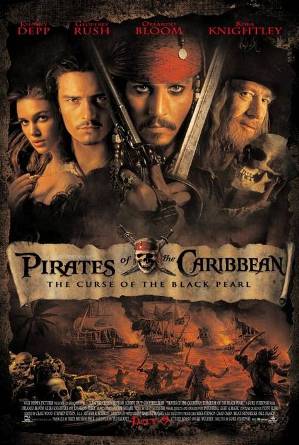
Pirates of the Carribean: The Curse of the Black Pearl (2003)

c854d-pirates_of_the_caribbean_movieStarring Johnny Depp, Geoffrey Rush, Orlando Bloom, and Keira Knightley, the film opens with Elizabeth having her first encounter with Will Tuner and she also sees a mysterious ship. Now in the present, a man recently promoted to Commodore proposes to Elizabeth. Through a series of events she is not able to answer and then ends up meeting the notorious Captain Jack Sparrow. He is taken captive after a duel with Will Tuner. However, his mutinous former crew raid the city from their ship the Black Pearl. Elizabeth is taken captive and Jack and Will join forces to rescue her, while the Commodore makes his own arrangements. Once again they face the pirates and end up in grave trouble. Jack, Will, and Elizabeth all prove their bravery and cleverness. Ultimately, they are able to take down the immortal pirates and Captain Jack is let go once again. This film was entertaining with good action and enjoyable character. I thoroughly understand how Jack Sparrow has become an icon.

4/5 Stars

Beauty and the Beast (1991)

7bdf2-beautybeastposterMy affinity the past decade has gradually turned from the classical Disney formula to the seemingly more inventive storytelling of Pixar. However, Beauty and the Beast certainly has all the makings of a great Disney film, and it is perhaps one of the last classics to come out of the canon.

As per usual, the story gets its inspiration from books and fairy tales. This time from France. Of course, any good fairy tale must have a prince and this specific prince was unfortunately turned into a great ugly beast by an old woman-turned-beautiful enchantress who he insulted. After that trauma, he is resigned to that awful fate until he learns what true love is. Until then he lives locked away in an enchanted castle with no human contact and only a magic mirror to gaze into.

Belle is the most beautiful girl in her little French village where she devours book after book and deflects the increasing advances of the handsome yet conceited Gaston. She lives with her quirky father who has a knack for crazy inventions. One such contraption actually works and he rides off to show it off, but on the way he gets lost out in the wilderness. Lo and behold he ends up at the Beast’s fortress and is soon imprisoned. His daughter goes after him and receives a warm welcome from the enchanted staff of the castle, but the Beast will only let her father go if she stays. So she tearfully agrees. The drama is heightening.

It is slow at first, but over time the Beast’s timid side is revealed, and he begins to fall for Belle. The breaking of the spell seems imminent and yet he reluctantly lets the homesick Belle go see her father again. However, Gaston has been working in the shadows and riles up a mob to lock Maurice away and then go after the child-killing Beast. Humanity must be saved from such a villainous creature after all.

In typical Disney fashion, the final act is a wholly entertaining conclusion with an often uproarious skirmish between the villagers and the enchanted inhabitants of the castle. Top that off with a necessary final showdown, some passionate kisses, and some sumptuous final sequences, and everyone is happy. Disney has always been adept at making films with a wide range of appeal and they do it again here with their foolproof formula. They take a universal story and fill it with mellifluous music and absorbing visuals. The animation is often inventive and fun while the characters fill all the necessary spots. You have your villain, your beautiful girl, your anti-hero, a bickering clock and candle, along with a kindly teapot. What more could you want?

I must say I am curious to watch the original French version La Belle et la Bete (1946) by Jean Cocteau to see how this version varies. Until then I am happily content with this film. This is the type of animated film audiences deserve to see and hopefully they will. Bonjour and Be Our Guest!

4.5/5 Stars

Review: Harvey (1950)

Why am I so infatuated by Harvey you ask? Let me clarify that. I’m not talking about the title rabbit. Why am I so enamored by this fantastical film from 1950? It all stems from Jimmy Stewart as Elwood P. Dowd, which was undoubtedly one of the most unique and remarkable performances in his storied film career.

Elwood is often quotable (Here, let me give you one of my cards, What did you have in mind, etc.). However, I think his innocence and perpetually pleasant demeanor is what makes him so wonderful to moviegoers, like myself, and to many of the characters in this story. He has his oddities, to be sure, but a little common courtesy and thoughtfulness is something that is often lacking in this world. Elwood is the complete epitome of that kind of individual. He always has an open invitation, he constantly insists that others enter before him, he has a penchant for giving flowers, he is the king of compliments, and he can put a positive spin on most anything (I Plan to leave. You want me to stay. Well, an element of conflict in any discussion’s a very good thing. It means everybody is taking part and nobody is left out).
. 
Sure, his friend is a giant invisible rabbit named Harvey. So what? By the end of this film, I might be a little bit of a lunatic too, but after all, that’s being human for you. What makes us who we are, are those quirks that populate our persons. For Elwood it’s his pal Harvey, for others, it might be something more mundane than a giant invisible pal. 
However, I will undoubtedly keep returning to Harvey, because it is a thoroughly enjoyable film that gives us a little lesson in life, and it certainly does not hurt that it is quite funny, in a whimsical sort of way. 

As I noted already Stewart is wonderful, playing Mr. Dowd straight, but he is surrounded by an eclectic group including Josephine Hull, Cecil Kellaway, and Jesse White. They are necessary foils for his character to bump up against. Although Charles Drake and Peggy Dow are somewhat flat at times, both of them fit the sentimentality of the film just right. It’s a pity Dow was not in more films because she seems like such a lovely person on the screen. But why focus on the negative, because after all Elwood P. Dowd never would.

4/5 Stars

Harvey (1950)

Having a solid cast headed by James Stewart with support by Josephine Hull, the film follows the life of a very pleasant man, Elwood P. Dowd, who befriends everyone he meets. However, he has a major peculiarity in that his closest companion is a 6 foot 3 1/2 inch rabbit named Harvey. His loving but annoyed sister tries to get Dowd interned at the sanitarium. However, due to circumstances, things do not turn out as she planned. Along the way Dowd capivates and befriends many people with his simple charm. Rather then have her brother injected so he forgets Harvey, Hull’s character realizes he needs to stay the same. With everyone in a happy and content mood, Dowd walks off again with his best friend. Stewart is wonderful in this quirky role and overall the cast is very good. I have to say I was wary of this film based on the premise but after you get past the absurdity it really is enjoyable and it reels you in.

4.5/5 Stars

My Neighbor Totoro (1988)

7eaa5-my_neighbor_totoro_-_tonari_no_totoro_movie_posterFrom the famed Japanese animator Hayao Miyazaki, this enchanting film is about two little girls and their very unusual neighbor Totoro.

The film opens with Satsuki and her little sister Mei arriving at a new home out in the country with their father. They are two energetic and rambunctious girls, who are excited by this new adventure. Their father is a kindly man, who spends a great deal of time with them when he is not working. Several other characters play a part including the elderly lady Nanny, the young boy Kanta, and of course the girls’ mother who is in the hospital. First, the girls chase dust creatures through their supposedly “haunted house.” Then, one day Mei follows a strange furry little creature under their house and then into the depths of the woods nearby.  She takes a tumble and all of a sudden she finds herself in the dwelling of a big fluffy Totoro spirit and falls asleep on its belly. When she tries to show Totoro to Satsuki and her father she cannot find him.

However, one evening as they wait for their father’s bus, Totoro comes to the stop, and this time Satsuki is introduced to the spirit who leaves them with a gift. After they spend another magical night with Totoro a few days later, the girls learn to their dismay that their mother is not coming home as planned. An annoyed Mei decides to take some corn to the hospital many miles away. Her disappearance causes a panic in the town, especially with Satsuki. She searches tirelessly for her little sister until her feet are sore. Her only other option is to plead with her neighbor Totoro to help her. Thanks to Totoro Mei and Satsuki are reunited and they see to their delight that their mother is in high spirits at the hospital.

This is certainly a film for children, but it would be unfortunate to call this a childish film. I must take a brief moment to praise the animation led by Miyazaki too. Every single image could almost be a painting they are so beautiful.  In my limited knowledge of anime, it is far above anything I have seen before. It was great to see this film in the original Japanese because it seemed more authentic, but what really struck me was the realistic nature of these young girls. Perhaps they speak a foreign language (to me) but their moods are universal. They can be extremely loud, they pout, share moments of laughter, and they love their parents.

Furthermore, this story does not need some major conflict to drive the plot. Their father is a loving open-minded man who does not even briefly doubt their adventures. I was even thinking that the obvious turn of events was that their mother would die and yet that is not the case. What this film really has is a wonderful innocence which can be appreciated by all ages. Instead of creating some major pathos we are simply able to enjoy this magical friendship between this remarkably cute fluffy spirit Totoro and these two girls. I certainly cannot wait for more from Studio Ghibli and I’m sorry that such an artist is retiring soon.

 
4.5/5 Stars

It’s a Wonderful Life (1946)

This is not only a Christmas classic but a classic in any sense of the word. It is the best of Stewart and Capra adding up to one of the most heartwarming stories of all time.  This may exhibit Stewart is his everyman role once again, but it breaks away from Mr. Smith in many ways making it another uniquely great film. A film like this that makes you know and feel for characters so profoundly is certainly worth watching.

Starring Jimmy Stewart and Donna Reed with a fantastic supporting cast,  the film tells the life story of George Bailey. We watch with the angel Clarence as he sees George’s life unfold. George saves his brother Harry as a boy and as a result, loses hearing in his ear. He works in the Bedford Falls drugstore and keeps the proprietor Mr. Gower from making a deadly mistake. Later on, he plans to travel the world and go to college so he can escape his hometown and do bigger and better things. But once more he sacrifices. One fateful day, he doesn’t know it yet, but he meets the love of his life Mary, and the same day his kindly father has a stroke. Soon after,  Harry goes off to college and George is left holding down the fort at their father’s old building and loan. He builds up all those around him with selfless kindness, while simultaneously standing up to the grumpy millionaire Mr. Potter. Eventually, he marries Mary and has children. First, during the Depression George gives up his honeymoon to keep the building and loan open. Then, during WWII while his brother and others become heroes, George stays in Bedford Falls because of his poor hearing. In this post-war period, the story picks up in the present.

Although, by unfortunate circumstances George Bailey finds himself contemplating suicide after the absent-minded Uncle Billy misplaces $8,000. That’s when Clarence comes into his life to show George just how important he really is. George sees a world where Harry is dead, Mr. Gower is a disgrace, Martini does not own the bar, his mother has no sons, Uncle Billy is insane, Violet is disgraced, Bert and Ernie do not know him, Mary is an old maid, and Mr. Potter has monopolized Bedford Falls.

Once he gets his life back George finds immediate joy and gains so much because of his friends and family. He runs through the streets of Bedford Falls yelling out “Merry Christmas,” because he is simply grateful to live again. Miraculously, the whole town rallies around him, and George reaps the reward for all he has sowed over the years. Clarence is finally awarded his wings and George Bailey is the richest man in town. There is nothing much to do after this film but simply be happy and sing “Auld Lang Syne.” It is a Wonderful film in many ways, with a wonderful cast, and a wonderful message. It has some of the greatest character development of any film ever because you do not simply become attached to one man but an entire community. That’s what makes the scene where Uncle Billy loses the money one of the most difficult for me to watch. Each and every time I’m so attached to these people. Even if I already know the resolution, I cannot bear for anything bad to happen to them. In fact, it is interesting to focus on just one of the supporting characters and see how they are affected by the life of George Bailey. It makes me ask myself if I were to die tomorrow would anyone care? We know in the case of George they certainly would.

I am further reminded of the phrase that is written on the wall of the building and loan, “You can only take with you, that which you give away.” This is what George Bailey did, and I believe it is something that each and every one of us should be mindful of. He is a great character not only because James Stewart played him genuinely and with such magnetism and heart, but because he was such a sacrificial figure. True, this is a sentimental film given the title and the director, but it is paramount to realize the progression this film follows. George must sink into the depths of his despair and disillusionment before he can truly realize that It’s a Wonderful Life. I would challenge you the next time you watch this film, to not simply acknowledge it as perennial Christmas fare, but look a bit deeper because there is so much more here. As always, Attaboy Clarence! You did it again.

5/5 Stars

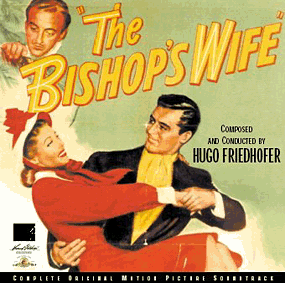
The Bishop’s Wife (1947)

Starring Cary Grant, Loretta Young, and David Niven, I would certainly consider this film a Christmas classic. It opens and we are introduced to the kindly and handsome angel Dudley (Grant). When a Bishop prays for guidance in the difficult task of building a Cathedral, Dudley is sent to him. The once genial man has become frustrated and troubled, making life more difficult for his loving wife. When Dudley arrives, Henry finds out in disbelief that he is an angel. However, to everyone else Dudley is simply a charming man who has come to assist Henry. Everyone gravitates towards his kindness, except Henry. Dudley befriends an old professor, is kindly to the servants, helps their little daughter, and above all makes the Bishop’s wife happy by spending time with her. Over time he becomes attracted to her but she doe snot feel the same way. A jealous Henry stands up to the angel and realizes he must strengthen his marriage. Before he leaves Dudley explains he will not be remembered and he will not reutrn. Then on Christmas Eve the Bishop delivers a sermon as a new man. Dudley look on contentedly, knowing that he wrote the sermon. Most importantly he fixed the Bishop’s attitude and marriage so he could continue doing good with or without a cathedral. Grant’s charming portrayal reminds me somewhat of Clarence Oddbody and it makes sense because Henry Koster directed James Stewart in Harvey as well.

4/5 Stars

Midnight in Paris (2011)

8d293-midnight_in_paris_posterDirected and written by Woody Allen and starring Owen Wilson, this film is a nostalgic piece of romantic fantasy. 

Gil is a successful screenwriter, who is attempting to finish his first novel, and he is in Paris with his wife (Rachel McAdams). She dismisses his work on a nostalgia shop because she feels it is not as worthwhile as his screenwriting career. Gil is infatuated with everything about Paris, while his wife is content with fine dining and shopping with her parents and wine tasting with stuffy friends. 

Then one evening Gil wanders the streets of Paris, and at Midnight a 1920s style car pulls up and he is invited in. Over the course of the evening, he meets the likes of F. Scott Fitzgerald, Zelda Fitzgerald, and even Ernest Hemingway, who agrees to read his manuscript. The following night he brings his wife but she leaves and he is picked up once again at midnight. This time he talks with Hemingway, meets Gertrude Stein, Pablo Picasso, and the beautiful Adriana (Mario Cotillard). Gil continues to return at night much to his wife’s annoyance and his father-in-law’s disapproval. He meets legendary surrealists such as Salvador Dali, Man Ray, and Luis Bunuel, who he inspires with his conversation. 

He finds Adriana’s diary in the present and meets a fellow aficionado (Lea Seydoux) of the olden days. Gil returns to the 1920s and Adriana convinces him to go back to the 1890s where they meet Toulouse-Lautrec, Gauguin, and Degas. This is where Adriana is happy and despite their love, Gil realizes that even though nostalgia is good it is best to live in the present. Gil gets some final feedback on his manuscript and then breaks up with Inez, realizing it was not meant to be. However, Gil finally does find someone who shares his love of Paris in the rain. 

Allen made this film really enjoyable for me because he brought to life many people such as Hemingway, Dali, Bunuel, and others. This type of history fascinates me much like Gil, and it was fun to see these figures represented in the flesh by the likes of Tom Hiddleston, Kathy Bates, and Adrien Brody. That being said, this film carries a good lesson about living your life in the present. I would have initially said that Owen Wilson seemed wrong for this film, but I think he did a wonderful portraying Gil as a man mesmerized by the golden days of Paris.

4/5 Stars


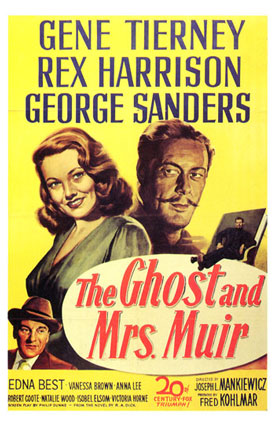
The Ghost and Mrs. Muir (1947)

f5ab0-the-ghost-and-mrs-muir-postersStarring Gene Tierney, Rex Harrison, and George Sanders, the film is about a widowed mother who moves with her daughter to a supposedly haunted house. She and the ghost have some altercations but she will not be intimidated and she has fallen in love with the unique home. Soon Mrs. Muir and the Ghost bond as he dictates his life story for her book. However, once it is done, they realize the problems with their relationship. Mrs. Muir falls for a human man and when it gets serious Michael decides to leave her life, causing her not to remember him. Soon the years pass and the unmarried Mrs. Muir is getting older with her daughter growing up. Finally Mrs. Muir passes away peacefully and now she is reunited with the one she forgot and they can be happy for eternity. This is a very nice film and Tierney and Harrison are both wonderful in their roles. Although the plot is simple it is unique and enjoyable all the same.

4/5 Stars

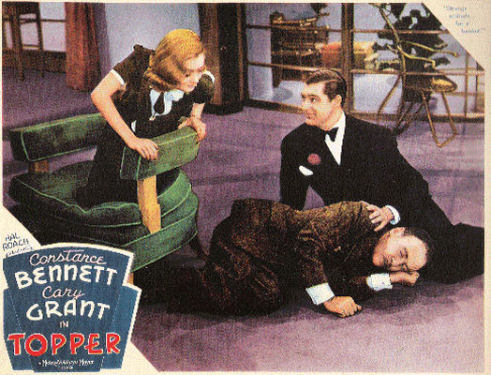
Topper (1937)

e1812-topper_lobby_cardThis fantasy comedy starring Cary Grant and Constance Bennett opens with a married couple flying down the road in their automobile. The unusual thing is that George Kerby is driving with his feet and that pretty much sums of this pair straight from the beginning. They live a wild, fun-filled life full of wealth and parties. However, all this craziness gets them killed when George takes on a curve in the road too fast. They decide as a good deed they must brighten up someone else’s life. Their subject of choice is Mr. Topper, an older fellow from the bank where George had acquired a great deal of stock. He is rather like a grumpy but lovable old dog who just does not want any excitement. The ghosts’ of the Kerbys change that however causing “Toppie” to get his name in the gossip columns after a stay at a chaotic vacation spot. His stuffy wife is dismayed, and his butler is peeved, but finally Topper is starting to enjoy life thanks to the prodding and trouble making of the Kerbys. This film has some good moments, but I would say that Grant’s comedy roles would just keep getting better after this one. 
 
3.5/5 Stars