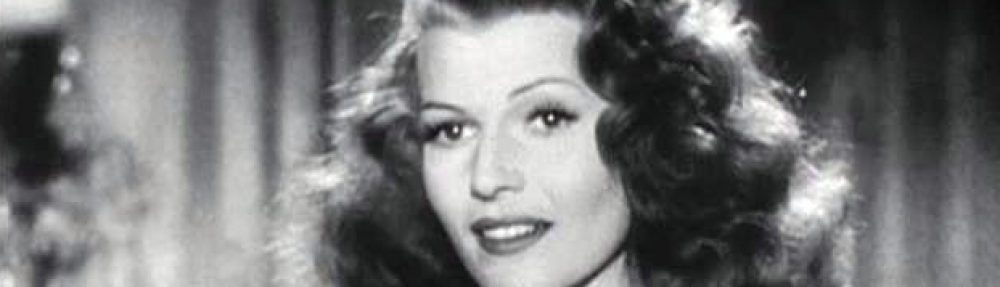
 In style if not entirely in execution The Lineup exhibits some similarities to Murder by Contract from the same year. Both films choose to take hit men as their main characters and it becomes a surprisingly intriguing way to look at a crime. Because the killers are a certain brand of sociopath who make film criminals all the more compelling based on not only on the way they carry themselves or the actions they take but the very words that leave their lips.
For the modern viewer, it’s very possible to miss the fact that The Lineup was a Dragnet-like detective show of the 1950s and this film installment carried over some of the same hallmarks from the program.
The police lieutenant is played by a no-nonsense Warner Anderson who utters every word as if he has marbles crammed in his throat. The other man (Emille Meyer) is what you expect from a second fiddle, a bit more flabby, a rounder face, and a funny intonation to his voice. Still, together these two men represent the arm of the law in San Fransisco, only two hardworking men in a vast force of crimefighters.
Don Siegel does well in all facets of the film from the opening mayhem on the streets of San Francisco that set the groundwork for all the rest, guiding the plot through the rhythms of procedures, hits, crime scenes, and casings. The climatic scenes on the Embarcadero pack the type of gratifying wallop you would hope for.
Meanwhile, Stirling Silliphant’s script has an odd cadence to it that’s particularly entrancing. It’s not hardboiled patter and that’s perhaps signified best by the fact that we meet our two main villains mid conversation on an airplane. One lauds the use of proper grammar and diction while the other, an out of town killer only known as Dancer (Eli Wallach) reads a grammar book to improve himself. After all, who’s ever heard a killer who knows their subjunctives?
From one end we follow the police as they look into a few big payloads of heroin that are being shipped in from Asia using unsuspecting tourists. There are no solid leads but they have enough competency to know something is up. They do all the things that they’re supposed to in order to nab the wanted parties. But it’s not that simple.
Because we also see a bit of what’s going on with the other side of the law. Dancer and Julian (Robert Keith) are called in to retrieve the payloads for a shadowy Mr. Big orchestrating everything from the background. And these are two of the most peculiar criminals you’ve ever known. Dancer’s a bit of a tough guy and he’s almost never caught without his trusty briefcase that carries his silent killer. He’s not about to take any flack from their chatty wheelman (Richard Jaeckel) either.
Except Dancer listens to Julian, an older fellow (obsessed with last words) who seems to serve little purpose except to be Dancer’s constant voice of reason and his coach giving him pep talks and guidance from every location. First, a Seamen’s club near the Bay, then a local residence, and finally an aquarium where they track down their last unsuspecting carrier, a young mother (Mary LaRoache) traveling with her little daughter.
But all great crime pictures must have some kind of twist, a wrench in the plans or an about face and The Lineup likewise begins to tear at the seams. Except it actually begins to mean something because in some ways we’ve built more of a connection with the criminals than the good guys.
With its surprisingly authentic images of San Francisco preserved from the 1950s, you can definitely trace a line between this film and Dirty Harry another Siegel picture that made extensive use of SF’s iconic terrain as well. Silliphant also graduated to several big crime films most notably In the Heat of the Night. But there should always be a place for smaller gems like this because they must differentiate themselves from the pack in the ways they draw up their characters and how they choose to rehash themes that have existed all throughout the tradition of gangster flicks and film-noir. That is the only chance they have to be remembered. The Lineup certainly stands out amid the fray.
3.5/5 Stars
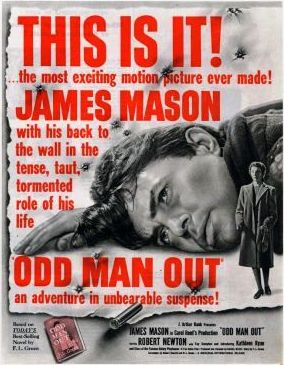 In my profession, there is neither good nor bad. There is innocence and guilt. That’s all. ~ Denis O’Dea as the Police Inspector
 White Heat burns like hot coals even today as the epitome of incendiary cinema. It’s a gangster picture from master Warner Bros. craftsman Raoul Walsh that’s volatile and intriguing, highlighted by the always fiery James Cagney as a crazed man-child with a mom complex.
 John Garfield was never the most dashing of leading men but nevertheless, he was always thoroughly compelling as ambitious working class stiffs during the 1940s. He had a straightforward tenacity about him like he had to fight his way to the top. At the same time likable and destined for trouble right out of the gates. You can cheer for him and still rue the decisions that he makes. That’s what makes his foray as boxing champ Charlie Davis all the more believable. His aspirations are of a very real nature and they give his character a genuine makeup.
 Father hear my prayer. Forgive him as you have forgiven all your children who have sinned. Don’t turn your face from him. Bring him, at last, to rest in your peace which he could never have found here. ~ Ida Lupino as Mary Malden
 Films Noir often find their hooks in lurid titles but also in metaphor. Ride the Pink Horse fits into the latter category as pulled from the pages of Dorothy B Hughes and adapted by Ben Hecht & Charles Lederer. The horse can be taken in the literal sense as one of the wooden animals that go round and round on the local carousel but there’s some symbolism in this opulent creature. In some distant way, it’s the fantasy of a different life that every man seems to crave when he doesn’t have it. But still, he strives and grinds to get closer and closer to it. More often than not he does not succeed in finding so-called contentment.
 And it’s from these opening moments that we try to get a line on Gagin by watching his every move and word. He’s brusque and abrasive with almost crazed features — constantly suspicious, demanding, and sour. He had a little too much cyanide for breakfast (although he does like fruit cocktail). Just as we watch him with interest, his probing eyes case every joint and every person he comes in contact with. Because, if it’s not obvious already, he’s not come to San Pablo for R & R. He’s come to town to avenge his dead army buddy, who was double-crossed and put out of a commission by a very big man (Fred Clark).
 Just as there is a cultured femme fatale (Andrea King), her counterpoint is the tentative Pila (played sympathetically but rather unfortunately by Wanda Hendrix), who floats in to watch over Gagin even when he doesn’t want her around. She stays anyways.
 They Drive by Night is a surprisingly engrossing picture and I only mention it for its obvious relation to High Sierra. It came out a year earlier, helmed by Raoul Walsh starring George Raft, Ann Sheridan, Ida Lupino and, of course, Humphrey Bogart. The important fact is that if Walsh had gotten his way, he would have cast Raft again as Hollywood’s perennial tough-guy leading man.
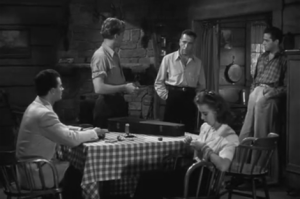 He’s not about to lose his nerves or take his eyes off the objective but the two young bucks he’s thrown in with (Alan Curtis and Arthur Kennedy) carry the tough guy bravado well but there hardly as experienced as him. He’s not too happy about the girl (Ida Lupino) they have hanging around either because she’s an obvious liability. In his experience, women squawk too much. The man on the inside (Cornel Wilde) is even worse, a spineless hotel clerk with even less nerve.
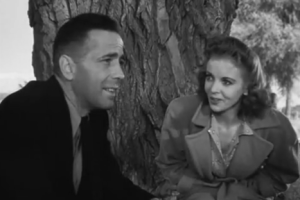 In an unassuming act of charity, Roy has a doctor friend take a look at Velma and ultimately pays for the surgery that heals her ailment completely. Still, if the story ended there it would be a happy ending but with the heist in the works, Roy is not so lucky. He pulls off the job and makes his getaway but with most any cinematic criminal activity in Hollywood’s Golden Age there must be repercussions. After all, that’s what keeps things interesting and it’s true that Roy and Marie are able to lay low for a time but soon the word is out and the gangster is a wanted man.
 The film opens with a dead end drifter being ushered off a bus in the little every town of Walton, wedged somewhere between LA and SF. Although in actuality it was shot partially on location in Orange, California, serving up a perfect representation of quaint Middle America. You can almost hear Paul Simon singing from the future (Got off a greyhound to look for America) as Dana Andrews gets off the bus. Except he winds up at Pop’s instead. There he sizes up the town and gets his first eyeful of the alluring waitress Stella (Linda Darnell).
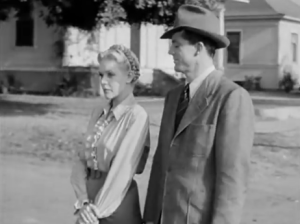 Being blessed with a certain amount of charm, Stanton strikes up a relationship with the untouchable gal, the churchgoer, the book reader, the generally good human being, June. He knows how to pull her out of her shell. Catering to her necessity to get out and live life (All the things you look down on are the things that make up life. Little things, like a game of bowling..or a swim at night, or a dance, a kiss, stuff that bubbles). It works and she begins to be swayed. Conveniently she also has a great deal of money. The outcome seems obvious and yet the story twists in unexpected ways.
 Fallen Angel undoubtedly gets a bad rap because it does not reach the rapturous, beguiling heights of Laura (1944) from the year prior, but it deserves to be seen in its own light. It’s true that both films are murder mysteries but while Fallen Angel isn’t all that interesting in that regard it has a surprisingly sharp script in other ways. Preminger works through his story with a certain dynamic assurance and like its predecessor, it’s the characters that are by far the most fascinating. Laura was a superior mystery, character study, etc., but Fallen Angel gleams brightly thanks in part to its classical chiaroscuro cinematography and an engaging menagerie of locals including Charles Bickford, Percy Kilbride, Bruce Cabot, and John Carradine.
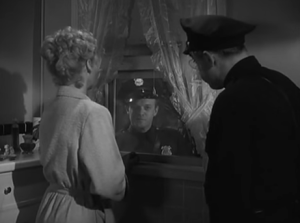 The whole thing turned on a freak accident. You’ve got to believe that Susan.
 If you know what you want in life be sure of it and you can’t miss. I found that out early. ~ Lawrence Tierney as Sam Wilde
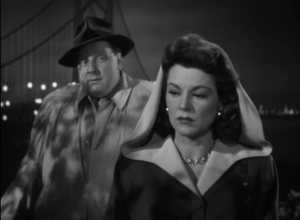 However, evil always looks to catch up with the guilty party and a private investigator is poking around in all the places he can to find the culprit behind an egregious crime. Walter Slezak’s Albert Arnett is a witty sleazeball with the lowest scruples imaginable when money is concerned. But he also happens to be decent at his occupation bringing him to San Francisco in pursuit of answers.
 4 Star Films