
Criss Cross (1949)

criss_cross_1949_trailer_2Aesthetically, Robert Siodmak’s roots in German Expressionism are crucial to the formation of the film-noir world as we know it today and Criss Cross has to be one of the most diverting additions to his repertoire. Once more he’s paired with his star from The Killers (1946) Burt Lancaster with another raging score from Miklos Rozsa and yet again there is a heist involved. However, whereas the film inspired by Hemingway’s original story was a story about a washed-up boxer — a humble Citizen Kane if you will — with some criminal elements mixed in, Criss Cross is all thriller. It represents the subset of film-noir that is the heist film, but it would hardly be film-noir without something going terribly wrong. This event is integral to the plotting as is the love triangle that becomes the main axis of the ensuing action.

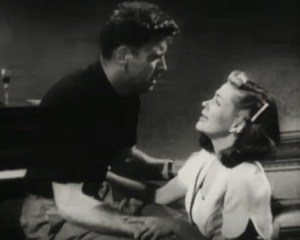
The location shooting throughout L.A. is put on display in the opening shot when the camera swoops down on a parking lot right outside a lively nighttime watering hole known as the Round Up. In these early stages, Siodmak reels his viewers in with a seductive close-up of Yvonne De Carlo looking straight at Burt Lancaster, her lover, except in looking at her man she’s also staring directly at the audience as well with those earnest eyes of hers. And from that point on her role as a femme fatale is cemented for good.

We know she’s undoubtedly nothing but trouble and yet we cannot help but be strung along with Lancaster. After all, someone that beautiful cannot be all bad, right? They never are, right? And we spend the rest of the film grappling with these questions, although the worst is always inevitable. So it goes with Criss Cross.

However, for the audience to try and understand the stakes of the story, most of the great film noirs develop the character’s pre-existing life as much as they magnify the moments of immense conflict. Criss Cross begins in the middle but soon flashes back to when Steve Thompson (Lancaster) first returns to Los Angeles, the sparkling city where his family lives as well as his former wife Anna (De Carlo). And despite the sirens going off and the chiding of friends and family including his mother and his concerned cop friend (Stephen McNally), he finds himself attracted to her once again like a moth to a flame.

He’s soon infatuated once more, embroiled in passion and at the same time petty bickering, tied up in complicated knots as Anna is also seeing the gangster Slim Dundee (Dan Duryea) who doesn’t take kindly to having another man around. In immaculate fatale fashion, Anna plays everyone off with a certain degree of vivacity and at the same time deadly innocence. One moment lively and carefree, the next biting and selfish. You can never pin her down and Steve never does. Still, he’s devoted to her. He goes half-way on a heist with his bitter rival just to save face and subsequently finds himself knee-deep in corruption that he never dreamed of, all because of a girl.

But aside from dealing with a guilty conscience, he still must survive a vengeful gangster.  The number of crisscrosses isn’t all that important, only the fact that they happen and on numerous occasions. The film finishes up with a gloriously fatalistic ending that while abrupt, in typical Classic Hollywood fashion, still delivers a satisfying final conclusion, going out just as it came in, with a rewarding dose of noirish intrigue.

Echoing the words of Proverbs, “The lips of an adulterous woman drip honey, and her speech is smoother than oil; but in the end, she is bitter as gall. Her feet go down to death.” That about sums up Criss Cross: an exhilarating and altogether deadly exercise from Robert Siodmak. Those questions still burrow into the back of our mind to the very end. Was Anna really insidious or just misunderstood? We’ll never know exactly. But perhaps the results speak for themselves. Anyways, that’s for each individual to judge on their own.

4/5 Stars
Murder by Contract (1958)

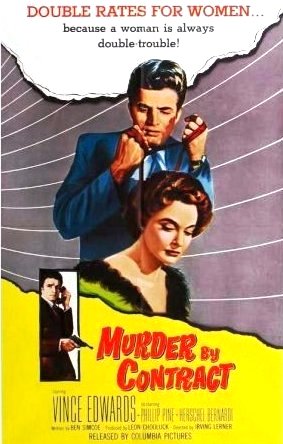
murder_by_contract_filmposterEvery once and awhile when you dig through the treasure trove of cinema which includes the B film you can wade through the refuse and come upon something truly special — elevating itself from all the lesser offerings of the past decades. Murder by Contract is such a film.
It’s not simply about the sheer economy because that’s what these lower billed films were supposed to be. Having a shooting schedule of a mere 7 days was hardly out of the ordinary. But it’s what all those involved from director Irving Lerner to cinematographer Lucien Ballard to lead Vince Edward were able to accomplish in that amount of time. This is an undeniable cult classic coming on the tail-end of what we know as film-noir and it’s easy to notice there’s something strikingly different about this film. It more ways than one it feels real, authentic, and true. Out of necessity, it chooses simplicity over the normal Hollywood production values and there’s an honesty in that.

Martin Scorsese even acknowledged the impact this film had on him at an early age and it’s true you can see bits of influence even in Taxi Driver as Travis bulks up and prepares for his future endeavors. You can see his fitness regiment mirrored in Claude our main person of interest.  In the same montage, the director adeptly suggests the passage of time while developing our protagonist through his silent actions.

Certainly, at face value, this is a very simple hitman film and there have been many ultra cool gunmen then and now. But there’s still something striking about the one we meet here. When we meet him he’s not a hit man at all but he’s driven to become one. He wants a contract, he gets it, and he carries it out. He does what he needs to do and he’s smart about it.

Vince Edwards does emit a certain calm and collected coolness but he’s also surprisingly existential for a film of this seemingly inconsequential nature. Alain Delon’s Jeff Costello is enjoyable for the very fact that he doesn’t talk. This man is interesting because he does — with choice words for waiters and about women among other topics. You get the sense that he’s a Superman as Dostoevsky wrote about and his handlers joke as much but that’s simply how he lives (Look, boy, you and me, we don’t pretend to be supermen. Me, I don’t even claim to be Mighty Mouse). Always smart, always proud and purposeful.

Given its initial humble locales, it’s easy to assume that the story is going to continue in this same vein for its entirety. But when Claude gets hired for a high-profile hit in Los Angeles his scenery also gets an upgrade to sunny Southern California. His timeline is two weeks but he’s content to soak in the sun, take his time, and think. He’s cool as always. The two men — his constant companions — who are to see that he completes the job are almost comically impatient. They don’t seem made for the crime business but here they are waiting at golf ranges and sitting in movie theaters to please their out of town guest before he goes to work earning his paycheck.

Another compliment to Murder by Contract is that it feels extraordinarily methodical and that’s a perfect reflection of Claude. He does get to his work in due time and he faces challenges, meeting them with the necessary reactions. Still, that doesn’t mean the hit is a piece of cake and because he waited so long even a pro like Claude begins to feel at least a little pressure. His two contacts are equally tense if not more so. Things begin to get testy between them as the deadline looms large.

This has to be the most idiosyncratic and interesting score I’ve heard since The Third Man. The strings of the electric guitar are used to haunt our consciousness as we nervously watch events unfold. Because that’s a lot of what being a hitman entails. Waiting around, biding your time. It requires nerves of steel. And Claude is business as usual to the end. But his business is a hard one.

4/5 Stars

“The only type of killing that’s safe is when a stranger kills a stranger. No motive. Nothing to link the victim to the executioner. Now why would a stranger kill a stranger? Because somebody’s willing to pay. It’s business. Same as any other business. You murder the competition. Instead of price-cutting, throat-cutting. Same thing. There are a lot of people around that would like to see lots of other people die a fast death… only they can’t see to it themselves. They got conscience, religion, families. They’re afraid of punishment here or hereafter. Me, I can’t be bothered with any of that nonsense, I look at it like a good business. The risk is high but so is the profit.” ~ Vince Edwards as Claude

The Big Clock (1948)

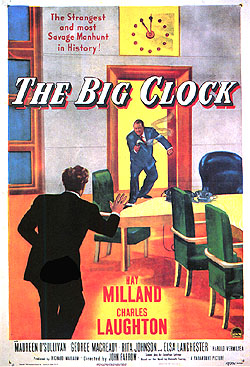
TheBigClock.jpgWith its rather dreary title aside, The Big Clock is actually an enjoyable thriller that works like well-oiled clockwork. It’s true that oftentimes the most relatable noir heroes are not the hardboiled detectives, although they might be tougher and grittier, it’s the hapless everymen who we can more easily empathize with. Bogart, Powell, and Mitchum are great but sometimes it’s equally enjoyable to have someone who doesn’t quite fit the elusive parameters that we unwittingly draw up for film-noir. Ray Milland is a handsome actor and he was at home in both screwball comedies (Easy Living) and biting drama (The Lost Weekend). He’s not quite what you would describe as a prototypical noir hero.

In some fascinating way, The Big Clock falls somewhere in the middle of those two reference points and to explain the very reasons it becomes necessary to start from the beginning. In fact, our story opens in a cold open that’s foreboding, shadowy and tense. The reasons being we don’t quite know yet and that’s how we get to know George Stroud (Milland), a workaholic chief editor of a crime magazine. He’s got a lovely wife (Margaret O’Sullivan) and a kid but, really, he’s married to his vocation. He’s never even been on a proper honeymoon.

And the reason for all this is Mr. Earl Janoth (Charles Laughton) the newspaper magnate with the vice-like grip and enigmatic way about him. He’s very practical in how he shows his displeasure (docking pay and firing employees at will) and it also allows him to exercise complete control in all facets of his business. That and the fact that his life is constantly on schedule, perfectly epitomized by the giant clock that has become the emblematic tourist attraction of his empire.

It’s a fascinating reflection of modern times circa 1940s Hollywood with international communication, journalists, and media conglomerates helping the world to function on a national level with mass media. Oddly enough, the story hardly conjures up Citizen Kane but instead the crime-filled frames of While the City Sleeps.

This film functions on two layers due to the fact that someone has been murdered. The blame is being pinned on a phantom man who looks strikingly like our hero, but simultaneously, the evil lurks close at hand. And things begin to fall into place. Strout is called upon to close in this criminal but only he knows that the man they are trying to capture is him. It’s complicated by the fact that, conveniently, he’s also the only one who knows for sure of his own innocence. After all, he would have known if he murdered someone. Here lies the tension as the film comes full circle back to its beginning – back to its climactic moments. Now we comprehend what’s at stake.

But what sets The Big Clock apart is the satisfaction in every little human interaction. The many characterizations are surprisingly lively and are at times fit more for a comedy than the darkened hallways of film-noir. Rita Johnson takes well as a bit of a femme fatale while Laughton pulls off his role with a certain sphinxlike iciness. Meanwhile, Laughton’s real-life wife, Elsa Lanchester delivers a scene-stealing performance as an eccentric artist who finds herself at the center of this entire investigation because of one of her very outlandish (and incriminating) paintings. And as every noir needs a thug, a menacing, mute Harry Morgan carries the mantle as is necessary–thank goodness he got promoted to M*A*S*H in due time. Everyone else, from the bartender to the elevator girl, to bar regulars all have wonderful moments to shine and show some personality that fills out the frames of the narrative.

Furthermore, John Seitz’s photography is on point, his camera roving with the necessary precision making for dynamic sequences while also developing the perfect tonalities of light and dark within the corridors of the mega news conglomerate. Director John Farrow is not all that well-remembered, but either way, The Big Clock stands tall as a quality film-noir that still somehow finds ways to be invariably funny. It’s a rare but still greatly welcomed combination.

4/5 Stars

D.O.A. (1950)

doa1950As one of the greatest B-films of its day, D.O.A. is framed by a crackerjack gimmick that actually pays heavy dividends. We watch a man making his way down a long corridor as the typically stringent score of Dimitri Tiomkin pounds away behind the credits. In this initial moment, our protagonist Frank Bigelow (Edmond O’Brien) rushes into police headquarters to report a murder: His own.
So begins a film that’s a gripping piece of noir from start to finish.  Through the following flashback encapsulating almost the entire storyline, Bigelow recounts his former life. He was an insurance man working the daily grind in beautiful Banning California. When he’s not working he’s trying to dodge the come-ons of his secretary Paula (Pamela Britton).

In fact, he gets away for a little vacation in San Francisco, away from the girl and from his suffocating job and he’s looking to live a little. A lively sales convention that’s taken over his hotel gets his spirits up as does the large population of charming women. In fact, every time a pretty gal walks by his eyes bulge out of their sockets (denoted by comic sound effects). He even makes a few chums.

But this is just the topsoil, the initial slice of life that Bigelow finds himself partaking of. He doesn’t realize what will soon happen and it happens so haphazardly it’s almost hilarious. It’s ludicrous really. Still going on the town, he hits up a jazz club that’s gone absolutely jive crazy as the beatniks of the day might say. It’s a real swinging place. But there’s also something deadly waiting for our hapless protagonist.

In one fateful moment, everything changes. He begins to feel sick. He’s disoriented as his existence takes a nose dive into a world of paranoia — it’s the true markings of noir. The news from the doctors isn’t good either. He’s been infected with a luminous toxin. How or by whom, he doesn’t quite know. It’s all deliciously cruel suggesting that all that is evil, all that is depraved, all that is poisonous, shines ever so brightly in the dark. In fact, that’s where evil thrives.

Still, Bigelow has no idea what he’s gotten himself into and he’s tasked with something that perhaps no one in the history of cinema has ever had to do. Find and apprehend their own murderer. There’s a trail of sultry girls and distracting exposition that all in all makes for a thoroughly bewildering plot. We should expect nothing less. Still, the end goal is finding one George Reynolds or Raymond Rakubian. Bigelow doesn’t quite know which one yet and neither do we.

Needless to say, watching O’Brien scramble across the streets of SF past onlookers and incoming traffic feels quite real and that’s because it was filmed with a certain amount of authenticity. There are scenes that were filmed on backlots to be sure but this isn’t one of them. In such moments, it’s quite easy to get a sense that in some ways this sequence directed by Rudolph Mare could be real. In fact, his background in cinematography can be seen plainly with what he finds interest in shooting. It all works together rather well. D.O.A. has one foot in reality and the faithfully doting Paula gives a little more weight to Bigelow’s state of being. There’s more at stake now, thanks in part to this girl who really does love him. She’s worried about him for most of the story.

Perhaps most extraordinarily, to the elation of film-noir lovers everywhere, D.O.A. does not cop out and it delivers a satisfying conclusion. Aside from a compelling lead performance by the promoted supporting player O’Brien, the hulking Neville Brand comes onto the scene with a psychotic turn as Chester the nervously taunting heavy (always mumbling ‘soft in the belly’). It’s true that many a good film noir needs a quality thug and Brand fits the bill. He personifies the tone of the film — brooding and deadly.

4/5 Stars

Review: The Phantom Lady (1944)

phantom-lady-1Robert Siodmak might not be the foremost of lauded directors, but it’s indisputable that film noir as a genre, a movement, a style, whatever you want to call it, would be a lot less interesting without him.
Phantom Lady is a perfect illustration of that fact as it takes a simple plotting device and rides it through the entire story to a fitting conclusion. It’s not a taut thriller or really anything of the kind but the characters and even the cinematic choices make it a surprisingly shadowy delight.

As the title suggests, any explanation of the narrative must begin and end with this phantom lady who, if you want to use storytelling terms, is the MacGuffin, the entity driving the plot forward to its final end. She’s necessary but as we might predict she’s at the same time integral to the story and not at all important.

Because the fact that she is missing is simply a pretense that leads to a response from our hero. And at first, our hero seems pretty obvious, the handsome down on his luck Joe with a pencil mustache (Alan Curtis). Once upon a time, I confused him with another noir regular Brian Dunlevy but no more. Anyways, our actual hero comes to the fore after the inciting incident. This man Scott Henderson all of a sudden comes back from a crummy night at the theater to find himself accused of strangling his wife. The cops seem to have a guilty until proven innocent modus operandi. True, the eyewitnesses for his alibi seem knee deep and yet everyone has hushed up, including a bartender, a jazz drummer, a flamboyant performer. Worst of all his female companion for the evening has vanished into thin air.

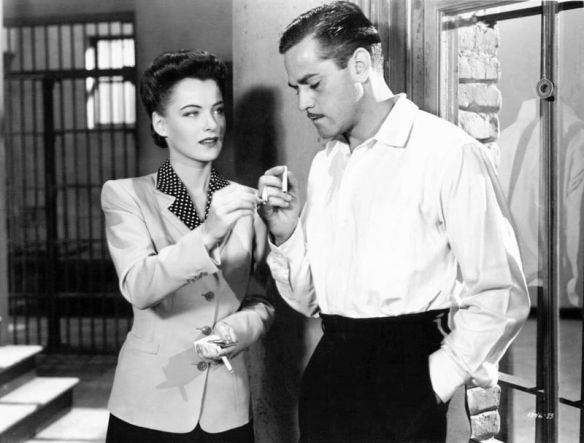
With no alibi, Scott still sticks to his ridiculous story that no one believes and he winds up sentenced for the murder of his wife. If you’re still following, it’s at this juncture where the story really begins. Henderson’s plucky secretary “Kansas” (Ella Raines) is smitten with her boss and determined to prove his innocence. So she becomes our intrepid noir hero digging around in the sleazy bars and dance halls, tracking down possible leads. A tight-lipped bartender is subjected to her merciless tailing and she even ingratiates herself to a swinging jazz drummer (Elisha Cook Jr.) who can really make his sticks fly.

They get her closer to the trail but each one becomes a successive dead end. She gains some encouraging allies in the initially skeptical detective Burgess (Thomas Gomez) as well as Scott’s best friend who has just returned from a trip to South America (Franchot Tone). Together they try and wrap up the loose ends. Of course, as an audience, the dramatic irony sets up the tension as we know what’s going on behind the scenes. So this is still partially a mystery as the search for the phantom lady continues but the joke’s really on us because soon enough we know what’s happening. However, whether it’s too late for our heroes is quite another question altogether.

Siodmak does well to develop a stylized atmosphere and there are some especially intriguing touches. The foremost is how many sequences, including the tailing sequence, function without music and yet jazz is utilized in a frenzied interlude that is almost unheard of in noir for its sheer vivacity. It’s oddly disconcerting, the juxtaposition suggesting this utter contrast between personified joy and the darkness that is seeping into the story. After all, a man is about to be sentenced to death. Jazz certainly does not fit the mood.

There’s also the paradigm of the noir working girl played perhaps most iconically by the audacious Ella Raines. In many ways, this is her film and she’s as good and almost better than many a gumshoe and insurance investigators. It’s a role that Raines embodies with great resolve and a certain amount of drive that we can appreciate in a female character of that day and age. She’s far from an objectified figure because she has brains and desires of our own — even if they are all for the well-being of a man.

It also should be noted that this was the first production credit for pioneering British screenwriter Joan Harrison. She was only one of only three woman producers in Hollywood at the time and this is a film that she could certainly be proud of with an impressive noir heroine.

3.5/5 Stars

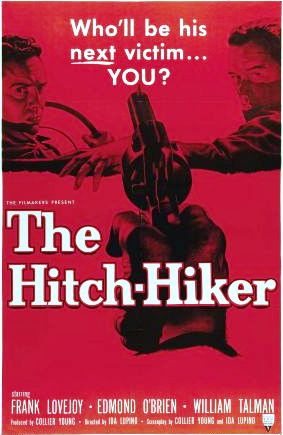
The Hitch-Hiker (1953)

hitch-hiker_posterPart of the harrowing allure of the Hitch-Hiker is that it’s actually based on a true incident that occurred only a year before the events shown. It’s not as if someone took artistic license with some murderers and made it into a horror spectacle. Hitchcock’s Psycho especially comes to mind.

Instead, director Ida Lupino takes a much more universal approach with an opening title card suggesting that the events that follow about a man and a gun and a car could really happen to any of us. Perhaps it’s a cheap plotting device but it does throw the audience into the passenger seat quickly as they are introduced to a rash of murders and the hardened killer behind the spree Emmett Myers (William Talman) who soon has the entire mobilized police force looking for him.

The meat and potatoes of the film involve the brutal murderer taking two vacationing fishermen hostage and grinding away at them as he utilizes them to flee the authorities and bends them to his will. After all, he’s the one with the gun, and he’s proved numerous times he’s not squeamish about using it.

It also plays into the narrative’s hands that both Edmond O’Brien and Frank Lovejoy are not necessarily classically handsome. But they work as everymen. If Joel McCrea was the poor man’s Gary Cooper sometimes I think of Edmond O’Brien as the poor man’s Humphrey Bogart but that’s neither here nor there. Because in little films like this O’Brien left an indelible mark on film-noir. D.O.A. and The Bigamist are two other such examples. Lovejoy on his part is extremely understated, not even being able to quite place his face but we cannot help but admire his quiet stalwartness. O’Brien’s character seems the flightiest of the three and within their ranks, we’ve found a triangle that creates the contentious dynamic that’s the foundation of the film’s entire conflict.

A film of this length and from this era doesn’t have any right to be as intense as it is, yet the Hitch-Hiker proves to be just that. It’s chock full of not only frank depictions of wickedness but enough psychological torture to send tremors up the spines of an audience. It’s a real sweaty thriller. William Talman is absolutely diabolical in a performance that is as vindictive as any other role that comes to mind. It’s that evil.

Meanwhile, the deeply underrated cinematographer Nicholas Musuraca (Out of the Past) flaunts his skills in low budget filmmaking while former husband-wife duo Collier Young and Ida Lupino team up in another surprisingly compelling project, despite its meager production values. I laugh derisively at any contemporary who might have suggested Lupino could only do so-called issue-driven “Woman’s Pictures” because The Hitch-Hiker is really all about three men where the tension mounts to great proportions. Forget any other category. This is a stone cold crime film that goes beyond a simple gimmick.

3.5/5 Stars

Panic in the Streets (1950)

panic_in_the_streets_1950It disappoints me that I was not more taken with the material than I was but despite not being wholly engaged, there are still some fascinating aspects to Panic in the Streets. Though a somewhat simple picture, it seems possible that I might just need to give it a second viewing soon. Let’s begin with the reality.

This noir docudrama is somehow not as tense as some of Elia Kazan’s other works. In fact, it’s port locale anticipate the memorable atmosphere of On The Waterfront, although it’s hard to stand up to such a revered classic. Still, the film does have its own appeals.

It begins with a gritty setting full of grungy character and New Orleans charm that continues the trend of post-war films taking the movie cameras to the streets and to the people who actually dwell there. In this way, the film shares some similarities to The Naked City.

The acting talent is also a wonderful strength with Richard Widmark playing our lead, Lt. Commander Clint Reed, this time on the right side of the law as a Naval Doctor trying to contain an outbreak of pneumonic plague before it spreads exponentially. His compatriot is played by the always enjoyable Paul Douglas a world-wearied police captain who must grin and bear joining forces with Reed.

The film is full of seedy undesirables and the most important and memorable one is Jack Palance (in his screen debut) showing off his tough as nails personality that was certainly no fluke. His right hand blubbering crony is the equally conniving Zero Mostel and together they make a slimy pair for the police to close in on. Because it’s one of their associates who ends up murdered but it’s only in the coroner’s office where they find out he was infected with something fierce.

This sets the sirens going off in Reed’s head and while not an alarmist, he wants everyone to consider the gravity of the situation. He has some trouble working with the police but he also seems to understand that this is not an isolated issue but it can affect his family — his wife Nancy (Barbara Bel Geddes) and his precocious boy (Tommy Rettig). But not just his immediate circle, but his entire community. And so he and Captain Warren race against the clock to not only to prevent an epidemic but solve a crime and apprehend the perpetrators. So this is undoubtedly your typical police procedural enlivened by New Orleans but there are also different layers to what is going on that have broader implications.

For instance, what do you tell the press? Do you keep it under wraps or let them shout it from the rooftops so the criminals get away scot-free — like rats fleeing the scene of the crime? Are you just looking for the murderers or are you considering the entire community at large? These questions deserve to be parsed through more thoroughly than I possibly can. So while Panic in the Streets is more methodical than a tense drama there are some very good things to it. Namely its location, its cast, and the universal nature of its central conflict.

3.5/5 Stars

The Blue Dahlia (1946)

bluedahliaSoldiers returning home from war is a recurring theme in films such as The Best Years of Our Lives and Act of Violence and given the circumstances it makes sense. This was the reality. Men returning home from war as heroes. But even heroes have to re-acclimate to the world they left behind.

Blue Dahlia is not so much about the assimilation of G.I.s though. It’s more an excuse to show the noir world creeping into a man’s life infecting all he left behind. As he returns, Johnny Morrison’s wife (Doris Dowling) is keeping company with another fellow (Howard Da Silva) and everyone else seems to know about it except Johnny. Also, his young boy died tragically while he was away and his wife has taken to a life of drinking and partying. He’s not expecting any of this but then again what happens in film-noir is very rarely what we expect.

Raymond Chandler weaves together his first original screenplay here, a production that was hampered by the impending deployment of Alan Ladd as well as Chandler’s own bouts with alcoholism and writer’s block. It’s hard to know which one caused the other. But either way, the film finds its roots in a murder and the man who is suspect just happens to be the returning G.I. Before he ever knew people were looking for him he playfully took the name Jimmy Moore after meeting a lady (Veronica Lake) who happens to be closer to him than either of them realize.  Their paths cross more than once.Then he’s on the run. His war buddies (Hugh Beaumont and William Bendix) are worried about him after being questioned by the cops. And the cops are anxious to hone in on the killer because no one is of any real help. No solid leads come their way and that means Johnny has to track down the killer himself.

The direction of George Marshall is not particularly inspired but his players are compelling enough. Alan Ladd can still play the brusque tough guy and William Bendix steals the show with his own blue-collar bravado and snarling bluster. Veronica Lake doesn’t show up until well into the film and in many ways, despite her billing, she feels relegated to a smaller role. She’s not particularly memorable in the majority of it even with her scenes with Ladd. She’s mostly just there which is grossly unfortunate. It feels like a waste.

After the novelty of Hugh Beaumont wears off it makes sense why he transitioned to TV while Howard Da Silva and Doris Dowling denote a certain sleaze that comes off quite well. Meanwhile, Frank Faylen plays an integral role as one of his typical curmudgeon types. He made a killing off of that niche. Still, Ladd and Bendix are the main attraction in this adequate serving of film-noir. On a darker note, this film also gave its name to the unsolved Black Dahlia killing of Elizabeth Short in 1947. It’s one time when perhaps reality was more tragic than fiction. Raymond Chandler could not have even dreamed up such a grisly drama. At least not for the silver screen.

3.5/5 Stars

The Glass Key (1942)

the-glass-key-1942With Dashiell Hammett’s The Maltese Falcon making a splash just the year before and giving a big leg up to its star Humphrey Bogart as well as its director John Huston, it’s no surprise that another such film would be in the works to capitalize on the success. This time it was based on Hammett’s novel The Glass Key and it would actually be a remake of a previous film from the 30s starring George Raft.
But instead, we had Alan Ladd in the lead fresh off a career-making performance the year before. True, Ladd’s no Bogart and the forgotten Stuart Heisler is hardly the caliber of Huston, and still, the film is somehow entertaining in its own way. It channels the political corruption of Force of Evil with a bit of the unfathomable plot and mile-long laundry list of characters rather like The Big Sleep. And once more like any comparison with the Maltese Falcon, it hardly holds a candle to these other films but it’s not trying to be overly smart. It never makes an attempt at commentary or some deep philosophical character study but it does ladle out some unabashed noir entertainment.

There’s the pairing of Ladd and Veronica Lake once more to capitalize on their breakout success in This Gun for Hire. Noir regular Brian Donlevy stars alongside them playing a tough guy and political boss named Paul Madvig. His right-hand man Ed Beaumont (Ladd) stands stalwart by his side until Madwig gets caught up in politics as well a murder accusation. By day he tries to win the hand of the pretty daughter (Lake) of an aspiring governor while at night he looks to run out the towns gangsters namely one Nick Varna. As one might expect murder, corruption and familial turmoil all become integral plot points

Once more Ladd shows his aptitude for playing “leading roles” that still somehow allow him to stand on equal footing beside other stars. His most prominent performance as the gunslinger Shane is a fine example because although he is the title character, still somehow he manages to walk in the periphery and he does so with a quiet confidence. Similarly, in This Gun for Hire and The Glass Key, there is a cool curtness to his demeanor that he pulls off well. It allows him to be the star without really seeming like it. That’s the quality he’s able to cast and Lake works well to balance him out. Donlevy gives a surprisingly spirited performance but he’s not a magnetic star. If anyone, this is Ladd’s film with Lake too.

As we would expect with any decently entertaining noir thriller, the rest of the film is filled out with quite the menagerie of characters the most memorable of those being William Bendix as a rough and tumble henchman. He and Ladd have it out in a couple of scenes and in real life, they would become lifelong friends. The way they beat each other up though it’s sometimes hard to tell.

3.5/5 Stars

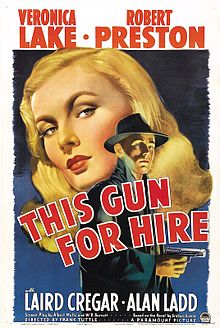
This Gun for Hire (1942)

220px-this_gun_for_hire_movie_posterAlan Ladd and Veronica Lake found themselves partnered together on numerous occasions partially out of convenience (at 5’6 and 4’11 they were a perfect height match) but also there’s a genuine chemistry between them. And it all came into being with This Gun for Hire an economical film-noir where Ladd wasn’t even one of the top-billed stars.

Those coveted positions above the title went to Lake and the relatively young buck Robert Preston with Ladd tacked on with an “Introducing” title card. It was his latest attempt to break into the film industry that had long relegated him to bit parts and uncredited cameos (ie. Citizen Kane). It worked.

His menacing thug Raven is the first character we meet and he soon proves his brooding menace is more than just show. He is a gun for hire after all and he finishes up some business for a client getting his payoff through a nervous and portly fellow named Gates (Laird Cregar). But the money is hot and Raven soon finds a price on his head. He’s been had and he’s not about the let that slide.

The main push from the law enforcement is led by none other than Michael Crane (Robert Preston) who has recently been vacationing with his girlfriend Ellen Graham (Veronica Lake). As he burns the midnight oil she has her own gig as a magician/nightclub singer while also taking on some clandestine activities — activities that’s she sworn not to tell anyone about — even her beau.

As we might expect with the tenets of noir, the film is a lot bigger than we are initially led to believe, not simply involving murder, but also treason and government secrets as Pearl Harbor is still fresh on everyone’s minds. In such a way, our three leads get tied up both literally and figuratively as Raven continues as a fugitive in search of the man who set him up.

He too crosses paths with Ellen and in her, he finds a kind of confidante who doesn’t immediately write him off, despite his deadly tendencies. Before her he only liked cats, the reason, they don’t need anyone, rather like him. But he’s also not about to reform, not until his work is done.

Although its transitions are at times choppy and awkward, there’s indisputably an intrigue that courses through This Gun For Hire that makes it a diverting bit of noir and its latter half is the pinnacle of the action as the dragnet closes in around Raven. For the 1940s, it was a crackerjack finale but unfortunately, it’s sullied now by an abrupt happy ending. No matter.

While Robert Preston is a fairly flat lead, Veronica Lake is her usual playfully sympathetic self and Laird Cregar plays the spineless oaf to perfection. His slimy sort is one of the reasons noir becomes so wickedly delectable. In fact, he’s perhaps second only to Alan Ladd’s characterization because over the course of the film Ladd systematically steals the picture, taking every little bit of limelight and making it count. Solidifying his stardom by playing a highly compelling heavy and essentially stealing the girl away from his male costar.

Edward G. Robinson, Humphrey Bogart, and perhaps most notably James Cagney, all played corrupt, crazed, and vindictive gangsters at one time or another. What sets Ladd apart is his utterly emotionless eyes. They’re still the eyes of a stone cold killer but there’s a vast emptiness there. Anyways it’s the perfect laconic performance for film-noir and while he never reached the heights of Bogart (also a former supporting player), Alan Ladd rightfully so gained recognition for his own career — most notably in Shane. But everything has to start somewhere and This Gun For Hire is precisely that film. His mark is all over it.

3.5/5 Stars