The Blue Angel (1930)

blueangel1The Blue Angel is the name of a nightclub and it turns out to be a very fateful nightclub indeed. It just takes us a while to figure out why. Although Josef Von Sternberg’s film is known, rightly so, for making a star out of Marlene Dietrich — in the first of their 6 collaborations — this early German sound film is nevertheless about the decline and fall of Emil Janning’s character. Immanuel Rath begins as a professor at the local college, and although his pupils are unruly, he commands the utmost respect. He sees it as his prerogative, and he is quick to bring order and discipline to these young lads. But boys will be boys and they become corrupted by the beautiful cabaret singer Lola-Lola (Marlene Dietrich). One evening the professor drops into the seedy joint to look out for some of his troublemakers and talk with the proprietor. Of course, he unwittingly ends up meeting the gorgeous girl backstage and returns the following evening with a seemingly very flimsy excuse.

Ironically, his boys are not the only one who take a liking to her. The once restrained and reserved man of learning begins to change. He becomes a man obsessed and infatuated beyond the point of logic. But what does he care? He enjoys being in Lola’s company and the idea of a marriage proposal makes complete sense in the reverie that he is swimming in. So they do get married. The professor leaves all the common sense behind and goes on the road traveling with his wife and their promoter.

blueangel2But by this point, he is a sorry figure, so pitiful and bedraggled in every way. He reluctantly parades himself in front of audiences as a clown just to make some money for him and his wife. It is, of course, inevitable that he return back to his old stomping ground, and it does eventually happen. He reluctantly goes onstage and it is difficult to watch this final chapter. Lola is no longer his. He’s completely ruined. Completely destroyed. Oh how far the man has fallen, as he winds up keeled over on top of his former desk in the gymnasium.

I think I enjoyed Emil Janning’s in The Last Laugh more and yet to its credit The Blue Angel does not cop out in the end. It has a tragic trajectory that in some ways feels like a precursor to such noir as Scarlet Street and Nightmare Alley. It’s understandable how Dietrich became a star because stars have the capability of drawing your attention. Janning’s gives a wonderful performance certainly, but the allure of Dietrich is too much to discount. She steals the show just like she steals the Professor’s heart. We’re just “Falling in Love Again and we Can’t Help It.”

4/5 Stars

Metropolis (1927)

MetropolisposterFritz Lang’s archetypal sci-fi epic is steeped in politics, religion, and humanity, but above all, it is a true cinematic experience. It is visually arresting, and it still causes us to marvel with set-pieces that remain extraordinary. How did Fritz Lang piece together such a gargantuan accomplishment? Maybe even equally extraordinary, how was I able to see almost a complete cut of this film, which was at different times thought to be lost, incomplete, and ruined?

Metropolis really feels like one of the earliest blockbusters, although I would have to further substantiate that. Still, it’s basic story is generally captivating following a young man named Freder from the upper echelon of society with a father who runs things. This young man is really in the perfect position to succeed, the way society is set up. He even goes to the preeminent school where all the boys are dressed in white. Little does he know in the lower depths the beleaguered, grungy, weary masses in black are slowly killing themselves with work. The machine that drives this society is never satisfied, always desiring to be fed more and more and more.

When the boy finally sees the reality of the infrastructure his paradise is built upon, he cries out in horror. This is not the way things are supposed to be. He eventually switches places with one of these workers and attends a meeting deep in the catacombs (an allusion to the early Christians), where the pure goddess Maria lifts the spirits of her fellow man. But of course, the evil inventor Rotwang is enlisted by Freder’s father Joh Frederson. Their own relationship is marred by conflict over a woman they both loved. Freder’s dead mother. And so the scientist looks to resurrect his long lost love, and he needs Maria to develop his plan. He kidnaps her and from her likeness creates a double, who goes out to wreak havoc on all of Metropolis. The apocalyptic words of the Book of Revelation ring true as the whore of Babylon deceives the masses and leads them to destruction.

But Freder is the Mediator, he is the Savior of his people, and he is necessary to bring peace and tranquility to a world that has descended into such brokenness. So Metropolis is certainly a film full of symbolic touches, religious connotations, and political commentary, but all of this is developed by Fritz Lang through an archetypal hero’s narrative.

Hollywood has become an industry seemingly so obsessed with story, screenplays, plots. Certainly, a film like Metropolis is at least adequate in that area alone, but what really sets a film such as this apart is its cinematic scope. The sheer vast expanses it fills. The scope it creates through its plethora of extras and encompassing sets is hard to downplay. How to describe scenes where water is literally breaking down walls and covering masses of fleeing children? Or smokestacks spewing out refuse while trains, planes, and automobiles pass by in every direction. People scattering this way and that, following the false Maria in a chaotic frenzy. It reminds us what the motion picture, the moving picture, is all about. The images that are brought before us lead to a suspension of disbelief because more importantly they are incredibly affecting. At the atypical 20 frames per second, they are images full of tension, full of energy, and full of life.

Metropolis-new-tower-of-babelIn a sense, with Metropolis, we can easily see a precursor to Chaplin’s Modern Times a decade later. There is a general apprehension of the machine and the impact of a true industrial revolution. There is a fear that there are more positives than negatives. That machines will take over and man will become outdated. Perhaps someday our creation will destroy us. By today’s standards, such notions seem archaic, but are they? We still live in a society ever more obsessed with advancement, technology, and all the things that come with that. However outdated some of Metropolis might feel, and there are numerous such moments, at its core is the final resolution that between the body and the mind there must be a heart to regulate. We are not simply animals with bodies or rational machines with minds, but the beauty of humanity is that we have a heart, pulsing with life and vitality. That is something to be grateful for and never lose sight of.

5/5 Stars

Nosferatu (1922)

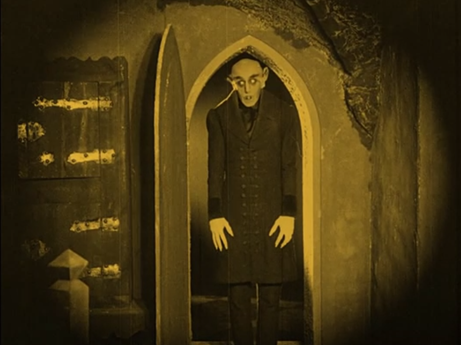
nosferatu1The hand of F.W. Murnau is less noticeable in this early classic of his, but Nosferatu still works seamlessly as a piece of drama and horror. In fact, it by now has become somewhat of a horror classic and the archetype when it comes to vampire movies, taking a lot of inspiration from Bram Stoker’s Dracula. I think one of the things that makes Nosferatu so gripping is the fact that it mixes the plausible with the supernatural making for this weirdly rewarding ride. Is it scary? No, not in the modern sense of the word.

But it’s a story steeped in Myth. There is mention of the Black Death, supernatural creatures, and a being that “suckles himself on the hellish elixir of their blood.” What wonderful imagery that develops a genuine awe in this devilish being. And yet in the same instance, we’re getting scientific explanations of venus fly traps and tentacled polyps acting as symbols certainly but also tying us back to the real world. These forces of nature are real, backed by science, and make a vampire just a little more conceivable.

Running through Nosferatu is a love story, and much like Sunrise, although Nosferatu is a “symphony of horror,” there is also a bit of a love song underlying the vampire tale. It lends this story some heart, because these characters, like our protagonist Hutter, actually have something to live for.

Nosferatu most certainly is a symphony, and along with the expressionistic images, it uses title cards as well as excerpts from ship logs, books, and letters to tell the story. One such inter-title card from Count Orlock reads: Your wife has a lovely neck. Hutter has little idea what he means (or pretends not to), but we know, making it a rather funny but unnerving comment. There’s something about knowing what is undoubtedly going to happen and being powerless to stop it. For instance, when someone acknowledges they have two mosquitoes bites quite close together that spells trouble to the audience, but we can only watch and wait.

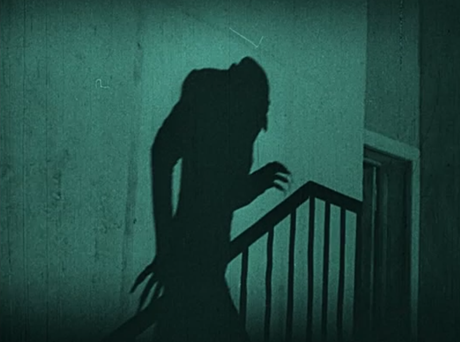
nosferatu2Because when Hutter first goes to offer Count Orlock a house we know it is bad news, to begin with, but it takes a long time for anything to actually happen. Orlock moves into the abandoned mansion across from Hutter and his wife, and that’s when the danger strikes close to home. There’s a madman in the hospital diverting attention, and Hutter winds up incapacitated so he is incapable of coming to the aid of his love. She is left vulnerable and the vampire has already proven what havoc he can wreak with the crew on a ship. Aside from Max Schreck’s frightening facade complete with pointy ears, bulging eyes, and menacing fingers, the vampire literally appears and disappears into thin air. There is a haunting aura built around him because he is something supernatural, something that we cannot understand except through myth. I found myself getting tense waiting for something that I was not sure about. That was the exciting part. It’s not a blood and guts, monsters jumping out of closets, kind of horror. It’s not ridden with cliches either because it was the one creating its own mystique.

It’s hard to believe how much popular culture has been derivative from Stoker’s Dracula, much like Doyle’s Sherlock Holmes, or Shelley’s Frankenstein. However, amidst all the vast works of Dracula and vampires, Nosferatu stands out. It represents the visual aesthetic of German Expression wonderfully, and it casts a long shadow. It’s hard not to, at the very least, admire its artistry and be taken aback by its legacy. In the realm of silent films, Nosferatu is a must, pure and simple. It doesn’t rely on bloodcurdling shrieks and screams, but the images begin to invade our consciousness. One seems fleeting and the other sticks with us.

4.5/5 Stars

The Last Laugh (1924)

lastlaugh1Without sound, silent films become almost a completely visual medium and there was no one more visually-minded than German director F.W. Murnau. Aside from the opening title card and a message to begin the epilogue, he stays away from that kind of aid to tell his story and instead relies wholly on the image. His film does, however, boast a vibrant score, so that fills the void in the absence of dialogue.

Emil Jannings, the rotund, mustachioed leading man, stars as the veteran hotel porter, who is demoted to bathroom attendant due to his age and frailties. And it’s true that he always seems bent over and perpetually weary, but it only gets worse when he loses his esteemed position as the symbol of The Atlantic Hotel. Before he stood beaming ear to ear in his prim and pressed uniform that reflected his status. Then, he winds up towel in hand, resigned to stay hidden away in the bathroom. Now everyone could care less about him. It’s a tragic trajectory that this story takes.

The film opens at the lavish hotel which feels very similar to the grand hotel, and this along with the man’s apartment building are the main locations that Murnau works with. And he does set up his scenes so interestingly, whether it’s around a revolving door in the hotel or the staircase in the apartment. He’s constantly giving us a perspective of things with wonderfully textured, layered shots exemplified sublimely in such moments as Jannings superhuman feat carrying the large chest. Murnau gives it a wonderfully dreamy, ethereal quality, the way he clouds the frame. He also uses his actors in dynamic ways to fill the space in front of us. It hardly ever feels static or boring for that matter, because there’s almost always something of interest to be looking at.

lastlaugh2This is a very heart-wrenching film, because, in a sense, at its core, it’s about aging gracefully and trying to navigate that season of life. Because, the reality is that, each one of us will grow old. Our bodies won’t be able to function like they used to. Our feet will grow weaker. Our eyes will become tired more easily. We can completely understand this man’s plight. He has pride and the shame of acknowledging his demotion is too much for him to bear. He tries to hide it, from the wife and from the neighbors, but, of course, they find out. His family is ashamed and his neighbors belittle him with glee. The saddest thing is this doorman is not a bad fellow, as illustrated by how he comforted a little girl who was being made fun of. He’s a good man, and he deserves better than this and yet life very often is not just. The gossips and the connivers seem to get ahead. The beatitude, the first shall be last, hardly ever seems to be true. In fact, the film pauses with the following title card:

“Here the story should really end, for, in real life, the forlorn old man would have little to look forward to but death. The author took pity on him and has provided a quite improbable epilogue.”

There is a major shift in tone as the doorman is left a huge sum of money rather unexpectedly, and he spends the days now eating heartily and generously tipping all his former colleagues at the hotel. It almost feels like a completely different story, and it’s the ending that we want as an audience. Except still lurking in the back of our minds is that this is very rarely reality. But there is some satisfaction that at least in this case Emil Jannings had The Last Laugh.

This film is literally a piece of film history that has thankfully been reconstructed for our viewing pleasure and I’m thoroughly glad it was. I’ve only seen Murnau’s Sunrise: A Song of Two Humans, which is magnificent. However, after watching this earlier work it made me realize I need to examine more of his filmography, including Nosferatu (1922), Faust (1926), City Girl (1930), and Tabu (1931).

4.5/5 Stars

Phoenix (2014)

Phoenix_(2014_film)_POSTER

Speak low when you speak, love
Our summer day withers away too soon, too soon
Speak low when you speak, love
Our moment is swift
Like ships adrift we’re swept apart too soon
~ Speak Low (1943)

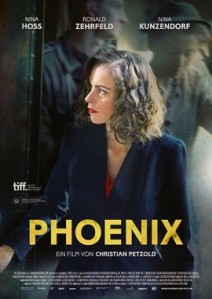
Anyone who’s watched a Christian Petzold film already knows that he crafts fascinating almost spellbinding films and that quality rests greatly on the laurels of Nina Hoss. Phoenix is yet another film that is a mesmerizing enigma.

It’s positively entrancing with its pacing — where you almost get lost within its minutes. Because although time never moves fast you quickly lose track as the mind is soon overwhelmed with a plethora of questions. In fact, all the time while you’re watching it all you can do is question. Implausibilities all but fade away in the presence of such uncertainty. If anything they get lost in the rubble.

It feels as if we’re trying to construct our own truth, which is almost maddeningly impossible because none of these characters seem ready to divulge any information. The past is a black shroud that everyone is reluctant to talk about. It makes sense because that soon after what do you say about the Holocaust? How do you cope or even begin to acknowledge the horrors that went on? It’s only 50, 60, 70 years later that we’ve finally been able to broach the subject as outsiders — people who did not experience those events firsthand. It’s easier for us to try and talk about it because we can never fully comprehend the climate. What would we have done? What would have happened to us? What would our lives have looked like in the aftermath?

The characters in Phoenix are beings in that post-war wasteland with specters hanging over them, and lives scarred by pain and suffering. They’re trying to salvage their existences the best they can, but they’re hardly existing as they did before the war. But allow me to backtrack for a moment.

Nelly (Nina Hoss) is physically maimed so horribly that her face is constantly covered in bloody bandages. Petzold does us a favor by not showing her visage before she gets reconstructive surgery. Like the shadow of the Holocaust, we are forced to imagine it on our own which is far more powerful. This is what her face looks like and this is perhaps how it happened.

What we do know is that she was arrested on October 4th, 1944 and her husband Johnny was as well. But Nelly’s faithful friend and guardian angel Lene says that he betrayed her. That’s what she believes, and yet upon hearing this news it hardly alters Nelly’s response. She’s still intent on finding him and picking up all the pieces. When she has a little more strength she begins wandering about the American sector looking for any signs of her former beau.

It turns out that Johnny works as a waiter in a cabaret Hall called Phoenix. When he first sets eyes on Nelly — it’s not his wife that he sees, but a wonderful impostor. She’s a woman who is strikingly similar, but her face is different. She’s the perfect accomplice as Johnny, or Johannes as he now goes tries to secure his dead wife’s assets.

What follows is his mission to make her into his old wife.  In many ways, it works as an inversion of the Vertigo conundrum. He thinks he’s making this woman into his deceased wife, and he coaches, dresses, and shapes her more in the image of Nelly. However, this hardly feels like an obsessive desire of dashed love, but a project to get him closer to his final goal. It’s not that sentimental, but Nelly follows along with the whole thing benevolently. To be close to Johnny is enough. But how does she even begin to break the news? Perhaps most frightening of all what will Johnny’s reaction be? After all, the wartime has changed them both.

So if you want to break it down to its most basic roots, Phoenix feels rather like a Holocaust film meeting Vertigo. But in essence, it defies that type of simple categorization. It lacks the odious horror of flashbacks and the glossy Hollywood production values of the latter. It fills its own niche altogether that even channels some of the darkness of noir. And there is no cathartic moment of emotional release. Instead, we are forced to watch as the characters bury their thoughts and feelings deeper and deeper. Perhaps they lie there somewhere under the surface. However, these are not histrionic people. They feel common and every day led by the performances of Hoss and Ronald Zehrfeld.

In this way, the performances are muted and repressed. In fact, there is little headway in the film and few epiphanies until the very end. That’s when for a few brief solitary moments things fall into place. We don’t know what will happen afterward, and in a way, we are suspended in the moment — left to ponder so many things. You could either make the case that Phoenix has shallow characters, or that there is so much depth within them that we cannot even begin to understand — like icebergs still partially submerged.

Many wonderful films lose so much of their magic because they dispel too much — give away too many of their hard-fought secrets. But Phoenix makes us work through everything, and it can be hard going certainly, and yet it is a thoroughly gratifying experience. We watch movies to be moved. We watch movies to be perplexed. We watch movies to acknowledge our wonderment in the human condition because it is a complex quandary that continually reveals new bits of enlightenment. Phoenix might leave us with more riddles than answers, and we should be content in that reality. That’s part of the magic.Like the mythical Phoenix of old, in a way, these characters try and die to their old selves, and rise out of the ashes a new.  Life is never that easy — always being clouded by doubts as our pasts come back to haunt us. It’s how we deal with that past that matters most.

4.5/5 Stars

Barbara (2012)

Barbara_(2012_film)If you’re acquainted with director Christian Petzold you probably know what you’re in for. A character study that is deliberate and systematic in its execution, courtesy of Nina Hoss, and moreover impactful in more ways than one. In this film, the narrative mode of the period piece certainly serves Petzold quite well. The setting is East Germany circa 1980. The settings are wonderfully stark. Depressed representations of a bygone era and yet somehow still strangely beautiful for depicting a simpler age. As Americans, we have a certain perspective that includes Cold War sentiment, boycotting the Moscow Olympics, and the like. But it’s a much different even intimate picture on the inside.

Our person of interest is the eponymous Barbara, a nurse stationed in Berlin, who tried to get an exit visa to the West. Now she has been transferred to a rural locale to continue her work with close surveillance by the Stasi. Her primary colleague is chief physician Andre Reiser, who is genial, but from the get-go Barbara is aloof. She does not want friends and she knows anyone could be working with the police.  She goes about her work being the best nurse she can possibly be, treating patients humanely. Most notable is Stella a girl from a labor camp, who is suffering meningitis, and finds a comforting figure in Barbara. From then on she is the only person Stella trusts.

In her free time, Barbara can often be seen smoking, riding her bike, or taking the train, but there is always a purpose to her activity. It’s in quiet defiance of her plight — an active form of rebellion as she tries to rendezvous with her boyfriend from the West in an effort to reconnect with him. Unknowingly Dr. Reiser grows continually fonder of Barbara and continues to be nice to her because she is quite remarkable. Together they try and decipher what is wrong with a young man who is recovering from a suicide attempt. But of course, his necessary surgery coincides with Barbara’s set date of escape. What follows is far from melodrama, but it is a far tenser slow burn as we watch events unfold. Our heroine does something that will alter her future although we cannot know for certain. Sometimes the best place to end a story is inside our own minds, and that is true with Barbara.

It’s a film that can make you squirm, but also make you think and feel. The German scenery is often breathtaking, the perfect landscape for bike riding, and the birds chirp blissfully in the background. It is the ultimate irony that in such a peaceful land so much suppression and pain takes place. But then again there can be so much joy taken out of something so minute as a masterwork by Rembrandt, proving that the human spirit cannot be fully quelled even there.

In the film’s nuances, you are apt to find beauty and also great depth of character. Not just in Nina Hoss, who is once again brilliant carrying an air of mystery mingled with moroseness that lingers on her face. This might be a poor comparison, but Hoss reminds me in some respects to other European starlets like Juliette Binoche, Irene Jacob, and Julie Delpy, who all carry a fascinating aura around them. The truth is American actors, in general, have to use so many words and in this way, they lose some of their allure. Nothing is left unspoken. Nothing is left untrod. But with Barbara, we do not know her ins and outs, what she is thinking, or even how her story ends.

Next on the watch list is Phoenix, the latest Petzold/Hoss collaboration. It goes without saying that I am beyond excited.

4/5 Stars

People on Sunday (1930)

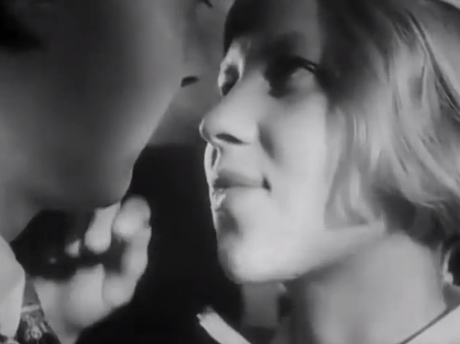
peopleonsunday1One of the last German silent films was People on Sunday, a modest project from a group of young men. Our stars are young professionals in real life and only amateur actors who did not quit their day jobs. They only could film on the weekends and that’s how we end up with People on Sunday! It takes on a faux-documentary style, and it follows the lives of four individuals as they meet one another and then spend a pleasant Sunday afternoon together.

There is certainly a breezy playfulness to the film as the two men and two women spend time frolicking at the beach and reclining in the sun. They share laughs while eating and listening to records. It quality fun and there seems to be a general innocence to their behavior that while sometimes rude is all in good fun.

This is, in fact, a film of the late Weimar Republic, without the cloud of Hitler’s Nazi regime hanging over the country (not until 1933). It stands in sharp contrast to later works or documentaries because People on Sunday is seemingly free and wholly unrestrained by ideology or prejudice.

We should undoubtedly be grateful for this historical piece of New Objectivity cinema and the reasons are twofold. First, since the film essentially works as a documentary, it gives us a wonderfully clear picture of what life was like in the world of Berlin. There are continuous shots of the city streets, passing vehicles, and people making their daily rounds.

One especially memorable moment occurs when the story takes a short aside to afford time for a montage of faces. The camera slowly captures face after face providing a sample of all the individuals who walk these streets. They transcend time and space because of their humanity, their mundane quality, and they have the same lightness of our main characters.

When we look at the names behind People on Sunday, it is almost staggering to acknowledge these men who were formerly unknowns.

As directors, you have Robert and Curt Siodmak. Your main writer is the great Billy Wilder. As cinematographer, you have another great in Fred Zinnemann, and finally, production was helped by the B-picture master Edgar Ulmer. Due to the rise of the Nazis, all of these figures would end up emigrating to Hollywood and the rest was history.

In many ways, we are indebted to them, because they helped form some of the great American classics and you can already see them honing their craft. The images are visually arresting and there is even a sense of humor that we could seemingly attribute to Wilder. It would only get better from then on.

If I’m not mistaken there are several scores that have been used to accompany the film, but I did really enjoy the Czech film orchestra because it added a lot to this otherwise silent picture. Hope you enjoy this unassuming jaunt as much as I did.

4/5 Stars

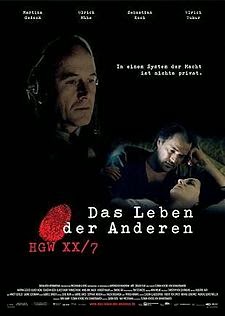
The Lives of Others (2006)

This is a moral tale that could only be told in the context of the GDR. A loyal member of the Stasi is given the task of bugging the home of an influential playwright and he spends countless hours listening in on The Lives of Others. In what would have been a very uncommon occurrence this loyal comrade sees another side of the nation he lives in. It is a place full of corrupt officials, double crossing girlfriends, repression, little free speech, and above all suicides.

In an act that proves detrimental to his own career and even his way of life, Wiesler caves to his emotions to do what is ultimately good and right. After the wall crumbles he and others like him seemingly fade into oblivion. However, the one man who was unknowingly saved finally learns of his savior and resolves to write his next great work. The Sonata for a Good Man. 

I think there is certainly a universal quality to this film because although it is German language and focuses on a subject that is distinctly German, the quality of the characters translates into any language because they are human. The struggle of Wiesler is the same for many of us and we can empathize with his evolution and ultimate resolve. We can only hope that people are not put in these same positions in the future and we must also constantly question our own government so they are never reach this degree.

4.5/5 Stars

Run Lola Run: A Snap Shot of Modern German Film

a28ad-runlola1How many films would you guess have a lead character with a name like Lola? The name actually has profound significance in the history of German cinema. The origin of this heritage can be traced back to the famed German actress Marlene Dietrich. She got her big break in Joseph Von Sternburg’s Weimar Era film Blue Angel, where she played the cabaret performer Lola-Lola which ultimately led to a storied career in Hollywood. Many years down the line the acclaimed Rainer Werner Fassbinder would make a film named Lola representing the New German Cinema of the 1970s and 1980s. Not surprisingly he took his inspiration from von Sternburg and also focused on a cabaret singer named Lola. These two connected allusions gave inspiration for the prestigious German film awards (The Lolas) which have carried that name since 1999. With this lineage, it seems fitting that Tom Tykwer’s Run Lola Run released that very same year, would share that hallowed name.
Run Lola Run proved to be the forerunner to modern German cinema which regained some of the excitement and interest of previous generations. The film was the perfect way to reflect the turn of the century and the beginning of a new page in German film history. It pays homage to the past but perhaps, more importantly, it moves forward into new unmarked territory. Germans certainly have not forgotten about the Nazis or the GDR, but this film reflects the reality that they are continuing to move on.
All that being said, it is extremely difficult to categorize Run Lola Run because it resists any attempt to try and put it into a box. It falls somewhere in between classic art-house films such as Rashomon and Breathless. Akira Kurosawa’s film is noteworthy because it brought attention to Japanese cinema and it also tells its story three times over from three very different points of view. Jean-Luc Godard’s Breathless, on the other hand, ignited the French New Wave movement and the film itself was in homage to Hollywood crime films mixed with innovative editing and camerawork. However, there is a bit of light and comedic Hollywood blockbusters like Scott Pilgrim vs. the World in Lola too. Films like these share a comic book reality full of superpowers and bright hairstyles, exhibited by people who in every other way look normal. As English writer Richard Rayner put it, Run Lola Run “brings Hollywood pizazz to the European art movie” (Kosta, 165). It was further described by the German film scholar Michael Töteburg as a, “romantic-philosophical actionloveexperimentalthriller” and although this title might be applicable it only serves to confuse the situation more (168, Kosta). Any of these comparisons ultimately falls short because they fail to describe Run Lola Run in its entirety, as difficult as that may be to believe. It truly is a genre bender and that gives a clue to why it was successful all over the world. With Run Lola Run, Tom Tykwer is able to creatively synthesize, unique storytelling, aesthetics, philosophical questions, animation, and good old-fashioned thrills, into a film with an inventive flare. He successfully ushered in the new millennium of German film culture and he did it with style.
Even with the introduction of his film, Tom Tykwer sets it up in a way that opens differently than most other movies, because there is a philosophical yet nonsensical feel. It commences with two philosophical quotations and then a bit of narration. The first excerpt comes from famed American poet and author T.S. Eliot who wrote, “At the end of our exploring we shall cease from exploration…and the end of all of our exploring will be to arrive where we started…and know the place for the first time.” Then the second quote by the German coach Sepp Herberger (famous for winning the 1954 World Cup) simply states that “After the game is before the game.” These rather abstract and paradoxical assertions are perfect in this film for multiple reasons. The words of T.S. Eliot suggest that time is all interconnected, and in some ways, it alludes to how the narrative in Run Lola Run will be replicated with the characters beginning anew each time. The game metaphor is extended further when we are introduced to many of the supporting characters in a mass of blurred humanity. At the same time, numerous existential questions are being raised by a narrator. It is important to note that this voice belongs to Hans Paetsch, a man who had been the voice of fairy tales in Germany during the 20th century. In a sense, Tykwer is gearing up his audience not only for an existential ride but a fairy story as well. The only answer we receive as viewers, however, is more from Herberger again. “The ball is round. The game lasts 90 Minutes. That’s a fact. Everything else is pure theory” (Run Lola Run). This quote is meant to beckon back to Fassbinder’s film The Marriage of Maria Braun (1979), which “returned to the past to identify the moment in postwar Germany history in which the game was won.” Of course, this came with the victory in the World Cup which was spearheaded by Herberger. With this statement, the absurd game that is Run Lola Run begins, and before it has even started Tom Tykwer has effectively succeeded in bringing up more queries and alluding to German culture. However, unlike the former New German Cinema, Tykwer is eager to move past that and play a new game entirely.
 After the prelude, it seems absolutely necessary to look at the title credits of Run Lola Run, because they say a lot about the film as a whole and the themes that will carry through the entire story. First off, the importance of clocks and the race against time becomes evident early on and it remains throughout the whole movie. The music and sound effects really help to emphasize this motif of running because they have a repetitive, upbeat, rhythm that dictates the tempo. With the changing scenes, the music, in turn, changes to fit the moment. Furthermore, the animation and the Polaroid snapshots are a unique way to go about the title credits and they give us more visual cues about the characters before the story actually begins.
In a flash, after the absurd introduction and the whirlwind opening credits, we are already in the middle of another sequence that maintains this furious pace. The opening shot sends us zooming down to a map, through a building window, down halls, until it comes to rest on a bright red phone in a room. Here we are introduced to Lola (Franka Potente) as she converses with her frantic boyfriend Manni (Moritz Bleibtreu), who is calling from a phone booth in town. Ironically, the plot of the film is rather simple, but as we will soon see it is the way that Tykwer goes about it that is interesting.
Aside from the breakneck speed, and the beating soundtrack, the visuals also work to create this frantic mood. First off you have Lola with her mop of cartoonish red hair. However, perhaps just is noticeable are the quick cuts between the characters as they talk on the phone. Each time they say something it cuts to that character and then switches back when the other person speaks. However, when the camera returns it is almost always a different shot from the previous one. So not only does the rapid editing create motion, the cinematography does as well since the camera is physically moving. A conventional film would not have shot a simple sequence this way, but Tykwer effectively uses it to build up speed despite the stationary aspect of a telephone conversation. In these opening moments and for the rest of the film, the director also uses black and white, sped up flashback to get around normal narrative limitations. Interestingly enough, even when the film is looking back in time the pace is maintained by speeding up the footage and not playing any dialogue.
The inciting incident begins with Manni who was supposed to pick up some money for a thug, but he accidentally left the bag in the subway where it was taken by a bum. This was in part because Lola was late to pick him up since her moped was stolen. Just like that that there is our first instance of chance as well as the importance of time. All of this means that Manni is short 100,000 marks and he only has 20 minutes before the thug Ronnie will be calling on him. As Manni is frantically recounting how it all happened one sequence especially stands out. There is a moment where Lola realizes that he left the bag of money and they both whisper, “the bag,” except it keeps on repeating and the images rapidly flash between Lola and Manni (Run Lola Run). It makes sense that the director would do this to get our attention because in reality, the whole film revolves around the contents of that bag. Twkver does a very similar thing when Manni is surmising where the bum has run off to with the money. The camera rapidly flashes through images of locales while Manni rattles on about Florida, Hawaii, Canada, Hong Kong, Bermuda, and so on. Then the montage ends with an image of Ronnie, the man Manni will have to answer to, and this suggests that his mind has come back to reality. Despite all of this, Lola tells him to stay put and promises to think of something. Here we see a hint of almost superhuman abilities in Lola when she gives off a piercing scream to silence Manni and then she tosses the phone receiver back on the hook. From this point, we are given a view into Lola’s mind as she breezes through people she can go to. To replicate this, the camera revolves around her and facial profiles flash on the screen for a mere instant. In fact, it gets to the point where it almost feels like subliminal messaging since the frames disappear so quickly. After mulling through the images in her brain, she settles on her banker father to ask for help. It is from this spot that the story diverges with each of her different runs being slightly altered by chance.
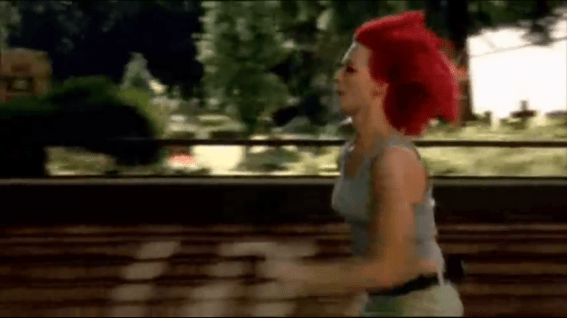
It is now the first time through and Tykwer brings back the animation by depicting Lola’s descent down the stairs with cartoonish images further developing this fanciful world. When she enters back into the real world the race is on and the upbeat score is dominant at this point and it keeps rhythm with the movements of her body. Arms pumping, legs churning, chest heaving. Despite all this repetition it does not seem to become more monotonous, it simply ups the tension with each gesticulation. Interestingly Lola crosses paths with the same people during each of her runs. Instead of having each encounter develop the same way, Tykwer changes up the results each time. He ingeniously gets around the restraints of conventional narrative by using rapid sequences of Polaroid photos to represent what will happen after Lola leaves the frame. Thus, this is yet another way in which we see how minute details will be manipulated to completely alter the future. For instance, Lola bumps into a lady with a small child and then Lola is followed by a man on a bike. The woman curses her out angrily but ironically we see that her baby is taken from her and she commits a kidnapping. Then, the man on the bike actually stole it so he is beaten, goes to a café, finds love, and is married. These potentially drawn-out scenes actually happen in a matter of seconds thanks to snapshots, and the speed is retained as Lola continues to sprint towards her destination. Everything is moving so fast that our brains might possibly get left behind trying to process it all and yet miraculously it works for the most part.
The power of chance is further evident when Lola is nearly run over by a businessman and then passes a homeless man on a street corner. As an audience, we do not know it yet but he will play into a later story, right now his only outcome is that he crashes into another car. With the homeless man, on the other hand, we know he was the one with the money and ironically Lola does not give him a second look. All the time that she sprints, flashing by in her peripherals are scenes of modern Germany. There is the ever-present construction, brick buildings, concrete pillars, signage, and urban life. It gives the impression of a car ride with images zooming by for an instant, closely followed by a continuous line of other objects. The adrenaline rush of Lola is contrasted with the scenes in the bank where Lola’s father is having an intimate conversation with his lover. The two moods clash as the frantic girl bursts on the scene asking for money. Here this narrative thread takes its first twist. Lola’s father abruptly disowns her revealing she was born by another man and then she is thrown out. This seems hardly realistic and yet it fits the themes of Run Lola Run. Almost anything can happen and it can be attributed to chance or fate.  This frees Tykwer up by giving him tremendous narrative freedom to examine these topics in any way he’s sees fit. And he does that by continuing the race to Manni as time continues to run down.
Before Lola can get to him, Manni crosses the street and holds up the market there. She implores him, “Why didn’t you wait for me?” His answer is simple. “I did, you got here too late.” This perfectly sums of the whole sequence (Run Lola Run). If only Lola could have run faster or had just caught the bum, or if Manni waited only a moment longer. Then again Lola could have easily been injured by the car that almost ran over her. Eventually, she and Manni do get away as a light song plays in the background with the words, “What a difference a day made. 24 little hours” (Run Lola Run). This is an ironic statement especially after what ultimately plays out. The final moments of the run include accidental events of great consequence. Earlier the gun Lola has discharges and then a policeman accidentally fires, mortally wounding her. Here is a moment reminiscent of a Jean-Luc Godard crime film that always seems to take a turn for the worse. However, in Lola’s case, she again seems to exhibit superhuman powers. Before dying she whispers that she does not want to leave and then she literally orders time to stop. Run number two begins soon after.
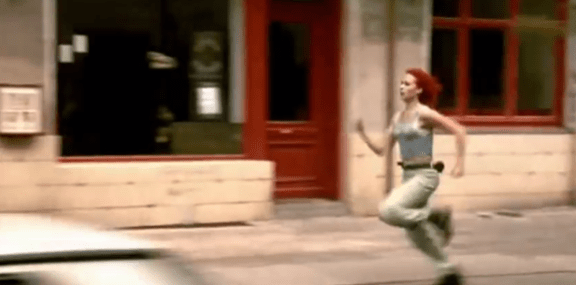
All of a sudden Lola is going down the stairs again except this time her animated doppelganger is tripped by an animated man and thus she begins the new sequence of events. Again she collides with the lady (who we learn will win the lotto this time around). She also bumps into the homeless man going around the corner, except surprisingly she does not give him a second look as she hustles onward. She hurtles the hood of the car this time and again the driver gets into an accident, but this time he hits the rear of the other vehicle instead of the front. Then at the bank, Lola’s father is loyal to his wife and kids while conversing with his lover. Still, he and Lola have a volatile fight that ends with her throwing a major tantrum. Strikingly the security guard remarks, “It just isn’t your day. Doesn’t matter. You can’t have everything” (Run Lola Run). Whether it is his timely statement or something else, Lola turns right around and proceeds to steal a gun, hold her father hostage, and rob the bank for 100,000 marks. This time luck is on her side because the SWAT team lets her flee unimpeded not suspecting that she is the culprit.
However, although she reaches Manni in time, she cannot save him from an incoming ambulance. This was the same ambulance that crashed through a pane of glass earlier and the same ambulance which was of little importance to the story during the first run. Again, everything is up to chance. Now the roles are reversed and Manni is on the verge of death with Lola looking on. After a moment in which the couple is in limbo again, the phone drops off the hook and kicks off run number three.
           
 Third times the charm as Lola once again scampers down the stairs, hurdling over the dog and scaring it off this time. For the first time, she does not hit the women and also for the first time she cuts into the street in front of the man on the stolen bike. These changes are a portent of radical developments in her replayed future. The camera actually follows the biker and his path crosses with the homeless man, who also swiped something of value. The bum comments that “life is sure crazy sometimes” and the other man attempt to pawn his ride for 70 marks (instead of the previous 50) (Run Lola Run). Although this quote from the bum is unassuming, Tykwer places it to say something about the central themes of the film.  Like earlier quotes, it suggests that insignificant minutiae can, in fact, lead to a crazy turn of events. This is, of course, the Butterfly Effect, the idea that the flapping of a butterfly’s wings could cause a hurricane weeks later.
Back with Lola, she runs into the hood of the car and then as she goes around the corner. This time there is no homeless man. He instead is on a bike which Manni spots by chance and chases after. Ironically, now he is running while Lola stands at the casino trying to win the money at roulette. Her bloodcurdling super-human scream leads to a big payoff and Manni is able to get his money and smooth out his situation with Ronnie. This is the reality that they were hoping for all along and they finally have it. Tykwer teases us by ending the film with the clicking of a camera. The one time we really care about what the snapshots will say of the future, he decides not to show us. We must simply be content with the narrative that he has given us and leave it at that. Critic Roger Ebert wrote that he liked Lola, though he didn’t get to “know her very well, and she is usually out of breath” (www.rogerebert.com). Depending on how you see it, this is one of the positives or negatives of this film. The narrative is so interesting that the characters take on a lesser importance in some respects. In fact, sometimes it seems like we know more about the supporting cast because most of what we see of Lola is her motions. According to the title of the film, however, Tykwer was not lying, Lola runs just as the title suggests and that should be good enough.
In this final run, there is a possible nod to the classic Fritz Lang thriller M, in which a serial killer is caught by the authorities because of a tip from a blind man. In Manni’s situation, he ends up noticing the thief because of a blind woman (who is Bleibtreu’s mother in real life) (Kosta, 174). There is yet another film allusion that is especially interesting to consider in terms of the motif of time. As Lola is racing against time to win money at the casino, there is a sequence where the camera moves through a group of people to focus on a painting. The image is of a young blonde-haired woman with a bun, facing away from the viewer. This is a small nod to another painting in Alfred Hitchcock’s Vertigo. It is a psychological thriller deeply concerned with spirals, whether it was staircases or even a spiral from a piece of art, which indicated the continual spiral of time. Fittingly, just after focusing on this image the camera looks at the clock and our story of Lola’s race against the clock continues as her third spiral starts to come to a close.
With all the scenery that Lola goes rushing by it seems necessary to dwell on the locales a little. Lola sprints past Garnison Cemetary (in the former East) at the start of every run. Furthermore, she can always be seen sprinting underneath the train on the Oberman Bridge which was formerly “a border crossing for Germans during the time of the wall” (Kosta, 175).  An international audience may not know this, but for native Germans of a certain age, it implicitly suggests the post-unification period is in full force. Such landmarks are now symbols that signify that the East and West truly are united in contemporary Germany. This is just another detail that Tykwer does not directly tell us, but it just adds to the layers of the film.
Another aspect of Lola that deserves some attention is the soundtrack which Tom Tykwer actually worked on himself with the help of some others. The score actually changes with the beginning of each new run that Lola has. The first techno beat that is created is best described as the most intense and pulse-pounding of the three. The theme for run two still has a steady pace, but for some reason, it seems less intense and there is a greater focus on the lyrical content. The third theme is similar to number two because it also has a steady beat, and yet there is a greater emphasis on the quiet lyrics which are actually spoken by Franka Potente in English. When you break down the score down like this it does not appear all that impressive, but cohesively with all the aspects of the film, it works wonderfully. The fact that you notice it, but do not dwell on it too much, suggests that it is the perfect addition to this collage that Tom Tykwer composed. Something would be lost if it was taken out, and yet it does not take away from the aesthetic qualities of the cinematography or the editing.
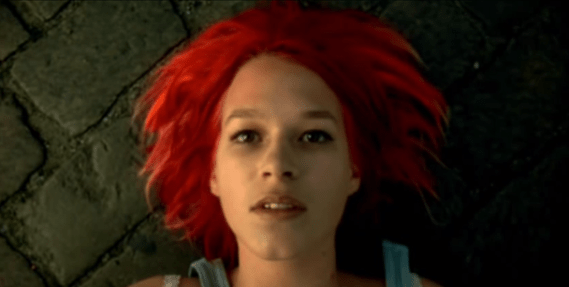
Although Tom Tykwer’s most acclaimed film to date has been Run Lola Run, he has made other films both in Germany and internationally. His two pre-Lola films were Deadly Maria (1993) and Winter Sleepers (1994) which follow a repressed introverted woman who lashes out and then a group of people during a mountain blizzard respectively. With The Princess and the Warrior in (2000), Tykwer was reunited with Franka Potente, and then with Heaven (2002) he got his first chance at an international film, which starred Cate Blanchett and Giovanni Ribisi. His two other major efforts in the 2000s were Perfume: The Story of a Murderer (2006) and The International (2009). The first is an adaption of an acclaimed book and as the name implies it is about a perfume obsessed murderer. The second film teamed Tykwer with Clive Owens and Naomi Watts in a thriller about an Interpol agent. However, Tykwer’s most commercially successful film came relatively recently with Cloud Atlas (2012). The sci-fi, fantasy flick, starring Tom Hanks and Halle Berry, shares many of the themes of Run Lola Run as isolated events affect the past, present, and future in a span of 500 years. His upcoming project called A Hologram for a King will also star Tom Hanks (www.tomtykwer.com). Although he has never matched the heights of Lola, Tom Tykwer still shows an interest in intriguing topics, especially having to do with time and the potential consequences of actions. The good news is that he is not done creating so there are potentially some really good ideas left in his brain that he can bring to the screen. We will just have to wait and see.
All in all Run Lola Run has everything you could possibly want packed into barely 80 minutes of film. Tom Tykwer gifted us an avant-garde thriller full of questions on chaos theory, German cultural allusions, inventive narrative, and a colorful heroine. It was composed through a deft amalgamation of cinematography, editing, music, plot twists, and a great deal more. He knows the masters whether it is Joseph Von Sternberg or Alfred Hitchcock. He knows where German film has been before during the Weimar Era and The New German Cinema. However, perhaps more importantly as Barbara Kosta puts it, “Tykwer belongs to a generation of Germans that embraces popular culture rather than criticizes it as colonization of the mind and a form of cultural imperialism” (Kosta, 165). Thus, he is not a part of the New German Cinema but rather the German cinema which is new right now. Run Lola Run did for Germany what Breathless and Rashomon did in those countries. Critics can argue all they want about the degree that this is true, but the fact is that Germany has a film history, and they also have a future. Run Lola Run is just the first snapshot in this whole collage of contemporary German films that have been brought to our culture’s attention.
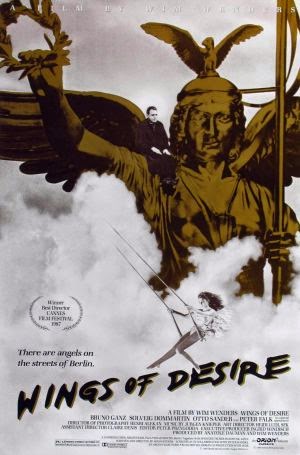
Wings of Desire (1988)

7ebbf-wingsofdesireposterDirected by Wim Wenders, this German film has almost a stream of consciousness feel. It opens over the skies of West Berlin where a couple angels watch over the humans as unseen and unheard guardians. They pay attention to the thoughts, desires, joys, and fears of a plethora of folks from all walks of life and act as unobserved comforters. These angels are immortals and although they are familiar with humanity they are not a part of it. 

Among others, the angel Cassiel observes an old man named Homer who dreams of a world of peace. Damiel on his part finds himself infatuated with an utterly lonely circus trapeze performer, and he also watches over the actor Peter Falk as he begins shooting his next film. Because of his newfound love, Damiel desires to feel what it is to be human. Aside from affection, he yearns to be able to do the little things that go along with being mortal like drinking a hot cup of coffee. Finally, determined Damiel does indeed shed his angel wings and immortality for a chance to be human. He knows what it is to breathe, to tell colors apart, and he finally does get his cup of coffee. 

Quite by chance, he has an encounter with Falk who tells Damiel a secret and encourages him in his new life. Cassiel, still an angel, tries to stop a suicidal youth from jumping, but he is unsuccessful and it hits him hard. 

In the final moments of the film, by fate, Damiel meets his girl at a concert, and they embrace as if they had known one another for an eternity and in a way they had. This film is beautifully photographed in a sepia tone that reflects the viewpoint of the angels. It is only the humans who see the world in all its glory, bursting with different colors. This film was quite fascinating, and it is the type of film I would want to make that really gets up close and personal with some many people without actually focusing on them. Furthermore, Peter Falk was a wonderful addition to this film, and he was a pleasure to watch because he gave off the impression that he was simply being himself. And I think he was.

Next on my list to see from Wim Wenders is Paris, Texas, but I would also like to explore more of the New German Cinema from the likes of Rainer Werner Fassbinder and Werner Herzog. 

4.5/5 Stars