20th Century Women (2016)

20th_Century_Women.pngIn his noted Crisis of Confidence Speech, incumbent president Jimmy Carter urged America that they were at a turning point in history: The path that leads to fragmentation and self-interest, down that road lies a mistaken idea of freedom. It is a certain route to failure.

This also serves as a viable entry point into Mike Mills’ intimate, pensive eulogy, 20th Century Women. This is a film on the verge of so many things. It frames its story in the context of the time and the people that existed in one particular moment. Mills floods his canvas with natural light but also paints it with bold colors and plants us in this world that’s somehow tangible and present while still only being a memory to look back on.

It’s 1979. Nixon is slowly fading. Reagan is coming with his conservative boon. You have the Talking Heads. You have hardcore punk. Feminist novels and the woman’s movement. Skateboarding down the empty Santa Barbara roadways. It feels less like a time of change and more of a moment on the brink of something new.

But this very self-awareness in the era is provided by the characters who live within that context because this is their life, these are their memories, and they connect them together delving into the past and soaring forward to all that is yet to come. They recount the world they know through matter-of-fact voice-over to match the images that undoubtedly play in their own heads. This is for them. Namely a son and his mom, Dorthea and Jamie. There’s is a generational difference but not so much a divide.

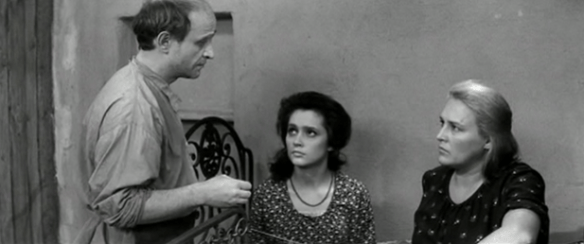
Dorthea (Annette Bening) is an eccentric, dynamic, empathetic woman who cares deeply about life and others. She believes in each individual person’s rights and volition–you might even say she’s progressive in some ways. But she’s also a mom and a woman bred in a different age. Her son Jamie (Lucas Jade Zumann) makes a point of the fact that she’s from the Depression.

Giveaways include her chain smoking habit, a penchant for Bogart, and a predilection for show tunes. She was an aviator and draftswoman in a male-dominated world. But She came out of a time where the community was expected to look after everyone and she searches out the same framework for her son because he’s of a certain age.

If you were pressed to pick out the story’s inciting incident it might be the moment where Dorothea gathers the instrumental women in Jamie’s life around her kitchen table to enlist their help. Because the men around him either don’t resonate (Billy Crudup as William) or they only make their presence known on birthdays (namely Jamie’s father).

She takes a near death experience to mean he’s going through his adolescent phase and she doesn’t believe she can be all things for him anymore. As she notes later, they are better suited for the role because they get to see him in the world as a person. She will never get that. Oh, the heartaches of parenthood–being so invested–while simultaneously trying to be hands-off.

And so in some sense, her tenant Abbie (Greta Gerwig) and their teenage neighbor Julie (Elle Fanning) make a concerted effort to press into his life. Julie is the one who sneaks up through his window sometimes, not to sleep with him, though they often share the same bed, for mere companionship, someone to feel safe around and to talk to. Because he’s someone she knows can be trusted amid the fray of highschoolers.

In one particular sequence, Elle sits on the bed her eyes looking sullenly at Jamie as she tries to talk through their relationship. She concludes, “I think I’m too close to you to have sex with you.” In one sense, it’s touching because it shows that their connection goes beyond this physical act that all the kids are doing, she holds too much respect for him, but it also points to the sorry state of affairs when something like sex is seen as dirty and degraded. That’s part of what she is wrestling with. That and the fact that her therapist mother tries to conveniently label her every action.

Elle Fanning leaves a startling impression casting herself in this film in a light that in one sense is the prototypical edgy, angsty teenager but there is also an undeniable vulnerability and genuine caring quality there that steeps her in unknown depth. That top layer is nothing new but that latter aspect is a testament to Mills’ characters.

Meanwhile, Gerwig provides her exorbitant supply of charismatic energy and panache that allows her to hold some of the most memorable scenes in the film in comedic terms and yet she also proves that there still is a certain tenderness in the red-haired, photography-loving, punk listening, new age modern woman, Abbie.

At the behest of Dorthea she tries to invest some of her artistic spirit into Jamie’s life, showing off the punk scene, introducing him to seminal feminist texts, and helping him to be comfortable around women but, of course, he’s more comfortable than most which is a sign of a certain amount of maturity. In fact, he impacts these women as much as they speak to him and that’s a testament to everyone involved, all flaws aside.

Even if Jamie is, in truth, our main character, perhaps a stand- in for Mills or for us, this film succeeds in crafting stalwart female characters with actual contours that are worth dissecting and with inherent worth denoted by their actions and what they care about.

I don’t know a great deal about Mike Mills but watching a film like 20th Century Women I feel like I know him better–not all of him certainly–but there are pieces here that are no doubt personal and give us a slight view into his experiences.

It’s intimate and there’s an unquestionable amount of vulnerability in his story that must be admired for its sheer honesty. It comes off as purely genuine and real. Because the bottom line is the fact that it never runs on agenda. It never tries to overtly get us to think something or feel something else. If it comes to any overarching conclusions at all it’s that life can be hard and confusing and the same goes for people.

Each one of us can come off as a complex enigma. Even the ones we know and love. It’s possible that we will never know and love them as much as we wish we could. It’s possible we cannot help them or guide them as much as we would like. Still, that’s okay.

For some, this will be a maddening, rudderless picture but to each his own. However, if I may be so bold, 20th Century Women is the kind of film I would want to make–a film wrapped up in its cultural moment in a way that feels so authentic–where the events playing out even if they’ve been made cinematic have real resonance for me as a human being.

Yes, it’s the kind of effort that won’t be received by everyone but a film so very personal rarely is. A film like this you don’t necessarily make for other people anyway. You make it for yourself and the ones you love and leave it at that. This is a love letter.

3.5/5 Stars

Chimes at Midnight (1965)

chimes of midnight 1“There live not three good men unhanged in England. And one of them is fat and grows old.”
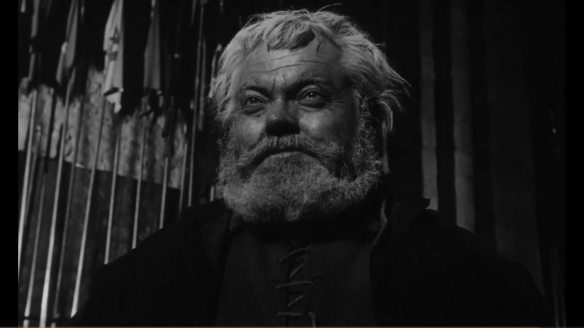
It seems Orson Welles never did anything on a cursory level. There’s always a gravitas — the unique personality of the man displayed in his work whether it is behind the camera or in front of it. But in the same breath, he never takes himself too seriously. And it’s no different in his orchestration and portrayal of the character Falstaff in Chimes at Midnight. It’s easy to argue that Charles Foster Kane was more memorable, Harry Lime was more beloved, and Hank Quinlan more remembered, but truly Shakespeare’s Falstaff just might be Orson Welles’s greatest role. At the very least his most underappreciated role for the very fact that far too few people have seen it.

He’s blustering and rotund, filling up the frame not only with his girth but with his witticisms and tall tales. But as much as this is a comic tale of farcical proportions, it’s also a storyline of tragedy and betrayal.

Being woefully under-read when it comes to Shakespeare, it was hard to come into this story because I had very meager reference points. However, Welles fuses together fragments of four narratives into an epic tale of his own creation, so prior knowledge perhaps was not admissible. The works he picked from include Henry IV Part 1 and 2, Richard II, Henry V, and The Merry Wives of Windsor.

Still, when I do get in such a state of disarray, I have learned not to fret and to simply sit back and partake of what is offered me. With Welles, this is not a difficult task at all because of what he gives the viewer. It’s always spectacular, grandiose, and richly wrought in some way, shape, or form. And for Welles the impresario, the Bard is a source of inspiration that is truly worthy of him, or you could say it the other way around even. He is worthy of the Bard.

chimes of midnight 2The triangle with Prince Hal (Keith Baxter) vying for the affection of his father King Henry IV (John Gielgud), while simultaneously holding onto his relationship with Falstaff is an integral element of what this film is digging around at. But there’s so much more there for eager eyes.

Once more, rather like The Trial, it’s easy to marvel at the restrictions that Welles faced and what he still accomplished within that forced economy. He took the Spanish countryside, a budget of less than $1 million, and crafted a work that is often considered the best Shakespearian adaptation ever and some say even the best of Welles. If the man himself was any indication, then maybe so, because he was fond of this work in particular.

From an audience’s point of view, he does some truly spectacular things. Despite the poor sound quality really throughout the entire film, the interiors of the castle are expressive in the same way The Trial’s cavernous alcoves were. Equally telling are Welles’ trademark low angles.  But Chimes at Midnight also spends more time outdoors, the most spectacular scene being the battle sequence portraying the Battle of Shrewsbury.

Welles uses every imaginable trick in the book to make 18o extras and the Spanish countryside work for him to the nth degree. It develops one of the most dynamic, perturbingly chaotic war zones ever through cross-editing, trick shots, speed changes, and an elaborate patchwork of images that turns war into something unfathomably ugly. His smoke and mirror techniques matched with the chaotic clashing of metal, weaponry, bodies, and jarring visuals is a superb showcase of a truly inspired filmmaker. Because the images are so evocative, adding to something far greater than their individual parts.

chimes of midnight 3And it’s only one high point. Aside from Welles’s towering performance, Jeanne Moreau stands out in her integral role as Doll Tearsheet, the aged knight’s bipolar lover who clings to him faithfully. The cast is rounded out by other notable individuals like John Gielgud, Margaret Rutherford, and Fernando Rey.
Honestly, few others can hold a candle to Falstaff. A great deal of that lies in the similarities between the character and the man playing him. He’s portly,  speaks in rich tones with tremendous wit but the bottom line is that he is met with tremendous disappointment, despite the towering heights of his reputation. He’s constantly short on funds trying to get what he needs from the relationships he’s cultivated with the people around him. However,  in the end, he wasn’t so lucky and the same could be said of Welles. Although Falstaff was exiled from the King’s presence, whereas Welles put himself through a self-made exile of his own. Still, he managed to come out with a work as stunning as Chimes at Midnight. That in itself is a tail worth noting about a man who was larger than life in his own respect. This is a miracle of a film not because it is perfect. It’s far from it, but it has so many remarkable moments in spite of its circumstances. It deserves to be seen by more people.

4.5/5 Stars

Silence (2016)

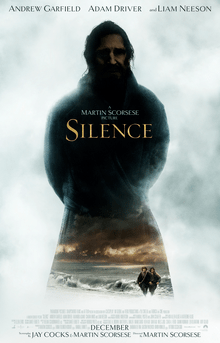
Silence_(2016_film).pngIf we can take Martin Scorsese’s varied film career as a reflection of the human experience, then his completion of his long-awaited passion project Silence is not all that surprising. He’s crafted numerous classics, countless cultural touchstones, some spiritual, some historical, and some incredibly honest. But at this point in his career it seems like he has nothing left to prove to us as his audience and maybe at this point in life, if nothing else, we could do well to try and learn from someone like him. Because given the climate with funding and the like, Scorsese could not have made such a film just for other people or money or acclaim. He must have made it, at least partially, for himself.
There’s no question that his life has been tough at times, even taking him to the brink of death, and in Silence, we see a period tale that touches on everything that is thought-provoking and all that is paramount in life. Man has long wrestled with God. Jacob did it literally in the narrative of Genesis. Nothing is new under the sun in a sense. And Scorsese by way of Shusaku Endo is doing a truly remarkable thing to consider these very questions. I admire him for having the wherewithal to even begin to tackle this material.

Coincidentally this is also a very faithful adaptation of Endo’s novel and so rather than recount the entire plot, my best advice is to read Endo for yourself and watch Scorsese’s own musing on the text afterward. But for those who don’t know, Silence is a fictionalized account based on true events involving two 17th century Portuguese priests Rodrigues (Andrew Garfield) and Garppe (Adam Driver) who head to Japan in order to spread their Christian faith–a faith that already has approximately 300,000 believers. Their mission is twofold as well, to track down their illustrious mentor Father Fereira (Liam Neeson) who is rumored to have apostatized.

However, their beloved faith is under fierce attack by the Japanese magistrate and for good reason. As articulated by the oddly compelling and strangely comical antagonist Inoue, foreign missionaries sometimes come to Japan like jealous women looking to steal the country away. They often are lacking cultural understanding meaning their message is neither contextualized or delivered in such a way that is helpful to the people. Is the message missionaries brought even the same anymore or do they simply trust that it will reach the people as they intended?

But delve into this issue and doubters can beg the question, can the Truth (capital T) be universal? There are certain similarities between religions. From a cursory level, you can either draw up the similarities between Christianity and Buddhism or cast them far apart. Father Ferreira finally conceded that doing good is enough. It leads to human flourishing but also to the detriment of his previous beliefs. And that’s only the one conflict.

Silence delivers numerous other tough questions to any viewer who is willing to consider them. How do you equate personal suffering versus the suffering of others? If to die a martyr is what some call Christ-like, to let others die for you could easily be called selfish and weak.

Still, is recanting Christ, the core of these missionaries’ belief system, worth it for the safety and well-being of others? The answer seems simple and yet somehow still so divisive. Most importantly of all, and potentially the most volatile and insidious question of all is this: Can you still be worthy of love if you have doubted, turned away, or committed evil? That is the central question at the heart of Silence.

In different ways, Scorsese’s film brings to mind droves of others from the likes of Bergman and Dreyer but the polarities of the emotions are more pronounced here and somehow the nuances still manage to be incredibly subtle. Bergman’s The Silence already seems to assume God is out of the equation entirely. Ordet takes the spiritual doubts of mankind and culminates in a miraculous crescendo of hope. Scorsese’s work strikes a tougher middle ground. And for that matter, this film is undoubtedly rough going. It’s long, pensive, and unsettling.

The heroes do not arrive at some Oscar-worthy self-actualization. Violence is not some entertaining cathartic release. On the contrary, these characters are at times pitiful–even the dregs–and the violence is methodical and repetitive like a deluge of ocean waves beating us back.

But as such, this is not a film to stew in or even a film to view alone. It is meant to be seen together, ruminated over in tandem, and considered with a certain amount of thoughtfulness. It asks for its viewer to be open, to be aware, and if need be, do their own amount of soul-searching. Are there questions that you’ve never been willing to confront? And this goes for anyone from any type of background, belief, or point of view.

For the spiritual, this undoubtedly would be a tough picture because it confronts their doubts head-on. For those who do not consider themselves all that religious, it throws you right into the dilemma of fallible man and demands you at least consider the problems therein.

Thus, to call it slow or plodding completely circumvents the entire point. Such an assertion strips this film of its power which is derived from the very audacity of its silence. The way in which Garfield practically whispers his dialogue in voiceover. How there is hardly ever a score because Scorsese takes his title seriously. He’s not about to disrupt the novel’s power with Hollywood expectations. Silence can be just as powerful as noise if not more so. Some would argue that is the very power of the God of the Bible. It’s these very paradoxes that run through Endo’s entire novel.

The humility of the Japanese throughout the film is astounding and the utter hopelessness of the priests at times is equally telling. It flips the savior paradigm that we expect. The most substantive example is the Japanese guide Kochijiro and Father Rodrigues. The Father sees the other as the Judas figure, the betrayer, and yet he is Peter. He too has denied the one who loves him most. They’re no different. Except Kochijiro is far more aware of his shortcomings–there’s no pretense to think he is Christ-like. He is humbled just as we can be humbled by the sheer boldness of Silence.

4.5/5 Stars

All the President’s Men (1976)

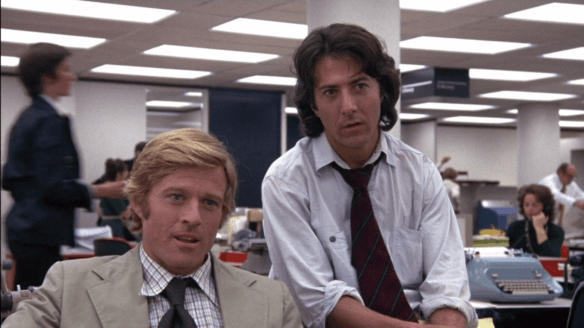
allthepresidentsmen1You couldn’t hope to come up with a better story than this. Pure movie fodder if there ever was and the most astounding thing is that it was essentially fact — spawned from a William Goldman script tirelessly culled from testimonials and the eponymous source material. All the President’s Men opens at the Watergate Hotel, where the most cataclysmic scandal of all time begins to split at the seams.
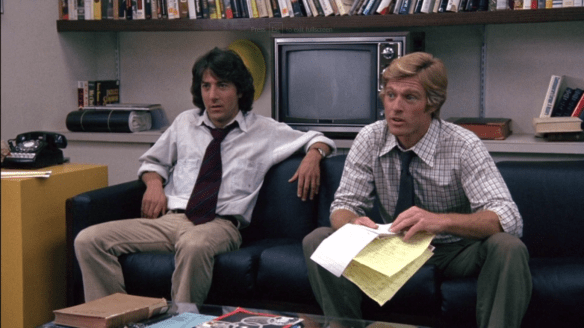
And Bob Woodward (Robert Redford) joined by Carl Bernstein (Dustin Hoffman) were right there ready to pursue the story when nobody else wanted to touch it. The Washington Post went out on a limb when no other paper would. Because if we look at the historical climate, such an event seemed absolutely ludicrous. Richard M. Nixon was the incumbent president. Detente had led to cooled tensions with the Soviets. And Democratic nominee George McGovern looked to be on a self-destructive path.

But the facts remained that these “burglars” had ties to the Republican Party and potentially the White House. It was tasked to Woodward and Bernstein to figure out how far up the trail led. And to their credit the old vets took stock in them — men made compelling by a trio of indelible character actors Martin Balsam, Jack Warden, and Jason Robards.

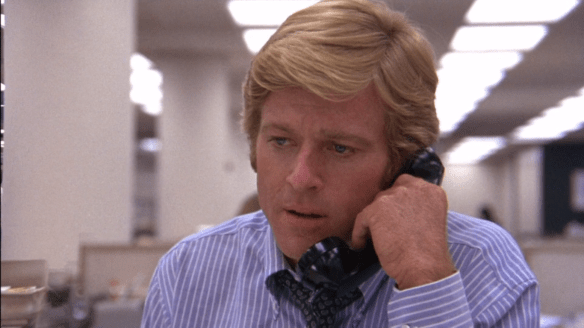
Woodward begins hitting the phones covering his notepad with shorthand and chicken scratch, a web of names and numbers. With every phone call, it feels like they’re stabbing in the dark, but the facts just don’t line up and their systematic gathering of leads churns up some interesting discoveries. Names like Howard Hunt, Charles Colson, Dardis, Kenneth H. Dahlberg all become pieces in this patchwork quilt of conspiracy. The credo of the film becoming the enigmatic Deep Throat’s advice to “Follow the money” and so they begin canvassing the streets encountering a lot of closed doors, in both the literal and metaphorical sense.

allthepresidentsmen3But it only takes a few breakthroughs to make the story stick. The first comes from a reticent bookkeeper (Jane Alexander) and like so many others she’s conflicted, but she’s finally willing to divulge a few valuable pieces of information. And as cryptic as everything is, Woodward and Bernstein use their investigative chops to pick up the pieces.
Treasurer Hugh Sloan (Stephen Collins) stepped down from his post in the committee to re-elect the president based on his conscience, and his disclosures help the pair connect hundreds of thousands of dollars to the second most powerful man in the nation, John Mitchell. That’s the kicker.

It’s hard to forget the political intrigue the first time you see the film. What I didn’t remember was just how open-ended the story feels even with the final epilogue transcribed on the typewriter. The resolution that we expect is not given to us and there’s something innately powerful in that choice.

allthepresidentsmen4Gordon Willis’s work behind the camera adds a great amount of depth to crucial scenes most notably when Woodward enters his fateful phone conversation with Kenneth H. Dahlberg. All he’s doing is talking on the telephone, but in a shot rather like an inverse of his famed Godfather opening, Willis uses one long zoom shot — slow and methodical — to highlight the build-up of the sequence. It’s hardly noticeable, but it only helps to heighten the impact.
Furthermore, some dizzying aerial shots floating over the D.C. skyline are paired with Redford and Hoffman’s voice-over as they are canvassing the streets to convey the type of paranoia that we would expect from a Pakula film. Because, much like the Parallax View before it, All the President’s Men holds a wariness towards government, and rightfully so. However, there is a subtext to this story that can easily go unnoticed.

The name Charles Colson is thrown around several times as a special counselor to the president, and Colson like many of his compatriots served a prison sentence. That’s not altogether extraordinary. It’s the fact that Chuck Colson would become a true champion of prison reform in his subsequent years as a born-again Christian, who was completely transformed by his experience in incarceration. And he did something about it starting Prison Fellowship, now present in over 120 countries worldwide.

It reflects something about our nation. When the most corrupt and power-hungry from the highest echelons of society are brought low, there’s still hope for redemption. Yes, our country was forever scarred by the memory of Watergate, but one of the president’s men turned that dark blot into something worth rooting for. It’s exactly the type of ending we want.

4.5/5 Stars

Hugo (2011)

hugo1“If you’ve ever wondered where your dreams come from, look around, this is where they’re made.” – Ben Kingsley as George Melies

Hugo is the most curious of Martin Scorsese movies in recent memory. Nowhere within its frames do we see Robert De Niro or Leonardo DiCaprio. There is a complete lack of profanity or violence, and yet it proves wholeheartedly that he is a masterclass filmmaker -– one of the best that we still have the pleasure of observing.

In this case, he took the story The Inventions of Hugo Cabret by Brian Selznick and transformed it into a visual feast of turn-of-the-century Paris, while also crafting a love letter to the very roots of cinema.

Hugo (Asa Butterfield) is now an orphan and spends his days scrounging for food and trying to befuddle the stickler of a station inspector (Sasha Baron Cohen), who is intent on sending all stray children to the orphanage. This is Hugo’s life as he fixes clocks living inside the labyrinth above the train station, and trying to rehabilitate a mechanical automaton that his dad was determined to salvage before he died suddenly.

hugo2Aside from the inspector, the station is full of a wide array of charming individuals who generally exhibit temperaments far more personable. However, the local toy shop owner (Ben Kingsley) is rather an odd fellow, who keeps to himself, but Hugo is wrong to cross him. He’s not a bad man, but he makes the boy work for all the things he has purloined.

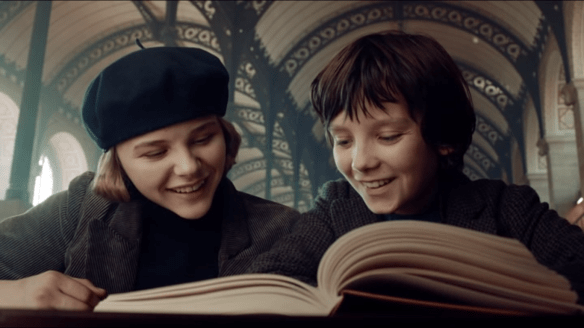
Hugo also gains a friend in Isabelle (Chloe Grace Moretz), an inquisitive girl who also happens to be Papa George’s goddaughter. The intrepid pair is intent on having an adventure and so they do. The automaton opens them up to the world of Lloyd, Keaton, Chaplin, Fairbanks, and the like. Hugo used to go to the cinema with his father, but he’s incredulous that Isabelle has never seen a movie picture. Her godfather would never allow it, and that’s where the mystery of this film lies.

hugo3Hugo is a beautifully magical melding of the old with the new –- the mechanical and the visceral. Extravagant colors make Scorsese’s canvas pop. It works together like clockwork.

Asa Butterfield’s charm lies greatly in his piercing blue eyes that have a certain innocence as well as a degree of sadness. Chloe Grace Moretz has a twinkle in her eye and her lips are ripe with elaborate language. Literature and poetry rain from her mouth as someone who finds enlightenment in books just as Hugo finds a special place in movies.

These are children who seek adventure in the everyday, find purpose in the tides of life, and discover magic in the world that surrounds them. That’s what gives life color and vibrancy. It could be Paris circa 1931 or right in your own backyard right now. All that matters is your perspective and donning a pair of new eyes – leading to awe in all things whether big or small, extraordinary or mundane. Looking at the world with the wonderment of a child.

In the redemption of George Melies, we truly do see that out of the ashes and fading strips of celluloid beauty still manage to rise again. This is a beautiful, intimate, and innocent film. In an age when a lot of these things are lacking, it’s a breath of fresh air.

4/5 Stars

Man of Marble (1976)

manofmarble1Andrzej Wajda’s Man of Marble holds a meta quality that still somehow feels radically different than Godard or Truffaut’s turns in Contempt and Day for Night. It attempts to channel a younger point of view — that of an ambitious student — with an overtly political agenda. Agnieszka is an independent, fiery individual intent on making her thesis the way she sees fit. She’s prepared to go digging around in uncharted territory or at least in territory that has been off limits for a long time. That understandably unnerves her adviser and still, she forges on.
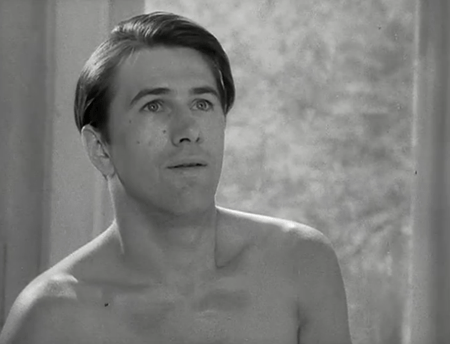
Thus, Wajda’s film is cut out of a block that is a wholly original artistic endeavor. It weaves its narrative of a film within a film from a far more humble perspective. That of an audacious but nevertheless unknown female scholar looking to complete her thesis by relating the story of a little-known bricklayer, Mateusz Birkut.

She combs through old faux newsreel footage woven together as propaganda as well as grabbing hold of outtakes that were thrown out. She conducts all the necessary interviews to get to the truth. First, comes a veteran filmmaker who now is a big name, but back then he was just trying to make a name for himself shooting a film on Birkut. She gets in touch with colleagues and friends listening to their points of view. And finally, she even tracks down Birkut’s estranged wife to try and uncover a few last crucial pieces. It hardly seems the stuff of high drama, but Andrzej Wajda’s film functions as a humbler Citizen Kane.

manofmarble2Everywhere she goes Agnieszka drags along her crew who utilize handheld cameras and wide-angle lenses, at her behest, just like American films. It becomes obvious that Birkut was hardly a political figure, instead contenting himself by using his hands to lay breaks and lay them well. He takes pleasure in his work with a big sloppy grin almost always plastered on his face. It was people like him who made Nowa Huta into the great city of industry that it was, and he became an emblem of that. The party monumentalized him and he became the man of marble to be lauded by all.
But when his livelihood, his hands, are scalded horribly,  Mateusz has little else to do. He begins to fight for social issues, the rights of workers like himself, but at the same time, his best friend Witek is put on trial for sabotaging the party. Pretty soon Birkut himself has fallen for grace, is sent away to prison and re-education, and he returns to find his wife no longer wants him.

The sleuthing has gotten so far and yet it looks like it won’t even make it past review. Agnieszka looks to be at the end of her luck as her camera and film materials have been revoked, but that doesn’t stop someone with her determination. Pretty soon she is scrounging around The Lenin Shipyards in Gdansk. At first, it doesn’t make much sense, but then we see it. Birkut’s son works there and maybe he is the missing piece of the puzzle! Man of Marble ends with a rather ambiguous dead end… or is it only the end of the beginning?

Just as Agnieszka’s was initially green-lighted, it’s perhaps even more extraordinary that Wajda got away with making such a politically charged film. In truth, he got stuck in censorship purgatory for some time, but that did not stop it from ultimately being released. But aside from crafting a meta, political, and fragmented narrative, Man from Marble also speaks to the issue of trans-generational memory.

In her conversation with the director Jerzy Burski he dismisses her idea for a film as “history” and she retorts back that it’s “ancient history” for her. That’s why it interests her. She comes out of the age of disco, synths, and bell-bottoms. Thus, that era that preceded her holds fascination, even in its most mundane moments, because she can never fully comprehend it like her elders. She wasn’t there to experience it like they could. It gives at least a bit of insight into what would drive her so obstinately to tell this story.

4/5 Stars

Charlie Wilson’s War (2008)

charliewilson1With Aaron Sorkin’s script as a road map, Charlie Wilson is a character that Mike Nichols can truly have fun with. You can easily see him getting an undue amount of delight in this man who was able to do such a momentous thing while simultaneously walking on the wild side. It had to be a good story to warrant the director’s cinematic swan song.
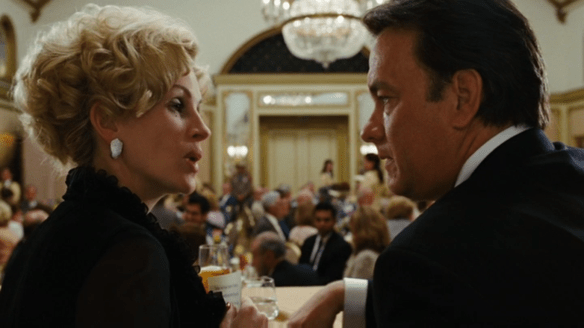
It’s a film that’s surprisingly overflowing with talent, headlined by the big three: Tom Hanks, Julia Roberts, and Philip Seymour Hoffman. However, Amy Adams, a young Emily Blunt, and even the old veteran Ned Beatty pop up. Hanks is the undisputed star and Hoffman is the other standout among all the other players. Most of the female roles feel decidedly unsubstantial which is not too surprising given Wilson’s lifestyle. However, Charlie Wilson’s War also is a necessary piece of storytelling because it attempts to understand a period of history that for some reason is often absent from film. From 1980 to ’88 during the Carter and Reagan administrations, a lot happened — even as Dan Rather remained through it all.

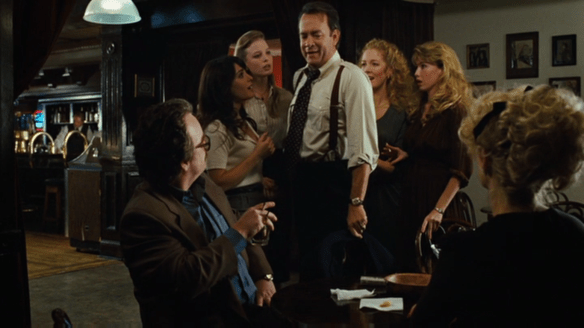
charliewilson2In the opening moments, it becomes obvious that Charlie Wilson is not so much an easily corruptible representative as he is a sexed-up man who enjoys charming female company. He’s “Good Time Charlie” for good reason. He surrounds himself with pretty young things, doesn’t mind playing around a bit, and even has a cocaine charge hanging over him after a potentially objectionable night in Vegas. In fact, the attorney looking into his case is, interestingly enough, one Rudy Giuliani.

But the one thing that he had driving him was the desire to end the Soviets total obliteration of Afghanistan with their helicopters, and so he tried to spearhead the most extraordinary of covert wars which ultimately had considerable consequences. His keen ally Joanne Herring (Roberts) is resolute to get support for the oppressed people of the Middle East because it’s a religious issue. Meanwhile, CIA officer Gust Avrakos (Hoffman) battles with him over acquiring more funding. Although he’s not necessarily a great man, people like Charlie and it serves him well.

This film is fascinating, in a sense, for the implications it had for the cultural moment in which it came out. Could Charlie Wilson and Joanne Herring have had any idea that these weapons used to fight the Soviets might have fallen into the wrong hands — the hands that orchestrated 9/11? That’s certainly a big jump and perhaps an utterly unwarranted presumption, but it’s a thought that nevertheless creeps into a skeptical mind. If nothing more it suggests that all history is so intertwined and interconnected. You cannot talk about the roots of the Cold War without starting with Word War II beforehand or you cannot attempt to get at the War on Terror without acknowledging the waning years of the Cold War that preceded it.

It’s troubling in a sense that we turned these things into a righteous war. Though it is understandable to want to do what is right, and oftentimes God is used to justify certain actions, it gets difficult when there is far greater ambiguity. It’s not always as easy as good vs. evil. We are all besmirched by greed, corruption, and the like. There’s no simple way to get around this fact, even bringing to mind Bob Dylan’s classic indictment “God on our Side” right about now.

This film carries those same undertones of religion and God that feel misguided since politicians and whoever else utilize him as their ultimate justification — their ace in the hole. Gus ironically feels the most honest for his general disdain for the practice. The war against the Soviets and the War on Terrorism are undoubtedly far more complicated matters, just as a discussion of God is a complex issue in its own right. Like the famed fable of the Zen Master, all we can really say is “We’ll see.” It takes a wise person to acknowledge they don’t know the end of the story, just like they don’t know all the answers to the big questions. They can only try their best to understand what will happen and act in the most sagacious way possible.

3.5/5 Stars

Raiders of the Lost Ark (1981)

raidersof1I’m not one to rewatch movies too often — it’s simply not in my nature and I am still relatively young in my film affinity. That means there are still so many great titles to see and discover. But Raiders is one of the special films that I would gladly make room for every year at a couple times. Most of it has probably been said before, but to put it simply Spielberg’s collaboration with George Lucas is one of the greatest adventures put to film pure and simple. It takes inspiration from old action serials and there is something inherently classic about Indiana Jones and the world he inhabits. It is 1936, after all, and the perfect evil force in the Nazis is on the rise.

Raiders begins with an opening gambit that could standalone by itself with its introduction of Indy (Harrison Ford) as he tries to recover an ancient artifact. He dodges traps and outruns a boulder only to be thwarted by his old nemesis Belloq (Paul Freeman). That’s followed by one of the great cinematic panoramas as he makes a mad dance to his getaway plane where Jacques and his friendly pet snake Reggie are waiting. We don’t need much explanation because it just works.

raiderof2From then on we get a little more about Dr. Jones’s background as a professor in archaeology who is enlisted by two government men to impede the Nazis. Their goal is to recover the Ark of the Covenant because its supposed power would make their military might unstoppable. But most of us undoubtedly know that. Indy ends up tracking down the daughter of an old mentor who also happens to be his former flame, Marion Ravenwood (Karen Allen). They’ve got something still burning because although it is extremely volatile, you can see they still secretly care for each other. After they are paid a visit by the Nazis, Sallah (John Rhys-Davies) acts as their host and loyal guide in Cairo. That doesn’t stop Marion from getting kidnapped or Indy almost getting killed more than once. One of these times involved an iconic duel between a sword and a revolver (certainly not a fair fight).

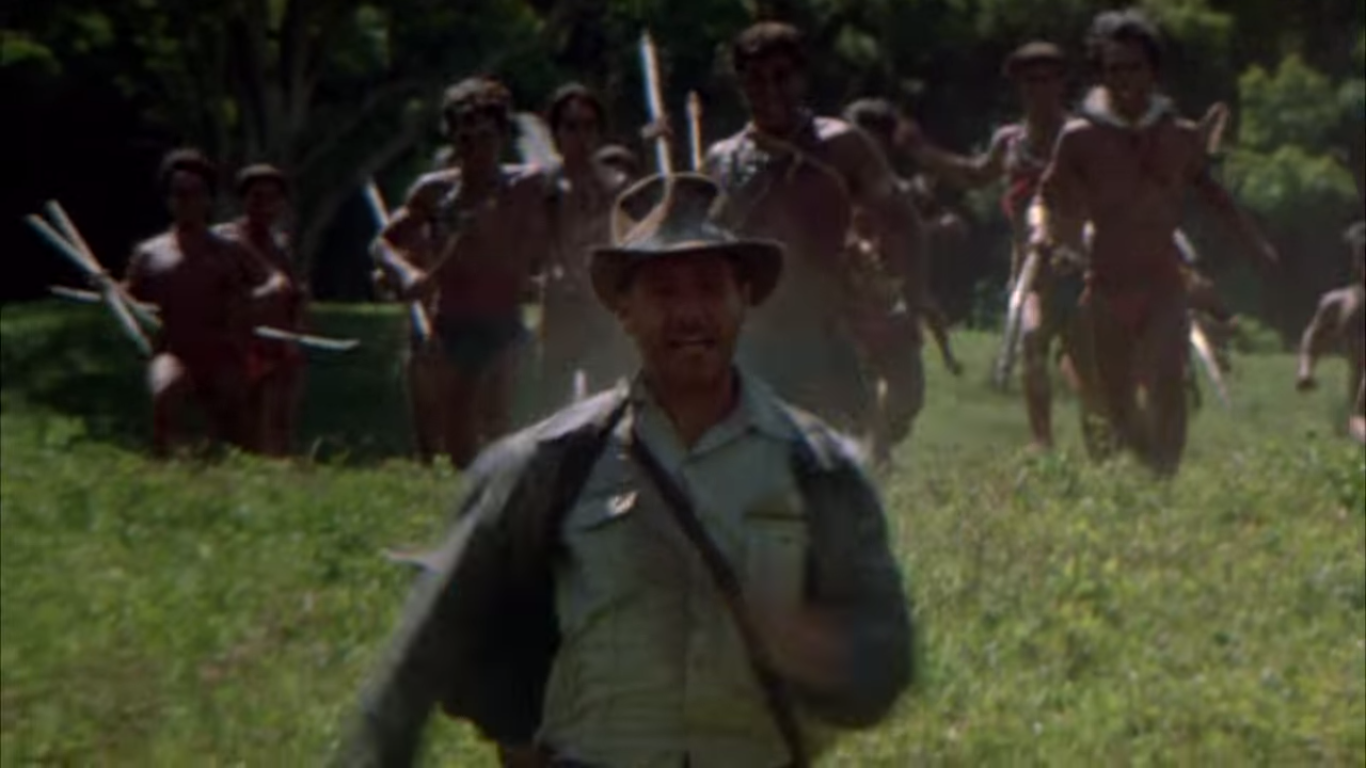
raidersof3In fact, Raiders is made up of many of these memorable sequences that add up to something greater than their parts. It’s a full story surely, but it is built up from these varying vignettes. Indy gets thrown into a pit of snakes with Marion by his side. He nearly gets his head taken off by a chopper blade (you should have seen the other guy), and finally, he begins a high-speed chase for the ark on the back of a noble white steed. It gives him time to pull a few stunts on a truck as he whittles down the opposition single-handedly. The audience even gets an obligatory Wilhelm Scream once or twice.

What it all comes down to is tracking the Nazis to their island lair where they hope to test the great powers of the Ark. I’m not sure how biblical it all is, but it seems more like a Pandora’s box because far more trouble than good comes out of it when opened. But in his infinite wisdom Indy and Marion don’t do anything except keep their eyes shut. They’re tied up after all. And that’s how the raiders were stopped and Indy completed his treasure hunt. The Ark is in the hands of the government and they file it away with numerous other very important and highly secret artifacts. The perfect ending to a film that has humor, melodrama, supernatural power, and a good old-fashioned tale of good vs. evil.

It’s crazy to think that Tom Sellick was almost Indy if it were not for his commitment to  Magnum P.I. Because Harrison Ford, despite his many iconic roles, will forever be Indiana Jones, thanks to that hat, that whip, and that revolver. He’s an awesome adventurer-professor type. You don’t see that every day.

5/5 Stars

Commissar (1967)

commissar1

Even with the so-called Khrushchev Thaw, it’s pretty amazing that Commissar even got made and perhaps even more astounding that it made it to the viewer all these years later. Some of that might be because it originated from Russian Civil War literature and anything else we can attribute to luck.

It is, as it titles suggests, about a commissar: an official of the Communist party, but this one seems special. First of all, she’s a woman which in itself is an interesting piece of commentary, but perhaps more so is the transformation she goes through.

From the outset, she is what we conjure up in our minds. Brutal, tough as nails, masculinized and mechanized by the collectivist agenda of the party. She’s the perfect comrade cog in the communist machine. Except then she receives the startling news that she is pregnant, and she must seek refuge in the home of a nearby Jewish clan. They are forced to quarter her, serving the greater good. She’s aloof to the whole idea and their diminutive patriarch puts up a fuss.

You see, he already has five children, a wife, and a mother to look after. He can’t afford to have this unwanted extra baggage, and she’s no friend of theirs. In this sense, the film feels reminiscent of Melville’s Silence de la mer. However, Commissar evolves into its own creature, just as all parties involved change over time. Yefim and his wife make their guest comfortable the best they know how and following the pregnancy they take good care of her.

Seeing her with a newborn is an altogether strange and foreign image, and with the cult of motherhood, the commissar’s whole demeanor shifts. She looks on at this family with contented eyes and stares back at her former life with some reluctance. It seems impossible to traverse the same paths she once did.

Perhaps most frightening are the images that are interwoven into the plot. They are disorienting, paranoia-filled, listless dreams that swoop in during pregnancy and restless hours of sleep. In the present, there are the children playing their militant games, terrorizing their sister, a sad reflection of the things going on outside of their own homes. There are constant contributions and pogroms always hanging over God’s people.

Whether it’s a hopeful fairy tales or a truth which you are willing to die for, the film paints a fairly bleak picture of what it means to live life. Our commissar is wholly disillusioned and the shadows of the Holocaust hang over the narrative because they lurk in the near future, not the past.

Director Aleksandr Askoldov’s favors a  fluid camera that nevertheless feels unrefined more times than not in its blunt and most certainly chaotic movements throughout the frame. It’s as if it’s not confident keeping still  — needing to prove its mobility in all circumstances. Still, the film boasts a lasting power that feels counter-cultural. This is not the film we expect coming out of the USSR circa 1967. These characters feel conflicted, their story feels sobering at best. It also offers up a strangely haunting dance sequence like no other, but then again this is far from an ordinary film. The director would soon be fired, expelled from the party, and exiled. The KGB would lock his film away and throw away the key for 20 years. He undoubtedly struck a cord — then and now.

3.5/5 Stars

Review: The Godfather (1972)

godfather1That moment when the undertaker is first seen pleading for justice and the camera slowly pulls closer, it’s so slight we hardly even notice it, but we hear his bitter monologue about America and his disfigured daughter. A head appears in the frame and we get our first vision of the now iconic Don Vito Corleone (Marlon Brando as masterful as ever). It’s a brilliant little scene that introduces us to the character this whole narrative revolves around, and it really is an important point to enter his story, on the wedding day of his daughter.

But it’s not just this opening scene that’s of note. In the sprawling expanse of this film that goes from New York, to Hollywood, to Las Vegas, and even back to the old country in Sicily, there is so much to be taken in. A gruff studio head faces the wrath of Corleone when he gets a present in bed, and he learns never to cross the Godfather again. There’s the moment where Vito first utters the words, “Make him an offer he can’t refuse” and then it is mirrored by his son Michael later on.

godfather2You have the quip from the tubby Clemenza after they pull one of the many hits and then very business-like they leave the gun, but take the ever-important cannoli. There’s the turning point where Michael the war hero faces off against crooked cop McCluskey  (Sterling Hayden) and the opportunistic heroin dealer Solozzo because he wants revenge for the shot they took at his father. There’s the striking juxtaposition when Michael takes part in the dedication of his god-child knowing full well what is happening to the bosses all across town. Finally, we once more peer into the inner office now with Michael at the helm, and the door closes as a concerned Kay looks on at what her husband has become.

But not many people need to be told what their favorite scenes from The Godfather are, and they could probably rattle them off while giving color commentary. Aside from just being great scenes, however, these moments tie together a major theme that pervades this entire epic narrative. Because really, when you break it all down, with all the bloodshed, all the business, and everything else this film encompasses, it’s really about family. It becomes such an interesting paradigm, how Family can be sacred, held in such high regard, and yet violence is at times necessary and it’s also seen as a part of life. The two things are so interconnected and yet somehow they still can occupy two different spheres. Wives, children, etc. are left out of the fray. But when it comes down to business, men like Don Corleone will do what they have to do. After all, they are the men of the family and with that comes responsibility and a need to be stoic and strong. Never lose your temper, never show weakness, never say what you’re thinking, and always make them an offer they can’t refuse.

Vito Corleone played so famously by Marlon Brando is the epitome of The Godfather. A 40-year-old man was made to look decades older, he was given a distinctive mouth guard, and the rest is a giant simply delivering his lines with the nuanced — almost gasping delivery — that he was so well known for. He is in many ways the center point as the patriarch of this great family and the head of their business. Although his role does change as the circumstances change, he is a man of incredible influence with a great many friends, allies, as well as a few enemies. In other words, he’s the man with judges and politicians in his pocket, but it doesn’t come without a cost.

Sonny (James Caan) is the eldest son who is first in line to take over the role as head of the family. But although Sonny is a tough guy, his fiery temper is his downfall. He doesn’t know when to keep his mouth shut, and he lets his anger get the best of him. It doesn’t bode well in a business like his.

Tom Hagen (Robert Duvall) is another interesting addition to the family, because he’s not really one of them at all, but Vito took him off the street and he’s rather like a son, becoming a trusted member of Corleone’s inner circle. He helps carry out business and represents the Don when it comes to legal issues. He’s a good man to have around, but it also makes for an interesting dynamic with Sonny and even Michael.

Fredo (John Cazale) is the one brother who is lost in the shuffle, and he’s most certainly the weakest. All he’s good for is living it up and getting drunk so the family sends him to Las Vegas to stay out of trouble. He is unfit to be head of the family, because he simply has no guts and although his father cares about him, he would never trust him with the business.

godfather3

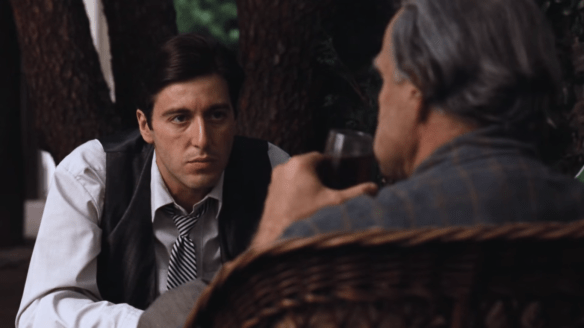
Michael (Al Pacino) comes back a war-hero and with a girlfriend in Kay (Dianne Keaton) who has no understanding of his culture or his people. In fact, the family wants to keep Michael as far from the fray of the family business as possible to protect him. The only possible role he might play is something unimportant so there’s no chance of him getting hurt. But while Don Vito is the focal point at first, The Godfather really evolves into the evolution of Michael from beginning to end. He starts out as an idealistic veteran so far removed from corruption. But the turn of events that deeply affect his family cause him to step into a different role, and he changes as a result. He is a far cry from the man we met during the wedding because now his almost subservient nature has been replaced by a cold-blooded dominance that is personified through his eyes. They’re like to icy black holes that can stare right through you, and they do.


The cinematography of Gordon Willis is obviously superb and generally popularized the golden tinge of The Godfather that gives it a classy and generally nostalgic touch of the 1940s. It makes locales like the open air wedding, Don Vito’s inner office, or even a cathedral all that more atmospheric. On his part, the score of Nino Rota manages to be hauntingly beautiful at one moment and even upbeat when necessary.

What more is there to say but that The Godfather is cinema at its purest and transcendent in its scope. There are few films that carry such magnitude in the vast annals of film history.

5/5 Stars