That moment when the undertaker is first seen pleading for justice and the camera slowly pulls closer, it’s so slight we hardly even notice it, but we hear his bitter monologue about America and his disfigured daughter. A head appears in the frame and we get our first vision of the now iconic Don Vito Corleone (Marlon Brando as masterful as ever). It’s a brilliant little scene that introduces us to the character this whole narrative revolves around, and it really is an important point to enter his story, on the wedding day of his daughter.
But it’s not just this opening scene that’s of note. In the sprawling expanse of this film that goes from New York, to Hollywood, to Las Vegas, and even back to the old country in Sicily, there is so much to be taken in. A gruff studio head faces the wrath of Corleone when he gets a present in bed, and he learns never to cross the Godfather again. There’s the moment where Vito first utters the words, “Make him an offer he can’t refuse” and then it is mirrored by his son Michael later on.
 You have the quip from the tubby Clemenza after they pull one of the many hits and then very business-like they leave the gun, but take the ever-important cannoli. There’s the turning point where Michael the war hero faces off against crooked cop McCluskey (Sterling Hayden) and the opportunistic heroin dealer Solozzo because he wants revenge for the shot they took at his father. There’s the striking juxtaposition when Michael takes part in the dedication of his god-child knowing full well what is happening to the bosses all across town. Finally, we once more peer into the inner office now with Michael at the helm, and the door closes as a concerned Kay looks on at what her husband has become.
But not many people need to be told what their favorite scenes from The Godfather are, and they could probably rattle them off while giving color commentary. Aside from just being great scenes, however, these moments tie together a major theme that pervades this entire epic narrative. Because really, when you break it all down, with all the bloodshed, all the business, and everything else this film encompasses, it’s really about family. It becomes such an interesting paradigm, how Family can be sacred, held in such high regard, and yet violence is at times necessary and it’s also seen as a part of life. The two things are so interconnected and yet somehow they still can occupy two different spheres. Wives, children, etc. are left out of the fray. But when it comes down to business, men like Don Corleone will do what they have to do. After all, they are the men of the family and with that comes responsibility and a need to be stoic and strong. Never lose your temper, never show weakness, never say what you’re thinking, and always make them an offer they can’t refuse.
Vito Corleone played so famously by Marlon Brando is the epitome of The Godfather. A 40-year-old man was made to look decades older, he was given a distinctive mouth guard, and the rest is a giant simply delivering his lines with the nuanced — almost gasping delivery — that he was so well known for. He is in many ways the center point as the patriarch of this great family and the head of their business. Although his role does change as the circumstances change, he is a man of incredible influence with a great many friends, allies, as well as a few enemies. In other words, he’s the man with judges and politicians in his pocket, but it doesn’t come without a cost.
Sonny (James Caan) is the eldest son who is first in line to take over the role as head of the family. But although Sonny is a tough guy, his fiery temper is his downfall. He doesn’t know when to keep his mouth shut, and he lets his anger get the best of him. It doesn’t bode well in a business like his.
Tom Hagen (Robert Duvall) is another interesting addition to the family, because he’s not really one of them at all, but Vito took him off the street and he’s rather like a son, becoming a trusted member of Corleone’s inner circle. He helps carry out business and represents the Don when it comes to legal issues. He’s a good man to have around, but it also makes for an interesting dynamic with Sonny and even Michael.
Fredo (John Cazale) is the one brother who is lost in the shuffle, and he’s most certainly the weakest. All he’s good for is living it up and getting drunk so the family sends him to Las Vegas to stay out of trouble. He is unfit to be head of the family, because he simply has no guts and although his father cares about him, he would never trust him with the business.
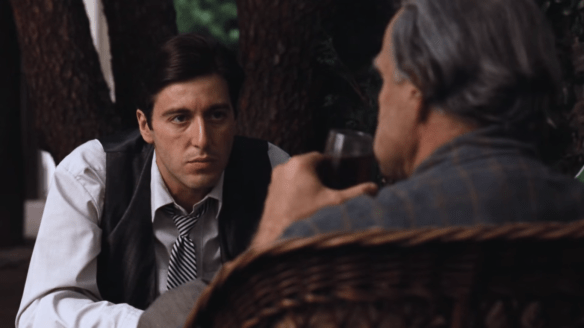
Michael (Al Pacino) comes back a war-hero and with a girlfriend in Kay (Dianne Keaton) who has no understanding of his culture or his people. In fact, the family wants to keep Michael as far from the fray of the family business as possible to protect him. The only possible role he might play is something unimportant so there’s no chance of him getting hurt. But while Don Vito is the focal point at first, The Godfather really evolves into the evolution of Michael from beginning to end. He starts out as an idealistic veteran so far removed from corruption. But the turn of events that deeply affect his family cause him to step into a different role, and he changes as a result. He is a far cry from the man we met during the wedding because now his almost subservient nature has been replaced by a cold-blooded dominance that is personified through his eyes. They’re like to icy black holes that can stare right through you, and they do.
The cinematography of Gordon Willis is obviously superb and generally popularized the golden tinge of The Godfather that gives it a classy and generally nostalgic touch of the 1940s. It makes locales like the open air wedding, Don Vito’s inner office, or even a cathedral all that more atmospheric. On his part, the score of Nino Rota manages to be hauntingly beautiful at one moment and even upbeat when necessary.
What more is there to say but that The Godfather is cinema at its purest and transcendent in its scope. There are few films that carry such magnitude in the vast annals of film history.
5/5 Stars
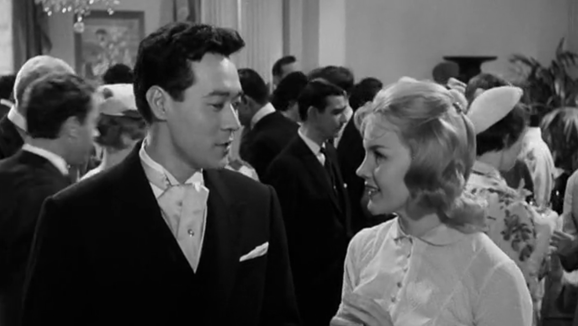 Bridge to the Sun is one of those films that was ahead of its time. Its main players are hardly remembered by modern audiences. Belgium director Etienne Perier was only a little blip on the Hollywood radar. The leading lady Carroll Baker was probably more notorious for her controversial role in Tennessee’s William’s Baby Doll than she was famous. James Shigeta was a pioneering actor, who was famously told, “If you were white, you’d be a hell of a big star.” He aged gracefully, but was slowly relegated from leading roles to bit parts in Hawaii Five-O and Die Hard. In truth, the film, based on the memoirs of one Gwen Terasaki, does suffer from a clunky script at times, and the box office returns were not too favorable. In fact, it was an outrageous flop back in 1961.
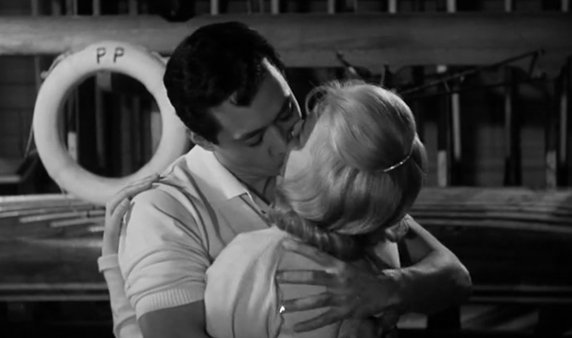 In fact, this film does not shy away from showing that affection, even though it undoubtedly made some viewers squeamish at the time. More than once Gwen and Terry embrace in intimate moments that signify the deep-seated love that holds them together. Because it’s far from easy. Gwen finds it difficult living in a Japanese culture where the woman is meant to be wholly subservient to her husband. She’s fine with the bowing and the taking off of shoes even, but not being allowed to talk is about the limit. With his family, her strong, lovable husband now seems cold and distant. However, they cannot stay mad forever and soon enough their little girl Mako is born, making them a happy little family. But of course, imperial Japan and isolationist America are on the brink of conflict and Terry and his family are tottering on the brink of calamity. He’s seemingly one man trying to hold together the relations of two nations that he has such close ties to. One because of his wife, the other due to his birth. Then, on a fateful day in December 1941 Japan struck the first blow and life would never be the same. Terry is now being detained and Gwen is fearful she might be forever separated from her husband. Disregarding what everyone else says, she takes her young daughter and follows her husband once again to his homeland – knowing full well what might be in store for her and her daughter.
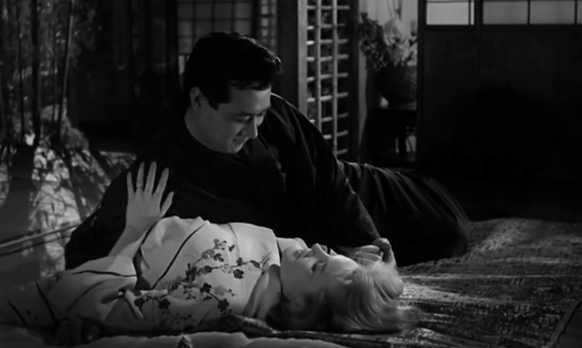 And when they arrive abroad there is the discrimination and the myriad of strange looks. Even as she makes the long journey across the sea all the white folk scoff at her, but Gwen takes it calmly and fearlessly. Once overseas the climate has changed greatly and now Terry is being questioned for his loyalty. The ethnicity of his wife doesn’t help and the firebombs raining down from above don’t exactly calm their nerves. But again and again, Terry and Gwen prove to be a resilient couple. The anomaly that should never have happened—seemingly could never have happened, and yet they did and they remained unequivocally together.