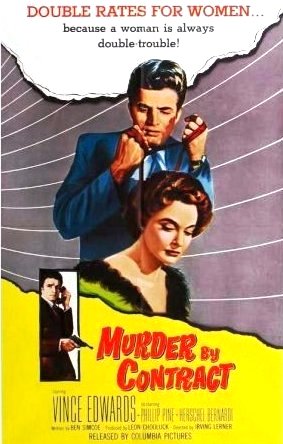
Murder by Contract (1958)

murder_by_contract_filmposterEvery once and awhile when you dig through the treasure trove of cinema which includes the B film you can wade through the refuse and come upon something truly special — elevating itself from all the lesser offerings of the past decades. Murder by Contract is such a film.

It’s not simply about the sheer economy because that’s what these lower billed films were supposed to be. Having a shooting schedule of a mere 7 days was hardly out of the ordinary. But it’s what all those involved from director Irving Lerner to cinematographer Lucien Ballard to lead Vince Edward were able to accomplish in that amount of time. This is an undeniable cult classic coming on the tail-end of what we know as film-noir and it’s easy to notice there’s something strikingly different about this film. It more ways than one it feels real, authentic, and true. Out of necessity, it chooses simplicity over the normal Hollywood production values and there’s an honesty in that.

Martin Scorsese even acknowledged the impact this film had on him at an early age and it’s true you can see bits of influence even in Taxi Driver as Travis bulks up and prepares for his future endeavors. You can see his fitness regiment mirrored in Claude our main person of interest.  In the same montage, the director adeptly suggests the passage of time while developing our protagonist through his silent actions.

Certainly, at face value, this is a very simple hitman film and there have been many ultra cool gunmen then and now. But there’s still something striking about the one we meet here. When we meet him he’s not a hit man at all but he’s driven to become one. He wants a contract, he gets it, and he carries it out. He does what he needs to do and he’s smart about it.

Vince Edwards does emit a certain calm and collected coolness but he’s also surprisingly existential for a film of this seemingly inconsequential nature. Alain Delon’s Jeff Costello is enjoyable for the very fact that he doesn’t talk. This man is interesting because he does — with choice words for waiters and about women among other topics. You get the sense that he’s a Superman as Dostoevsky wrote about and his handlers joke as much but that’s simply how he lives (Look, boy, you and me, we don’t pretend to be supermen. Me, I don’t even claim to be Mighty Mouse). Always smart, always proud and purposeful.

Given its initial humble locales, it’s easy to assume that the story is going to continue in this same vein for its entirety. But when Claude gets hired for a high-profile hit in Los Angeles his scenery also gets an upgrade to sunny Southern California. His timeline is two weeks but he’s content to soak in the sun, take his time, and think. He’s cool as always. The two men — his constant companions — who are to see that he completes the job are almost comically impatient. They don’t seem made for the crime business but here they are waiting at golf ranges and sitting in movie theaters to please their out of town guest before he goes to work earning his paycheck.

Another compliment to Murder by Contract is that it feels extraordinarily methodical and that’s a perfect reflection of Claude. He does get to his work in due time and he faces challenges, meeting them with the necessary reactions. Still, that doesn’t mean the hit is a piece of cake and because he waited so long even a pro like Claude begins to feel at least a little pressure. His two contacts are equally tense if not more so. Things begin to get testy between them as the deadline looms large.

This has to be the most idiosyncratic and interesting score I’ve heard since The Third Man. The strings of the electric guitar are used to haunt our consciousness as we nervously watch events unfold. Because that’s a lot of what being a hitman entails. Waiting around, biding your time. It requires nerves of steel. And Claude is business as usual to the end. But his business is a hard one.

4/5 Stars
“The only type of killing that’s safe is when a stranger kills a stranger. No motive. Nothing to link the victim to the executioner. Now why would a stranger kill a stranger? Because somebody’s willing to pay. It’s business. Same as any other business. You murder the competition. Instead of price-cutting, throat-cutting. Same thing. There are a lot of people around that would like to see lots of other people die a fast death… only they can’t see to it themselves. They got conscience, religion, families. They’re afraid of punishment here or hereafter. Me, I can’t be bothered with any of that nonsense, I look at it like a good business. The risk is high but so is the profit.” ~ Vince Edwards as Claude

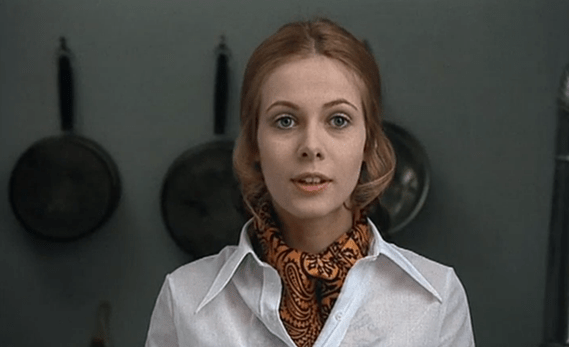
Claude Jade as Christine Doinel

claude jade

As often happens in the life of a classic movie aficionado, I became acquainted Claude Jade quite by accident and it happened at a random point in her filmography. In Hitchcock’s Cold War thriller Topaz (1969) she has a small part to play but the Master of Suspense was pointed to the actress by Francois Truffaut the French critic and director who had undertaken an immense interview with Hitch that has remained a treasure for cinema fanatics.

But still, that in itself has little bearing on Claude Jade. Jade came to the forefront of my mind after watching several entries in Truffaut’s famed Antoine Doinel saga starring Jean-Pierre Leaud, the first of these being Stolen Kisses (1968). And she immediately left an indelible mark on this viewer because she seemed the complete antithesis of our main character. Antoine was always a bit of a troublemaker, a vagrant, a malcontent, and whatever other negative descriptors you want to throw out. In some respect, it’s difficult to like him.

Yet from the first moment we see Christine Darbon, the wide-eyed ingenue, Antoine, and the audience are immediately taken with her for those very reasons. She’s so kind and sweet in ways that Antoine never manages to be. There’s an innocence and a playfulness behind her eyes that’s disarming. If we knew any better, we would say that he had no right in pursuing a relationship with a girl such as this. But to his credit, he does eventually get his life figured out just enough to begin to see her.

It’s these interludes of Stolen Kisses that we might say puppy love is bubbling up. There are furtive glances. Breakfast at the kitchen table. Walks through the neighborhood park together. It feels like a little slice of paradise and even in their utter differences, it seems that Antoine and Christine might make a life together. Perhaps they were even made for each other after all.

bedandboard1

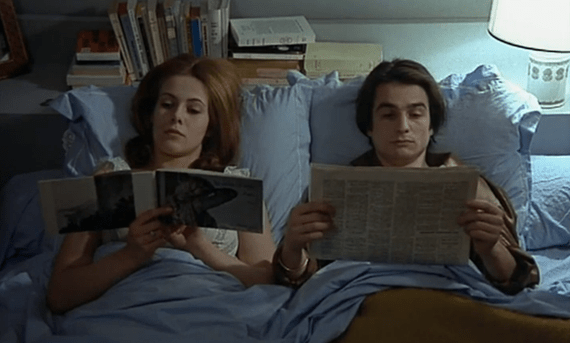
In Bed & Board (1970), the next installment in the series, the couple is now married and rather happily so. They have a baby and he has a flower shop and she teaches violin lessons. But they have each other and they are content. Reading in bed together after the day’s activities are over or eating a dinner of baby food because going to the store like adults is far too difficult.  How could Antoine not be happy with a wife such as this?

However, he is always plagued by inner demons and infidelities. In this case, dismantling his marriage and all that is good with his life with another woman. But part of what makes Christine phenomenal is the immense grace in which she handles Antoine. Again and again, we are reminded of just how much he does not deserve her and yet she sees something in him that is worthwhile and worth staying with. If nothing else, she makes us appreciate Antoine as a protagonist, blessing him with a human side, and suggesting there are still some redeeming qualities left in him.  So by the film’s end despite the turmoil and turbulence, they went through, they still have enough affection to stay together.

In Truffaut’s final installment Love on the Run (1979), the passage of time is not so kind to them as is often the case with life. But what stays the same is Christine (and unfortunately Antoine too). She remains a caring figure lighting up the screen with her charm, youthful exuberance, and quiet dignity even with she is slighted.

I will end by quoting the eminent critic Pauline Kael who noted in one of her reviews that Claude Jade was “a less ethereal, more practical Catherine Deneuve.” If I’d have to wager a guess on what she was getting at, it would probably be something along these lines. Deneuve was always this aloof beauty who exists in almost a different stratosphere and if we might be so bold to make the assumption, she feels almost unattainable. Maybe she doesn’t live in the same world that we do. Hers is a cinematic existence. But Jade in her playful winks and everyday interactions makes us feel like we know her well.

Because her life with Antoine is not unlike our own in some respects. That makes us appreciate her immensely and adore her even moreso because she feels like one of us. Deneuve is revered because she is beautiful in an elegant way. She would never be one to get her hands dirty. But with Jade, there’s that immediate connection. Rather than create a dichotomy however between “ethereal” and “practical” I’d much rather say that I appreciate them both and the impact that they both had on French cinema.  Antoine Doinel, sometimes I think you’re an idiot. In fact, I know so. How could you not remain true to a woman with a face like that?

claude jade 2

This is my entry in the Reel Infatuation Blogathon….


The Glass Key (1942)

the-glass-key-1942With Dashiell Hammett’s The Maltese Falcon making a splash just the year before and giving a big leg up to its star Humphrey Bogart as well as its director John Huston, it’s no surprise that another such film would be in the works to capitalize on the success. This time it was based on Hammett’s novel The Glass Key and it would actually be a remake of a previous film from the 30s starring George Raft.
But instead, we had Alan Ladd in the lead fresh off a career-making performance the year before. True, Ladd’s no Bogart and the forgotten Stuart Heisler is hardly the caliber of Huston, and still, the film is somehow entertaining in its own way. It channels the political corruption of Force of Evil with a bit of the unfathomable plot and mile-long laundry list of characters rather like The Big Sleep. And once more like any comparison with the Maltese Falcon, it hardly holds a candle to these other films but it’s not trying to be overly smart. It never makes an attempt at commentary or some deep philosophical character study but it does ladle out some unabashed noir entertainment.

There’s the pairing of Ladd and Veronica Lake once more to capitalize on their breakout success in This Gun for Hire. Noir regular Brian Donlevy stars alongside them playing a tough guy and political boss named Paul Madvig. His right-hand man Ed Beaumont (Ladd) stands stalwart by his side until Madwig gets caught up in politics as well a murder accusation. By day he tries to win the hand of the pretty daughter (Lake) of an aspiring governor while at night he looks to run out the towns gangsters namely one Nick Varna. As one might expect murder, corruption and familial turmoil all become integral plot points

Once more Ladd shows his aptitude for playing “leading roles” that still somehow allow him to stand on equal footing beside other stars. His most prominent performance as the gunslinger Shane is a fine example because although he is the title character, still somehow he manages to walk in the periphery and he does so with a quiet confidence. Similarly, in This Gun for Hire and The Glass Key, there is a cool curtness to his demeanor that he pulls off well. It allows him to be the star without really seeming like it. That’s the quality he’s able to cast and Lake works well to balance him out. Donlevy gives a surprisingly spirited performance but he’s not a magnetic star. If anyone, this is Ladd’s film with Lake too.

As we would expect with any decently entertaining noir thriller, the rest of the film is filled out with quite the menagerie of characters the most memorable of those being William Bendix as a rough and tumble henchman. He and Ladd have it out in a couple of scenes and in real life, they would become lifelong friends. The way they beat each other up though it’s sometimes hard to tell.

3.5/5 Stars

This Gun for Hire (1942)

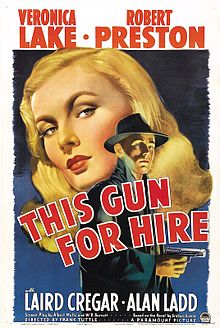
220px-this_gun_for_hire_movie_posterAlan Ladd and Veronica Lake found themselves partnered together on numerous occasions partially out of convenience (at 5’6 and 4’11 they were a perfect height match) but also there’s a genuine chemistry between them. And it all came into being with This Gun for Hire an economical film-noir where Ladd wasn’t even one of the top-billed stars.
Those coveted positions above the title went to Lake and the relatively young buck Robert Preston with Ladd tacked on with an “Introducing” title card. It was his latest attempt to break into the film industry that had long relegated him to bit parts and uncredited cameos (ie. Citizen Kane). It worked.

His menacing thug Raven is the first character we meet and he soon proves his brooding menace is more than just show. He is a gun for hire after all and he finishes up some business for a client getting his payoff through a nervous and portly fellow named Gates (Laird Cregar). But the money is hot and Raven soon finds a price on his head. He’s been had and he’s not about the let that slide.

The main push from the law enforcement is led by none other than Michael Crane (Robert Preston) who has recently been vacationing with his girlfriend Ellen Graham (Veronica Lake). As he burns the midnight oil she has her own gig as a magician/nightclub singer while also taking on some clandestine activities — activities that’s she sworn not to tell anyone about — even her beau.

As we might expect with the tenets of noir, the film is a lot bigger than we are initially led to believe, not simply involving murder, but also treason and government secrets as Pearl Harbor is still fresh on everyone’s minds. In such a way, our three leads get tied up both literally and figuratively as Raven continues as a fugitive in search of the man who set him up.

He too crosses paths with Ellen and in her, he finds a kind of confidante who doesn’t immediately write him off, despite his deadly tendencies. Before her he only liked cats, the reason, they don’t need anyone, rather like him. But he’s also not about to reform, not until his work is done.

Although its transitions are at times choppy and awkward, there’s indisputably an intrigue that courses through This Gun For Hire that makes it a diverting bit of noir and its latter half is the pinnacle of the action as the dragnet closes in around Raven. For the 1940s, it was a crackerjack finale but unfortunately, it’s sullied now by an abrupt happy ending. No matter.

While Robert Preston is a fairly flat lead, Veronica Lake is her usual playfully sympathetic self and Laird Cregar plays the spineless oaf to perfection. His slimy sort is one of the reasons noir becomes so wickedly delectable. In fact, he’s perhaps second only to Alan Ladd’s characterization because over the course of the film Ladd systematically steals the picture, taking every little bit of limelight and making it count. Solidifying his stardom by playing a highly compelling heavy and essentially stealing the girl away from his male costar.

Edward G. Robinson, Humphrey Bogart, and perhaps most notably James Cagney, all played corrupt, crazed, and vindictive gangsters at one time or another. What sets Ladd apart is his utterly emotionless eyes. They’re still the eyes of a stone cold killer but there’s a vast emptiness there. Anyways it’s the perfect laconic performance for film-noir and while he never reached the heights of Bogart (also a former supporting player), Alan Ladd rightfully so gained recognition for his own career — most notably in Shane. But everything has to start somewhere and This Gun For Hire is precisely that film. His mark is all over it.

3.5/5 Stars

Review: East of Eden (1955)

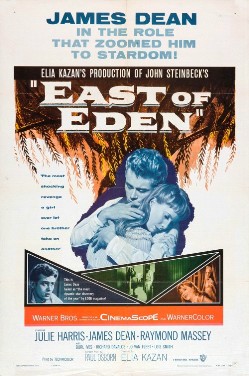
east_of_eden_posterEast of Eden. It was John Steinbeck’s epic work. Showcasing a familial narrative sprawled across his familiar locales of Salinas and Monterey over the turn of the century. But as a film, it rather unwittingly became James Dean’s. He wasn’t even a star yet. He had been on the stage and in a few small roles on television. His performance as Cal Trask was his first film role and the only one that ever got released during his lifetime. As his following two films, both premiered after his untimely death (curiously not all that far away from this film’s setting).

Director Elia Kazan utilized Technicolor and the harrowing perspective of Cinemascope to paint East of Eden with vibrant colors and rather unnerving angles. It’s also true that Kazan, known for evoking intense performances from actors bread on the Method,  was more inspired than perhaps even he realized when he cast Dean. The actor’s body movements. His moody histrionics. His angst emanating from those piercing eyes of his. Even his terminal sadness channeled from his own real-life desire for his father’s love. It’s all within the role of Cal Trask and takes away any doubt about who the focal point of this film is.

And for some, this might be a rather glaring problem with the film. Kazan’s adaptation of the latter half of Steinbeck’s novel focuses on the Cain and Abel dynamic between brothers Cal and Aron as they vie for the affection of their father Adam. For the film to work, each of these characters should be on equal footing. And it’s true that the film is a pendulum of emotional turmoil. It’s positively charged with virulent intensity. First, it’s Cal who is angry and isolated as he tries to discover the whereabouts of the mother he never knew. Meanwhile, his brother Aron (Richard Davalos) is happily in love with his girl and readily defends his brother against any criticism.

But as Cal tries with all his might to win the affection of his father by any means possible, things begin to change. No, his father never exhibits the type of pleasure in him that he so desires, but in his struggles, Cal becomes closer with his brother’s girl — gaining her sympathy.

As time passes, the U.S. is teetering on the brink of the Great War and still, Cal cannot earn his father’s love and his brother becomes more and more jealous. As Cal comes into his own, showing a certain amount of industry and thoughtfulness, it seems Aron becomes more withdrawn and cold. And still, Adam loves his “good son” the best.

James Dean’s performance is spectacularly engaging. I would argue it’s not a morbid sense of curiosity that draws us to him as a tragic hero. But he truly had a special ability to control entire scenes with a glance or some slight movement. Like a Brando or a Clift, he had a certain ability to tap into something that classical actors couldn’t quite touch. Whether it was realism or not is slightly beside the point because they live in characters who are charged with real emotions. It makes Dean’s role as Cal Trask almost palpable. You can feel all that is going on inside of him.

It’s the fact that Dean is so memorable, that brings to light just how much some of the other roles pale in comparison. Davalos does a fine job in his first film, but he cannot balance the scales weighed down by Dean. Raymond Massey on his part is a fairly flat actor not given to anything altogether interesting. It is Dean who elevates Massey’s role in a sense (even though Massey despised the younger actor). Furthermore, Julie Harris is a reputable performer with great heart but she somehow seems miscast (perhaps she’s too old for her role). And Jo Van Fleet gets into the film with a few integral scenes but even she does not have enough time to neutralize Dean.

Perhaps it’s because of the now iconic screen tests of Dean and Paul Newman working off each other, but part of me wonders if Newman in the role of Aron could have done anything to counterbalance Dean. Part of me rejects this hypothesis because Newman never had the same type of melancholy or intensity that Dean was able to muster. He was the likable one. Still, it’s an interesting supposition that in no way takes away from the phenomenal way James Dean burst onto the scene in 1955. He was an explosive supernova of talent — unfortunately for us, he was snuffed out far too quickly.

4/5 Stars

4 Star Double Feature – Coming of Age Flicks

Starter for 10 (2006)

The cast boasts the likes of James McAvoy, Benedict Cumberbatch, Rebecca Hall, Alice Eve, and even James Corden all in one film together! The year is 1985 and Brian is off to his first year at university which turns into a formative moment in his life of new experiences, romantic entanglements, and, yes, even trivia. He’s really good at trivia. But sometimes being good at trivia still cannot prepare you for the things that life throws at you. That’s what makes life, life and not a game show as he finds out.

Sing Street (2016)

Also set in 1985 but in this case in Dublin, Sing Street is a high school coming of age story about a boy who forms a band to get a girl. It’s a simple premise but John Carney’s film explores much of the turbulence as well as the glories of that time in life. It’s about love and music and personal exploration. It also happens to be a darn good musical with a steady stream of catchy 80s tunes both real and fictional.

https://www.youtube.com/watch?v=C_YqJ_aimkM

4 Living Legends Part 4

rose_marie_1970Here is another entry in our ongoing series of Classic Hollywood Stars who are still with us.
Glynis Johns (1923-)

Whether it’s a blessing or a curse (I consider it a blessing), Glynis Johns will forever be immortalized as Mrs. Banks the woman suffragette in Mary Poppins (1964) bringing a certain amount of energy and personality to Disney’s musical classic. However, she also makes a memorable turn opposite Danny Kaye in the zany medieval comedy The Court Jester (1956).

Rose Marie (1923-)

A veteran of vaudeville, Sally Rogers is undoubtedly best remembered as part of Rob Petrie’s comical gag writing team on The Dick Van Dyke Show developing a particular comic rapport between herself, Morey Amsterdam, and Van Dyke for some extraordinary moments. She also frequently guested on The Hollywood Squares hosted by Peter Marshall.

Jacqueline White (1924-)

Perhaps she is a little-known actress, but Jacqueline White left an indelible mark on film-noir for two films in particular. The first being Crossfire (1947) and the fantastic B film The Narrow Margin (1952).

Richard Erdman (1925-)

Richard Erdman has a very, very special place in my heart. The reason being I first got to know him as Leonard Rodriguez on the incomparable comedy Community. Guessing there might be a story behind him, I looked him up and little did I know he had an illustrious Hollywood career in many films I had seen early on in my introduction to film. His acting credits include such classics as The Men (1950), Cry Danger (1951), and Stalag 17 (1953). Even back then, even though he had more hair, there’s still that unmistakable sense of humor.

4 Living Legends Part 3 (sort of)

800px-dorothy_malone_-_written_on_the_wind_-_studio_publicity_photoFor my ongoing series of living legends, I chose 5 individuals actually who in some way had an impact on the film industry as we know it today. Without further ado, here are a handful of living legends.

Gene Reynolds (1923-)

So Gene Reynolds began as a child actor back in the 1930s first appearing ni the Our Gang shorts and also making appearances in films such as Captains Courageous and Boys Town. Truth be told, I have yet to see one of his early performances. It’s unforgivable I know. However, Reynolds also had a great affect on me because of the many television shows he created/directed/produced later in his career. The list begins most prominently with MASH which he co-created but also Leave it to Beaver, The Andy Griffith Show, Hogan’s Heroes, and Lou Grant.

Billy & Garry Watson (1923 and 1928)

Okay, so this entry is a little unique because Billy and Garry Watson are hardly known on their own but as two parts in an acting entity, The Watson Family. If the name doesn’t ring a bell, that’s not necessarily unbelievable, but this group of siblings shared the screen with many of the great stars of the 1930s. Their film credits include the likes of Showboat, Young Mr. Lincoln, and perhaps most memorably, Mr. Smith Goes to Washington.

Lola Albright (1924-)

Lola Albright had a long and varied career in both film and television. Perhaps her most memorable role was opposite Kirk Douglas in Champion (1949) as one of his many flings on his way to the top of the boxing world. However, with the popularity of television, she also took many guests spots and even had a stint filling in for Dorothy Malone on Peyton Place.

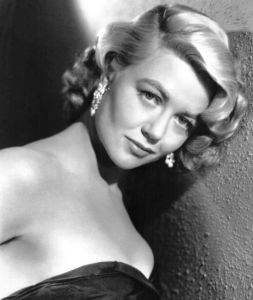
Dorothy Malone (1925-)

Dorothy Malone will best be remembered for her work in some of Douglas Sirk’s greatest melodramas including Written on the Wind and The Tarnished Angels. She also took on a particularly memorable cameo opposite Humphrey Bogart in The Big Sleep. She too dabbled in television with her most prominent role being that of Constance Mackenzie on the syndicated television version of Peyton Place.

Kansas City Confidential (1952)

KCConfidential.jpgSaying that Phil Karlson has a penchant for gritty crime dramas is a gross understatement. And yet here again is one of those real tough-guy numbers he was known for, where all you have to do is follow the trail of cigarette smoke and every punch is palpable–coming right off the screen and practically walloping you across the face.
Like all heist films, there must be a point of inception, however, Kansas City Confidential finds its story after the crime has been committed and the perpetrators have split up without a hitch. The man who takes the heat, their fall guy and the unsuspecting stooge is Joe Rolfe (John Payne who is adept at playing such roles) a nobody truck driver and a convict once upon a time.

It seems like the perfect crime as the three hired hands all wore masks and had no connection to each other, except for the stocky and demonstrative Mr. Big, the mastermind behind the whole operation and the one calling the shots. He sends each man off with enough money to tide themselves over until he contacts them to reconvene for their big payoff. Whether or not he will actually cough up the 300,000 clams he owes each of them is quite another story.

Still, each man heads his own way and Joe is getting grilled by the cops day after day in the hopes that he will crack. Finally, he is released, but with no prospects and no job, he sits in a bar stewing in his anger. The story takes it’s next big turn when he follows a lead down to Mexico to tail one of the hoods in on the job Peter Harris (Jack Elam). And although Joe is going in blind, he soon catches wind of the impending rendezvous in Barados and decides he’ll just show up as well, to get to the bottom of the entire mess.

It’s there where he first crosses paths with two other leering hoods, the beady-eyed Tony Romano (Lee Van Cleef) and the silently brooding Boyd Kane (Neville Brand). However, while keeping tabs on these cronies, he keeps company with a budding lawyer Helen Foster (Coleen Gray), who has come to call upon her protective father, the former policeman Tim Foster. If this set up isn’t plain enough already, it certainly becomes increasingly interesting as the gears continue to turn towards the story’s inevitable climax.

Most certainly Kansas City Confidential boasts jarring close-ups, low budget facades and perpetually sweaty faces that accentuate its unsentimental noirish qualities. However, Coleen Gray acts as a more enlightened noir heroine, who does not grovel for her man or weep incessantly at the thought of danger. Instead, she’s training to be a lawyer, and rational but still unequivocally kind. Despite not having a proper meet cute, the chemistry between Gray and Payne still works surprisingly well.

What makes the film inherently more interesting is how the crime is embroiled with family issues. Because, as an audience, we know Mr. Big’s identity: a corrupted cop who got a bum steer and now is going to reap the benefits of setting up some real losers. Still, that doesn’t excuse what he did and Joe got dealt a similarly sorry hand. The fact that Foster’s daughter is involved sheds him in a more humane light and in the same instance makes Joe a more likable figure. In many ways, she brings out the best qualities of both these characters. It’s the darker recesses that lurk behind their characters. Those are made more evident by the likes of Lee Van Cleef, Jack Elam and Neville Brand, a real rogues gallery of baddies if there ever was one.

4/5 Stars

Walking in the Footsteps of Duke

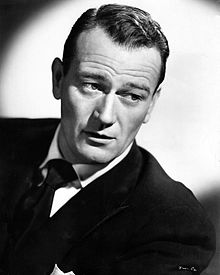
john_wayne_publicity_photo_1952Contrary to popular belief, I wasn’t always a classic movie aficionado or a western lover but you do not have to be either of those to know and love the Duke because he is more of an American icon than a simple movie star in the conventional sense. He’s so integral to the very cultural fabric of our country. For instance, by watching I Love Lucy or M*A*S*H (and Radar’s impressions) or having one of your dad’s favorite film being True Grit, you can get to know him by simple osmosis. It’s just a fact. Even words like “Pilgrim” and “Baby Sister” begin to sneak into your everyday lexicon. You cannot help but hear them and by association use them (I’m not speaking from experience at all).

Even from an early age I had an awareness of John Wayne and I’m not quite sure where that began but I certainly do recall knowing who he was. However, I’m not sure if I had ever seen one of his films or at least not one of his famous ones. Watching the likes of Stagecoach, The Searchers, The Man Who Shot Liberty Valance, even True Grit came years later. However, from early on I think it was evident that in many ways I almost subconsciously grew up walking in the footsteps of John Wayne. It’s only now that I realize the undeniable facts.

To start, it must be noted that Wayne was a transplant to Southern California, my home for many years now. He actually was born Marion Morrison, larger than life even at birth in the town of Somerset, Iowa in 1907. It’s true that I got to visit his home, now a makeshift museum that memorializes his career in humble fashion (On a side note: I too have family from Iowa so that’s yet another small connection to the Duke’s beginnings).

300px-Wild_Goose.JPGBut it’s from these roots that he ultimately moved out to sunny California, a noted member of the USC football team before a career-ending injury. This is a part of his life that I will mostly gloss over. Because it was the next part of his life that always resonated with me on a personal level. His very persona seems imprinted on the world that I grew up with from an early age. His name and likeness could seemingly be found everywhere. I grew up seeing his statue and even passing by his personal boat The Wild Goose and seafront home on family excursions (also featured in a Columbo episode).

Rumor has it that his son Ethan roamed the same hallways and the same classrooms as I did in high school. By association, I even hold a personal anecdote of the Duke that my father has often regaled me with. Once, in a local shop, he saw Rooster Cogburn himself in all his imposing glory, sans eyepatch, patronizing the local establishment. That was probably only a few years before he passed away in 1979 — only a single momentary occurrence.

Although that was still some years before I even became acquainted with him, there’s no doubt that John Wayne is a timeless figure and I will enjoy him on film for many years to come because there’s something personal about his persona both on screen and off. I truly feel like I do walk in his incomparable footsteps, looming large even now, so many years after his final film The Shootist in 1976.

Because he is far more than a movie star. He’s not simply John Wayne, Marion Morrison, or the Duke, he’s a multifaceted, colorful figure, polarizing but also so personable. In every role, you knew it was him and he never felt like he was faking one word or action. He’s authentic, straight-talking, and true. He held unswervingly to certain convictions and fought tirelessly for those who did not pack a shotgun as well as he did. And I admire that. Thus, John Wayne is not simply an actor who I enjoy seeing for his sheer timelessness but I’ve also had the enjoyment of walking some of the paths that he frequented and blazed. They certainly are big boots to fill but it’s fun to see their impact even today.

For the John Wayne Blogathon HERE