Green for Danger (1947)

green-for-danger-2Green for Danger gives murder mysteries a good name because it is drawn up excellently but also with a degree of charm and that should not be taken too lightly or maybe it should. But either way, there’s no doubt that director Sidney Gilliat’s tale based off of a novel by Christianna Brand is quality entertainment.

Early on the fitting backdrop of wartime Britain circa 1944 is developed from a historical moment that is uniquely dynamic in its own right. The German V1 “doodlebug” rockets are raining down overhead leaving the Isles in rubble. In such an environment nurses and doctors must work continually to care for numerous patients in need of medical assistance. The most pivotal patient for the sake of this story is the seemingly unextraordinary postman Mr. Huggins. Complications on the operating table do not bode well for him and he doesn’t make it. Though it hardly seems the pretense for murder.

Still, some are not so sure. Namely, the suspicious Sister Bates and yet another murder, this time more blatant, gathers the attention of Scotland Yard and so they send one of their men over — our trusty narrator — the one and only Inspector Cockerill (Alastair Sim).

He dictates the entire story with a rather amused detachment, conducting his job with a certain degree of care but he doesn’t mind a laugh or two. It’s truly a delightful performance from Sim, playing the jocular inspector like we’ve never seen before. His is a dryly wicked wit and he’s even prone to little bits of physical antics. One moment he watches with the giddy satisfaction of a schoolboy as the doctors duke it out, making no effort to stop the violence. But he also makes full use of a pair of voluminous eyes that can shift between sly glances and glaring accusations whenever the change is called for.
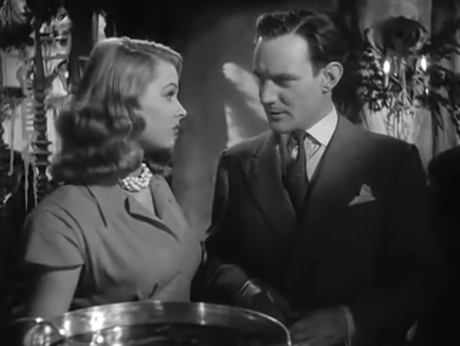
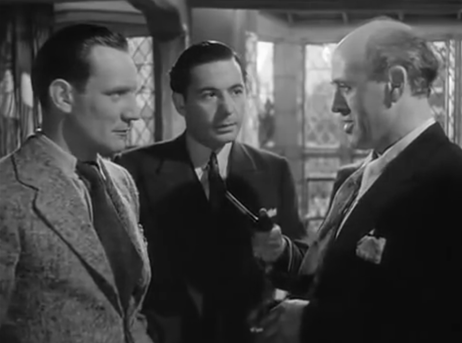
green-for-danger-1He comes in and steals the film but he does have some enjoyable castmates to work off of. Dr. Barnes (Trevor Howard) the anesthesiologist and the suave surgeon Mr. Eden (Leo Genn) are both in love with the same girl and understandably so. The attractive Nurse Freddi (Sally Gray) is a real prize but only one among a taut nursing staff including the fragile Nurse Sanson and the always lively Nurse Woods (Megs Jenkins). Before the Inspector arrives on the scene they are the true backbone of the storyline and it’s confirmed early on that the murderer comes from within their ranks. The age-old puzzle is left, to decipher who the culprit is and for what nefarious purpose.

It’s hardly a spoiler to say that the revelation of the murderer and the reason for the murders is hardly the highlight of the film. Because although we are dragged along by our curiosity as we have been trained to do with such mysteries, engaging films such as Green for Danger have more depth than the simple patterns of intrigue with a big reveal at the end. Because once you’ve seen one, you’ve seen them all, or at least you won’t be surprised the next time around. But this rendition has enough life in its characters, specifically Sim, to work beyond a basic murder mystery plot.

It strikes me that British backdrops often serve as the best environments for Whodunits and the quintessential nature of this reality has to do with certain sensibilities that the British people generally embody. They are civilized, proper, and not prone to the same fits of drama as other people. There’s also a reason that film-noir is an American genre and not really English. That darkness seeps out more readily and uninhibited.

But the Whodunit can still function because, despite their outward exteriors, that does not mean the characters within this film cannot still stoop to jealous action and even murder. Green for Danger is a thoroughly enjoyable exercise in such themes.

4/5 Stars
Review: Chinatown (1974)

chinatown1Forget it, Jake, it’s Chinatown

The more you watch movies like Chinatown, the more you realize how much you’re still learning. I saw it the first time and I naively thought I knew everything about it. After all, it seemed fairly cut and dry. But the beauty of this film is a labyrinth-like story that can still keep me engaged after multiple viewings. There are things that I missed, things that I have to piece together once more, and more often than not details I simply forgot.

Robert Towne’s script has an intricacy to its constantly spiraling mystery plot that remains powerful and Roman Polanski — with cameo included — directs the film with a sure hand as well as a cynically bitter ending worthy of his work. At that point, he was returning to the same city where a few years prior his wife Sharon Tate had been brutally murdered and that certainly had to still be heavy on his mind.

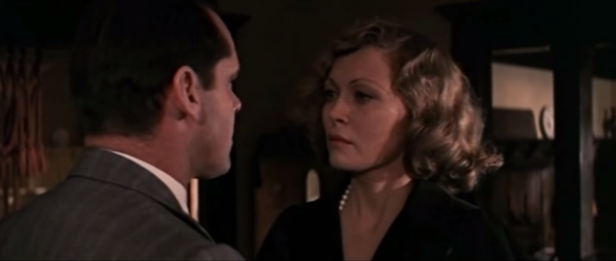
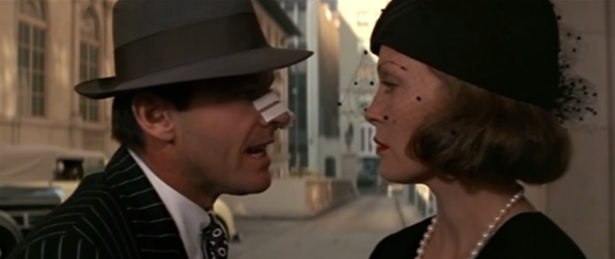
Throughout, Chinatown has elegant visuals of a desert-dry Los Angeles circa 1930s, and it is aided by a smooth Jerry Goldsmith score made for such a period crime film as this. Jake Gittes (Jack Nicholson), is the smooth-talking, smart-aleck P.I. with a penchant for trouble, but that goes with the business. In the tradition of all his heirs like Spade and Marlowe, the whole story is told from his point of view and we get the details at the same pace as him. That means a lot of the time we are just as confused as him, trying to pick up all the pieces.

Aside from Nicholson, Faye Dunaway’s performance is an interesting reworking of the archetypal femme fatale, because she has a different side to her. Also, John Huston’s performance is wonderfully nefarious, because he plays Noah Cross with a top layer of geniality that is ultimately undermined by his base nature. It’s wonderfully wicked.

In the story’s first few moments of being in his office, we begin to learn a little about the means Gittes uses to appease his clients. Then, his newest client walks through the door, a Mrs. Mulwray, who wishes for him to tail her husband. And so he does, just like that, and he’s pretty good at it too. Hollis Mulwray (an anagram for Mullholland) happens to be an integral part of the L.A. Department of Water and Power as the chief engineer. From what Gittes sees, the bespectacled Mulwray seems to have his scruples, but he also has a secret girl, who the P.I. is able to snap some incriminating photos of.chinatown2 Back at the office, another woman shows up, a Mrs. Mulwray, but this time the real one. She wants to slam J.J. with a lawsuit, but he realizes he got framed, and in the end, she quickly drops her case. Pretty soon Gittes former colleague Lt. Escobar digs up Mulwray’s body and the cause of death is the height of irony. He drowned during a drought, a cruel demise, and his body is joined by that of a drunk, who also was wandering around the local reservoir. It’s time for our nosy P.I. to do a little more snooping, but he is scared off by two security guards from Water and Power who give him a deadly nose job.

None worse for wear aside from a small cast, J.J. knows the department is diverting water. It’s more than a little runoff like they contend. He gets lunch with Noah Cross (The great John Huston), who is the father of Mrs. Mulwray and the former business partner of the deceased. Like J.J., he’s curious about finding the mysterious girl, and he sweetens the pot for the P.I.

A bit of detective work takes Gittes to the hall of records and then a vast acreage of orange groves where he is mistaken for a member of the Department of Water and Power. They aren’t too happy to see him, but Mrs. Mulwray is able to bail him out. They check up on an assisted living home and tie it into the whole conspiracy. Someone is buying up land under the names of the unknowing residents.

chinatown3But as it turns out, Mrs. Mulwray is hiding a major secret of her own that she’s been keeping. Another girl is murdered and since he’s found at the crime scene, Gittes is in a tight spot with the police and so he wants to get things straightened out. But he doesn’t quite understand what he’s gotten himself caught up in. At the last minute, he decides to take the hero’s path, but it’s to no avail. The good is snuffed out, the bad walk away free, and corruption still runs the streets of L.A. There’s not much the cops can do about it either.

chinatown4So many people remember the film’s final words, which epitomize this place of confusion, corruption, and helplessness. The final words of Jake are just as illuminating, however, because he repeats the words he spoke to Mrs. Mulwray earlier when she asked what he did when he worked a beat in Chinatown, “As little as possible.” It’s so pessimistic and yet it’s the truth that everybody knows. He must resign himself to doing nothing because there is no way he can win, no way to overcome the forces that be. It’s a haunting conclusion, but ultimately the most powerful one we could hope for.

Earlier I alluded to the fact that every time I watch this film I pick on things that I missed before. For instance, within Robert Towne’s script are some interesting instances of foreshadowing. The first comes in the form of a pun uttered by the Chinese gardener who is constantly muttering, “It’s bad for the glass/grass.”

Then, while they are in the car Mrs. Mulwray dejectedly drops her head on the steering wheel and it lets out a short honk. This acts as an important portent to the end of the film along with the blemish in her left eye. If you have not seen the film yet, this might sound very cryptic, but if you keep your eyes open these little details are rewarding. Chinatown is a fascinating place to return to again and again after all.

5/5 Stars

Review: Vertigo (1958)

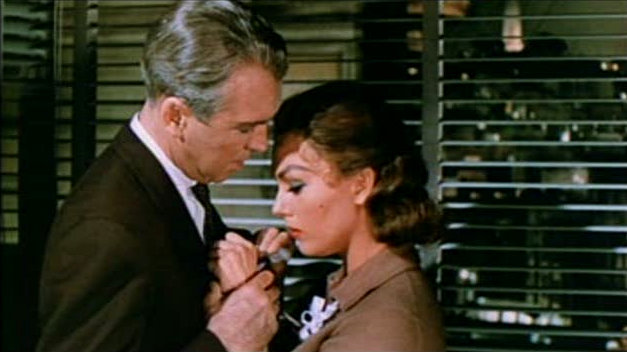
Vertigo_1958_trailer_embrace“The Greatest Film of All Time.” It certainly seems like an arbitrary title, but if nothing else it gives film aficionados something to discuss. And that’s what Alfred Hitchcock’s Vertigo is now being called for many reasons. Rather than join the debate, I wish to take a few moments to acknowledge what makes the film itself special.

On the surface, shall we say the first viewing, Vertigo is thoroughly enjoyable as a psychological thriller and mystery. The title sequence is haunting with an eye staring back at us from behind the credits and as an audience we are quickly thrown into the action, watching the opening chase scene unfold. In only a few moments one man is dead and the other John “Scottie” Ferguson (James Stewart) now has debilitating vertigo that takes him off the police force. We never learn why they were chasing a man on the rooftops. It doesn’t really matter. It’s a time later with his friend Midge (Barbara Bel Geddes) that we first see Scottie after the harrowing events. She obviously cares deeply for him, and he sees her simply as a good friend so we can undoubtedly expect her to be in the film more.

Then, rather mysteriously, an old school acquaintance named Elster (Tom Helmore) calls up Ferguson, hoping to get him to shadow his wife. It has nothing to do with infidelity, but fear, because the worried husband believes that something is wrong with his wife Madeleine. She disappears for hours at a time and is barely conscious half the time. He would describe her as possessed and Scottie is noticeably skeptical. But he relents and agrees to tail her sending himself spinning headlong into a mystery that will become his obsession.

Vertigo_1958_trailer_NovakHe gets to know Madeleine by following her, all throughout the streets of San Francisco, and much like Rear Window, this part of the film becomes a repetition of scenes followed by the reactions of Stewart. Hitchcock’s background in silents is seemingly at work here as he lets the images and score of Bernard Hermann take center stage along with Stewart’s expressions. We end up all over, from a flower stand to a cemetery, an art museum, and an old hotel. Madeleine goes from place to place like a solemn specter and we watch in expectation. Something must happen.

In an instant, she leaps into the water near the Golden Gate to commit suicide and that’s when Scottie swoops in to rescue her. He can’t lose her now because by this point he’s entranced by the icy blond who he only knows from a distance. And so their relationship progresses if you can call it that. They wander together and Madeleine shares her nightmares with Scottie.

The two of them head to San Juan Bautista and that’s when the nightmares become a reality for both of them. It’s devastating to Scottie, and the second phase of the film begins. He’s inconsolable and madly in love with this girl he cannot have. She’s hardly real. But then wandering the streets listlessly he spies Judy Barton, who coincidentally looks strikingly like Madeleine.

So he does the only thing that he can think of, meet her and try to turn into the girl he so desires. His obsessions are the only things that drive him, that and the haunting memories. Finally, he figures out the mystery, but the swirling cycle continues as he goes back to San Juan Bautista. A cruel twist of deja vu rears it’s ugly head once more.

Vertigo_1958_trailer_Kim_Novak_at_Golden_Gate_Bridge_Fort_PointHitchcock always was one for visual showmanship and it reveals itself whether it’s the parallel symbolism that Scottie notes in the painting of Carlotta Valdes or the out-of-body dream sequence that he suffers through. There’s also the dizzying zoom creating the so-called Vertigo Effect whenever Stewart looks down from a great height. These are obvious visual flourishes, but it’s almost more interesting to watch our main characters walk the streets of San Francisco, especially since there are so many real landmarks to work with (ie. Golden Gate, Mission San Juan Bautista, Muir Woods National Monument, and the Coit Tower among others). There’s something mesmerizing and trance-like about all these scenes that’s difficult to discount. It pulls us in as an audience. We want to see more. Bernard Hermann’s score is, of course, noteworthy and at its core, there is a constant disconcerting quality. It is strangely majestic and beautiful, but it pounds away menacingly. And it spirals in and out with the same sounds, the same crescendos. You think you would get sick of it, but strangely enough, you don’t. It enraptures us.

Vertigo_1958_trailer_embrace_2Then there are the players. Kim Novak has the dual role as Madeleine and Judy. She carries out both with the needed precision. Elster’s wife is elegantly beautiful, aloof and ethereal in a way that makes her the obvious fantasy of Stewart’s character. When she casts a sidelong glance or stares up at Stewart there is a faraway quality in her eyes. The clothes. The hair. How she talks. Even how she carries herself. She is spellbinding, otherworldly, and almost unattainable in all ways. Then there’s Judy, the epitome of a Midwestern girl. Pretty but not elegant. Smart but not cultured. But she falls for Ferguson as he falls for an impossible ideal.

Vertigo_1958_trailer_Stewart_on_a_laddderJames Stewart is an important piece in this film because it’s his character’s obsession that drives the plot. His instabilities, his desires, his anguish, his vertigo. It has been said that Stewart himself is a stand-in for Hitchcock and the own inner workings of the director’s being. His obsession and lusts. That may be true but something else that could be inferred is that Stewart is really a stand-in for all of us. After all, there was no greater every man than him, but there also is a universal quality to the baggage weighing on his being. Stewart’s every man is certainly being subverted, or could it be he is becoming a more accurate depiction of everyone? It’s a scary thought but what is buried inside of us? What are our own fantasies, obsessions, and lusts that lurk under the surface? Let me put it a different way.

For Stewart, he has three prominent women in his life. There’s the fantasy in Madeleine, the perfect ideal, who will ultimately ruin his life because intimacy with her is impossible. There’s Judy who has a passionate love for him, but it seems complicated in so many ways. She’s trying to measure up to his standards. The ideals and fantasies he has created poison what they could have. Then, there’s Midge who is practical, funny, and also completely devoted to Scottie. If his head were on straight he would go right to her because he would undoubtedly find the most satisfaction in that relationship, but his obsessions have undermined that.

There was an alternate ending of the film which showed Scottie with Midge once more, listening on the radio about Elster’s capture. The ending that was kept is more powerful, not because Elster got away scotch free, but because we don’t see Midge again. She all but disappears by the end of the film and with her goes all that could have been decent and good about reality for Scottie. He gets so caught up in fantasy and that tears his life apart. He’s literally spiraling in a web of never-ending hellish obsession.  Who knows what becomes of him? We can only guess.

5/5 Stars

The Pink Panther (1963)

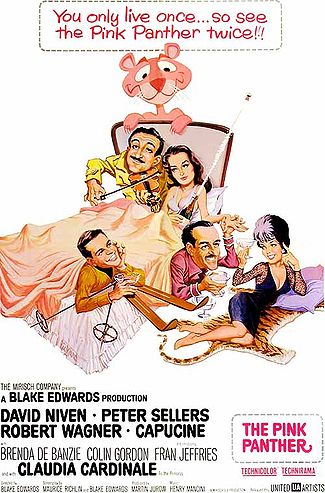
Pink_panther63I came into the Pink Panther with a bit of prior knowledge about the franchise and Henry Mancini’s legendary theme music. In all honesty, the first film I ever saw in the series was A Shot in the Dark (1964). Peter Sellers‘ Inspector Clouseau is the undisputed star of that film which came out only a year later.

That’s why this initial installment from Blake Edwards was rather surprising, to begin with. This is a David Niven vehicle with him playing a modern Don Juan of sorts who also is a world renown thief known as “The Phantom.” He and his female accomplice have their eye on the equally well-known diamond christened the Pink Panther. It now is in the possession of a beautiful young princess (Claudia Cardinale), but the people of the country believes the diamond belongs to them. Into this seemingly serious story of theft and international relations waltzes in the ever-bumbling but good-natured Inspector Clouseau.

Sir Charles Lytton (David Niven) has his eyes on Princess Dala, surveying her every movement. What he doesn’t know is that his young nephew (Robert Wagner) is up to some tricks of his own, and he flees the United States in search of his uncle. Clouseau leaves France with his lovely wife Simone (Capucine) and follows the princess to a ski resort to see if he can sniff out the culprit. They turn out to be a lot closer than he realized.

It’s during a chaotic masquerade ball when the diamond is in jeopardy, with several costumed apes having their eyes on it. The bumbling Clouseau clumsily tries to set a trap, and yet he unwittingly stumbles upon the culprits leading to a chaotic car chase. In fact, The Pink Panther has a rather odd ending with the culprits getting away and Inspector Clouseau getting the blame. Don’t be too worried, however, because Sellers brought the character back numerous other times.

Despite being initially relegated to a supporting role, there is no doubt that Sellers steals his scenes with his ad-libbing and numerous brilliant pieces of slapstick. He might be stepping on his Stradivarius in the dark or getting his hand jammed in a beer stein.  It’s all the funnier when everyone else is playing the scenes relatively straight. There were some other humorous sequences of deception as the culprits try and pull the wool over the Inspector’s eyes. It’s not all that difficult because he’s an utter buffoon. But lovable. Did I mention that?

3.5/5 Stars

Phantom Lady (1944)

PhantomladyThe film uses the motif of a mysterious lady who cannot be found as the jumping off point for this Film-Noir. It is this so called phantom lady who Scott Henderson (Alan Curtis) meets at a bar after having a spat with his wife. They lift each others spirits and part ways. Returning home, he is met by the police inspector (Thomas Gomez), who found that Henderson’s wife was strangled to death. Scott is the prime suspect and now he needs his alibi which seemed so airtight before.

She truly has vanished and no one remembers her so Henderson is on the verge of the death penalty. It is his smitten secretary Carol (Ella Raines) who takes up his cause. She retraces his steps interrogating a bartender and wheedling information out of a puny drummer (Elisha Cook Jr.). Soon an old friend (Franchot Tone) of Scott’s returns from South America and everything gets a little more interesting.

Phantom Lady stars a cast of only a couple recognizable names, however Robert Siodmak does a decent job at making this noir interesting and it is certainly worth a watch.

3.5/5 Stars

Review: Rear Window (1954)

Hitchcock_stills_0006_rear-windowWho in their right mind would make a film that takes place in a courtyard? Rear Window has always been fascinating from a technical standpoint, and Alfred Hitchcock is certainly not “The Master of Suspense” for nothing. He uses the confined space of a single Greenwich Village courtyard with an incapacitated individual to truly build the tension to immeasurable heights. The events within the film are often highly bemusing as Hitchcock has a wicked sense of humor, whether Jefferies is trying desperately to scratch that itch or the conversation turns morbid as he tries to eat breakfast.

The script has so many great little moments of back in forth repartee; some supplied by the always dynamic Thelma Ritter who plays the nurse with a lot of advice and opinions about rear window ethics: “We’ve become a race of peeping toms. What people ought to do is get outside their own house and look in for a change. Yes, sir. How’s that for a bit of home-spun philosophy.

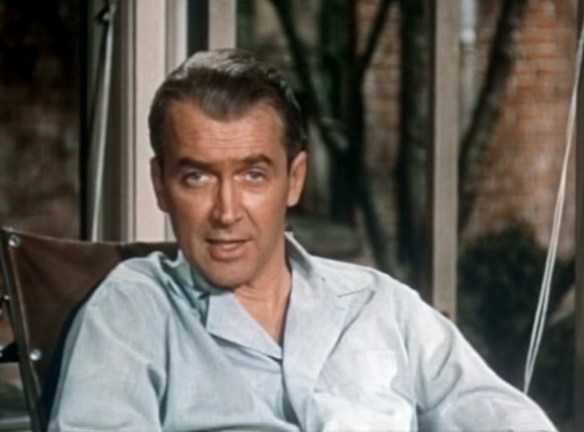
James Stewart is always a pleasure, but this time around he is perhaps at his most constrained as famed photographer L.B. Jefferies, who is laid up in his apartment for weeks on end with a leg in a cast. He got the injury thanks in part to his last big photo shoot where he ran in front of an oncoming race car. With nothing better to do, he spends his idle moments people watching and getting to know his neighbors. That’s one way to put it at least. As an actor, Stewart is stuck and relegated to conveying his whole performance through his gaze and the dialogue he speaks to those few who come in and out to see him. Most of what he’s doing is simply looking across the way and yet it works.

His neighbors are as follows:

There’s Ms. Torso who is an aspiring dancer and always the target of many men. There’s Ms. Lonelyheart who never can find the love she so desires. A washed-up composer spends the entire film trying to figure out his newest project (even getting a visit from Hitchcock himself). There are the newlyweds who hardly ever leave their bedroom because they’re doing something… Then, comes the older couple on the second floor with a cute little dog and the sculptor who lives below.

Most interesting of all is the couple directly across the way from Jefferies’ because that’s where a long-suffering husband and his wife live. All seems normal, to begin with, however, Jefferies begins to have his suspicions thanks to circumstantial evidence and no sign of Mrs. Thorwald. His first thoughts immediately shoot to murder, but it seems highly unlikely. Day and night he continues to watch seeming to get more evidence, only to have his theories crushed, and then gain new hope through more evidence.

James_Stewart_in_Rear_Window_trailerThe interesting part is that as an audience we are fully involved in this story. We see much of the picture from Jefferies’ apartment, because there is no place to go, and so we stay inside the confines of the complex. In this way, Hitchcock creates a lot of Rear Window‘s  plot out of actions occurring and then the reactions that follow. We are constantly being fed a scene and then immediately being shown the gaze of Jefferies. It effectively pulls us into this position of a peeping tom too. Danger keeps on creeping closer and closer as he discovers more and more. The narrative continues to progress methodically from day to night to the next day and the next evening.
In the climactic moments, he finally faces the man who he always looked in at from the outside and yet by the end the roles are reversed with Jefferies space being fully invaded, and yet he can do little to flee, because of his cast. Hitchcock cuts it in such a choppy and chaotic way which breaks with the smooth continuity of the rest of the film, but it works so wonderfully in stark juxtaposition.

This is one of the main appeals of Rear Window because it has this Hitchcockian story of murder, mystery, and suspense. However, I am constantly eager to revisit this story, since there are so many other intricacies that are of interest.

Although the film uses a score by Franz Waxman, the majority of the sounds heard are diegetic and they either are street noises or music wafting around the courtyard from one of the apartments.  Also, there is only one small outlet to the outside world. At times, it becomes fun to survey what is going on whether it is kids playing on the street corner or cars passing back and forth. It builds this sense of realism suggesting that this world that has been created is larger than this one set full of apartment buildings.

Another important element is themes of romance and love. Jefferies comes into the film with issues in his own love life. His girl is the elegant and refined Lisa Fremont (Grace Kelly), who seems perfect, too perfect in his estimation. In his mind, they just don’t seem compatible enough, and he cannot see marrying her. It’s something they have to work through because she truly loves him.

Really every character essentially has a different outlook on love and different struggles, because romance is never an easy thing. Like the lyricist’s song, it is so often fragmented, but in their case, Jefferies and Lisa seem to figure things out just as the song finally gets finished. The moment where you can see it in Jefferies’ face that he is both impressed and worried for Lisa’s safety seems to be the time when things change. He realizes his love for her since she is very dear. He quits his thinking and his analyzing of their relationship, as gut-wrenching emotions take over when she is caught. In a sense, he listens to Stella’s earlier advice: “Look, Mr. Jefferies, I’m not an educated woman, but I can tell you one thing. When a man and a woman see each other and like each other they ought to come together – wham! Like a couple of taxis on Broadway, not sit around analyzing each other like two specimens in a bottle.”

Wendell Corey, in his supporting role as Jefferies’ friend and the police detective, is a man who can be a skeptic and still prove his loyalty as a friend. They can be at odds and still poke fun at each other with mutual affection. It feels real. Raymond Burr as the villainous Lars Thorwald works well too because he is certainly an angry, unfriendly grouch, but he does not seem altogether evil. It shows how easy it is for the lines to be blurred.

rear-window-first-shot-of-gkAbove all, Grace Kelly shines opposite Jimmy Stewart. There’s no one quite like her, so elegant, eloquent, with a touch of playfulness and adventure. She is willing to fight for her man and even go out on a limb for him (ie. breaking into Thorwalds’ apartment). One of the film’s most extraordinary images, out of many, has to be when a shadow covers the face of Stewart as he rests. Then there is a close-up of Kelly, her face slowly descending towards him. It’s hard to forget and for the rest of the film, she attempts to not let him forget her.

It’s not often easy for me to make statements like this, but Rear Window has to be close to my favorite film of all time. Yes, I said it. It never gets old for me, and I pick out new things every time. It’s more than just a mystery thriller. Hitchcock made it a technical marvel that is also steeped in themes of love and ethical questions. The players are the best of the best from James Stewart, to Grace Kelly, to Thelma Ritter, all down the line. It’s at times deliberate, but never boring, completely immersing the viewer into this drama as a firsthand witness. It’s the type of cinema we just don’t get every day because it has everything and it cuts to the core — to the most visceral level. That is the sign of cinematic greatness.

5/5 Stars

Zodiac (2007)

Zodiac2007PosterAfter watching this film I was certainly intrigued but I thought that it was a rather slow film in many respects. However, when you think about it this film is really intriguing. One reason is that as a procedural the film utilizes this pacing to its advantage as it covers the events of the case.
Another reason is that Zodiac is based on the true events that took place in Northern California in the late 60s and early 70s. Furthermore, the culprit was never truly found even if there are a number of suspects who seem the most probable based on circumstantial evidence and testimony.

The point is we still don’t know who the Zodiac killer is even at the end of the film and this adds to the legend, mystery, and intrigue that surrounds the whole story.

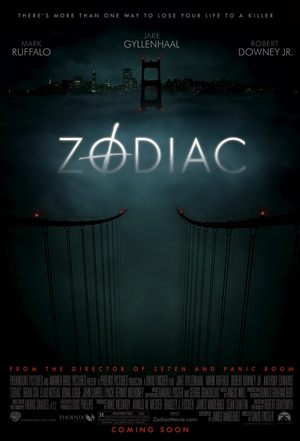
Most definitely deserving of a movie adaption, director David Fincher, Jake Gyllenhaal, Robert Downey Jr., and Mark Ruffalo, make Zodiac work as a engaging albeit plodding procedural.

4/5 Stars

To Catch a Thief (1955)

800px-To_Catch_a_Thief3Robert Wagner certainly knows It takes a thief, to catch a thief. The same goes for Cary Grant in this film which has him playing reformed cat burglar John Robie who is suspected for a series of thefts that have struck the French Riviera.

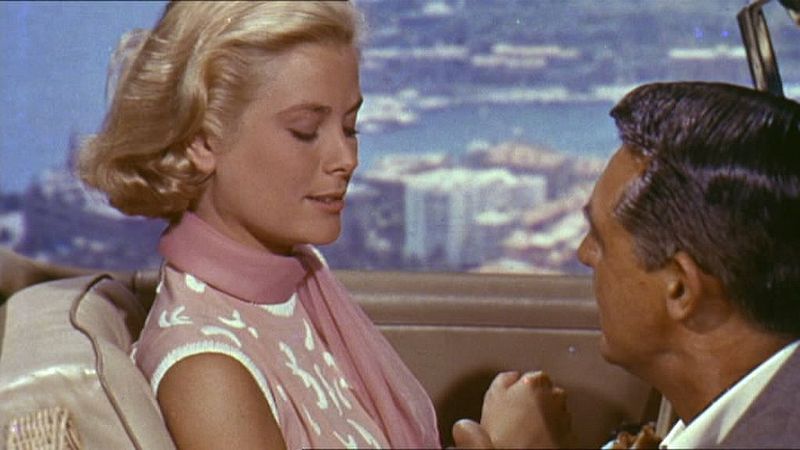
However, he knows he is not the culprit so he must clear his own name by catching the cat himself. The police want to nab him, his old French resistance buddies suspect him, and a beautiful young American woman (Grace Kelly) traveling with her mother is sure he is the cat. With a little help, mixed with some passionate romance, he is able bring some closure and get the girl.

That is all fine and dandy if you wanted a typical romance thriller. However, no one does it as well as Hitch. He somehow wonderfully balances the little bits of humor with his darker moments of suspense.  Jessie Royce Landis helps bring that comedy whether she is putting her cigarette out in some eggs or holding her book upside down as she commits a little white lie.

Hitchcock certainly had better films, but this one is so fun and it has the same glamorous Hollywood look as Hitchcock’s Man Who Knew Too Much (1956) with location shooting and vibrant colors.

Cary Grant and Grace Kelly make quite the pair, perfectly matched with the French Riviera in all its glory. I am convinced that Grace Kelly is and always will be one of my favorite actresses, period. Any era, any genre. Her name sums up her persona, because much like Audrey Hepburn, she has an extraordinary grace in how she carries herself. She can also be quite mischievous as well in her role as Francie. She is sure to set off fireworks.

4/5 Stars

The Grand Budapest Hotel (2014)

35f8c-grandbudapest3

The farthest Eastern boundary of the European continent makes the perfect landscape for a new addition to the quirky Wes Anderson canon. But more on that later. First our story.

It gains inspiration from the writings of forgotten Viennese author of the 30s and 40s Stefan Zweig. In fact, the author’s own plot device is used in this story of friendship, love, and murder. An inquisitive writer (Jude Law) from the 1960s becomes intrigued by the aging proprietor of the Grand Budapest Hotel Zero Moustaffa (F. Murray Abraham).

The rather mysterious figure is glad to tell his story and how he came to acquire the iconic hotel. And that’s where our real story begins, back in 1932, with concierge and small time celebrity M. Gustave (Ralph Fiennes). He is a dying breed of a man, full of culture, a bit effeminate, and known to wine and dine older patrons. He also has an immense affinity for poetry.

It was under his leadership that the young, stoic bellboy Zero got his start. What an exciting beginning it was.  One of Gustave’s most faithful patrons, Madame D (Tilda Swinton), dies suddenly and he is bequeathed the priceless painting Boy with Apple.

The family of the deceased is in an uproar led by belligerent son Dmitri (Adrien Brody). Soon Gustave has become the strangest of fugitives as he is wanted for the murder of the old lady.

During that time, young love springs up and Zero meets the love of his life Agatha (Saoirse Roman), a spunky baker who returns his affection.

Now the imprisoned Gustave takes part in an escape attempt a la Le Trou except this rendition is successful to a degree. Faithful Zero meets up with his mentor, and Gustave turns to the only ones he can. The concierges from all the surrounding area. They oblige, getting the two fugitives away, but soon Dmitri’s cold-blooded assassin Jopling (Willem Dafoe) is on their tails at a local monastery.

War is imminent and back at the Grand Budapest things do not look promising.  The ever fearless Agatha agrees to go fetch Boy with Apple, but she is soon spotted and pursued by the ever brutish Dmitri who tries to use his gun. That’s not a smart thing when all the rooms are full of quartered soldiers and a chaotic gunfight ensues.

In the aftermath, a second will is uncovered that makes M. Gustave the sole owner of the Grand Budapest and many other possessions that Madame D owned. In a Deja Vu moment, Gustave and Zero ride the train once again before getting boarded and questioned. Always the gentlemen, Gustave defends Zero who is targeted for his immigration status. It was in that way the story ends and returns to the young author and elderly Zero Moustaffa.

He never could bear to give up the Grand Budapest despite the toll of Communism. It’s not because of Gustave, but his dear Agatha who died only two years after. It’s his only link to the happiest times of his life.

What The Grand Budapest Hotel ends up being is an odd mix of black comedy and romantic sentiment all wrapped up in an Anderson world.

His shots are often framed symmetrically and muted pastels abound as well as scaled miniatures, creating his always distinctive mise-en-scene. He is also a fan of a smooth moving camera often involving zooms.

Anderson is obviously a student of cinema and his film at times are reminiscent to 30s fair such as Grand Hotel and The Rules of the Game. He also channels another famed Viennese Ernst Lubitsch who was a master of highbrow romantic comedies.

Hotel also boast a superb cast comprising most of Anderson’s stock company. If there’s anyone who has been in more than one of his movies, they are probably in this one, even for just an instant.

So given the normal Wes Anderson flair or eccentricities, this film is visually pleasing and quite entertaining. It is a worthy follow up to Moonrise Kingdom, darling.

4/5 stars

L’avventura (1960)

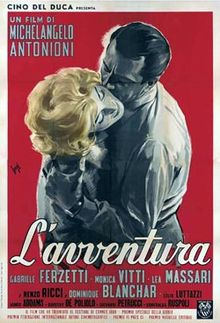
L'avventuraSmallL’avventura is one of those films that it is difficult to make a cohesive review for. If you are watching it purely to be entertained, you have it all wrong, because that is not its main purpose. Its greatest attribute is the special place it has in the pantheon of film art.

It is a film about a group of high society adventurers who go on a boat trip through some islands, only to have a woman passenger literally disappear, practically into thin air. Her boyfriend and her best friend search for her in the ensuing days, only to fall for each other, and that is about it. This is, of course, the most superficial level possible.

L’avventura is quite interesting visually and I wish I could have seen it on the big screen. The reality is, oftentimes, not a whole lot is happening, but it causes you to actually focus on the images in the frame. Michelangelo Antonioni gives us numerous settings all over Italy, and most have something to do with the wanderings of natural beauty Claudia (Monica Vitti) or her companion Sandro.

Anna (Lea Massari), despite her early importance, is hardly in the film. She is only a wisp in the wind and the mystery surrounding her is of lesser importance. The outcome is what matters as her friend and boyfriend become lovers. Theirs is the relationship that is explored as it develops, evolves, and becomes fully tested.

In the final moments, Antonioni toys with us, suggesting just possibly that Anna might be in the picture again. In fact, he must have a very cruel sense of humor indeed. Here in L’avventura as well as Blow-up (1966) he waves a mystery in front of our nose and leaves it unresolved. It is absolutely maddening, in some respects, and yet he makes us look at something else altogether. He also had the gall to name a film with a meandering plot like this L’Avventura! The nerve of it all, and yet I respect him for it because it messes with our conventions and forces us to be uncomfortable.

It is understandable that this was a polarizing film at Cannes in 1960, and I can only imagine that it has the same effect over 50 years later. One thing is for sure. This is no Gilligan’s Island with a three-hour cruise set in Italy. There is a lot more to it than the plot. Not my favorite adventure, but I respect its pure audaciousness of form.

4.5/5 Stars