
 “You can’t just do anything at all and then say ‘forgive me!’ You haven’t changed a bit.” ~ Colette
The prospect of watching Love on the Run saddened me and not for the reasons you might expect. Not because it’s noted as the weakest film in Truffaut’s famed Antoine Doinel series, although that it is. Not because it utilizes a clip show rather like a lazy sitcom as some will undoubtedly note (although this does actually give way to some rather entertaining reminisces as Antoine crosses paths with two old acquaintances). And it’s not even because this is the last film in the series and Truffaut never got around to any more installments before his death in 1983. Though that is sad.
The truly heartbreaking thing about this film is not even the fact that Antoine and Christine (Claude Jade) are getting a divorce although that is at the core of it. It’s that Antoine, who has long been the focal point of these films with his certain brand of charming charisma, really has not changed a great deal.
Time and time again, his superficial relationships with women are explored and time and time again his self-destructive habits hardly seem playfully entertaining but if you want the most honest answer, it’s all rather disheartening.
He has a new girl who we meet in the opening credits. Her name is Sabine. She’s young, radiant, very pretty and works in the local record shop. If we didn’t know any better we could easily make comparisons between her and Christine.
We see that little boy from 400 Blows and even that same young man looking to win the affection of a cute brunette named Collete. However, now a few years down the road, none of that panned out. He’s terribly selfish, undeniably a cad and always trying to say he’s sorry to save face. Sabine says it well when she calls him a pickup artist (You sure have a strange idea about relationships. You seem to only care about the first encounter. Once they’re together it’s all downhill).
However, if we look again we remember that Doinel’s home life was hardly a prize, schoolmasters were unfeeling and his mother passed away — the only real family he had in the world.
Maybe,  Antoine Doinel is a character who thinks only in the cinematic and it is true that he often functions in a bit of a faux-reality. He seems normal but never quite is. He seems charismatic but we are never won over by him completely. Still, we watch the unfoldings of his story rather attentively.
Like all the women who he tiptoed around with, as an audience, we have liked him but never truly loved him — an important distinction to make. And coincidentally, we also see right through him. Perhaps because he’s often too much like us or other times not enough like us. It’s hard to put a finger on which one it is exactly.
We leave the film essentially where it began. Antoine has once more been scolded by his girl and made up. It’s difficult to know quite precisely how to feel about that. Love on the Run is worth its nostalgia, woven in between the most recent moments of Doinel’s life. While his character is trying, he is still strangely compelling. But at this point, it’s hard to know what to do with him. Nevertheless, Francois Truffaut was unparalleled in the continuous narrative he was able to craft — flawed, personal and most certainly memorable.
3.5/5 Stars
 Why do you watch me? -Magda
 And despite the clandestine nature of his activities he still somehow remains innocent in the eyes of the beholder. Daily he works at the post office behind the glass and in the evening he studies languages. But he’s continually drawn to this lady across the way. He feels like he knows her. He wants any pretense to meet her and so he creates a bit of fate anytime he can.
 However, often times sex and love become synonymous terms and that is the underlying tension between Tomek and Maria Magdelena’s relationship. Though innocent, he wants true love, a love that transcends a simple physical act and is summed up with affection, intimacy, and an inherent closeness. He is taken with her beauty certainly but even more so he is invariably alone. Meanwhile, she is so enraptured with sex and denigrating such a grand (and admittedly messy) thing as love, to a simple physical act. She can’t understand this wide-eyed boy and his delusions. She’s ready to open him up to the way the world actually turns. And her callousness ultimately crushes Tomek’s tender heart. She broke it not by simply rejecting him, because this is a ludicrous love story, but truly obliterating any of the naive aspirations he had for love.
 At face value, Model Shop is an ordinary film of little consequence but look a little deeper and it’s actually a fascinating portrait of the L.A. milieu in 1969. Part of that is due to the man behind it all.
 Lou Gossett Jr. What a performance. He imprints himself on our brains just like the new recruits he berates, pushes, and toughens on a daily basis. He’s inscrutable. We want to hate him. We want him to get his comeuppance. Yet in the end, we cannot help but appreciate him. We are just like one of his recruits and that’s, in part, why this story works at all.
 Watching An Officer and a Gentleman, it is rather amazing that it succeeds as part romance, part war drama since all its action takes place at an air force cadet school. They haven’t even reached the front yet. There are no explosions or bombs bursting in air. It even shares similarities with Fred Zinneman’s star-studded From Here to Eternity (1953) years before. But that story had far more star power and a climatic event like Pearl Harbor to build the story around. Here there’s nothing quite like that. But it’s not really needed. We are reminded that mankind is inherently interesting and when you throw a bunch of them together under duress it’s a formula for heightened emotions.
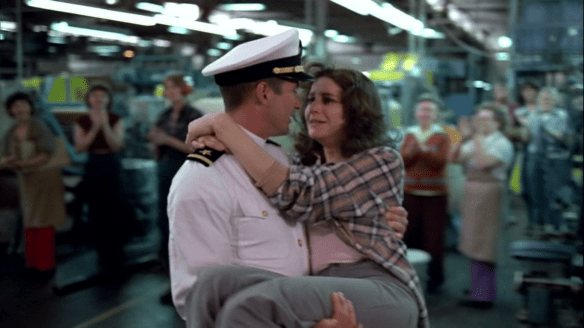 Certainly, the film functions because it has all the necessary components, a rebellious hero played by Gere, troubled pasts, innumerable odds and the like. However, breaking the film down to its simple plot points hardly gives the film the credit it is due. There are so many intangibles when you watch something on the screen that really gets to your gut. It’s not necessarily manipulation on the part of any one person, director, screenwriter or otherwise. It’s simply the emotional clout that the medium of film is capable of.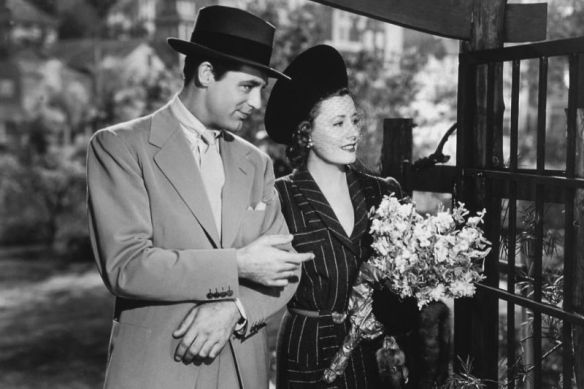
 Children believe what we tell them. They have complete faith in us. They believe that a rose plucked from a garden can plunge a family into conflict. They believe that the hands of a human beast will smoke when he slays a victim, and that this will cause him shame when a young maiden takes up residence in his home. They believe a thousand other simple things. – Jean Cocteau
  The fact that Miracle on 34th Street and this film came out the same year seems to suggest that there was something special in the air of New York City that year. It was a magical place, specifically during the Christmas season with Santa Claus going on trial and winning, while tramps helped reform millionaires. Admittedly, It Happened on Fifth Avenue is one of those films that could easily come under fire for its implausible plot, its unabashed sentiment, and any number of other things.
 Rainbows, the soft misting of waterfalls, and honeymooning couples going through the tunnel of love. It hardly feels threatening at all, but that’s what makes film-noir so delicious. As the film style most reflective of the human condition, it proves that the dark proclivities and jealousies of the human heart can crop of anywhere–even a gorgeous tourist trap like Niagara Falls.
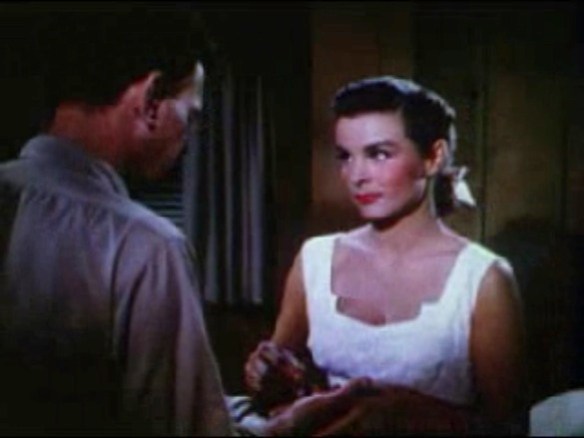 Without a question, Jean Peters becomes our favorite character as Polly, and it was an eye-opening for me personally to see her in a role so vastly different than Pickup on South Street. I had pigeon-holed her, rather erroneously as such a character, but Niagara shows a more tempered side to her persona that felt more representative of her as an actress. Max Showalter plays her husband, the genial and oblivious Ray Cutler, who takes his lovely wife on a long overdue honeymoon, only to have it totally ravaged thanks to the Loomises.
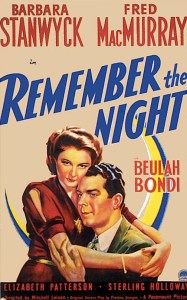 I find that many of the best Christmas movies aren’t really about Christmas at all — at least not in the conventional sense that we’re so used to. Not trees or presents or lights or even holiday sentiment although those might all be there.
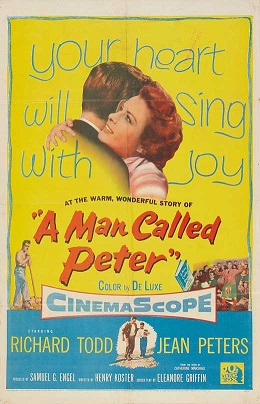 The film’s tagline reads, “Your heart will sing with joy” and that about sums up A Man Called Peter.
