Elevator to the Gallows (1958)

elevatorto3This affair like a Racine tragedy will be over in 24 hours

Elevator to the Gallows was the debut of Louis Malle, a man who found success in both his native France and the United States. In truth, it’s an easy bit of delectable icy noir to enjoy, because it goes down quite effortlessly. From the cold open this film remains ridiculously cool, boasting a score from jazz visionary Miles Davis that dances and sways in sensual rhythm with the images onscreen. Recently I’ve gone through somewhat of a minor Jazz epiphany and Davis was a major instigator of that.

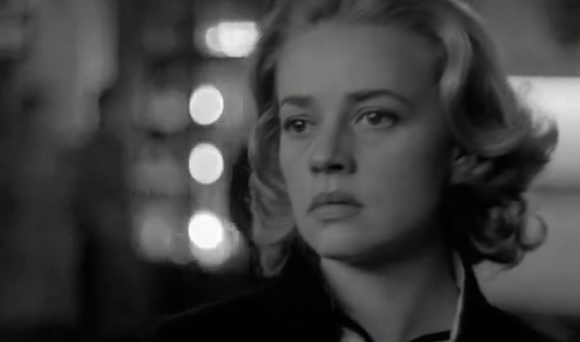
For all intent and purposes, this is the film that made Jeanne Moreau into an icon to be noticed. She’s not the same type of beauty as Brigitte Bardot or Catherine Deneuve, but this film shed some light on why she stands out among the best of France’s leading ladies. Really she’s the only character who we get inside the head of — we hear her thoughts as they drift in and out of her mind. Also, out of everyone, Malle allows his camera to dwell the longest on the face of Moreau with few distractions. We see her wander the streets listlessly, checking her complexion in windows, and somberly gliding upstream as cars speed past on all sides. It’s as if she’s constantly living in a dreamy alternate reality that is only broken when she must actually interact with the humans that inhabit the space that exists around her. But how did she get here?

elevatorto4Back to that cold open. Florence is communicating with her lover Julien, as they put their plan into action. It all happens so fast as the credits flash on the screen, but soon enough we gather that he plans to kill her husband, so the two of them can finally be together. So, in other words, it feels like some kind of love triangle with Florence Carala. As a former paratrooper deployed in Indo-China and then Algeria, Julien is more than capable of carrying out the task. It requires scaling a building on a rope, taking the shot to finish off the condescending war profiteer Mr. Carala, framing it as a suicide, and then making a getaway without anyone being wise.

All the pieces fall together, but Julien forgot one thing. The rope is still hanging there! He rushes up to fix his mistake, but on the way down another employee unwittingly shuts down the lift, and now Julien is stuck in the elevator with no easy way to get out of his jam. He is sure to be caught. It’s a tense spot he’s in, but really that’s not where the heart of the story lies because Julien remains where he is for much of the film.
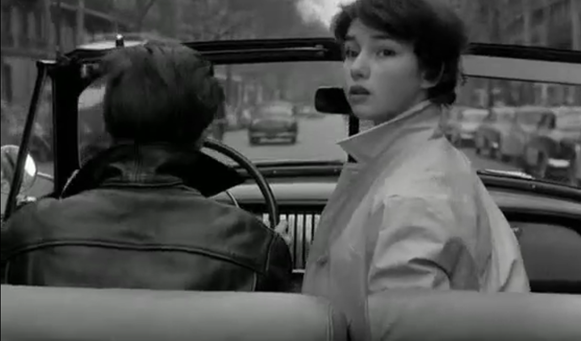
elevatortoThe other arc feels closely tied to The French New Wave Movement as an angsty young man decides to take Julien’s sweet ride for a spin and his reluctant girlfriend takes part in their little escapade. Their final destination is a hotel where they decide to register as Mr. and Mrs. Julien Taverner because it’s bound to be a good bit of fun. They even get chummy with a pair of German tourists and the champagne flows freely.

Meanwhile,elevatorto1 an anxious Mrs. Carala begins to listlessly comb the streets trying to gather what happened to her lover. Where did he go? Julien
still sits in the elevator trying to rig a way out as the cigarette stubs pile around him. The good times of young lovers Louis and Veronique soon turn sour when the boy loses his temper and with that, all rationality goes out the window. As Godard once quipped all you need for a film is a girl and a gun, and in this case, it rings true.

Now Julien is wanted for a murder he did not commit and is still the unknown perpetrator of yet another murder that has yet to be uncovered. When he finally breaks out of his prison the following morning, he inadvertently walks into a big heap of trouble. But it is Louis and Florence, who end up back at the scene of the crime where a dark room becomes their downfall.

4.5/5 Stars
Late Autumn (1960)

lateautumn1Yasujiro Ozu has the esteem of being christened “The Most Japanese Filmmaker.” It’s certainly a high honor, but at first, it can feel rather counter-intuitive because after all, such a great master of cinema cannot be considered average or a composite in the scheme of Japanese film history. And I don’t think that is what this title is trying to get at. The fact is that Ozu, over time, really experimented with the conventions written by classical western filmmakers and he built his own unique aesthetic that is quite evident later in his career. That being said, his film’s are very Japanese in the way they interact with and dissect the culture that he comes out of, and I think that is paramount to understanding and ultimately appreciating his work.

It’s no different with Late Autumn, Ozu’s penultimate film, a social-familial drama that shares a great deal of similarity to some of his earlier work. The fact is, he’s constantly returning to these ideas of marriage, family, generational differences, and the underlying etiquette that is so prevalent in Japan and Asian cultures in general. But of course, much of what he examines is universal and that’s what allows his films to remain timeless.

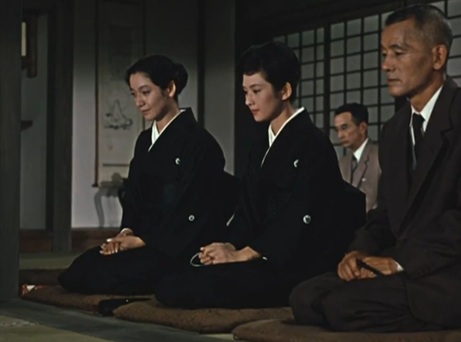
With Late Autumn, in particular, it’s easy to marvel at how the director frames his space because he seems to have tremendous spatial recognition. He’s confident in his aesthetics which he highlights with colors and axis lines, which are then further embellished with human subjects. Not many directors are brazen enough to show us an empty room, a hallway, or the mundane facade of a building, but Ozu is so self-assured in his composition. They are too long and occur too often to be establishing shots. He wants to continually convey to us the space that his characters inhabit and he’s meticulous. Everything is placed with pinpoint precision just the way he wants. And it shows.

On a basic level, Late Autumn can meld nicely with many of the director’s other works also based around the seasons. In this color installment, three adult men gather for the funeral of one of their mutual childhood friends. It’s a sad occasion as they wistfully remember the good old days when they were young and in love. But as a service to their deceased friend, they agree to find a husband for his sweet sunshine-faced daughter Ayako (Yoko Tsukasa). However, they also worry for his widower Akiko (Setsuko Hara), who is equally beautiful, since the years have been very good to her. What follows is the typical fumbling attempts at matchmaking, trading manners, and so on. When Mr. Mamiya inquires if he should ask for a young man’s picture and resume, we assume it’s a joke, but he’s quite serious.

What makes Autumn different than earlier classics like Late Spring or even Tokyo Story, is that it shows the next generation of young people.  The kids embrace the rockability of Elvis while reading Mickey Mouse cartoons. The young adults are folks who have grown up in the specter of WWII. They want to leave behind the world of useless honor and restraint.They speak their minds and show their discontent.

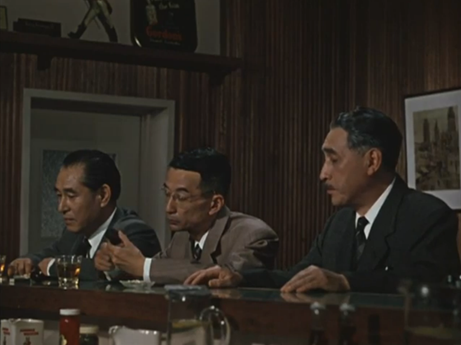
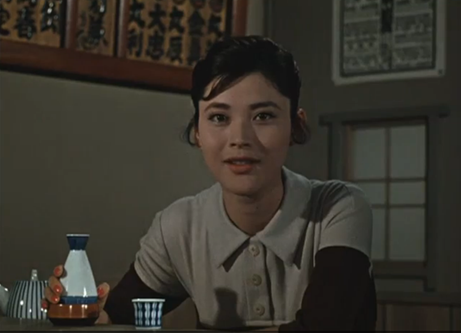
lateautumn2I enjoy the light touches of humor injected into this film because the three chums sit around the bar making observations with a bouncy score that seems more at home in a Tati comedy. Sometimes they’re genuinely trying to be funny, but more often it’s hilarious because they’re actually so dysfunctional. They take on this task of watching over their friend’s family with all seriousness, but they get sidetracked by their own desires and personal concerns. They stir up rumors, make waves, and ultimately cause a lot of trouble. Everything gets muddled and it’s the blunt and frank assertions of young Yuriko (Mariko Okada) that points out their failures. She sees how they have made a mess of things and calls them out for it. Perhaps it feels abrasive, but I think they like her for it and the audience does as well. She’s a reflection of this new generation that’s not looking to mince words or hide behind social etiquette. They’re fed up with that type of lifestyle. In fact, Yuriko is the one who says marriage is the worst. The ideal would be if love and marriage always went together, but they don’t.

lateautumn3Thus, although the relationship between Ayako and her mother takes center stage as the film progresses, Yuriko is extremely pivotal. It’s the lives of the first two women that are affected by the unintentional bungling of these men, but it is Yuriko, who signifies change for the better. In many ways, this story feels very similar to Late Spring in particular, but the interest is not so much in original ideas as it is in re-imagining ideas. It’s a film for the 1960s where men are slowly losing their vice-like grip and societal norms are changing as women move to the forefront. But what remains are the suggestion that it’s alright to push back against societal pressures, and interpersonal relationships are delicate flowers that must be cultivated with care. So easily they can be trampled and destroyed. It takes a certain type of person to acknowledge their own faults while persistently loving those around them.

This is the utmost compliment, but in many ways, Setsuko Hara reminds me a great deal of my own grandmother, a woman who radiated a genuine kindness that was apparent to everyone who walked through life alongside her. Bless their souls. Both of them.

4.5/5 Stars

Hannah and Her Sisters (1986)

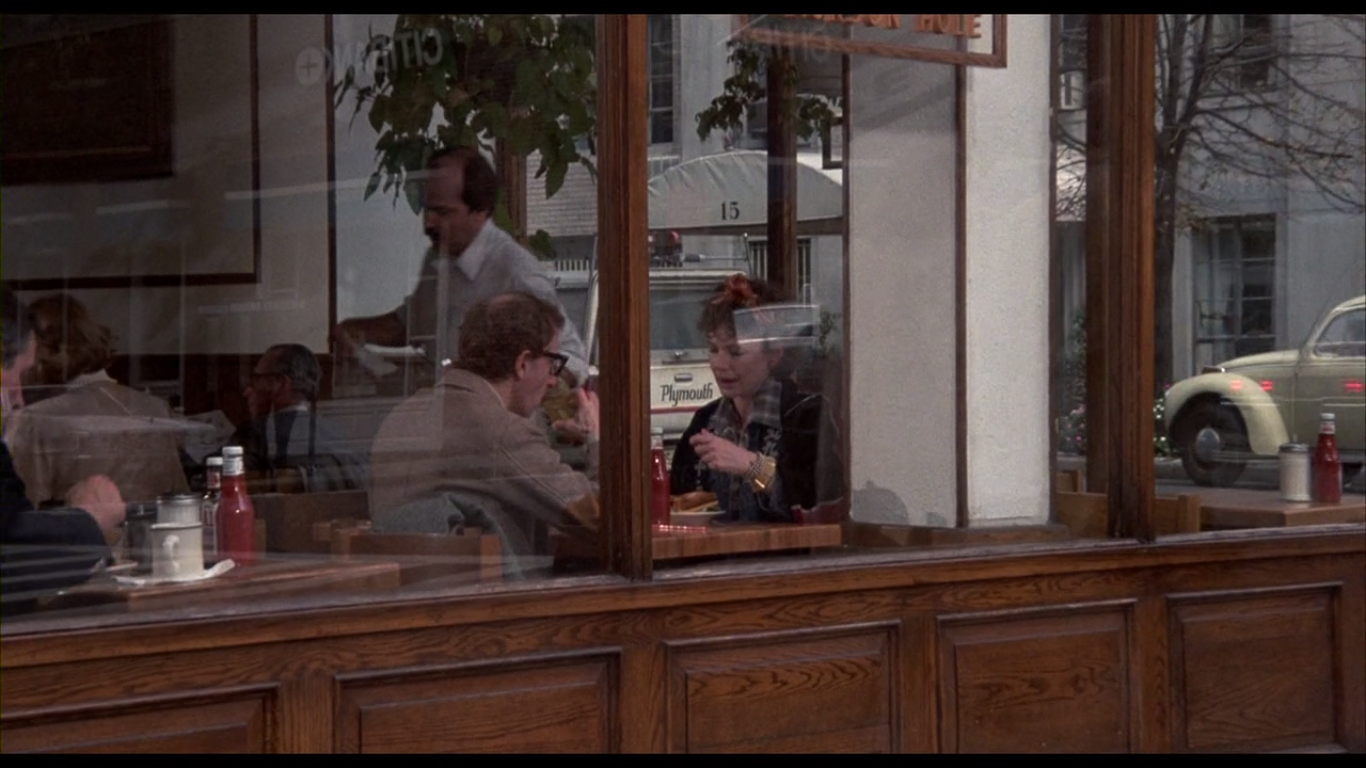
hannahand1Recently I was thinking about who I would characterize as favorite directors versus directors that I simply respect. In the latter category, I would stick the likes of Quentin Tarantino, The Coen Brothers, and Wes Anderson. Because truth be told, I do not always like or even enjoy all their films, but I can still appreciate them. They have their own unique artistic visions when it comes to making movies and that comes out of the fact that they know the lineage that they are derivative of. That’s something that cannot be taken lightly.

I think I would same the same of the work of Woody Allen, and he truly is a special icon of film. There’s no saying that his work is not original because each film bears his mark, but it also takes cues from the past.The utmost compliment I can give Hannah and Her Sisters is the fact that it might be one of my favorite Allen films thus far, behind Annie Hall. It does noticeably take cues from the likes of Bergman and Bunuel however, but that does not detract from its own charms.

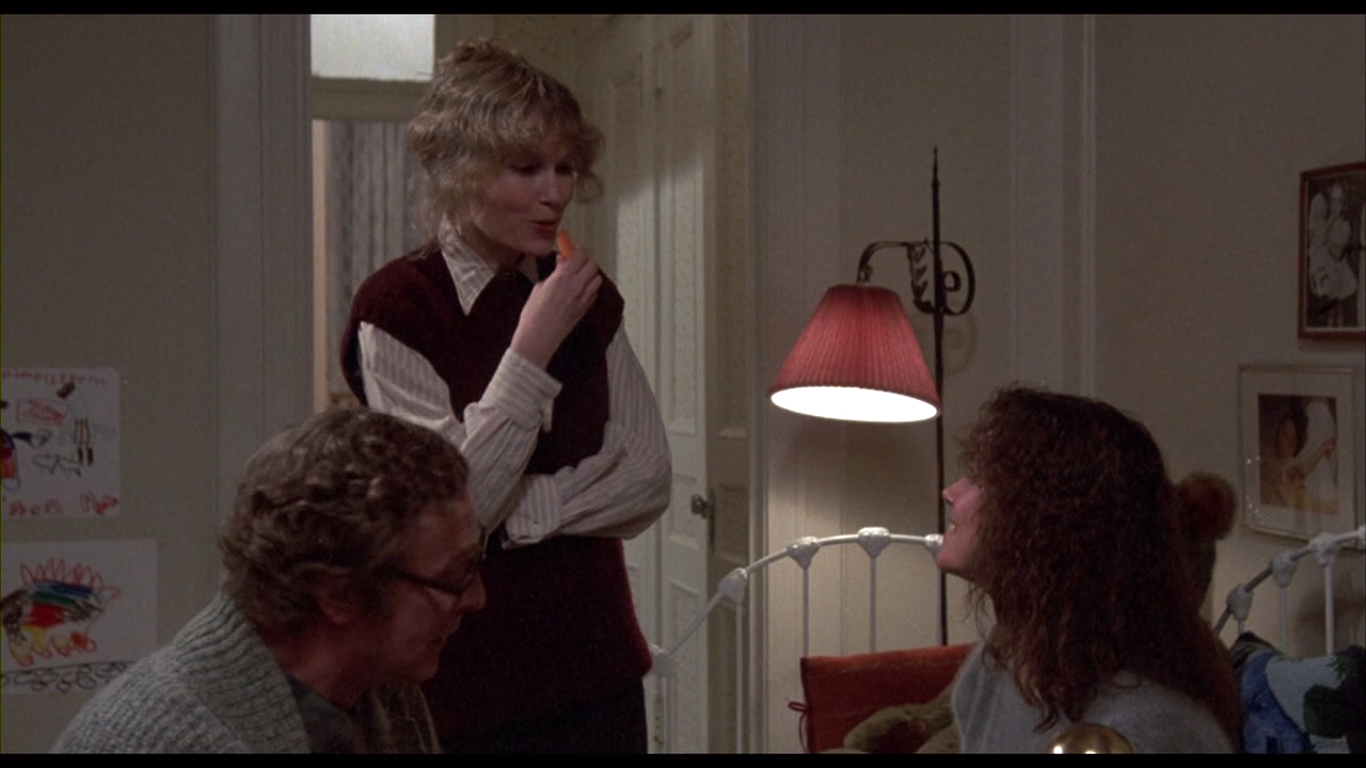
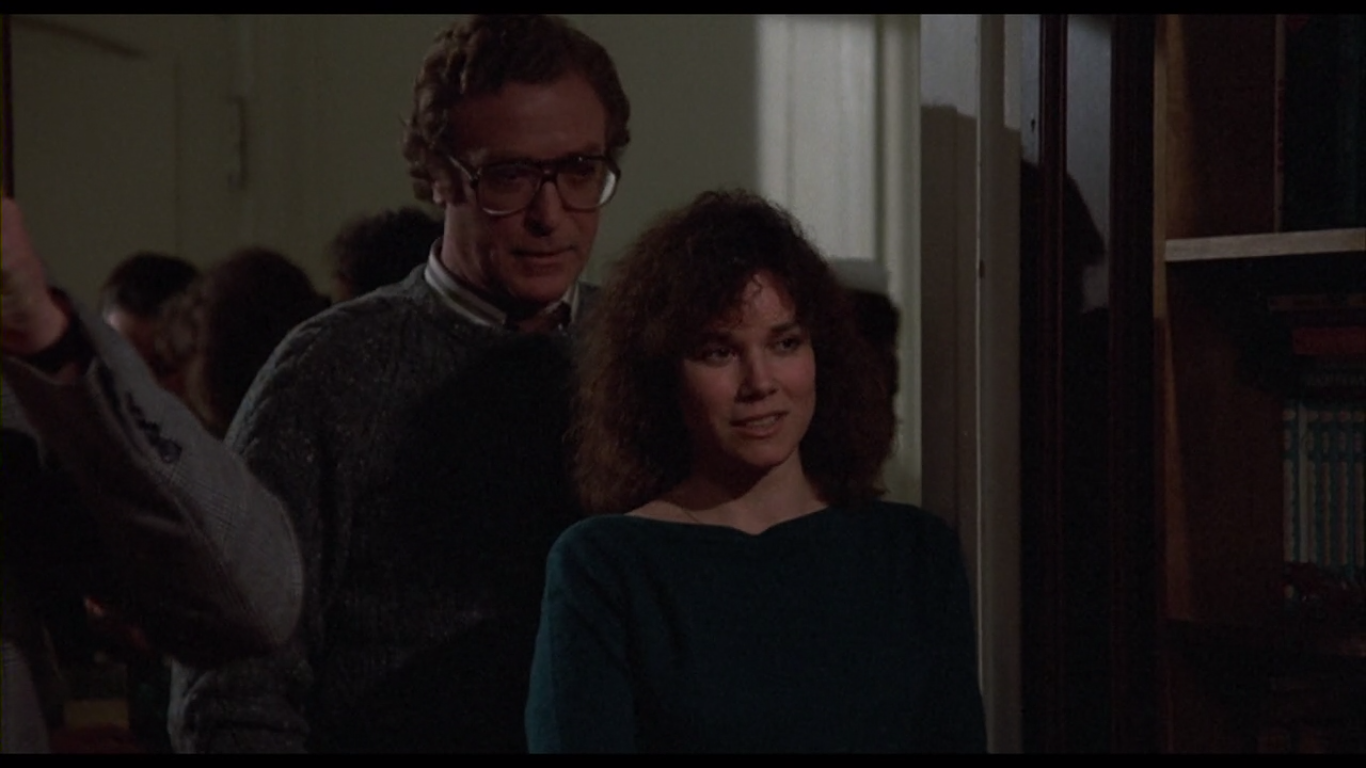
hannahand4It begins and continues throughout with rather arbitrary inter-titles written in white letters over a black background. But it’s the perfect embodiment of Allen’s style of writing to go along with his typically anachronistic scores that nevertheless elevate the charm of his films. What follows is an engaging storytelling set piece extended over three Thanksgiving dinners with Hannah (Mia Farrow) and her two sisters. Holly (Diane Wiest) is the aspiring actress, who has run a catering service on the side while fighting a drug problem and trying to figure out her love life. Lee (Barbara Hershey) is a natural beauty, who lives with an older intellectual named Frederick (Max Von Sydow). She has also unwittingly made a conquest of her sister’s respectable husband Elliot (Michael Caine), who nevertheless gets quite nervous in her presence.

This is a film about their families — their interconnected lives that constantly fluctuate and change dynamically with every passing month and holiday. Their lives go from the invariably awkward, to the tragic, and finally, find their perfect equilibrium. The voices inside their heads are constantly active with fears, thoughts, and desires.

hannahand5What’s perhaps most striking about this film is the great depth of the cast. Maureen O’Sullivan stars next to her real-life daughter. Carrie Fisher makes an appearance as Holly’s friend and rival. Even Daniel Stern, Julie Louis Dreyfuss, and Allen regular Tony Roberts pop up in various moments. Perhaps most spectacularly of all, Allen himself commands the spotlight as anxious hypochondriac Mickey Sacks. Essentially it’s the character that Allen always takes on, but in this case, he stuck himself in almost a B-plot. He gets his chance to swim in his fatalism, pessimism, and philosophical dialogues about God and religion. In fact, it is quite reminiscent of Bergman in this respect, but from a uniquely Allenesque perspective. His awkward jokes (eg. I had a great time tonight it was like the Nuremberg trials) make me crack a smile or let out a genuine chuckle in spite of myself. Bergman would never do that to me, but Allen enters that territory while going so far as casting von Sydow in a slight nod to his Swedish hero.

But really all of this is set to the greater backdrop of the familial drama. That’s where the meat and potatoes of this story lie and in this dynamic, there is a lot of genuinely great moments. One of the most memorable is also one of the most difficult when the three sisters gather together over lunch and their relationships seem to be falling apart in front of our eyes. As it goes with the passage of time, things eventually turn out okay and another holiday gathering comes. Each sister is content with where they’re at and so are their spouses. It’s probably one of the most upbeat Allen movies I can think of, if only it were not besmirched by his own personal life. But that’s a dialogue for a different time. After all, this film is really about Hannah and Her Sisters.

4.5/5 Stars

Claire’s Knee (1970)

claireskneeClaire’s Knee is a film made for color. Eric Rohmer’s other films up to this point had almost exclusively been black and white, but it’s as if he knew that his newest oeuvre deserved different treatment. It’s vast countrysides and glistening lakes abundant with flowers and fruits fill up our senses. We get to watch and see and experience the beauties of this oasis. And there is no music because the songs of the birds suffice.

Jerome (Jean-Claude Brialy) is a reserved but genial diplomat, who also pulls off his beard quite well. He’s taking a peaceful holiday at Lake Annecy as he prepares himself for marriage with his longtime sweetheart. Quite by chance, he bumps into an old friend named Aurora during a jaunt in his speedboat. Through her, he meets her landlady Madame Walter, the lady’s daughter Laura, and finally Claire, Laura’s older half-sister. It’s an increasingly interesting chain of acquaintances.

The course of the film follows the progression of the summer days signified by white inter-titles expressing the date and time. During these days Jerome, in a sense, willingly becomes Aurora’s “Guinea pig” for her next novel as they discuss love, life, relationships, desire, and the like. Early on, Aurora notices that young Laura has taken some liking in Jerome, and he good-naturedly pursues the relationship, to see what happens.

clairesknee2She’s a young girl who has some big ideas. Laura admits feelings for Jerome, but it’s seemingly only fleeting young love. She still has many years ahead of her, and yet her opinions on love and friendship are already forged. She’s willing to discuss them in depth with her much older counterpart. They take a hike through the mountains together, dance together on Bastille Day, but it’s not a romance. She moves on to a younger boy more fitting for her.

But that’s enough skirting around the uncomfortable. It’s the entrance of Claire that feels integral to the film, if not simply for the fact that the film’s title revolves around her. The fact is Claire is a beautiful girl, who intrigues and disturbs Jerome for the simple fact that her physical appearance is all he knows about her.

The moment he witnesses her picking fruit off a tree up above him, he cannot stop looking. He’s absolute powerless around her. She intimidates and casts a spell that mystifies him. The fact he wishes to touch her knee is hardly a thing to be taken all that seriously. By this point, we know that Jerome and Aurora are not all that serious. It’s almost as if they’re playing a game. And yet Jerome still earnestly wishes to touch Claire’s Knee.

In a moment of sincerity he even acknowledges he is drawn to thin delicate girls, but having a girl made to order would hardly be a recipe for true love. Because the fantasy could never equate to actual compatibility and joy for two individuals. The perfect moment does finally arrive, and it seems like Jerome can finally act out on his desire. He is caught in the rain with Claire and they must wait, taking refuge from the rain. He has news about her boyfriend that brings her to tears. In an instant, he caresses her knee, but soon enough all the desire is gone and it gives way to a good deed.

clairesknee3Thus, somehow Jerome maintains his good-natured personality despite his potentially disastrous relationships with the two girls. It’s as if he knows that inconsequential flings and fantasies can never measure up to true love. He heads off ready to marry his bride to be. We never get a feeling that this is some odd ploy to get a dramatic rise out of its audience. Rohmer’s moral tale is genuinely curious about love. In truth, it’s packed full of musings and revelations on the issue. It draws the conclusion that love means nothing without action.

To his credit, Brialy pulls off the role nearly flawlessly, because he could have so easily seemed like a perverted jerk, but somehow he still comes out of this film with his reputation intact. Perhaps it’s because Laura and Claire are such striking characters. Jerome somehow pales in comparison, despite his age. Although young, Laura seems beyond her years and then there’s Claire. A young woman so exquisitely beautiful in a natural, carefree sort of way. She is perfect to be the subject of this film.

4/5 Stars

Random Harvest (1942)

220px-Random-harvest-1942There’s not a mean bone in Ronald Colman’s body. He’s the perfect gentleman and Greer Garson is his perfect counterpart. Theirs is the story of Paula Ridgeway and Smithy, or Charles Rainier and Margaret Hanson, or closer yet, both of these stories together. But there’s need for some explanation.

A man (Colman) returned from the great war with no memory to speak of, barely able to talk, and no family to vouch for him. His life is one of isolation in an asylum. Until the day he escapes and happens to run into Paula (Garson), a compassionate stage performer who never lets him alone again. She sees it in his eyes that he’s a good man, and watches over him rather like a guardian angel. His war injuries inhibit his speech, but Paula’s vibrant personality is the best possible therapy he could ever receive. She brings him out of his shell, making him feel like a man again. Marriage comes soon after and they are deliriously happy with a child on the way soon enough.

Then comes the fateful day that “Smithy” visits Liverpool to inquire about a new job. But a street accident leaves him shook up once more, and this time around he has no recollection of his last 3 years of life. Paula is forgotten and all he can recall are the trenches and his old family name, Charles Rainier. His relatives are all in a hubbub upon his arrival with his young step-niece Kitty (Susan Peters) taking an especially great interest in her uncle. He tries his hand in the family business and finds himself very handy at the work while young Kitty continues to correspond with him as she goes through school. She pleads and coaxes him to marry her, and since he is genuinely fond of her, he agrees. It seems like ages since we’ve thought of Paula, but this is the true tipping point of the film.However, at the last minute, Kitty calls off the marriage realizing it was always a dream. It would never work out.

In this stage of his life, Ronald begins to confide in his secretary who is strikingly familiar to the audience. But he has no idea who she might be,  except for Ms. Hanson, a highly competent, very beautiful woman. She doesn’t dare reveal her identity but here lies the portion of the film that tugs at the audience’s heartstrings. Paula or Margaret (whatever you want to call her) is caught in such a delicate and maddening predicament. She wonders if her love even has the capacity for happiness now. There’s little hope of getting out of this cycle, and yet as we would surmise from the very beginning, love wins out.

This film hinges on these faint wisps of memories and near deja vu moments that Rainer encounters. They are what separate him mentally from the love of his life who he isn’t even capable of knowing anymore. Their tragedy is not of their own doing or even due to human depravity. It is fateful circumstances outside of their control that keeps them apart, reminding us that oftentimes the world is unjust for no apparent reason.

Ronald Colman is always a wonderfully restrained actor who nevertheless is a pleasant lead. He’s even more muted here, and it works beautifully in juxtaposition with the vivacious energy of Greer Garson. In her own right, Garson is photographed in such a way that is so pure and unblemished with softened features that captivate the screen with true Hollywood glamour.

You can easily toss around words like sentimentality or schmaltz with a love story like this, but sometimes it’s better to let all the emotions of the film pervade your mind and overwhelm your senses. It’s an easy film to give in to and an easy film to forgive, because it’s main players are generally so likable. If modern actors tried their hand at such a masquerade, more likely than not, we would scoff at their attempt and then throw them out with not so much as a second glance.

But not so with Ronald Colman and Greer Garson. It’s not a waste of time giving them a couple hours because in that time they make us believe in love. True, it is an over-trod cliche, but in a cynical world that edges more and more towards a worldview of self-preservation and pessimism, maybe Random Harvest is what we need. It undoubtedly pumped invigorating life into wartime viewers and if you give it a chance, it can do the same today.

4/5 Stars

Girl Shy (1924)

girlshy1Harold Lloyd’s feature Girl Shy is not so much a comic gag reel as a character-driven story. The first type I would equate more with Keaton, the second feels more like the sentiment of Chaplin. Lloyd does both very well and in this case, he plays Harold, a tailor’s apprentice with a stuttering problem — which actually is very pronounced — despite the lack of sound. Of course, his nervous bouts only come along when he has the harrowing experience of interacting with the opposite sex.

Instead of attending a town-wide dance in Little Bend, Harold resolves instead to stay in his basement and type away at the novel he’s writing. It’s called “The Secret of Making Love” and it’s his manifesto for all the boys who don’t quite know how to act around girls. Really, he’s penning it for himself and within its pages, he details how to win over anyone from a vampire to the flapper. To him, it’s going to be the next great thing and we cannot help but admire his ambition — misguided as it may seem.

Aboard the local train he helps a pretty young woman (Jobyna Ralston) stowaway her dog from the conductor, and then he excitedly regales her with his book, when he’s not shaking. The lovely time is broken up when they reach their final destination, but as parting gifts, they trade a box of dog biscuits for a pack of cracker jacks. Perhaps not the most romantic of gestures, but neither one cares. In fact, Mary detours through Little Bend several more times until she finally runs into Mr. Meadows again. They sit by a pond where Harold mistakes a tortoise for a rock and gets in a bit of a sticky situation. However, the gags do not overshadow the human aspect, which is still at the forefront of our tale.

When Harold finally has his date with the publisher everyone laughs at his joke-of-a-book. It dashes all his dreams and he knows he cannot get Mary now. So he puts up a false front, not wanting to string her along, and so, of course, the heartbroken girl goes to the only other person she can. The token rich middle-aged suitor, who is stuffy and boring.

But on the advice of a proofreader, the publishers decide to spin Harold’s book as a humorous read and unbeknownst to him a check comes in the mail. He’s dejected at first because these aren’t the terms he wanted, but then he remembers Mary, and upon seeing news of her marriage, he rushes to stop the impending wedding.

girlshy2At this point Girl Shy loses its heartfelt narrative thread in favor of Lloydian acrobatics, a la Speedy, but don’t get me wrong, it’s still thoroughly enjoyable watching Lloyd frantically try to hitch a ride to the wedding by any means possible. I was half surprised he didn’t try to pull a little girl’s bike away from her because he tried about everything else imaginable. In case you hadn’t guessed, he gets the girl in the end.

Going back to Chaplin, I think he tugs at the part of our hearts that feels sympathy for the poor and unfortunate masses. Lloyd on the other hand channels a different vein, relatable to all those who have ever been rejected or made fun of for being awkward and uncool. He suggests that there is still hope for those people. I relate to the quiet stoicism of Keaton certainly, but the nerdish charm of Lloyd hits home too. I think a lot of us can relate to Girl Shy.

4/5 Star

Carnal Knowledge (1971)

carnalknow1“If you had a choice would you either love a girl or have her love you?”

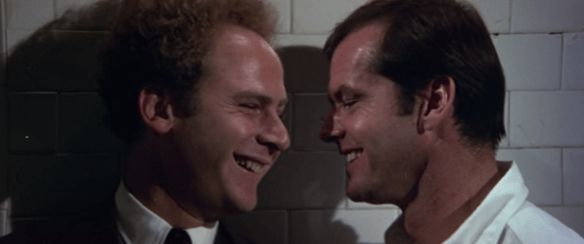
That is the question posited to commence the daydreamy dialogue rolling over the credits of Mike Nichol’s Carnal Knowledge. The nostalgic refrains of Glenn Miller’s “Moonlight Serenade” bring us in as we begin to listen to the cadence of two voices. We’ve heard those voices before probably numerous times. One has a sneering quality, and it belongs to none other than Jack Nicholson, coming off a few early classics like Easy Rider and Five Easy Pieces. He’s got the trademark snideness in his delivery. It’s all there. The other voice is more soft-spoken and calming. It can be heard on numerous folk records of the ’60s and ’70s — the voice of Art Garfunkel.

These two men play Jonathan and Sandy, two college roommates who spend their entire lives confiding in each other as they try their hands, usually unsuccessfully, with relationships. The age-old debate between looks and brains is only one major point of contention.

There are the awkward opening moments at a college mixer. The college dorm room talks cluttered with girls, girls, and more girls. In fact, they both get tangled up mentally, emotionally, and physically with a girl named Susan (Candice Bergen).

Both leave college going off in two different directions in the realm of romantic relationships. Nicholson’s character is more about the open-minded approach keeping his options open and he thumbs his nose at any ultimatums a woman gives him. He’s his own man and he’s not going to be held down — even going berserk with his longest partner Bobbie (Ann Margret), because of her insistence on wanting more. He’s not about that but ends up cycling through the women. The irony, of course, is that although he seems like a more stable, contented than his best friend, Sandy still winds up in several different marriages just the same.

Really, the film fits somewhere in there with Who’s Afraid of Virginia Woolf and The Graduate if only for the fact that Carnal Knowledge engages with broken human relationships once more. In one sense, there can be a great deal of hurt, pain, and even abuse that come out of them. But also they can be wellsprings of depth and even humor at times. What makes this film, based off of a Jules Feiffer script, is the buddy perspective. It’s the buddy perspective that you could argue that was given a facelift and re-popularized by When Harry Met Sally. And yet you can see it here as well.

There’s candid, frank, sometimes even overtly crass dialogue. And it continues through their entire lives no matter who they are with, what jobs they are in, or how their looks have changed. The conversations continue. The sobering fact is that both haven’t been able to figure things out. It doesn’t seem like they’ve come all that far from their naive college days. Jonathan now seems like a lonely dirty older man compared to a dirty young man. Sandy is enraptured by a young woman who can mystify him with her thoughts. They haven’t really changed a whole lot.

The closing moments of Carnal Knowledge are perturbing not necessarily because of what happens, but because of the realization of what these men have become (or haven’t). We see first-hand that Jonathan has fully succumbed to his own self-narcissism while Sandy tries to convince himself that he’s happy. It’s sad really.

3.5/5 Stars

The Earrings of Madame De… (1953)

MadamedeposterThe Earrings of Madame De…, in essence, feels like the perfect incarnation of an Ophuls’ film. In fact, sometimes I forget that Ophuls is actually German because his films are full of French sentiment. I mean that not because of their cast, although we do have Charles Boyer and Danielle Darieux, but more so due to the fact that his films are about elegant, melodramatic romances that fit the decadence of Parisian high society. For instance, in Madame De… Danielle Darrieux is positively swimming in luxury, whether it means dresses, furnishings, or especially jewelry. Materially her husband Andre (Boyer), a French general, has lavished all the worldly possessions upon her. Except that’s not what she wants. At least that’s not what will make her happy. She may be obsessed with the material, but even the material which she so desires is ultimately poisoned over time. Over time Andre cannot even win her over with trinkets and gifts. She cares little for the eponymous earrings until they come from her true love Baron Donati (Vittorio De Sica).

These are the same earrings that she sold to pay off a debt. The same earrings that Andre reacquired from the jeweler and then made the rounds once more. Ophuls said himself that he was drawn to this narrative because “there is always the same axis around which the action continually turns like a carousel. A tiny, scarcely visible axis: a pair of earrings.” And really it is a fascinating plot device that ties the entire narrative together, while also seeming to reflect the utter frivolity and triviality of it all. How can these earrings hold so much weight to one person? And yet that’s only the face value, because, to begin with, they are only an object to be coveted and maybe cherished. Over time they become a token, a symbol of true love and Louise gives them away to the parish because she no longer needs them. She has some notion now of what true love actually feels like.

For the majority of the film, Andre is forever civil with her. He knows that she does not really love him, and he even has time for a mistress on the side. He handles her opportune fainting spells and little charades with grace and at times amusement. But when he gets a hint at Donati’s relationship with his wife, he does what any honorable gentlemen would do. He’s indignant of his rival and builds a huge feud out of nothing. What follows is a duel and the rest is history.

Madame De… probably does not get as much acknowledgment as it should, because Ophuls was a champion of so-called “Women Pictures,” which actually take on the point of view of women, in an industry that’s so male-dominant even to this day. Thus, Madame De… is a little different in perspective, and it tries to hide all of its tragedy behind superficiality. It makes for an interesting lesson in romance and the female psyche. Yet again the director shows his immense affinity for staircases turning them into the personal playground for his camera. He loves to twirl, pirouette, and glide just as much as Louise and Donati do as they dance the night away at the ball. De Sica is a champion director in his own right, but it was especially fun to see him in front of the camera and he seemed an apt player opposite his costars. The worthy equal of Boyer and a suave love interest on top of that. There’s nothing more romantic than Danielle Darreux dreamily repeating to him, “I don’t love you, I don’t love you, I don’t love you.” The sad irony is that those words ring true with her actual husband as reflected by a pair of earrings.

4.5/5 Stars

The Crowd (1928)

220px-Crowd-1928-PosterThe Crowd is a true piece of urban Americana, setting the standard when it comes to your average everyday American. King Vidor’s film lacks big-name star power and plays on a universal story similar to Murnau’s Sunrise. Our protagonist is Johnny Sims, who was fittingly born on the 4th of July. He’s the quintessential stand-in for anyone who has ever pursued the American Dream. He faces the death of his father at an early age and grows up getting lost in the masses of New York. With wall to wall skyscrapers towering above and a hopping city life, it’s easy to disappear.

This film is not Metropolis, but it is about a metropolis with the same behemoth sets swimming over the top with extras. In fact, at his job, Johnny looks like the original C.C. Baxter from The Apartment. He’s a cog in the giant mass of humanity, a little stop in the ever-churning conveyor belt.  Like Baxter, Sims becomes smitten with Mary, a lovely girl he meets on a double date with his joking colleague Bert. A lively night at a carnival and going through the tunnel of love cements their relationship. Soon they are married and heading off to the perfect honeymoon destination: Niagara Falls. This is where the love story is at its peak, riding on a wave of euphoria since these two are loved and in love. They feel indestructible, and there’s no one in the world that they would rather be with.

But as per usual, life happens to get in the way of love. Johnny isn’t too fond of Mary’s brothers and her mother, and the feelings are mutual. They just don’t see eye to eye, and they are skeptical of his prospects as a breadwinner. Matters are made worse during a tiff where Mary threatens to leave, and Sims does little to object. Their house is slowly falling apart, although they keep it together momentarily since she announces her pregnancy. That is the thin thread that binds them together.

Following their baby boy, comes a little girl, and finally, the raise that Johnny has been hoping for, but it’s not much. Things continue to be difficult as Johnny still waits for his ship to come in. His wife is annoyed with him and the meager prospects ahead. We are reminded that it’s not the big things but often the little ones that cause the most damage. Like little biting remarks that cut to the quick. And yet somehow, Johnny and Mary hang onto their romance.

In one scene she gazes down from the windowsill at him on the street below and they make up after a row. It’s rather reminiscent of Romeo and Juliet, reflecting that they still care about each other. But matters are not helped by the fact that Johnny seems pretty useless. On a beach holiday Mary struggles to get everything right, and despite her best efforts, it all turns out wrong.

Only a few years before Johnny laughed out loud at a man forced to humiliate himself carrying signs masquerading as a clown. How embarrassing! And yet a desperate Johnny winds up with a similar lot. It doesn’t help that personal tragedy strikes his family where they are most vulnerable. In its day it was actually considered obscene (for featuring a toilet), and it was far from a success due to a downbeat ending. This is a Pre-Depression world, and yet life is still far from easy.  And that allows The Crowd to stand the test of time fairly resiliently because it’s still possible to relate with its patriotism, its tragedy, and its resolute optimism.

4.5/5 Stars

Ali: Fear Eats the Soul (1974)

alifear4Werner Rainer Fassbinder is one of those artists known for his tumultuous personal and political life, and yet with all the dialogue swirling around his backstory and untimely death, there is no doubt that he sent a charge through the film community that is still being acknowledged today. The New German Cinema of the 1970s breathed new life into an industry and created a massive impact. Part of the fact is that Fassbinder’s work hearkens back to his forefathers while constructing a space within the medium that was all his own. That’s what the great filmmakers do. They take what has already been done, grab hold of some inspiration, and run with it into some new uncharted territory.

In the case of Ali: Fear Eats the Soul, he takes the work of 1950s melodrama master Douglas Sirk and transposes it to his contemporary Germany. His particular inspiration is All That Heaven Allows, which revolves around the shocking romance between a respectable woman and her younger suitor. That in itself makes for a juicy piece of drama, but Fassbinder expands on that by adding a racial component. Always fascinated by topics of race, Fassbinder looks at an elderly German lady (Brigitte Mire), who begins to form a bond with a much younger Moroccan laborer named Ali (El Hedi ben Salem).

alifear3What begins as a small gesture, soon enough actually develops into something more, because once they sit down to coffee, they realize they actually appreciate each other’s company. Although I don’t understand German, the subtitles make it clear that Ali’s German is rather rudimentary, and yet that matters little to Emmi. She just enjoys having someone to talk to.

Emmi works as a maid and her husband is deceased and her children are grown up. She’s lonely. Ali has a group of friends from his homeland, but he feels like he’s treated less than human in Germany. Emmi’s different than your average German, but then again, her first husband was a Pole during the Nazi regime, so she’s no stranger to going against the grain. To her, it’s not a big deal. It’s just gets blown up by family and the tenants around her. Her nosy neighbors are quick to gossip and they all have a heavy case of discrimination. In fact, the unlikely couple is surrounded by narrow-minds sitting atop old bodies. A prime example is the local grocer, who ignores Ali, before changing his tune since he wants Emmi’s business.  But even Emmi’s children are not pleased. You can understand being surprised and a bit dismayed, but once a television set is kicked in, there’s automatically more to it. It’s not simply anger in it being such a rash decision, but the fact that Ali is a foreigner (and much younger). And yet all these separate issues are so closely intertwined it becomes an interesting situation. More often than not it’s the pervading bigotry that is the most noticeable.

alifear5Although the issue of age plays a role too, because at times Emmi looks out of place with Ali’s friends, and the same goes for Ali among her friends. It even leads him to a one night stand with the sultry bar owner (Barbara Valentin).  But Emmi is a very forgiving soul and in her, Ali finds grace. I’m not sure if I concur with all the conclusions that Fassbinder draws, but I can respect his stands on race. In fact, when Ali alludes to the catastrophe in Munich during the Olympics in ’72, such a current events make this prejudice toward Arabs all too real. It was a real pertinent issue and it still is to this day.

As for Fassbinder, he certainly knows how to work around his sets. The composition of his scenes is simple, but vibrant in mise-en-scene. He certainly has a touch of Sirk, being a little less luxurious, but still as bright. The closest modern example I think of is Wes Anderson as far as utilizing interesting color schemes and symmetry to frame shots. Also, there are quite a few times where Fassbinder maintains a shot for seconds on end. In such moments, it feels like we’re looking at a painting in a Fassbinder gallery. And it is exactly that. Art with an emotional depth from one of the foremost German masters.

4.5/5 Stars