Miracle of Morgan’s Creek (1944)

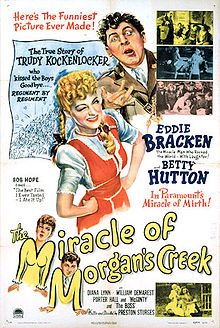
220px-The_Miracle_of_Morgans_Creek_1944_posterPreston Sturges was a revelation when I first saw Sullivan’s Travels and then The Lady Eve. His scripts are always wildly hilarious and full of memorable characters, whether they are headliners or just supporting the stars. The Miracle of Morgan’s Creek (1944) was a lesser known film to me, starring Eddie Bracken and Betty Hutton, but I was ready to see what this screwball could deliver.

With the start of the war, there began a push on the home front to strengthen morale by throwing parties and drinking victory lemonade in honor of the boys going overseas. Young Trudy is intent on dancing the night away with a lot of soldier boys. She just wants to do her part in the war effort after all. Her grumpy and domineering daddy Mr. Kocklenlocker (William Demarest) forbade her from taking part in such a shindig.

She sullenly goes to the movies with Norval Jones (Eddie Bracken), the young man who has been infatuated with her since they were kids. However, she somehow talks Norval into letting her go off to a party, and she spends the night living it up, while he waits dejectedly at the theater. When she finally returns its late morning of the next day and Norval knows her father will kill him.

However, Trudy also discovers a ring on her finger signifying that she married a soldier in her wild stupor the night before. The only problem is she cannot remember who it was, there were so many soldiers that she danced with after all. On top of that, add the prospect of a baby and you have a real doozy that has small-town scandal written all over it.

Norval tries his best to help remedy things for Trudy, only to wind up in jail with a big to-do building up — even making its way to the governor! Things don’t look good for poor Norval until Trudy gives birth and it’s a MIRACLE! When he finds out about what happens he has a little fainting spell.

That’s the craziness that is the Miracle of Morgan’s Creek, thanks to the rapid-fire dialogue and caricatures created by Preston Sturges. William Demarest is especially memorable as the hard apple Mr. Kocklenlocker who is always bossing his daughters around, but he’s not all bad. By now Morgan’s Creek looks dated, but all the same, it is still a memorable piece of WWII homefront cinema. Supposedly it was standing room only back in the day and honestly, it’s surprising that this film ever got past the censors. Bigamy, pregnancy, and so much more all comically mentioned in a 1940s film. Who would have thought?

4/5 Stars

Heaven Knows, Mr. Allison (1957)

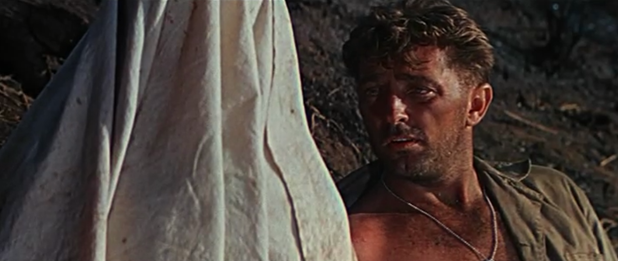
heavenknows3From John Huston comes another film about a woman of principle and a man who seems to be everything she is not. This time instead of Katharine Hepburn and Humphrey Bogart aboard The African Queen in WWI, we have Deborah Kerr and Robert Mitchum stuck on a deserted island together during WWII.

Kerr is Sister Angela who was on the island only a few days with a priest before he passed away. Now she is alone taking care of herself in solitude. That is until castaway Marine Mr. Allison washes up on her shore in a raft. For a time it is just the two of them as the Sister offers the marine food after his long, arduous journey. But after getting rest and some nourishment, he returns the favor proving his resourcefulness at scrounging up food on the island. For a while, they live in relative ease like this.

But they are reminded that the war is still going when the Japanese set up camp on the island. The unlikely pair finds themselves living in a cave together. Allison invades the camp on the sly to acquire food for them, and they continue to manage in hiding. Once the enemy is gone, the exuberant marine gets drunk on some sake and professes his love to the novice nun. Although the situation had never quite been awkward up to that point, it quickly becomes so. Sister Angela, in a tizzy, flees out in the pouring rain and winds up getting sick as a result.

heavenknows5To add to the predicament, the Japanese forces return, and back to the cave, it is. This time Mr. Allison must kill a soldier in order to get a blanket for Sister Angela. Soon the Japanese are burning the underbrush in pursuit of the culprit. It’s dire straights certainly, but then help comes.

Mr. Allison once again proves himself and regains the faith and admiration of Sister Angela. Once the marines roll in Mr. Allison is able to leave the island on a stretcher with the faithful novice by his side. They are a strange pair, but their relationship makes this story actually engaging. In a way, the life of a marine and a nun have some similarities, although they fall at completely different ends of the spectrum. In the same way, Mitchum and Kerr are adept at playing their roles to that degree. Allison is rough around the edges, a Joe Palooka type, and yet he means well. The nun is devoted to her calling, proper, and it never seems as if she could ever approve of Mr. Allison. And yet, in the midst of all the divides that seem in place, a true bond forms. It’s an entertaining relationship and these two stars,  led by John Huston’s direction, made it thoroughly enjoyable.

4/5 Stars

People on Sunday (1930)

peopleonsunday1One of the last German silent films was People on Sunday, a modest project from a group of young men. Our stars are young professionals in real life and only amateur actors who did not quit their day jobs. They only could film on the weekends and that’s how we end up with People on Sunday! It takes on a faux-documentary style, and it follows the lives of four individuals as they meet one another and then spend a pleasant Sunday afternoon together.

There is certainly a breezy playfulness to the film as the two men and two women spend time frolicking at the beach and reclining in the sun. They share laughs while eating and listening to records. It quality fun and there seems to be a general innocence to their behavior that while sometimes rude is all in good fun.

This is, in fact, a film of the late Weimar Republic, without the cloud of Hitler’s Nazi regime hanging over the country (not until 1933). It stands in sharp contrast to later works or documentaries because People on Sunday is seemingly free and wholly unrestrained by ideology or prejudice.

We should undoubtedly be grateful for this historical piece of New Objectivity cinema and the reasons are twofold. First, since the film essentially works as a documentary, it gives us a wonderfully clear picture of what life was like in the world of Berlin. There are continuous shots of the city streets, passing vehicles, and people making their daily rounds.

One especially memorable moment occurs when the story takes a short aside to afford time for a montage of faces. The camera slowly captures face after face providing a sample of all the individuals who walk these streets. They transcend time and space because of their humanity, their mundane quality, and they have the same lightness of our main characters.

When we look at the names behind People on Sunday, it is almost staggering to acknowledge these men who were formerly unknowns.

As directors, you have Robert and Curt Siodmak. Your main writer is the great Billy Wilder. As cinematographer, you have another great in Fred Zinnemann, and finally, production was helped by the B-picture master Edgar Ulmer. Due to the rise of the Nazis, all of these figures would end up emigrating to Hollywood and the rest was history.

In many ways, we are indebted to them, because they helped form some of the great American classics and you can already see them honing their craft. The images are visually arresting and there is even a sense of humor that we could seemingly attribute to Wilder. It would only get better from then on.

If I’m not mistaken there are several scores that have been used to accompany the film, but I did really enjoy the Czech film orchestra because it added a lot to this otherwise silent picture. Hope you enjoy this unassuming jaunt as much as I did.

4/5 Stars

Monkey Business (1952)

monkeyb5I always was under the assumption that the screwball comedy died off in the 1940s with homages coming out years later. Is there such a thing as neo-screwball comedies? Anyways, after watching Monkey Business I feel it is necessary to reevaluate that general conclusion. Here is a film from Howard Hawks that channels a great deal of the madcap craziness that you see in his earlier works like Bringing up Baby (1938). For lack of a better term, it is very screwy indeed. Right from the opening credits, you have the voice of God (Hawks himself) breaking the fourth wall and calling Cary Grant by his real name.

Then the film actually opens, and we meet the quintessential absent-minded genius Barnaby (Grant) and his loving wife Edwina (Ginger Rogers). They are meant to go to a social gathering and yet he is so caught up in his work that they stay behind. You see he is trying to develop an elixir of youth. His experiments are of interest to the business-minded and much older Oliver Oxly (Charles Coburn), who only sees the positives of such a discovery. Barnaby tries to explain to him that it’s not so cut and dry. In fact, his work could have dire effects if careful precautions are not taken.

Little does Dr. Fulton know that one of his lab chimps got loose in his lab and tampered with some chemicals, dumping them in a water cooler. After this absurd moment, Barnaby unknowingly consumes the rejuvenating concoction and his whole demeanor takes a turn.

Soon he’s out buying flashy clothes, getting a flamboyant car, ice skating, and driving like a speed demon down the thoroughfares with an astonished secretary Ms. Laurel (Marilyn Monroe). Cary Grant even shows off his impressive acrobatic skills, performing a cartwheel and a few other tricks.monkeyb3Only when the concoction wears off does he figure out what happened, and he resolves to be more careful next time. Except next time turns out to come sooner than he was expecting when Edwina willingly drinks some of the substance so Barnaby can observe her. Just like that, she is a prank-pulling schoolgirl with insatiable energy.

Once more Barnaby takes the elixir while Edwina is sleeping off the effect. However, when she wakes up a misunderstanding leads to more mayhem as she tries to get help from Mr. Oxly. What develops is a spiral into more hilarity. Barnaby and Edwina are reunited, Edwina’s old flame is incensed, Ms. Laurel is petrified, and chimps and man alike are taking part in some Monkey Business. If none of this makes much sense then I did my job!

3.5/5 Stars

An Affair to Remember (1956)

anaffairto2An Affair to Remember (1956) has always been noted as a great American romance as far as I can ever remember, and I figured out that part of that was because it gets a mention in Sleepless in Seattle (1993). Whatever the reason, I finally got around to watching it and it is certainly an enjoyable weepy. Any film with Cary Grant as a romantic lead is usually, at the very least, charming and this one is too. He is a famed man on an ocean liner who has finally gone and gotten himself hitched. It’s big news and as soon as the ship touches down he is going to meet his love.

Quite by chance, he meets Deborah Kerr’s character and they are immediately taken with each other. Soon their friendship grows into an affectionate romance, and yet they feel uncomfortable in front of the other passengers who seem to be watching their every move with interest. They both know that once the boat reaches New York things will not be the same between them for some time.anaffairto4And so it is, but they had made one last plan to meet each other at the top of the Empire State Building. Grant makes it, but Kerr is detained for a very good reason. After seeing her in an awkward situation at the theater, Grant resolves to go see her and get to the bottom of what happened. It’s a tearful, albeit happy, reunion as they come back together.

If any of this feels familiar, like a rerun, that’s because it is. Leo McCarey actually made An Affair to Remember (1956) as a scene for scene remake of his earlier film Love Affair (1939). I never thought I’d say that I like a film with Charles Boyer more than a comparable one with Cary Grant, but it’s the truth. I’m not sure if it’s because I saw it first or that the film feels more intimate, but I really enjoyed Love Affair. An Affair to Remember is certainly elegant in color and Deborah Kerr gives a fine performance, but I was personally blown away by Irene Dunne as an actress. In fact, back in the day, Dunne worked quite a bit with Cary Grant (The Awful Truth, My Favorite Wife, and Penny Serenade).

So my advice is, go back and give Love Affair a watch. It’s still by McCarey with much of the same story so it’s really a personal preference what film you like more.

3.5/5 Stars

All That Heaven Allows (1955)

allthatheaven4When I first saw the work of Douglas Sirk, I was immediately struck by how well it seemed to personify 1950s Hollywood. All That Heaven Allows (1955) is little different in its opulence and superficial soap opera tonalities. Except for this one, at times, feels a little like it should be a part of a Norman Rockwell Saturday Evening Post cover. Perhaps it glides a slightly more interesting line between high society country club members and quintessential middle America.

The two alternatives are contrasted in our screen couple played by Jane Wyman and Rock Hudson.

Cary Scott (Wyman) is a well to do, middle-aged widow with two grown kids off at school. She is often lonely and always sensible when it comes to the life decisions she makes. After all, she doesn’t want the local gossip blabbing about her life to all their society friends.

That changes rather gradually thanks to her seasonal gardener and professional tree-trimmer Ron Kirby (Hudson). He is a different sort of spirit who seems to be content with nature and his place in it as nurturer. Their acquaintance begins over a harmless cup of coffee and turns into an excursion to his humble abode. Over time, Cary is introduced to Ron’s brand of friends, all charming, down-to-earth folk who live life to the fullest without worrying about wealth or societal pressures. This is what she has been looking for, and he is the man she needs. So when Ron proposes marriage she readily accepts.

Now comes the task of putting it before the kids and then showing Ron to the local snarks. The socialites are no different with their sniggering and pointed remarks. There is no mercy for Cary and Ron. In fact, they are appalled by such a scandalous romance. The children who normally are rational and kind, do not mince words with their mother. Ned talks about the family honor, the legacy of their father, and their home. He cannot bear for his mother to supposedly throw all that away. Kay, on her part, is always getting caught up in psychoanalysis, but this time all rationale goes out the window after her boyfriend breaks up with her.  Under this built-in pressure, Cary reluctantly breaks off their marriage, mostly for the sake of the children.

allthatheaven2Except she is never quite the same and never feels like she did with Ron. Cary is resigned to staying in her lavish home, while reluctantly accepting the newest form of modern entertainment — a television. Christmas time is especially hard when she runs into Ron, but then the kids come home. That’s when she realizes her grave error and what comes next is exactly what you expect, with a few small diversions. Cary turns back to Ron, who has been in a funk of his own. Following an accident that was induced by Cary’s presence, Ron is bedridden and Cary rushes to his aid. This is the life she was meant for no matter what society says of her.

It’s pretty mushy, weepy stuff in a sense. That’s the superficial level of second-rate romance and picture-perfect technicolor. In fact, All That Heaven Allows is visually beautiful in a sickening sort of way. The town is too pristine, the seasons too perfect, the snow too puffy. And yet it all seems to be an impeccable supplement to Sirk’s moral drama. Ironically, this is not a moral tale about unbridled love between a woman and her younger lover. That would make complete sense. Instead, Sirk subverts that wonderfully, by suggesting the weight of the blame is on society and the peer pressure that permeates the upper crust.

Even if this film is a little too syrupy in its sweetness, I can manage a spoonful or two because there is a greater meaning to this frivolity. All That Heaven Allows is certainly an acquired taste, but it’s worth taking a chance on.

4/5 Stars

Review: Gun Crazy (1950)

guncrazy2

Bart has an intense obsession with guns. It’s what his life revolves around. It’s the only thing he wants to do as a boy and the only things he seems to think about. It becomes a problem when he breaks a store window, but during the following hearing, his sister and friends vouch for his character. He would never take a human life or kill. That’s not in his nature.

No matter, it is decided Bart should be sent off to a special preparatory school, and he only returns years later as a grown man recently off a stint in the army.  He’s back in his hometown not quite sure what his future plans will be, but his buddies are glad to see him. They shoot some, drink a few beers, and decide to take a jaunt to the carnival for a night of fun.

Their Bart meets the girls of his dreams. There’s a quality to John Dall that makes Bart into a pure victim of his circumstances. He’s quickly infatuated with the gun slinging and sensuous Peggy, who seems to share his one love. A goofy smile is plastered on his face as he faces off against her in an act of skill. He makes her uneasy and ultimately beats her. 

He gets a job with the carnival and spends as much time as he can with her when he’s not shooting guns. They are fed up with their boss and leave the migrant life behind. Marriage is on their radar, and they live it up with the money they have. But Peggy wants more and she wants to keep living the high life. 

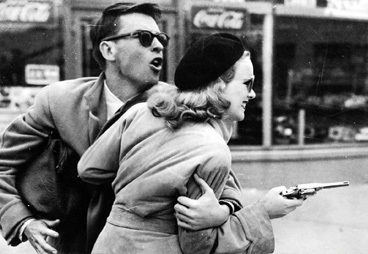
She wants to rob a gas station. It’s one little idea that soon blows way out of proportion. They are holding up banks, gas stations, and any place with money that they can lay their hands on. The pair is fugitives with exploits plastered all over the front pages and roadblocks waiting to stop them up. All the while Bart makes Peggy promise not to shoot anything because he still is totally opposed to killing people. 

It seems like things might end peaceably, except once again the gun-toting lovers are nearly flat broke so Peggy coaxes Bart into one last job to end all jobs. For the first time, despite their planning, just enough goes wrong to nearly botch their mission. Bart drives off and Peggy shoots a guard. He’s not the only one. 

 guncrazy1When Bart finds out, after the fact, he realizes they have just stepped up a level with murder stuck on them. The game is winding down and the only place Bart can turn is his hometown where his sister is. For good reason, she cannot stand Bart or Peggy who she sees as poisoning her brother. And it’s true. Bart seems different now, so paralyzed by fear that he even pulls a gun on his old friends.

The last ditch effort of Bart and Peggy is to literally head for the hills. The dragnet is sent out and the hounds are let loose. They hardly have a chance before dropping from exhaustion in a swamp. They’re trapped and a crazed Peggy looks to shoot it out to the death. But for once Bart breaks with her remembering his friends. It doesn’t help him much.

Gun Crazy is a B-film and yet it is easy to forget because the way Joseph H. Lewis constructed this film is so impressive in its economy. One scene that reflects this so beautifully is the long take from the back seat of the car. The camera does not change positioning and so we see a bank job from the outside, and it only helps to build up greater tension.

 We also have enough time to care about certain characters. We have enough time to see Peggy is really no good. Yet with her keen marksmanship, she is a different shade of femme-fatale who is still as deadly as any of her contemporaries. Along with They Live by Night (1948), this is one of the archetypal Bonnie and Clyde-esque films. Thank goodness this film’s title was changed from Deadly is the Female to the more apt Gun Crazy. That it is. 

4/5 Stars

Bay of Angels (1963)

bayof3Bay of Angels is quite different than anything else I have seen by Jacques Demy. Similar to Lola (1961) it is shot in starkly beautiful black and white and it has a kind of love story, but it lacks the music or general whimsy that often characterized Demy’s later works.

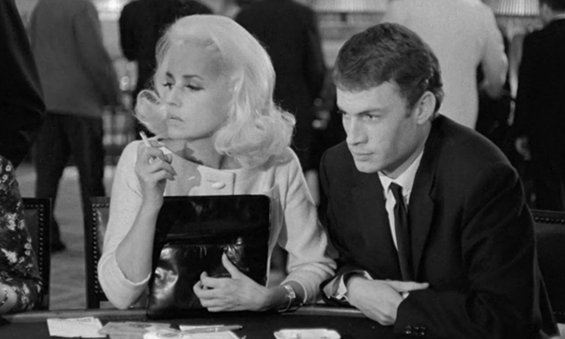
This film finds its subject matter in gambling, and it follows one woman’s obsession and another man’s growing interest in roulette. At first, Jean is a rather bored young bank employee, who is coaxed by a colleague to take up gambling.

bayof2

Initially, he is skeptical, looking down at the pastime as a frivolous waste of time and money, after all, he is a sensible young man. However, he parts with the sensibilities that his father would have for him and instead take a few weeks of vacation to spend some time in the casinos of Nice and Monte Carlo.

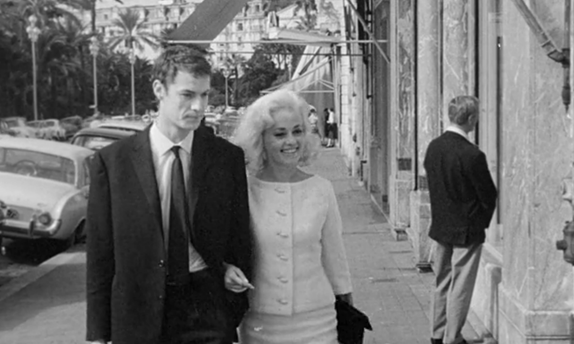
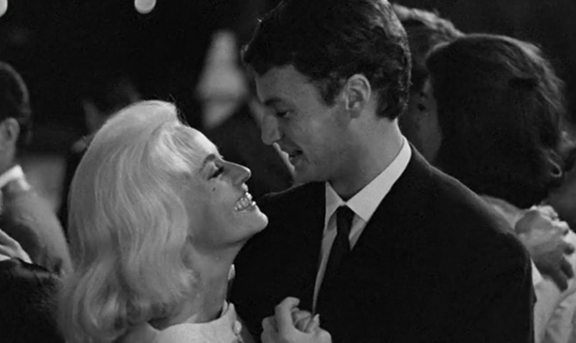
Soon he gets bitten by the gambling bug and he’s hooked. He finds an equally enthused companion in Jackie (Jeanne Moreau), who has had a far longer history with roulette. Jean falls for her very quickly and Jackie holds onto him like her good luck charm. Their many days spent in the casinos are constantly fluctuating roller coasters of luck. Once gambler’s fallacy has taken hold it’s hard to kick the habit, and Jackie constantly blows her money. If not at the wheels, it gets spent on fine dining and clothes. She has no restraint when it comes to spending and Jean indulges her willfully. It gets so bad that Jean begins to get as reckless as his companion, and he cannot bear to leave her, although she really does have a problem.

bayof4The formally reserved persona of Jean becomes violent and passionate for Jackie’s affection, but she’s not quite as ready to give it out. The ending felt a bit forced, but yet again Demy delivers a story that is riddled with feelings of love and passion.

It is an interesting observation that his male characters pale in comparison with his female leads ranging from Anouk Aimee, Jeanne Moreau, and Catherine Deneuve. These ladies who are always the object of affection, steal the screen with their mesmerizing performances. In fact, Claude Mann has a rather slumping posture, a glum face, and not particularly good looks. Thus, in contrast, Jeanne Moreau looks like an especially alluring beauty, who seems at home in gaudy gambling houses billowing with smoke or seaside promenades.

Bay of Angels is supposedly the place that brings the pair luck, but the reality is that this film is all about chance. Not fate so much as Demy usually explores, but a topic that is still somewhat similar. It is also a film that makes me never want to play roulette. I do not want the mundane lifestyle of Jean, but I would like to find my excitement somewhere else. I suppose that’s what made Moreau’s character so fascinating because her obsession was so great and yet she simply accepted it and thought little of it. But it drove her life.

We’re partners in a game. Let’s leave it at that.” ~ Jackie

4/5 Stars

Lola (1961)

Lola1961As the debut of Jacques Demy, Lola has some qualities that, for lack of a better term, are very un-Demy. First off, he was a member of the French New Wave period of filmmakers and yet he resigned himself to making mostly musicals, taking inspiration from Hollywood and setting them in his own unique world. He was not concerned with the experimenting or political undertones of many of his peers. However, this is probably the most typical looking of his work and thus a jumping off point for the rest of his career.

Not quite as elegant in camera movements as Max Ophul’s work which received a nod, Lola still has a pleasing sleek visual style representative of the French New Wave. Its silky smooth, black and white cinematography courtesy of Raoul Coutard (Breathless), however, makes the film look more like something from Godard.

Lola is what Demy himself coined “a musical without music,” I suppose because it lacks the signature singing of his later films, but keeps the music and some of the other elements. Demy’s film also has a sense of cinematic realism with characters crossing paths with one another in various coincidental moments. It may be highly unbelievable in its plotting and yet it works within the Demy world of romance and fatalism which he would often revisit later on.

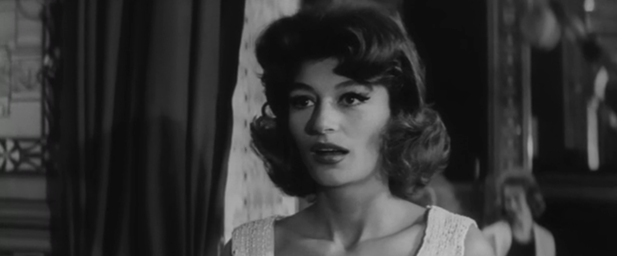
lola3This film follows a cabaret singer named Lola (Anouk Aimee) in a small seaside village called Nantes. She has a young son and a lover who she has long waited for. In the meantime, childhood friend Roland Cassard (Marc Michel) trudges on with his life without much drive. He is a befriended by a lady and her daughter Cecile at the local bookstore where they strike up a quick friendship. Then, by chance Cassard runs into to Lola, or Cecile as he used to know her when they were children. It’s been many years and although she has been getting together with an American sailor (Alan Scott) named Frankie, she is excited to go out for an evening with Roland. However, in another interesting meeting young Cecile runs into Frankie while buying a comic book and they have some fun together.

lola6In the end, Lola tells Roland that she will never truly love him and they must remain friends. It’s a bitter time for Roland as he decides to leave like he was originally planning. Finally, Michel returns and Lola is reunited with her love. It’s another bittersweet tale of love from the mind of Jacques Demy. Whimsical, poignant, and wistful too. That’s not the last we will see of Roland, though his luck doesn’t get much better (Umbrellas of Cherbourg), and  Lola returns too (Model Shop). Now only to go back and watch The Blue Angel (1930) from von Sternberg and Lola (1981) by Fassbinder which both bookend this work by Demy also chronicling a cabaret singer. There’s a lot of history here still to be seen and Jacques Demy is a worthy addition to the lineage even if this is not his best film.

4/5 Stars

Review: The Killers (1946)

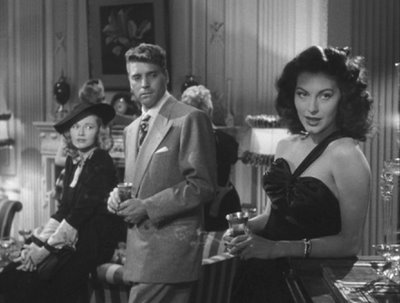
Thekillers2It’s been said that Robert Siodmak’s The Killers was Ernest Hemingway’s favorite adaptation of one of his works which was, in this case, a short story. As a film-noir, it works on numerous levels from the cinematography, to the score, to the young stars, to the ingenious narrative. Some credit, of course, can go to Hemingway for the concept, but a lot of the creative success must be given to the likes of Siodmak, John Huston and a host of others.

The film opens in an instant with two lurking gunmen entering a diner in a small New Jersey town called Brentwood. Their target is a washed up boxer called “The Swede” and we do not know why, but after terrorizing a few locals, they riddle him with bullet holes and that’s the end of it. It’s an intense sequence because the thugs (William Conrad and Charles McGraw)  are antagonistic and Miklos Rozsa’s score is nearly relentlessness.

The story could have ended there if it wasn’t for an insurance investigator named Reardon (Edmond O’Brien), who takes an interest in the dead man so he can find his beneficiary. In the present, he begins to piece together little fragments of the boxer’s past slowly but surely.

It starts out with Nick Adams who witnessed the thugs and worked with The Swede when a mysterious man came by the filing station. Soon after Ole Andreson stopped coming in to work and a while later he was dead. That’s all Nick knows, and it does not give Reardon much to go on.

Next, he tracks down The Swede’s beneficiary who turns out to be a kindly hotel maid. The connection seems slim, but it turns out that she kept him from committing suicide after a tough evening where he tore his flat apart. It’s still not much to go on, but Reardon thanks her and moves on with his investigation, still intrigued.

Then he goes to Philadelphia and gets his biggest puzzle piece from a policeman named Lubinsky, who used to run with the Swede as kids and probably knew him the best of anyone. He and his wife explain to Reardon how Pete Llund, as he was known, lost his final bout and was forced to move on with his life. About that time he met Kitty Collins for the first time and was infatuated for good.

Charleston is next the old stooge who spent a good many years locked up in a cell with the Swede. Reardon comes upon him at the funeral and from the old convict, he learns about a bank job that the washed up boxer got involved in. The other partners were Blinky, Dum Dum, and Big Jim. They are Reardon’s next points of interest.

Blinky is near death and recounts the robbery. Dum Dum crosses path with Reardon and shares about the aftermath of the job which went sour. Next, comes Big Jim whose tight-lipped about the past. Last but not least is Kitty, who is fearful that Reardon knows something and can actually blackmail her. That’s when everything begins to line up and heat up. After being absent for so long, the Killers are back in the picture and Rozsa’s score picks up again threatening the status quo of the film. They put us on edge again and for good reason. But the real focal point of the ending is Kitty.

Obviously, Citizen Kane has so many layers of interest, but it shares a similar narrative arc to The Killers where the main character is killed and his story gets pieced together thanks to flashbacks that are furnished from the present. Except, in many ways, the story of The Swede intrigues me more as a character. Charles Foster Kane is a magnate with an impressive if not tragic life.

Swede’s life is probably just as tragic except it was more humble and chock full of more crime. He was small time and he even failed in love when his friend Lubinsky got the girl of his dreams. It’s an interesting life too that ended unnaturally with gunshots rather than Kane who died as an old man. The Swede was cut short in a tragic sort of way and I think that’s part of what intrigues Reardon. It’s more than a job, but a mysterious story of a man’s life that the audience also gets taken along for. As far as storytelling goes, it’s great and it really works to flesh out these characters.

Ultimately, Reardon feels like the main character of sorts, but such an aura is built around The Swede and Kitty that it is understandable that this film made stars out of Lancaster and Gardner. They are certainly memorable partially because we hardly ever seen them in the present (except for Kitty at the end). Their whole persona is built off of what others say and there’s something interesting about that. There’s the fatalistic and sullen Swede which turned out be a perfect debut for Burt Lancaster. Ava Gardner has the soft seductive whisper of lethal poison all wrapped up in a beautiful body and it leaves a major impression.

Above all else, The Killers is a prime example of film noir blending German Expressionism from Siodmak’s native Germany with more documentary style sequences that take inspiration from post-war neo-realism. The opening sequence especially drips with noir sensibilities that, at its most dramatic, looms with shadows from the exterior of the diner to the low-key lighting of the Swede’s bedroom. For a while, it’s even difficult to know that’s Burt Lancaster reclined on the bed because his whole body is fully encased as he speaks. It’s only when he gets up into the light that we finally are introduced before he gets gunned down a few minutes later. It’s great staging and the atmosphere remains for a great deal of the film from the prison cell to Big Jim’s mansion. Each place is contrasted with the present or other locales like Reardon’s office which are more natural in lighting. It doesn’t get much better than that.

4.5/5 Stars