Pitfall (1948)

4ac39-pitfall2In Italy Pitfall‘s title was translated to Tragedy in Santa Monica. And that it is, but it plays out as a typical, everyday tragedy. It is far from Shakespearian. John Forbes (Dick Powell) is sorely tired of the monotony of his life: A wheel within a wheel within a wheel so to speak. And he is tired of being the so-called “backbone of the country” employed at Olympic Mutual Insurance Company.

He has a steady job and all, a beautiful, loving wife (Jane Wyatt), and a cute little son Tommy. He’s your prototypical middle-class man from your typical middle-class family. That’s what’s wrong with his life. To put it plainly he’s in a rut and desperately wants to get out.

Pitfall is a  bit of a riff off of Double Indemnity. There is some of the same framework but very different variables and outcomes, so that’s enough comparison.

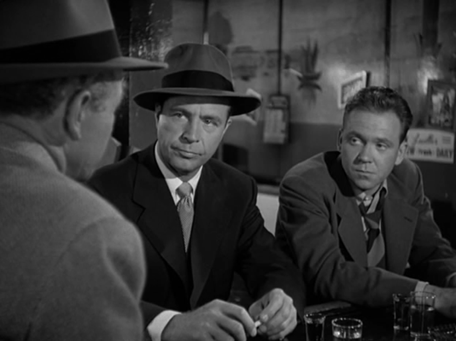
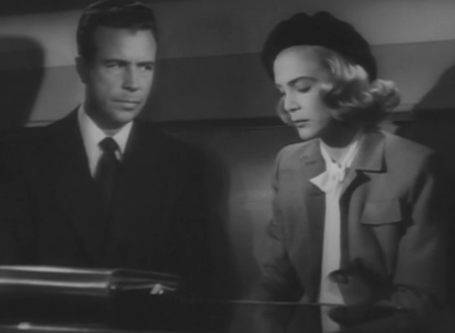
Things get interesting when Mona Stevens (Lizabeth Scott) comes into the picture. She is a model with a boyfriend who was just recently put into prison for embezzlement. Now Forbes’ company is charged with getting back some valuables from Stevens and she gives them up willingly. Along the way, a hired private investigator named Mac (Raymond Burr) takes a liking for her, but the feelings are not reciprocated. That’s before she meets Forbes.

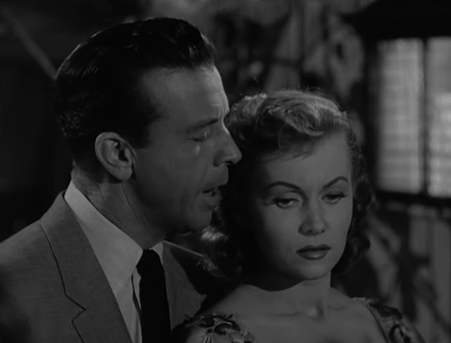
When they meet, Forbes is immediately struck by her and she takes a liking to his goodwill. Everything would be great in another world. Except in the real world, Forbes is married and Mac is jealous. After he gets accosted by Mac, Mona finds out about her fling’s home life. Surprisingly she lets him off the hook, but Mac won’t let her off.

Forbes’ overall demeanor changes and he feels reinvigorated, even back at home and in the office. But it’s never that simple, and things begin to get messy as Smiley finally gets his ticket out of the clink. Mac has been his constant visitor, filling the paranoid brute with ideas. He thinks Mona has been unfaithful, and he wants to get the guy she was with.

The ending of Pitfall is far more painful than a multitude of meaningless deaths in a monster movie. The reason being, these characters actually have some importance. There is a sense that human life is sacred and if anyone dies it is a big deal, whether they were “good” or “bad.”

Furthermore, there are hardly words enough to describe the look on Jane Wyatt’s face when she finds out the truth. This is one instance when the father did not know best, and their marriage was shaken to the core. It feels all too real. However, this film’s denouement is not quite as fatalistic as Double Indemnity. There still is a tinge of hope that these two individuals can salvage something out of a very difficult situation.

This is yet another feather in the cap of film-noir. So simple and yet so potently effective. I cannot wait for more with Dick Powell.

3.5/5 Stars

What’s Up, Doc? (1971)

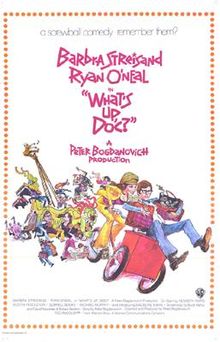
What's_Up_Doc_posterA nod to the 1930s screwball comedies, this hilarious film is directed by Peter Bogdanovich and stars Ryan O’Neil and Barbra Streisand. It opens with the prologue, “Once upon a time there was a plaid overnight case,” however very soon it becomes obvious that there are four of these cases! 

One belongs to the bookish Ryan O’Neil who is going to a musicologist convention with his annoying fiancée Eunice, the other to the free spirited Judy, one has top secret information, and the last is full of jewels. This dramatic irony is set up early on for the audience and things really get chaotic when Judy tries to pick up Howard. She masquerades as his fiancée and creates a good impression with a Mr. Larabee who is in charge of giving out the grant. However, later, Judy succeeds in completely destroying Howard’s room while causing more problems for Howard with Eunice in the process.  

The next day Howard is invited to a party at the home of Mr. Larabee and he is instructed to bring his charming “fiancée.” That’s where the mayhem hits its peak. All four bags end up together. There are gangsters, government agents, guests, servants, and Judy and Howard all a part of the chaotic ruckus. The unlikely couple finds themselves on the run through the hilly streets of San Fran where an epically frenzied car chase takes place. Put together a pane of glass, some bumpy steps, three cars, a parade, and a large body of water to add up to some hilarious moments. The bedlam carries over into the local courthouse where everything is eventually figured out. Everything is back to equilibrium and Howard flies off into the sunset with his new love and an in flight Bugs Bunny short.

4/5 Stars

Marriage Italian Style (1964)

Marriage_Italian_StyleI had never seen any of De Sica’s later work and with the quintessential pairing of Sophia Loren and Marcello Mastroianni this seemed like a perfect place to start the journey. The character Domenico is easy to dislike from the beginning because he constantly floats in and out of the life of the former prostitute Filumena who is ironically devoted to him.

The film relates the struggles of matrimony and family in Italy as Filumena tries to support her family while struggling with Demenico who is never truly ready to commit to her. In fact he becomes absolute fed up with her after a trick marriage, but that is just the beginning.

I can only imagine what Divorce Italian Style will be like (which also features Mastroianni). Without question Sophia Loren is certainly the driving force in this film.

4/5 Stars

Yesterday, Today and Tomorrow (1963)

Yesterday,_Today_and_TomorrowThis is the lightest of any De Sica film I had seen up until this point and interestingly enough it was split up into three narratives. The first one follows a woman who continually gets pregnant in order to avoid going to jail, but after seven kids, the toll is too much on her jaded husband. Needless to say there is a happy ending.

The second tale follows a superficial socialite with a Rolls Royce. She ditches her cars as quickly as she ditches her lovers. Although the story does not go very far it is easy to see she is a snob used to getting her own way. Ironically a humble man would in many ways be too good for her.

The final vignette follows an amiable prostitute as she befriends a young man destined to join the clergy. However, he becomes smitten and so she must do her best to encourage him to continue his calling.

That really is only the basics, but it was certainly enjoyable to see Sophia Loren and Marcello Mastroianni in three separate roles playing off of each other in different ways. They reflected three very different walks of life and three varying relationships mixing a great deal of humor with a few more somber moments. All in all it was fairly enjoyable.

4/5 Stars

Jules et Jim (1962)

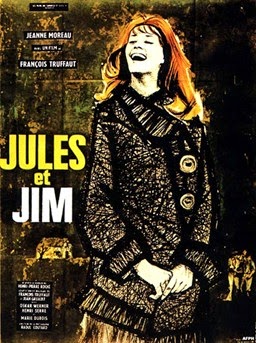
Jules et Jim (1962)Directed by Francois Truffaut, this film begins before WWI with two friends, the timid Austrian writer Jules and the more outgoing Frenchman Jim. Both men become enchanted by a statue that a friend had seen and soon Jules meets the free spirited Catherine after being with several women before her. Although he begins a relationship with Catherine, she soon casts her spell on both of them causing them to have a very close relationship. 
Just before the Great War begins Jules and Catherine are married but when the fighting starts the two men are on opposite sides. Fortunately, they both come out of the war and Jim comes to stay with his friends in their mountain home. Now they have a daughter but their marriage is difficult because Catherine has had several affairs. She begins to flirt with Jim and Jules gives his blessing hoping Catherine will still be present in his life. 
Catherine and Jim end up separating however when they struggle to have a child. Later, they reconnect in Paris but Jim resolves to marry another girl much to Catherine’s jealousy. They meet one last time and Catherine goes on a drive with Jim that ends fatally. Jules is left to grieve for his best friend and his true love.
It is interesting how Catherine is really the main character here despite the title suggesting otherwise. Jeanne Moreau does not seem like your typical beauty either and yet Truffaut makes her character truly special. If you want to become acquainted with Truffaut and the style of French New Wave this one of the films you need to go to. The 400 Blows first, Jules and Jim soon after. 
4/5 Stars

The Umbrellas of Cherbourg (1964)

umbrellas1 It is hard to remember a time when I was so devastatingly sad due to a film, and it does not leave a deep hurt but a more wistful despondency that is far more real. However, that’s enough misery for the time being. Directed by Jacques Demy and starring an exquisitely young Catherine Deneuve, this cinematic opera is a moving musical piece that looks to be conventional and turns out to be quite the opposite. 

The story begins in November of 1957 with a young mechanic named Guy (Nino Castelnuovo) who is deeply in love with the beautiful 16-year-old Genevieve (Deneuve). Guy cares a great deal for his godmother Elise who has a caregiver to look after her. Genevieve helps out her mother in running a small umbrellas shop in Cherbourg which allows them to scrape by. They must sell some family heirlooms to a kindly jeweler who is smitten with Genevieve. However, Genevieve and Guy have plans of marriage until Guy learns suddenly that he has been drafted for the war in Algeria. They spend their last hours together, and she vows to wait for his return. 

umbrellas7In the following months, it becomes evident that Genevieve is pregnant, but her mother tells her that Guy has probably forgotten her already. The jeweler, Roland Cassard (Marc Michel), professes his love for Genevieve and agrees to adopt her unborn child. Thus, partially on the urging of her mother Genevieve accepts his proposal and they are soon married leaving Cherbourg for good. 

Finally, Guy returns from the war and things have changed. He now has a limp and is fed up with his old work at the garage. Furthermore, the Umbrellas shop is sold and Genevieve is wed and gone. Adding insult to injury his godmother soon passes away. With no one else to turn to, he looks to the caretaker Madeleine, and he realizes her love for him. They get married and he turns his life around with her help. 

The years pass, and now during Christmas of 1963, a car pulls into Guy’s new gas station. After many years, the two former lovers come face to face once more. Now they have marriages and children, and their interactions are painfully aloof. They have moved on with their lives and they have moved on from their passionate romance. 

umbrellas13True, their lives have become sensible, but in this opera that Demy has constructed, this conclusion is sad and bittersweet. And yet if this were the only painful moment that would be one thing, but there are so many that touch the heart and move the viewer. When Guy goes off to the army and takes off on the train we can feel the great weight of anguish. More often than not, you can read the sadness on the face of these characters which complement the beautiful ballads they utter. In other words, it’s one thing to recount the plot and quite another to watch the events unfold.

I have to say that I had never seen a film that played out entirely through song, and even in the opening sequence, Demy consciously melds the diverse forms of film and opera. Umbrellas has the vibrancy and color of movies and takes the dramatic story line and songs of opera, to create a unique piece of musical artistry complete with acts and all. Its colors are bright and vibrant–utterly distinct in their composition. Everything from the bikes to the umbrellas and even back alleyways are beautiful. Although there are many magnificent melodies, rather surprisingly there is not one specific song that stands out (Well, maybe the theme), but instead, it plays rather like one continuous song with different sections and overtures that complement while not overshadowing each other.

umbrellas4Demy’s earlier film Lola also gives an interesting insight into the character of Roland Cassard who once again becomes acquainted with a mother and her daughter in a shop. This time around he has accomplished his dream of traveling the world as a diamond merchant, however, Lola is still heavy on his heart. Another thing that is remarkable about the film is the weather which in many ways plays as another character. The varying degrees of rain and snow dictate the mood and shift with the changing seasons. There’s no doubt that Jacques Demy and his collaborator Michel Legrand created something special here that elevates the musical to a heartfelt tragedy of romance. That’s something many men would not be brave enough to do. 

4.5/5 Stars

To Catch a Thief (1955)

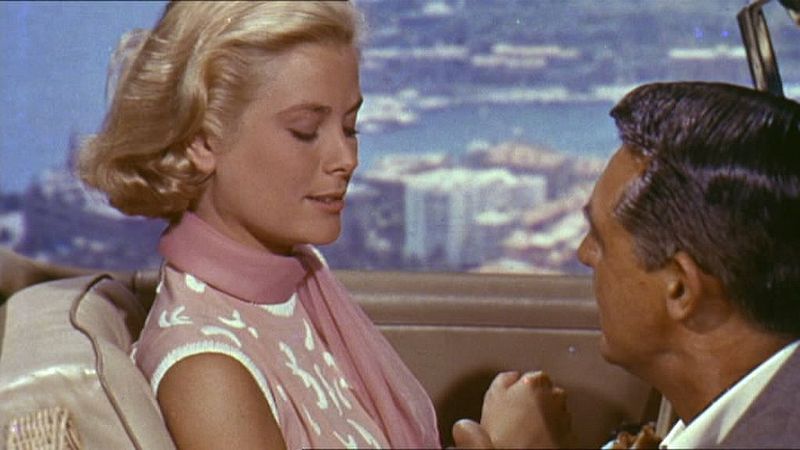
800px-To_Catch_a_Thief3Robert Wagner certainly knows It takes a thief, to catch a thief. The same goes for Cary Grant in this film which has him playing reformed cat burglar John Robie who is suspected for a series of thefts that have struck the French Riviera.

However, he knows he is not the culprit so he must clear his own name by catching the cat himself. The police want to nab him, his old French resistance buddies suspect him, and a beautiful young American woman (Grace Kelly) traveling with her mother is sure he is the cat. With a little help, mixed with some passionate romance, he is able bring some closure and get the girl.

That is all fine and dandy if you wanted a typical romance thriller. However, no one does it as well as Hitch. He somehow wonderfully balances the little bits of humor with his darker moments of suspense.  Jessie Royce Landis helps bring that comedy whether she is putting her cigarette out in some eggs or holding her book upside down as she commits a little white lie.

Hitchcock certainly had better films, but this one is so fun and it has the same glamorous Hollywood look as Hitchcock’s Man Who Knew Too Much (1956) with location shooting and vibrant colors.

Cary Grant and Grace Kelly make quite the pair, perfectly matched with the French Riviera in all its glory. I am convinced that Grace Kelly is and always will be one of my favorite actresses, period. Any era, any genre. Her name sums up her persona, because much like Audrey Hepburn, she has an extraordinary grace in how she carries herself. She can also be quite mischievous as well in her role as Francie. She is sure to set off fireworks.

4/5 Stars

Written on the Wind (1956)

WrittenOnTheWind2Here is a film that wholly personifies an over the top melodrama or soap opera. Douglas Sirk’s film is full of complicated romances, tense relationships, drunkenness, and murder. Yet when the two stars drive away through the gates of the Hadley Estate everything is resolved (at least to a degree).

It seems that Sirk undoubtedly knew how over the top his story is and he reinforces it with his blatantly loud colors, dramatic music, flashy cars, gaudy interiors, and so on. He embraces a style that seems stereo-typically 1950s Hollywood and he makes it work.

Ironically Rock Hudson gives a good performance and Lauren Bacall is okay but the real drama flows from Robert Stack and especially Dorothy Malone. They are the black sheep of the Hadley family and by the end of the film they definitely deserve the moniker. Except there is more to them then that. Kyle is a tragic figure to be sure and despite her sex-crazed ways there still is a bit of sympathy for Marylee.

I cannot wait to see more Sirk because he seems quintessentially 1950s.

4.5/5 Stars

Cover Girl (1944)

5fff5-covergirlmpRusty Parker (Rita Hayworth) is a chorus girl at Danny McGuire’s place (Gene Kelly), however she has the chance of a lifetime to be the cover girl of a major magazine. She is going places with a rich suitor who wants to hire her and then propose marriage. Rusty neglects her old job and it leaves Danny dejected and angry. He knows that Rusty has a great future in front of her but he cannot stand to break up their team that includes their mutual friend Genius (Phil Silvers). At first Rusty does not understand her true feelings and rashly decides to get married. However, much like her grandmother before her, Rusty realizes in the nick of time how she feels.

This Technicolor film has one or two decent numbers and I was surprised how nimble Phil Silvers is on his toes. He dances well with Kelly and Hayworth. As always Eve Arden is as humorous as ever and Gene Kelly used his artistic control fairly well.

3.5/5 Stars

Good Will Hunting (1997)

9db12-good_will_hunting_theatrical_posterGood Will Hunting is an extraordinary story on multiple levels because it is about the little guy. The trajectory of a lowly janitor being propelled to MIT genius is moving no matter how often it gets copied or imitated. It just never gets old. Then, there is the story of two young unknowns named Matt Damon and Ben Affleck who shot to fame thanks to some big dreams and a few mentors. Now they are two of the top names in Hollywood over 15 years later and they continue to be (Gone Girl and Interstellar are proof).

However, back then they were a long shot with only a solid idea for a film. It worked wonderfully though because of its core themes. It’s about friendship. It’s about romance. It’s about fear and aspirations. It’s about vulnerability. It’s about long shots making the most of their lives. Admittedly, that could be almost any film so there’s a need to bring the microscope in a little closer.

At face value Will Hunting (Matt Damon) seems like a young thug from South Boston who loves his beer, buddies, broads, and brawls. He and his friends including Chuckie (Ben Affleck) spend their days trying to make ends meet and fill the rest of their time with the aforementioned. We get glimpses of a different Will, however, a brilliant young man holding a plethora of book knowledge and blessed with a photographic memory. He’s able to philosophize rings around conceited Harvard students catching the eyes of a cute British girl named Skylar (Minnie Driver). They are a sweet couple and it seems like it might add up to something good.

Then, comes the necessarily fateful day when Will solves the unsolvable equation on the MIT wall, following that feat with a brawl fight that lands him with a potential jail term hanging over his head. It’s a strange dichotomy and it deeply surprises Professor Gerald Lambeux who quickly realizes the unassuming genius that is Will Hunting. He’s fantastic, but in order to utilize his potential Lambeux agrees to have him meet weekly with a therapist.

What follows is an absurd string of therapy sessions where Will, who wants none of this analysis, makes a mockery of his psychologists. When Lambeux’s former roommate and last resort Sean Maguire (Robin Williams) is called in it looks like more of the same.  But he is different. He sees something more and Sean is not about to give up on the kid. Their sessions begin as a battle of wills until Will’s defenses finally break down. They construct something beautiful, something real,  and in many ways vulnerable.

It is then that Sean teaches Will about true love and living life with no regrets. He had a wife who passed away from cancer, and he is hardly a big name academic, but he wouldn’t trade his life for anything. That’s enough for him. All the while, in between sessions, Will must figure out his life whether he wishes to work in the stuffy world of academia with professor Lambeux, continue living with his chums in Southie, or move forward with Skylar who is off to Stanford soon.

Sean doesn’t force him into one decision or another but he gives him personal advice. As a young man, he met a pretty girl in a bar, the same day in 1975 that Carlton Fisk hit his famed home run. But Sean gave up his seat to spend that evening with a girl and it paid off. She would be his wife for all those happy years before she came down with cancer. In Will’s eyes, and perhaps even the eyes of the audience, he was utterly insane to pass that up, but for Sean, there were no regrets. That’s enough.

On the verge of turning 21, there are so many choices, thoughts, feelings, and fears swirling around. Not to mention Will’s ugly past as a foster kid full of abuse and a heavy rap sheet. It’s the steady and pragmatic consoling of Sean where he finds relief. Sean will not be quelled in reminding him, “It’s not his fault.” That’s simply the hand he was dealt.

In another beautiful scene that is oft cited, Chuckie tells his friend, in the most genuine way that he can, that he doesn’t want Will to stick around. Because, the reality is, Will has been given a ticket out of Boston, and it would be a knock to all of his friends if he stayed around. On the day Chuckie won’t need a note. He’ll have satisfaction enough that his friend will be gone. To this day, it still feels a tad corny, but it works within the film so I will go with it.

Down the line, Sean receives a sincere note in his mailbox and Chuckie walks up the steps to Will’s place and no one answers. No one needs to say anything because they all know Will has gone to follow his dreams. Go west young man after the girl you love and take a chance. No regrets. It is the perfect ending for this film and at the same time the most aggravating.

Robin Williams was an obvious standout in this film, and it saddens me to think that he is no longer with us. I think I appreciate him most in his dramatic roles because he is so genuinely funny it comes out organically. He is a great counter to Matt Damon. Without that dynamic, this would be a far less noteworthy film. Also, the script is full of quips and a great balance of intellectual and laymen terms making for a unique story. It takes time to acknowledge the idiosyncrasies and pain that are a reality of human existence.  That’s why it hits home. Hopefully, Will as well as all of us find what we are hunting for.

4/5 Stars