Review: It’s a Wonderful Life (1946)

5632c-wonderfullife4Every time I go through the emotional, romantic, heart-warming and at times uncomfortable roller coaster that is It’s a Wonderful Life, something new always seems to stick out to me.

It is always impressive for a film of this length that so much is packed into it. Within minutes we are fully enveloped in this story, and every sequence gives further insight into these characters. There is hardly ever a wasted moment because there is significance in each scene. Pointing us to the nature of George Bailey.

Furthermore, it is easy to forget the darkness that this film submerges itself in because it reaches such a jubilant crescendo. However, this is a story that covers the years including The Great Depression and World War II. Its protagonist sinks into a state of wretchedness complete with angry outbursts, negative feelings, and drunkenness. George Bailey loses all hope and his perspective is so completely distorted. For all intent and purposes, his life looks like it’s over, and it takes a frightening alternate reality to shake him out of his disillusionment. Put in this framework, it makes sense why it was a commercial flop when you juxtapose it with the big winner that year The Best Years of Our Lives. They both deal with post-war reality, but with very different lenses.

That’s the benefit of hindsight and a new context since we do not usually see It’s a Wonderful Life as a gloomy post-war tale, but a more positive parable that is universal in its impact. The first part of this story feels a bit like a Job story of hardship, and the second act is reminiscent to Dickens’ A Christmas Carol, but that’s the simplest of observations. There is a lot more to be parsed through.

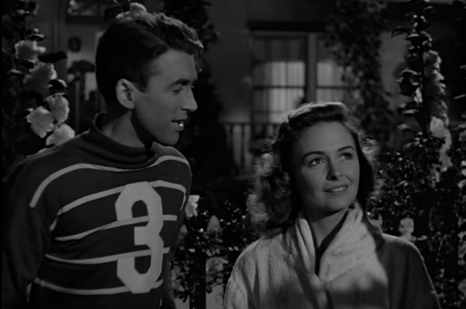
The romance of George and Mary is what many of us aspire to and it causes us to really empathize with their young love that weathers the good and bad breaks they receive. It’s the fairy tale love story we want, with the rock hard reality we are used to in our own lives. Some favorite moments in their life together would be the splash they make during the Charleston dance off, singing Buffalo Gals together, smooching on the telephone together, sharing a makeshift honeymoon together, and embracing after George gets his new perspective on life.

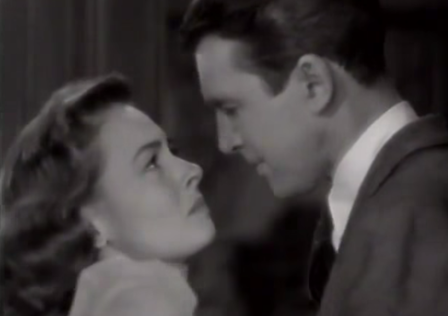
There are a fair number of close-ups utilized in this film, but they are usually used at crucial points in the narrative, and they tell us a great deal about both George and Mary.

The first key moment comes during a freeze frame of grown up George with hands outstretched giving us our first look at the man we will be following from there on out. The next big moment occurs when George learns that Potter will gain control and the Building and Loan will be disbanded if he leaves. He realizes in an instant that he must give up his plans. Then, he waits excitedly for Harry with Uncle Billy and it is a happy moment, but George learns his younger brother might have another job. The camera follows his worried face as he goes to follow his new sister-in-law. Never thinking of himself, he realizes that Harry has a chance for better things and that leaves George still working the Building and Loan.

After their tiff, the scene where George and Mary are talking on the phone with Sam Wainwright is a solidifying moment in their relationship. There are so many underlying emotions and unspoken feelings that they are having trouble figuring out and reconciling. And yet there is that violent epiphany when their eyes link. The tears and anger are quickly traded for passionate kisses reflecting the often complicated facts of romance.

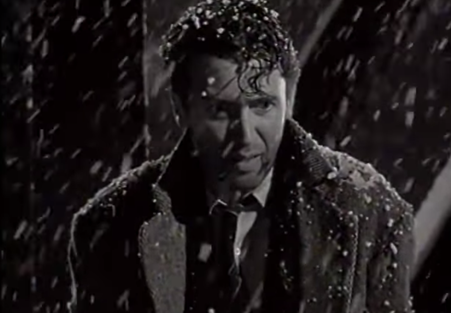
One of the final close-ups that hits home occurs when the now non-existent George stumbles away from the front door of his mother, who now has no concept of him. There is sweat on his brow (maybe from the 90 degree summer heatwave) and desperate bewilderment in his eyes. This is the lowest point he could have imagined. His own mother does not know who he is. His wife has grown old and lonely in an existence of exile. Stewart’s face is so expressive and earnest suggesting that George knows just how important human companionship is. Humanity was made to be in fellowship with each other. Lack of money means very little in comparison to our friendships and family ties. This is essentially what George finally comprehends and what Clarence reminds him. George understandably lost sight of his wife and his children and his friends. They were a gift not to be taken lightly.

Aside from these close-ups, it is also evident that a great deal of  effort was put into creating this world from the characters and their back stories to the town itself which was constructed on the RKO lot. Everything from the building facades, to stray dogs, and snow make the drama more atmospheric. It’s one of those films that reveals the beauty of using real props inhabited by seemingly real people. That’s why I sometimes am disillusioned by CGI. Although it can allow us to create amazing spectacles, oftentimes it creates a world that feels altogether fake and alien. It’s not relatable and it lacks the humanity that makes up our existence each and every day. In other words, it has very little of what makes It’s a Wonderful Life so compelling to me.

Perhaps there are more impressive or greater films, but there are few with greater heart and there is something to be said for that.

5/5 Stars

Review: Miracle of 34th Street (1947)

703c5-miracleon34thChristmas movies do not get much better than this. What a concept! Here’s a film about a man who really is Kris Kringle aka Santa Claus. He gets picked up by Macy’s department store to be their Santa Claus, and he winds up facing a hearing to decide whether he is legitimate or not. His pet project is to make an unsentimental little girl (Natalie Wood), and her practical mother (Maureen O’Hara) believe in him. He finds an ally in a young lawyer (John Payne) who believes in his holiday cheer and is also smitten with the girl’s mother.

Some people would undoubtedly say it’s a bunch a hogwash to make a movie about such a topic. Maybe it is only holiday tripe, but I find it is very hard to refute this “Miracle” of a Christmas classic. The characters portrayed are so spot on and heartfelt it is so easy to get pulled into their story. At the same time, it’s difficult not to like a film where department stores help each other, the hustle and bustle is toned down, and for once mankind has faith in each other for awhile.

As an audience, we gravitate towards Edmund Gwen because he represents the Santa we all wish to know. He is kind, thoughtful, generous, and above all a magical gift giver. Maureen O’Hara goes through a character progression that mirrors that of her daughter, except it is perhaps a little more poignant in her case due to her maturity. It would seemingly be easy to dislike her and yet thanks to O’Hara we cannot help but feel for her. She is also extremely beautiful, even in black and white. Although young, Wood proves to be a memorable little girl in this one, and she was just getting started. Payne is a good addition in his own right — a highly underrated actor.

The film is rounded out by a wonderful array of characters in the Macy’s store like magnate R.H. Macy (Harry Atrim), well-meaning Mr. Shellhammer (Philip Tonge) and friendly young janitor Alfred (Alvin Greeman). Shoppers such as the one and only Thelma Ritter in an early role, and civil servants like Judge Harper  (Gene Lockhart) round out New York’s population with generally decent people who we can relate to. The one exception is Dr. Sawyer (Porter Hall), the company psychologist, and greatest villain of the film, who is the antithesis of Kris and his Christmas spirit.

My hope is that this one never pales, never loses its cheer, and maintains its timelessness for many Christmases to come. Until the next Macy’s Thanksgiving parade comes along have yourself a merry little Christmas and remember all psychologists are not evil jerks looking to ruin the holidays!

5/5 Stars

White Christmas (1954)

58e88-white_chrismas_filmMany times I feel like a broken record (this time playing a Christmas tune), but White Christmas is one of those classics that I never get tired of. It is so ingrained, so integral to my childhood memories, that I have difficulty analyzing it or finding fault.

Wonderful, visceral films stop being something that must be thought about and simply become an all out experience. That’s what White Christmas is for me. A full blown Christmas experience courtesy of Bing Crosby, Danny Kaye, Rosemary Clooney Vera-Ellen, Dean Jagger, director Michael Curtiz and of course Irving Berlin.

I mean this as a compliment, but at a basic level, I always thought of White Christmas as a Christmas-like version of Singin’ in the Rain. We have a talented and dashing leading man in Crosby (Bing Crosby) and his mischievous and hilarious partner in crime (Danny Kaye). They are never better than during their parody of the sister’s act (It’s a priceless gem of a moment). Although, there is constant chemistry throughout the film thanks to the bickering and back and forth between two buddies.  Similarly to Singin’ in the Rain, you also have big spectacles, lavish sets, great songs, dancing, and constant quotability. It brings out the most reluctant of crooners and even the guys with two left feet. But what about the story?

White Christmas follows those two war buddies as they make it big as a boffo double act. Along the way, they help out a pair of sisters as well as their washed-up former commander General Waverly (Dean Jagger), who owns an inn in snow-less Vermont. Although, it’s lacking in business,  it’s the perfect locale for matchmaking, acts of kindness, and misunderstandings courtesy of local innkeeper and resident eavesdropper Emma (Mary Wickes). But what we end up receiving is a joyous romance with plenty of Christmas cheer and sentiment to go around.


Bing Crosby’s pipes are as good as ever (“Count Your Blessings”) and Danny Kaye can make his voice crack like no other. Vera-Ella has a talented pair of legs and Rosemary Clooney can carry a tune in her own right opposite Crosby. Whether it’s “Snow,” “Sisters,” or the eponymous track, there’s so much to offer. Weather any slow sections and you will be rewarded thanks to the even-handed direction of Michael Curtiz (Casablanca), paired with the ever memorable compositions of Irving Berlin. Now go spend the holidays with your kith and kin. Vermont must be nice this time of year, all that snow.

4/5 Stars

Christmas in Connecticut (1945)

416cc-christmasinconnecticutElizabeth Lane  is the perfect cook, hostess, wife and mother who is the talk of the town thanks to her daily column in a reputable publication. Anecdotes from her quaint lifestyle out on a Connecticut farm have everyone from war vets (Dennis Morgan) and publishing magnates (Sydney Greenstreet) fawning over her cooking. She’s a chef extraordinaire. Except she doesn’t actually exist, or rather not in that incarnation. Instead the persona is the creation of New York columnist Elizabeth Lane who lives in an apartment with very little culinary ability of her own. That’s why things get complicated when a young sailor followed by the old publisher want to meet her and share Christmas on her farm. She knows Mr. Alexander Yardley is a stickler for the truth and so she rushes to pull off a masquerade to keep her job. It’s a harebrained scenario involving the farm of a beau and her kindly chef pal Felix (S.Z. Sakall) who covers for her lack of cooking ability. For a while it works and romance is in the air, but as you would expect things get a little complicated. Everything ends up hunky dunky in the end. If you’re feeling a Christmas comedy with screwball elements, you’ve come to the right place. Stanwyck is always great and Sakall invariably steals the show at times.

3.5/5 Stars


Eternal Sunshine of the Spotless Mind (2004)

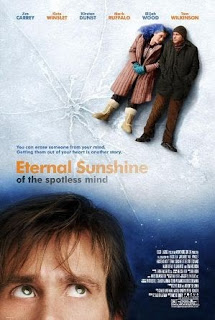
86a5e-eternal_sunshine_of_the_spotless_mind_ver3Starring Jim Carrey and Kate Winslet this fantasy romance opens with a man named Joel waking up in a funk. He boards a train and meets the free-spirited Clementine for what seems to be the first time.

The film then starts at the beginning where Joel and Clementine were actually lovers. They had a fight however, and Clementine paid for all of her memories of Joel to be erased. When Joel finds this out he too wants to have the procedure done. It takes place in his sleep and so he begins to see their romance in reverse order.

When he revisits some of the good times, he tries desperately to save some of the memories, but in the end they are erased. The film starts up again where it began with the pair meeting. They both discover tape recordings about their relationship and it causes them to become scared and confused. Joel asks her if they can begin again and Clementine is apprehensive that the same problems will creep up again.

However, they do decide to go through with it again because love is worth the risk. The non-linear, inventive story line by Charlie Kaufman is interesting and the rest of the  cast was pretty good including Mark Ruffalo, Elijah Wood, and Kirsten Dunst.  Furthermore, it was interesting to see Jim Carey in a dramatic role. This is a solid romantic comedy with some interesting ideas about memories, but I feel it deserves another watch due to the confusing story arc.

4.5/5 Stars

Drinking Buddies (2013)

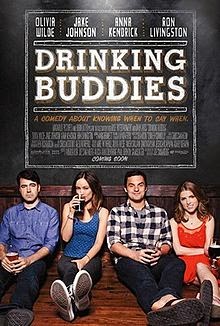
fd0b8-drinking_buddies_posterHere is an interesting little film that while not great has a lot of interesting things to say. It is about relationships, friendships, and life in general. It really revolves around two coworkers who work at a brewery together and also are almost constant drinking buddies.

With this territory comes often complicated lines and boundaries because they both are invested in other relationships with a significant other. The buddy status remains only to be taxed as Kate gets dumped by her boyfriend and struggles through her coping process. The one who ultimately gets most deeply affected is Luke. For one he does not want to see his friend this way, but it probably does not help either that he has deep feelings for her, as a buddy or otherwise.

There is an insanely large quantity of beer consumed which is not surprising given the name. However, what I really found interesting about the film was the “buddies” aspect. It looked at relationships and friendship between the opposite genders through a seemingly real and genuine lens. Sometimes it can be difficult, complicated, awkward, and most definitely painful. It is not anything like a movie. I guess that’s why I was content that the film did not try to tie itself up in a neat bow.

All the matters is that Kate and Luke are buddies again. Sure, there may be some unresolved stuff for them to work out, but then again aren’t our lives always complicated like that? I know mine certainly is and I suppose I wouldn’t want it any other way. As long as I have my buddies to go through it along side of me.

3.5/5 Stars

Vicky Cristina Barcelona (2008)

8c89f-vickycristina2Although he is not present you can hear and see the undeniable hand of Woody Allen behind this romance set in Barcelona. In a film that at times feels like a precursor to the more interesting Midnight in Paris, Allen takes on romance in another elegant city with two young Americans who have been transplanted there from their everyday lives.

Vicky (Rebecca Hall) is the practical one of the two with a fiance who is kind but by no means a romantic. Cristina (Scarlett Johannson) is the more adventurous type and she is intrigued by a forward Spanish painter (Javier Bardem) who invites them to spend a holiday with him. All the red lights are going off in Vicky’s head and she will not have it. But Cristina is interested enough to drag her friend along on this whim. They have a matter of fact narrator to guide their little tale of love and personal revelation.  Enter Maria Elena (Penelope Cruz) stage right and things gets a bit complicated.

This is a Film about love. A Film about people having their mini midlife crisis and a film about trying to figure things out. In that ways it is relatable and yet I have this uncomfortable feeling that Woody Allen is speaking to me veiled behind the worldviews of his characters. It seems like I can hear his voice obviously peeking out behind many of these characters so they lack interest. There’s nothing new and exciting. For instance, I liked Rebecca Hall, but to be honest her character is bland and she soon comes to realize that herself. It’s not just her either but the social circles she interacts in. The people are dull, middle class, American types. Cristina might have a little bit more mischief in her, but that does not necessarily make her all that interesting.

However, Javier Bardem and Penelope Cruz play a pair of characters who are perhaps the most interesting. Maybe it is just a result of playing artists but they are often difficult to read and do not make complete sense. They are both romantics but they are prone to violent passion or angry fights. That’s the dynamic Vicky and Cristina get thrown into and I doubt either one expected it.

The story ends like other Allen films as a quirky romance with touches of comedy and strange acts of fate. Vicky and Cristina leave Barcelona perhaps a little wiser but with little more figured out about life.

3.5/5 Stars

La Notte (1961)

36075-lanotteposterHere is a film full of glitz reminiscent of La Dolce Vita, a cast starring the likes of Mastroianni, Moreau, and Vitti, with a meandering plot courtesy of Michelangelo Antonioni and gorgeous black and white visuals.

This film is certainly not for the action fanatic because we are given very little. In fact the story revolves around a couple who have trouble communicating so even the dialogue seems sparse at times. The marriage is slowly going down the tubes and neither partner is ready to acknowledge it until the end when the wife finally does.

Moreau definitely had stronger performances like Jules and Jim because here she hardly talks and is highly misanthropic. Monica Vitti is more interesting in her role simply because she has more energy infused into her.

One of my favorite moment in the film had to be at the party where Mastroianni first sees  Vitti playing a rudimentary shuffle board. We are watching just like he is except there is a strange sensation that something is doctored with the image. It turns out that we are only looking at the reflection and then the camera swivels to the right to actually show reality. It was one of the noticeable artistic shots that really stood out to me.

La Notte is a subdued film, more often than not, and so if you go expecting that type of pacing you start to enjoy the little pieces here in there that are given to you. By the end it is rather sad because the marriage not working. There is no huge fight, no bickering, just apathy and that is in many ways more painful to see.

4/5 Stars

L’avventura (1960)

L'avventuraSmallL’avventura is one of those films that it is difficult to make a cohesive review for. If you are watching it purely to be entertained, you have it all wrong, because that is not its main purpose. Its greatest attribute is the special place it has in the pantheon of film art.

It is a film about a group of high society adventurers who go on a boat trip through some islands, only to have a woman passenger literally disappear, practically into thin air. Her boyfriend and her best friend search for her in the ensuing days, only to fall for each other, and that is about it. This is, of course, the most superficial level possible.

L’avventura is quite interesting visually and I wish I could have seen it on the big screen. The reality is, oftentimes, not a whole lot is happening, but it causes you to actually focus on the images in the frame. Michelangelo Antonioni gives us numerous settings all over Italy, and most have something to do with the wanderings of natural beauty Claudia (Monica Vitti) or her companion Sandro.

Anna (Lea Massari), despite her early importance, is hardly in the film. She is only a wisp in the wind and the mystery surrounding her is of lesser importance. The outcome is what matters as her friend and boyfriend become lovers. Theirs is the relationship that is explored as it develops, evolves, and becomes fully tested.

In the final moments, Antonioni toys with us, suggesting just possibly that Anna might be in the picture again. In fact, he must have a very cruel sense of humor indeed. Here in L’avventura as well as Blow-up (1966) he waves a mystery in front of our nose and leaves it unresolved. It is absolutely maddening, in some respects, and yet he makes us look at something else altogether. He also had the gall to name a film with a meandering plot like this L’Avventura! The nerve of it all, and yet I respect him for it because it messes with our conventions and forces us to be uncomfortable.

It is understandable that this was a polarizing film at Cannes in 1960, and I can only imagine that it has the same effect over 50 years later. One thing is for sure. This is no Gilligan’s Island with a three-hour cruise set in Italy. There is a lot more to it than the plot. Not my favorite adventure, but I respect its pure audaciousness of form.

4.5/5 Stars

Shadowlands (1993)

2bfce-shadowlands_ver2Starring Anthony Hopkins and Debra Winger with direction by Richard Attenborough, this film chronicles the romance of famed Christian professor and author, C.S. “Jack” Lewis with the American poet Joy Gresham. Jack is by now a respected professor at Oxford and a widely acclaimed lecturer who often speaks on the issue of human suffering. In his personal life, he is rather reserved. He lives with his older brother Warnie and spends times with his colleagues discussing topics of all sorts at the local pub in the evenings. 

It is not until he receives a letter from an American admirer named Joy Gresham that his life seemingly begins to change. He first accepts to meet her only to be gracious, but soon their relationship develops into a close bond. Jack meets Joy’s son Douglas who is enthralled by Narnia. He even offers them a place to stay during the Christmas season, since they have nowhere else to go. Lewis and Gresham are very different people, to say the least. He is a quiet intellectual with the sensibilities of an Englishman, while she is a plain -speaking American who does not mince words. However, these differences bring them closer together because they help each other to view the world in a radically new light.  Jack learns how Gresham’s marriage is going badly and he settles to marry her in a practical union so she and Douglas can stay in England. They do not speak of it much and it hardly seems real. Joy calls him on it realizing for herself that he allows no one to challenge him. There is no vulnerability to him whatsoever.

However, then Joy is diagnosed with bone cancer and slowly but surely she begins to deteriorate. For the second time in his lif,e Lewis understands the anguish that comes when a loved one is suffering. Because, the fact is, he most definitely loves Joy, and it simply took a tragedy to make him realize it. As with any inexplicable suffering, Lewis is tested in his faith, and the reality human suffering has new meaning to him. It is no longer just lecture material, becoming a far more personal process.

Although this film is not so much focused on C.S. Lewis as a Christian theologian or apologist, I think Anthony Hopkins does a wonderful job of portraying him as a kindly and gentle man of faith. He struggles with doubts and fears like every human, but he found something wonderful in his love for Joy which ultimately changed him.

Debra Winger must also be commended because she played well off of Hopkins and even though I have no picture of the real Gresham, Winger seemed to embody her. In some ways, I found her most beautiful when she was bedridden, absent of all makeup and seemingly so pure. It positively tears your heart out watching her son say a tearful goodnight or to look on as Jack stays up with her. This is a better picture of real, unadulterated love than most films can hope to manage because it very rarely becomes a sappy melodrama instead resorting to more deliberate means. As Jack says we live in the “Shadowlands,” but amidst the pain and suffering, love seems to shine through even brighter.

This was such an enlightening film for me because I always envision C.S. Lewis as a scholar and rational thinker, which he was. But he also had a vulnerable human side and this film, as well as A Grief Observed (written after Joy’s death), prove that point. It’s hard not to feel for him and that’s part of the beauty of this story.

4.5/5 Stars