Rear Window (1954) – Alfred Hitchcock

02805-rearwindowposterStarring James Stewart, Grace Kelly, and Raymond Burr with director Alfred Hitchcock, this is a superb film that takes place in a very limited space. L.B. Jefferies (Stewart) is a professional photographer who is incapacitated in his flat with a broken leg. All he has to pass the time is watching the people across the courtyard. Although he very rarely interacts with them, he slowly begins to know them just by spectating. Pretty soon he realizes something is amiss when the annoying wife across the way is no where to be seen and her husband (Burr) is acting strangely. With help of his ravishingly beautiful girlfriend (Kelly), Jeffries tries to uncover the truth. Everything escalates when Lisa breaks into the man’s apartment and it finally peaks in a climatic confrontation. In the end all is well and Jeffries realizes his true love. This is one of my favorite films because of its unique setting and it is possibly Hitchcock’s best. He takes an environment that is so confined and then makes a very entertaining and suspenseful film with it.

5/5 Stars

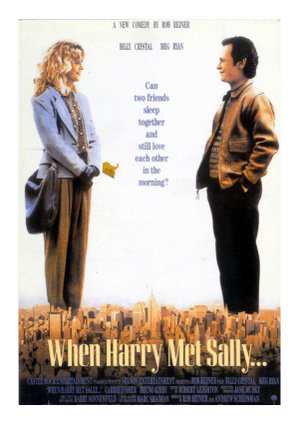
When Harry Met Sally (1989)

aa6b4-whenharrymetsallyposter1A romantic comedy directed by Rob Reiner, and starring Billy Crystal and Meg Ryan, the film opens in 1977 when Harry and Sally first meet and then share a long car ride to New York. They part ways not expecting to see one another again. Sure enough they meet again and they both are in serious relationships with others. But a few more years down the line they cross paths and they both are having trouble getting over their failed love lives. With the situation the way it is, Harry and Sally decide to become friends and they begin to confide in each other while also spending more time together. However, they want to remain just friends and they set each other up with their best friend respectively. This ends in their best friends becoming romantically involved and it leaves Harry and Sally where they were before. When Sally is going through a tough time Harry comforts her and in the moment they make love. In the aftermath their relationship becomes tense and it ends in a fight. All alone on New Year’s Eve they finally make up and share a kiss. They are finally a couple. This film has adult themes but Reiner makes this film a nostalgic feel in a way by using a flashback, voice-over, split screen, and conversations from married couples. Furthermore, the soundtrack by Harry Connick Jr. is reminiscent of crooners from a bygone era. In my mind, this film seemed very similar to some of the old romantic comedies including The Awful Truth (1937).

4/5 Stars

Annie Hall (1977)

Starring Woody Allen and Diane Keaton, the film begins with Alvy Singer (Allen), a comedian with a good career and two unremarkable romantic relationships. That all changes when his friend (Tony Roberts) introduces him to the lively Annie Hall (Keaton). Over time they begin to grow fond of each other and they spend lots of quality time together in New York. However, after a trip to Los Angeles, they decide to split up and Annie stays in California. Alvy realizes his love and goes to see her again. His proposal of marriage is rejected, however after some time passes he comes across Annie in New York and they remember all the good times. This comedy romance is a quirky Allen movie that uses sight gags, breaks the fourth wall, utilizes voice over, and has lengthy camera shots.This film is a lot about simply talking and it certainly has its moments of brilliance.

4.5/5 Stars

Rebel Without a Cause (1955)

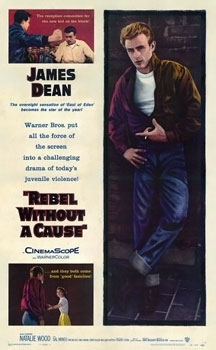
A film starring James Dean, Natalie Wood, and Sal Mineo,  with direction by Nicholas Ray, Rebel Without a Cause follows three teenagers, who are confused and conflicted about their lives. 

The initial sequence rolling behind the opening credits has the inebriated Jim Stark lying in the street fiddling with a toy monkey. Then, he is brought into juvenile hall, and simultaneously the story gives us a glimpse of not only the rowdy Jim, but discontented Judy, and the distant boy Plato. Each one has their own personal pain, and thus this film from the beginning really focuses on three rebels, who embody the adolescent generation. James Dean is Jim Stark: the new kid on the block, who is constantly moving with his parents. In the station when his parents retrieve him, there is obvious tension on all fronts, which include heated arguments, and outbursts on the part of Jim.

The morning after being brought in he meets Judy only to get mixed up with her friends. Stark however also befriends the isolated loner Plato, who was in the station the night before. The trouble with the other teens starts with a switchblade contest during a school excursion to Griffith Observatory, but the stakes get bigger when they compete in a “Chickie Run” over a cliff. Stark lives but the other boy, Buzz, dies in the accident. Everyone flees the scene before the police arrive.

Stuck between a rock and a hard place, Dean and Wood’s characters gravitate towards each other. Their parents seemingly do not understand them, and so they find comfort in each other instead. Their new found friend Plato tags along as they hold up in an abandoned mansion for the night. They spend the evening lounging around, making light of their parents and just talking. 

However, all does not bode well when some of the high school thugs come looking for Stark. Plato flees the scene with a gun, and soon he has policemen on his tail. Plato is in a paranoid and unstable state. Jim tries to console him and bring him out peacefully. But despite his best efforts, tragedy strikes one final blow.  All is not wasted, however, because Jim’s father (Jim Bachus) vows to be a better and stronger parent than he was before. 

Following his breakthrough in East of Eden, Rebel would be the movie that defined Dean’s short but iconic career. His line “you’re tearing me apart!” would further define the angst felt by many teens at the time. There is a certain aura around this film for some reason, maybe because of Dean’s portrayal that is at times so moody, and at other times so subtle, but powerful nonetheless.

I think part of the credit must go to director Nicholas Ray, who gave Dean free reign to improvise and develop his character in the way he saw fit. The film is tragic in another sense because all the primary stars died at an early age. Dean’s is the most remembered, but Mineo and Wood, both died extremely young as well. In Rebel Without a Cause, they all gave memorable performances and there are other notable players in this film including the usually comedic Jim Bachus and a very young Dennis Hopper.

I think Rebel ultimately survives today because it tells a universal tale of a generational divide and a divide between young people fighting peer pressure. In the heads of teenagers the world can become jumbled and between school, fitting in, and home life it can be a struggle. This film dramatically illustrates that fact. So maybe the kids look different, the cars are older and such, but the struggles of Jim Stark, Judy, and Plato are still relatively the same.  I must say this film really makes me want to visit the Griffith Observatory too, because it became such an integral part of this film’s story, and it is still around to this day.

James Dean only had three major film performances and you could make a case for which was the best. I think it is safe to say that this role was his most iconic. It’s hard not to identify him with his red jacket, blue jeans, and the ubiquitous cigarette. He was the Rebel Without a Cause.

 
5/5 Stars
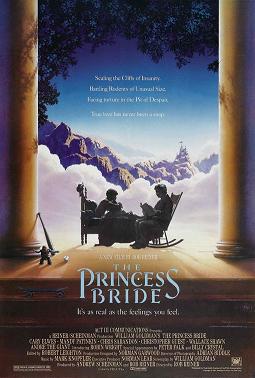
The Princess Bride (1987)

f1a6c-princess_brideDirected by Bob Reiner and starring an esemble cast this has to be the best action-comedy-romance-fantasy ever. It starts with a grandpa (Peter Falk), reading his grandson a fairy tale. In the story there was a peasant boy (Cary Elwes) devoted to a beautiful girl (Robin Wright). However, she treated him poorly and is eventually married off to the Prince Humperdink against her will. She is then kidnapped by a group consisting of a giant, a swordsman, and a self-proclaimed genius. Her devoted love comes to the rescue but Humperdink takes her back and has her true love tortured. Joining forces with the giant and the swordsman Inigo, along with the help of Miracle Max, Wesley leads a daring rescue. He arrives in the nick of time and his friends show great bravery. He saves his damsel in distress and they live happily ever after. This film is in a category all by itself and it is very quotable if not in fact inconceivable.

4.5/5 Stars

The Palm Beach Story (1942)

06b18-the_palm_beach_story_postrStarring Claudette Colbert and Joel McCrea with direction by Preston Sturges, the film opens with the chaotic marriage of a couple. As the story progresses we learn they are essentially broke because the husband is a lowly architect and his wife cannot do much anything. She resolves to divorce him so that he will not have to support her. She makes her way to Palm Beach by train, using her feminine charm on many men. One such millionaire is especially smitten with her. Despite his awkwardness, she continues the relationship as she wants to send money to her husband so his airport can be built. However, things get complicated when her husband comes for her and the millionaire’s chatterbox sister comes to visit as well. In order to save face Colbert’s character introduces him as her brother. Now her husband is being pursued by another woman and she is close to being proposed to. Finally, she explains what is going on leaving the brother and sister disappointed. However, there is still hope thanks to a hilarious coincidence. The film ends with there beautiful simultaneous wedding ceremonies. Preston Sturges definitely has a knack for the quirky dialogue and situations. I have to say I personally enjoyed the Lady Eve and Sullivan’s Travels more but this film was certainly all over the place.
 
4/5 Stars

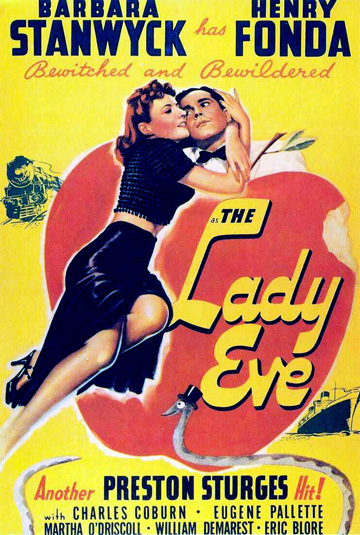
The Lady Eve (1941)

Starring Henry Fonda and Barbara Stanwyck with director Preston Sturges, this screwball comedy is a good one. The supporting cast is rounded out wonderfully by Charles Coburn, Eugene Pallete, and William Demarest. The story begins on a big ocean liner where a beautiful young woman (Stanwyck) tries to pull a con on a naive, rich bachelor (Fonda). Slowly however they begin to fall in love and they plan to get married. He catches wind of her notoriety and becomes cold and that ends their relationship. In an act of revenge she poses as someone’s niece, a Lady Eve, so that she can be close to him. Through a series of events he thinks she is a different person who looks similar and over time they decide to get married. When Eve tells him about all her boyfriends he feels he has made a mistake. Back on the ship he is ecstatic to see the first girl and they embrace. Fonda’s character feels guilty because he is already married but then again she is too…to him. This film has a great combination of wit and slapstick which makes it an enjoyable classic.

4.5/5 Stars

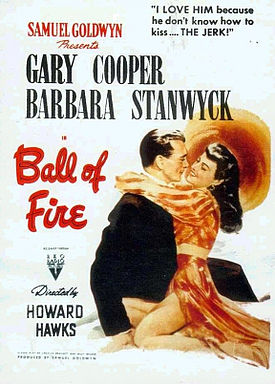
Ball of Fire (1941)

a5490-ball_of_fire_movie_posterStarring Gary Cooper and Barbara Stanwyck, the film revolves around a young man (Cooper) and seven older intellectuals compiling a Encyclopedia who get involved with a burlesque dancer (Stanwyck). They are interested in her constant use of slang and she is happy to use them as a cover to avoid the cops while she waits for her gangster boyfriend. However, things take a turn when the young man falls for her and proposes. Little does he know they are being used until they unknowingly transport her back to the gangster. He feels betrayed and she realizes her love for the corny intellectual. Although they are held by the gangster’s thugs, the intellectuals join their wits to overcome their foe. In the nick of time they stop the marriage and the true loves get back together. Howard Hawks directs a nice combination of humor and romance. The story by Billy Wilder, is Snow White and the Seven Dwarfs with some major twists.

4.5/5 Stars

Ninotchka (1939)

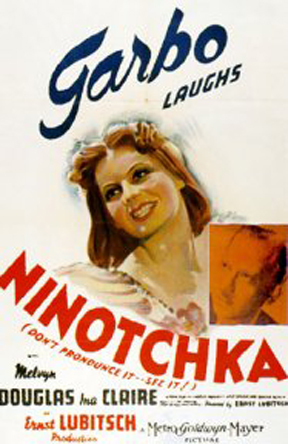
e937e-film_ninotchkaStarring a cast including Greta Garbo and Melvyn Douglas with director Ernst Lubitsch, the film opens in Paris with three quirky Soviet Russians. They are sent to sell some jewels and at the same time to marvel at the capitalist society. Their curt, robotic, and serious comrade arrives to help them. She meets a Parisian playboy and seriously hopes to learn about his society.  However, after he finally makes her laugh the two of them become romantically involved. A jealous duchess manipulates the situation and Ninotchka is back in Moscow. She is reunited with her friends there but still is somber because she is no longer with her love. That changes quickly enough though. Lubitsch gives us another witty comedy that plays off the conflict between ideologies and cultures. Garbo, Douglas, and the three Russians are all likable characters that help make this film fairly good.


4/5 Stars

Mr. Deeds Goes to Town (1936)

Starring Gary Cooper and Jean Arthur with director Frank Capra, this film follows a man from a small town who is left $2 million by a dead relative. Longfellow Deeds is thrust into a life in New York where everyone wants his attention in order to get money and support. However, this man they took for a stooge has common sense and grows fed up with them all. The only person he talks to is Arthur’s character who is actually a reporter. While she writes damaging articles, they slowly begin to fall for each other. He finds out what she did and eventually decides to give his money away. Fortune hunters try to claim he is crazy and they bring their case to court. Initially Deeds does not defend himself, but when his love speaks on his behalf he changes his mind and fights for his cause. Capra was wonderful at making the feel good films about the common man. Here he does it once again in a precursor to Mr. Smith Goes to Washington and Meet John Doe.

4.5/5 Stars