My Man Godfrey (1936)

24635-my_man_godfreyStarring William Powell and Carole Lombard with a zany cast of others, the film follows a funny socialite daughter who takes a “Forgotten Man” as her family’s butler. Godfrey takes the job and soon learns how to cope with the scatterbrained girl, her stuck up sister, their ditsy mother, their long suffering father, and Carlo who is the man patronized by Mrs. Bullock. On accident Godfrey comes in contact with an old friend and his secret almost comes out. In the cover up Lombard’s character believes him to be married with children. Because she loves him, she goes away to Europe to try and forget him. However, upon hearing the truth, she is ecstatic and Godfrey finds himself being married all of the sudden. This is a good example of the screwball comedies of the 1930s and I will admit, it is a pretty good film.

4/5 Stars
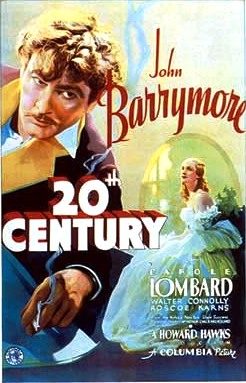
Twentieth Century (1934)

63742-twentieth-century-post1Starring John Barrymore and Carol Lombard with direction by Howard Hawks, this archetypal screwball comedy revolves around a frenetic impresario and the emotional girl he made into a household name on Broadway. 

Oscar Jaffe is the undisputed king of Broadway and after he christens the inexperienced Mildred Plotka, Lily Garland, she becomes his box office Queen. He makes her into a great actress and their numerous collaborations turn out success after success. However, as several years pass Lily is fed up and she ends her connection with Jaffe in a volatile falling out after she finds that he has hired a private investigator to keep tabs on her. Without his starlet Jaffe produces flop after flop and he is endangered of being jailed by his backers. He escapes in disguise and boards the Twentieth Century Limited train. He is accompanied by his two quirky assistants and it just so happens that Lily has boarded that same train. Jaffe sees it as a chance to make amends, but Lily will have nothing of it. They have some more frenzied confrontations on the train as Jaffe tries to convince her to star in his next project. In a last ditch effort he pretends to be deathly ill after a scuffle so that she will sign a contract in her distress. In the end she proves to truly care for him and once again they are back on Broadway, Lily Garland star extraordinaire, and Oscar Jaffe the domineering visionary. 

Along with It Happened One Night, this is one of the early examples of the screwball comedies. This was a perfect practice run at it for Howard Hawks who would direct the more well-known Bringing Up Baby in 1938. The leading performers are absolutely chaotic and over the top in their performances, but it’s the way it should be. Furthermore, like most screwball comedies the odd supporting characters are often a great source of laughs. The extended train sequence here reminded me somewhat of The Palm Beach Story another raucous film.
 
4/5 Stars

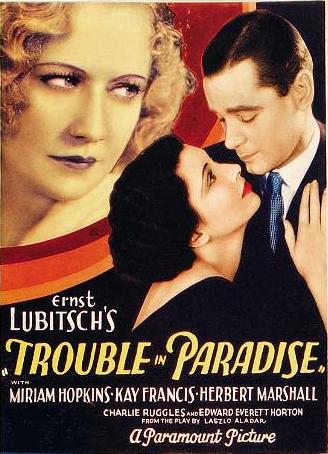
Trouble in Paradise (1932)

73432-troubleinparadise1932Starring Kay Francis, Herbert Marshall, and Miriam Hopkins with director Ernst Lubitsch, this film is a funny pre-code era romantic comedy. A man and a woman crook meet each other in Venice and after wreaking some havoc they fall in love and get married. The two of them move to Paris in order to pull a big heist on the elegant Collete perfume tycoon. Things get complicated when the male crook begins to fall in love with her. Furthermore, her two other suitors get jealous and eventually realize where they have seen him before! Then his wife learns what is going on and she is jealous. He sadly breaks off his relationship with the lady he meant to rob. But once a pick pocket always a pick pocket and he and his wife make up. For being an early 1930s film, I particularly enjoyed this one. Lubitsch did a fine job directing and there is a lot of wit.

4.5/5 Stars

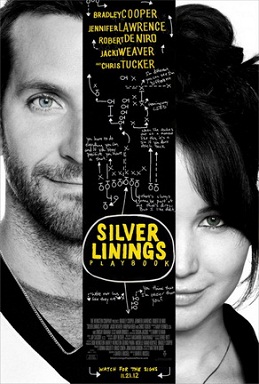
Silver Linings Playbook (2012)

154c0-silver_linings_playbook_posterStarring Bradley Cooper and Jennifer Lawrence with Robert De Niro, this film opens with a man named Pat who is being released from a mental health facility in Philadelphia. As he tries to recover from a tragic event in his marriage, he moves back in with his parents, goes to therapy sessions, and improves himself while struggling to keep his emotions in check. His traumatic past and bipolar disorder make life difficult but then he meets a young, straightforward widow named Tiffany. Because of their unique situations, they form an odd type of friendship. Eventually Tiffany agrees to give a letter to Pat’s wife if in return he trains as her partner for a dance competition. At the same time Pat’s superstitious father makes a giant bet on an Eagles football game as well as their contest which are both happening on the same day.

It finally arrives and they get ready to show off what they practiced only to have the unexpected occur. In the end, a new Pat realizes how he really feels and chooses to live his life the way he wants.

This film had a lot of coarse language and it was depressing at times. Despite this, the acting was great and it ultimately gave off a positive outlook that focused on the silver linings in life. The direction was solid and I also appreciated the soundtrack. Furthermore, this film tackled the difficult topic of mental illness head on with a good result.

4/5 Stars

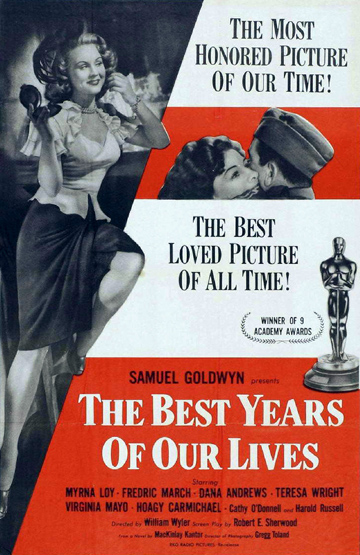
The Best Years of Our Lives (1946)

Directed by William Wyler, the film chronicles the lives of three men as they return from World War II. They feel joy and then angst trying to integrate back into society  with lives that are strangely different from when they left. They face various struggles like finding a job, holding a marriage together, to just trying to get used to a disability. Although they each have their own lives which we get to see first hand, they are still intertwined. Together these three men find it within themselves to make these the best years possible. Full of both highs and lows, this movie is extremely touching and leaves you with a smile. The cast is superb including Dana Andrews, Fredric March, Harold Russell (real life amputee), Myrna Loy, Teresa Wright, Virginia Mayo, and of course Hoagy Carmichael. This film is great because it does not try to glamorize and it stands the test of time in my mind.

5/5 Stars

The Heiress (1949)

fa57e-heiress_wylerStarring Olivia de Havilland and Montgomery Clift with director William Wyler, the film takes place in New York in the 1840s. Catherine is a shy and awkward young woman who lives with her domineering father who is a prominent widowed doctor. At a party a young man introduces himself and begins seeing Catherine frequently. Quickly their plans turn to marriage but her father will not approve. Since her lover is not rich, he sees him as a fortune hunter. Catherine decides to elope with her love, but he never returns leaving her feeling rejected and forlorn. soon the doctor gets ill and dies, but the relationship does not end will since Catherine blames her father. And in the process she has grown cold. Clift’s character finally returns and after some reluctance Catherine seems to agree to get married. he leaves to gather some belongings only to return to a bolted door. Catherine gives him some rejection of his own after what she endured. This films becomes interesting because you do not know who was truly in the right. First Clift seems to be the heel and then de Havilland evolves so much the audience turns on her.

4/5 Stars

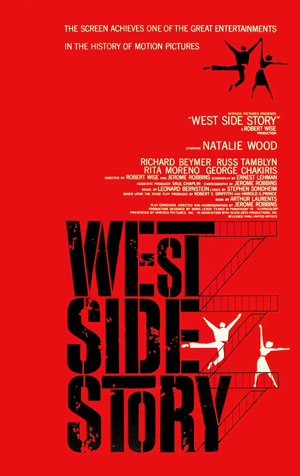
West Side Story (1961)

354d1-west_side_story_posterIn this 1960s, musical adaption of Romeo and Juliet, two lovers become infatuated with each other but the problem is that none of their friends would ever approve. They come from two different classes and backgrounds which are constantly at odds. The two sides frequently clash as represented by the Shark and Jet gangs. Naively, the lovers believe they can get away and be happy forever. However, the situation escalates when the gangs take part in a rumble. Pretty soon the situation is out of control and it has become something nobody wanted. Hope for the future finally seems possible for the pair but it is brutally crushed in an instant. The viewer is left with a feeling of tragedy. This is a very good film for the most part and many of the songs are great, sticking with you afterwards. I suppose it is quite difficult to go wrong with a story from Shakespeare .

4.5/5 Stars

Meet John Doe (1941)

Starring Gary Cooper and Barbara Stanwyck with direction by Frank Capra, the film begins with a news woman (Stanwyck) creating a made up story about John Doe, a man willing to commit suicide to protest big government. In order to keep the story going, they take a man off the street to effectively be John Doe. At first John (Cooper) and his friend the Colonel (Walter Brennan) are attracted by the chance to work. However, slowly he seems to become John Doe and the whole nation is seemingly behind him with Stanwyck’s character falling for his image as well. A political machine tries to discredit him and prove he never was John Doe. Now all along John decides to go through the suicide to prove his point to all. The political machine tries to stop him and Stanwyck finally does saying they can still keep the ideals of John Doe alive. Sharing some similarities with Mr. Smith, this film is one of those feel good films.

4/5 Stars

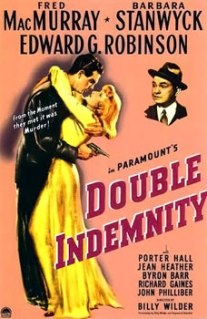
Double Indemnity (1944) – Film-Noir

If the Maltese Falcon was the first great film-noir then this film has to be a refining and improvement of the genre. Billy Wilder put together a crime film that is still intriguing today with its femme fatale and other techniques in storytelling and cinematography.
*May Contain Spoilers

Starring Fred MacMurray, Barbara Stanwyck, and Edward G. Robinson, this is a classic film-noir. Walter Neff is your average American insurance salesman. However while trying to sell some accident insurance he falls for a woman who is married to a former widower. Together they plot and carry out a murder on her irritable husband trying to cash in on a double indemnity clause. Although everything goes as clockwork the two of them must stay apart and Neff’s colleague is hot on their trail. Through a series of visits with Deitrichson’s depressed step-daughter, Neff himself finds out Phyllis was seeing someone else. In their final confrontation he figures out she killed her husband’s first wife . Then she preceded to use Neff for her own purposes.Following their confrontation Neff feels guilt and so he records all he knows for his colleague Keyes to hear later. This movie was definitely full of suspense as well as great characters. Directer Wilder utilizes the voice over with flashback very effectively to tell the story.

5/5 Stars


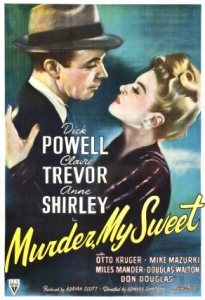
Murder, My Sweet (1944) – Film-Noir

murder my sweet

This film-noir adaptation of the Raymond Chandler novel stars Dick Powell, Claire Trevor, and Anne Shirley. It opens with a blinded Philip Marlowe being interrogated and so he agrees to spill everything he knows.

It all started one evening in his office when a big thug named Moose came in to get his help in finding a girl. Marlowe agrees to take the case and he questions a drunken bar owner but all is not right. He returns to his office where a man named Marriot wants his protection during a ransom drop off. However, at the location Marlowe is knocked out and the man is left dead. Through a series of events he meets Helen Grayle and her significantly older husband, who are both involved with a necklace. Also involved is the shady psychic adviser Jules Anthor, not to mention Mr. Grayle’s protective daughter Anne. Marlowe is forced to meet with Anthor and he eventually finds himself locked up in a facility. He gets away and after a meeting with Anne they head down to the Grayle’s beach house. There they have a confrontation with Helen. Now Anther is dead and Marlowe agrees to show Moose his girl Velma. They head down to the beach house and Marlowe puts all the pieces of the case together in front of Helen. Then Ann, Mr. Grayle, and finally Moose all burst onto the scene in a final chaotic finale.  Despite this bleak conclusion, there is also a hint of a happy ending. Much like the Big Sleep this film at times becomes incomprehensible but it just means your brain must work fast to catch up. Dick Powell I felt was a great Marlowe and Anne Shirley was a strong heroine. This is a quintessential film noir to say the least.

4/5 Stars