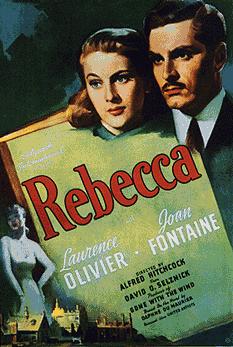
Rebecca (1940) – Alfred Hitchcock

This film directed by Alfred Hitchcock and starring Laurence Olivier with Joan Fontaine, was adapted from the Daphne du Maurier novel of the same name. The story begins in Monte Carlo where Max De Winter (Olivier) and a young woman (Fontaine) have a chance meeting as she is working for an older lady. Soon she learns that his previous wife died the year before. Fairly soon the two of them are attracted to each other and Max has plans of marriage and returning to his Manderley. However, back home the fairy tale is over and the new Mrs. De Winter is constantly tormented by the housekeeper Mrs. Danvers. Pretty soon Max himself seems to have changed. Confused Mrs. De Winter must learn what happened to Rebecca, the lady who was so enchanting. When she actually finds out the truth it is almost too much to bear. Like many Hitchcock films this one is certainly worth watching and it was actually his first American film. Olivier, Fontaine, George Sanders, and Judith Anderson all have very good performances.

4.5/5 Stars

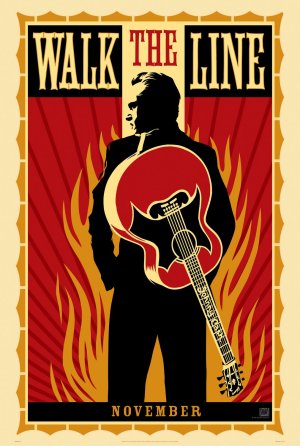
Walk the Line (2005)

Walk_the_lineStarring Joaquin Phoenix and Reese Witherspoon, this biopic opens with Johnny Cash recalling his past as he gets ready to perform at Folsom prison. JR is the son of an abusive share cropper and his brother Jack dies when he is just a boy. He goes off to Korea and comes back with a few songs under his belt. Cash marries his girlfriend and they move to Memphis where Cash tries to get work. On a whim he tries to form a gospel band to audition at Sun Records. Initially it goes poorly until Cash begins to Sing Folsom Prison Blues. Soon Johnny Cash and The Tennessee Two are signed and touring with many different artists. There Cash meets the likes of Jerry Lee Lewis, Elvis Presley and of course June Carter. Cash begins to fall for the recently divorced Carter but she rejects his initial advances leading Cash to go to drinking and drugs. They part ways but then later on they begin to tour again. His music is a success but his relationship with June causes his marriage to go down the tubes. He continues to takes more pills. This is the low point in his career but June gives him a second chance. They perform together at Folsom in 1968 and then after one rejection of marriage, June finally accepts while they are performing a duet. The two of them continue to perform and raise a family together. Phoenix was commendable as Cash and Witherspoon’s vivacious performance gave life to this film. One things is for sure, johnny Cash had a hard life that was full of mistakes. That’s what made his music so good. It was often personal and most importantly human. Because humans make mistakes. Thank you Man in Black for giving us what you did. 4/5 Stars

Vertigo (1958) – Alfred Hitchcock

acaeb-vertigomovie*May Contain Spoilers!

Vertigo is an intriguing Hitchcock thriller, set in San Francisco, that has you cheering for Jimmy Stewart as he falls in love and struggles with his fear of heights. Right away you are met with the haunting opening credits and the dramatic opening sequence where Scottie (Stewart) acquires his vertigo. From then on Scottie must cope with his dizzying condition however, he has no time to remedy it since he suddenly finds himself tailing a beautiful woman for a friend. Much of the rest of the film seems surreal with minimal dialogue and interesting cinematography, leading up to the death of Madaleine (Kim Novak). Then the film switches gears and is mostly about the impact on Scottie who had become infatuated with Madaleine. Often he appears to be in a trance and he becomes obsessive after meeting Judy who looks strikingly like Elster’s dead wife. Scottie becomes controlling, trying to make Judy into the image of the woman he loved. She just wants him to love her for who she is but that cannot be. Fittingly, the film ends the way it began with drama and tragedy. This certainly is a fascinating view of human psychology and complex emotions. In order to appreciate this film it is almost necessary to watch it at least twice, once to understand the plot and then another time to spot the little details. Of all of Hitchcock’s work, I would say I still enjoy Rear Window or North by Northwest better but this film at least deserves a viewing or two.

5/5 Stars

Groundhog Day (1993)

01498-groundhog_day_movie_posterStarring Bill Murray and Andie MacDowell, this romantic-fantasy-comedy is about a conceited weatherman named Phil Connors who goes to cover Groundhog Day. After coping with the day once, Phil wakes up and goes through it again realizing he is in a time loop. At first since there are no consequences Phil memorizes every occurrence, takes advantage of situations, and romances any woman he wants. However, over time the novelty wears off and it soon gives way to monotony. He even starts committing elaborate suicides to get out of each day. However, as he continues to fall for his producer, Phil begins to change and decides to use all he knows for good. After one day he is the most loved man in town and surprisingly enough he finally is free. The concept of this film is certainly interesting and it brings up hilarious and thought-provoking situations. Phil Connors begins as a self-serving jerk, hits rock bottom, and finally finds redemption in showing kindness for others. And the best part is he no longer has to listen to I Got You Babe!

4.5/5 Stars

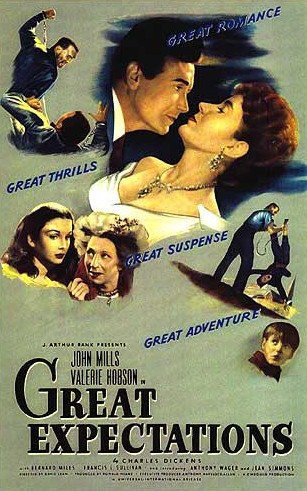
Great Expectations (1946)

ad366-great_expectationsWith director David Lean, and starring John Mills as Pip, the film begins with Pip as a young boy. Upon meeting a fugitive, Pip show him kindness and the man promises he will return the favor. A year or so later Pip begins to go to the home of an eccentric, rich widow to call on her. There he meets the lady’s adopted daughter Estelle and he falls for her. Now an adult, Pip learns he has a mysterious beneficiary who is paying for him to move to London to be a Gentleman. There he interacts with Mr. Wemmick, the attorney of Mr. Jaggers, and also Herbert Pocket (Alec Guinness). Then, someone shows up on his doorstep and changes his world. Soon he is orchestrating an escape for his friend, saying goodbye to the cold Estelle, and showing his displeasure for the elderly Ms. Havisham. However, in the end he learns a happy truth and reunites with Estelle. This moody, Dickens adaption actually has an optimistic side which is a nice change.

5/5 Stars

Rear Window (1954) – Alfred Hitchcock

02805-rearwindowposterStarring James Stewart, Grace Kelly, and Raymond Burr with director Alfred Hitchcock, this is a superb film that takes place in a very limited space. L.B. Jefferies (Stewart) is a professional photographer who is incapacitated in his flat with a broken leg. All he has to pass the time is watching the people across the courtyard. Although he very rarely interacts with them, he slowly begins to know them just by spectating. Pretty soon he realizes something is amiss when the annoying wife across the way is no where to be seen and her husband (Burr) is acting strangely. With help of his ravishingly beautiful girlfriend (Kelly), Jeffries tries to uncover the truth. Everything escalates when Lisa breaks into the man’s apartment and it finally peaks in a climatic confrontation. In the end all is well and Jeffries realizes his true love. This is one of my favorite films because of its unique setting and it is possibly Hitchcock’s best. He takes an environment that is so confined and then makes a very entertaining and suspenseful film with it.

5/5 Stars

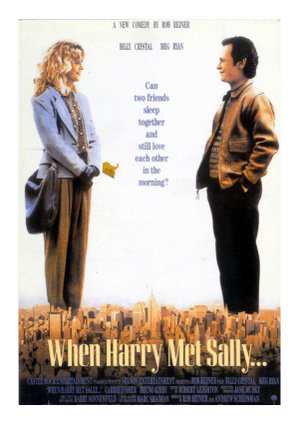
When Harry Met Sally (1989)

aa6b4-whenharrymetsallyposter1A romantic comedy directed by Rob Reiner, and starring Billy Crystal and Meg Ryan, the film opens in 1977 when Harry and Sally first meet and then share a long car ride to New York. They part ways not expecting to see one another again. Sure enough they meet again and they both are in serious relationships with others. But a few more years down the line they cross paths and they both are having trouble getting over their failed love lives. With the situation the way it is, Harry and Sally decide to become friends and they begin to confide in each other while also spending more time together. However, they want to remain just friends and they set each other up with their best friend respectively. This ends in their best friends becoming romantically involved and it leaves Harry and Sally where they were before. When Sally is going through a tough time Harry comforts her and in the moment they make love. In the aftermath their relationship becomes tense and it ends in a fight. All alone on New Year’s Eve they finally make up and share a kiss. They are finally a couple. This film has adult themes but Reiner makes this film a nostalgic feel in a way by using a flashback, voice-over, split screen, and conversations from married couples. Furthermore, the soundtrack by Harry Connick Jr. is reminiscent of crooners from a bygone era. In my mind, this film seemed very similar to some of the old romantic comedies including The Awful Truth (1937).

4/5 Stars

Annie Hall (1977)

Starring Woody Allen and Diane Keaton, the film begins with Alvy Singer (Allen), a comedian with a good career and two unremarkable romantic relationships. That all changes when his friend (Tony Roberts) introduces him to the lively Annie Hall (Keaton). Over time they begin to grow fond of each other and they spend lots of quality time together in New York. However, after a trip to Los Angeles, they decide to split up and Annie stays in California. Alvy realizes his love and goes to see her again. His proposal of marriage is rejected, however after some time passes he comes across Annie in New York and they remember all the good times. This comedy romance is a quirky Allen movie that uses sight gags, breaks the fourth wall, utilizes voice over, and has lengthy camera shots.This film is a lot about simply talking and it certainly has its moments of brilliance.

4.5/5 Stars

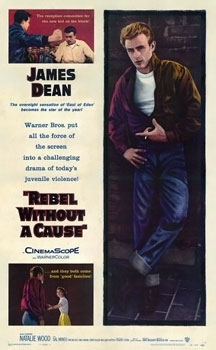
Rebel Without a Cause (1955)

A film starring James Dean, Natalie Wood, and Sal Mineo,  with direction by Nicholas Ray, Rebel Without a Cause follows three teenagers, who are confused and conflicted about their lives. 

The initial sequence rolling behind the opening credits has the inebriated Jim Stark lying in the street fiddling with a toy monkey. Then, he is brought into juvenile hall, and simultaneously the story gives us a glimpse of not only the rowdy Jim, but discontented Judy, and the distant boy Plato. Each one has their own personal pain, and thus this film from the beginning really focuses on three rebels, who embody the adolescent generation. James Dean is Jim Stark: the new kid on the block, who is constantly moving with his parents. In the station when his parents retrieve him, there is obvious tension on all fronts, which include heated arguments, and outbursts on the part of Jim.

The morning after being brought in he meets Judy only to get mixed up with her friends. Stark however also befriends the isolated loner Plato, who was in the station the night before. The trouble with the other teens starts with a switchblade contest during a school excursion to Griffith Observatory, but the stakes get bigger when they compete in a “Chickie Run” over a cliff. Stark lives but the other boy, Buzz, dies in the accident. Everyone flees the scene before the police arrive.

Stuck between a rock and a hard place, Dean and Wood’s characters gravitate towards each other. Their parents seemingly do not understand them, and so they find comfort in each other instead. Their new found friend Plato tags along as they hold up in an abandoned mansion for the night. They spend the evening lounging around, making light of their parents and just talking. 

However, all does not bode well when some of the high school thugs come looking for Stark. Plato flees the scene with a gun, and soon he has policemen on his tail. Plato is in a paranoid and unstable state. Jim tries to console him and bring him out peacefully. But despite his best efforts, tragedy strikes one final blow.  All is not wasted, however, because Jim’s father (Jim Bachus) vows to be a better and stronger parent than he was before. 

Following his breakthrough in East of Eden, Rebel would be the movie that defined Dean’s short but iconic career. His line “you’re tearing me apart!” would further define the angst felt by many teens at the time. There is a certain aura around this film for some reason, maybe because of Dean’s portrayal that is at times so moody, and at other times so subtle, but powerful nonetheless.

I think part of the credit must go to director Nicholas Ray, who gave Dean free reign to improvise and develop his character in the way he saw fit. The film is tragic in another sense because all the primary stars died at an early age. Dean’s is the most remembered, but Mineo and Wood, both died extremely young as well. In Rebel Without a Cause, they all gave memorable performances and there are other notable players in this film including the usually comedic Jim Bachus and a very young Dennis Hopper.

I think Rebel ultimately survives today because it tells a universal tale of a generational divide and a divide between young people fighting peer pressure. In the heads of teenagers the world can become jumbled and between school, fitting in, and home life it can be a struggle. This film dramatically illustrates that fact. So maybe the kids look different, the cars are older and such, but the struggles of Jim Stark, Judy, and Plato are still relatively the same.  I must say this film really makes me want to visit the Griffith Observatory too, because it became such an integral part of this film’s story, and it is still around to this day.

James Dean only had three major film performances and you could make a case for which was the best. I think it is safe to say that this role was his most iconic. It’s hard not to identify him with his red jacket, blue jeans, and the ubiquitous cigarette. He was the Rebel Without a Cause.

 
5/5 Stars

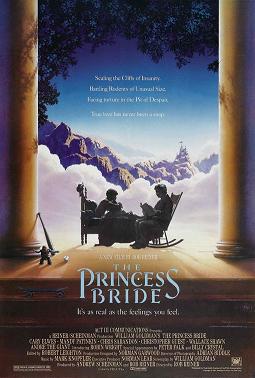
The Princess Bride (1987)

f1a6c-princess_brideDirected by Bob Reiner and starring an esemble cast this has to be the best action-comedy-romance-fantasy ever. It starts with a grandpa (Peter Falk), reading his grandson a fairy tale. In the story there was a peasant boy (Cary Elwes) devoted to a beautiful girl (Robin Wright). However, she treated him poorly and is eventually married off to the Prince Humperdink against her will. She is then kidnapped by a group consisting of a giant, a swordsman, and a self-proclaimed genius. Her devoted love comes to the rescue but Humperdink takes her back and has her true love tortured. Joining forces with the giant and the swordsman Inigo, along with the help of Miracle Max, Wesley leads a daring rescue. He arrives in the nick of time and his friends show great bravery. He saves his damsel in distress and they live happily ever after. This film is in a category all by itself and it is very quotable if not in fact inconceivable.

4.5/5 Stars