
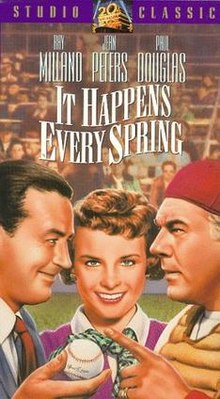
 Does this film glorify those who cheat and deceive taking advantage of others through the advances of modern science? Certainly not! Well, maybe a little but this is one of those ludicrous stories that never makes a pretense of being real life or a moral tale for that matter. It’s just a zany story that’s actually quite rewarding to be a part of.
At its core is a middling college researcher. He’s in love with a girl but not rich enough to offer her much of anything. What’s more intimidating is that her father is the dean of the school and Vernon’s tireless amount of research is getting him nowhere fast. Another seemingly trivial detail remains that every spring he gets obsessed with baseball and becomes distracted in his lectures, in his lab, and in life in general.
If you want to think about one of Disneys live-action classics, it’s easy to draw some similarities between this film and The Absent-Minded Professor (1961). In the latter film, flubber is used for an advantage on the basketball court. Here it’s all about baseball.
Vernon Simpson (Ray Milland) discovers the extraordinary characteristics of his new substance methylethylpropylbutyl quite by accident when he rolls a dampened baseball by a block of wood only to have the two repel. His eyes almost pop out of their sockets when it works time after time. The implications are simple. He can harness this discovery to make it in the MLB and S.T. Louis has aspirations for a pennant but needs pitching. This is his chance to realize his dreams.
The film admittedly doesn’t explain much about why Vernon is infatuated with baseball. Perhaps it was enough that most Americans still were taken with it since it was “The National Pastime.” Regardless, he hurriedly gets a leave of absence from work and provides a cryptic message to his girl not to worry about him.
His baseball career as chronicled by the film is a meteoric rise that totally revels in its completely ludicrous nature. He walks into the clubhouse talks with the manager (Ted De Corsia) and the teams head executive (Ed Begley) who doubt this adamant thick-headed nobody who brags he can win 30 games. Boy, does he shut them up and they’re glad he did.
Most everything is textbook as far as a film about a science researcher playing major league baseball and using a miracle substance to win ballgames can be. His girlfriend thinks he’s involved with the mob. He tries to keep his true identity a secret under the pseudonym King Kelly, and he begins to form a bond with his veteran bunkmate and backstop Monk Lanigan (Paul Douglas). I’ve always been a fan of Paul Douglas as an actor because he plays his characters straight with a gruff yet palpable sincerity. It’s little different here. Milland though hardly an American bred on stickball nevertheless is a charmingly scatterbrained lead.
I didn’t realize it until now but I’m rather fond of science fiction baseball comedies. It breaks every rule of baseball. It’s absurd. There’s so much to call into question and yet I don’t want to. But just for the fun of it all, let’s look at a few obvious inaccuracies from It Happens Every Spring.
King Kelly would never get a win if he came into a game that his team was already winning and yet he asks for $1,000 in compensation for such an appearance. Furthermore, it looks like he’s committing a balk about everytime he winds up. And if he’s not then baserunners would be stealing on him all day because he never pitches from the stretch. He’d be an easy target.
Believe it or not, Kelly actually doctoring the baseball, secret formula aside, definitely is not all that ludicrous. Pitches such as the spitball and scuffball were famously used in the games early days. Pitchers like Burleigh Grimes, a personal favorite of mine, made a living off the pitch and though the spitball, in particular, was outlawed in 1920, pitchers like Grimes were grandfathered in. He continued throwing it until 1934.
Still, that didn’t completely deter later pitchers from using it like another Dodger great Preacher Roe and then Gaylord Perry in the modern era. As long as you didn’t get caught there was no recompense and the same can be said of Kelly. Again, we’re not glorifying cheating. Don’t get any ideas.
3.5/5 Stars

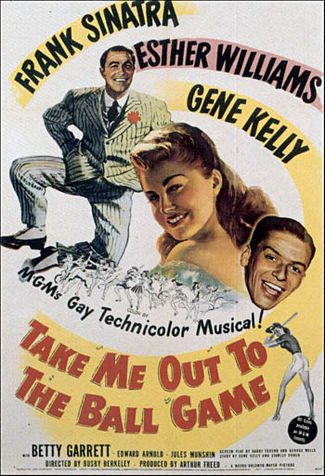 There’s something perfectly in sync between Gene Kelly and Donald O’Connor so I could never choose another duo over them but Kelly and Frank Sinatra are such wonderful entertainers that they help make this period baseball number a real musical classic even if it has to fall in line behind a row of other quality contenders.
 “You can fool all of the people some of the time, you can even fool some of the people all the time, but you can’t fool all the people all the time.” ~ Inscription in the Fortune Cookie
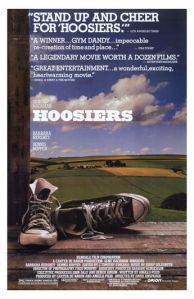 The last time I saw Hoosiers it was on VHS and I was only a boy and I hardly remember anything. Gene Hackman yelling. Dennis Hopper as a drunk. Jimmy the boy wonder, “The Picket Fence”, and of course Indiana basketball at its finest. But in those opening moments, as he drives into town and walks through the halls of his new home, I realized just how much I miss Gene Hackman. Yes, he’s still with us but the moment he decided to step out of the limelight and retire from his illustrious career as an actor, films got a little less exciting. His passionate often fiery charisma is dearly missed.
 John Garfield was never the most dashing of leading men but nevertheless, he was always thoroughly compelling as ambitious working class stiffs during the 1940s. He had a straightforward tenacity about him like he had to fight his way to the top. At the same time likable and destined for trouble right out of the gates. You can cheer for him and still rue the decisions that he makes. That’s what makes his foray as boxing champ Charlie Davis all the more believable. His aspirations are of a very real nature and they give his character a genuine makeup.
 4 Star Films