A Most Wanted Man (2013)

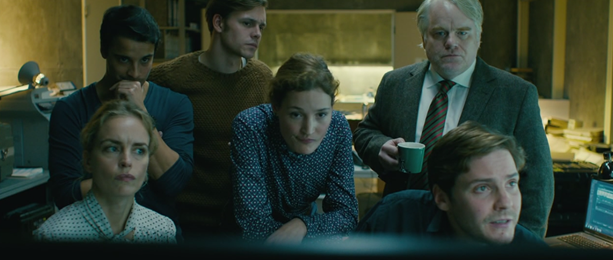
mostwantedman1A Most Wanted Man gained some notability as one of the last works of Philip Seymour Hoffman, and it must be acknowledged that he gives a truly worthwhile performance. No surprise there.

He’s Gunther Bachmann, the German head of a covert team that is looking to undermine potential threats from Islamic terrorist organizations in a post-9/11 society. The film features cinematography that can be best described as sullen and pale, fitting the mood of a, at times, dismal Hamburg, Germany. It looks to be everything a spy thriller is supposed to be, boasting an international cast including the likes of Rachel McAdams, Willem Dafoe, Daniel Bruhl, Nina Hoss, and Robin Wright, who are all intriguing to see in action.

But it is Hoffman with his team that commands the most attention, as they try and monitor an escaped political prisoner from Chechnya, who is seeking refuge but is also suspected of terrorist affiliations. He is contacted by a compassionate lawyer  (McAdams) who wishes to help him, but they get caught up in Gunther’s plan and try and flee from his prying eyes. It doesn’t exactly work. But really they are both part of a bigger ploy to pin down a wealthy Muslim philanthropist who could be in it even deeper with terrorist organizations. They just have to catch him with the help of some insiders and a banker (Dafoe), so Dr. Abdullah can be put away unequivocally. But Gunther also has his superiors and the American diplomat (Robin Wright) continually questioning his plans and mistrusting his motives. After all, he works for a, technically, unconstitutional organization that’s supposed to be off the radar.

mostwantedman2What A Most Wanted Man becomes is a brooding game of watching and waiting interspersed with a few moments that get the heartbeat up. But honestly, it’s mostly waiting, and it does serve to build the tension. There is one final turn that we could probably expect, and overall this is not a film of high volumes of action. In fact, there is barely any. Except by the time it ends, we are left with the same hopelessness and moroseness that seems to float over these characters in a haze. We are constantly wondering, “Where do their allegiances lie?” or “Why are they doing this?” and in the end, it doesn’t seem to matter. This is by no means Chinatown in its intricacy or otherwise, but you do get that same sense of futility.

I must admit I was a little surprised to see Rachel McAdams playing a German, but ultimately I was able to accept it. And although my knowledge of German film is limited, it was exciting to see two talented actors like Nina Hoss and Daniel Bruhl be featured, but they regrettably were relegated to smaller, hardly interesting turns. We might have to simply content ourselves with their other roles. Because this is most certainly Philip Seymour Hoffman’s show first and last. And it would, unfortunately, end up being his last. However, he left us as jaded and distraught as ever, and that’s a compliment to the actor he was.

3.5/5 Stars

The Revenant (2015)

The_Revenant_2015_film_poster (1)By definition, a revenant is someone who returns, but there is often a connotation that they are returning from the dead like a specter. The term gives major insight into Alejandro González Iñárritu’s latest undertaking with Leonardo DiCaprio. It’s a fully immersive, grimy, gory, grisly, grizzly-filled piece of cinema caked in blood, sweat, and tears in every sense of the word.

Its production took the cast and crew to Canada and Argentina to shoot sequences that were probably just as desolate in person as they looked onscreen. In that way, Iñárritu did not fudge or cheat with the use of excessive computer-generated imagery. Even if his production was overlong and undoubtedly volatile, you could say he was rewarded with vast expanses of engulfing cinematic visuals. Emmanuelle Lubezki yet again probably becomes one of the film’s biggest assets and his use of natural lighting is superb. In truth, it’s a painful exhibition in acting by DiCaprio and this icy frostbitten wilderness becomes the backdrop for a gargantuan feat of survival.

What would inspire such a film? I think many people were asking that, and it does find some of its story from the true circumstances of Hugh Glass, a 19th-century explorer, trapper, and guide who was part of a fur trapping expedition out west. After enduring an onslaught from a group of belligerent Pawnee, Glass can hardly recover from a bear mauling that essentially leaves him a lifeless carcass of a man.

His scared and scattered band is just hoping to get to their outpost to regroup, but their leader (Domhnall Gleeson capping off a phenomenal year) is intent on holding onto Glass because he’s the only one who knows the way back. His main insubordinate is the grubby, paranoid, scumbag John Fitzgerald, played so invariably corrupt by Tom Hardy. Glasses Pawnee-born son, the young trapper Bridger (Will Poulter) and a reluctant Fitzgerald agree to stay behind with the feeble man, while the others push forward. But being the backstabber that he is, Fitzgerald looks to bury Glass alive or finish him off for good with his musket. It doesn’t make much difference to him, but Hawk doesn’t want to see his father dead. Fitzgerald could care less. After all, what is he supposed to do? Keep this man alive only so he might die too?

Bridger naively follows Fitzgerald’s lead and they leave Glass behind for dead. There is no man who could survive, half-frozen, half-dead and still find a way to live another day. That’s where the story goes into stage two of survival.

The images that follow are ceaselessly gripping with majestic landscapes that are raw and brutal in the same breath. DiCaprio forges through streams, makes fires by some miracle, and keeps warm any way humanly possible. To don such a role you almost have to give up any human sensibilities and allow yourself to simply exist. He crawls and claws painfully, eats raw meat torn from a dead bison carcass, and sleeps inside the hide of his dead horse. It should repulse us in our modern lifestyles of comfort and excess, but in the same sense, it is a fascinating portrait of realism taken to the extreme.

The final chapter follows Glass as he returns to the fort, gets in contact with Captain Henry, only to chase after the fleeing Fitzgerald one last time. When he caught news of the ghost man’s return from the dead he knew the implications. Dead men tell no tales, but it’s a different story if they don’t die.

Unfortunately, The Revenant is rather laborious in the end and it’s a fatalistic revenge tale certainly but it’s not altogether satisfying. True, the perpetrator of evil is brought to justice, but that doesn’t mean a great deal. Perhaps because we admire Glasses gumption, but we never really build a connection with him. He truly is a solitary figure looking to avenge the death of his boy. There’s not more to grab hold of with this dynamic, maybe due to the fact that he is really a ghost. He’s so gaunt, battered, and spent that there is little space for emotions to fill all the nooks and crannies. Only a constant, pulsing desire for vengeance.

Still, we can always go back and be contented in Lubezki’s gorgeously stark visuals. The frontier look of this film brought to mind Malick’s film (also with Lubezki) The New World for a brief instant, and it makes me want to give it another look. Otherwise, The Revenant stands as an impressive feat, but it does not quite have the emotional wallop that it had the potential to wield. Although, the performances are thoroughly impressive, even if it’s more for their singular commitment than anything else.

4/5 Stars

The Sixth Sense (1999)

The_sixth_senseAll I knew going into The Sixth Sense was that it featured Bruce Willis and there was a twist at the end. That was about it. Thus, it was an interesting opening to have our main character already be shot within the first few minutes. But it’s not much of a spoiler per se because we quickly flash-forward to a year later.

That first case came back to haunt him in the form of a very distraught patient, with a major grudge, however, Dr. Malcolm Crowe has seemingly gotten past it and continued with his life. It doesn’t mean that his marriage is not still difficult and his work still taxing, but he gets by. Finally, he gets a case that might help him resolve his previous failures, at least that’s how he sees it. Of course, the intelligent, but aloof boy Cole Seer (Haley Joel Osment) sees the world in a whole different way. He literally sees dead people, but let’s take a step back for a moment. He has trouble connecting with his loving but nevertheless troubled mother (Toni Colette) and Dr. Crowe seems like his only friend. None of the kids at school like him, because they think he’s a creep.

What Crowe does is help him work through everything that it is unique about Cole and also help him see that there may be some purpose behind these ghosts that he can see. They want him to do things for him so maybe this is Cole’s chance to help them. And so he begins the process and despite it being terrifying and disconcerting at times, he is able to lay to rest these specters. Finally giving them peace and in the wake of a traffic accident that results in a death, Cole finally opens up to his mother. She has trouble believing him at first, but she never discounts her son, which leads to a tearful scene between mother and son.

M. Night Shyamalan is obviously well-known for his great interest in supernatural stories with twist and turns, but to his credit, he firmly plants his films in a reality, like Philadelphia, that we can grasp onto. That’s our base and he can go from there with psychological thrills and even a touch of horror. However, his film actually has characters that are far from throwaway, even if we just look at Malcolm, Cole, and his mother. They are individuals that we can grow to care for over the course of the movie even with the supernatural plot devices and of course, the final surprise ending.

Honestly, I had an unfair advantage knowing that something was coming, so I caught onto some of the peculiarities leading to the final disclosure, but I was still relatively surprised when it came. Despite the rather contrived plot and purposefully cryptic opening, followed by a long wait, the final payoff of The Sixth Sense is certainly worth it.

4/5 Stars

Review: The French Connection (1971)

frenchcon5There is a pervading gritty realism to William Friedkin’s French Connection that undoubtedly took some cues from the French New Wave and the Neorealist movements. Hand-held cameras are taken to the streets of New York and to the train terminals. There is literally trash piling up in the gutters, old dilapidated bathroom stalls, and worn out facades all over the city. It’s urban, depressed, and a place of crime. In many ways this film is like Bullitt for New York, in fact, Steve McQueen was even offered the lead.

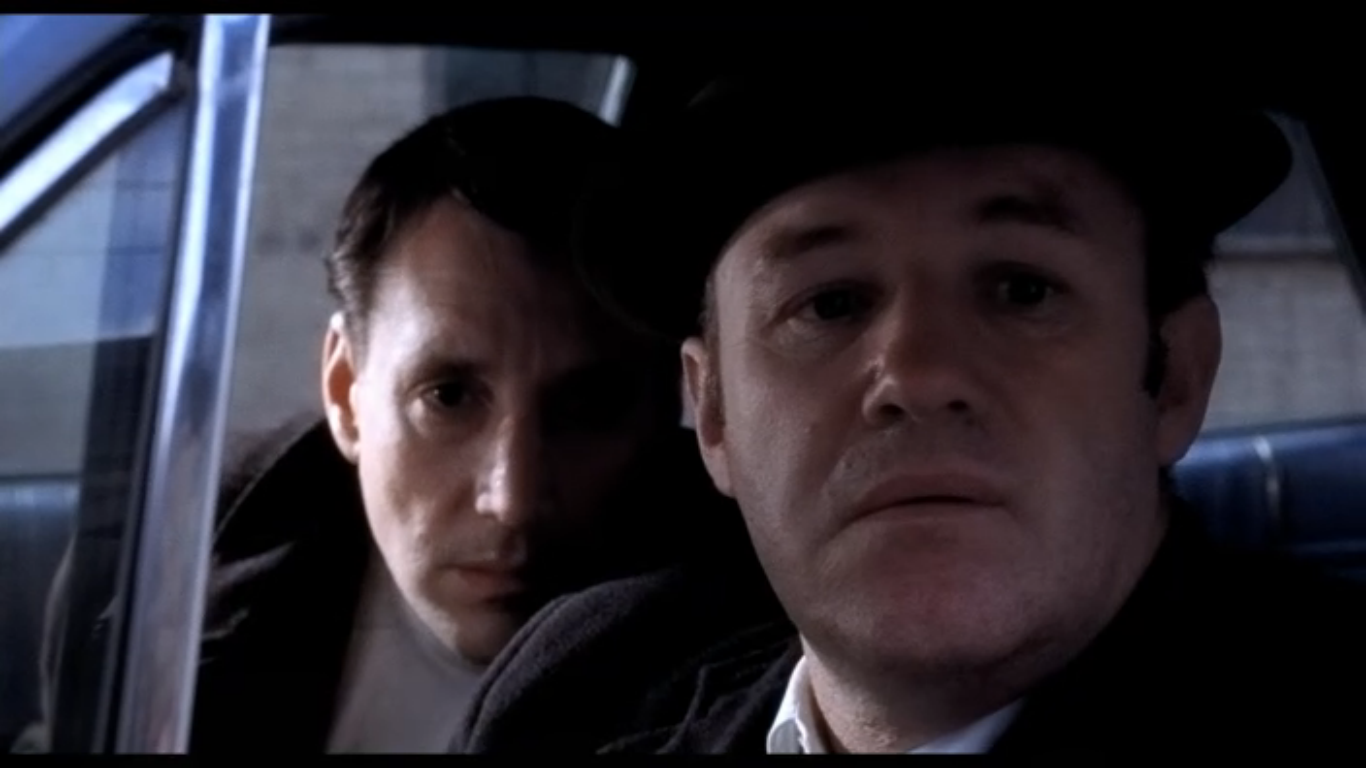
However, this time around our main cop is Popeye Doyle (played by Gene Hackman) and his partner Cloudy Russo (Roy Scheider). Both play a key role, but Popeye (the man with the hat) is of the greater interest. He’s a wise guy, belligerent, barking, loud-mouthed hot head, often driven by obsession in his job. He also happens to be an undercover cop in the narcotics division. He’s used to getting dirty and using the rough stuff when necessary. After all, it’s a jungle out there and there’s no room for pushovers.

From the get-go, we come to understand that this story has a French Connection, in Marseilles to be exact, and we know who is involved (Fernando Rey). We just cannot quite pick out all the details. Simultaneously, on a hunch, Doyle and Russo start running surveillance on a guy they happen upon in a club. Things don’t quite add up since he runs a deli called Sal and Angie’s by day and lives it up at night. An undercover informant also tips Popeye off to a big shipment of heroin that’s coming in.

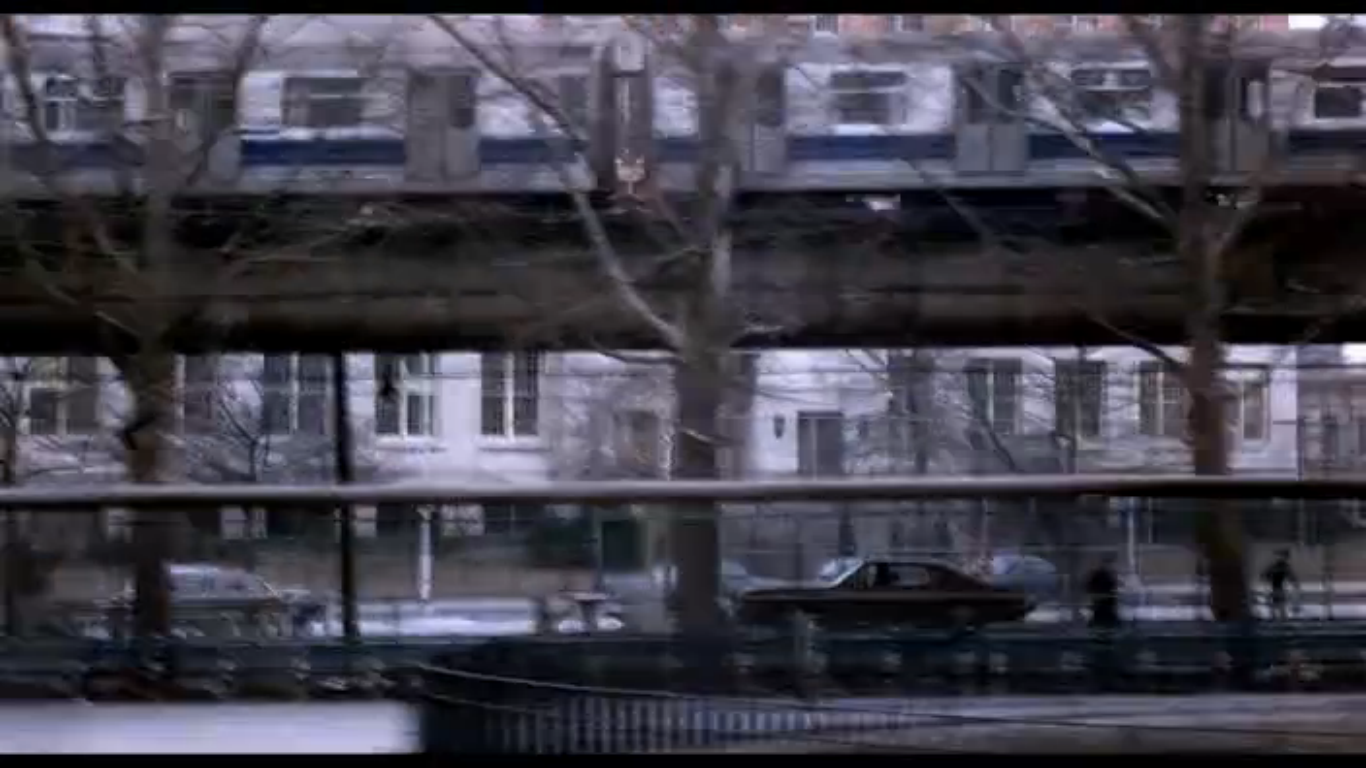
frenchcon9Sal Boca has to be into something and so a game of tailing begins on the streets after he and his French contacts are spotted together. Frog 1 named Charnier (Rey) has Popeye on his tail only to shake him adeptly. That’s only the beginning, however, after a sniper comes after Popeye and yet another chase ensues. The fugitive boards a train and Doyle commandeers a car to follow close behind. Thus, was born one of the greatest car chases of all time and it doesn’t even involve two cars. After the adrenaline of that moment has worn off Doyle and Russo are on another stakeout and this time impound a car belonging to frog # 2 Henri Devereaux. Popeye has a gut feeling that the vehicle’s dirty and they literally tear it apart end to end, with little luck. But he’s a force of nature and very little will get in the way of his obstinate drive.

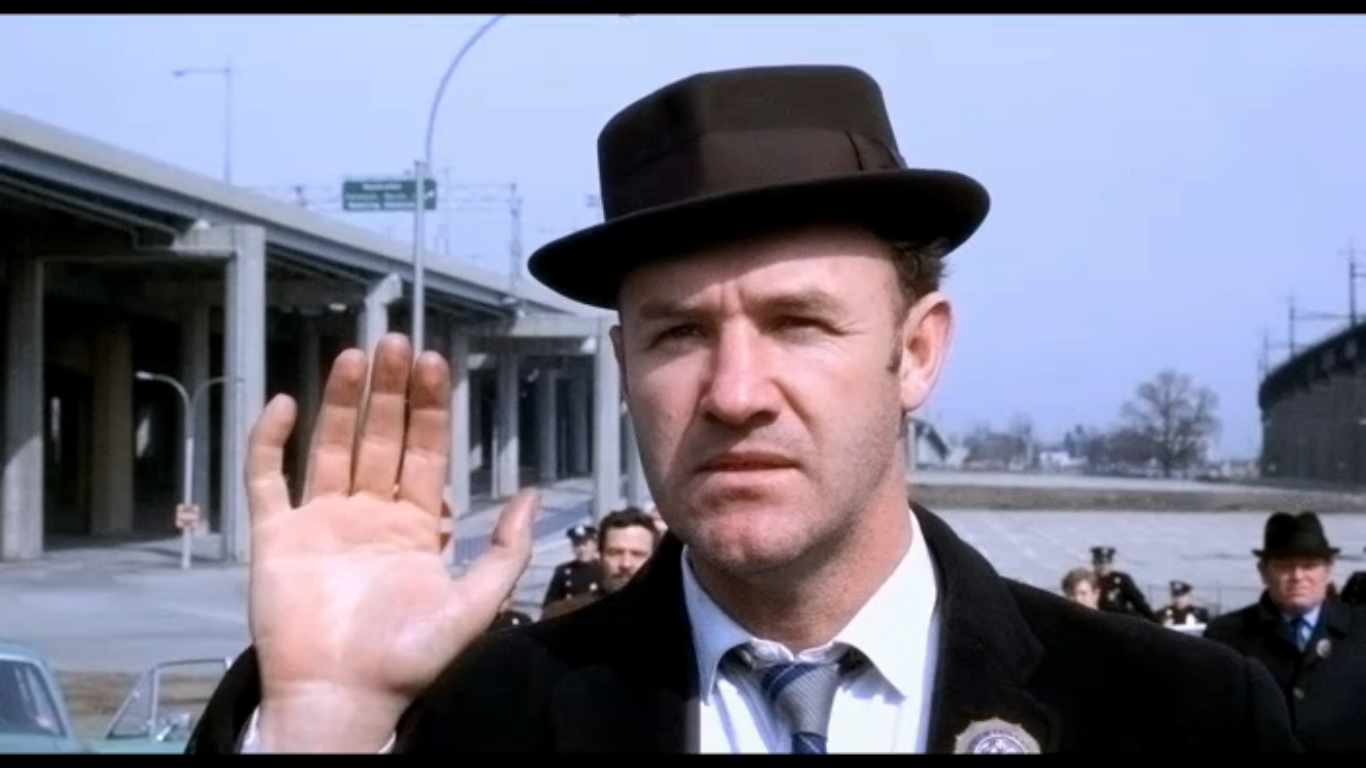
frenchcon11When the drop finally takes place everything goes off smoothly enough, but there’s a roadblock, and Popeye is waiting for them with a playful wave. He’s got them now. The final roundup leads him into an old warehouse as the hunt continues, but The French Connection finishes open-ended. Sal was gunned down, the meeting was busted, but not everyone was caught, and Charnier seems to have vanished into thin air. To top it off, Doyle shoots the wrong man and without flinching continues his obsessive hunt.

Friedkin’s film was partially based on true events from the 1960s and the two men the story was patterned after actually are featured as the boys’ superior Walt Simonson (Eddie Egan) and federal agent Bill Mulderig (Bill Hickman), who has a longstanding dislike for Doyle. Their presence in the production of this film helps to lend to the realism and nuances that the film is able to take on. The score isn’t all that noticeable, but it’s a tense arrangement that adds some underlining anxiety to some scenes. Stakeouts get more interesting than you would ever give them credit for. Really on the simplest level, this film is about one man’s hunt, his obsessive chase, which at times no longer seems about justice at all, but personal vindication.

4.5/5 Stars

Drive (2011)

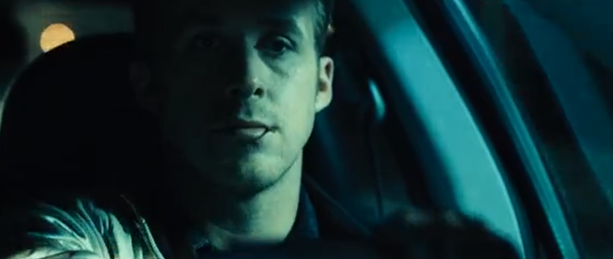
drive1You always think of the man in the getaway car as the wimp. Why else is he supposed to keep the engine running instead of helping with the job? Well, not anymore. Ryan Gosling completely demolishes that myth with Drive. It’s a neo-noir of sorts, but don’t get the wrong idea. This isn’t your conventional Hollywood action flick. Albert Brook’s corrupt thug sans eyebrows says he used to back sexy European action films and that’s ironically enough what Drive is. There’s a new age electronic score to match the stylized action. Silky smooth slo-mo mixed with golden illumination of the characters and the L.A. nightscape.

Although he’s really a stunt driver and spends his spare time working as a mechanic for the shop owner (Bryan Cranston), the Kid (Gosling) works jobs on the side as a getaway car driver, and he’s the best of the best. He proves it in the opening minutes, perfectly timing his escape with the conclusion of a Clippers game. It makes disappearing into the night that much easier.

He keeps things in check, keeps his cards close to his body, and at times reminds me of Alain Delon in Le Samourai. He’s not quite so icy cool, almost serene, and yet that can disappear in a flash. So still, so slight of word and movement, and yet behind the wheel, he has so much purpose. He doesn’t use a gun. His methods are more brutal, and he only uses them when absolutely necessary. Such a role gives me a newfound respect for Ryan Gosling. He really does seem to have the true ability to take on some interesting roles of varying degrees and intensities.

drive2All the characters around him are not necessarily fully developed entities on their own, but they function as more of an essence, developing this stylized world. Carey Mulligan is the aloof woman next door with the far-off gaze and quiet demeanor. There is an aura around her much like the Driver, maybe because they don’t talk much. There’s a mystery to them. Oscar Isaac and Christina Hendricks have relatively short screen time, but they play pivotal roles in the film and they lend credence to the story because even if they’re no good, we have at least a little empathy towards them. And then Albert Brooks and Ron Perlman are real crud of the earth who we don’t mind seeing suffer. It may not be a nice thing to say, but it’s undoubtedly the truth. The Driver seems outside of this fray at first, but he ends up getting involved in it whether it’s because of Irene or her husband’s botched robbery attempt. It becomes his business and it proves cataclysmic.

Aside from Le Samourai, there’s a bit of Bullitt here thanks to the ultra sleek car chases, and maybe even some Point Blank, another film that functions as a dreamy, unconventional thriller. We never see the inside of whatever jobs are being pulled, but it actually builds the tension as we sit on the outside waiting with the driver. He’s all business as the audience sits sweating it.

drive3What this film has and what I am not necessarily a proponent of, is the brutality and stylized gore. It fits the overall tone of Drive, but it does rub against me rather abrasively in a way that seems to make a spectacle of violence. That’s something that I don’t want. But then what is that saying about me? Do I find violence more palatable when it looks like an ugly and vile act? Yes, certainly, but I think I like it best when it is implied because that in itself seems perhaps even more stylized, and far less offensive.

But nevertheless, this story that parallels the fable of the scorpion and the frog is an engaging, albeit jarring ride.  You can help someone, you can want no part of them, but they will come right back and sting you because it’s in their nature. This is a story of relationships, of destruction, and a man who kicks it into high gear.

4/5 Stars

Review: North By Northwest (1959)

1024px-North_by_Northwest_movie_trailer_screenshot_(6)Wedged between two landmark Hitchcock films in Vertigo (1958) and Psycho (1960), North by Northwest is iconic in its own right, but it boasts sprawling adventure and a bit of a lighter tone. It’s rather like Teddy Roosevelt wedged in between Jefferson and Lincoln on Mt. Rushmore but that comes later.

Supposedly the film was once to be called In Lincoln’s Nose, but when the now famous slanted North by Northwest logo hits the screen you instantly know you’re in for something extraordinary. The title sequence is wonderfully exciting given a boost by yet another impeccable score from Bernard Hermann.

This film is once again beautifully shot in color (VistaVision), but it covers more ground than Vertigo and has far more elaborate set pieces. The action begins ordinarily enough at an office building where advertising man Roger O. Thornhill (Cary Grant) makes his way out of the office. It’s a busy day at the office, but Roger has a dinner engagement and an evening at the theater to look forward to. His plans and his whole life are put on hold after he fatefully flags down a waiter.

His actions don’t go unnoticed and two menacing men lead him off at gunpoint as he tries to head to a phone. He is utterly confused, but we know it has something to do with the name George Caplan. These men think that’s who he is, and not to be persuaded otherwise, they take him to their leader (James Mason), who is very interested to meet him. Over the course of a harrowing evening, Thornhill is left on the edge of the road in a completely drunken state to die. But instead he gets brought in on a drunk driving charge and of course, no one will believe his cockamamie story, even his skeptical mother (Jesse Royce Landis).

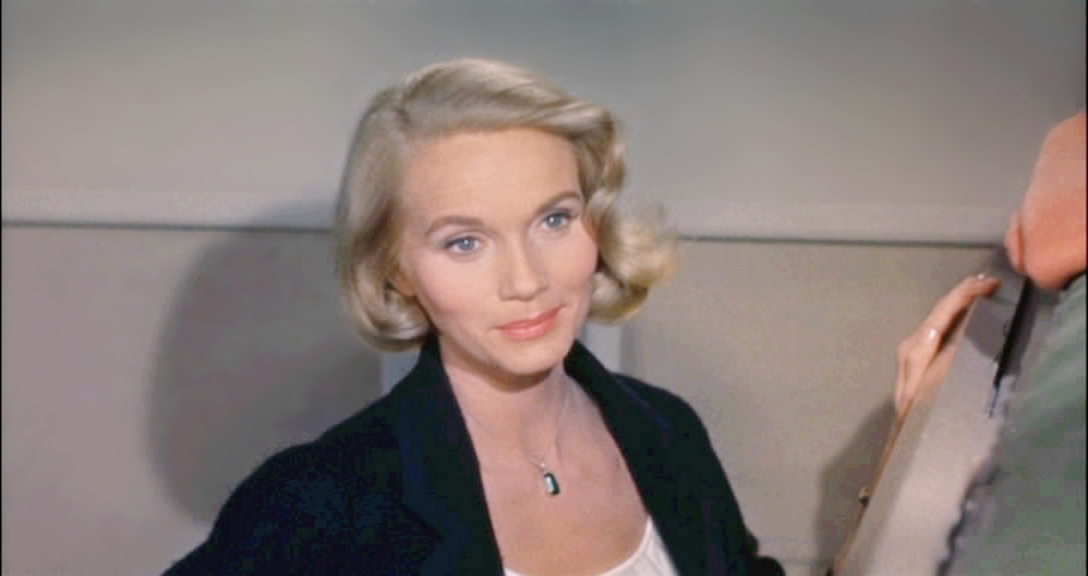
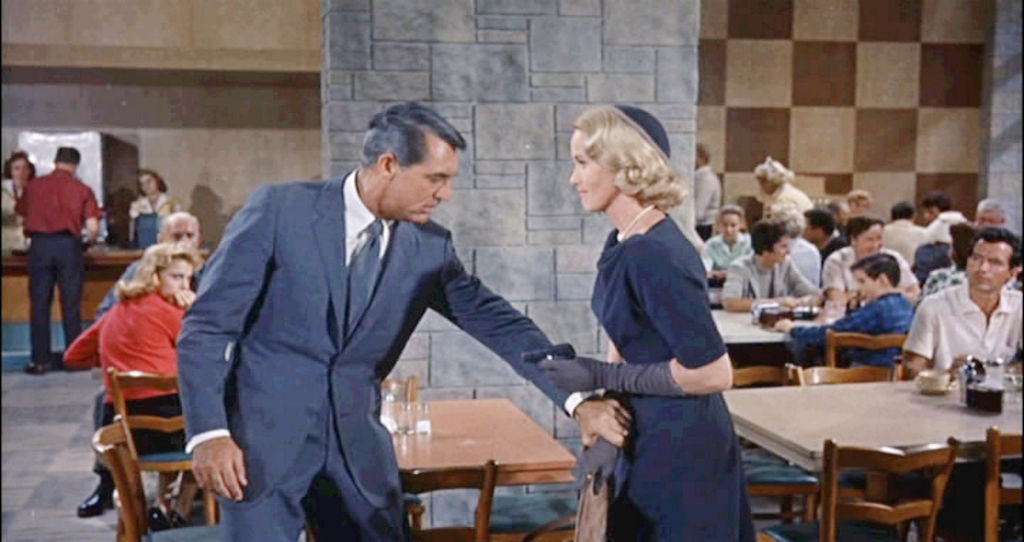
North_by_Northwest_movie_trailer_screenshot_(21)Next, it’s onto the U.N. Building to find out who Lester Townsend is, but of course, his captors are on his trail and just like that Thornhill is framed for murder and a fugitive on the run from the thugs and the cops. He tries to get away train ticket out of town, but in order to evade the law he ducks onto a train and meets the pretty blonde Eve Kendall (Eva Marie Sainte), who extends a favor. Little does he know what her angle is. Right now all he cares about is a little tete a tete and perhaps an amorous evening.

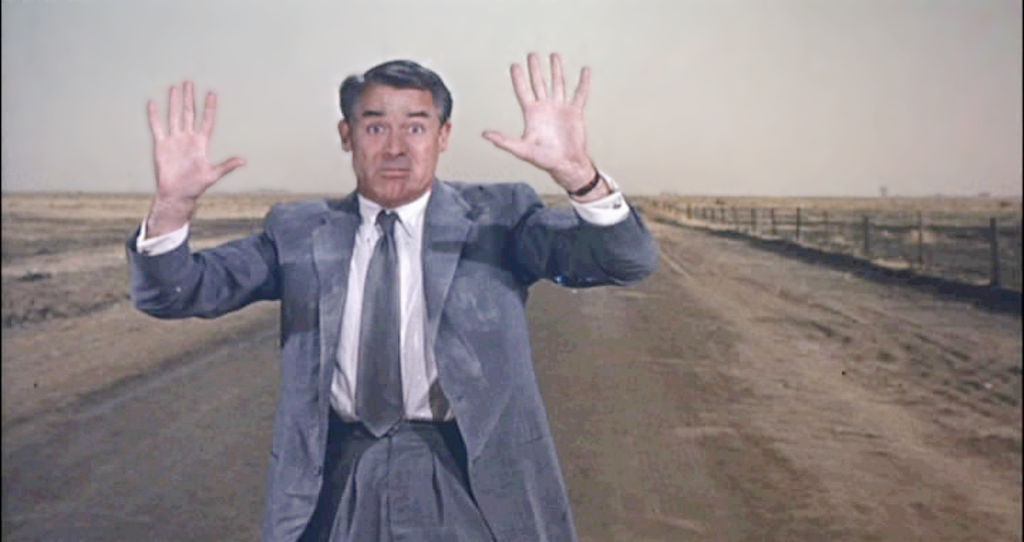
Kendall wistfully sends her new lover off to meet Caplan. Instead, he is met by a bi-plane and once again running for his life. But the build-up of this now iconic scene is wonderful. Hitchcock utilizes his background in silents to allow the scene to progress without hardly any dialogue and it unfolds ominously. However, he proves that even on an isolated roadside stop danger can still be present. Thornhill has new opinions of Kendall now and continues following the trail of Caplan which leads him to his old nemesis (Mason) and wouldn’t you know, Eve is by his side.

North_by_Northwest_movie_trailer_screenshot_(31)Roger feels like he has everything figured out, but he gets a visit from the mysterious Professor (Leo G. Carroll), who helps straighten him out with all the business surrounding the elusive George Caplan. With this new insight, Roger goes to the Professor to Rapid City and the one and only Mount Rushmore. It’s the perfect spot for a Hitchcockian finale to satisfy the director’s flair for the thematic.

North By Northwest is fun because we get to be right alongside Grant when he gets caught up in the whole mess. Although we see the picture a little more clearly than him, all the details are not handed over to us. So in a sense Hitch lets us in on a few secrets without showing us his entire hand. The staging is also wonderful whether it is the U.N. Building (with that marvelous aerial shot), or desolate Bakersfield, and even the soundstage set up to look like the surrounding area of Mt. Rushmore. It’s such a contrast to Rear Window and it uses the scenery very effectively similar to Vertigo.

Ernest Lehman’s script simply put is a lot of fun, because we have our villains, we have our romantic leads having a lot of great scenes together, and the pacing is surprisingly good. I am amazed how spry Cary Grant looks for his age (especially compared to aging Jimmy Stewart). Eva Marie Saint is great and in my estimation, she is the second-best Hitchcock Blonde following Grace Kelly, but you can easily disagree. James Mason plays yet another debonair villain and there are a handful of fun appearances by the likes of Martin Landau and Edward Platt.

One reason I’m constantly drawn to this film is that it feels rather like a road trip as we slowly cross the continental United States with Cary Grant. Furthermore, it’s simply good, unadulterated fun. There’s not a ton of analysis or commentary to mull over or to think deeply about (maybe some implications to the Cold War). But I’m content to sit back and watch with glee as a crop duster nearly clotheslines Cary Grant. Movies don’t get much better than this, seriously.

5/5 Stars

Review: Taxi Driver (1976)

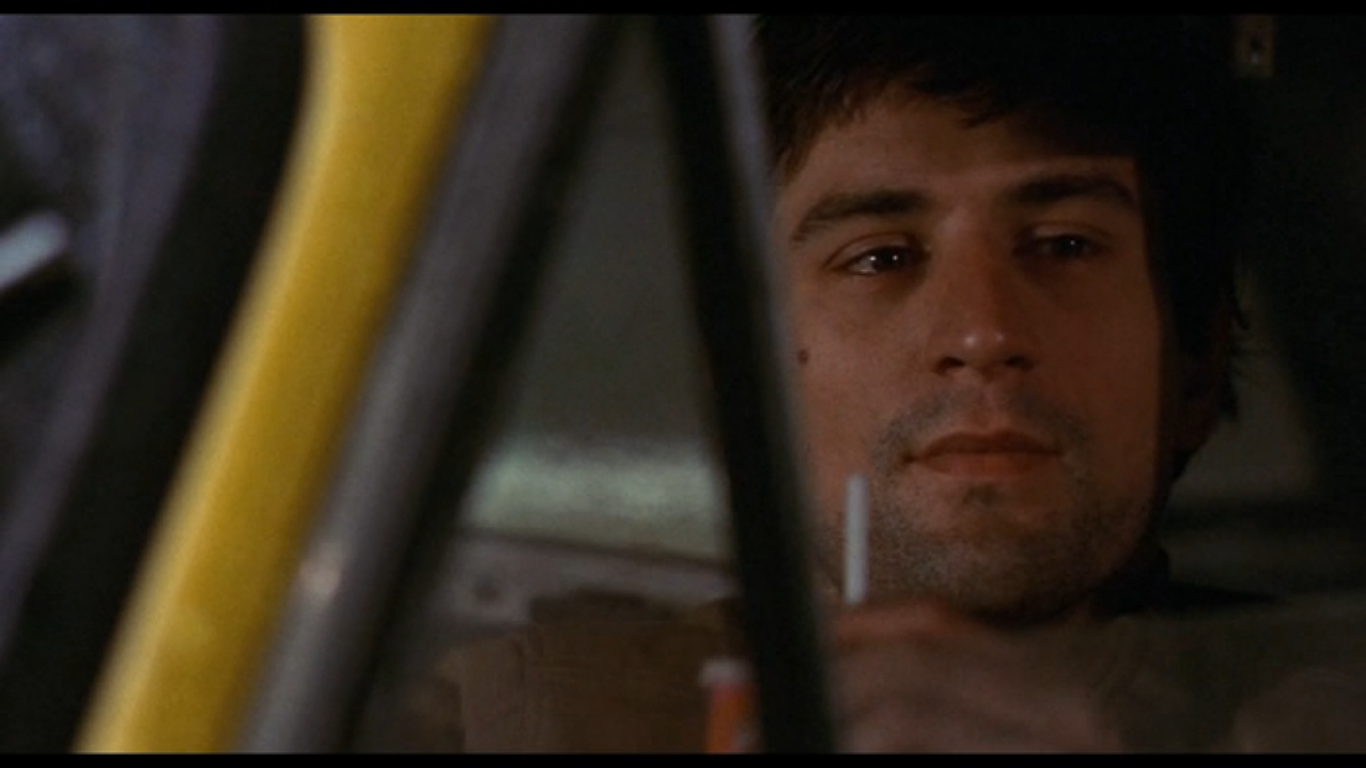
taxidriver1Well. Whatever it is, you should clean up this city here, because this city here is like an open sewer you know. It’s full of filth and scum. And sometimes I can hardly take it. ~ Robert De Niro as Travis Bickle

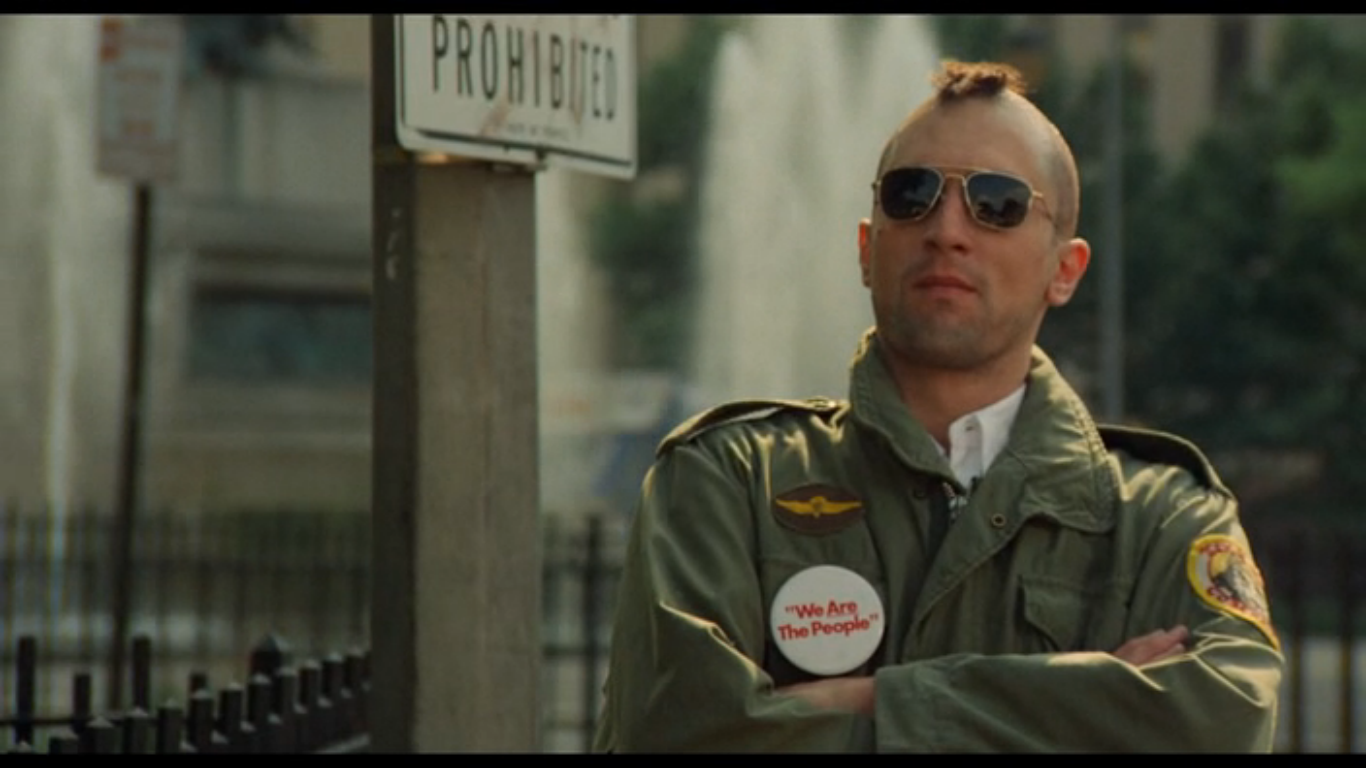
Taxi Driver‘s Travis Bickle is an American icon representing anyone and everyone who has ever felt like an outcast, outsider, or misfit. He’s the perfect embodiment of any of the angst or disgust that might surge through our veins at any given time. Except before I ever saw Martin Scorsese’s film, I always assumed him to be a thuggish villain. But his character is more complex than that. He’s far more relatable than I would have initially given him credit for.

The film actually opens feeling like the pilot of the Sitcom Taxi or something. There’s Bernard Hermann’s beautifully cool jazz-infused score and then the illuminating lights of an average New York evening. It feels strangely peaceful in spite of all that is going to go down.

Travis is an ex-Vietnam vet who takes a taxi driving job for the strangest of reasons. He just wants something that will have him working long hours and he isn’t too particular about what part of town he ends up in. From the get-go, he strikes the audience as a quiet almost silent observer of all that takes place around him on the streets every night. He’ll sit around with a couple cabbies as they chew the fat, but he’s essentially isolated — a repressed young man who doesn’t really express himself. His existence feels tragic and lonely, certainly not deadly.

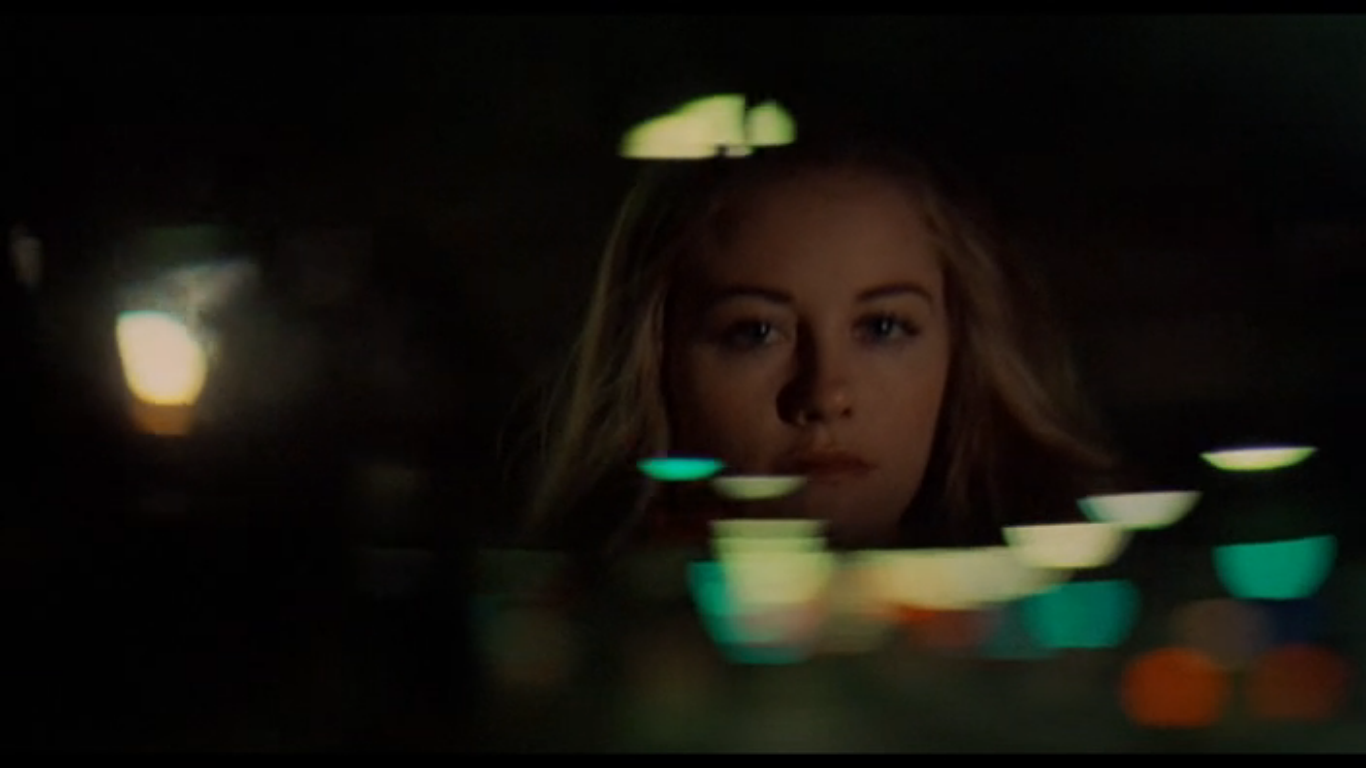
taxidriver2There is a small beacon of hope when a pretty campaign volunteer named Betsy (Cybil Sheppard) catches his eye, and he has an extremely awkward interaction with her but it lands him a date. But Travis just doesn’t quite know how to act, he hasn’t learned what it means to be in a relationship and he has an error in judgment while they are out. However, he doesn’t see it that way. He feels his attempts at kindness were completely rejected.

Then, he also begins to notice a young hooker out on the streets and his next mission is to get her away from there back home. He thinks it’s the right thing to do and he means well but young streetwise Iris (Jodie Foster) doesn’t seem to want his charity. So once again Travis seems unwanted and not needed when he is trying to do something nice.

Travis even acknowledges to his colleague Wizard that he’s getting all twisted up inside and confused. He’s distraught and he has no way to deal with it so his outlet includes a heavy strength regimen and loading up on a ton of guns. Never a good sign, but it his mind’s eye it’s all to clean up the streets of the scum of the earth.

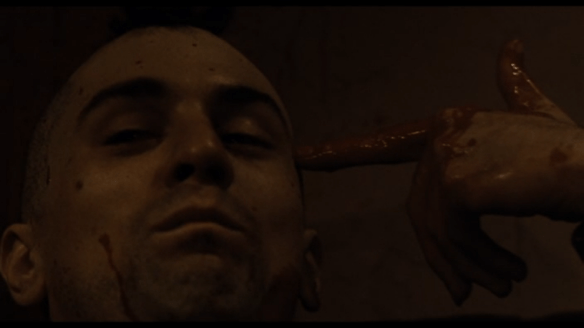
However, first he attends a rally for a presidential candidate that Betsy will be at and he has intent to cause harm, but he backs out at the last minute and goes to Plan B confronting Iris’s pimp Sport (Harvey Keitel) and shooting him. The inner demons of Travis are unleashed as he goes off, but his delusions of grandeur reassure him that this is all for Iris. This is for her good. All this bloodshed.

taxidriver4The final moments after his rampage have Travis receiving a letter from Irises parents who are grateful for his actions to save their daughter from corruption. Then, a fully recuperated Travis finds Cybil sitting in the back seat of his taxi cab in all her glory. It’s beyond his wildest dreams, which begs the question is this reality, or is this just a clever construction of his own brain? Another delusion of grandeur. It’s a wonderful open-ended finale.

Paul Schrader’s script is a wonderful character study giving introspection into one troubled man’s psyche. However, there is controversy on two fronts. It’s rumored that John Hinckley Jr. who tried to assassinate Ronald Reagan was influenced by this film and also the finale seems to reflect many people who commit mass shootings. Oftentimes they are people who are deeply troubled and are looking for some type of attention. But with that desire comes often deadly consequences.

taxidriver3Martin Scorsese’s film has also received pointed criticism for its violence which is hard to downplay. However, Taxi Driver remains interesting because it is not bloated with killing (in fact only one scene is actually bloody). Most of the film has to do with relationships or lack thereof because a lot of what Travis does is watch and listen. It might be Martin Scorsese in a cameo as a jealous husband or a presidential candidate asking Bickle’s opinion from the back seat. Furthermore, like any warm-blooded boy, he knows that Cybil Sheppard is a dream girl. And he has enough compassion to want Iris to have a normal childhood. It’s just that his conscientiousness is misdirected and subverted.

The film resigns itself to following this one man in the wasteland that is New York. It’s starkly beautiful and thought-provoking placing a troubled anti-hero in front a canvas of urban realism. I could never condone his behavior, but then again I could never be completely against him either.

4.5/5 Stars

Review: Vertigo (1958)

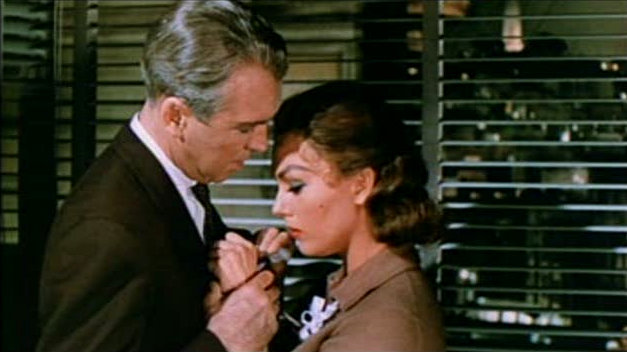
Vertigo_1958_trailer_embrace“The Greatest Film of All Time.” It certainly seems like an arbitrary title, but if nothing else it gives film aficionados something to discuss. And that’s what Alfred Hitchcock’s Vertigo is now being called for many reasons. Rather than join the debate, I wish to take a few moments to acknowledge what makes the film itself special.

On the surface, shall we say the first viewing, Vertigo is thoroughly enjoyable as a psychological thriller and mystery. The title sequence is haunting with an eye staring back at us from behind the credits and as an audience we are quickly thrown into the action, watching the opening chase scene unfold. In only a few moments one man is dead and the other John “Scottie” Ferguson (James Stewart) now has debilitating vertigo that takes him off the police force. We never learn why they were chasing a man on the rooftops. It doesn’t really matter. It’s a time later with his friend Midge (Barbara Bel Geddes) that we first see Scottie after the harrowing events. She obviously cares deeply for him, and he sees her simply as a good friend so we can undoubtedly expect her to be in the film more.

Then, rather mysteriously, an old school acquaintance named Elster (Tom Helmore) calls up Ferguson, hoping to get him to shadow his wife. It has nothing to do with infidelity, but fear, because the worried husband believes that something is wrong with his wife Madeleine. She disappears for hours at a time and is barely conscious half the time. He would describe her as possessed and Scottie is noticeably skeptical. But he relents and agrees to tail her sending himself spinning headlong into a mystery that will become his obsession.
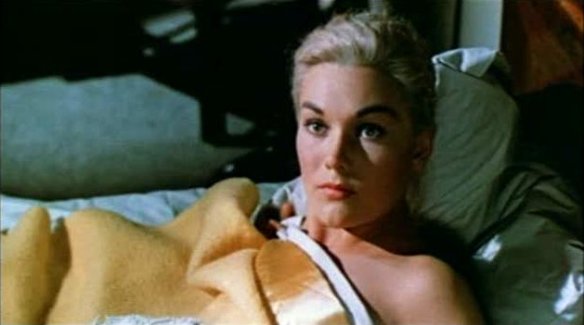
Vertigo_1958_trailer_NovakHe gets to know Madeleine by following her, all throughout the streets of San Francisco, and much like Rear Window, this part of the film becomes a repetition of scenes followed by the reactions of Stewart. Hitchcock’s background in silents is seemingly at work here as he lets the images and score of Bernard Hermann take center stage along with Stewart’s expressions. We end up all over, from a flower stand to a cemetery, an art museum, and an old hotel. Madeleine goes from place to place like a solemn specter and we watch in expectation. Something must happen.

In an instant, she leaps into the water near the Golden Gate to commit suicide and that’s when Scottie swoops in to rescue her. He can’t lose her now because by this point he’s entranced by the icy blond who he only knows from a distance. And so their relationship progresses if you can call it that. They wander together and Madeleine shares her nightmares with Scottie.

The two of them head to San Juan Bautista and that’s when the nightmares become a reality for both of them. It’s devastating to Scottie, and the second phase of the film begins. He’s inconsolable and madly in love with this girl he cannot have. She’s hardly real. But then wandering the streets listlessly he spies Judy Barton, who coincidentally looks strikingly like Madeleine.

So he does the only thing that he can think of, meet her and try to turn into the girl he so desires. His obsessions are the only things that drive him, that and the haunting memories. Finally, he figures out the mystery, but the swirling cycle continues as he goes back to San Juan Bautista. A cruel twist of deja vu rears it’s ugly head once more.
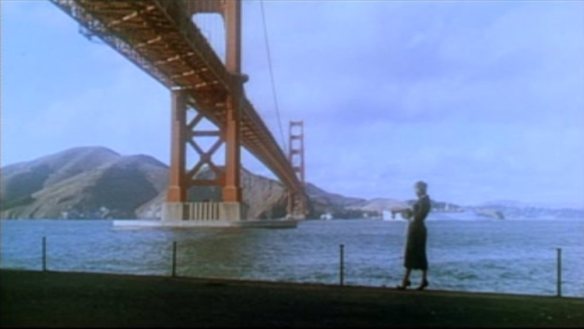
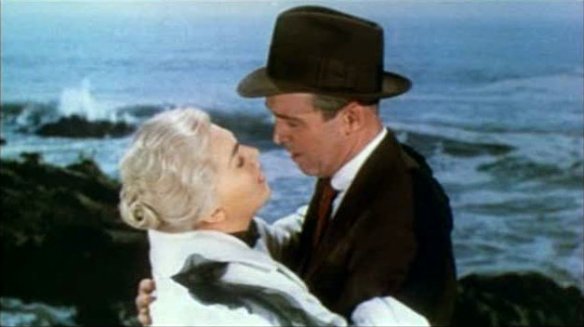
Vertigo_1958_trailer_Kim_Novak_at_Golden_Gate_Bridge_Fort_PointHitchcock always was one for visual showmanship and it reveals itself whether it’s the parallel symbolism that Scottie notes in the painting of Carlotta Valdes or the out-of-body dream sequence that he suffers through. There’s also the dizzying zoom creating the so-called Vertigo Effect whenever Stewart looks down from a great height. These are obvious visual flourishes, but it’s almost more interesting to watch our main characters walk the streets of San Francisco, especially since there are so many real landmarks to work with (ie. Golden Gate, Mission San Juan Bautista, Muir Woods National Monument, and the Coit Tower among others). There’s something mesmerizing and trance-like about all these scenes that’s difficult to discount. It pulls us in as an audience. We want to see more. Bernard Hermann’s score is, of course, noteworthy and at its core, there is a constant disconcerting quality. It is strangely majestic and beautiful, but it pounds away menacingly. And it spirals in and out with the same sounds, the same crescendos. You think you would get sick of it, but strangely enough, you don’t. It enraptures us.
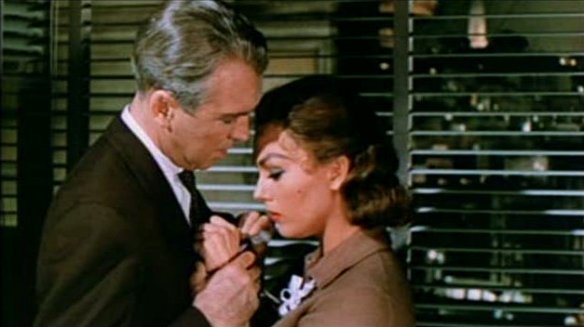
Vertigo_1958_trailer_embrace_2Then there are the players. Kim Novak has the dual role as Madeleine and Judy. She carries out both with the needed precision. Elster’s wife is elegantly beautiful, aloof and ethereal in a way that makes her the obvious fantasy of Stewart’s character. When she casts a sidelong glance or stares up at Stewart there is a faraway quality in her eyes. The clothes. The hair. How she talks. Even how she carries herself. She is spellbinding, otherworldly, and almost unattainable in all ways. Then there’s Judy, the epitome of a Midwestern girl. Pretty but not elegant. Smart but not cultured. But she falls for Ferguson as he falls for an impossible ideal.
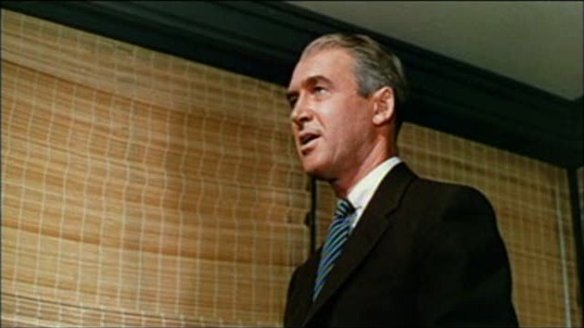
Vertigo_1958_trailer_Stewart_on_a_laddderJames Stewart is an important piece in this film because it’s his character’s obsession that drives the plot. His instabilities, his desires, his anguish, his vertigo. It has been said that Stewart himself is a stand-in for Hitchcock and the own inner workings of the director’s being. His obsession and lusts. That may be true but something else that could be inferred is that Stewart is really a stand-in for all of us. After all, there was no greater every man than him, but there also is a universal quality to the baggage weighing on his being. Stewart’s every man is certainly being subverted, or could it be he is becoming a more accurate depiction of everyone? It’s a scary thought but what is buried inside of us? What are our own fantasies, obsessions, and lusts that lurk under the surface? Let me put it a different way.

For Stewart, he has three prominent women in his life. There’s the fantasy in Madeleine, the perfect ideal, who will ultimately ruin his life because intimacy with her is impossible. There’s Judy who has a passionate love for him, but it seems complicated in so many ways. She’s trying to measure up to his standards. The ideals and fantasies he has created poison what they could have. Then, there’s Midge who is practical, funny, and also completely devoted to Scottie. If his head were on straight he would go right to her because he would undoubtedly find the most satisfaction in that relationship, but his obsessions have undermined that.

There was an alternate ending of the film which showed Scottie with Midge once more, listening on the radio about Elster’s capture. The ending that was kept is more powerful, not because Elster got away scotch free, but because we don’t see Midge again. She all but disappears by the end of the film and with her goes all that could have been decent and good about reality for Scottie. He gets so caught up in fantasy and that tears his life apart. He’s literally spiraling in a web of never-ending hellish obsession.  Who knows what becomes of him? We can only guess.

5/5 Stars

5 Fingers (1952)

5fingersHonestly, this doesn’t feel like a typical Joseph L. Mankiewicz film. It was written by someone else and because he was nearing the end of his contract with 20th Century, he didn’t end up editing the project. Supposedly the overseeing of Daryl Zanuck led to several scenes being scrapped which Mankiewicz thought were good. Also, as a director, his name does not usually scream spy thriller like an Alfred Hitchcock. He’s more in his element with cultured dramas about relationships. However, 5 Fingers is still an engaging tale based on the historical wartime events surrounding the informant code-named Cicero.

In real life, Elyesa Bazna was an Albanian born valet who worked under the British ambassador to Turkey. He played both sides, first ingratiating himself as a gentleman among the Brits and then taking pictures of top secret information and passing it off to the Germans in the period between 1943-44. Cicero, as he was called, could easily come off as an abhorrent traitor and yet James Mason plays his character Diello with an adeptness that is underlined with an air of civility. We don’t particularly care for the man, but he’s not a monster, just a bit crooked and concerned with personal gain. Mason certainly did have a knack for playing the criminal type and I must admit I’m curious to watch more films with him because his performances have not quite won me over yet. There’s still time for that.

The film altogether is not that tense, but it does set the groundwork for some interesting interactions which all seem to stem from Cicero. He is subservient and aloof when it comes to serving the ambassador. He’s quite open with the Countess Anna Staviska (Danielle Darreux), who turns into a confident, romantic partner, and in some ways an accomplice — just wait. Meanwhile, he deals with the Germans self-assuredly knowing what he wants and how he’s going to get it. He’s no slouch and he seems devilishly good at the spy game.

Throw in some double-crossing from the countess and a dynamite word like “Overlord” (aka D-Day) and Dellio finds himself on the run with the Brit’s counterintelligence operative (Michael Rennie) hot on his tail. Thanks to his assistance, the Germans are trying to protect him as he gets ready to hightail it to South America. There’s one small thing he didn’t account for. He’s been duped. He and the countess both. All he can do is break out in a fit of laughter. I’m not sure if that’s how the real story ended — probably not, but it makes for a fitting conclusion of this tale as his money slowly drifts away in the wind.

3.5/5 Stars

Three Days of the Condor (1975)

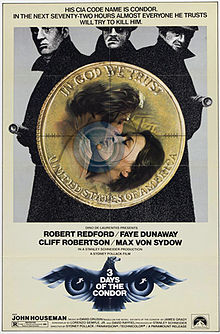
Three_Days_of_the_Condor_posterIn the wake of Watergate, the 1970s saw the advent of many political thrillers with arguably the granddaddy of them all being All The President’s Men. Three Days of the Condor is another film that finds Robert Redford trying to get to the bottom of a web involving politics and intrigue. However, this film reminds me a great deal of The Parallax View which came out a couple years earlier. Similarly, this film has probably its most startling moments during its opening sequence and slowly unwinds after that into a thriller full of paranoia and uncertainty.

Sidney Pollack’s film kicks into high gear abruptly as all “Condor’s” colleagues at a CIA-backed literature research post are gunned down by unknown professional hit men. Joe Turner (Robert Redford) was literally out to lunch picking up sandwich orders, and he returns to find his colleagues dead. From that point on begins his life of constant fear, because he cannot know who is with him and who is against him. He can trust no one.

While taking a moments respite, Turner notices a patron named Kathy Hale who is about to meet her boyfriend on the slopes, and he follows her and holds her hostage so he can have a place to stay. It’s supposed to be a matter of chance, but I mean, it is Faye Dunaway so it cannot be that random right? No matter, she’s initially deathly afraid of him, and he does not give her any relief holding her at gunpoint and tying her up. They’re both afraid.

But whether it’s some form of Stockholm syndrome or the fact that she actually believes his predicament, Kathy agrees to help him, and they have the obligatory lovemaking session inter-cut with the stark pictures on her wall.

What happens after this is sometimes difficult to track with as Redford’s character begins his search for a government agent named Higgins, avoiding hit men, while trying to understand who is even after him. Why do they want him? He’s just a lowly bookworm with one cockamamie theory about the odd languages a certain thriller has been translated in.

This one idea has got him caught up in something much bigger than he can ever know involving a hired mercenary named Joubert, CIA Deputy of Operations Leonard Atwood, and oil! That’s what it was all about. That’s why 7 people died and Turner can do barely anything about it. After all, who will print his story? Who will believe him? That’s is the country and the era he lives in after all.

Redford gives an admirable performance, and I personally prefer him to Warren Beatty any day. Dunaway walked a weird line between being demure and submissive, while also dishing out some sass every once and a while. It made her character feel uneven in a sense and she came to like Turner rather abruptly. Then again it was Robert Redford.

All in all, this film’s plotting seems utterly ludicrous to me now, and it becomes more and more ambiguous by the end. It feels hardly like a conclusion at all, much like the Parallax View. And much like the other film I can understand how this story could really strike a cord, especially after Watergate, when so much governmental corruption seemed possible. The sky was the limit and so Three Days of the Condor was perhaps not as far-fetched as it initially appeared. That’s a scary thought indeed.

3.5/5 Stars