
 Honestly, this doesn’t feel like a typical Joseph L. Mankiewicz film. It was written by someone else and because he was nearing the end of his contract with 20th Century, he didn’t end up editing the project. Supposedly the overseeing of Daryl Zanuck led to several scenes being scrapped which Mankiewicz thought were good. Also, as a director, his name does not usually scream spy thriller like an Alfred Hitchcock. He’s more in his element with cultured dramas about relationships. However, 5 Fingers is still an engaging tale based on the historical wartime events surrounding the informant code-named Cicero.
In real life, Elyesa Bazna was an Albanian born valet who worked under the British ambassador to Turkey. He played both sides, first ingratiating himself as a gentleman among the Brits and then taking pictures of top secret information and passing it off to the Germans in the period between 1943-44. Cicero, as he was called, could easily come off as an abhorrent traitor and yet James Mason plays his character Diello with an adeptness that is underlined with an air of civility. We don’t particularly care for the man, but he’s not a monster, just a bit crooked and concerned with personal gain. Mason certainly did have a knack for playing the criminal type and I must admit I’m curious to watch more films with him because his performances have not quite won me over yet. There’s still time for that.
The film altogether is not that tense, but it does set the groundwork for some interesting interactions which all seem to stem from Cicero. He is subservient and aloof when it comes to serving the ambassador. He’s quite open with the Countess Anna Staviska (Danielle Darreux), who turns into a confident, romantic partner, and in some ways an accomplice — just wait. Meanwhile, he deals with the Germans self-assuredly knowing what he wants and how he’s going to get it. He’s no slouch and he seems devilishly good at the spy game.
Throw in some double-crossing from the countess and a dynamite word like “Overlord” (aka D-Day) and Dellio finds himself on the run with the Brit’s counterintelligence operative (Michael Rennie) hot on his tail. Thanks to his assistance, the Germans are trying to protect him as he gets ready to hightail it to South America. There’s one small thing he didn’t account for. He’s been duped. He and the countess both. All he can do is break out in a fit of laughter. I’m not sure if that’s how the real story ended — probably not, but it makes for a fitting conclusion of this tale as his money slowly drifts away in the wind.
3.5/5 Stars



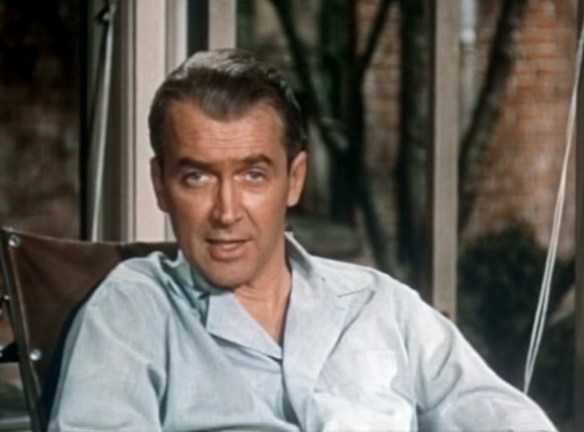 The interesting part is that as an audience we are fully involved in this story. We see much of the picture from Jefferies’ apartment, because there is no place to go, and so we stay inside the confines of the complex. In this way, Hitchcock creates a lot of Rear Window‘s plot out of actions occurring and then the reactions that follow. We are constantly being fed a scene and then immediately being shown the gaze of Jefferies. It effectively pulls us into this position of a peeping tom too. Danger keeps on creeping closer and closer as he discovers more and more. The narrative continues to progress methodically from day to night to the next day and the next evening.

