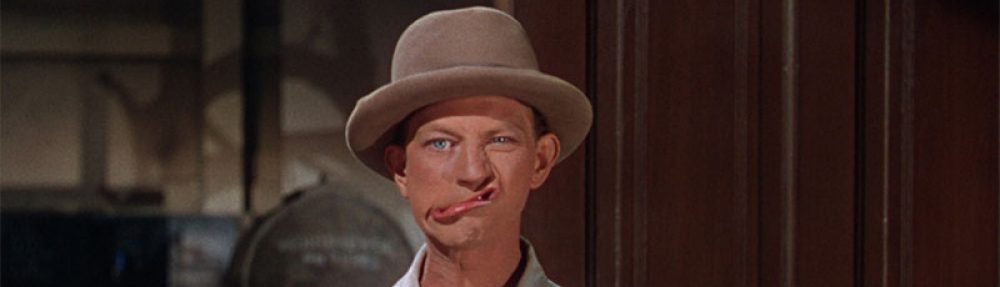
Starring Tony Curtis and Sidney Poitier with director Stanley Kramer, the film opens in the pouring rain with a truck full of convicts. It goes off road and no one is hurt except two men escape. A Sheriff an state policemen begin tracking them on foot. However, this pair is unique since one is the white “Joker” Jackson and the other is a black man named Noah Cullen. Their racial prejudice and conflict of interests causes sparks to fly. Through it all they are forced to work together just to survive, whether it be wading through rapids, climbing out of a ditch, or trying to break their chains. Along the way they narrowly escape a hanging and they meet a lonely white woman. Jackson is forced to make a decision about his newfound comrade and Cullen in turn also makes a sacrifice of his own. This is such an extraordinary story about racial conflict. Ultimately, they are no longer so much black or white as much as they are fellow men. In an era full of racial tensions, this film was extremely relevant and it is still powerful to this day.
Category Archives: Thriller
The Conversation (1974)
Directed by Francis Ford Coppola and starring Gene Hackman, this film begins with a commonplace conversation between a young man and woman in the relatively busy Union Square in San Francisco. As they make their way around their words seem of little importance and yet unbeknownst to them they are being followed and recorded. The mastermind behind it all is the surveillance expert Harry Caul who uses his know-how and a small team to track their words from a van. As a professional and a highly respected member of his field, Caul is guarded and he tries not to concern himself with the reasons behind his surveillance. However, as he works his magic in his private lab space, Caul finally does become affected when he picks up on bits and pieces of the conversation. It deeply troubles him and he continually plays the tapes back.
Because of his concern, Caul holds out on giving the tapes to the assistant of the Director, the man who commissioned the job. The aide pressures him more and more and then finally Caul finds the tapes are stolen. Fearing that the couple is in grave danger, Caul takes the room right next to theirs, but unfortunately despite his best efforts, his fears seem to be confirmed. After searching the empty room Caul goes to confront the Director only to find that things are not as they seem and Caul is the only one who realizes it. The disillusioned man is then threatened over the phone and informed that now the shoe is on the other foot and he is under constant surveillance. Little did he know the implications of the conversation…
Gene Hackman may have played more memorable characters like Popeye Doyle, Lex Luthor, or even Norman Dale in the Hoosiers, however, I am not sure if he played a more complex character than Harry Caul. He is a detached man who has no telephone, tells white lies about his birthday, has multiple locks on his door, keeps his equipment caged and he has no significant relationships. The other side of him loves the saxophone and is a devout Catholic. He is no hero and not what we would normally call a villain. He is Harry Caul a lonely, confused human who has tendencies for good but still constantly struggles to reconcile that with his career. Above all, The Conversation is a thought-provoking psychological thriller which gives the audience lots to mull over.
Persona (1966)
“Persona: The image or personality that a person presents to other people” ~ Merriam-Webster Dictionary
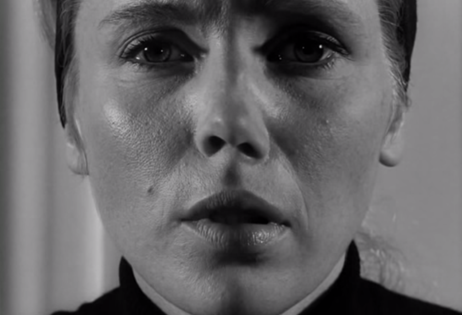
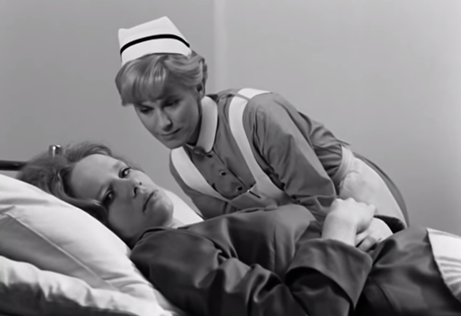
The opening sequences in the hospital are noticeably minimalist with an accentuated sterile environment. The close-ups feel reminiscent of The Passion of Joan of Arc and the highly dramatic and unnerving score sends twinges down our spine. To top it off, the takes can be excruciatingly long, focusing on an inert face or a solemn figure crouching in a doorway. Silence is just as prevalent as dialogue.
At its core, Bergman’s film is an examination of individual characters in space. Alma (Bibbi Andersson) is the young sprightly nurse who is called in to take care of catatonic actress Elisabet Vogler (Liv Ullmann). Their interactions quickly move from the plain hospital room to the seaside cottage loaned out to Mrs. Vogler for her recovery.
What begins as attendant watching over patient soon evolves into a vulnerable woman finding a silent foil to confide in. The Persona is changing.
All of a sudden roles are reversed and when Alma discovers a letter Elisabet sent away to the administrator, things are never the same. She feels betrayed learning that the actress has been analyzing her in silence. All that’s left is bitterness and anger towards her mute companion. No words come out of her mouth. Only blank stairs and more silence. She remains strangely calm in juxtaposition with the agitated Alma who becomes more and more tormented. But it is at this point we have lost much of our grip on reality. The lines, as well as the images, are often blurred and warped.
By the time the film came to its conclusion I hardly knew what to think. It elicited powerful feelings and reactions of aching and apprehension. If nothing else Bergman certainly makes you think and his Persona is unquestionably a striking piece of cinematic art. He has the skill of riddling our minds like a Bunuel or even Godard. It’s powerful if not completely satisfying because we can never hope to fully understand it.
Gone Girl (2014)
My only advice for Gone Girl is to leave all your preconceived notions at the theater entrance because you are about to be blown out of the water. This is not the movie you were expecting–probably very few people were.This is one of the most intense dramas that has come out in years and it in many ways functions as a thriller, a black comedy, and even a satire of the media. The often grisly depictions of violence make the proceeding moments of laughter all that more uncomfortable. Fincher made thrillers before, but nothing quite like this. It’s fidget-inducing, spine-tingling, and utterly perplexing.
Wages of Fear (1953)
Directed by Henri-Georges Clouzot, this international thriller stars a cast headed by Yves Montand. The film opens in a hell-hole of a town in South America where many jobless drifters spend their days. The joke is that it is really easy to get there, you just can never get out again. A Frenchman named Mario (Montand) is one of these vagabonds who has little to do except make eyes at a pretty girl (Vera Clouzot), and sit around the local hangout. Then a massive fire breaks out at a nearby oil field of the corrupt, American Southern Oil Company (SOC). In order to stop the devastation, the solution is to use explosions triggered by nitroglycerin. But the journey to the fields is extremely dangerous so there is the brilliant idea of finding four eager vagrants to transport two trucks of nitro on this 300-mile suicide mission. In need of a break, most of the town jumps at the opportunity. However, only four men actually get this “privilege.”
Soon the confident Jo turns into a sickly coward, but the other three must keep on going if they want their payoff. In the end, this mission turns out to be too much for some. Eventually, Mario gets ready to return to his girl with $4,000 in toe, a deliriously happy man.
4.5/5 Stars
Gaslight (1944)
Directed by George Cukor and starring Ingrid Bergman, Charles Boyer, and Josesph Cotten, with Angela Lansbury, this film begins rather abruptly with a young girl in England who witnessed the aftermath of her aunt’s murder. Then in a whirl wind she has become married to a nice young pianist and they move back to her old home in England to settle down to together. From that point on everything begins to change gradually. Gregory has a violent outburst over a letter, Paula loses her brooch mysteriously, a picture is misplaced, there are seemingly footsteps from above, and the gaslights change for no apparent reason. Gregory continues to manipulate and isolate his wife telling her it is for her own girl. A traumatic night at the opera and the new maid only worsen Paula’s mental state. She soon believes she is sinking deeper and deeper into hysteria thanks to Gregory. However, a former admirer of her aunt becomes curious of Paula and tries in earnest to meet her as he reopens her aunt’s case. Finally, they meet and together they piece together what is really going on. In the final climatic moments the inspector comes to Paula’s aid and she turns the tables on her husband. All the main players do a wonderful job, especially Bergman, and this film was built up nicely. My only qualms would have to be Joseph Cotten playing an Englishman and I found it hard to follow in the very beginning.
4.5/5 Stars
Die Hard (1988)
Starring a cast including Bruce Willis and Alan Rickman, the film opens during the Christmas season with cop John McClaine arriving in L.A. to be with his estranged wife and kids. He goes to an office party to meet his wife and that is when terrorists strike. John gets away unnoticed and he must wage a one man war against the criminal mastermind Hans Gruber, and his henchmen. First the police, then the FBI get involved but they can do little to remedy the situation from the outside. It comes down to the grit and determination of McClaine to take on his adversary all throughout the skyscraper. Fittingly, it all culminates with a showdown with the man behind it all. This film is definitely full of action and excitement. Several of the characters are enjoyable to watch and a handful are quite irritating.
4.5/5 Stars
The Prestige (2006)
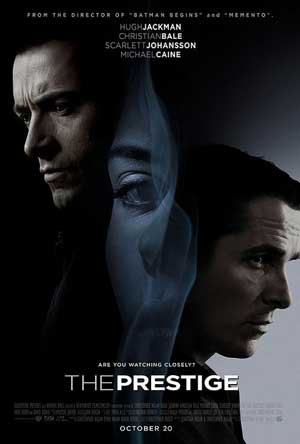
Starring Christian Bale, Hugh Jackman, Scarlett Johannson, and Michael Caine with director Christopher Nolan, this film is about two magicians who ultimately become rivals. After the death of Robert Angiers’ wife, he blames Alfred Borden and thus begins their quest to become the greatest magicians the world has ever seen. Along the way Borden finds a wife and has a daughter, while Angiers tries to discover Borden’s secrets various ways. Both men will stop at nothing to succeed even if it means sabotage, wounding, or even traveling to Colorado in Angiers’ case. With Borden in jail for murder of his rival, it appears as if Angiers has won. However, in the end all is not as it seems and it is revealed to the audience. Once again Nolan uses non linear storytelling to develop this intriguing mystery. I was not much of an authority on magic but now I know you have the pledge, the turn, and of course the prestige.Goldfinger (1964)
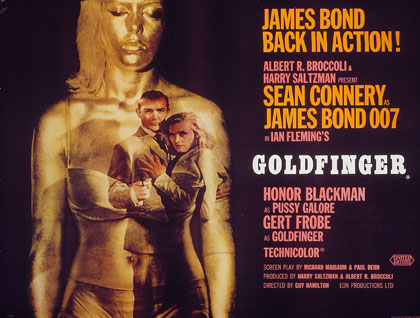
Starring Sean Connery as Ian Fleming’s character James Bond, Agent 007, this installment has him facing off with Goldfinger. After an entertaining opening sequence, Bond is given the assignment of keeping an eye on Auric Goldfinger, a powerful man with a insatiable desire for gold. Along the way he crosses paths with beautiful women, Goldfinger’s deadly chauffeur Odd Job, the highly trained pilot Pussy Galore, and of course the criminal mastermind himself. Bond and Goldfinger battle back and forth, first with wits and then everything becomes much more sinister. Bond is taken captive as Goldfinger tries to implement his dastardly plan revolving around a vault full of gold. Needless to say, in the end 007 is victorious and he gets the girl. With Bond’s modified Ashton Martin, great action, good characters, and a memorable theme, this film is “shocking, positively shocking.”
4.5/5 Stars
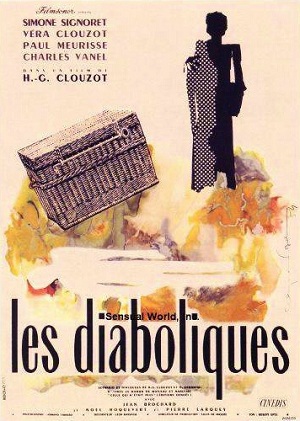
Diabolique (1954)
This French thriller begins at a small boarding school for boys. The principal is a difficult man who is married to a wealthy but frail teacher, and his mistress is another one of the teachers. Because he has been awful and abusive to both of the they befriend each other and devise a plan to kill him. They lure him away from school and eventually drown him in a bathtub. They go back to the school and dispose of the body in the murky pool. The deed is done and they are both apprehensive, especially the frail wife. When the pool is finally drained there is no body! This and other strange occurrences further frighten the wife and she becomes sickly. However, she could never expect what she saw one night that led her to die of fright. The twist at the end of the film is good. It is rumored that Hitchcock tried to get the rights to this story. He would just have to settle for making Psycho instead. What a shame.