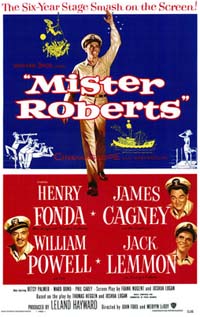
Mister Roberts (1955)

Starring an all star cast including Henry Fonda, James Cagney, William Powell, and Jack Lemmon, this comedy-drama chronicles the happenings on an unimportant boat during World War II. Mr. Roberts (Fonda) is one of the officers on The Reluctant and he is good to his men but constantly at odds with the difficult captain (Cagney). The ship doctor (Powell) is a kind and sagely old fellow while Ensign Pulver (Lemmon) is spineless, lazy, and still somewhat likable. due to an agreement with the captain, Roberts loses the respect of his men. However, when they realize what he has done for them, they honor him and help him get transferred so he can see some action. Pulver who is happy for Roberts, had tried to impress him earlier. After some bad news Pulver finally does something and it is fearless. I enjoyed this film because of the cast and its good combination of drama and comedy.

4/5 Stars

Review: The Best Years of Our Lives (1946)

15548-best2byears
Who in their right mind would make a film like this today? I mean it’s nearly three hours of incessant talking and character development. There are no explosions or special effects. There are not even any war scenes! And yet it is pure gold from William Wyler. He forces us to get to know these characters — all the details about them — and it is a pleasure.

In a year that boasted the likes of It’s a Wonderful Life, it is not simply a testament to the post-war sentiment, but also the power of this film, that led it to garner so much praise including a Best Picture Oscar.

Like Capra’s film, WWII plays a role here without actually focusing on the fighting. The effects of such a cataclysmic event were enough on their own.  The Best Years of Our Lives chooses to focus on the point of view of three returning servicemen. However, it would be selling the film short to suggest that is all the film is about. It revolves around deeper issues such as family, camaraderie, patriotism, and of course romance. Over the course of the film each man must navigate his own path, and much of those pathways have to do with their romantic relationships.

Al (Fredric March) has been married 20 years and yet he returns to a home with a wife and kids who seem more foreign than the battlefronts he fought on. His loving wife Milly (Myrna Loy) patiently allows him to become acclimated and stands beside him as he stands up for his convictions at his bank.

Then there is Homer (Harold Russell), the double amputee, who is bracing for the worst as he returns to his family and the girl next door named Wilma. His way of dealing with the situation is to avoid those he loves because by not letting them get close he thinks that will allow them to move forward with their lives. However, Homer completely misjudges just how much his girl loves him. Wilma is the real deal, and she is prepared to remain faithful to Homer no matter the circumstances.

The final relationship is perhaps the most complicated of the lot. Fred Derry (Dana Andrews) is the complete antithesis of Al. He has little work experience, and he was a young man who only knew his wife for a handful of days before he went off to war. Now it is all coming back to bite him because Marie (Virginia Mayo) is not ready to patiently wait around while the former soda jerk tries to find a job. She wants money, nights on the town, and good times. Sparks fly and Fred finds himself drawn more and more to Al’s daughter Peggy (Teresa Wright) since his marriage is a loveless one. This relationship is perhaps the most agonizing to watch as Fred is torn apart, but he ultimately gets the girl who will accept him for who he is.

“The best years of our lives” may have been during the war for some, but that really does not matter, because with the right attitude humanity is able to move forward to make the best of the future. That is one of the merits of this film, it exudes hopefulness and despite their different lots, each character is able to find a little slice of joy.

No one personality outshines any of the others, but on the contrary, all the players add up to the perfect combination. I will shamelessly acknowledge that Teresa Wright is one of my favorite actresses and over the last few years I have come to really appreciate Dana Andrews. They really do deserve more credit and I hope this film continues to get the praise it deserves. It is a delectable slice of cinema and Americana.

5/5 Stars

Saving Private Ryan (1998)

c1b38-saving_private_ryan_poster

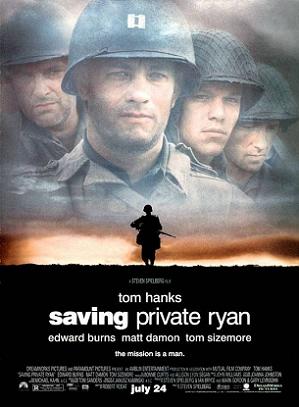
Telling an amazing story of bravery, Saving Private Ryan is both inspiring and moving. Beginning with the invasion of Normandy on D-Day June 6, 1944, the film follows a group of American soldiers as they look for a Francis Ryan. Since all three of his brothers are dead their mission is to find him and send the private home . Despite the dangers and the subsequent deaths of many comrades, they finally complete their mission after one last heroic fight. The movie flashes forward to the present day Ryan as he kneels at the graves of those brave men who saved him. Unsure he asks his wife if he lived a good life because those soldiers payed the ultimate price for him. With director Steven Speilberg, Tom Hanks, Matt Damon, and other good character actors, this is a powerful war film with great battle sequences as well as amazing heroism.

5/5 Stars

The Great Escape (1963)

Based on true events, this film describes the heroic exploits of POWs in a German Stalag during World War II. With extreme heart and teamwork the men take upon the task of making a massive escape. Led by Richard Attenbourough, Steve McQueen, James Garner, and Charles Bronson to name a few, they begin their monumental task. Despite adversity, their plan slowly becomes reality and escape is imminent. When the time comes over 70 men get away in the night, escaping secretly across Germany. However, relief is quickly replaced by tragedy as many of the escapees are shot or captured. Through it all the Allies struggle courageously against the Nazis. By the end they may be a little battered but they certainly are not beaten. Besides a wonderful ensemble cast, this film has one of the most iconic themes and chase scenes of all time.

4.5/5 Stars

Twelve O’Clock High (1949)

Starring Gregory Pb181c-twelve_oeck, the film follows a strict brigadier general who takes command of a group of bombers who fly precision daytime missions during WWII. Frank Savage is sent to relieve his friends because the group has suffered a great deal of poor luck. From the get go this tough leader is at odds with his men. They all want to be transferred and yet with the help of the camp adjutant, Savage is able to lead them effectively. His touch tactics lead to success in the air and a pride in his men develops. However, after one good mission Savage is incapable to go up the next day. He becomes a lifeless man and only when his men return does he revert back to normal. All this is remembered by Major Stoval as the film concludes. Peck and Dean Jagger were both very good and the bombing mission was certainly exhilarating to watch. It is more about the people then the war and that still makes it a good film.


4.5/5 Stars


Go for Broke (1951)

Starring Van Johnson along with a handful of WW II vets, this film looks like your average war film. It follows this group of soldiers from their initial training all the way to deployment. Then, we follow their exploits in Italy and France that coincide with their everyday interactions. However, this film is very significant because it actually tells the story of Japanese Americans in the 442nd infantry unit. They not only faced the enemy on the battlefield, they also had to deal with a great deal of prejudice within the armed forces. However, as with the example of Van Johnson, the Budha-Heads were able to win respect because of their courageous fighting. In the climatic moments of the film these men save a lost division and then return home as heroes. Since I am half-Japanese it was exciting for me to come across this film because this kind of topic has not been covered often. The fact that it actually had Nisei actors and was  made quite soon after the war is also amazing.

3.5/5 Stars

Rome, Open City (1945)

Directed by Roberto Rossellini this Italian neorealist film depicts the harsh realities of life in Rome during WWII during Nazi occupation. We are given an inside look at the bravery and everyday lives of these people. We become familiar with a fugitive engineer and resistance leader. He gains assistance from a kindly and collected priest who also runs a church. Their stories intertwine with a widowed woman who is just about to be remarried, a beautiful girlfriend, and a Gestapo office who is intent on stopping the resistance. After one tragic event everything continues on a downward spiral. The fugitive Manfredi and the priest, are both betrayed. Don Pietro must look on as the other man is brutally tortured to the point of death. Next, the Gestapo try to use the priest’s own beliefs against him and yet he will not yield either. He too then faces a fate just as horrible. This film at times was brutally realistic and it is perhaps one of the most moving films I have seen. We do not normally think of the struggles of Italians during WWII since Mussolini was allied with Hitler, however much like the French or even Germans, they faced tremendous danger and hardship. Furthermore, it humanized the Italians in my mind a great deal. This is the first film of the war trilogy that I have seen and now I want to see the other two. As you can see I’m still a little fuzzy on my Italian history and I would love to learn more.

5/5 Stars

The Caine Mutiny (1954)

With a stellar cast starring Humphrey Bogart, Van Johnson, Fred MacMurray, and Jose Ferrer among others, the film begins with a young ensign assigned to the mine sweeper named the Caine. After the first lax captain is reassigned, their new commander Queeg (Bogart) is a stickler for detail and order. After a series of incidents the crew becomes increasingly annoyed with him. The situation worsesn when Queeg begins to obsess about a few missing servings of strawberries. All these events boil over during a typhoon when the second-in-command (Johnson) prodded on, feels Queeg is unfit for command and he takes over control of the Caine. In the ensuing court martial, he is put on trial for mutiny and his attorney (Ferrer) must try to show Queeg to be truly unstable. Although he wins the case, everyone soon comes to realize Queeg was just a war-wearied man who gave a lot of himself. Despite some stark revelations the young ensign finally marries his girl and gets a pleasant surprise when he is reassigned to another boat.

4/5 Stars

Sergeant York (1941)

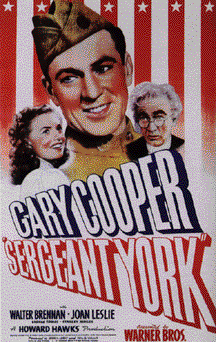
Starring a wonderful cast including Gary Cooper, Walter Brennan, and Joan Leslie with director Howard Hawks, this is a feel-good film. Alvin C. York (Cooper) lives in a small town in Tennessee where he works hard but also drinks a lot. Over time however he becomes a devout Christian and falls for a girl named Gracie (Leslie). He is hoping to get married and own a piece of bottom farm land. World War I begins and after a great conflict inside of himself, Alvin decides to go fight. While there he proves his valor, helping to capture 132 German soldiers almost single-handed.  He returns home a great hero and is reunited with his family and Gracie. Despite being a great war picture, this is also a very nice biography of a simple yet religious man who tried to live his life to the best of his abilities.

4/5 Stars

Apocalypse Now (1979)

10713-apocnowIn this hellish adaption of Joseph Conrad’s Heart of Darkness set in Vietnam, Martin Sheen is a captain given a classified mission. He must go down the river into Cambodia to terminate a Colonel Kurtz (Marlon Brando), who has gone rogue. The main part of the film follows his journey on a boat with a small crew of men. They meet up with a hardened napalm-loving colonel (Robert Duvall), watch a USO show, and witness as well as take part in senseless killing. With the crew whittled down, Willard finally reaches the outpost of Kurtz, only to witness the horror that lies there. After waiting so long to complete his mission, Willard feels conflicted about it upon seeing Kurtz. This is one of Francis Ford Coppola’s most famous films and it truly was a labor of love since it took a long time to complete. Although their parts may seem minimal, Brando, Duvall, Dennis Hopper, and even Harrison Ford contribute. Because I read the source novel, I could appreciate the film in that sense but The Godfather is a better film in my opinion.

4.5/5 Stars