Review: Butch Cassidy and the Sundance Kid (1969)


Not that it matters, but most of it is true…

The film opens with some old sepia-toned footage of a notorious gang from the turn-of-the-century and that is when we meet our two anti-heroes Butch Cassidy (Paul Newman) and the Sundance Kid (Robert Redford). Butch is the brains behind the operation (I got vision and the rest of the world wears bifocals) and Sundance is the brawn, with the most accurate gun in the West.

They make a living robbing banks and trains, but due to their lifestyle, they seldom come out ahead. Life becomes more difficult with tumult within the gang, a crackdown by the authorities and a price tag on the heads of Butch and Sundance.
Soon it becomes evident that their life of crime will never be the same with a professional tracker on their tails and a posse formed to see them hang. They are chased through hills, rock, water, and the like before finally getting away in one final desperate attempt at escape.
With one last brilliant piece of inspiration, Butch decides they should head for Bolivia to lay low, and soon enough they pack their bags and bring along The Kid’s girl (Katharine Ross) to the promised land of South America. They get more than they bargained for thanks to the language barrier and a lack of decent plunder. However, even abroad, their legend grows, winning them the new moniker “Banditos Yanquis.” The pair takes a stint on the right side of the law for once, but it somehow seems bleaker than their early days as bandits. It is evident that the hourglass is running out on them. And so it does, but not without one final glorious battle to cement the aura around two legends of the West.
I will not go so far as to call Butch Cassidy and the Sundance Kid a masterpiece because I have read too many reviews to know that there has been a great deal of division over the film. I can only speak from my own experience when I say that I quickly grew to love this story. This appreciation stems from the spot on chemistry of Paul Newman and Robert Redford. Their outlaws are not your typical thugs but lovable buffoons you cannot help but cheer for through all their screw-ups and pratfalls. Paul Newman has his ever-present mischievous smile plastered on his face, and Redford plays the cool and collected Kid to the tee. Perfect casting for the roles and to think it might have been Steve McQueen and Warren Beatty.
 
They got together again in The Sting, which was another good film, although I will always be partial to their first collaboration. William Goldman’s script can only be described as a fun romp that accentuates the comradery of Butch and Sundance. The musical score by Burt Bacharach with the inclusion of “Raindrops Keep Falling On My Head” is often at complete odds with what we have come to expect with classic westerns, but that suits the film just fine.
 
You see this is not your typical western by any means. It’s not supposed to be. Butch and Sundance are working in the twilight of the West. The horse is soon to be replaced with the future: the bicycles. Bank vaults are becoming more complex, fervor for the Spanish-American War is at its peak, and lawlessness is no longer going to be tolerated. Whether people realize it or not, this film is one in a final wave of classic westerns that finally petered out in the 70s. Now the western genre, just like the West before it, is dead. A dying breed of genre much like film-noir or even musicals.
 
That’s why Butch Cassidy works for me. People have criticized the constant change in tones, but this story never claims to be the absolute truth, and it would not be the same film if it did. This story of outlaws is not a history lesson but a legend about two infamous bank robbers. There are moments where we love these antiheroes and moments where we do not know quite what to think of them. They become disillusioned and beaten down by the changing times. Their ambush in Bolivia has only one apparent conclusion. It ended in a bloody and violent death. However, we do not have to see that for the sake of the legend of Butch Cassidy and the Sundance Kid. In one mythical moment, they regained their previous status. They went out as they came in, and they will forever be remembered as Butch and Sundance of the Hole in the Wall Gang. They have since been replaced by superheroes on the silver screen, but in their day and age, they were the original supermen — tarnished as they were.
What is amazing is that the film has not only resonated with audiences for generations, but with the leads themselves who really identified with their roles. That is perhaps the greatest compliment to its characters. 

5/5 Stars 

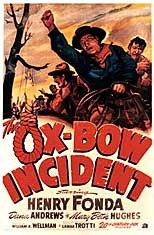
The Ox-Bow Incident (1943)

Starring Henry Fonda, Dana Andrews, Harry Morgan, Anthony Quinn, and many more, the film begins with two drifters (Fonda and Morgan) who enter a small western town. Soon it gets around that a man is dead and some of his cattle were also stolen. Hurriedly, a posse is put together and they ride off to find the culprits even though the Sheriff is looking already. They come upon three men and the majority of the posse believes the men are the perpetrators even though the trio profess their innocence. The posse votes on the spot whether to hang them or give them a trial and then they act. Only afterward do they discover the whole truth. Although the plot is simple, this western brings up some interesting and difficult questions. It certainly seems to blur the lines between the good and bad guys.

4/5 Stars

She Wore a Yellow Ribbon (1948)

6a177-sheworeayellowribbonpost“Never apologize. It’s a sign of weakness.”

She Wore a Yellow Ribbon can probably be considered lighter fare than the Searchers or Liberty Valance, but it is still worth a watch for Ford or Wayne fans.The 2nd installment of John Ford’s cavalry trilogy, this film was shot in Monument Valley in color and features a 41 year old John Wayne playing a 60 year old captain on the verge of retirement. However, before he is done he must diffuse the aggression of the Native Americans due to the aftermath of the Little Big Horn. At base and on the the trail he must deal with two young bucks (James Agar and Harry Carey Jr.) and the stuck up girl (Joanne Dru) they are fighting over. However, he also has some very capable men in his company, two of which are played by Victor McClaigen and Ben Johnson. With his retirement imminent he salvages his last mission before riding off as a civilian towards California. Except they are not quite done with him yet.

Here Wayne takes on a more fatherly role and does a good job dispelling his knowledge and know how as the experienced Nathan Cuttings Brittles. As usual John Ford does not disappoint and there is some brilliant scenery whether it is Monument Valley in the rain or the shine. Next are Fort Apache (1948) and then Rio Grande (1950)!

4/5 Stars

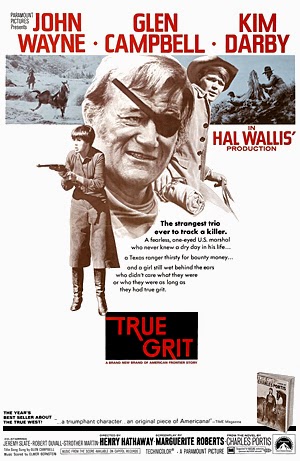
True Grit (1969)

6c138-truegritposterJohn Wayne was always memorable but he was probably never more iconic than his turn as Marshall Rooster Cogburn. He is a gruff, tough, drinking man who is willing to take on anyone and everyone at the drop of a hair. Yet despite all of that fury, Wayne embodies him in such a way that makes him lovable all the same.

Wayne is usually a given to steal the spotlight but Kim Darby gave him more than he bargained for as the stubborn, no-nonsense Maddie Ross. Following suit singer Glen Campbell showed he can do more than knock back a tune, playing the Texas Ranger.

As with many of his other great westerns, Wayne is surrounded by a solid group of stock characters including the likes of Dennis Hopper, Robert Duvall, Strother Martin, and even John Fiedler.

The film is adapted from the Charles Portis novel where Maddie, intent on catching the man who killed her father, hires Cogburn to track him down. They are joined by Laboeuf and thus begins there search.

Nothing beats seeing Wayne charge across a vast meadow towards Ned Pepper and his cronies, with his guns drawn and bridle between his teeth. The sequence is enhanced by the spectacular Colorado landscape that adds a character to the entire film. The Coen Brothers brought us a darker, more dramatic interpretation of this film, but it is hard to beat the fun of Henry Hathaway’s version. John Wayne, Rooster Cogburn, whatever you want to call him, he has True Grit. Isn’t that right baby sister?

4.5/5 Stars

Review: The Man Who Shot Liberty Valance (1962)

a44af-themanwhoshotNothing’s too good for the Man Who Shot Liberty Valance!!! But who is he exactly? How did it happen? Where is he now?

The Man Who Shot Liberty Valance is perhaps one of the moodiest and most atmospheric westerns of all time. In a sense, it is almost like a Noir Western with its often stark cinematography (especially during the climatic moments), and it is told through a long flashback that encapsulates nearly the entire narrative. Both qualities are typical film-noir.

John Ford had numerous classic westerns, but this one is possibly one of the darkest in tone. The film has a typically great John Ford cast (like My Darling Clementine or The Searchers). Of course, it would not be one of his westerns without John Wayne, then add James Stewart, Vera Miles, and of course Lee Marvin. Then the secondary cast is rounded out by such great character actors as Edmund O’Brien, Andy Devine, Woody Strode, Strother Martin, Lee Van Cleef, John Carradine, and Denver Pyle among others.

This film is also steeped in politics. It becomes more obvious the more you watch that there is this underlining conflict between democracy and a different system of representation. Could this be a critique of Communism also packed into a western? Probably.

One of the moments that really stood out this time around was the flashback within the flashback when Doniphan (Wayne)  reveals his point of view to Ransom Stoddard (Stewart). He was, in fact, the man who shot Liberty Valance. We knew it at heart but finally we have the proof and all of sudden his behavior seems justified and he becomes the tragic hero of the film.

It is an unjust ending and yet it plays out the way it was meant to — maybe not the way it should have. The lawyer got the girl, the fame, and the spot in Congress, because he is a hero for something he did not actually accomplish. Tom instead is the one who fades into the past. It struck me that this is one of the few films I can remember where Wayne actually dies, the other would be the Shootist. Except here he is dead before the story has even began. The legend of John Wayne himself lends nicely to this legendary man in the film who we only know through the recollections of others. As the newsman noted, when the legend becomes fact you print the legend.

4.5/5 Stars

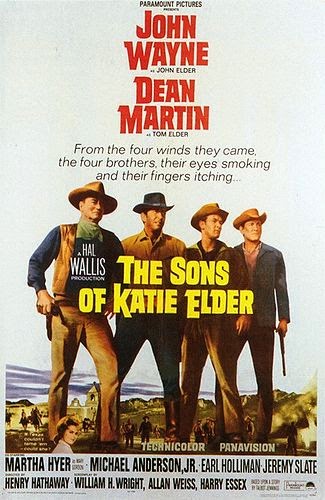
The Sons of Katie Elder (1965)

eb358-sons_of_katie_elder_1965Although John Wayne was old enough to play the father, the dynamic between the sons of Katie Elder is a fun one, besides the fact that John Wayne and Dean Martin could never in a million years be brothers.

Otherwise this is a relatively typical western with a menacing bad guy who has control of the small western town facing the brothers who are in the right. However, the town ultimately turns against them thanks to corruption and the stupid bravado of an inexperienced deputy. The balance is finally returned and justice is dealt, but not without some bloodshed of course.

Besides Wayne and Martin, there were some memorable turns by James Gregory, George Kennedy, Paul Fix, and a few others.

3.5/5 Stars

Rio Grande (1950)

f5e4d-riograndeThe last installment of John Ford’s Calvary Trilogy. Not the best of him or Wayne for that matter, but it is still a worthwhile film. First, there is the tension in the paring between Wayne and Maureen O’Harra as they quarrel about what to do about their young son who is a member of Wayne’s unit. There is a supporting cast including the likes of Victor McLaglen, Ben Johnson, Harey Carey Jr., and Calude Jarman Jr.

While watching it I was just thinking how Ford has so many great looking films in both color and black and white. This one uses the latter as well as a Monument Valley backdrop to perfection. It just looks so beautiful in every shot and Maureen O’Hara does not hurt the eyes either for that matter.

Soon after Ford would pair again with a few of his stars to make another little film. Anyone for The Quiet Man?

3.5/5 Stars

Winchester ’73 (1950)

2604e-winchester_73_-_1950-_posterStarring James Stewart and directed by Anthony Mann, this western follows the journey a special rifle takes in the old west. Stewart wins it in a competition but it gets stolen soon after. An Indian trader wins it in a card game only to have an Indian take it. Stewart, his pal, get pinned down with some cavalry by the Indians. They survive and the rifle is given to a young man with a girlfriend after Stewart is gone. A treacherous gunslinger coolly kills for it but then gives it up to the original bandit who claims it as his. In a final mountaintop showdown, Stewart faces off with his estranged brother who killed their father. He wins back his rifle and rides back into town to his friends. This is a good western with an interesting storytelling device. It was a surprise to see Will Geer, Rock Hudson, and Tony Curtis as unknowns.

4.5/5 Stars

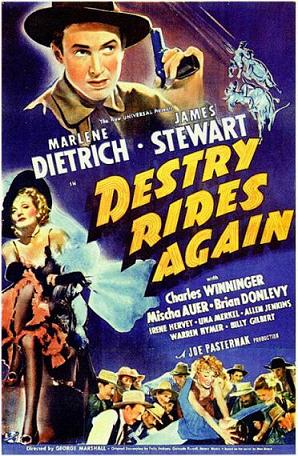
Destry Rides Again (1939)

4ff56-destryridesagainposterThis comedy turned dramatic western, starring James Stewart and Marlene Dietrich, begins in a town run by a saloon owner and inhabited by a sleazy song girl. Corruption and cheating reign supreme as the sheriff is killed and the town drunk takes his place. He turns right around and calls the son of an old friend, Tom Destry Jr., to be his deputy. Despite a comical entrance, and an abhorrence for guns this man is very different. Using his smarts and playing dumb, he is able to work for justice even though he seems to be helping the villains. He picks up the trail of the dead sheriff only to have the present sheriff shot as well. In the final unorthodox showdown, good fights bad and the womenfolk join the fray. Destry finally takes up his gun and is nearly killed, but he gets the town boss in the end. It carries another great cost however. Despite this tragic end, the film finishes on a lighter note. You will finish the film understanding that Destry knew a lot of people in his time.

4/5 Stars

The Shootist (1976)

24767-shootist_movie_posterIn his last film performance, John Wayne stars alongside Lauren Bacall, Ron Howard, and James Stewart in this tale about a notorious old gunfighter, who comes to stay in a small western town. J.B. Books gets a medical diagnosis from an old friend, and the doctor confirms that he is slowly dying from cancer.

 Books pays for a room in the home of a local widow (Bacall) where his reputation and actions one night scare off tenants. He receives a visit from the uneasy local sheriff (Harry Morgan), gets an offer for a book to glorify his life, has an old flame drop in on him, and old rivals and young guns are bent on killing him.

His lifestyle impresses the young man Gillom (Howard), but his mother openly disapproves of Books. Amidst all this, Books desires to live his last days in peace and he is waited on by Bond, and the two of them become to respect each other as her boy also comes to idolize Books more. The shootist sets everything up to die on his 58th birthday, going so far as ordering a special tombstone and sending three separate notes to different gunmen in town. He leaves his horse to Gillom and bids farewell to Bond before heading off for one last showdown. 

In the saloon, he is met by three men bent on killing him. Books is wounded but proves his skill one last time. In a cruel moment, however, Books is gunned down right in front of the horrified Gillom, who in a single instant ceases to be an innocent boy and becomes a man. 

This film was the perfect swan song for Duke because in many ways the character he plays mirrors his real-life western persona. Gone were the days when he was a kid in Stagecoach, a courageous sheriff in Rio Bravo, or even the gritty old codger in True Grit. He was truly reaching the twilight of his career.

Even it was one of the most storied of acting careers it was finally coming to an end. In just three years he would die of stomach cancer, and there was no gunshot to go with it this time around. During this movie, he still has life in him though, and even when he shares scenes with the whitening and tired-looking icon James Stewart, Wayne seems as resilient as ever. The Shootist is certainly not his greatest film or best performance, but I think it can be said John Wayne went out on his own terms just like Books.

4/5 Stars