
The Naked Kiss (1964)

thenakedkiss1If you’re not at least mildly prepared for it, The Naked Kiss comes at you like a ton of bricks. A woman comes at the camera menacingly beating up a man, for a reason we don’t know. Then her hair comes flying off and there she is still swinging at him completely bald. It’s frightening, frenetic, and completely engrossing. From thence on, Sam Fuller has us in the grips of his story, even if we don’t quite know what it’s about yet. His hook has grabbed us.

It turns out the women we were so brutally introduced to is named Kelly (Constance Towers). A couple years down the road she looks strikingly different, with no sign of turmoil. Instead, she’s a sleek beauty working the streets of Grantville.
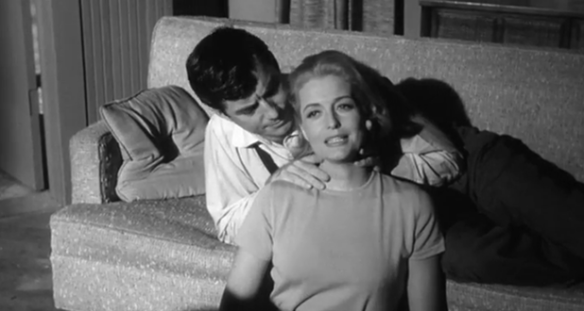
thenakedkiss2Of course, her first customer happens to be a police chief named Griff (Anthony  Eisley), who advises her to skedaddle out of town as quick as possible. He gives her the details on a cozy joint across the border known for their Bonbon girls. He thinks he’s got her pegged, but Kelly goes and does something even he wouldn’t expect.

She acquires a job at an orthopedic hospital for disabled children and quickly becomes a favorite in the ward. All the kids love her dearly, and she cares for them faithfully. But Griff still thinks she’s working an angle. His mind is closed off, looking for every opportunity to dredge up Kelly’s guilt. He wants to confirm everything he already knows about her, even if it’s not true.

Kelly’s stellar performance catches the eye of town millionaire J.L. Grant, who also happens to be a good friend of Griff’s. She and Grant hit it off on topics such as Lord Byron and Beethoven. Their time together turns into romantic dreamscapes of Venetian waterways.

At the same time, Kelly is extremely sympathetic to her fellow workers supplying money for a woman so she can keep her baby instead of getting an abortion. To naive young Buff, she warns of selling herself out and becoming a Bonbon (“You’ll be every man’s wife-in-law, and no man’s wife. Why, your world with Candy will become so warped that you’ll hate all men. And you’ll hate yourself! Because you’ll become a social problem, a medical problem, a MENTAL problem!… And a despicable failure as a woman”). It’s in these candid moments where Kelly reveals her scruples, although she’s not above vigilante justice, whether it involves her old pimp or the morally questionable proprietress Candy.

There are strangely peaceful lulls that only make the climactic moments in the film all the more dramatic. Fuller utilizes the children’s song from the hospital wonderfully with the hollow images he juxtaposes on screen. The song reverberates several times as a haunting marker of what Kelly has seen between a little girl and her soon-to-be husband. But that’s over with now. Kelly has deeper troubles to worry about afterward.

The Naked Kiss is a pulpy delight as only Fuller can deliver with twisted natures and deep-seated brokenness. He makes glorified trash which is often times far more engaging than the most polished blockbuster Hollywood can churn out. The seedy exterior almost always gives way to great depth. Even when you step back for a moment, it becomes obvious how implausible this story is. How does Griff not know about his best friend? Yet Fuller plays the drama so well we are completely engrossed.

thenakedkiss3The social commentary is there. The characters are interesting. Meanwhile, Fuller slices and dices through taboo subjects that would have horrified censors and yet he brings them to the forefront in such a way that hardly glorifies them, but actually gets them out in the open. Every detail isn’t written out, but Fuller throws us into the narrative and allows us to track with him. He puts a little faith in his audience.

Constance Towers’ performance looms large in this film and she reminds me a great deal of Gena Rowlands. Her turn as Kelly is multifaceted and dynamic. Her look of genial charm just as easily turns into an icy gaze of contempt. Furthermore, she, much like Fuller, is willing to go to the streets and acknowledge all the dirt and grime there. She wants to clean it up, and she truly is the hooker with the heart of gold. Only such an easy categorization should not take away from Towers’ role at all. There’s more to her than a look, or a wig, or a body.  To paraphrase Grant, she’s the most interesting contradiction I’ve met in some time.

4/5 Stars
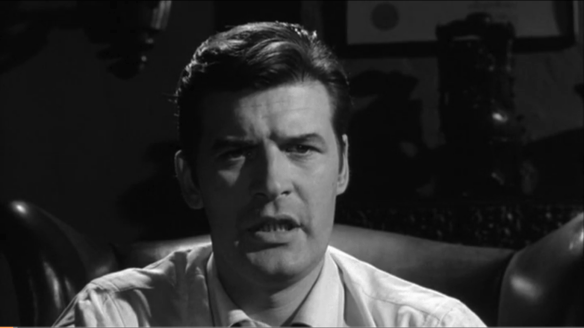
Shock Corridor (1963)

shockcorridor1“This long corridor is the magic highway to the Pulitzer Prize” – Johnny Barrett
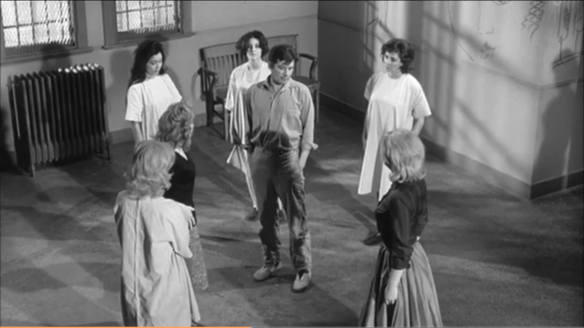
Being a jack of all trades, producer, director, screenwriter extraordinaire Sam Fuller also had a stint as a journalist. Therein lies his obvious stake in Shock Corridor, a film that looks frightening on paper, and is even more eye-opening in execution. True, this is not an altogether realistic film, but that’s what makes it such a stirring portrayal. It dives into the darkened recesses of a sanitarium showing us things we don’t want to believe. They probably weren’t all true, but there’s still that shred of doubt. We’ve seen enough One Flew of the Cuckoo’s Nest and read enough horror stories to know better. Fuller plays off that fear which intrigues us as much as it alarms.

Investigative journalist Johnny Barrett (Peter Breck) can see it now. If he infiltrates a mental institution he can dig up the truth on a murder case that occurred behind closed doors and was quickly hushed up. Such a piece of detective work could earn him the Pulitzer Prize easily, and the tantalizing prospect is too good to resist. His girlfriend played by Constance Towers pleads with him to back out, because she wants no part of the plan.

But he teams up with his editor Swannee and Psychiatrist Dr. Fong to cook up a backstory the people in charge will buy. Barrett gets coached in how to act and respond to every question. It’s a potential long shot, but just like that, they buy his sordid story of obsession with his sister thanks to a performance by Cathy. He’s in.

shockcorridor3Behind the pearly gates, there are brawls galore and noisy neighbors riddled with all sorts of neurosis, quirks, and ticks. There are the good cop and bad cop who help care for the patients and keep them at bay. Johnny even begins to have hallucinations of his girlfriend drifting through his dreams. He gets introduced to hydrotherapy, dance therapy, and even faces a traumatizing experience at the hands of women in the female ward.
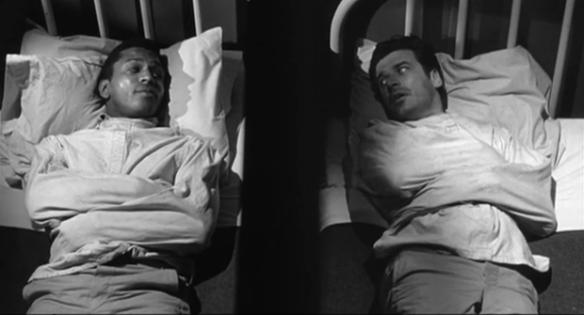
All the while, he is sniffing around for any information on the man named Sloan who was killed with a knife by a man in white pants. He makes his rounds questioning three different witnesses and amid their idiosyncrasies, they give him bits and pieces of fact. However, their own mental capabilities are clouded by traumatic war experiences, racist ramblings, and fear of impending nuclear war.

shockcorridor2The boisterous, tumultuous chaos of the ward does almost become maddening, even to the viewer. Johnny has a few angry outbursts of his own as the strain of the facility gets to him more and more every day. Electric shock therapy among the other treatments leaves him mixed-up, confused, and overtly paranoid. He’s hardly the man we met in that office so many days ago and even if he got the scoop he was looking for, at what cost? Shock Corridor has a thunderously disconcerting ending worthy of a Fuller production.
From casting Philip Ahn as a knowledgeable psychiatrist to the absurdity of an African-American obsessed with the KKK and Pro-White sentiment, Fuller once again does a lot on the racial front. He manages to represents Asians in a positive light and the character of Wilkes points to the still inherently twisted nature of southern white supremacists, even after the advent of such legislation as Brown v. Board.  Thus, once more he gives us a sensationalized story with a surprising amount of depth to it. No doubt he had a soft spot for journalism since that’s what he made his living off of at one time. But Shock Corridor implies that there is such a thing as crossing the line. It’s the utter extreme, but it’s cautionary nonetheless.

3.5/5 Stars

The Steel Helmet (1951)

steelhelmet1“What a fouled-up outfit I got myself into” – Sgt. Zack
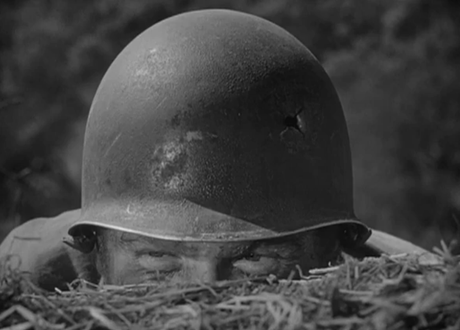
Samuel Fuller always had an eye for the visually dynamic and a nose for controversy. His war picture The Steel Helmet was at the forefront of films about the Korean War, in fact, it was probably the first.

Despite, being shot in a few solitary days in California, he somehow managed to develop a generally atmospheric terrain overflowing with fog of war and overgrown with foliage. It’s an unsentimental, gritty, sweaty storyline. In other words, it’s very Fuller and its cynical lead is Gene Evans as the thick-headed Sergeant Zack weighed down by war-induced pessimism. He’s got a bullet hole in his helmet to prove it. He’s been good enough to last through this game of survival of the fittest thus far, and he hopes to keep it that way.

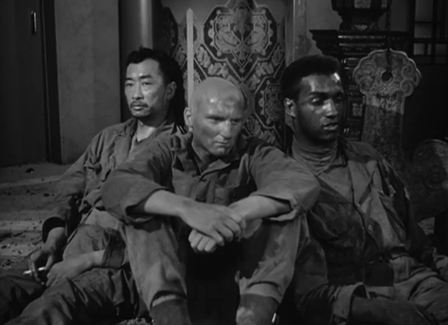
Zack picks up a peppy young South Korean, the original “Short Round,” and the sergeant reluctantly allows him to tag along as he continues his pilgrimage. Next, comes the African-American medic Corporal Thomson, who like Zack was the sole survivor of his unit. In the forest depths, they run into a band of soldiers led by the experienced Lt. Driscoll. Although Zack wants nothing to do with them, he agrees to stick around after they get pinned down by a couple snipers.

Their mission: to set up an observation post at a nearby Buddhist temple.  However, the road ahead includes booby traps and other menacing perils of war. They have one of their hated “gooks” waiting for them, and he causes some havoc before being captured. However, perhaps more insidiously he tries to undermine the men by going after Thompson and the “Buddha head” Nisei vet named Tanaka (Richard Loo). The wily enemy, in perfect English mind you, notes the hypocrisy of an American society where African-Americans can die on the battlefield, but then only get to sit on the back of a bus. He then suggests how he and Tanaka have a great  more in common, aside from their eyes, especially since the American government put Japanese-Americans in Internment camps

steelhelmet2But the old WWII vet simply acknowledges the facts and retorts with his own piece of trivia. In the all Japanese-American regiment the 442nd 3,000 Nisei “idiots” got the purple heart for bravery. All he knows is that he’s an American no matter how he’s treated. That doesn’t change. Once more Fuller delivers some of the most engaging portrayals of Asian characters ever and the discussions of race relations were way ahead of their time. Both Richard Loo and James Edwards are honorable characters who hardly fall into any common stereotype.

After staving off this psychological warfare, the band calls in an artillery barrage on some nearby snipers. But soon the enemy is swarming them and it’s a wildly thrashing, blasting battle to the death.  The fight scenes are sheer chaotic madness, but then again isn’t that what war often escalates to? It just doesn’t make sense. Billows of smoky haze engulfing the war zone. Whirrs, bangs, explosions, and every other sound imaginable except silence. That comes when the bodies are dead and strewn all over the battlefield. In truth, silver stars mean very little when you’re just trying to survive.

Fuller was prophetic by suggesting that there is no end to this story. He was right. It went on for a couple more years and ended in a cease-fire that still continues between North and South Korea to this day. He’s also one of the great economical filmmakers where less is most certainly more. What a stroke of brilliance that he could use a weeks time, the grounds of The Griffith Observatory, and a few minor actors and extras to create such a fascinating film.

4/5 Stars

It’s a Mad Mad Mad Mad World (1963)

itsamadmad1It’s easy to forgive this sprawling comedy for a weak script because it does a wonderful job of playing to its strengths and delivering a hilarious payload of laughter. Stanley Kramer (known mostly for his social dramas) drops this raucous comedy full of bone-shattering slapstick and violently wild antics. It also assemblies arguably the greatest comic ensembles with some of the biggest names you could ever hope to see on the big screen. Everyone seems to come out for a who’s who of comedic talent in roles big and small. Half the fun is recognizing a familiar face on the screen for a quick cameo, giving a nod of approval, and then grabbing hold of this rip-roaring comedy once more as it hits breakneck speed. There’s nothing sophisticated about it and that’s part of its charm.

The film opens on a mountainous road when a car goes careening off the side of the cliff. Some onlookers go to see what they can do, but little do they know they’ve stumbled on to a gold mine. It’s not hidden under Jimmy Durante’s big nose, but a giant “W” in Santa Rosita State Park. It’s all very suspect, and everybody gets ready to head their different ways. However, a little old-fashioned, All-American greed sets in and they begin to high-tail it down the coast. The prize of a $350,000 payoff is too much to disregard.

After a harrowing car chase the treasure-seekers break off as follows:

Sid Caesar and his wife Edie Adams charter a prehistoric bi-plane and wind up spending the majority of the film trying to escape the basement of a convenience store using any means possible. Buddy Hackett and Mickey Rooney find a plane of their own, the only problem is that their pilot (Jim Bachus) gets a little tipsy mid-flight, leaving landing duties in their inept hands.The long-suffering Milton Berle constantly is being berated with the incessant babbling of loud-mouthed Ethel Merman. Poor Jonathan Winters is ditched by everyone else, then double-crossed by Phil Silvers, before he’s finally is able to hitch a ride. Berle finally loses all patience and teams up with buck-toothed Brit Terry Thomas. Spencer Tracy the wry police chief Culpepper watches all these events unfold with a play by play being fed his way. Meanwhile, his life begins to fall apart, but that pales in comparison to the gas station that Winters demolishes with his bare hands. That’s not the only destruction this gang leaves in their wake either. They total cars, destroy buildings, and do every type of damage you could ever expect. It’s great!

When everyone finally happens on the treasure they’ve picked up a couple cabbies played by the venerable Eddie “Rochester” Royal and Peter Falk. The mayhem leads to an excavating party and a final chase as Culpepper takes the money and runs with the gang hot on his heels. It all ends thrillingly from the top of a fire escape with a precariously situated ladder. The boys all end up in the hospital, but it’s still a laughing matter thanks to a stray banana peel.

Although the laughs slow down a bit in the second half, this film is a wonderfully good time. You have cameos from everybody like Jerry Lewis, Jack Benny, William Demarest, Buster Keaton, Don Knotts, Carl Reiner, and even The Three Stooges. Since there so many people who did make the cut I’ll be a glass half empty misanthrope and list off a few names who did not end up joining the film’s cast. Red Skelton, Bob Hope, Jackie Gleason, Stan Laurel, Bud Abbott, Lucille Ball, Peter Sellers, and of course Don Rickles who never let Kramer live it down for not inviting him. Quite the list, but mind you I’m not complaining too much.

The film takes on a personal note too because my dad actually saw the movie being shot on highway 73 back in the 1960s, and he remembers it rather fondly. To me, the film takes on deeper significance due to the crisscrossed palm trees which also became the iconic symbol of Inn-N-Out Burger all across California. What’s not to love about such a Mad Mad Mad Mad World?

4/5 Stars

Review: Some Like it Hot (1959)

somelikeithot1Only Billy Wilder would dare to make such a film. Somewhere amidst the St. Valentine’s Day Massacre and men dressed in drag, he could find the inspiration for one of the most high-powered, zaniest, even subversive comedies of all times. There’s very little overstatement in that assertion because Some Like it Hot is all that and most importantly it’s just good unadulterated fun.

It finds its genesis in the Jazz Age of Chicago circa 1929 where gangsters like Spats Colombo (George Raft) are running the streets, the crash hasn’t quite hit yet, and the Dodgers are a long way away from leaving Brooklyn. George Raft takes on a parody role hearkening back to the days of Scarface, but this time, there are a lot of laughs in the wake of his destruction.

Small-time musicians, Joe and Jerry, are living paycheck to paycheck and things aren’t going so hot for them when the authorities raid a not so legitimate establishment. Immediately they high tail it, but they’re not safe for long when they unwittingly stumble upon the St. Valentine’s Day Massacre. They frantically flee the scene of the crime knowing the mobsters will soon be after them and to make matters worse they have no money. What to do? What any desperate pair of musicians would do, dress up as women and join an all-girl ensemble for three glorious weeks in sunny Florida. Sounds ludicrous when Jerry (Jack Lemmon) first drops the idea half-serious, but after the hot water they find themselves in, Jerry (Tony Curtis) takes him up on the masquerade.

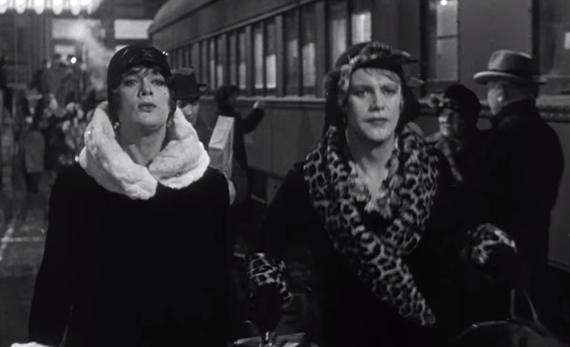
somelikeithot2So they pack their bags, do up their faces, and change their voices an octave or so higher. They wobble to the train station on top of their heels as Josephine and Daphne, just what the band leader Sweet Sue ordered and our two effeminate fugitives get aboard for a wild ride indeed.

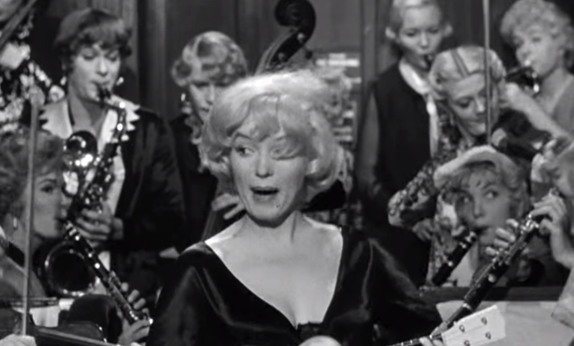
They soon meet the other gals including the vivaciously scatterbrained Sugar Kane (Marilyn Monroe), who already has a strike against her for getting caught drinking. It looks like bad news for her during a bouncy rendition of the 20s tune “Runnin’ Wild.” Amid the toot-tooting of Josephine’s sax and the bass twirling of Daphne, Daphne also finds time to bail Sugar out. She’s quick to make friends too during an after-hours get-together in her compartment. It’s one of the uproarious moments where Jerry/Daphne must go through the battle of the sexes. He’s so giddy to have so much female company and yet he must maintain his facade. What’s brilliant about Lemmon is he actually seem to genuinely relish his part. Whether it’s his character or not I’m not sure, but he buys into his role especially when it comes to his budding romance, but that comes later.

All things are bright and cheery when they arrive in Florida with palm trees and bachelors galore, all ready and waiting for a little tete-a-tete. One such bachelor is Osgood Fielding (Joe E. Brown), who immediately has his eyes on Daphne. And let the comedic irony and romantic entanglements begin. What follows are two absolutely preposterous tales of romance that crank up the absurdity.

somelikeithot4Joe swipes a sailor’s cap and a pair of glasses while donning his best/worst Cary Grant impression to woo Sugar as an aloof magnate complete with oil fields and a yacht. It’s all part of his plan to win her love, and Daphne views the whole thing disapprovingly, hoping to catch his buddy in the lie. Thus, now Joe has committed himself to two roles and somehow he’s able to keep the plates spinning by borrowing Osgood’s boat for a romantic night with Sugar and using a bicycle to rush back to the hotel and put on the whole Josephine act.

Meanwhile, Jerry gets more and more invested in the whole Daphne performance dodging Osgood’s playful advances, while finally dancing the night away to a killer tango. It’s the diversion Joe needs in his plan to get with Sugar, and he’s succeeding. But Jerry, or should we say Daphne, isn’t doing so bad either. With a flower between her teeth and when she’s not trying to lead, they make quite the couple. Could there be wedding bells?

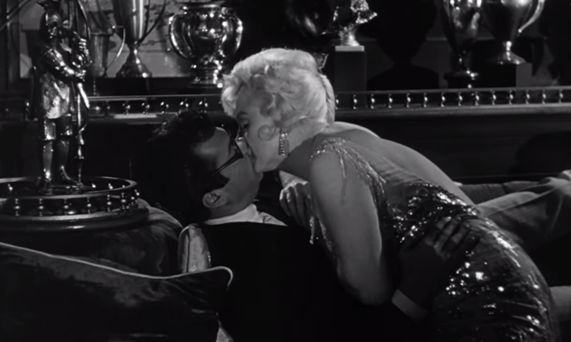
All that hilarity goes on halt when Spats Colombo and his gang come to town for a conference and the girls avoid suspicion at first, but their nervousness tips the mobsters off. The chase continues and the boys must finally drop the act if they want to get out alive. But Joe delivers one final gesture to Sugar not wanting to ditch her completely. They plan to catch a ride with Osgood who will elope with Daphne. But in a last-ditch effort, Joe finally lets everything drop and breaks all pretenses. It makes for an awkward situation when he gives Sugar a big kiss in front of a full audience, still dressed in drag.

As they get away in the little motorboat, Joe pleads with Sugar not to stick by him, because he really is a bum. But she doesn’t care, does she? He’s Tony Curtis, a Cary Grant type. Now it’s Jerry’s turns as he tries to cook up excuse after excuse why he cannot marry Osgood, and of course every time he’s rebuffed. Finally, in exasperation, he pulls off the wig, loses the voice, and yells, “I’m a man!” Without missing a beat, his beau shoots back, “Well, Nobody’s Perfect.” The look on Lemmon’s face is priceless and this moment is the perfect capstone on one of the wildest films you could ever imagine.

somelikeithot5It’s absolutely astounding that despite all the headaches and troubles Marilyn Monroe brought to the set, including constantly flubbing lines and being generally difficult, her performance bubbles over with a playfully ditsy sensuality that captivates the screen. I for one can hardly ever see the turmoil going on underneath because the role of Sugar is so vibrantly joyful, innocent, and genuinely funny put up next to her great co-stars. Her numbers like “I Wanna Be Loved by You” exude the friskiness that she was known for and there’s no question that Monroe has a magnetism on the screen that was unequivocally her.

Joe E. Brown plays the giddy playboy with devilish hilarity, the perfect comic companion for Lemmon. While Tony Curtis is great, he plays the straight man in the sense, that it feels like he’s just doing this out of necessity. Lemmon is an absolute riot, taking on this role willingly and bubbling over with enthusiasm that is palpable. He has that cackling laugh that adds an exclamation point too many of his conversations and when he starts dancing around with those maracas, shaking his hips, it’s hard not to crack a big goofy smile.

Billy Wilder always had a gift for films with wonderfully entertaining characters and plot lines that poke holes and find humor in modern sensibilities. He gets away with so much by dancing the fine line of what is acceptable for the 1950s and yet he puts it together in such an engaging and uproarious way that it remains a classic. Not just of comedy but of film in general. I’m not ashamed to say that I do like it hot. Although air conditioning is nice every once and awhile.

5/5 Stars

Ex Machina (2015)

Ex-machina-uk-posterThe film industry needs films like Ex Machina. They’re smaller productions, but that usually means they’re more audacious and oftentimes far more interesting. First time director and veteran screenwriter Alex Garland delivers up a story that takes place in an isolated, ultra-modern getaway that’s a helicopter ride away from civilization. Caleb (Domhnall Gleeson) gets dropped into this little piece of paradise thinking he’s won a huge honor, and in truth, he has hit the jackpot. He makes his way to this isolated locale and comes face to face with Nathan (Oscar Isaac), the mastermind behind his little company. We don’t quite understand why Caleb was called in or what the following hours will look like exactly.

Nathan quickly clears up any ambiguity with one pointed question: “So do you know what the Turing Test is?”That begins the jumping off point for the entire narrative which is compartmentalized into different sessions of observations. It’s Caleb’s job to interview the one and only Ava (Alicia Vikander) over the course of a couple days to decipher whether or not she can pass the Turing Test. Yes, Ava is a highly intelligent A.I., but just how intelligent we’ll find out over the course of the story.

This is most of the film, but there are a lot of oddities that plant themselves in back of our minds. Who is Kyoko the maid? Is Nathan to be trusted? After all, Ava induces powercuts so she can talk with Caleb in confidence. Because she knows we act differently when unobserved — when all the eyes aren’t watching us.

Ava is strikingly metallic, mechanical, and still somehow incredibly lifelike. Nathan has developed her in such a way that she has attraction down to a science. She somehow exudes a robotic sexuality.  The trick is finding the perfect algorithm for action that is not automatic. Getting the precise equilibrium of nature vs. nurture.

The mind games delve ever deeper as Caleb tries to maintain a balance between his intellect and his own insecurities. Ava asks to question him, and the tables are quickly turned. Caleb is manipulated constantly and he himself manipulates. But he realizes too late that he served one function, only to be quickly discarded.

Ex Machina is fascinating as it spirals deeper and deeper into an abyss of deception and disorientation. It exists in that terrifying realm of the not so distant future, and while we are not there yet, it feels like we may be on the cusp of such a world. It brings up questions of man’s desire to be God and the dichotomy that arises between the creators and the created. The history of computer science arguably extends all the way back to Alan Turing, and it certainly has opened grand avenues of exploration. But with such power, including Artificial Intelligence, Search Engine Optimization, and the like, we are opened up to a far more perilous world. A world, where if we’re not careful we can lose all grasp of reality and all confidence in our fellow man.

4/5 Star

Review: Citizen Kane (1941)

citizenk3“That’s all he ever wanted out of life… was love. That’s the tragedy of Charles Foster Kane. You see, he just didn’t have any to give.” – Jedediah Leyland

It might seem rather trite to attempt to write anything on Citizen Kane, but as someone who can admittedly be trite sometimes, there seems to be a need to give it a go. Here it goes. Citizen Kane is forever an enigma, in the sense that it was fully under the control of the independent-minded and ultimate auteur Orson Welles during the studio age. It didn’t come out of some movie making assembly line, but instead, it’s a debut that exhibits so many elements that have befuddled and fascinated audiences for generations. There’s certainly the technical and production aspect which became the watermark and inspiration for countless millions. Then you have the human aspect which also deserves some attention.

Swirling around a film with this much mythology there is always bound to be hearsay and rumors, but supposedly in later years, Welles considered Citizen Kane a comedy, in the sense that everything is over the top camp, much in the same way that Welles the man was a larger than life caricature. He played the part of an alienating artistic mastermind to a tee, and it fit the way he made this film. Grandiose in scope,  infused with inspired vision, and really an all-out war for acknowledgment.

Because of the many stories about Kane which have now become the stuff of legend, the parallels between Charles Foster Kane and news magnate William Randolph Hearst stand out. Whatever his opinions of the actual film ended up being, Hearst did his best to besmirch the film and keep it out of theaters. And so it goes Welles’ debut did not get much of an opening, ironically because of a man rather like his main character. It would be interesting to know what Welles would have thought of such a situation. Would he have been greatly incensed or taken it rather like a compliment that he had created something so volatile? Because it’s true, Citizen Kane is still smoldering today, and it retains a constant place in cinematic discussions even 70 years after its release.

There’s so much to talk about and so much that most everyone has probably already talked about. It has such an intriguing narrative structure, and it models time in such fascinating ways. Because a lot of this film is about the passage of time as it pertains to one man’s life and the memories of his life. He is dead after uttering that immortal word “Rosebud,” but his memories live on through the recollections of those around him.

We get access to the story through a newsreel, but like such a reporting device we leave it knowing very little about the man except for his material possessions and maybe a little about his career. What we really want to know is the man, and the nameless reporter becomes our stand-in.

He pieces together Kane’s childhood by sitting in a musty vault and reading over the thoughts of the boy’s caretaker and financial adviser Mr. Thatcher. With one particularly memorable match cut, we jump a number of decades in a matter of seconds as the banker speaks to a young Kane only to turn around speaking to a young man. But he’s not much help except that Kane put Thatcher under fire with his brand of yellow journalism.

citizenk2Mr. Bernstein is a kindly fellow and an old man by now who used to work with Kane at The Inquirer when it all began. He knew the man who had a song named after him, who bought out the staff of the rival paper The Chronicle, started his own war, and married the niece of the president.

From the now elderly and slightly infirm Jedediah Leyland (Joseph Cotten), we learn of the rise and slow decline of the man along with his friendship with Leyland. There is a sequence here with Kane’s first wife that wonderfully shows the degradation of a marriage over the years as he is more devoted to the paper than his spouse. It’s tragically sad, and there’s more heartbreak in that one scene than most films can muster in their entire runtime. Because Kane could love, and he wanted love, but he also seems to love himself more than any other person. He’s married to his work and the personal independence that comes with it. Ultimately, Kane’s political career suffers from scandal and his own bullheadedness. Leyland switches branches to get away and becomes a drama critic prepared to lambaste the operatic debut of Kane’s second wife. It really is bad though Kane will never hear of it. He’s always in need of proving himself to those around him.

Our investigative journalist returns to the nightclub of Susan Kane to get the rest of the story from her, and it only becomes more depressing. After being forced into an opera career she has no ambition for, Kane finally relents and Susan spends her days in Xanadu, the fortress he built for her sake. But she wants more than the stuff that he can give her. She wants to get out, have fun, and have companionship. Kane doesn’t know how to do that, and soon after she left him.

What was left behind was a deeply troubled, isolated old man with nothing but material possessions to weigh him down in a river of loneliness. His life was a jigsaw puzzle and yet when we get the piece pertaining to his final word, it fails to help us make any headway. Because the reality is that no one word can explain a man’s life. It is interesting how Kane desperately wanted love so you would think that his last words would refer to a person. It just shows how messed up his relationships were. He thought he could get joy from possessions so it’s only fitting that his final words were another thing. It’s sad really, so if Orson Welles wants to call Citizen Kane comedy, there seems to be a need to qualify that and christen it a “tragi-comedy.”

Herman Mankiewicz’s script with Welles is the quintessential tale of the rise and fall of one man and with the ever-changing times, that archetypal narrative has remained prescient because America is still built on those sorts of individuals. It can be the nation of visionaries as well as tragedy. Wealth and loneliness.

As for the great Bernard Hermann, his score personifies the changes in Kane over the years and this was the first time I noticed the wonderful reprises of his theme song. It can be heard throughout although it seems to lose all the gaiety and luster it had years before.

citizenk1Gregg Toland’s cinematography is strikingly beautiful utilizing the distinctly clear, deep focus to frame shots wonderfully. Background and foreground remain equally important becoming a wonderful way to convey distance. Also, the camera always seems to be making the viewer crane our necks, getting a slight view of the ceiling or it has us looking down at the figure below us. We very rarely see them head-on as they appear. Furthermore, Kane is steeped in trick shots, mirror images, and all sorts of things that I cannot even begin to do justice to. It could be a nurse walking into a room or Kane solemnly plodding through the vast corridors of his domain. It’s a veritable paradise for the eyes because we are always being met with visual marvels. Citizen Kane has grown on me every time I see it since it’s not simply narrative, or backstory, or history, but also at the most basic level, it’s one of the most prominent expressions of this highly visual medium called film.

5/5 Stars

Commissar (1967)

commissar1

Even with the so-called Khrushchev Thaw, it’s pretty amazing that Commissar even got made and perhaps even more astounding that it made it to the viewer all these years later. Some of that might be because it originated from Russian Civil War literature and anything else we can attribute to luck.

It is, as it titles suggests, about a commissar: an official of the Communist party, but this one seems special. First of all, she’s a woman which in itself is an interesting piece of commentary, but perhaps more so is the transformation she goes through.

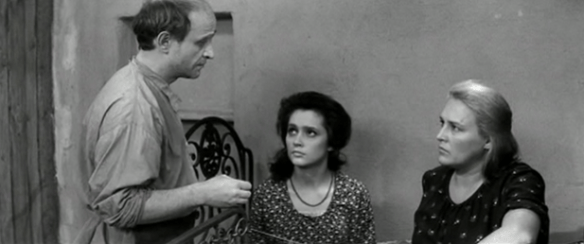
From the outset, she is what we conjure up in our minds. Brutal, tough as nails, masculinized and mechanized by the collectivist agenda of the party. She’s the perfect comrade cog in the communist machine. Except then she receives the startling news that she is pregnant, and she must seek refuge in the home of a nearby Jewish clan. They are forced to quarter her, serving the greater good. She’s aloof to the whole idea and their diminutive patriarch puts up a fuss.

You see, he already has five children, a wife, and a mother to look after. He can’t afford to have this unwanted extra baggage, and she’s no friend of theirs. In this sense, the film feels reminiscent of Melville’s Silence de la mer. However, Commissar evolves into its own creature, just as all parties involved change over time. Yefim and his wife make their guest comfortable the best they know how and following the pregnancy they take good care of her.

Seeing her with a newborn is an altogether strange and foreign image, and with the cult of motherhood, the commissar’s whole demeanor shifts. She looks on at this family with contented eyes and stares back at her former life with some reluctance. It seems impossible to traverse the same paths she once did.

Perhaps most frightening are the images that are interwoven into the plot. They are disorienting, paranoia-filled, listless dreams that swoop in during pregnancy and restless hours of sleep. In the present, there are the children playing their militant games, terrorizing their sister, a sad reflection of the things going on outside of their own homes. There are constant contributions and pogroms always hanging over God’s people.

Whether it’s a hopeful fairy tales or a truth which you are willing to die for, the film paints a fairly bleak picture of what it means to live life. Our commissar is wholly disillusioned and the shadows of the Holocaust hang over the narrative because they lurk in the near future, not the past.

Director Aleksandr Askoldov’s favors a  fluid camera that nevertheless feels unrefined more times than not in its blunt and most certainly chaotic movements throughout the frame. It’s as if it’s not confident keeping still  — needing to prove its mobility in all circumstances. Still, the film boasts a lasting power that feels counter-cultural. This is not the film we expect coming out of the USSR circa 1967. These characters feel conflicted, their story feels sobering at best. It also offers up a strangely haunting dance sequence like no other, but then again this is far from an ordinary film. The director would soon be fired, expelled from the party, and exiled. The KGB would lock his film away and throw away the key for 20 years. He undoubtedly struck a cord — then and now.

3.5/5 Stars

Review: This is Spinal Tap (1984)

thisisspinal1Director Rob Reiner makes an appearance in his own film as documentarian Marty Di Bergi. It’s tongue in cheek, but no one seems to have told Spinal Tap or anyone else in the film for that matter. For all intent and purposes, they are a real band with a real camera crew following their every move. The lines between fiction and reality are very easily blurred, because Spinal Tap seems more legitimate than some bands that come together, with one original album attached to the film and two subsequent albums that followed. That’s the funny part, or maybe it’s sad, depending on how you see it. It mocks, it parodies, and it attempts for the overly-dramatic, and yet it doesn’t fall too far from the actual music industry.

This mockumentary, rockumentary, or whatever you want to call it, follows Spinal Tap during their not-so-long-awaited tour in the States. Their trajectory mirrors all the great rock bands of their day and age. Right now they’re in the Zeppelin or Aerosmith stage, but led by their two founding members David St. Hubbins (Michael McKean) and Nigel Tufnel (Christopher Guest), they started a skiffle band back in Mother England. It was a humble beginning, with numerous arbitrary name changes, a hippy phase (much like the Beatles), and finally the genesis of their big-haired, hard rock 1980s persona. After all, their amps go up to eleven, one higher than the typical amplifier. They’ve cranked things up to new levels, but it doesn’t help that they’re album Smell the Glove is getting some negative backlash for its cover art.

What follows is a less than promising tour with failed autograph signings and malfunctioning props onstage. All the while, the immature musical nucleus of the band Nigel and David begin fighting. It feels very Lennon/McCartney and their Yoko Ono is David’s girlfriend Jeanine (June Chadwick). When their original manager quits in a huff, Jeanine steps in and things keep on going downhill. Bassist Derek Smalls (Harry Shearer) just seems like he’s along for the ride, and their most recent drummer is just happy he hasn’t met the unfortunate fate of spontaneous combusting like his predecessors. No one seems to care about the keyboardist Viv. Ain’t it the truth.

Then, the fateful day comes when the band splits up, or at least Nigel finally leaves having had enough of it all. But as they play second-bill to a puppet show at an amusement park in lovely Stockton, California, the boys realize they need Nigel back. Although the U.S. wasn’t too welcoming to them, they look to have a bright future in Japan with popular hits like “Sex Farm” “Big Bottom” and “Stonehenge.” They’re very popular over there, and of course, their amps still go up to eleven.

4/5 Stars

Review: The Silence of the Lambs (1991)

silenceof1The Silence Lamb is a horror film at times, a thriller at others, and most definitely a character study in its entirety. It features two wonderfully different figures in budding young FBI agent-to-be Clarice Starling and incarcerated serial killer Hannibal Lecter played so impeccably by Jodie Foster and Anthony Hopkins respectively.

It begins as a hunt for a serial killer named Buffalo Bill (Ted Levine), who for some reason kidnaps his victims, kills them, and skins them like some kind of perverse trophy. This in itself makes for an interesting albeit grisly storyline. The race is on to find this man before he murders his latest victim who happens to be the daughter of a prominent senator. Thus, there is an immediate need to get inside his head and figure out what the next logical steps should be. That’s when Agent Jack Crawford (Scott Glenn) of the Behavioral Science Unit calls on Starling to help him out.

The narrative of Silence of the Lambs is twofold because this larger manhunt becomes the backdrop for an arguably far more interesting development. The initial meeting and budding relationship, if we can call it that, between agent Starling and cannibalistic psychopath Dr. Lecter is deliciously intriguing. He just might be the key to unlock this case, but it’s not without peril.

silenceof2As the saying goes, “Quid pro quo.” Lecter is rather intrigued by Starling, so different and far franker than any of the other people who get thrown his direction. So he agrees to help her only asking in return that she open up about herself. It seems like a dangerous proposition with Lecter constantly playing mind games. He’s skilled at probing, dissecting, teasing, and prodding. But Starling willingly goes through his questioning to get help with the case. After all, who better to catch a serial killer than another serial killer?

They touch on the death of Starling’s father, a town Marshall, and her horror in seeing the slaughter of newborn lambs. In return, he tells her that all the information she needs is in the case files. But antagonistic Dr. Chilton is more a hindrance than a help to Starling’s case, and she must figure out the rest on her own.

Going through the files she finally makes some headway in her search for Buffalo Bill, but an FBI tactical unit already has sights on his location. Then there’s a surprising about-face in the case, not to mention that Lecter escapes his cell, kills his guards and is on the lam. Starling is not in danger from him, but he is looking to have an old friend for dinner instead.

Ultimately the plucky young agent comes through big in her case and in the academy. The film ends on a high note for her, but with it comes a titillating call from Dr. Lecter. He pays his respects for her recent graduation then goes off after his newest victim. Such a conscientious killer to offer up his congratulations like that.

How does one go about playing a man so evil and yet intricately interesting on so many levels? Hopkins said himself that he copied a friend who never blinked because it always makes people on edge. He likened his voice to an amalgamation of Katharine Hepburn and Truman Capote if that even makes sense. Finally, he saw parallels to another famed movie villain, the computer HAL in 2001: A Space Odyssey.  Both so intelligent, so unfeeling and ultimately so deadly. What might put Lecter a trifle above HAL are his chilling unflinching facial expressions that are sure to send shivers down the spine of any normal person. A face like that just doesn’t leave you.

4.5/5 Stars