 I love the forum that is created in international cinema where all things can be debated and discussed without fear of what the audience will say. Hollywood caters to the audience and that more often than not means that thrills are given greater weight than substance. Eric Rohmer worked at Cahiers du Cinema alongside French New Wave visionaries like Jean-Luc Godard and Francois Truffaut, but he joined the game a little later than his colleagues with a different style. Rohmer took his pseudonym from director Erich von Stroheim and British novelist Sax Rohmer. He was a highly educated man and that comes out in his films.
My Night at Maud’s comes from the perspective of a man, who we have a sneaking suspicion might be a lot like Rohmer. Jean-Louis (Jean-Louis Trintignant) is a reserved, highly religious, intelligent man. He attends mass on Sunday, bumps into an old school chum on the street, and willfully enters a discussion on all sorts of philosophical topics.
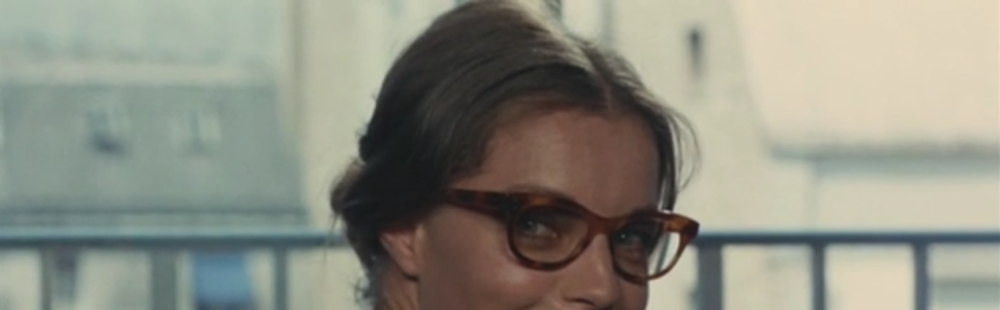
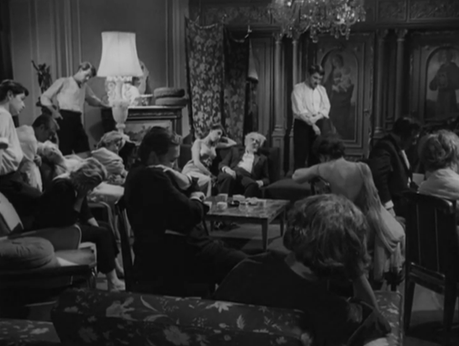
Whereas Godard interest himself in the lowly gangsters, the streetwalkers, or the lovers on the run, Rohmer’s character are in a completely different stratosphere. They are a higher slice of society, and it shows in what they spend there time philosophizing about. In fact, there’s a lot of discussion stemming from Pascal’s wager on whether or not it is beneficial to believe in God. Although he can be a bit of a clown, Vidal is also a philosophy professor and ready and willing to delve into such topics. He holds hypotheses on the meaning of life, and he’s considered where hope comes from. These are intelligent beings and deep thinkers, and by transference, they lead us to think. They drop by on Vidal’s friend Maud (Francoise Fabian), who is a divorcee, irreligious, and most certainly a free thinker. She’s also beautiful, and she likens there little late night convo to the salons of old as they gather around her bed to raise their conjectures.
 I feel like I have known people like Jean-Louis, and I cannot help but like them. He’s a fairly resilient Christian, but not a perfect example mind you, and yet he feels far from a hypocrite. With his new dialogue partners, he speaks of his past love affairs and how they can exist with his religious convictions. Maud rather matter-of-factly labels him a “shame-faced Christian” and a “shame-faced Don Juan,” because he’s not fully committed or acknowledging of either. And yet she generally likes him a lot. He likes her company too and so they can continue talking in a genial manner. She pokes fun and ribs but never attacks. And she openly brings up numerous different ideas about Christianity. There are things that feel very human, but not very Christian to her. Maud asks if Christians are judged by their deeds? She assumes there is a bookkeeping aspect of Christianity where good deeds are weighted versus sin. Several times the rather obscure term of Jansenism is thrown around a bit in reference to the theology of Dutchman Cornelius Jansen. It surely is difficult to keep up we these folks at times, but it’s well worth it.
Maud has her own preconceived notions about religion, while Jean-Louis has some delusions about romance. He thinks he’ll meet a pretty blonde Catholic gal and fall in love. It sounds utterly preposterous and yet then he meets Francoise (Marie-Christine Barrault) after his night at Maud’s. She’s the perfect embodiment of everything he’s ever dreamed of in a romantic partner. They seem like a good pair, although she is still in school, they are intellectual equals with similar personal convictions.
 Sure enough, 5 years down the line they are married with a young son. Jean-Louis has not seen Maud for many years now, but quite by chance they bump into each other on the beach. Both pick up where they left off as if no time has passed because it’s so easy for them to converse. Francoise is noticeably uncomfortable around Maud, but nothing more is said about it. Jean-Louis moves on and plays contentedly with his family on the beach. Maud heads back up the hill as cordial as ever. This is an ending that is made powerful in its subtleties above all else because Jean-Louis and the audience realize something about Francoise. Yet there is no need to voice those conclusions because all that matters to him is that he is happy. It toes a soft line between romance and drama, instead resorting to a beautiful exchange of ideas. Noticeably, in Rohmer’s film, there is no score so the dialogue is elevated to the level of music. It fills the void using deep, introspective and personal forms of verbal expression.
4/5 Stars
 In spite of being a jaded viewer at this point, the Russo Brothers (Arrested Development and Community) and the screenwriting duo of Christopher Markus and Stephen McFeely (The Narnia Franchise) proved still capable when it comes to keeping the Marvel Franchise afloat and, nay, helping it to flourish like few franchises ever have. The pair of directing and writing duos who brought us Captain America: Winter Solider were able to add another link in the armor, and Marvel has remained stalwart. There are moments of misguided drama, times when the fight sequences become monotonous rather than momentous, but Marvel always does well to keep their funny bone intact.
 Sabrina, Sabrina where have you been all my life? ~ William Holden as David Larabee