
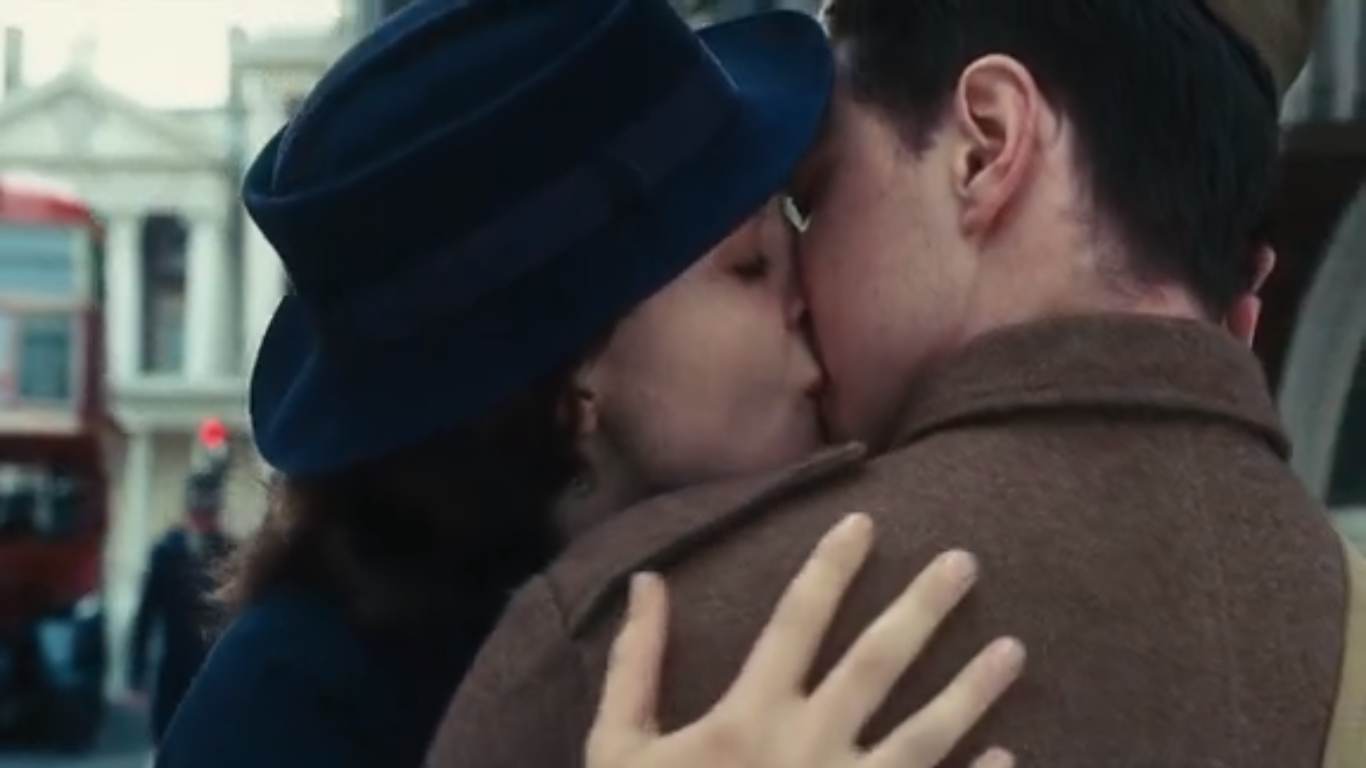
 Without any prior knowledge and given what we know to begin with, it looks like Atonement will be a love story revolving around the characters of Keira Knightley and James McAvoy. They are, after all, the big stars in this WWII era romance based on the Ian McEwan novel. We expect to become enraptured in their passionate love affair that is to be indubitably broken up by war. However, it becomes evident very quickly that this is really a tale about a young girl and budding author, played through the years in succession by Saoirse Ronan, Romola Garai, and Vanessa Redgrave. It is her point of view and her part in this narrative that becomes most important, although we do not have any indication as to why to begin with.
So in front of the peering eyes of Briony Tallis, her older sister Cecilia (Knightley) and the son of the family housekeeper Robbie Turner (McAvoy) start something which Briony cannot fully comprehend and understand. What is it that is really going on around her? An intricate manipulation of time and place begins, relating the story from a number of perspectives, but always returning to Briony. How does Cecilia really feel towards Robbie, who is in a sense below her, but still proud? Briony knows she has feelings for the housekeeper’s son, but how is she to react when she finds her sister and Robbie crammed up against the bookcases together. Then, when a pair of pesky twins goes missing a search party begins. Again Briony sees something that she cannot fully understand, and yet she makes a judgment that will unwittingly tear apart two lives. There is constantly an inquisitiveness, a confusion in her expressions that is absolutely spot on. And in these moments the score is suffocating with its pounding, clanging, and banging.
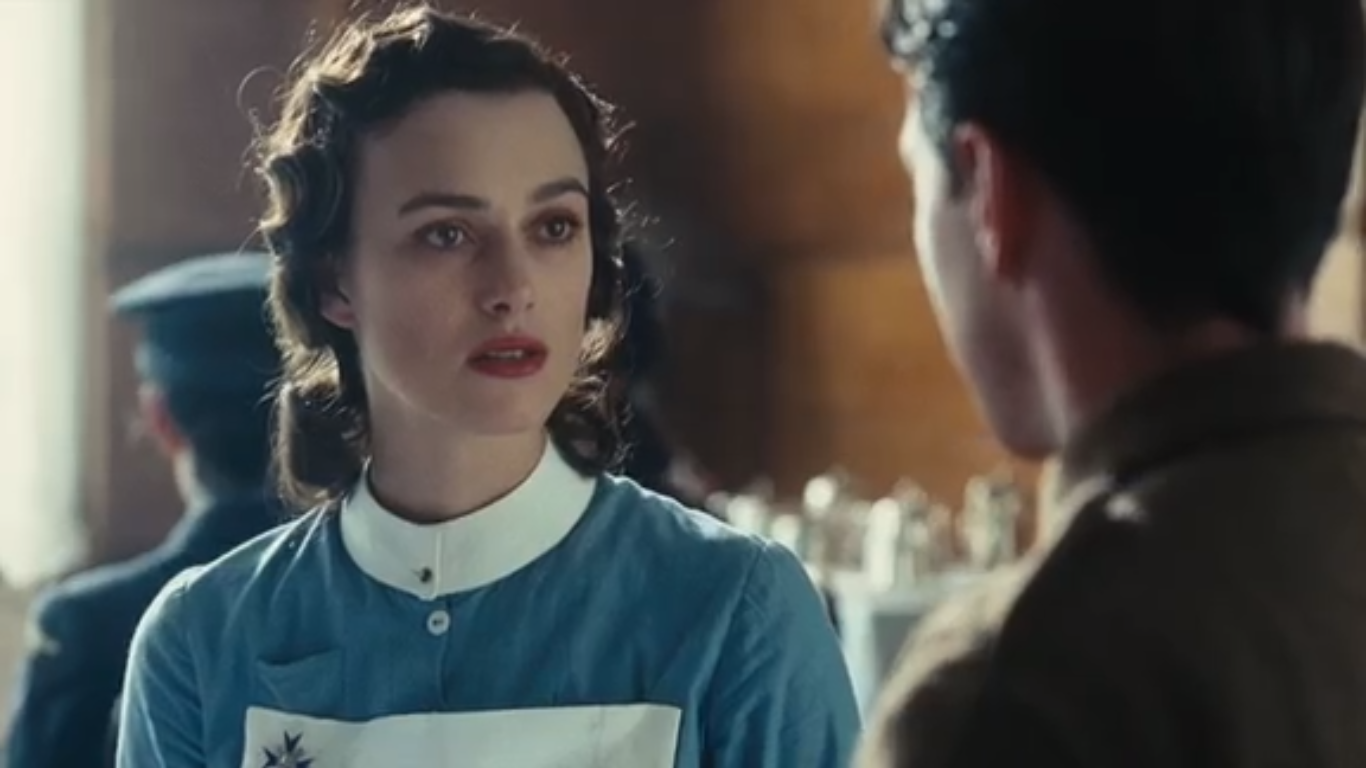 Robbie gets sent away, torn from his love Cecilia, and Britain is on the brink of war. When the two lovers finally get a chance to see each other, he has joined the army in order to be released from prison, and she is working as a nurse. But it’s a heartbreaking separation because although the passage of time is condensed for us, we can easily see the reserved, hesitant quality in both of them. How are they supposed to react? It’s difficult to hold onto the same feelings, maintain the same type of passion when you’re separated by the years. Cee reaches out to touch his hand, and he avoids her slightly. You cannot exactly blame him, but there is a tinge of sympathy for her.
But their romance is quickly renewed and heightened once more in a matter of days, only to have the war this time pull them apart. And it’s something that’s very hard to rebound from. Robbie ends up in the middle of France and when he finally discovers the coast with a couple of comrades they come across all the forces at Dunkirk getting ready to retreat. For those engaged with WWII history, Dunkirk was in one sense a wounding blow to the English ego, but also a testament to their resilience. The men are beaten and battered, but escape the Nazi onslaught to fight another day. And yet we don’t see the fighting. With a wonderfully dynamic tracking shot director Joe Wright gives us an eye into the tired and wounded masses. And it’s somber, chilling, melancholy, and still strikingly beautiful in the same instance.
 Back home, Briony is now working in a hospital almost as penitence for wrongs and soon the hospital is inundated with wounded from the retreat. She is quickly thrown into action comforting a dying French soldier with a penchant for the soft refrains of Debussy. Then, comes the pivotal confrontation where Briony, now older, faces her sister who has refused to talk with her. And Robbie is there too. Together they painfully and angrily point out what the young girl had done to both of them. It’s heart-wrenching to the nth degree and yet the final revelation makes it all the more painful.
Now many years down the line, Briony, who is now much older (Redgrave) and an author of 21 books, is interviewed about her final novel Atonement. It lays out the events of the whole film, and she explains her reason for writing such a story. She wrote it to be read by the public certainly, but most importantly she wrote it for Robbie and Cee. To give them closure and the dignity that they deserved.
So you see, it’s the book within the book really or more correctly Ian McEwan writing a novel called Atonement featuring a fictitious version of the same work. In a sense, I do feel manipulated by this film, but do I mind? Not really. I don’t hold it against the film because it tells its story with so much beauty and grace.
4/5 Stars
 Galaxy Quest might be a kitsch homage to all things Star Trek and Star Wars, but that’s the secret to its unequivocal success. It stands on the laurels of its campy fun which it wears as a banner like all the Trekkies and Star Wars fanatics it looks to pay tribute to.


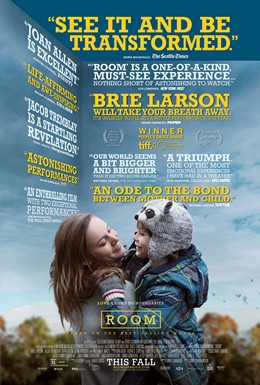 Brie Larson has been on my radar for a while, ever since The Spectacular Now and Short Term 12. But she’s also a personal favorite who deserves to be in the company of other such shooting stars as Jennifer Lawrence, Shailene Woodley, Miles Teller, and Michael B. Jordan just to name a few.


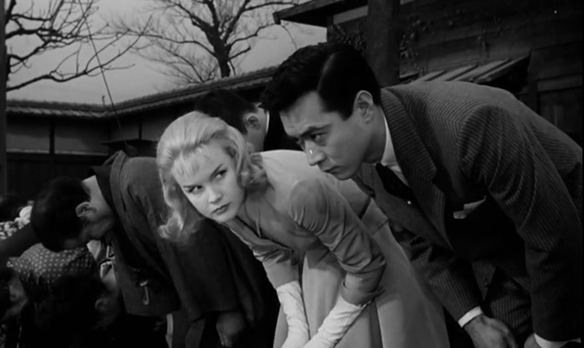
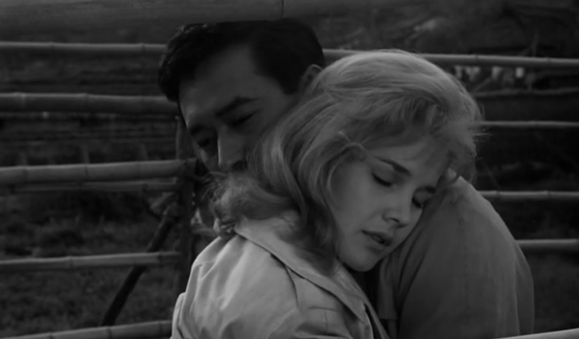 Bridge to the Sun is one of those films that was ahead of its time. Its main actors are hardly remembered by modern audiences. The top-billed leading lady, Carroll Baker, was probably more notorious for her controversial persona in films like Tennessee’s Williams’ Baby Doll than she was famous. James Shigeta was a pioneering Japanese-American actor, who was once told, “If you were white, you’d be a hell of a big star” (The Slanted Screen). He aged gracefully but was slowly relegated from leading roles to bit parts. Belgium director Etienne Perier was only a slight blip on the Hollywood radar. When it came out in 1961, its narrative based on the memoir of Gwen Terasaki ended up being an abysmal flop. Honestly, it’s not all that surprising, because the public was not ready for such a film, and its candid depiction of interracial marriage. Now, with a fresh pair of eyes in the 21st century, Bridge to the Sun looks quite extraordinary. Certainly, this is a love story, but under very different circumstances, in a very different world. Although it was made in the classical Hollywood mode, it still manages to groundbreaking, not necessarily due to its form, but thanks to its content. Because Bridge to the Sun places an Asian man and a Caucasian woman together, as they navigate two starkly different cultures both tottering on the brink of war.
 In truth, this film does not shy away from showing their affection, even though it undoubtedly made some viewers squeamish at the time. More than once Gwen and Terry embrace in intimate moments that signify the deep-rooted love that holds them together. Sometimes it’s far from easy. For instance, when they first travel to Japan, Gwen finds it difficult living in a culture where women are meant to be wholly subservient to their husbands. She’s fine with the bowing and the taking off of shoes even, but not being allowed to speak her mind is about the limit.
 Gwen and Terry cannot stay mad forever, especially with the birth of their little girl Mako. In fact, it is actually in a moment when their family is in danger of being pulled apart that Gwen shows her true resilience and loyalty as a wife. Pearl Harbor has just blown up and that means there is a freeze on all Japanese aliens. Terry is stuck at the embassy about to be deported, and an FBI agent advises Gwen that she would be much better off staying in the states. But as she converses with him you can see the determination in her eyes. She knows what it means to go to Japan. Her daughter as a child of mix race will be scorned, and Gwen herself will be looked down upon if not endangered by her status as an American citizen.
 lously these individuals salvaged their marriage and preserved their family. Meanwhile, the world around them would not make the necessary concessions. It allowed cultural differences to define relationships, and ultimately increase the void between nations. The rubble of WWII was eventually cleared and new hope was built upon that foundation. In reality, the chronicles of the Terasakis was an emblem of that hope. Inherent in their story is the possibility that two people and two nations really, can be reconciled and even thrive together. Perhaps the United States was not ready for such a message to come out of Hollywood, even as late as the 1960s, but nevertheless, it seems like a message we can certainly take to heart today.
 “I don’t like anybody pushing me around. I don’t like anybody pushing you around. I don’t like anybody getting pushed around.” Van Heflin as Sam Masterson
 17 or 18 years later a full-grown Sam Masterson (Van Heflin) decides to return to his old stomping grounds, Iverstown, on a whim. He’s surprised to learn that the “little scared boy on Sycamore street” is now District Attorney (Kirk Douglas). And he’s now married to Martha Ivers (Stanwyck). She and Sam had something going long ago, but he’s all but forgotten it by now. He’s made a living as a gambler who has a pretty handy dandy coin trick, but really Heflin’s character could be anything.
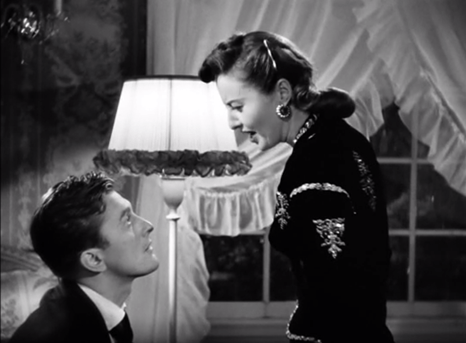 We don’t actually see Barbara Stanwyck’s face until 30 minutes into the film, but it doesn’t matter. She as well as
  Honestly, although Stanwyck is our leading lady, it’s quite difficult to decide whose film this really is. Van Heflin and Barbara Stanwyck are at its core, but then again, Scott and Douglas do a fine job trying to upstage them. There’s a polarity in the main players, meaning Stanwyck and Heflin have the power, and the other two are the subservient man and woman respectively. However, the film really becomes a constant tug-of-war. Douglas is not just a spineless alcoholic. There’s an edge to him. Scott seems like a softy and yet there’s an incongruity between her persona and that prison rap that hangs over her. Heflin seems like the one relatively straight arrow because as we find out, Stanwyck is fairly disturbed. She’s no Phyllis Dietrichson and that becomes evident in yet another climatic conflict involving a gun. But she’s still demented, just in a different way.

 4 Star Films