Review: Chinatown (1974)

chinatown1Forget it, Jake, it’s Chinatown

The more you watch movies like Chinatown, the more you realize how much you’re still learning. I saw it the first time and I naively thought I knew everything about it. After all, it seemed fairly cut and dry. But the beauty of this film is a labyrinth-like story that can still keep me engaged after multiple viewings. There are things that I missed, things that I have to piece together once more, and more often than not details I simply forgot.

Robert Towne’s script has an intricacy to its constantly spiraling mystery plot that remains powerful and Roman Polanski — with cameo included — directs the film with a sure hand as well as a cynically bitter ending worthy of his work. At that point, he was returning to the same city where a few years prior his wife Sharon Tate had been brutally murdered and that certainly had to still be heavy on his mind.

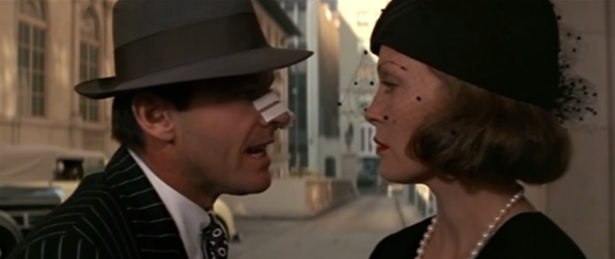
Throughout, Chinatown has elegant visuals of a desert-dry Los Angeles circa 1930s, and it is aided by a smooth Jerry Goldsmith score made for such a period crime film as this. Jake Gittes (Jack Nicholson), is the smooth-talking, smart-aleck P.I. with a penchant for trouble, but that goes with the business. In the tradition of all his heirs like Spade and Marlowe, the whole story is told from his point of view and we get the details at the same pace as him. That means a lot of the time we are just as confused as him, trying to pick up all the pieces.

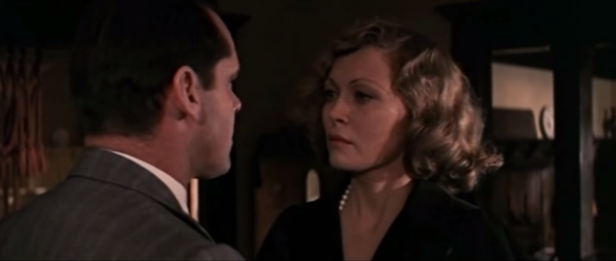
Aside from Nicholson, Faye Dunaway’s performance is an interesting reworking of the archetypal femme fatale, because she has a different side to her. Also, John Huston’s performance is wonderfully nefarious, because he plays Noah Cross with a top layer of geniality that is ultimately undermined by his base nature. It’s wonderfully wicked.

In the story’s first few moments of being in his office, we begin to learn a little about the means Gittes uses to appease his clients. Then, his newest client walks through the door, a Mrs. Mulwray, who wishes for him to tail her husband. And so he does, just like that, and he’s pretty good at it too. Hollis Mulwray (an anagram for Mullholland) happens to be an integral part of the L.A. Department of Water and Power as the chief engineer. From what Gittes sees, the bespectacled Mulwray seems to have his scruples, but he also has a secret girl, who the P.I. is able to snap some incriminating photos of.chinatown2 Back at the office, another woman shows up, a Mrs. Mulwray, but this time the real one. She wants to slam J.J. with a lawsuit, but he realizes he got framed, and in the end, she quickly drops her case. Pretty soon Gittes former colleague Lt. Escobar digs up Mulwray’s body and the cause of death is the height of irony. He drowned during a drought, a cruel demise, and his body is joined by that of a drunk, who also was wandering around the local reservoir. It’s time for our nosy P.I. to do a little more snooping, but he is scared off by two security guards from Water and Power who give him a deadly nose job.

None worse for wear aside from a small cast, J.J. knows the department is diverting water. It’s more than a little runoff like they contend. He gets lunch with Noah Cross (The great John Huston), who is the father of Mrs. Mulwray and the former business partner of the deceased. Like J.J., he’s curious about finding the mysterious girl, and he sweetens the pot for the P.I.

A bit of detective work takes Gittes to the hall of records and then a vast acreage of orange groves where he is mistaken for a member of the Department of Water and Power. They aren’t too happy to see him, but Mrs. Mulwray is able to bail him out. They check up on an assisted living home and tie it into the whole conspiracy. Someone is buying up land under the names of the unknowing residents.

chinatown3But as it turns out, Mrs. Mulwray is hiding a major secret of her own that she’s been keeping. Another girl is murdered and since he’s found at the crime scene, Gittes is in a tight spot with the police and so he wants to get things straightened out. But he doesn’t quite understand what he’s gotten himself caught up in. At the last minute, he decides to take the hero’s path, but it’s to no avail. The good is snuffed out, the bad walk away free, and corruption still runs the streets of L.A. There’s not much the cops can do about it either.

chinatown4So many people remember the film’s final words, which epitomize this place of confusion, corruption, and helplessness. The final words of Jake are just as illuminating, however, because he repeats the words he spoke to Mrs. Mulwray earlier when she asked what he did when he worked a beat in Chinatown, “As little as possible.” It’s so pessimistic and yet it’s the truth that everybody knows. He must resign himself to doing nothing because there is no way he can win, no way to overcome the forces that be. It’s a haunting conclusion, but ultimately the most powerful one we could hope for.

Earlier I alluded to the fact that every time I watch this film I pick on things that I missed before. For instance, within Robert Towne’s script are some interesting instances of foreshadowing. The first comes in the form of a pun uttered by the Chinese gardener who is constantly muttering, “It’s bad for the glass/grass.”

Then, while they are in the car Mrs. Mulwray dejectedly drops her head on the steering wheel and it lets out a short honk. This acts as an important portent to the end of the film along with the blemish in her left eye. If you have not seen the film yet, this might sound very cryptic, but if you keep your eyes open these little details are rewarding. Chinatown is a fascinating place to return to again and again after all.

5/5 Stars

Inside Llewyn Davis (2013)

insidel2More often than not Llewyn Davis turns out to be a worthy character and I mean that in the sense that he is readily watchable. This probably isn’t the real folk scene of the 1960s, but it is the time and place seen through the Coen Brothers’ somber lens. Inspired by musician Dave Von Ronk, Llewyn is his own unique entity entirely. The film itself has a dreary look of washed out tones mimicking the days that most of us now know from black and white imagery. There are folk tunes wall to wall, befitting such a melancholy film, adding layers of melody and ambiance to this austere world of isolation.

In fact, we first meet Llewyn in a low lit bar singing the ode “Hang me, Oh hang me.” He’s not some budding talent or has-been. He had a partner once, who committed suicide by jumping off a bridge. They had a record that came and went out almost as fast. The unsold copies sit in a warehouse somewhere rotting away with the rats. That’s really Llewyn’s life. He’s couch hopping his way through Greenwich Village, a pitiful wanderer with the cat he was entrusted with in one hand and his guitar in the other. In the frigid winter air, he doesn’t even have a real overcoat. He can barely afford it.

insidel4The film goes so many places only to return to where it was. So much goes on without anything happening and so on. Llewyn has it out with Jean, a transformed and caustic Carey Mulligan, who doesn’t know who the father of her baby is. How it could ever be Llewyn’s doesn’t make much sense, since she seems to despise his guts. Why would she sleep with him?

Llewyn alienates his sister with his misanthropic outlook and foul mouth. He loses and tries to recover the cat of his folk-loving friends the Gorffeins. How they ever became friends we’ll never know. A spur of the moment trip to Chicago comes up and with it, there’s the token John Goodman performance that feels like an absurd aside to the entire plot. Then again, the film’s only plot is the wanderings of Davis, so if meeting passengers while hitchhiker marks his journey it seems pertinent.  A trip to the Gate of Horn for an impromptu audition turns out to be unfruitful and it is the film’s most difficult scene. Davis lays all his heart and soul out there in a poignant performance and all he gets from the producer Bud Grossman (F. Murray Abraham) is that he should join a trio. He’s not solo material.

insidel5Llewyn returns to Greenwich dejected and things continue going poorly for him. So we end up leaving him about where we started. Bob Dylan, Joni Mitchell, Joan Baez would come in time, but it’s the musicians like Davis that are a sadder tale. Those who faded away over the years. Who lay beat up in an alley for heckling a performance in a hole-in-the-wall bar. It’s the circle of life of a folk singer and you wonder if he would ever have it any other way. Undoubtedly this folk oasis was a more hopping, more welcoming place than the Coen’s painted it, but it does suggest something powerful.

Why would somebody subject themselves to this type of lifestyle? Unless they’re insane and like to suffer, it must be that they really believe in the music. They believe in bearing their heart and soul because the music makes them feel alive. Obviously, there is more to life than music, some would argue that point, but it is a brilliant starting point. We can respect someone who sticks by their convictions and their passions. Even if it means chasing through the streets of Greenwich Village looking for a cat. You would never see me doing that. Maybe if it were a dog. Maybe.

4/5 Stars

Royal Wedding (1951)

royalwedding1The Wedding of Queen Elizabeth and Prince Phillip was a once in a lifetime experience. They’re still together to this day and yet when they got married she was not even queen yet. It’s hard to believe. It’s only fitting that a momentous occasion like that would get a film, and Stanley Donen‘s musical is a bouncy little dance fest that uses the wedding as its backdrop, hence the title.

The story follows the brother-sister dance team extraordinaire of Tom (Fred Astaire) and Ellen Bowden (Jane Powell), who after a smashing opening weekend of their show Every Night on Sunday, get a call to perform in London in the wake of the big occasion. So they get aboard the first ocean liner available and head abroad. Tom is more interested in work than love, and Ellen leaves behind a string of beaus behind, but none of them meant much to her. She finds a budding romance with Lord Brindale (Peter Lawford), and it looks like it might actually amount to something. Quite by chance, Tom finds out a woman he meets on the street happens to be part of their production, the dancer Anne Ashmond (none other than Winston Churchill’s daughter Sarah). So of course, we have these two budding romances forming as the show gets into high gear and siblings must balance their obligations with love. It’s not always easy or without heartache, but it ends up just as glorious as the Royal Wedding.

Fred Astaire is an ageless wonder looking as spry as he ever did, and his individual numbers are probably the film’s best. His coat rack dance in the gym seemingly pays homage to his friend Gene Kelly and shows his brilliance at breathing life and vitality into inanimate objects. They become his partners in the dance. His inspiration for expression.

royalwedding2Furthermore, his dance on the ceiling looks as remarkable now and feels just as magical as it probably was back then. It’s a marvel because we look for any sign of a trick, but everything looks so fluid. Thus, it’s so easy to quickly forget the technical aspect and simply be blown away by the inventiveness of Astaire.

Jane Powell is a wonderfully bright young beauty and a lovely co-star for Astaire in both song and dance. It was refreshing not to have them playing romantic leads opposite one another and the brother-sister dynamic fittingly mirrored Astaire’s own longtime real-life partnership with his sister Adele. All in all, it’s a light and elegant bit of fun that’s an exuberant delight. It does what it sets out to do and that’s about all you can ask for.

3.5/5 Stars

Review: West Side Story (1961)

westside1Look at West Side Story through a simple lens and you might see a Shakespearian classic given a 1950s facelift and set to music. It might seem antiquated, perhaps not as politically correct as we have come to expect, and maybe a bit regressive. However, this musical based off of the bard’s famed Romeo and Juliet is most definitely a thematic spectacle pulsing with song and dance. It’s full of romance, full of angst, all expressed through the motions of the human body. In an age where we often feel like we have come so far and know so much, maybe a film like this is good for us if we take a step back for a moment.

Robert Wise’s film opens over the skies of New York and we are quickly introduced to the two competing forces that rule the streets with a “snappy” opening number. You have the local street gang, the Jets made up of delinquents of New York and the Sharks consisting of young immigrant Puerto Ricans. They hate each other for different reasons, but the bottom line is that they hate each other, and there’s no other way to slice it. A tiny scuffle broken up by Lt. Schrank and Officer Krupke is only a small tremor of what is to come, but it sets the tone.

The Jet’s leader Riff (Russ Tamblyn) is looking to have a rumble with their bitter rivals and the neutral territory at the local dance is the perfect opportunity to set things up. Although people are having fun and it’s a grand ol’ time you can tell there’s unrest between the factions bubbling under the surface. The indubitably funny John Astin makes a valiant effort to get them all to be friends, but it doesn’t work so well. Bernardo (George Chakiris) the leader of the Sharks accepts the offer to have a war council because he wouldn’t mind getting a piece of one of the Jets.

The glue that holds the narrative altogether, of course, is the romance that buds on the dance floor when our star-crossed lovers Tony (Richard Beymer) and Maria (Natalie Wood) first meet. This is important because Tony use to be a Jet and is still the best friend of Riff. Meanwhile, Maria happens to be the younger sister of head Shark Bernardo. This is a relationship that’s not supposed to happen and yet their inhibited, naive passion disregards all else. He’s obsessed with a girl named “Maria.” That’s all he has, a name to go with a face and yet he’s infatuated. The singing of “Tonight” reflects how caught up in this dream they really are. And finally “I Feel Pretty” is Maria’s own exuberant reaction to the turn of events.

As an aside, Richard Beymer supposedly wanted play Tony rougher around the edges instead of a hopeless romantic, but ultimately it seems alright that he did not. Only because this film is not simply a drama where a nuanced performance would be suitable, but it is also a musical and a romance. In many ways, we need his character to be as love-struck and idealistic as he is. Because his song and his love story are a striking contrast with the world he and Maria live in.

westside2With the rumble afoot the following night, it can only spell trouble for all involved. The moment that Tony promises Maria that he will try to stop the fighting, he is part of it. Things turn out as he could never have imagined. In fact, no one wanted things this way, revealing how big a difference one single day makes. Tragedy hits with a vengeance, making this a marvelous piece of cinematic expression, but also a jarring indictment of this broken world we live in.

All the choreography in the film is directed by Jerome Robbins, and it is beautiful to see the melding of something so graceful like ballet crossed with the street gangs of New York. There’s something inherently contradictory about it and yet the culture, as well as the angst, is revealed so beautifully. It can be smooth and slick with a group of buddies or violent with arms flailing, heads contorting, and bodies all over the place. But it’s never vulgar, the people might be, but the dance never is. It is always enjoyable to see George Chakiris dance, and he’s not the only one, from Rita Moreno to a whole host of others. They move with such grace but it is never dull because it has feeling. And that extends to their entire performances. In fact, Chakiris and Moreno are probably the most enjoyable, because they are far removed from the dreamy-eyed couple of Tony and Maria.

The composition by Leonard Bernstein is obviously outstanding and this is one of the famous soundtracks in musical history including the “Jet Song”, “Maria”, “Tonight”, and “I Feel Pretty.” However, I think I was especially interested in “America” and “Gee Officer Krupke.” The first puts to song the two conflicting perspectives that lead to civil unrest. There’s the idea that America is this land of opportunity and yet there’s also a negative flip side to this ideal. Also, the second song in a comical way, comments on the treatment of the youth of America. From a film that might seem outdated, it has some pretty frank analysis of the never-ending cycle that goes on.

westside3In fact, if we give our society a good hard stare, have things really changed? Are our discrimination and racism better than that of Lt. Schrank or just veiled behind greater open-mindedness? Are people still hating one another, even when they might be more similar than they realize? Is our society working towards collective good or are we slowly “killing” it through our acts of hate? Even a likable fellow like the drugstore owner Pop (Ned Glass) brings into question those who are against the violence but don’t really seem to do much about it. Words don’t act unless the people behind them do. That can go both ways.

All this pops into my mind because of a musical from over 50 years ago where, yes, Natalie Wood was, unfortunately, playing a Puerto Rican. But hopefully, we can look past that for a moment and see the artistic merit here and then think for a moment what themes we might glean from this West Side Story.

4.5/5 Stars

Review: The French Connection (1971)

frenchcon5There is a pervading gritty realism to William Friedkin’s French Connection that undoubtedly took some cues from the French New Wave and the Neorealist movements. Hand-held cameras are taken to the streets of New York and to the train terminals. There is literally trash piling up in the gutters, old dilapidated bathroom stalls, and worn out facades all over the city. It’s urban, depressed, and a place of crime. In many ways this film is like Bullitt for New York, in fact, Steve McQueen was even offered the lead.

However, this time around our main cop is Popeye Doyle (played by Gene Hackman) and his partner Cloudy Russo (Roy Scheider). Both play a key role, but Popeye (the man with the hat) is of the greater interest. He’s a wise guy, belligerent, barking, loud-mouthed hot head, often driven by obsession in his job. He also happens to be an undercover cop in the narcotics division. He’s used to getting dirty and using the rough stuff when necessary. After all, it’s a jungle out there and there’s no room for pushovers.

From the get-go, we come to understand that this story has a French Connection, in Marseilles to be exact, and we know who is involved (Fernando Rey). We just cannot quite pick out all the details. Simultaneously, on a hunch, Doyle and Russo start running surveillance on a guy they happen upon in a club. Things don’t quite add up since he runs a deli called Sal and Angie’s by day and lives it up at night. An undercover informant also tips Popeye off to a big shipment of heroin that’s coming in.

frenchcon9Sal Boca has to be into something and so a game of tailing begins on the streets after he and his French contacts are spotted together. Frog 1 named Charnier (Rey) has Popeye on his tail only to shake him adeptly. That’s only the beginning, however, after a sniper comes after Popeye and yet another chase ensues. The fugitive boards a train and Doyle commandeers a car to follow close behind. Thus, was born one of the greatest car chases of all time and it doesn’t even involve two cars. After the adrenaline of that moment has worn off Doyle and Russo are on another stakeout and this time impound a car belonging to frog # 2 Henri Devereaux. Popeye has a gut feeling that the vehicle’s dirty and they literally tear it apart end to end, with little luck. But he’s a force of nature and very little will get in the way of his obstinate drive.

frenchcon11When the drop finally takes place everything goes off smoothly enough, but there’s a roadblock, and Popeye is waiting for them with a playful wave. He’s got them now. The final roundup leads him into an old warehouse as the hunt continues, but The French Connection finishes open-ended. Sal was gunned down, the meeting was busted, but not everyone was caught, and Charnier seems to have vanished into thin air. To top it off, Doyle shoots the wrong man and without flinching continues his obsessive hunt.

Friedkin’s film was partially based on true events from the 1960s and the two men the story was patterned after actually are featured as the boys’ superior Walt Simonson (Eddie Egan) and federal agent Bill Mulderig (Bill Hickman), who has a longstanding dislike for Doyle. Their presence in the production of this film helps to lend to the realism and nuances that the film is able to take on. The score isn’t all that noticeable, but it’s a tense arrangement that adds some underlining anxiety to some scenes. Stakeouts get more interesting than you would ever give them credit for. Really on the simplest level, this film is about one man’s hunt, his obsessive chase, which at times no longer seems about justice at all, but personal vindication.

4.5/5 Stars

Atonement (2007)

atone2Without any prior knowledge and given what we know to begin with, it looks like Atonement will be a love story revolving around the characters of Keira Knightley and James McAvoy. They are, after all, the big stars in this WWII era romance based on the Ian McEwan novel. We expect to become enraptured in their passionate love affair that is to be indubitably broken up by war. However, it becomes evident very quickly that this is really a tale about a young girl  and budding author, played through the years in succession by  Saoirse Ronan, Romola Garai, and Vanessa Redgrave. It is her point of view and her part in this narrative that becomes most important, although we do not have any indication as to why to begin with.

So in front of the peering eyes of Briony Tallis, her older sister Cecilia (Knightley) and the son of the family housekeeper Robbie Turner (McAvoy) start something which Briony cannot fully comprehend and understand. What is it that is really going on around her? An intricate manipulation of time and place begins, relating the story from a number of perspectives, but always returning to Briony. How does Cecilia really feel towards Robbie, who is in a sense below her, but still proud? Briony knows she has feelings for the housekeeper’s son, but how is she to react when she finds her sister and Robbie crammed up against the bookcases together. Then, when a pair of pesky twins goes missing a search party begins. Again Briony sees something that she cannot fully understand, and yet she makes a judgment that will unwittingly tear apart two lives. There is constantly an inquisitiveness, a confusion in her expressions that is absolutely spot on.  And in these moments the score is suffocating with its pounding, clanging, and banging.

atone3Robbie gets sent away, torn from his love Cecilia, and Britain is on the brink of war. When the two lovers finally get a chance to see each other, he has joined the army in order to be released from prison, and she is working as a nurse.  But it’s a heartbreaking separation because although the passage of time is condensed for us, we can easily see the reserved, hesitant quality in both of them. How are they supposed to react? It’s difficult to hold onto the same feelings, maintain the same type of passion when you’re separated by the years. Cee reaches out to touch his hand, and he avoids her slightly. You cannot exactly blame him, but there is a tinge of sympathy for her.

But their romance is quickly renewed and heightened once more in a matter of days, only to have the war this time pull them apart. And it’s something that’s very hard to rebound from. Robbie ends up in the middle of France and when he finally discovers the coast with a couple of comrades they come across all the forces at Dunkirk getting ready to retreat. For those engaged with WWII history, Dunkirk was in one sense a wounding blow to the English ego, but also a testament to their resilience. The men are beaten and battered, but escape the Nazi onslaught to fight another day. And yet we don’t see the fighting. With a wonderfully dynamic tracking shot director Joe Wright gives us an eye into the tired and wounded masses. And it’s somber, chilling, melancholy, and still strikingly beautiful in the same instance.

atone5Back home, Briony is now working in a hospital almost as penitence for wrongs and soon the hospital is inundated with wounded from the retreat. She is quickly thrown into action comforting a dying French soldier with a penchant for the soft refrains of Debussy. Then, comes the pivotal confrontation where Briony, now older, faces her sister who has refused to talk with her. And Robbie is there too. Together they painfully and angrily point out what the young girl had done to both of them. It’s heart-wrenching to the nth degree and yet the final revelation makes it all the more painful.

Now many years down the line, Briony, who is now much older (Redgrave) and an author of 21 books, is interviewed about her final novel Atonement. It lays out the events of the whole film, and she explains her reason for writing such a story. She wrote it to be read by the public certainly, but most importantly she wrote it for Robbie and Cee. To give them closure and the dignity that they deserved.

So you see, it’s the book within the book really or more correctly Ian McEwan writing a novel called Atonement featuring a fictitious version of the same work. In a sense, I do feel manipulated by this film, but do I mind? Not really. I don’t hold it against the film because it tells its story with so much beauty and grace.

4/5 Stars

Galaxy Quest (1999)

Galaxy_Quest_posterGalaxy Quest might be a kitsch homage to all things Star Trek and Star Wars, but that’s the secret to its unequivocal success. It stands on the laurels of its campy fun which it wears as a banner like all the Trekkies and Star Wars fanatics it looks to pay tribute to.

The film opens in the days before international comic cons and crisscrossing social media connections when nerd culture was still highly prevalent, but perhaps not as refined, and dare we say trendy, as it is today. People dress up in costumes, dote over their heroes, and let the fantasy worlds flood into their lives. It’s like they forget those worlds aren’t real. Or are they?

The crew of the NSEA Protector has been off the air for well nigh 18 years, but they attend a Galaxy Quest convention in order to milk the franchise for all its worth. By now most parties involved are fed up with these shallow, superficial roles they were forced to dawn all those years ago.

Daryl Mitchell was the boy genius Lt. Laredo piloting the ship and has by now outgrown his part, only being remembered as the precocious kid he used to be. Alan Rickman is the intelligent Klingon-like Dr. Lazarus, and yet by this point in his career, he hardly deigns to play such a tacky part. He would be much more lauded on the Shakespearian stage, and he’s long been tired of his role as the only alien member of the crew. Tony Shalhoub is the crew’s even keel tech the very un-Asian Sgt. Chen. Meanwhile, Sigourney Weaver is the dumb blonde whose only job is relaying information from the computer to her commander, while in real life she’s assertive and miffed by Jason Nesmith’s cavalier attitude. She’s not the only one. And as the nucleus of it all is our Captain Kirk, our William Shatner, a pompous, showboating celebrity who doesn’t know when it’s time to hang up the towel, Jason Nesmith aka Peter Quincy Taggart.

The behind the scenes turmoil that they are going through is necessary and for these characters to find themselves they must go on a hero’s journey. They must actually go on a real galaxy quest and in the ensuing adventures they cease being actors donning roles begrudgingly, but they actually begin to believe in the parts they are playing. They grow closer to the people they portrayed on screen and as a result grow closer together as a real-life television crew.

The peaceful Thermian people represent all those alien species in the vast galaxies who have ever needed a savior. The crew of the Protector, although caricatures, represent all the heroic ensembles that have ever graced the silver screen. They’re petty, insecure, and unskilled, but they still manage to succeed and we’re cheering for them all the time with dopey grins plastered on our faces. Even Sam Rockwell, a young, insecure extra who doesn’t want to die at the end of the episode gets his chance, and as an audience, we wholly relate with the audacious nerd Justin Long who is able to help his heroes on their greatest mission yet.

Is this a tacky, sentimental, melodramatic space opera? Most certainly yes, and yet we would not want it any other way. What it goes out to do, it does very well and that is better than plenty of other parody films floating around out there.

“By Grabthar’s hammer, by the suns of Warvan, you shall be avenged!”

R.I.P. Alan Rickman, you will be dearly missed.

3.5/5 Stars

Days of Heaven (1978)

Days_of_heaven1You can see Terrence Malick’s fingerprints all over this film and that’s certainly not a bad thing. It has his eye for the breathtakingly beautiful visuals and there is almost a spiritual quality of reverence to its pacing and tone. Slow, methodical, and ultimately deeply impactful. And there are so many Biblical parallels that can be taken hold of as well.

It’s as if Malick cannot bear to be stuck indoors. He hates having walls surrounding him especially when a camera is involved. He takes considerable interest in the sky, the landscapes, and creatures inhabiting the space around him. It’s not just his human subjects either, but everything of all shapes, sizes, and sounds. He cares about the exterior more than the interior, the earth and the heavens rather than anything made by the hands of man. It’s that type of approach that allows for such breathtaking visuals from Nestor Almendros and Haskell Wexler because the priorities are set. The sky is literally the limit.

The story opens during the presidency of Woodrow Wilson and a young man named Bill (Richard Gere) is forced to flee his mining job for Texas taking along his girlfriend Abby (Brooke Adams) and his younger sister Linda. They travel around hitching a ride on a train looking for work until they finally find seasonal jobs at a Texas ranch in the fields. Life is relatively tranquil, although the work is hard. Bill maintains that Abby is his sister to keep people from getting ideas, but they are very close.

However, the young reserved owner of the ranch is instantly taken by her. She does not share his feelings, but a marital union is formed on the advice of Bill. After all, then she would have a cut of the man’s inheritance and the farmer doesn’t suspect a thing. So in this way, the love triangle is put into place, and yet relations still remain genial between everyone. This is a life they can get used to, especially for young Linda. That is until the man notices the intimacy of Bill and Abby and it angers him deeply. It’s only exasperated because Abby is starting to have feelings for him causing the web of romance and feelings to become ever more complicated.

And of course, on the day of the locust, the final restraints holding the farmer in place are released, and he unleashes on Bill with all his wrath. He is incensed beyond reason and once again Bill finds himself in another incriminating situation which he must flee from. Abby must start over with a new life and Linda finds herself at a boarding house. It’s not where we thought we would leave them, but it nonetheless satisfies as a half-resolution. It might as well be.

Many might notice that the narrative of Days of Heaven is rather thin, being held together by the meandering narration of Linda Manz. All this took Malick over 2 years to weave together into cohesion and it may not be a perfect fit, but it was thoroughly captivating because his film-making style is so visually robust. It’s often shot at gloriously magical times of day where the outlines of people and things become beautiful contours or stylized shapes. The sky is often bursting with color or warm like a painting of pastels. Those are the images that you are left with.

On her part, Brooke Adams is a natural beauty much in the same way of a Katharine Ross. Richard Gere is necessary with his playful and still fiery ways. Sam Shepard has a plainness and a calmness to him, but he really made this film with his explosion of emotion at the end, because something needed to break through the muted characterizations. It changed how we see him and really ups the tension of a generally restrained film.

4.5/5 Stars

Review: Rocky (1976)

rocky2The original installment of the popular franchise, Rocky was the pinnacle, and despite innumerable remakes, it still has never been eclipsed.  World Champion heavyweight Apollo Creed (Carl Weathers) even outlines why Rocky is, in fact, so popular. There’s nothing more American than an underdog story. A bum, an Italian Stallion, duking it out with the big boys and getting a shot to prove himself. From Creed’s point of view it’s all part of the act, a fine publicity stunt to bring in the public, but the film Rocky works on a similar principle. Most people relate to Rocky (Sylvester Stallone), and maybe at the very least, they can find it within themselves to root for his character even if he’s different then them. The beauty of this film is that Stallone and his creation were unknowns. They were nobodies. By the time all the sequels came out he certainly had garnered a following, but some of the intrigue of this whole narrative was lost in the process. He no longer felt like a long shot.

Furthermore, this film could have easily been a run-of-the-mill boxing movie. We’ve seen acclaimed performances in them before from people like Brando or even Kirk Douglas and John Garfield. But the character of Rocky makes all the difference, allowing the old standard to work once more. He’s a bum like most of the film boxers we ever became acquainted with, and he’s a little short in the brains department, but perhaps without even knowing it he good-naturedly embodies the spirit of his native Philadelphia. We cannot understand what he grunts half the time, but his actions reflect “The City of Brotherly Love.”

rocky1He cares about others on a level that some people don’t dare, and it even creeps into his work as an enforcer when his boxing prospects aren’t good. He doesn’t like being hurt or made fun off, but at his core, he’s a gentle spirit. He can’t bring himself to break a man’s fingers, he wants the kids to get off the streets and uphold their reputations. Above, all he constantly cracks jokes to the younger sister of his best friend Paulie (Burt Young). Her own brother won’t give Adrian (Talia Shire) the time of day, but despite her timidity, Rocky pops in on her everyday holding one-sided conversations at the pet shop. It doesn’t feel like simple common courtesy. He really likes her and grows to care about her. So really if this movie was just about boxing it would probably have faded away with so many other like-minded movies.

In the narrative, Rocky goes through all the hoops and finally reconciles with veteran trainer Micky Goldmill (Burgess Meredith), who looks to live vicariously through Balboa. He also deals with Paulie, who is prone to drinking which leads to volatile outbursts. And he even grapples with the media attention that comes courtesy of a bout with Creed. The montage of his training has become a thing of legend, hands outstretched with Bill Conti’s “Gonna Fly Now” ringing out over the steps below him.

Then there’s the showdown that the whole film culminates to and it’s nothing unusual, nothing we wouldn’t expect, but that’s the beauty of it because we want it anyway. We finally see everything on the line. Everything that Rocky has been working for is either to be realized or dashed to pieces. Well, the ending is a bit of a cop out, but you need some way to start the next sequel, right? This storyline is simple, almost naive in a way, but sometimes films like that are enjoyable and necessary. Every once and awhile we need a good underdog story to lift our spirits.

Sylvester Stallone burst onto the scene in lovable fashion and just like the film itself, I’m not sure he ever topped his original characterization of Rocky. He might be a broken coconut upstairs, but he certainly has a lot of heart. Humor me for just one moment because I have to say it at least once, “Yo Adrian!”

4.5/5 Stars

Room (2015)

Room_PosterBrie Larson has been on my radar for a while, ever since The Spectacular Now and Short Term 12. But she’s also a personal favorite who deserves to be in the company of other such shooting stars as Jennifer Lawrence, Shailene Woodley, Miles Teller, and Michael B. Jordan just to name a few.

Some of us already knew Larson had great performances on tap, but Room was just the ticket to get more people to finally prick up their ears and take notice.

From the annals of contemporary literature comes a story that asks us to buy into a premise that constantly unravels and unfolds until we are opened up to entirely new worlds. Ironically enough, it comes from shedding all falseness, getting outside of the box, and getting back to the old world — the real world.

Jack (Jacob Trombley) has spent his entire existence in Room with Ma (Brie Larson). Television has become his main educator and he believes in magic realms beyond Room that exist within the world of T.V. In truth, he has an utterly false sense of reality, but how could he not? All he knows are the dimensions of Room with a little skylight to peer out of and a tiny closet where he keeps his bed. His hair is overgrown like a little Samson and Ma tries to keep him fit and healthy the best way she knows how.

But Jack cannot quite comprehend what is happening around him, after all, he’s only 4. After his birthday, Ma decides it’s time to try and explain it to him. They are being held in Room against their will. A man name Old Nick kidnapped Ma, continually abuses her, and keeps her locked up. She doesn’t give Jack all this, but all he needs to know is that Nick is bad and they must try to escape. That is enough.

In essence, Ma fabricated this reality to keep him out of harm’s way. This bubble, known as Room, is all Jack has ever considered to be real. The rigidity and the regiment are what his life runs on. Now it’s time to leave the rabbit hole behind and relearn how the world ticks.

The initial conceit brings to mind Bunuel’s Exterminating Angel whereby the main characters are simply unable to leave a room — but the reason is arbitrary. Here Ma and Jack are able to get help and reacquire their freedom. But being outside of the confines of that space does not make life any easier.

Jack is an inquisitive, skeptical little boy, who even has moments of belligerence. However, when getting to the outside he clings to Ma like never before, because she is the only human form he has ever known besides Dora the Explorer and his imaginary dog.

Although the camera work feels rather shoddy at times and unextraordinary at best, the film nevertheless evolves into a human drama and its true substance dwells therein.

There’s a matter-of-factness to Trombley’s voice-overs that deliver his honest observations of all that exists around him.  The aftermath of abuse is volatile. Director Lenny Abrahamson’s film removes any notions that life can simply be normal again in a normal world with normal relationships because that’s just not true. It cannot be. The mundane is never as simple as all that. There are complications and confusions. Room‘s latter moments are quieter, more tender, and even more heart-wrenching. But there’s also searing pain and red-hot altercations. They’re about survival in the wake of something so horrible like abuse, but it’s also about surviving all the repercussions that follow.

For Jack, that means making discoveries with a fresh, innocent pair of eyes. There is absolute sensory overload with new and novel stimuli flooding his senses constantly. He’s subjected to new sights, sounds, words, and the entire world that he hardly ever knew. He even needs to learn how to play like a little boy.

For Joy it involves dealing with what’s going on in her head and coping with pain that has been festering for years, causing her to lash out at her family.  Even interviews cause her to question her own choices that are now fully solidified with the passing years. Could she have reacted differently? Did she have Jack’s best interests in mind?

The relationships of father, mother, and daughter, mother and son, dredge up pain and hurt. However, a suicide attempt and a stay in the hospital for Ma, reveal Jack’s child-like faith in what it means to live. They are two wounded individuals. One who has entered into a world that he has never known, and the other trying to settle into a life that now feels so distant and foreign.

Room is about two people making their way in the world. It succeeds not simply because of its anchoring performances, but due to the fact that it is willing to dwell in the difficult, heart-wrenching, and even mundane places. In those areas it speaks of love and strength that allows even the smallest most damaged goods among us to shed any shackles that inhibit our joy in life. Love knows no boundaries. That doesn’t make it easier. It’s just the truth.  Ma and Jack are able to give up their baggage — reconciling the old with a new way of life.

4.5/5 Stars